EasyLeadz vs Mailtester Ninja: Which Tool Wins in 2026?
One sells direct-dial mobile numbers, the other sells email verification at rock-bottom prices. They barely compete on the same axis — here is the honest breakdown of where each one earns its budget.
TL;DR
- EasyLeadz and Mailtester Ninja are not really the same product. EasyLeadz sells direct-dial mobile numbers scraped and matched from LinkedIn profiles. Mailtester Ninja sells cheap, high-volume email verification with a light finder attached.
- If your motion is phone-first SDR calling — especially in India, the Middle East, and parts of APAC — EasyLeadz has coverage most Western databases simply do not.
- If you already have a list and just need it cleaned before you send, Mailtester Ninja is one of the cheapest per-check options on the market. That price is the entire pitch.
- Neither is a complete prospecting stack. EasyLeadz is thin on email discovery; Mailtester Ninja is thin on enrichment, sourcing, and support SLAs.
- Most teams comparing the two actually need a third thing: one platform that finds the email, verifies it, resolves catch-alls, and returns a phone number from the same API call.
What are EasyLeadz and Mailtester Ninja?#
They solve two different halves of the same problem, and that is the single most useful thing to understand before you compare price tags.
EasyLeadz is an Indian B2B contact intelligence company best known for Mr. E, its Chrome extension. You open a LinkedIn profile, click the extension, and it attempts to return a direct mobile number for that person. Its reputation was built on mobile-number coverage in regions where Apollo, ZoomInfo, and Lusha thin out fast — India above all, plus Southeast Asia and the Gulf. Credits are consumed per successful reveal.
Mailtester Ninja came at it from the opposite direction. It is an email verification service with aggressive, almost disruptive pricing — the kind of per-check cost that makes agencies and high-volume cold-email operators pay attention. It also offers a basic email finder (name + domain → likely address) and an API. There is no CRM layer, no intent data, no phone product. It does one job and prices it near the floor.
So when someone searches "EasyLeadz vs Mailtester Ninja," they are usually not choosing between two competitors. They are trying to figure out which gap in their outbound stack is more expensive to leave open.

How do EasyLeadz and Mailtester Ninja compare head to head?#
Here is the practical side-by-side. Pricing moves — always confirm on the vendor's own page before you commit budget.
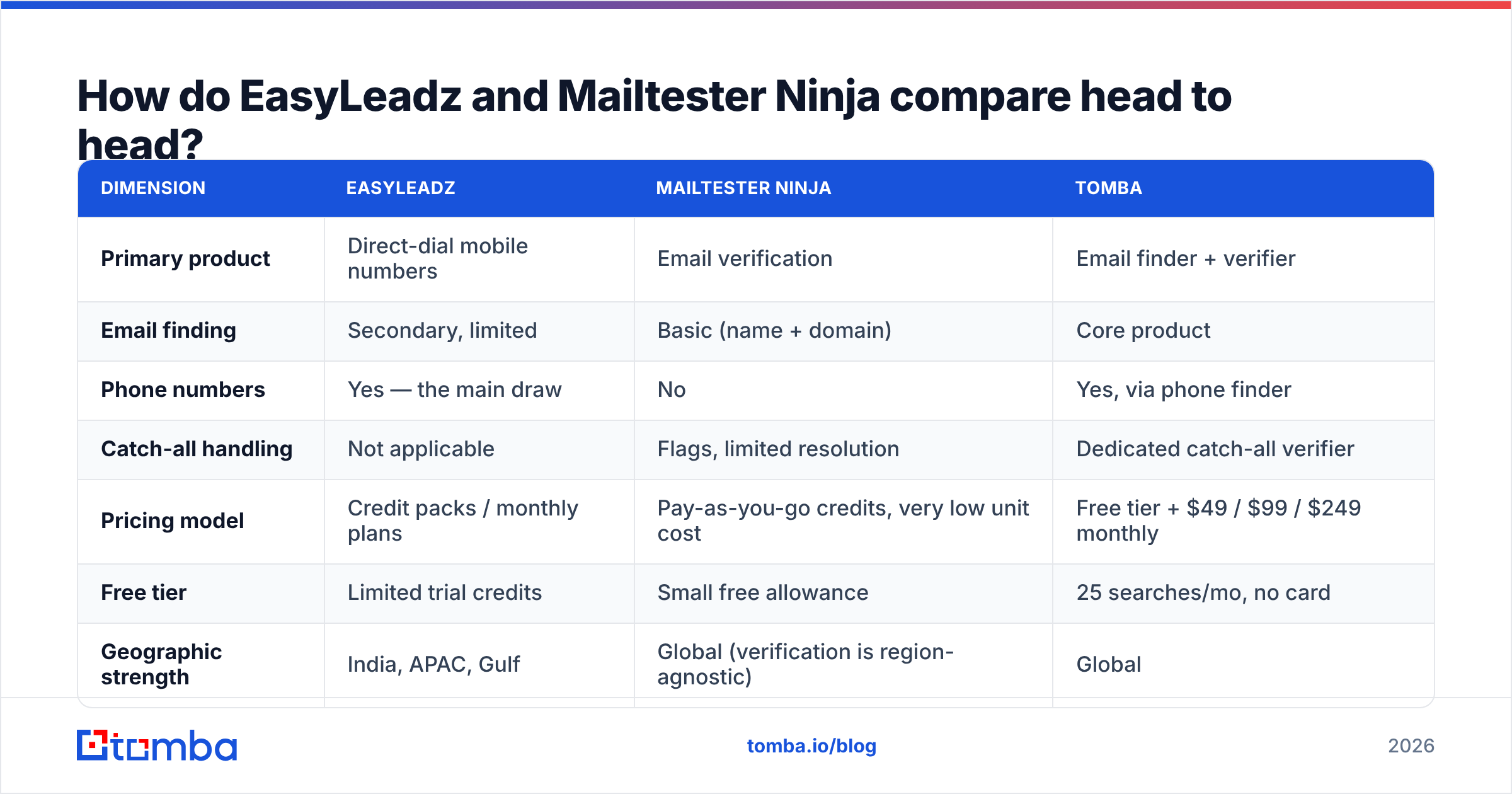
| Dimension | EasyLeadz | Mailtester Ninja | Tomba |
|---|---|---|---|
| Primary product | Direct-dial mobile numbers | Email verification | Email finder + verifier |
| Email finding | Secondary, limited | Basic (name + domain) | Core product |
| Phone numbers | Yes — the main draw | No | Yes, via phone finder |
| Catch-all handling | Not applicable | Flags, limited resolution | Dedicated catch-all verifier |
| Pricing model | Credit packs / monthly plans | Pay-as-you-go credits, very low unit cost | Free tier + $49 / $99 / $249 monthly |
| Free tier | Limited trial credits | Small free allowance | 25 searches/mo, no card |
| Geographic strength | India, APAC, Gulf | Global (verification is region-agnostic) | Global |
| API | Yes | Yes | Yes, documented, with CLI and MCP |
| Bulk workflow | CSV upload | CSV + API | Bulk finder + verifier, Sheets, Excel |
| Best for | Phone-first SDR teams | Cleaning lists you already own | Building and cleaning lists end to end |
The table exposes the real trade. EasyLeadz gives you a channel (the phone) that most of your competitors are not using. Mailtester Ninja gives you a cost structure that lets you verify 100,000 records without a procurement conversation. You cannot get both from either one.
Which one has better data accuracy?#
Accuracy means different things for each tool, so a single "who wins" number would be dishonest.
For EasyLeadz, accuracy = does this mobile number actually ring the person named on the profile? Public review data on G2 and elsewhere points to strong hit rates in India and noticeably weaker coverage in North America and Western Europe. Users consistently report the same pattern: excellent for APAC and Gulf territories, patchy elsewhere. That is not a knock — it is a positioning fact, and it should decide the purchase.
For Mailtester Ninja, accuracy = did the verifier correctly classify this address as valid, invalid, or risky? Cheap verification services usually make their margin by leaning hard on SMTP handshakes and lightweight heuristics rather than on deeper signal. That works fine on standard mail servers. It gets shaky on catch-all domains, on Microsoft 365 tenants that accept everything at the gateway, and on greylisted infrastructure. If a large slice of your list sits behind catch-alls, a bargain verifier will hand you a pile of "unknown" rows and leave the judgment call to you.

That last point is where most cold-email programs quietly bleed. A 4% bounce rate on 10,000 sends is 400 hard bounces, and Google and Microsoft both treat that as a reputation event, not a rounding error. Before you optimize for cost-per-check, run a sample through a proper catch-all verifier and see how many "risky" records resolve to a real answer. The delta is your true cost.
What should you actually evaluate before you pick?#
Skip the feature grid for a minute and answer these five questions honestly. They predict satisfaction better than any review score.
- What channel closes your deals? If replies come from calls, phone coverage is not a nice-to-have and EasyLeadz earns its line item. If replies come from email, phone credits are shelfware.
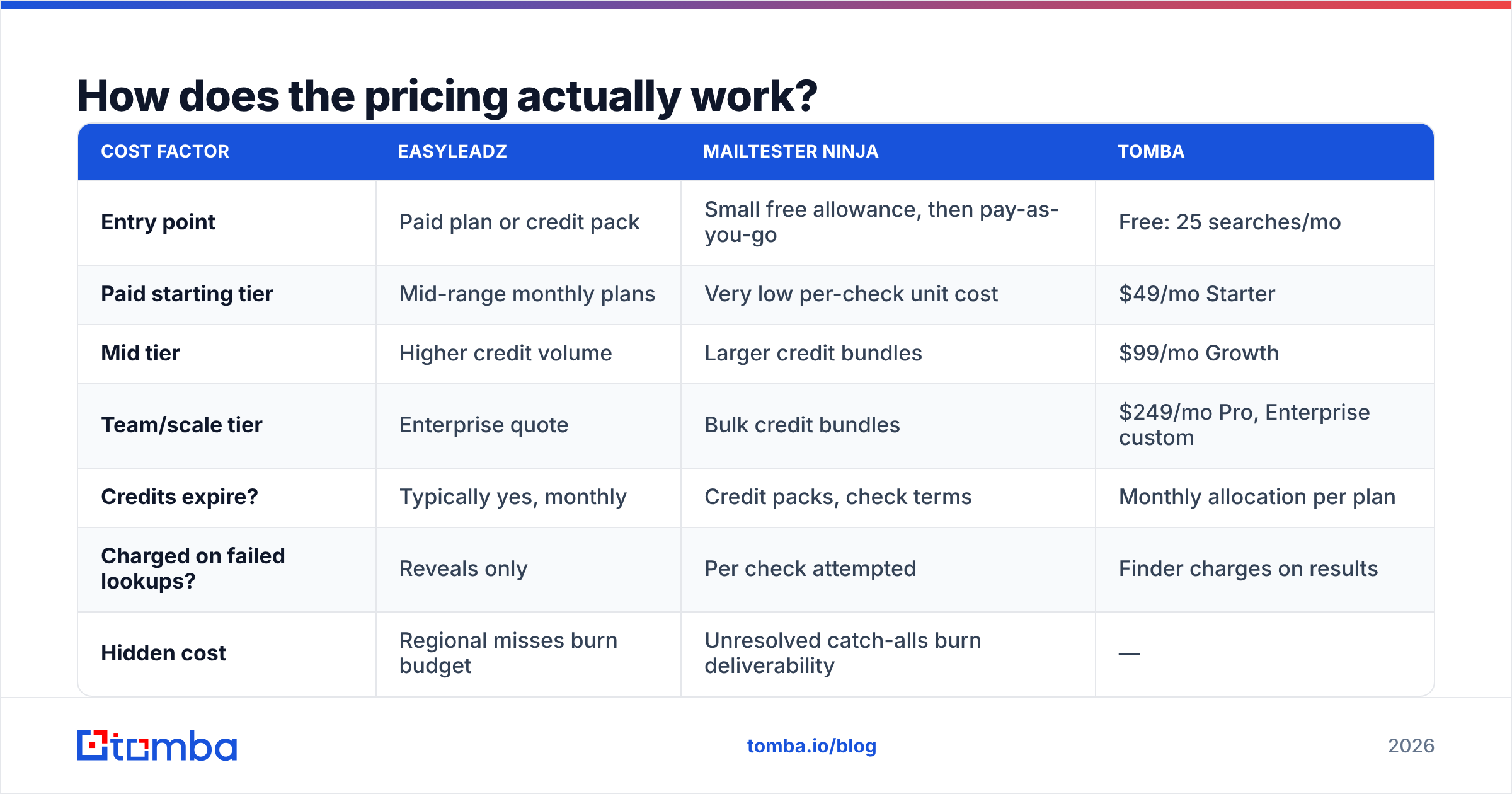
- Where are your buyers? A tool with 80% mobile coverage in Bengaluru and 20% in Boston is either a bargain or a waste, depending entirely on your ICP map. Test on 50 real target accounts, not on the vendor's demo list.
- Do you own the list already, or do you need to build it? Verification tools assume you have contacts. If you are starting from a company list, you need domain search and pattern detection first — verification is step three, not step one.
- How much of your list is catch-all? Pull 500 records and check. If it is over 25%, unit price on verification stops mattering and resolution quality starts mattering a lot.
- How many tools do you want in the loop? Every extra vendor is another API key, another credit balance, another invoice, and another place for your data to go stale independently.
Teams that answer these first rarely end up with buyer's remorse. Teams that lead with "which is cheaper per credit" almost always do.
How does the pricing actually work?#
This is where the two tools diverge hardest, and where the comparison gets genuinely useful.
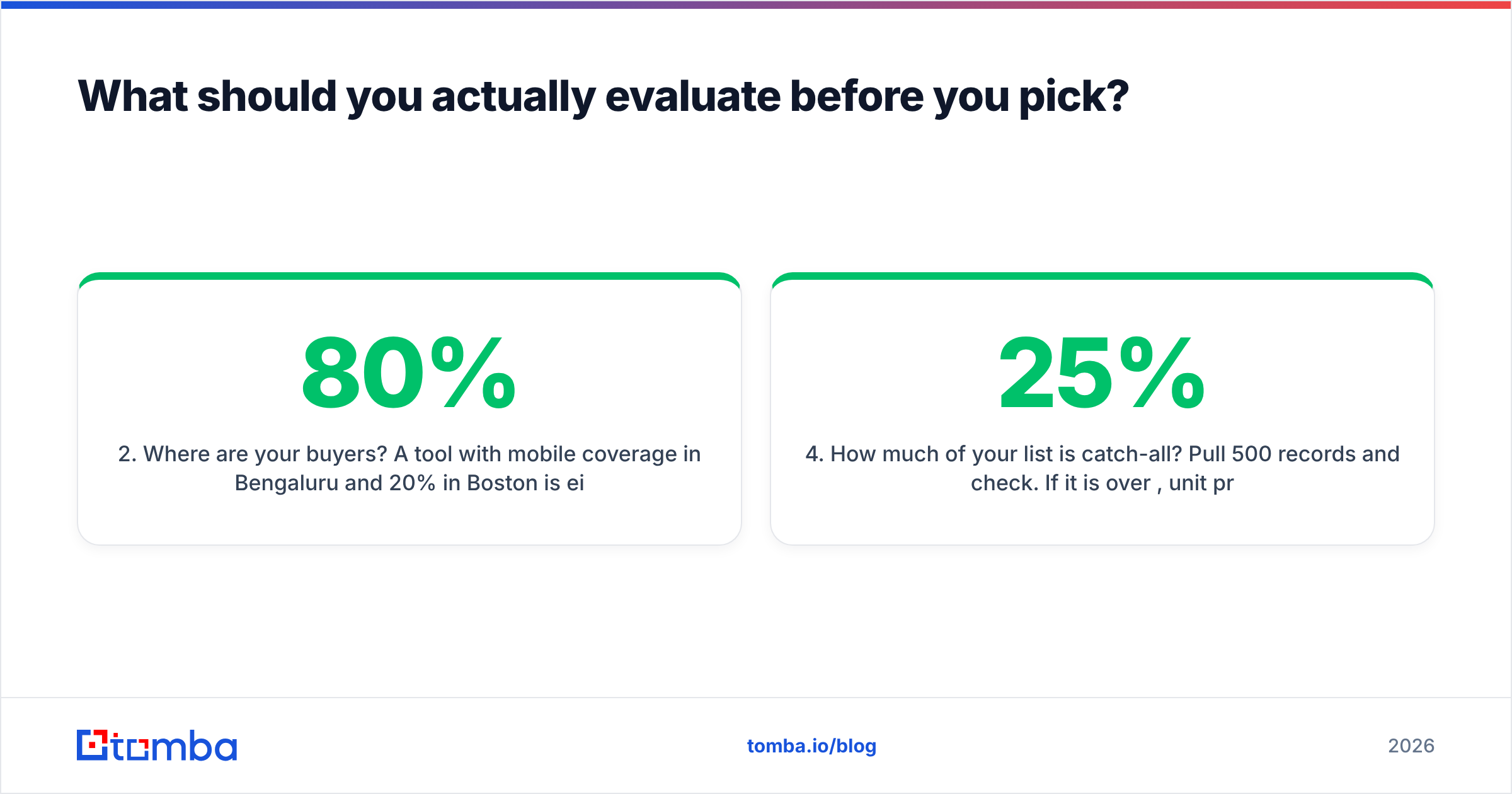
| Cost factor | EasyLeadz | Mailtester Ninja | Tomba |
|---|---|---|---|
| Entry point | Paid plan or credit pack | Small free allowance, then pay-as-you-go | Free: 25 searches/mo |
| Paid starting tier | Mid-range monthly plans | Very low per-check unit cost | $49/mo Starter |
| Mid tier | Higher credit volume | Larger credit bundles | $99/mo Growth |
| Team/scale tier | Enterprise quote | Bulk credit bundles | $249/mo Pro, Enterprise custom |
| Credits expire? | Typically yes, monthly | Credit packs, check terms | Monthly allocation per plan |
| Charged on failed lookups? | Reveals only | Per check attempted | Finder charges on results |
| Hidden cost | Regional misses burn budget | Unresolved catch-alls burn deliverability | — |
Note the last row, because it is the row nobody puts in a comparison post. Cheap tools are not cheap when they fail silently. A verifier that returns "unknown" on 30% of your list has not saved you money; it has moved the cost from your invoice to your sender reputation. And a phone tool that misses on two-thirds of your US accounts is not a $X/month tool — it is a $3X/month tool once you divide by successful reveals.
Run the arithmetic on cost per usable record, not cost per credit. That single reframe usually flips the ranking.

Who should choose EasyLeadz?#
Pick EasyLeadz if all three of these are true:
- Your sellers dial. Not "we sometimes call" — your pipeline genuinely depends on connect rates.
- A meaningful share of your ICP sits in India, Southeast Asia, or the Gulf, where most Western databases return blanks.
- You are comfortable pairing it with a separate email tool, because email discovery is not what EasyLeadz is built to win.
The Chrome extension workflow is fast for one-at-a-time LinkedIn prospecting. If your SDRs already live in LinkedIn Sales Navigator, the friction is close to zero. Where it strains is bulk: building a 5,000-row list from a company universe is not the shape of the product.
If you want phone coverage that sits inside the same platform as your email data, a phone finder attached to your enrichment stack removes an entire vendor from the chain. Whether that consolidation is worth it depends on how much of your value comes from EasyLeadz's regional edge specifically.
Who should choose Mailtester Ninja?#
Pick Mailtester Ninja if:
- You already have lists — scraped, purchased, exported, inherited — and need them cleaned before they touch your sending infrastructure.
- Volume is high and budget is tight. Agencies verifying millions of rows a month feel the unit price in a way that a 20-person SaaS team does not.
- You are technically comfortable. The API is straightforward, but there is no hand-holding, no CSM, and limited support surface compared to enterprise verification vendors.
Where it falls short is anything upstream. It will not build you a list from a domain, will not enrich a record with job title or company size, and will not tell you the email format a company uses so you can extrapolate. Those are separate jobs handled by an email finder and by data enrichment.
Also worth noting: extremely cheap verification is a competitive category with real churn. Vendors in this space appear, undercut, and consolidate. Check terms, uptime history, and how credits behave if you pause — the same diligence you would apply to any low-cost infrastructure dependency. Peers like BookYourData take a different route, bundling verified contact data with a purchase-the-list model, which suits teams that want records and validation in one transaction rather than assembled from parts.
Is there a better option than either one?#
For most B2B teams, yes — because most teams are trying to solve the whole chain, not one link of it.
The chain looks like this: identify the company → find the right person → derive their email → verify it → resolve catch-alls → attach a phone number → push to CRM. EasyLeadz covers the phone step well in specific geographies. Mailtester Ninja covers the verify step cheaply. Everything else is on you.

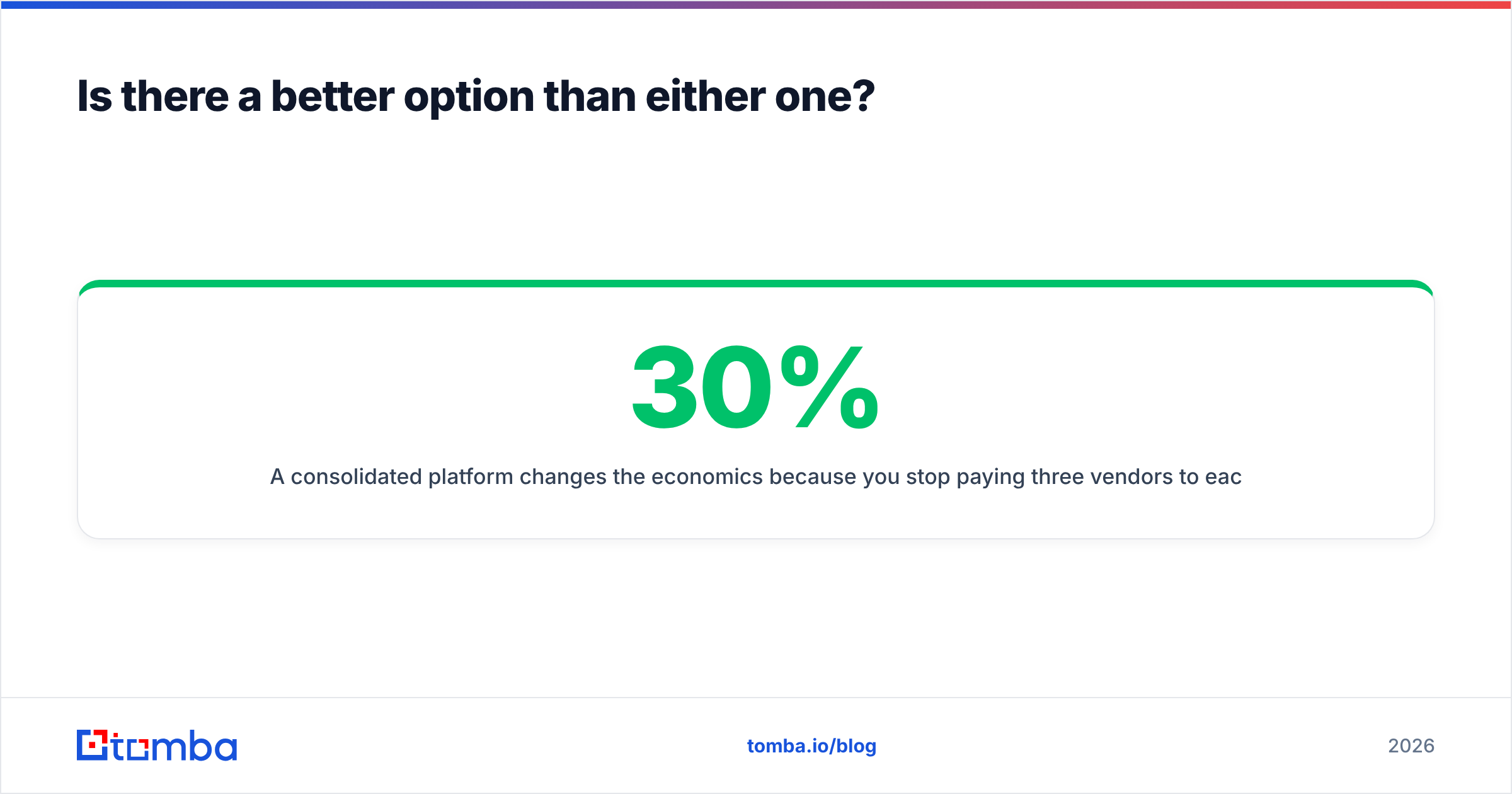
A consolidated platform changes the economics because you stop paying three vendors to each solve 30% of a workflow, and you stop reconciling three data formats. Tomba pricing starts with a genuinely usable free tier — 25 searches a month, no card — then $49/mo Starter, $99/mo Growth, and $249/mo Pro, with Enterprise on quote. The finder, the email verifier, catch-all resolution, domain search, phone lookup, and enrichment all sit behind one key.
Two things to actually test before you decide anything:
- Run the same 100 contacts through all candidates. Same list, same day. Compare valid-and-deliverable counts, not vendor-reported "accuracy."
- Check the catch-all bucket specifically. Whatever tool resolves more of those into a confident yes or no is the one protecting your domain.
What is the verdict?#
EasyLeadz wins on phone data in its home regions. Mailtester Ninja wins on verification unit price. Neither wins the whole workflow, and that is the decision most teams are actually making.
If you dial into APAC markets, buy EasyLeadz and pair it with a real email finder. If you only need a cheap bulk cleaner for lists you already own, Mailtester Ninja does that job at a price nobody undercuts easily. If you are building lists from scratch and want find, verify, catch-all, and phone in one place — start with the free tier and benchmark it against whatever you are paying for today.
Start with Tomba Email Finder. Run 25 searches free, no card required, and compare the deliverable-contact count against your current stack on the same target accounts. If it does not beat what you have, you have lost nothing but ten minutes. If it does, you have just removed two vendors from your renewal list.
Related guides#
Ready to find emails that actually work?
Join 150,000+ professionals who stopped guessing and started sending. Free credits on signup — no credit card required.
Get the Tomba newsletter
Practical outbound tactics and product updates — once every two weeks.
About the author