EasyLeadz vs Prosperfleet Valgen: Honest 2026 Comparison
One vendor has a public product, public pricing, and thousands of reviews. The other has almost no verifiable footprint. Here is how to compare them without burning a quarter of pipeline on bad data.
TL;DR
- EasyLeadz is a real, documented B2B contact-data product (marketed as "Mr. E") focused on direct mobile numbers, strongest in India and APAC, with a Chrome extension, an API, and thousands of public reviews.
- Prosperfleet Valgen has almost no verifiable public footprint — no independent review corpus, no published pricing, no public API docs we could confirm. That is not proof it is bad; it is proof you cannot buy it on reputation alone.
- The honest verdict: if you need contact data this quarter, EasyLeadz is the safer of the two because you can actually test and price it before signing.
- The bigger point: never pick a data vendor from a comparison post. Run a 100-contact bake-off against your own ICP and measure cost per usable contact, not cost per credit.
- If your outbound is email-led rather than phone-led, both of these are the wrong shape of tool, and a dedicated email finder will cost you less per connected conversation.
What are EasyLeadz and Prosperfleet Valgen?#
EasyLeadz is a B2B contact-intelligence platform best known for surfacing direct dial and mobile numbers from LinkedIn profiles. Its flagship interface is a browser extension: you open a prospect's profile, click, and it returns a phone number and sometimes an email. It sells credits rather than seats, offers a REST API, and has a real public presence at easyleadz.com plus an established review history on G2. Its data strength is heavily weighted toward India, Southeast Asia, and the Middle East — which is either its single biggest advantage or an irrelevance, depending entirely on where your buyers sit.
Prosperfleet Valgen is a different situation. When we went looking for the things that normally make a vendor comparable — a product page with feature detail, a pricing page, API documentation, a credible independent review count, a G2 or Capterra listing with more than a handful of entries — we could not confirm them. The name surfaces in GTM-services and data-consultancy contexts rather than as a self-serve SaaS product with a public trial.
That asymmetry is the comparison. You are not weighing two tools with published spec sheets. You are weighing a tool you can test in an afternoon against a vendor you would have to email, schedule with, and take on trust. Both can be legitimate. They demand completely different buying processes.

Why does vendor transparency matter more than feature lists?#
Because in B2B data, the failure mode is invisible until it is expensive.
A CRM that breaks tells you immediately. A data vendor that returns 40% stale records does not tell you anything — it quietly inflates your bounce rate, drags your sender reputation down, and by the time you notice, your domain is landing in spam for the prospects whose data was good. You paid twice: once for the bad records, once in deliverability damage.
Transparency is the cheapest proxy for accountability you have. A vendor that publishes prices, publishes coverage claims by region, and lets you run a free test is a vendor that expects to be measured. A vendor that will only talk numbers on a call has decided the number changes depending on who is asking.
None of that makes an opaque vendor dishonest. Plenty of excellent boutique data providers sell exclusively through conversations because their value is custom-built lists, not a self-serve lookup. But it does mean the burden of proof sits with you, and you should price that extra diligence into the deal.
How do EasyLeadz and Prosperfleet Valgen compare on paper?#
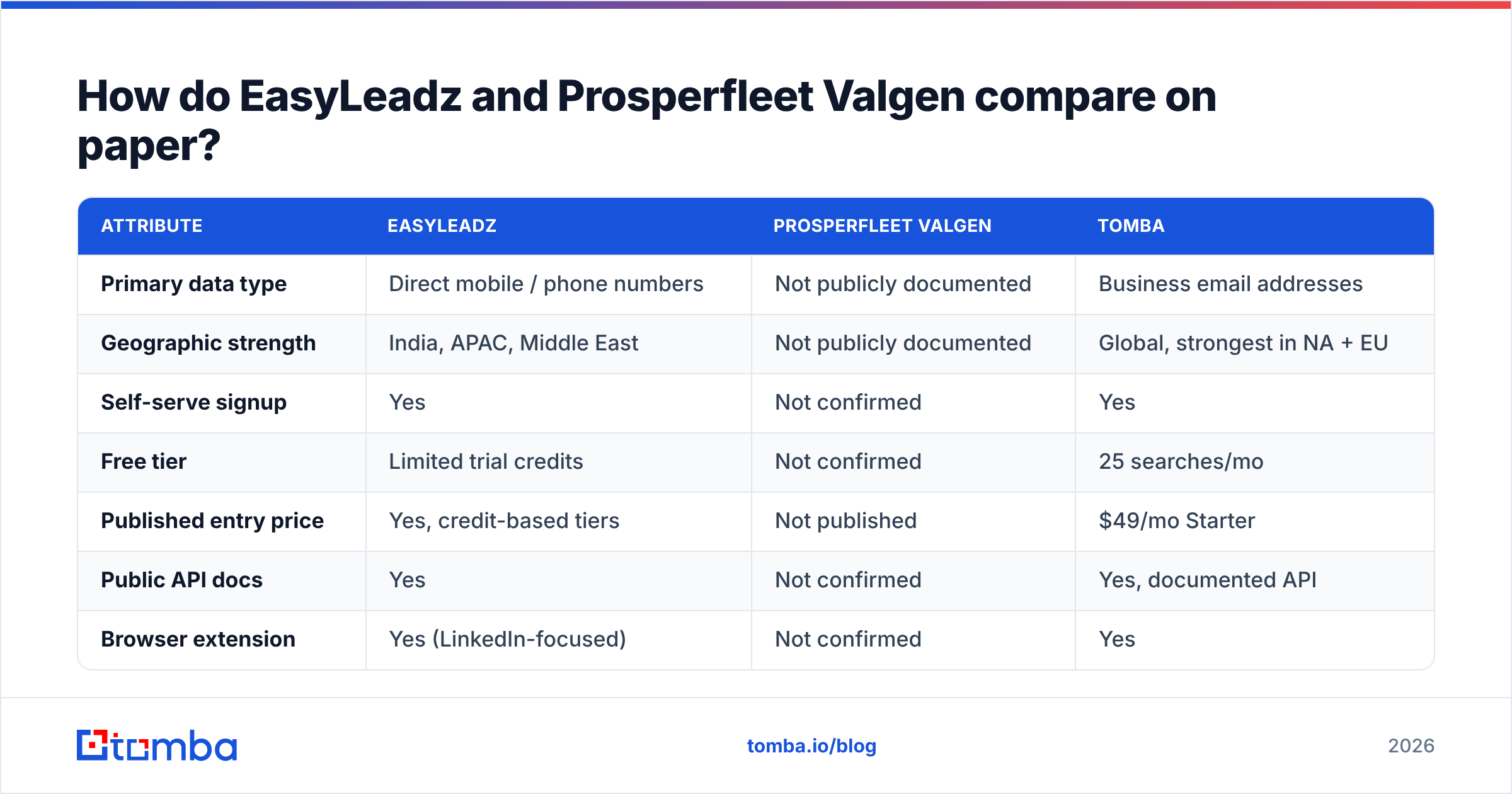
Here is the side-by-side, with a neutral third reference point so you can see where a transparent, self-serve vendor sits on each axis. Where we could not verify something, the table says so rather than guessing.
| Attribute | EasyLeadz | Prosperfleet Valgen | Tomba |
|---|---|---|---|
| Primary data type | Direct mobile / phone numbers | Not publicly documented | Business email addresses |
| Geographic strength | India, APAC, Middle East | Not publicly documented | Global, strongest in NA + EU |
| Self-serve signup | Yes | Not confirmed | Yes |
| Free tier | Limited trial credits | Not confirmed | 25 searches/mo |
| Published entry price | Yes, credit-based tiers | Not published | $49/mo Starter |
| Public API docs | Yes | Not confirmed | Yes, documented API |
| Browser extension | Yes (LinkedIn-focused) | Not confirmed | Yes |
| Bulk / CSV enrichment | Yes | Not confirmed | Yes |
| Built-in verification | Limited | Not confirmed | Yes, email verifier included |
| Independent review volume | Thousands | Minimal | Hundreds |
| Buying motion | Self-serve or sales | Sales-led / consultative | Self-serve |
Read that table as a map of risk, not of quality. Every "not confirmed" row is a question you would need answered in writing before a purchase order — and each one is a delay of days, not minutes.
What does EasyLeadz actually do well?#
Three things, credibly.
Mobile numbers in underserved regions. Most Western data vendors have thin phone coverage outside North America and Western Europe. If your ICP is a VP of Engineering in Bengaluru or a procurement head in Dubai, EasyLeadz will often return a working mobile where Apollo, ZoomInfo, or Lusha return nothing. That is a genuine moat, not marketing.
Credit economics that suit low-volume, high-value outbound. Because it sells credits rather than seats, a two-person founder-led sales team can spend meaningfully less than on a per-seat platform with a minimum commitment.
Speed of the LinkedIn workflow. Profile open, click, number returned, into the dialer. For a rep running 40 calls a day off a curated list, that loop is hard to beat.
Where it is weaker: email coverage is secondary to phone, verification is not its core competency, and coverage outside its home regions falls off noticeably. Several public reviews flag credit burn on failed lookups — worth clarifying in writing whether you are charged for a miss.
Where does Prosperfleet Valgen fit?#
Honestly: we cannot tell you, and you should be suspicious of any post that claims otherwise while linking to a signup page.
What we can tell you is the shape of vendor it appears to be — a GTM data and analytics provider operating consultatively rather than as a self-serve tool. If that is accurate, the right comparison is not "EasyLeadz vs Prosperfleet Valgen" at all. It is "buy a lookup tool" versus "buy a data project." Those are different budgets, different timelines, and different buyers. A lookup tool is a $50–$250/month line item a sales lead expenses. A custom data engagement is a procurement cycle.
If a Prosperfleet Valgen rep is in your inbox right now, the productive move is not to read more comparison articles. It is to send the six questions in the next section and judge the answers.
How should you evaluate any thin-footprint data vendor?#
Run this checklist before any contract. It works for Prosperfleet Valgen, for a boutique list broker, and for whatever new entrant pitches you next quarter.
- Ask for a blind sample against your own list. Send 100 target companies with names and titles, no other context. Ask for enriched records back before you pay. A vendor confident in its data will do this; one that refuses is telling you something.
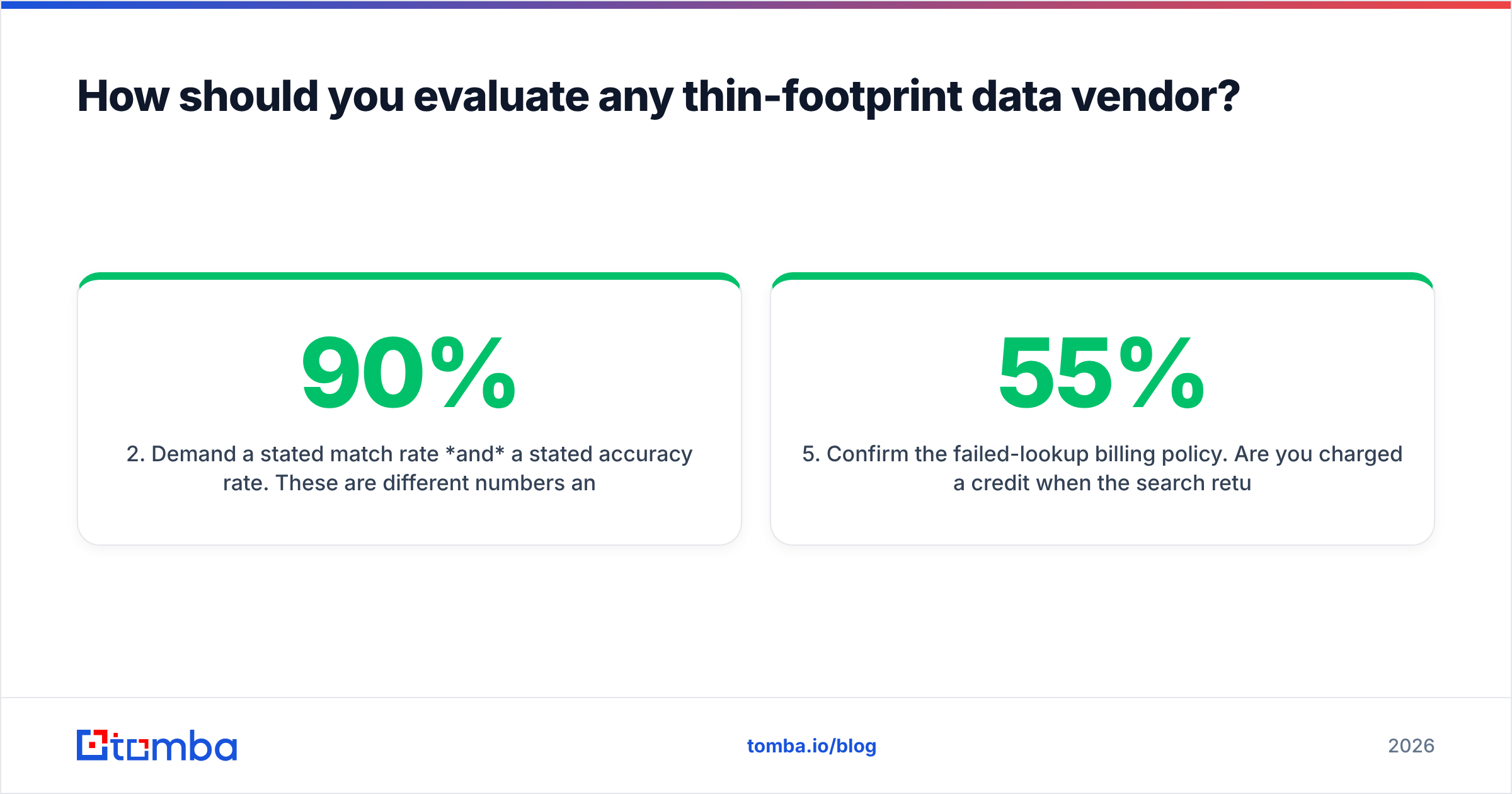
- Demand a stated match rate and a stated accuracy rate. These are different numbers and vendors conflate them constantly. Match rate is "we found something." Accuracy is "what we found was correct." A 90% match rate at 60% accuracy is worse than a 50% match rate at 95%.
- Get the data-sourcing answer in writing. Where does the data originate? Scraped, contributed, licensed, or user-network? Under GDPR and equivalent regimes, the legal basis for processing sits with you as the controller, not with your vendor. Compare against a vendor that publishes its data sources openly.
- Test the refresh cadence. Ask when a specific returned record was last verified. "Continuously" is not an answer. A timestamp is.
- Confirm the failed-lookup billing policy. Are you charged a credit when the search returns nothing? Over 10,000 lookups at a 55% hit rate, this single clause can double your effective cost per record.
- Check the exit. Can you export everything you have enriched, in CSV, without a support ticket? If the data you paid for is hostage to an active subscription, you are renting, not buying.
If a vendor clears all six, opacity stops being a red flag and becomes a business model choice. If it stalls on three or more, walk.
What is the real cost per usable contact?#
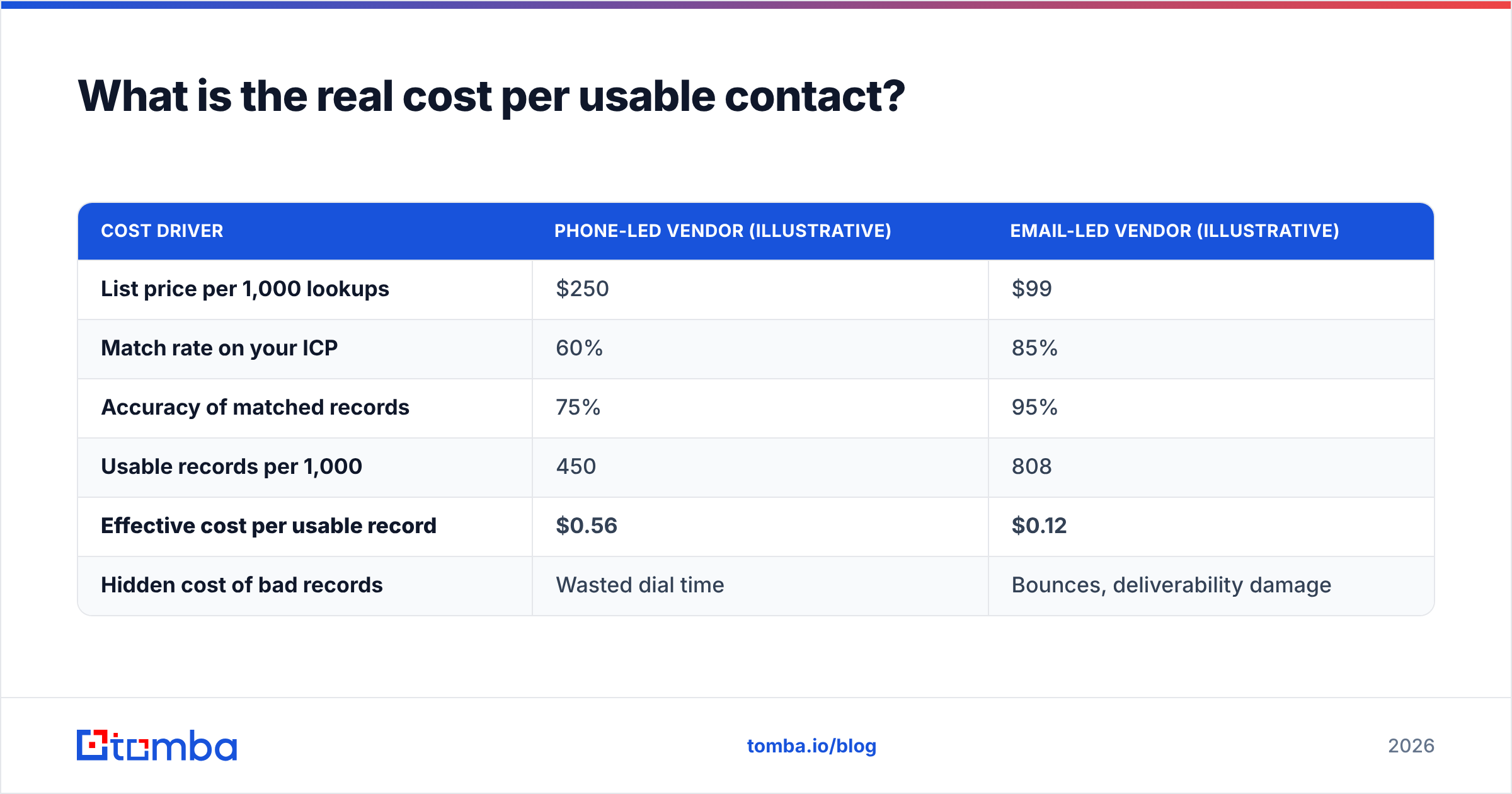
Sticker price is the least useful number in this category. What matters is what you pay for a record that produces a conversation. Here is the arithmetic that decides it, using illustrative figures to show the mechanism — plug in your own quotes.
| Cost driver | Phone-led vendor (illustrative) | Email-led vendor (illustrative) |
|---|---|---|
| List price per 1,000 lookups | $250 | $99 |
| Match rate on your ICP | 60% | 85% |
| Accuracy of matched records | 75% | 95% |
| Usable records per 1,000 | 450 | 808 |
| Effective cost per usable record | $0.56 | $0.12 |
| Hidden cost of bad records | Wasted dial time | Bounces, deliverability damage |
Two lessons fall out of this. First, a vendor that is 2.5x cheaper on the sticker can be 4x cheaper in practice once match and accuracy compound. Second, the hidden cost column is not symmetrical — a wrong phone number costs you 90 seconds, while a wrong email can cost you domain reputation that takes weeks to repair. That is why verification is not an optional add-on, and why running every list through an email verifier before send is the highest-ROI ten minutes in outbound.

Is there a third option worth testing?#
If your outbound motion is email-first — and for most B2B teams selling software, services, or anything with a considered buying cycle, it is — then neither vendor in this matchup is optimised for you.
EasyLeadz is a phone tool that also returns emails. Prosperfleet Valgen is, as far as public evidence goes, a services-shaped engagement. Neither is built around the workflow of "here are 800 target accounts, get me verified decision-maker emails by Friday."
That is where a dedicated email-finding stack earns its place. Practically, that means: domain search to pull every published address at a target company, pattern detection to infer the format for people who are not published, SMTP-level verification to strip the risky ones before send, and an API so the whole thing runs inside your sequencer instead of a spreadsheet. Pricing is public — free tier at 25 searches/month, Starter at $49/month, Growth at $99/month — so you can model cost per usable record before you talk to anyone. Compare the full Tomba pricing against whatever quote lands in your inbox.
If phone genuinely is your channel — you sell to operations leaders in markets where email response rates are floor-level — then EasyLeadz's regional depth is a real reason to buy it, and a phone finder can sit alongside your email stack rather than replacing it. Most teams end up running both, weighted toward whichever channel their ICP actually answers.
How do you settle this in one week?#
Stop comparing and start measuring. The bake-off:
Day 1. Pull 100 accounts that match your ICP exactly — right size, right geography, right buying trigger. Name the specific titles you need. This is your control set and you will reuse it for every vendor evaluation from now on.
Day 2. Run the same 100 through each vendor. Free tiers and trial credits usually cover this; for a sales-led vendor, this is the blind sample you demanded in step 1 above.
Day 3. Verify independently. Do not accept any vendor's own confidence score at face value — run the results through a neutral checker so every vendor is graded on the same scale.
Days 4–7. Send. Track bounce rate, reply rate, and connect rate by source. Then compute cost per reply, not cost per credit.
At the end of the week you will have a number that no comparison post can give you, because it is specific to your ICP, your geography, and your messaging. That number is the only thing that should decide this purchase.
The verdict#
Between EasyLeadz vs Prosperfleet Valgen, EasyLeadz wins on the criteria you can actually verify today: published pricing, a testable product, a documented API, and a large body of independent reviews. Prosperfleet Valgen may be an excellent fit for a custom data engagement, but it cannot be evaluated the way a self-serve tool can, and you should not treat the two as interchangeable line items.
The broader answer is that both are phone- and services-shaped solutions to what is usually an email-shaped problem. If your quarter depends on getting verified, deliverable decision-maker emails into a sequencer without a procurement cycle, start with the Tomba Email Finder — 25 free searches a month is enough to run the 100-account bake-off above, and $49/month covers most two-to-five-person outbound teams. Test it against whatever quote you are holding, measure cost per reply, and let the data decide.
Related guides#
Ready to find emails that actually work?
Join 150,000+ professionals who stopped guessing and started sending. Free credits on signup — no credit card required.
Get the Tomba newsletter
Practical outbound tactics and product updates — once every two weeks.
About the author