EasyLeadz vs SellHack: Which Contact Finder Wins in 2026?
EasyLeadz sells direct dials. SellHack sells cheap email lookups. Neither is a full prospecting stack — here's how they compare on coverage, accuracy, pricing, and where each one quietly costs you money.
TL;DR
- EasyLeadz is a phone-first tool. Its Mr. E extension is built around pulling direct-dial mobile numbers off LinkedIn, with unusually deep coverage in India and the wider APAC region. Email is a secondary output.
- SellHack is an email-first tool and one of the oldest names in the category. It's cheap, extension-driven, and thin on everything that isn't "guess and check an email address."
- Neither is a complete prospecting data layer. EasyLeadz gets expensive per contact once you scale; SellHack's verification depth and API tooling lag behind current standards.
- Pick EasyLeadz if you dial APAC prospects. Pick SellHack if you want a budget Chrome-extension lookup and nothing more.
- If you need email + verification + phone + API in one place, neither wins outright — compare both against a dedicated email finder before committing to an annual plan.
What are EasyLeadz and SellHack?#
They solve the same job — turn a name and a company into a way to contact someone — from opposite ends.
EasyLeadz launched out of India and built its reputation on direct dial mobile numbers. Its flagship product, the Mr. E Chrome extension, sits on a LinkedIn profile and returns a phone number in one click. Emails come along for the ride, but the phone data is why people buy it. If your ICP includes Indian SaaS founders, APAC engineering leaders, or Middle East operations buyers, EasyLeadz has records that US-centric databases genuinely do not.
SellHack is the older sibling — it's been around since roughly 2014, when Chrome-extension email hunting was a novel category. It does email lookup, bulk list processing, and basic verification, and it's priced aggressively low. The tradeoff is that the product has evolved slowly. Where newer tools ship API access, catch-all resolution, MCP servers, and CRM-native enrichment, SellHack largely still does the thing it did in 2016: find an email, check it, hand it over.
So "EasyLeadz vs SellHack" isn't really a fair fight on any single axis. It's a question of which incomplete tool is incomplete in a way you can live with.
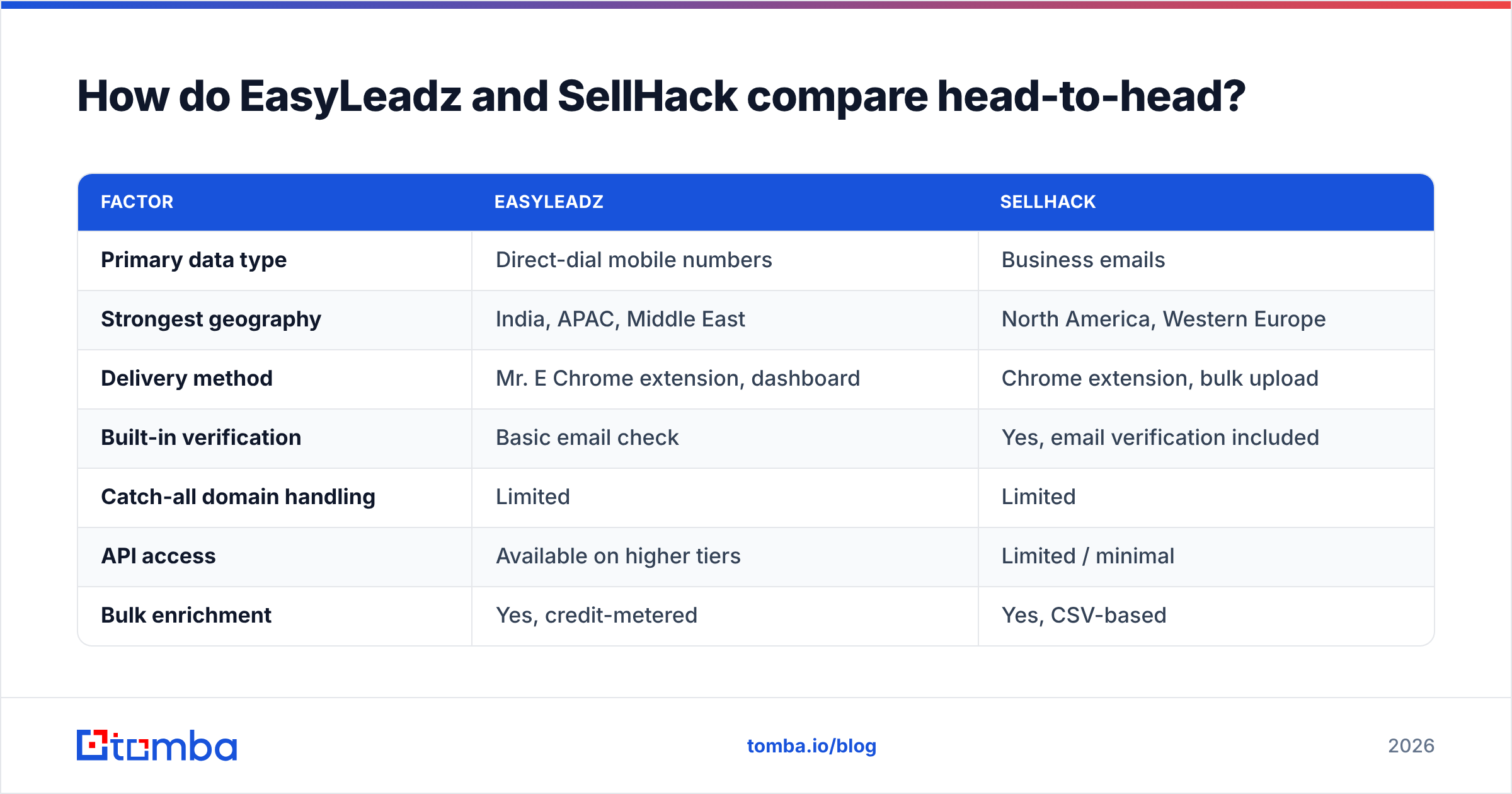
How do EasyLeadz and SellHack compare head-to-head?#
| Factor | EasyLeadz | SellHack |
|---|---|---|
| Primary data type | Direct-dial mobile numbers | Business emails |
| Strongest geography | India, APAC, Middle East | North America, Western Europe |
| Delivery method | Mr. E Chrome extension, dashboard | Chrome extension, bulk upload |
| Built-in verification | Basic email check | Yes, email verification included |
| Catch-all domain handling | Limited | Limited |
| API access | Available on higher tiers | Limited / minimal |
| Bulk enrichment | Yes, credit-metered | Yes, CSV-based |
| CRM integrations | HubSpot, Salesforce, Zapier | Fewer native, mostly CSV/Zapier |
| Free tier | Small trial credits | Small trial credits |
| Typical entry price | Roughly $59–$99/mo depending on tier | Lower, often under $50/mo |
| Best for | Phone-led outbound in APAC | Cheap, low-volume email lookup |
Pricing on both tools has moved more than once, and both run credit systems where the sticker price tells you very little. Always price by cost per usable contact, not cost per month — a $29 plan that returns 40% unverified addresses is more expensive than a $49 plan that returns 95% deliverable ones.
Which tool has better email accuracy?#
SellHack wins on email volume in North America. EasyLeadz wins on not-guessing.
Here's the mechanic that matters. Most email finders use one of two approaches:
- Pattern inference — the tool knows
firstname.lastname@company.comis the dominant format at a domain, applies it to your target, and does an SMTP check. Fast, cheap, and it degrades badly on domains with mixed formats or catch-all configurations. - Sourced records — the tool has actually observed the address in a crawled source, a partner dataset, or a submitted contact record, and re-validates it before serving it.
SellHack leans heavily on pattern inference. That's why it's cheap, and why it produces confident-looking addresses that bounce. EasyLeadz leans on sourced records for phone and a mix for email, which is why its email volume is lower but its phone accuracy is high.

The practical consequence: whichever of the two you pick, you need a separate verification step before anything hits a sequence. Neither tool's built-in check is aggressive enough to protect a sending domain on its own. Running found addresses through a dedicated email verifier — one that separates valid, risky, catch-all, and invalid rather than returning a binary yes/no — is the difference between a 1% bounce rate and a 7% one that gets your domain throttled.

How does pricing actually compare?#
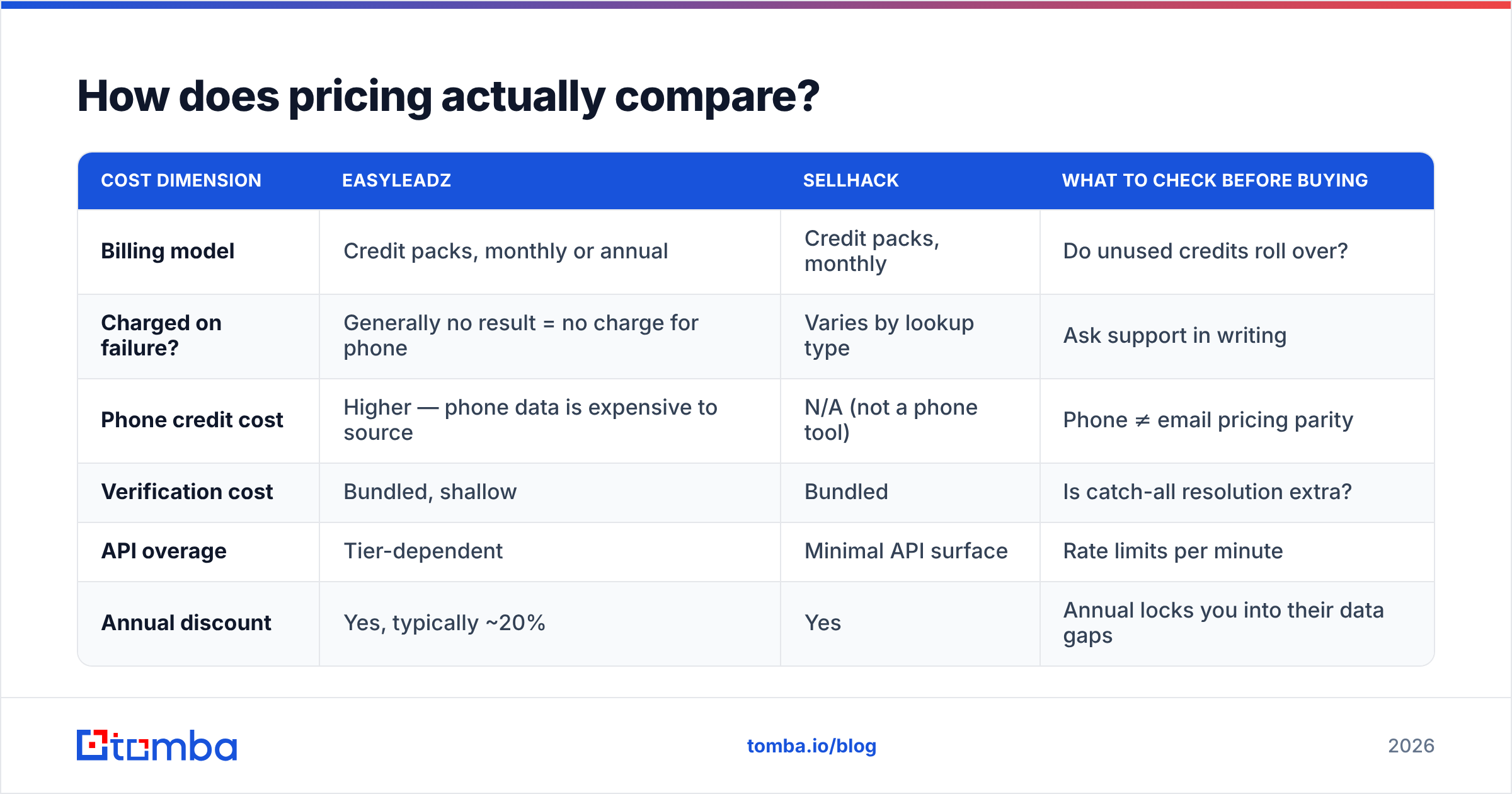
Both use credits. Neither credit is worth the same thing.
| Cost dimension | EasyLeadz | SellHack | What to check before buying |
|---|---|---|---|
| Billing model | Credit packs, monthly or annual | Credit packs, monthly | Do unused credits roll over? |
| Charged on failure? | Generally no result = no charge for phone | Varies by lookup type | Ask support in writing |
| Phone credit cost | Higher — phone data is expensive to source | N/A (not a phone tool) | Phone ≠ email pricing parity |
| Verification cost | Bundled, shallow | Bundled | Is catch-all resolution extra? |
| API overage | Tier-dependent | Minimal API surface | Rate limits per minute |
| Annual discount | Yes, typically ~20% | Yes | Annual locks you into their data gaps |
The trap in both cases is the credit that returns nothing useful. A credit spent on a catch-all domain that comes back "accept-all, cannot verify" is a credit you paid for and can't safely use. On a 5,000-contact month, if 18% of your target domains are catch-all — normal for mid-market B2B — that's 900 wasted credits unless your tool resolves catch-alls properly. This is exactly where budget tools quietly become expensive, and why a dedicated catch-all verifier belongs in the stack regardless of which finder you use.
For reference on what a transparent tiering model looks like, Tomba pricing runs a free tier at 25 searches/mo, Starter at $49/mo, Growth at $99/mo, and Pro at $249/mo, with the same credit covering finder and verifier work rather than splitting them into separate meters.
Is EasyLeadz better than SellHack for cold email?#
No — but SellHack isn't good enough at it either.
EasyLeadz's email database is narrower than SellHack's in North America and Europe. If you're running a 3,000-contact US SaaS campaign, EasyLeadz will leave more rows blank. SellHack will fill more rows, but a meaningful share of what it fills will be inferred rather than observed.
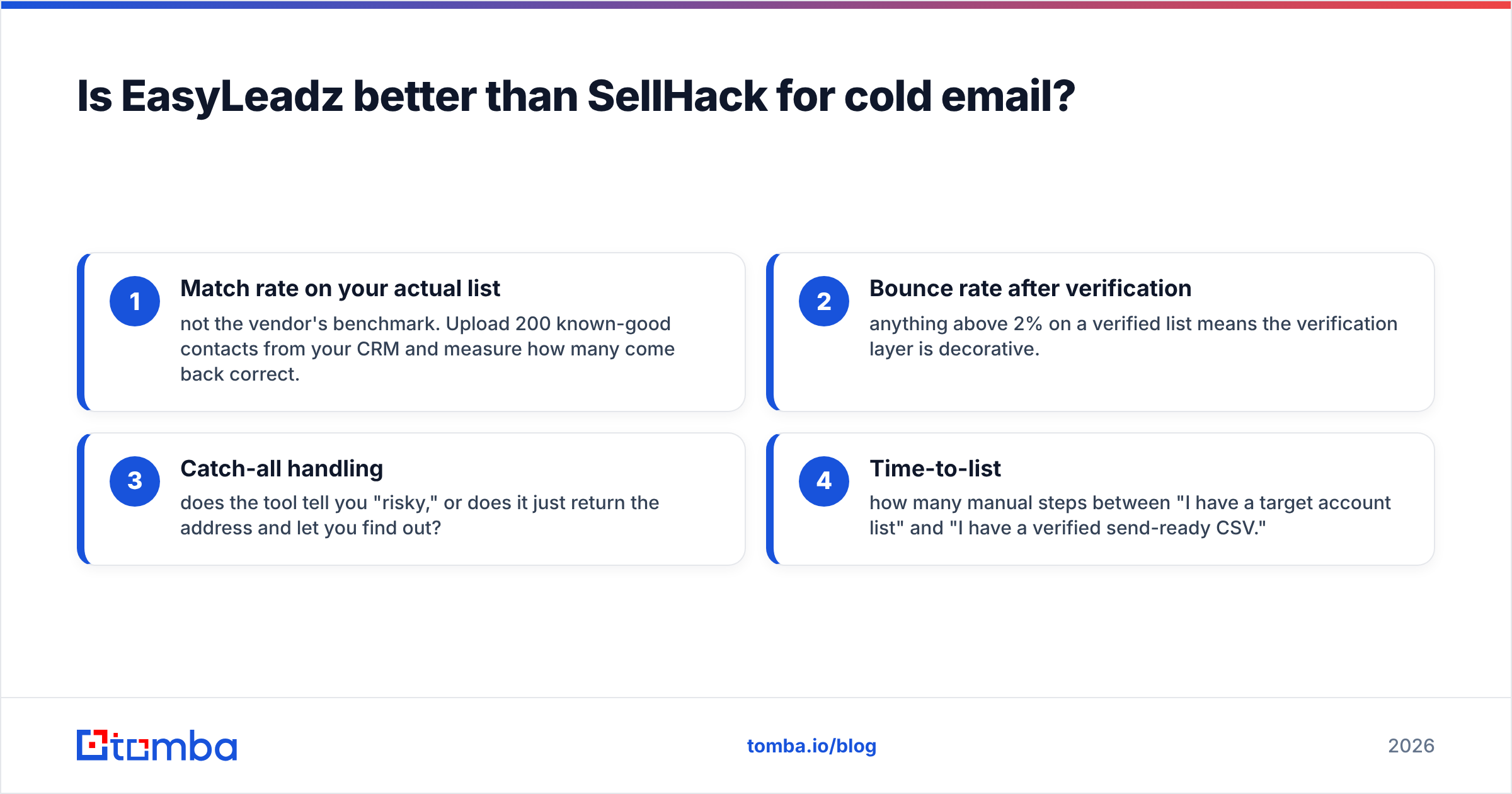
For cold email specifically, judge any tool on four things:
- Match rate on your actual list — not the vendor's benchmark. Upload 200 known-good contacts from your CRM and measure how many come back correct.
- Bounce rate after verification — anything above 2% on a verified list means the verification layer is decorative.
- Catch-all handling — does the tool tell you "risky," or does it just return the address and let you find out?
- Time-to-list — how many manual steps between "I have a target account list" and "I have a verified send-ready CSV."
SellHack scores acceptably on 1 and poorly on 3. EasyLeadz scores poorly on 1 outside APAC and acceptably on 3. Neither scores well on 4, because both were designed around one-off extension lookups rather than list-scale workflows. If your motion is list-scale, a bulk email finder that processes thousands of rows in a single job is a structurally different product from a browser extension, no matter how good the extension is.
What about phone numbers?#
This is the one category where EasyLeadz has a clear, uncontested win over SellHack — SellHack doesn't seriously compete here.
EasyLeadz's mobile coverage in India is the best-in-class claim it makes, and reviewers on G2 generally back it. If your SDR team dials Indian or Southeast Asian prospects, the tool pays for itself on connect rate alone.
Two caveats worth pricing in:
- Compliance. Direct-dial mobile data carries different regulatory weight than a business email. Under GDPR, TCPA, and India's DPDP Act, calling a personal mobile you sourced from a database has consent and do-not-call implications that emailing a work address does not. Get your legal team's read before you build a dialing motion on scraped mobile data.
- Decay. Mobile numbers churn slower than emails, but they churn. A record sourced three years ago and never re-validated is a wrong-number call and a burned first impression.
If phone is a genuine channel for you rather than a nice-to-have, run any provider's numbers through a phone validator before they enter the dialer, and treat a phone finder as a distinct line item in your data budget rather than something you expect a $29 email tool to throw in free.
Where do both tools fall short?#
Four gaps show up repeatedly in user reviews of both products.
- API depth. SellHack's API surface is thin; EasyLeadz gates its behind higher tiers. If your RevOps team wants enrichment triggered on form-fill or CRM record creation, both will feel constraining compared to a documented, rate-transparent email finder API.
- Data provenance. Neither publishes a clear account of where records come from and how often they're re-validated. That's an increasingly hard position to defend to a security review or a European DPO.
- Catch-all and role-account handling. Both return
info@andsales@addresses as valid results. They're technically deliverable and practically useless for one-to-one outbound. - Workflow reach. Extension-first design means someone is always clicking. Neither tool has strong native presence inside Sheets, Excel, Airtable, or an MCP-style agent workflow, which is where a growing share of prospecting work now happens.

How should you choose between them?#
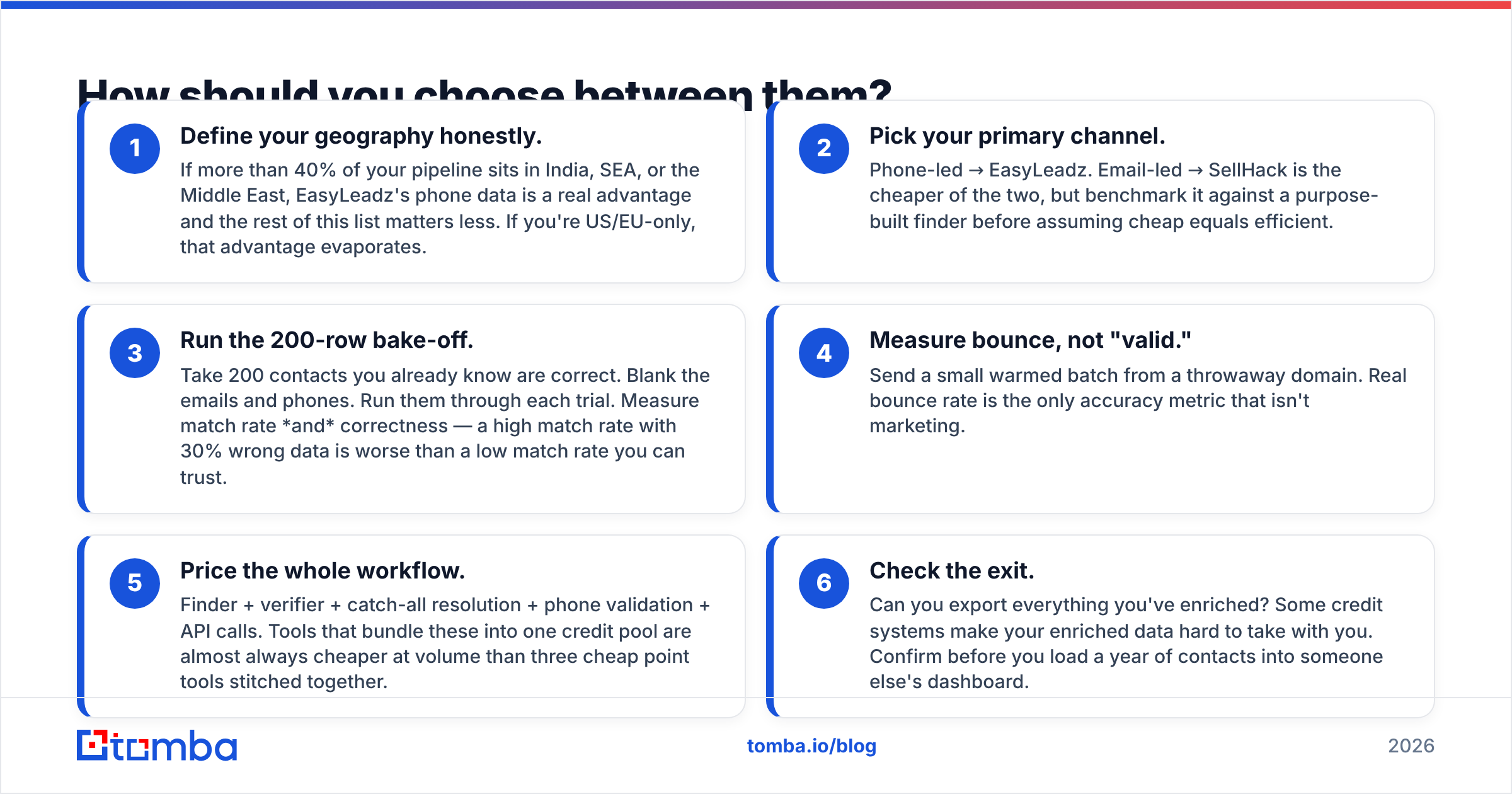
Run this in order. It takes an afternoon and saves an annual contract.
- Define your geography honestly. If more than 40% of your pipeline sits in India, SEA, or the Middle East, EasyLeadz's phone data is a real advantage and the rest of this list matters less. If you're US/EU-only, that advantage evaporates.
- Pick your primary channel. Phone-led → EasyLeadz. Email-led → SellHack is the cheaper of the two, but benchmark it against a purpose-built finder before assuming cheap equals efficient.
- Run the 200-row bake-off. Take 200 contacts you already know are correct. Blank the emails and phones. Run them through each trial. Measure match rate and correctness — a high match rate with 30% wrong data is worse than a low match rate you can trust.
- Measure bounce, not "valid." Send a small warmed batch from a throwaway domain. Real bounce rate is the only accuracy metric that isn't marketing.
- Price the whole workflow. Finder + verifier + catch-all resolution + phone validation + API calls. Tools that bundle these into one credit pool are almost always cheaper at volume than three cheap point tools stitched together.
- Check the exit. Can you export everything you've enriched? Some credit systems make your enriched data hard to take with you. Confirm before you load a year of contacts into someone else's dashboard.
What's the verdict on EasyLeadz vs SellHack?#
EasyLeadz wins if you dial APAC. SellHack wins if your only requirement is a cheap email lookup extension. Most teams need something neither one is.
The honest framing: these are two narrow tools competing for a budget line that increasingly wants a single, well-documented data layer. EasyLeadz is genuinely excellent at one thing that's hard to source elsewhere. SellHack is a competent legacy tool that hasn't kept pace with what verification and API expectations look like in 2026.
If your prospecting motion is email-first, list-scale, and needs to run through Sheets, your CRM, or an automated pipeline rather than a browser tab, start with a tool built for that shape. The Tomba Email Finder covers finder, verifier, catch-all resolution, domain search, and phone lookup on one credit pool, with a free tier at 25 searches a month so you can run the 200-row bake-off above before paying anything. Test it against both tools on your own list — that comparison, not this article, is the one that decides it.
Related guides#
Ready to find emails that actually work?
Join 150,000+ professionals who stopped guessing and started sending. Free credits on signup — no credit card required.
Get the Tomba newsletter
Practical outbound tactics and product updates — once every two weeks.
About the author