EasyLeadz vs Sparklane 2026: Which B2B Data Tool Wins?
EasyLeadz sells direct dials in India and APAC. Sparklane sells AI-scored account signals in France and the EU. They barely overlap — here's how to pick, and when neither one is the answer.
EasyLeadz vs Sparklane is a regional choice, not a head-to-head fight. EasyLeadz sells mobile numbers in India and APAC. Sparklane scores accounts in France and the EU. Here is how to pick one — and when neither belongs at the base of your stack.
TL;DR
- EasyLeadz is a mobile-number-first tool built around a Chrome extension. It is strongest on Indian and wider APAC contacts. Entry plans start near $29/mo.
- Sparklane is a French account-intelligence platform: AI lead scoring, business signals (funding, hiring, legal filings) and GDPR-native EU company data. It sells as an annual contract.
- They are not real rivals. One sells contact reachability. The other sells account prioritisation.
- Both are thin outside their home regions. If you sell across several continents, use a global email-first provider as your spine.
- Budget check: EasyLeadz is cheap to test. Sparklane needs a demo, a sales call and a yearly commitment.
EasyLeadz vs Sparklane: what does each tool actually do?#
Start with the honest framing. These two tools get compared because they both show up in "B2B lead generation software" listicles. Buyers rarely weigh them side by side. They solve different halves of the outbound problem.
EasyLeadz is an Indian company. Its flagship product, Mr. E, is a Chrome extension that reveals direct dial numbers and emails from a LinkedIn profile. You install it, you browse, you click "Get contact," you burn a credit. The pitch is speed and phone-number depth. That matters most for Indian, Southeast Asian and Middle Eastern contacts, where most US-built databases return empty results or a generic switchboard line.
Sparklane is a French platform in the account intelligence category. It reads company registry data, press, funding news, hiring activity and legal filings. Then it scores accounts against a model of your existing customers. The output is not "here's Jean's mobile." It is "these 200 companies look like your best customers, and three of them just raised a Series A." Contact data is a secondary layer.
That split drives everything else: pricing model, buying process, who on your team uses it daily, and what breaks when you outgrow it.
EasyLeadz vs Sparklane: features and pricing compared#
Here is the practical side-by-side. Prices reflect public and widely reported figures as of early 2026. Sparklane does not publish per-seat pricing, so read that row as a range from buyer reports and review sites, not as a quote.
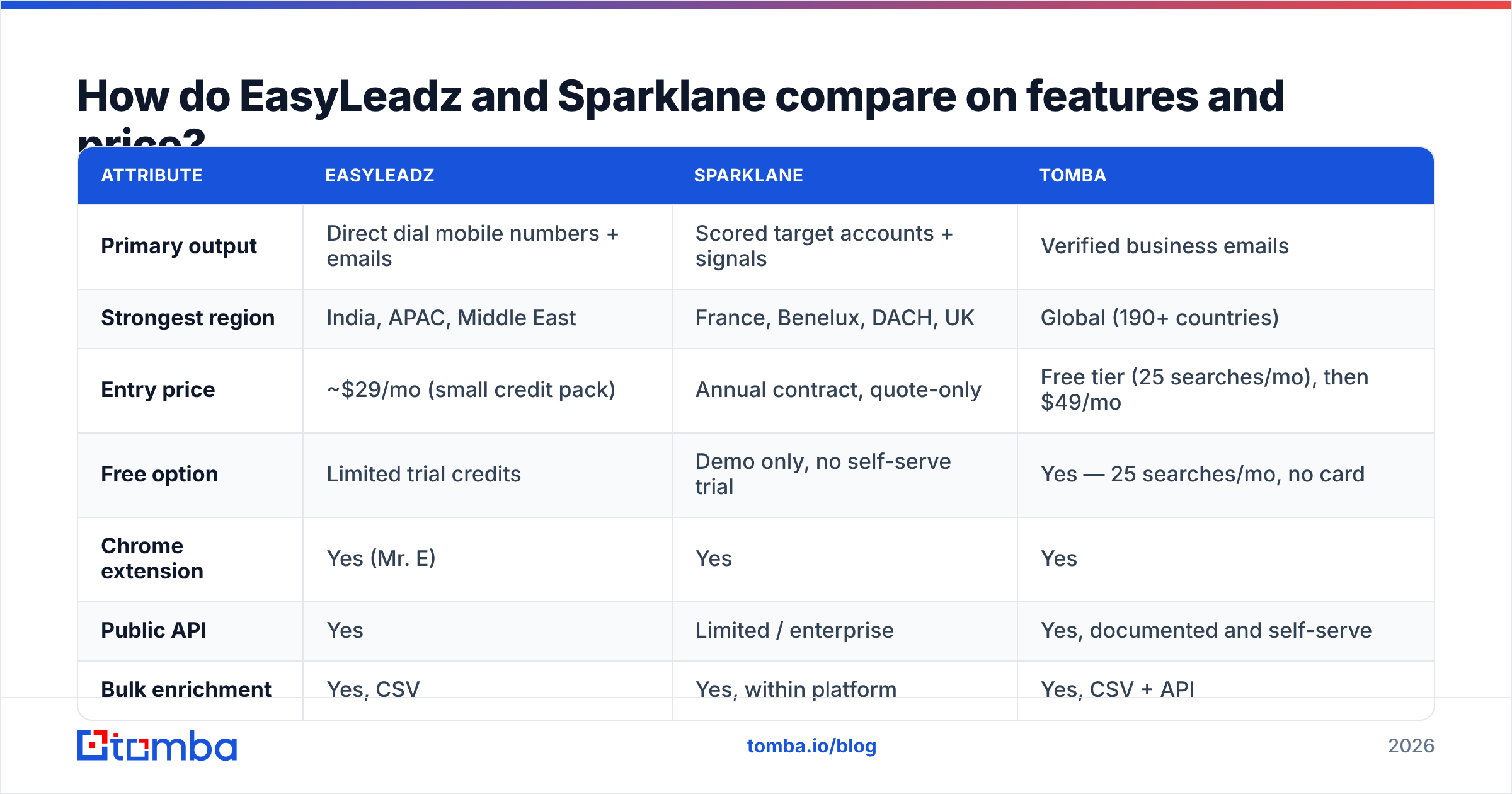
| Attribute | EasyLeadz | Sparklane | Tomba |
|---|---|---|---|
| Primary output | Direct dial mobile numbers + emails | Scored target accounts + signals | Verified business emails |
| Strongest region | India, APAC, Middle East | France, Benelux, DACH, UK | Global (190+ countries) |
| Entry price | ~$29/mo (small credit pack) | Annual contract, quote-only | Free tier (25 searches/mo), then $49/mo |
| Free option | Limited trial credits | Demo only, no self-serve trial | Yes — 25 searches/mo, no card |
| Chrome extension | Yes (Mr. E) | Yes | Yes |
| Public API | Yes | Limited / enterprise | Yes, documented and self-serve |
| Bulk enrichment | Yes, CSV | Yes, within platform | Yes, CSV + API |
| Intent / signals | No | Yes — funding, hiring, legal, press | No (email/phone data only) |
| Email verification included | Basic | Basic | Yes, dedicated verifier + catch-all |
| GDPR posture | Compliant, but non-EU processing | EU-hosted, GDPR-native selling point | GDPR compliant, opt-out honoured |
| Buying motion | Self-serve card | Demo → proposal → annual | Self-serve card |
Two rows deserve extra attention.
The pricing model gap is bigger than the price gap. EasyLeadz lets a single SDR expense a plan and start pulling numbers the same afternoon. Sparklane's buying cycle needs a discovery call, a scoping session about your ICP model, and a contract. If you are a five-person team testing a channel, that friction alone decides it. If you are a 40-rep EU enterprise with a RevOps function, the contract is the point. You want the onboarding and the ICP modelling.
Signals versus contacts is not a feature you can bolt on. Sparklane's scoring only pays off if you have the volume and the discipline to act on it. A team sending 200 emails a week does not need an AI to pick the 200. It needs 200 accurate addresses. A team with 40,000 accounts in its TAM absolutely does.
EasyLeadz vs Sparklane: which one has better data coverage?#
Neither tool covers the whole globe. Both admit as much in their own marketing.
EasyLeadz has the edge on phone data in markets that Western vendors treat as an afterthought. Say your buyer is a CTO in Bengaluru, a procurement lead in Dubai or a founder in Jakarta. EasyLeadz will return usable mobile numbers at rates ZoomInfo and Apollo cannot match. The failure mode is the mirror image. Run a list of German mid-market CFOs through it and hit rates fall off a cliff.
Sparklane has the edge on European company records: French SIREN/SIRET registry data, filings, and local press that US-centric providers never index. For a French or Benelux team selling into its own market, that is a real difference. For a US team selling into the US, it is near-useless.
This is where many teams get the evaluation wrong. They compare stated database sizes — "50M contacts" against "20M companies." The only number that counts is hit rate on your actual list. Take 200 real target contacts from your CRM, run them through each trial, and count how many come back with something you can dial or email. Published coverage stats are averages over a database you will never query in full.
Run your own coverage test in five steps:
- Pull 200 real prospects from closed-won accounts — not a random sample, your actual ICP.
- Strip existing contact data so you're testing discovery, not recall.
- Run the same list through each tool's trial or free tier on the same day.
- Score three things separately: found rate, verified-deliverable rate, and bounce rate after a real send.
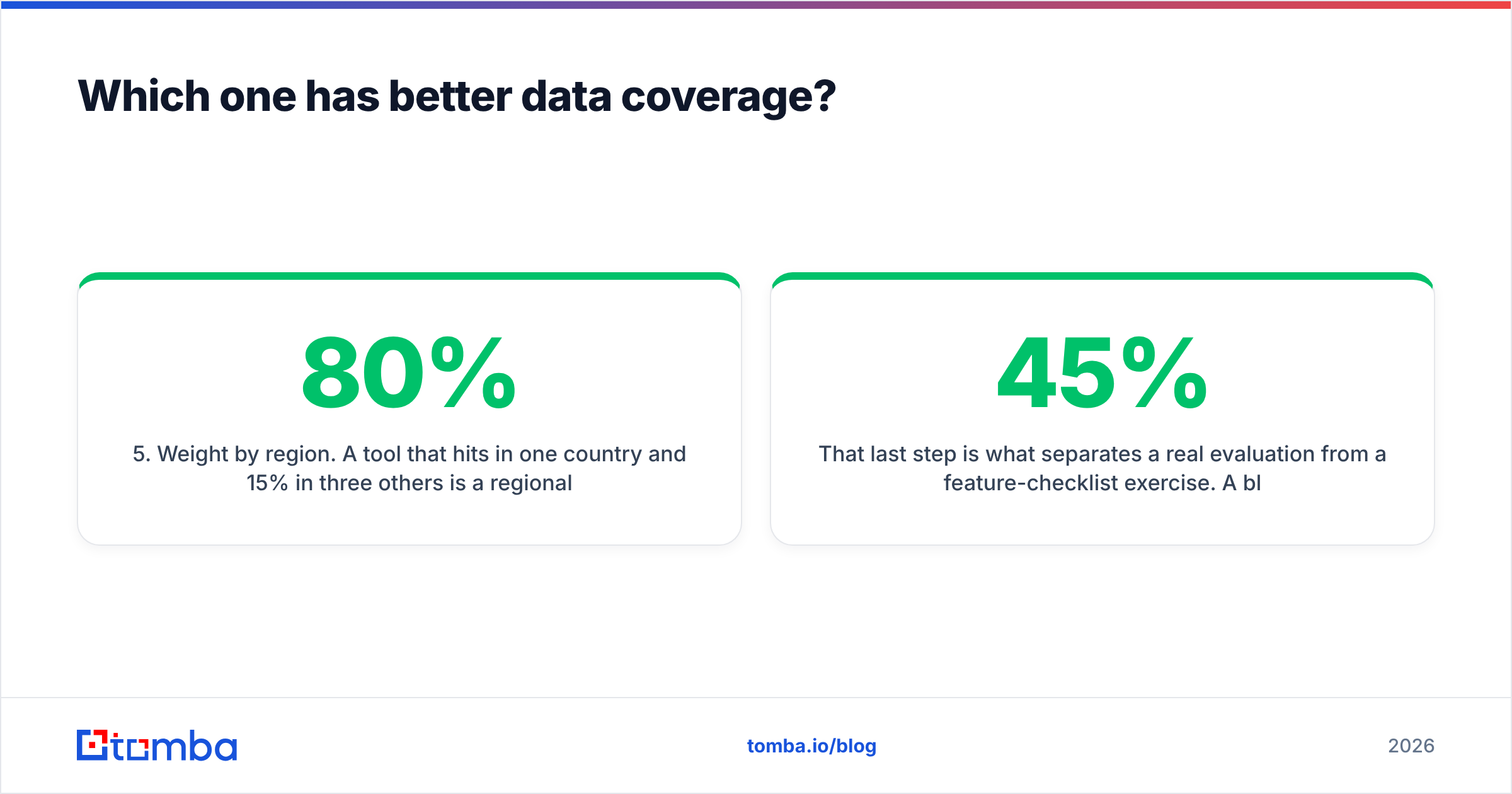
- Weight by region. A tool that hits 80% in one country and 15% in three others is a regional tool, whatever the homepage says.
That last step separates a real test from a feature-checklist exercise. A blended 45% hit rate hides the fact that every hit came from one country.
What are the honest pros and cons of each?#
EasyLeadz — where it wins
- Best-in-class mobile number coverage for India and much of APAC.
- Low friction: install, browse, extract. No onboarding required.
- Affordable entry point for individual reps and small teams.
- Straightforward API for developers who want to script enrichment.
EasyLeadz — where it hurts
- Coverage drops sharply outside APAC and the Middle East.
- Credit use is aggressive. A failed lookup can still cost you.
- Verification is thin. Run a dedicated email verifier before you send, above all on catch-all domains.
- Support and docs lag behind bigger Western vendors.
Sparklane — where it wins
- Useful account signals for EU markets, taken from official registries.
- GDPR posture is a real buying advantage in France, Germany and Benelux.
- The scoring saves time when your TAM is far larger than your capacity.
- Onboarding includes actual ICP work, which many teams have never done properly.
Sparklane — where it hurts
- No self-serve path. You cannot try it before a sales conversation.
- The annual commitment fits badly if you are still testing outbound.
- Contact data is a supporting act, not the product. You still need an email source.
- Value collapses outside Europe.

Is either one enough on its own?#
Usually not. The EasyLeadz vs Sparklane debate skips a third requirement, and so do most vendor comparison pages.
Outbound needs three separate things: who to target, how to reach them, and whether the address works. Sparklane answers the first. EasyLeadz partly answers the second. Neither answers the third at scale, and a bad third answer poisons everything upstream. A list of perfectly scored accounts with an 18% bounce rate will wreck your sender reputation faster than a bad ICP ever will.
Google and Yahoo's bulk sender rules have been in force since 2024, and they have tightened since. They set a hard spam-rate ceiling for senders. Google's own guidance is clear: repeated sends to invalid addresses push a domain toward the spam folder. So verification is not a layer you add later. It is load-bearing.
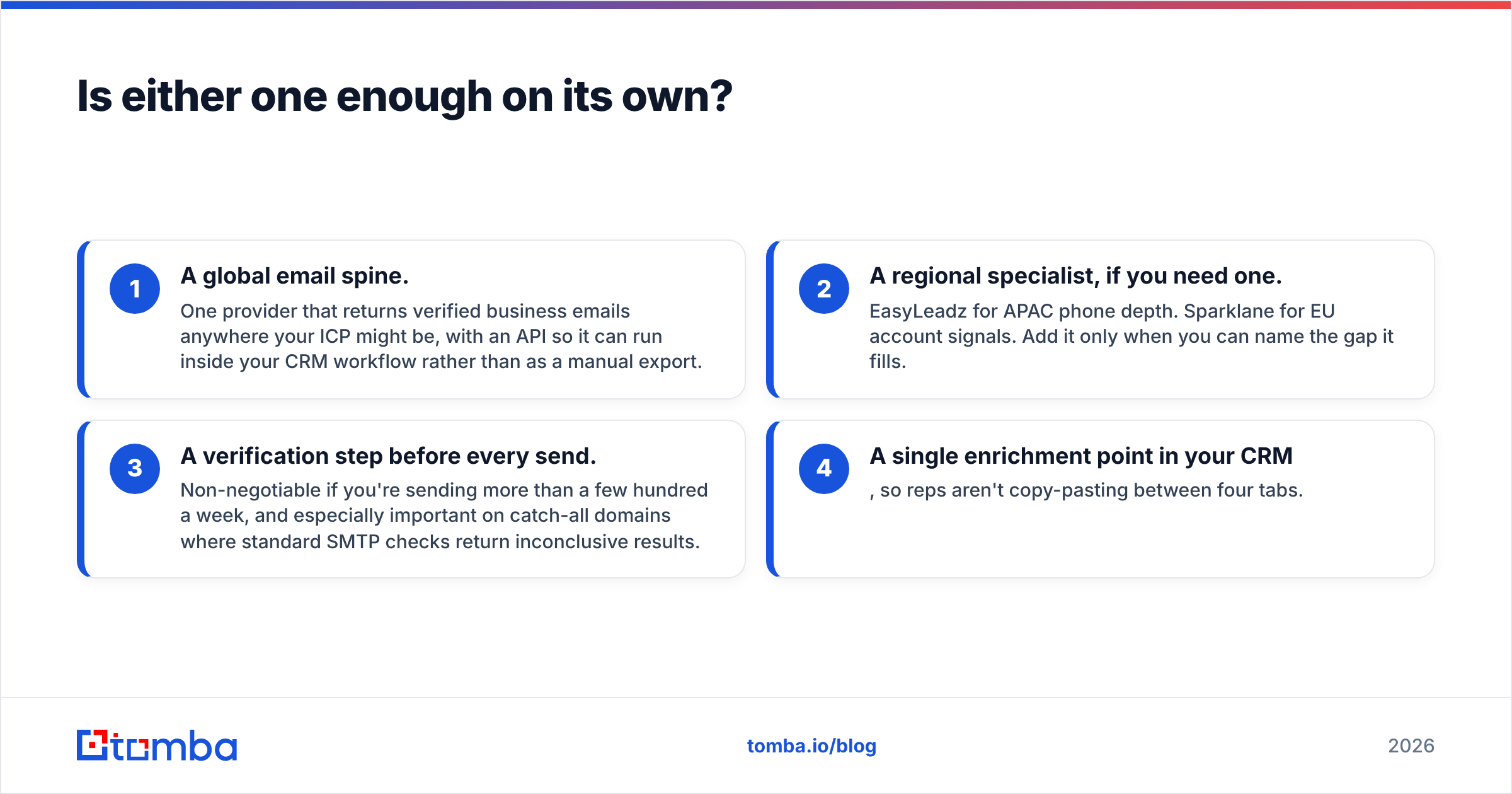
The practical architecture most teams land on:
- A global email spine. One provider that returns verified business emails anywhere your ICP sits. Give it an API, so it runs inside your CRM instead of as a manual export.
- A regional specialist, if you need one. EasyLeadz for APAC phone depth. Sparklane for EU account signals. Add it only when you can name the gap it fills.
- A verification step before every send. Treat it as non-negotiable past a few hundred sends a week. It matters most on catch-all domains, where plain SMTP checks come back unclear.
- A single enrichment point in your CRM, so reps aren't copy-pasting between four tabs.
This is where Tomba fits, honestly. It is not an account-intelligence platform and does not claim to be. It is not a phone-first tool for the Indian market either. It is the spine: email discovery and verification across 190+ countries.
Domain search maps every reachable contact at a target company. A catch-all verifier handles the domains that break other tools. A documented Tomba API runs enrichment for you, one call at a time instead of one browser tab at a time. The free tier is 25 searches a month, and paid plans start at $49/mo on Tomba pricing.
Want an EU-registry-style signal layer without the annual contract? Specialist providers such as BookYourData sell pay-as-you-go verified B2B lists with regional segmentation. That is a fair middle path between self-serve credits and enterprise contracts.
Which should you choose in 2026?#
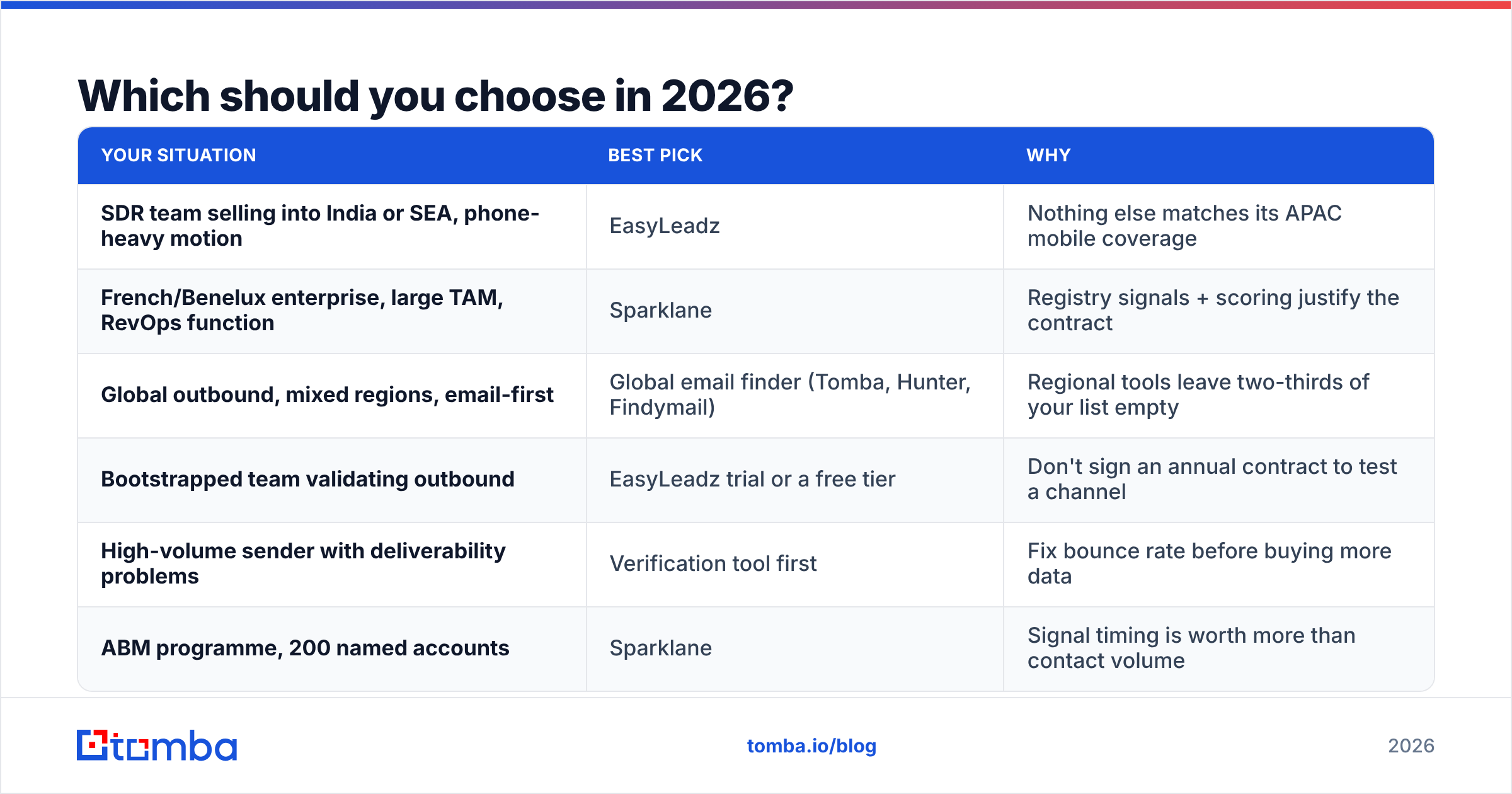
Match the EasyLeadz vs Sparklane decision to your situation, not to the feature list.
| Your situation | Best pick | Why |
|---|---|---|
| SDR team selling into India or SEA, phone-heavy motion | EasyLeadz | Nothing else matches its APAC mobile coverage |
| French/Benelux enterprise, large TAM, RevOps function | Sparklane | Registry signals + scoring justify the contract |
| Global outbound, mixed regions, email-first | Global email finder (Tomba, Hunter, Findymail) | Regional tools leave two-thirds of your list empty |
| Bootstrapped team validating outbound | EasyLeadz trial or a free tier | Don't sign an annual contract to test a channel |
| High-volume sender with deliverability problems | Verification tool first | Fix bounce rate before buying more data |
| ABM programme, 200 named accounts | Sparklane | Signal timing is worth more than contact volume |
A few rules of thumb hold up across evaluations.
Buy for the region, not the logo. The best predictor of whether a B2B data tool works for you is simple. It is the overlap between where the tool sources data and where your ICP sits. Everything else — UI, integrations, AI features — is a distant second.
Don't buy signals you can't act on. Intent and account scoring pay off when your capacity is the constraint. If your constraint is "we can't find valid emails," scoring only adds a step.
Test with your own list, not their demo. Every vendor demo runs on cherry-picked accounts. A 200-row test with your real CRM data takes an afternoon. It beats three weeks of comparison-shopping.
Treat verification as infrastructure. Whatever you buy on the data side, keep a verification step between discovery and send. It is the cheapest insurance in the stack. G2's category reviews show it is the layer teams regret skipping.
What's the verdict?#
The EasyLeadz vs Sparklane call comes down to geography. Are your buyers in India, Southeast Asia or the Gulf, with reps who live on the phone? Then EasyLeadz is the better buy. It is cheap enough to test this week, and its phone coverage in those markets is real. Are you a European enterprise with a large market, a RevOps function and budget for an annual contract? Then Sparklane's signals and GDPR posture earn their keep.
If you are anywhere else — or, more often, in several places at once — neither is the right foundation. Both are regional specialists. They work best as a layer on top of a global email source, not as a replacement for one.
Start with the layer that has to work everywhere. Run your target list through the Tomba Email Finder free tier — 25 searches, no card. Measure the hit rate on your own accounts before you spend on anything regional. If the spine covers 80% of your list, you will know how big the gap is, and which tool should fill it.
Related guides#
Ready to find emails that actually work?
Join 150,000+ professionals who stopped guessing and started sending. Free credits on signup — no credit card required.
Get the Tomba newsletter
Practical outbound tactics and product updates — once every two weeks.
About the author