EasyLeadz vs Tami AI: Which B2B Data Tool Wins in 2026?
EasyLeadz sells direct dials. Tami AI sells an AI research layer. They solve different halves of the same problem — here is how they compare on coverage, pricing, workflow, and what neither of them does well.
TL;DR
- EasyLeadz is a phone-first contact tool. Its core value is the direct dial you pull off a LinkedIn profile with a Chrome extension — email is secondary.
- Tami AI is an AI-native prospecting layer. You describe an ICP in plain language and it assembles and researches the account list for you, rather than making you build boolean filters.
- They are not really substitutes. EasyLeadz wins for SDR teams that dial; Tami AI wins for teams doing research-heavy, account-based outbound with small target lists.
- Both leave the same gap: neither is built as a high-volume, verified email engine with an API you can run at scale. That is where a dedicated finder/verifier stack matters.
- Budget check: EasyLeadz entry pricing starts around $49/mo for a small credit block; Tami AI is credit- and seat-based with quote-driven upper tiers. Always confirm current numbers on the vendor pages — both change quarterly.
What are EasyLeadz and Tami AI, actually?#
Short version: EasyLeadz sells you a phone number. Tami AI sells you a research assistant.
EasyLeadz — best known through its "Mr. E" browser extension — is an India-headquartered contact data provider whose reputation was built on direct dial coverage, particularly for APAC and Indian companies where most Western databases go thin. The workflow is deliberately narrow: open a LinkedIn profile, click the extension, burn a credit, get a mobile number and often an email. That is the whole product loop, and it is a good loop if your team's next action is a call.
Tami AI sits in the newer category of AI-native GTM tools. Instead of a filter panel with 40 checkboxes, you write something like "Series B fintech companies in the UK that recently posted a compliance hire." The system interprets that, builds the account list, enriches contacts, and surfaces the signal it used. It behaves less like a database and more like a junior researcher who never sleeps.
That difference in shape matters more than any feature checklist. Choosing between them is really choosing between speed of dial and quality of targeting.
How do EasyLeadz and Tami AI compare head to head?#
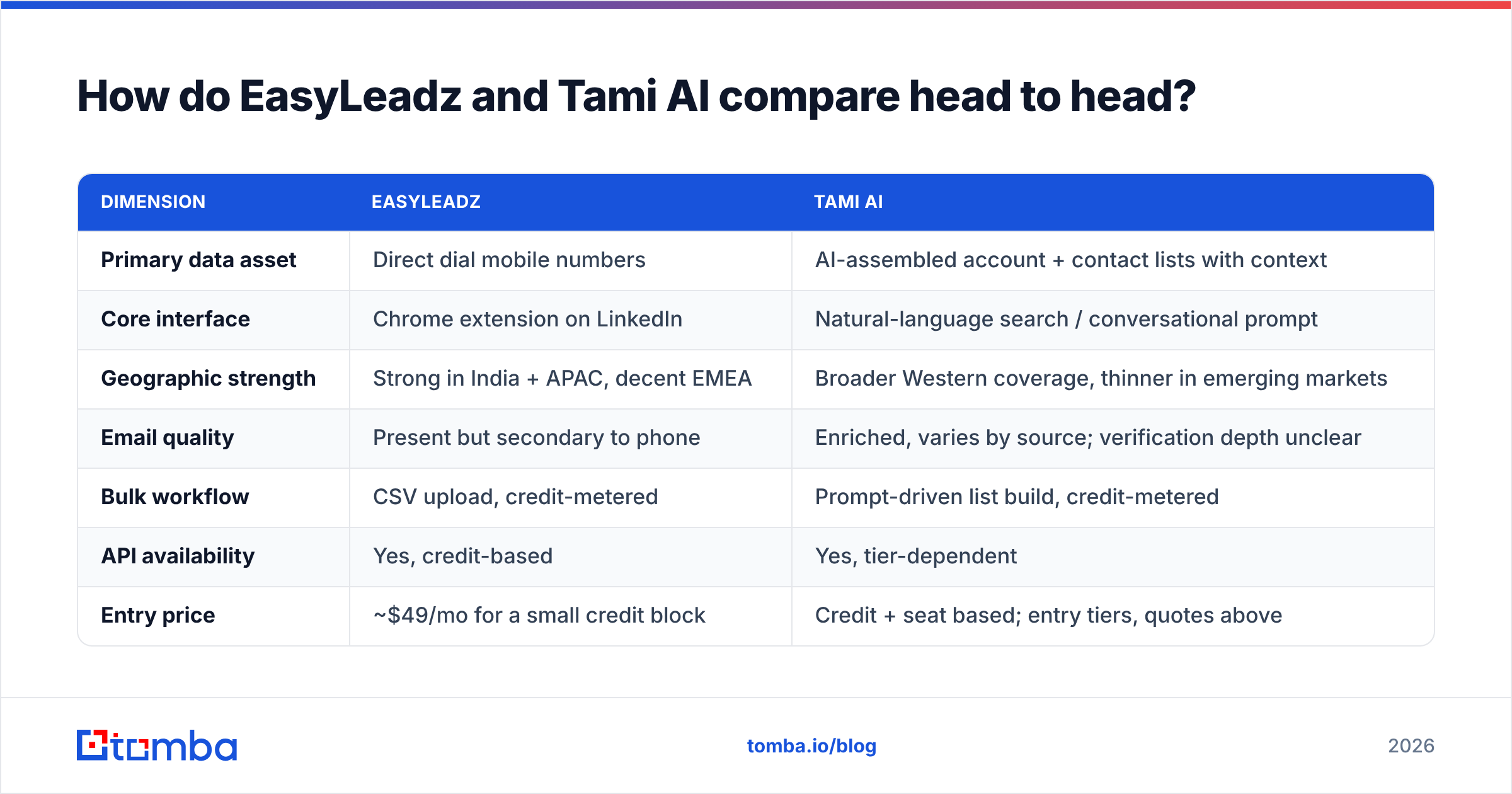
| Dimension | EasyLeadz | Tami AI |
|---|---|---|
| Primary data asset | Direct dial mobile numbers | AI-assembled account + contact lists with context |
| Core interface | Chrome extension on LinkedIn | Natural-language search / conversational prompt |
| Geographic strength | Strong in India + APAC, decent EMEA | Broader Western coverage, thinner in emerging markets |
| Email quality | Present but secondary to phone | Enriched, varies by source; verification depth unclear |
| Bulk workflow | CSV upload, credit-metered | Prompt-driven list build, credit-metered |
| API availability | Yes, credit-based | Yes, tier-dependent |
| Entry price | ~$49/mo for a small credit block | Credit + seat based; entry tiers, quotes above |
| Free tier | Small trial credit allowance | Trial / limited free usage |
| Best for | SDR teams that cold call | ABM and research-led outbound |
| Weakest at | Email verification depth, EU/US coverage parity | High-volume email throughput, cost predictability |
Read that table as two tools that barely overlap. If a rep's day is 60 dials, EasyLeadz has an obvious ROI story. If a rep's day is 12 highly-tailored emails to named accounts, Tami AI's research layer is worth more than any phone number.

Which one has better data coverage?#
Coverage is regional, not global — and every vendor's "95% accuracy" headline is measured on a sample they chose.
Here is the honest breakdown based on how these tools are built:
- EasyLeadz is strongest where Western databases are weakest. Indian, Southeast Asian, and Middle Eastern mobile numbers show up in EasyLeadz where Apollo, ZoomInfo, and Lusha frequently return nothing. If your TAM is India-heavy, this alone can justify the subscription.
- Tami AI is strongest on context, not raw record count. Its advantage is that it tells you why an account matched — a funding event, a job post, a technology signal. Raw record volume is comparable to mid-market providers, not to the giant databases.
- Neither is a verification specialist. EasyLeadz returns emails alongside phones but does not position itself as a deliverability tool. Tami AI enriches from aggregated sources. In both cases you should run the output through a dedicated email verifier before it touches a sending domain.
- Catch-all domains break both. Roughly a fifth of B2B domains accept everything at the SMTP layer, so a "valid" flag from any enrichment tool is meaningless there. You need a real catch-all verifier to separate a live mailbox from a wildcard trap.
- Recency beats size. A 2-year-old direct dial for someone who changed jobs is worse than no number, because it costs a rep a dial and a credit. Ask both vendors when their records were last re-validated, not how many they hold.
The practical test: take 50 known-good contacts from your own CRM — people you have actually reached — and run them through each tool's trial. Whichever returns more correct records on your specific ICP wins for you, regardless of what any review site says. G2's lead intelligence category is useful for spotting support and billing complaints, but it cannot tell you whose data fits your segment.
What do they cost, and where do the bills surprise you?#
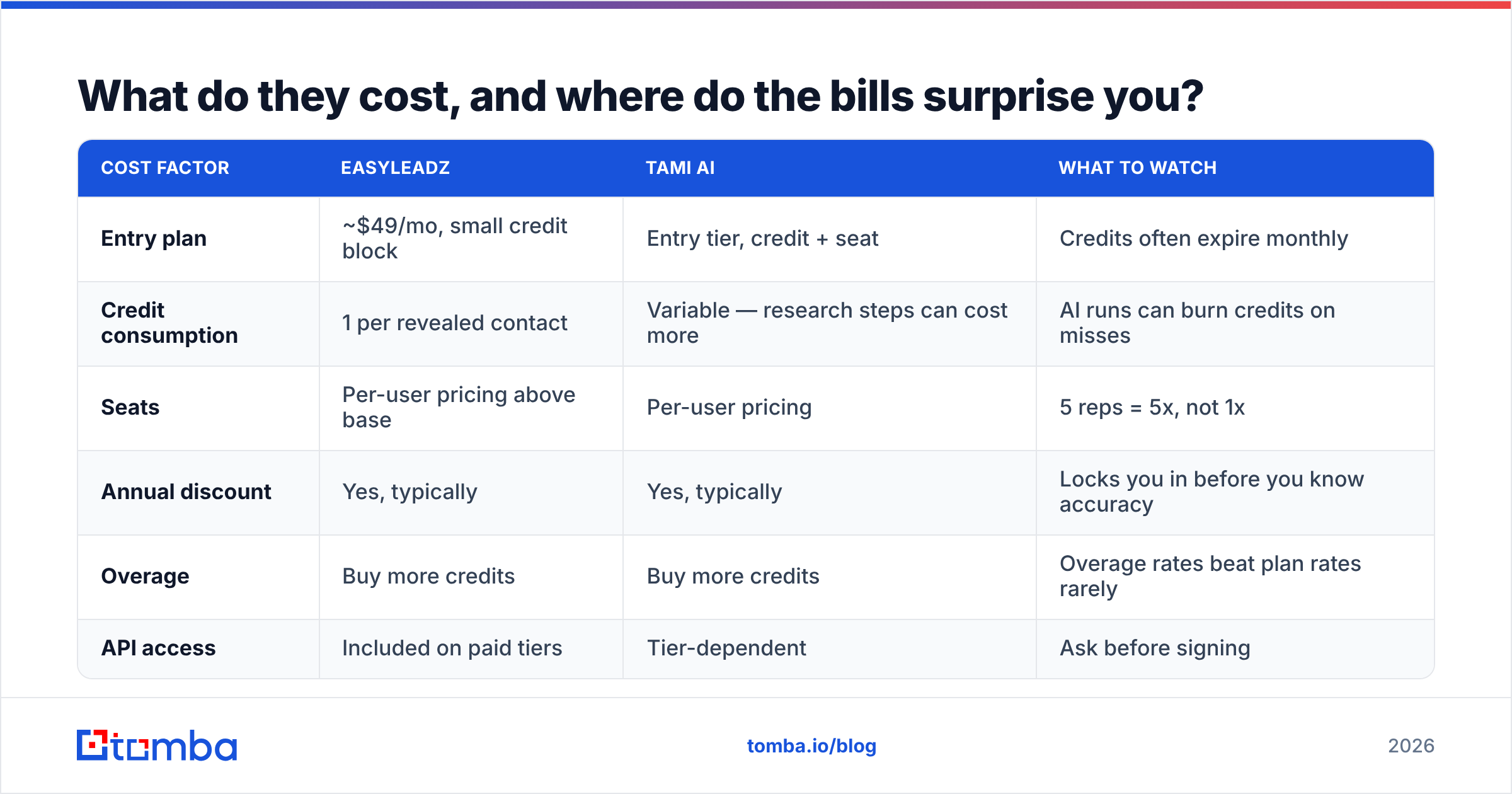
Both tools are credit-metered, and credit metering is where budgets quietly blow up.
| Cost factor | EasyLeadz | Tami AI | What to watch |
|---|---|---|---|
| Entry plan | ~$49/mo, small credit block | Entry tier, credit + seat | Credits often expire monthly |
| Credit consumption | 1 per revealed contact | Variable — research steps can cost more | AI runs can burn credits on misses |
| Seats | Per-user pricing above base | Per-user pricing | 5 reps = 5x, not 1x |
| Annual discount | Yes, typically | Yes, typically | Locks you in before you know accuracy |
| Overage | Buy more credits | Buy more credits | Overage rates beat plan rates rarely |
| API access | Included on paid tiers | Tier-dependent | Ask before signing |
The failure mode is identical for both: you buy annual, you discover your ICP is underserved in month two, and you have 10 months of a tool your reps stopped opening. Every contact-data purchase should start monthly, with a hard checkpoint at day 30 measuring connect rate (for phone tools) or reply rate net of bounces (for email tools) — not credits consumed.
One more line item that nobody quotes you: the cost of bad data downstream. A 6% bounce rate on a cold campaign is not a 6% loss of volume, it is a hit to sender reputation that suppresses the other 94%. That is a spend on a data tool that produces negative return.

Is EasyLeadz better than Tami AI for cold outbound?#
For phone-led outbound, yes. For email-led outbound, no — and probably neither is your answer.
Think of it like tools in a kitchen. EasyLeadz is a very good knife: one job, done fast, and you notice immediately if it's dull. Tami AI is a sous chef: it decides what to prep before anything gets cut. You do not compare a knife to a sous chef; you ask which stage of your process is broken.
Pick EasyLeadz if:
- Your motion is dial-first and your reps measure connects, not opens.
- You sell into India, APAC, or MENA and your current provider returns blanks.
- You want a lightweight extension, not a platform migration.
- Your list-building is already solved elsewhere.
Pick Tami AI if:
- Your ICP is defined by signals (funding, hiring, tech stack) rather than static firmographics.
- Reps waste hours on manual account research before writing.
- You run small, high-value target lists where 200 great accounts beat 20,000 mediocre ones.
- You want the why this account context to make it into the email copy.
Pick neither as your primary if:
- You send at volume and email deliverability is the bottleneck.
- You need programmatic enrichment inside your own product or data pipeline.
- You need catch-all resolution, pattern detection, and bulk verification as first-class features.
That third case is the common one, and it is why most teams end up running a dedicated finder alongside whichever of these they chose.
What does a complete stack look like in 2026?#
The mistake is assuming one vendor covers discovery, enrichment, verification, and dialing. Nobody does all four well. A workable 2026 stack looks like this:
- Targeting layer — where you decide who to contact. Tami AI fits here, as do intent platforms and your own product analytics. Output: a list of accounts and named people.
- Contact layer — where names become reachable addresses. A dedicated email finder resolves work emails from a name plus domain, and domain search pulls the full contact map of a company when you don't yet know who to target.
- Verification layer — where you protect your domain. Bulk verification, catch-all resolution, and role-account filtering happen before a single send.
- Channel layer — dialers for phone (EasyLeadz feeds this), sequencers for email.
- Automation layer — an email finder API so steps 2 and 3 run inside your CRM or data pipeline instead of in someone's browser tab.
Where does that leave EasyLeadz and Tami AI? EasyLeadz slots into layers 2 and 4 for phone. Tami AI slots into layer 1. Layers 2 (email), 3, and 5 are open in both cases.
This is where Tomba is a straightforward fit rather than a competitive claim. Tomba's Tomba pricing runs a free tier at 25 searches/month, Starter at $49/mo, Growth at $99/mo, and Pro at $249/mo — the same entry price point as EasyLeadz, but spent on email discovery, verification, and API throughput rather than on direct dials. If you need both dials and verified email at volume, running EasyLeadz for phone and a dedicated finder for email costs less than forcing one vendor to do a job it was not built for. And if you specifically need numbers alongside emails from one place, a phone finder covers the overlap without a second per-seat contract.
How should you run the evaluation?#
Do not evaluate on demos. Demos are run on the vendor's best data.
- Build a 100-row control set from contacts you have already reached — your own closed-won accounts. You know the right answers.
- Run all three tools blind on the same 100 rows: EasyLeadz, Tami AI, and one dedicated finder/verifier.
- Score three things: hit rate (how many rows returned anything), accuracy (how many were correct), and cost per correct record — not cost per credit.
- Check the tail, not the head. Every tool nails the VP of Sales at a 5,000-person US software company. Test your actual hard cases: 30-person manufacturers, non-English domains, recently-renamed companies.
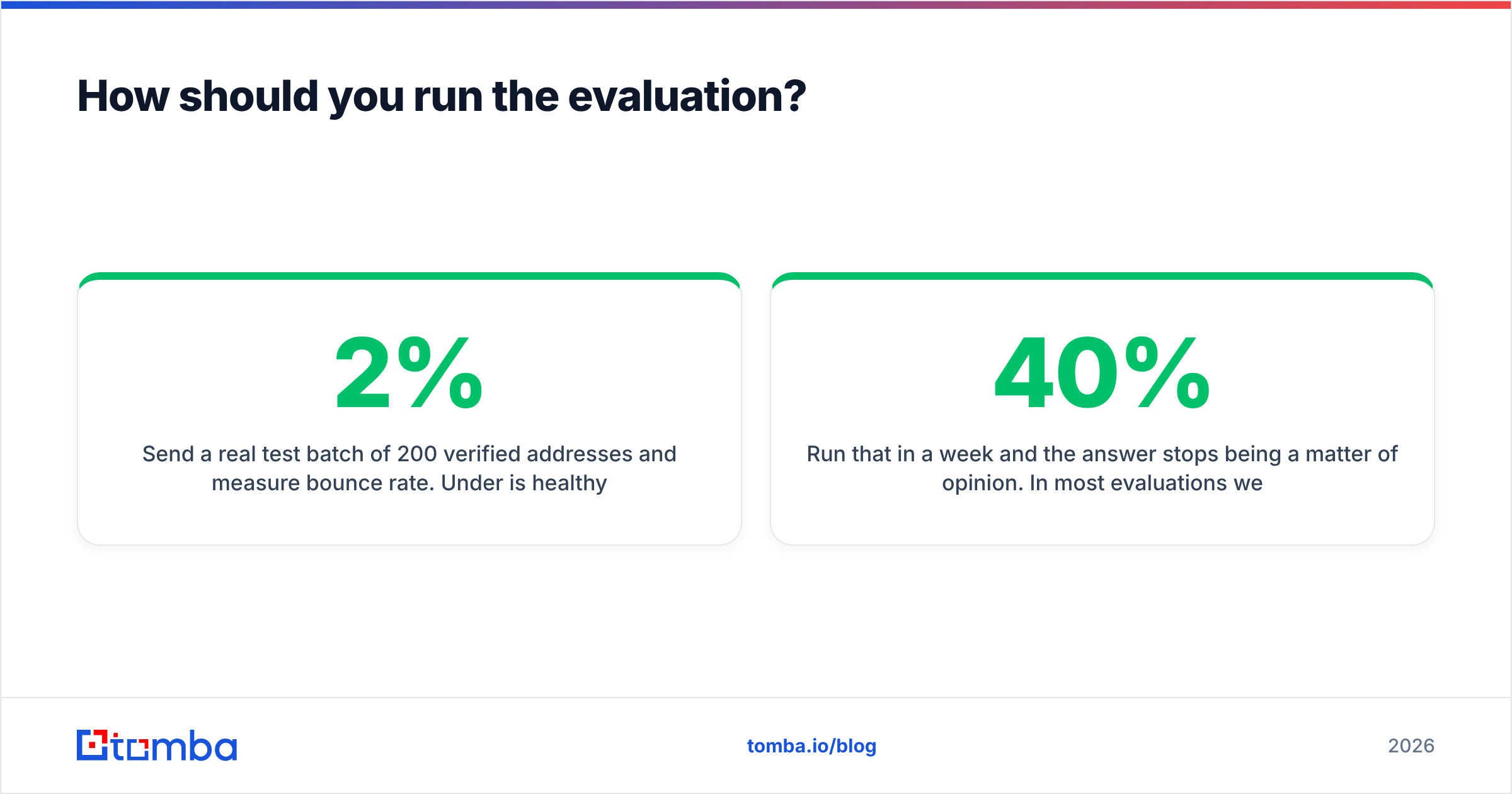
- Send a real test batch of 200 verified addresses and measure bounce rate. Under 2% is healthy; above 5% means the verification step is not doing its job.
Run that in a week and the answer stops being a matter of opinion. In most evaluations we have seen described publicly, the result is not "tool A beats tool B" — it is "these two cover different 40% slices of my list, and I need both, or I need a cheaper base layer under whichever one I keep."
The bottom line#
EasyLeadz and Tami AI are both defensible purchases for the teams they were designed for. EasyLeadz is the better buy if dialing is your motion and APAC is your market. Tami AI is the better buy if research time — not contact data — is your bottleneck. Neither is the right answer if your real problem is finding and verifying professional email addresses at volume, with an API and predictable per-credit economics.
If that last description is you, start with the Tomba Email Finder. Test it on 25 searches free, run your own control set against whatever you use today, and compare cost per correct email rather than cost per seat. If the numbers work, Starter is $49/mo — the same as an entry EasyLeadz plan, spent on the layer most outbound teams are actually missing. If they don't, you have lost a week and learned exactly which vendor owns which slice of your list, which is worth more than any comparison post including this one.
Related guides#
Ready to find emails that actually work?
Join 150,000+ professionals who stopped guessing and started sending. Free credits on signup — no credit card required.
Get the Tomba newsletter
Practical outbound tactics and product updates — once every two weeks.
About the author