EasyLeadz vs Techsalerator 2026: Data, Pricing, Verdict
EasyLeadz sells direct dials one contact at a time. Techsalerator sells datasets by the file. They solve different problems — and picking the wrong one wastes a quarter. Here is the honest breakdown.
TL;DR
- EasyLeadz is a contact-at-a-time tool. You sit on a LinkedIn profile, click an extension, and get a direct dial. Strongest in India and wider APAC, weakest as a bulk data source.
- Techsalerator is a data vendor, not a tool. You describe an audience, they quote you a file. Enormous country and vertical coverage, but no self-serve dashboard, no free tier, and a sales cycle before you see a record.
- They barely compete. One is a prospecting utility with a credit meter; the other is a licensing deal with a CSV at the end. Comparing their "price per lead" is close to meaningless without normalizing for verification.
- Both leave a verification gap. Neither is primarily an email-validation layer, so whatever you get out needs a bounce check before it touches your sending domain.
- If your actual need is email at scale, a dedicated finder-plus-verifier stack (Tomba, or a prebuilt list vendor like BookYourData) usually costs less per usable contact than either.
What are EasyLeadz and Techsalerator?#
They are not the same category of product, and that is the single most important thing to understand before you compare a price sheet.
EasyLeadz is best known for "Mr. E," a Chrome extension that surfaces direct dial phone numbers from LinkedIn profiles. The workflow is manual and per-contact: open a profile, click, spend a credit, get a mobile number. The company is India-headquartered, and its coverage reflects that — Indian and broader APAC mobile numbers are its genuine strength, and the reason a lot of teams selling into that region keep it around even after buying a bigger platform.
Techsalerator sits at the other end of the market. It is a data provider that licenses bulk B2B and consumer datasets — firmographics, contact records, geographic and country-specific files, sometimes point-of-interest or mobility data. You do not "use" Techsalerator the way you use a Chrome extension. You brief a rep on the audience you want, they scope it, and you receive a file or an API feed under a licensing agreement.
So the honest framing of EasyLeadz vs Techsalerator is: do I need a scalpel or a shipping container? Rep-driven, one-lead-at-a-time phone prospecting is a scalpel problem. Building a 200,000-record TAM file for a data warehouse is a container problem.

How do EasyLeadz and Techsalerator compare head-to-head?#
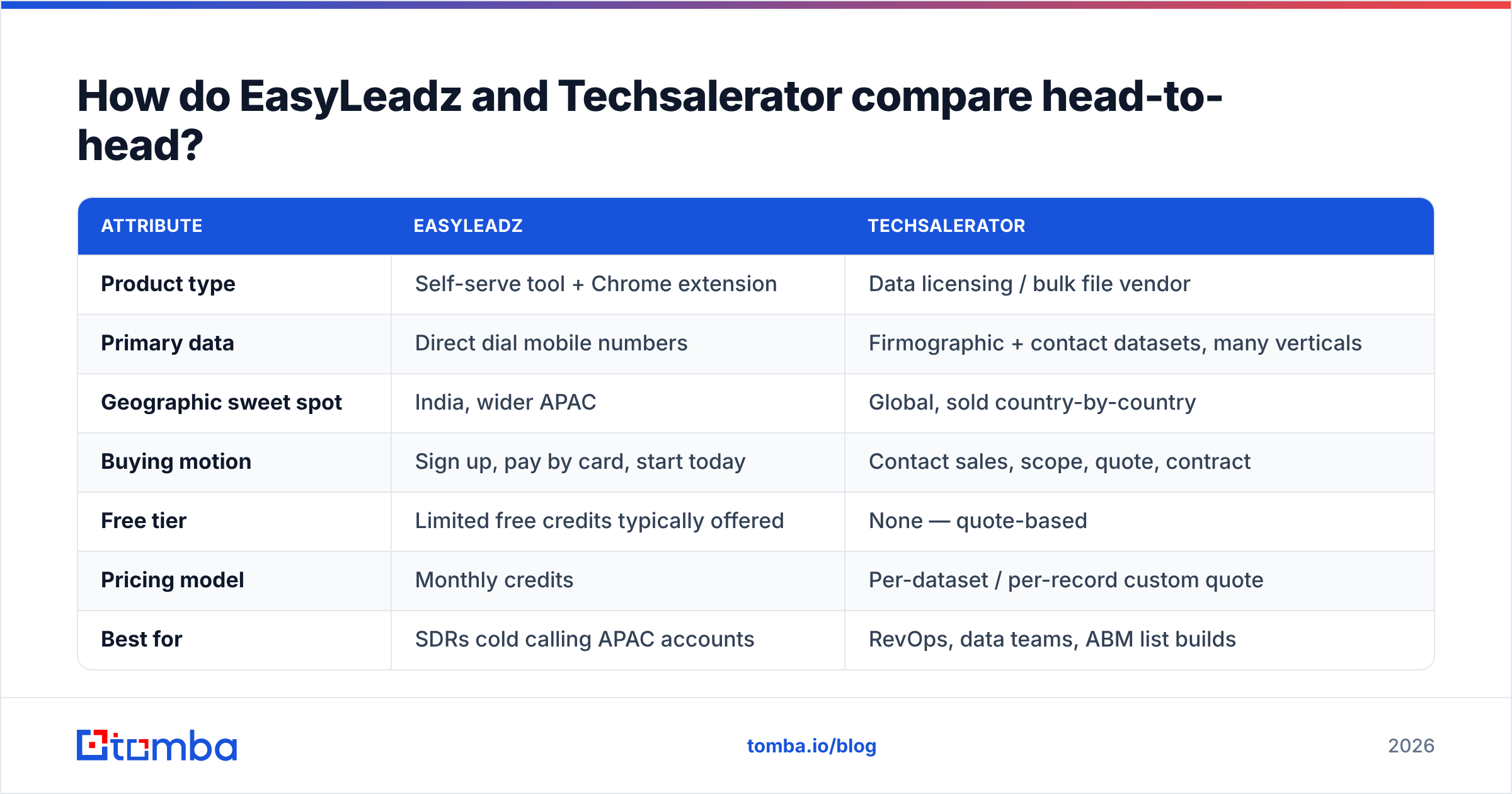
| Attribute | EasyLeadz | Techsalerator |
|---|---|---|
| Product type | Self-serve tool + Chrome extension | Data licensing / bulk file vendor |
| Primary data | Direct dial mobile numbers | Firmographic + contact datasets, many verticals |
| Geographic sweet spot | India, wider APAC | Global, sold country-by-country |
| Buying motion | Sign up, pay by card, start today | Contact sales, scope, quote, contract |
| Free tier | Limited free credits typically offered | None — quote-based |
| Pricing model | Monthly credits | Per-dataset / per-record custom quote |
| Best for | SDRs cold calling APAC accounts | RevOps, data teams, ABM list builds |
| Email finding | Secondary at best | Included in some datasets, not a workflow |
| Email verification | Not a core function | Not a core function |
| Time to first record | Minutes | Days to weeks |
| Integration surface | Extension, CRM pushes | File delivery, S3/API feeds |
The table makes the split obvious. If you are a two-person outbound team that needs to call 40 prospects this week, a licensing conversation is the wrong shape of purchase. If you are standing up an account-based program across six countries and need the data to live in Snowflake, an extension that fires one credit per click is the wrong shape too.
Which one has better data coverage?#
Wrong question — better for what?
Depth vs breadth. EasyLeadz goes deep on one field type (mobile numbers) in one region cluster. Techsalerator goes broad across countries, verticals, and record types. A depth provider will beat a breadth provider on its home turf almost every time, and lose badly outside it. Reps report solid hit rates on Indian direct dials from EasyLeadz and noticeably thinner results in Western Europe or Latin America. Techsalerator will happily quote you a French or Brazilian file, but you are buying a snapshot, not a live lookup.
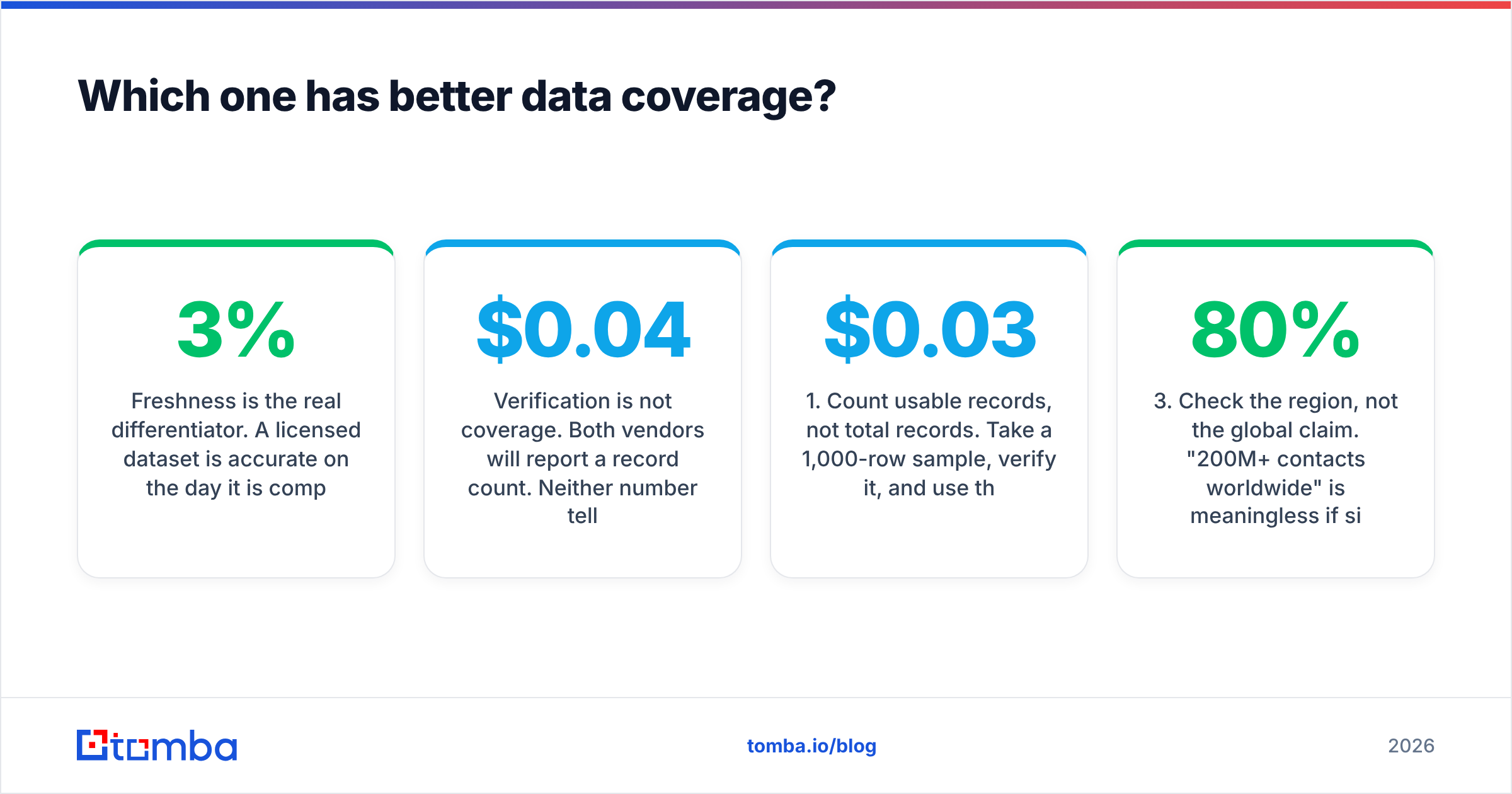
Freshness is the real differentiator. A licensed dataset is accurate on the day it is compiled and decays from there. B2B contact data typically decays somewhere in the range of 2–3% per month as people change jobs — which compounds to roughly a quarter to a third of a file going stale over a year. A per-lookup tool re-queries at the moment you ask, so its records are fresher by construction, even if its raw universe is smaller.
Verification is not coverage. Both vendors will report a record count. Neither number tells you how many of those records will actually connect. This is where teams get burned: a 300,000-row file at $0.04 per record looks brilliant until 38% of the emails bounce and your domain reputation takes the hit. Run any bulk purchase through an email verifier before your sequencer touches it, and price the file on surviving rows, not delivered rows.
Here is how to normalize the comparison honestly:
- Count usable records, not total records. Take a 1,000-row sample, verify it, and use the pass rate as your multiplier. A file at $0.03/record with a 60% pass rate costs $0.05 per usable record.
- Separate the fields you actually need. If you only need work email and job title, you should not pay for a 40-column enrichment bundle. If you need mobile numbers, most email-first vendors will disappoint you.
- Check the region, not the global claim. "200M+ contacts worldwide" is meaningless if 80% sit in one region you do not sell into. Ask for a coverage breakdown on your top three countries.
- Test refresh cadence. Ask both vendors how often a record is re-verified. Monthly is good, quarterly is normal, "at compile time" means you own the decay.
- Price the failure case. Bounced emails and dead dials cost more than the credits — they cost sender reputation and rep time. Weight accordingly.
How does pricing actually work for each?#
EasyLeadz runs a conventional self-serve credit model: monthly tiers, a credit allowance, extra credits available. Entry tiers are affordable enough that an individual SDR can expense one, which is a real advantage. Credits are consumed per reveal, so heavy users hit ceilings fast and the effective cost per contact climbs on the top end.
Techsalerator does not publish a rate card in any meaningful way. Pricing is scoped per project — record volume, field depth, geography, licensing term, and refresh rights all move the number. That is standard for the data-licensing category and it is not a criticism; it is just a different purchase. It does mean the "how much does it cost" question has no answer until you have had a call, and the floor for a serious dataset tends to sit well above what a small team budgets for tooling.

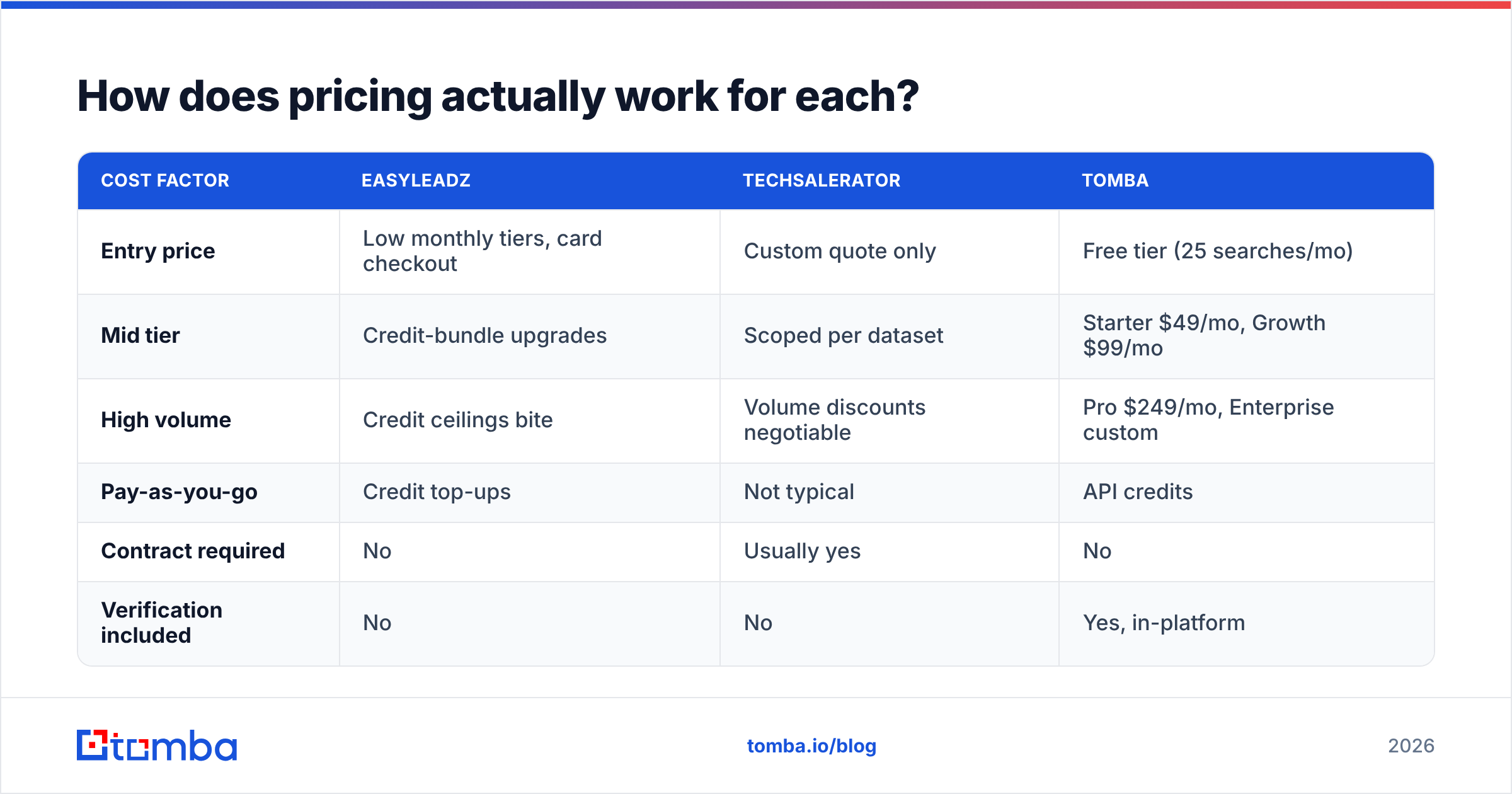
| Cost factor | EasyLeadz | Techsalerator | Tomba |
|---|---|---|---|
| Entry price | Low monthly tiers, card checkout | Custom quote only | Free tier (25 searches/mo) |
| Mid tier | Credit-bundle upgrades | Scoped per dataset | Starter $49/mo, Growth $99/mo |
| High volume | Credit ceilings bite | Volume discounts negotiable | Pro $249/mo, Enterprise custom |
| Pay-as-you-go | Credit top-ups | Not typical | API credits |
| Contract required | No | Usually yes | No |
| Verification included | No | No | Yes, in-platform |
Two things to notice. First, the only column where you can predict next quarter's bill without a phone call is the self-serve one. Second, verification bundled into the same platform removes a line item most teams forget to budget for. You can compare the specifics on the Tomba pricing page — the point is not that one number is smaller, it is that the total cost of a usable contact includes a verification step that quote-based data vendors leave to you.
Who should choose EasyLeadz?#
Pick EasyLeadz if most of these are true:
- You sell into India or APAC and mobile numbers are your primary channel. This is its genuine edge and no generic global provider matches it there.
- Your reps work profile-by-profile. The extension workflow fits a rep who researches an account, then reveals a number, rather than a data engineer building lists.
- You want to start today without procurement, legal review, or a data-licensing agreement.
- Your volume is modest — dozens to low hundreds of reveals per rep per month, not tens of thousands.
Skip it if you need email as your primary channel, if your ICP is North American or European, or if you need to populate a CRM with 50,000 accounts. Those are jobs it was not built for. For phone-led motions outside its home region, compare its hit rate against a dedicated phone finder on a real sample of your own accounts — not on a vendor demo list, which is always cherry-picked.
Who should choose Techsalerator?#
Pick Techsalerator if most of these are true:
- You need volume that no per-lookup tool can produce. Six-figure record counts are a licensing purchase, full stop.
- The data feeds a system, not a rep. Warehouse, CDP, ABM platform, or a model you are training — anywhere the destination is a pipeline rather than a dialer.
- You need unusual data types or geographies. Niche verticals, non-Western markets, or record types beyond standard contact data are exactly where specialist providers earn their fee.
- You have procurement capacity. A contract, a scoping call, and a legal review are part of the deal. If that sounds like friction, it is the wrong vendor.
Skip it if you are a small team, if you need results this week, or if your use case is "give me the email for this one person." Nothing about the model is designed for that.
What do both tools leave you to solve?#
Three gaps show up regardless of which you pick.
Verification. Neither is a verification platform. Whatever you receive should pass through syntax, MX, SMTP, and catch-all checks before it enters a sequencer. On bulk files this is not optional — one bad send at volume can cost you weeks of deliverability recovery. Bulk-check purchased lists through a bulk verify pass and treat the survival rate as the true measure of what you bought.
Email as a first-class channel. EasyLeadz leads with phone. Techsalerator sells fields, and email may or may not be complete in a given file. If email is your main motion, you want a tool whose core product is the email finder rather than a bonus column.
Workflow glue. Neither is a sequencer, a CRM, or an orchestration layer. You still need the plumbing that moves a verified contact into an outbound cadence and back into your CRM without a human copying cells.
How do these compare to the wider market?#
Worth knowing the shape of the field before committing:
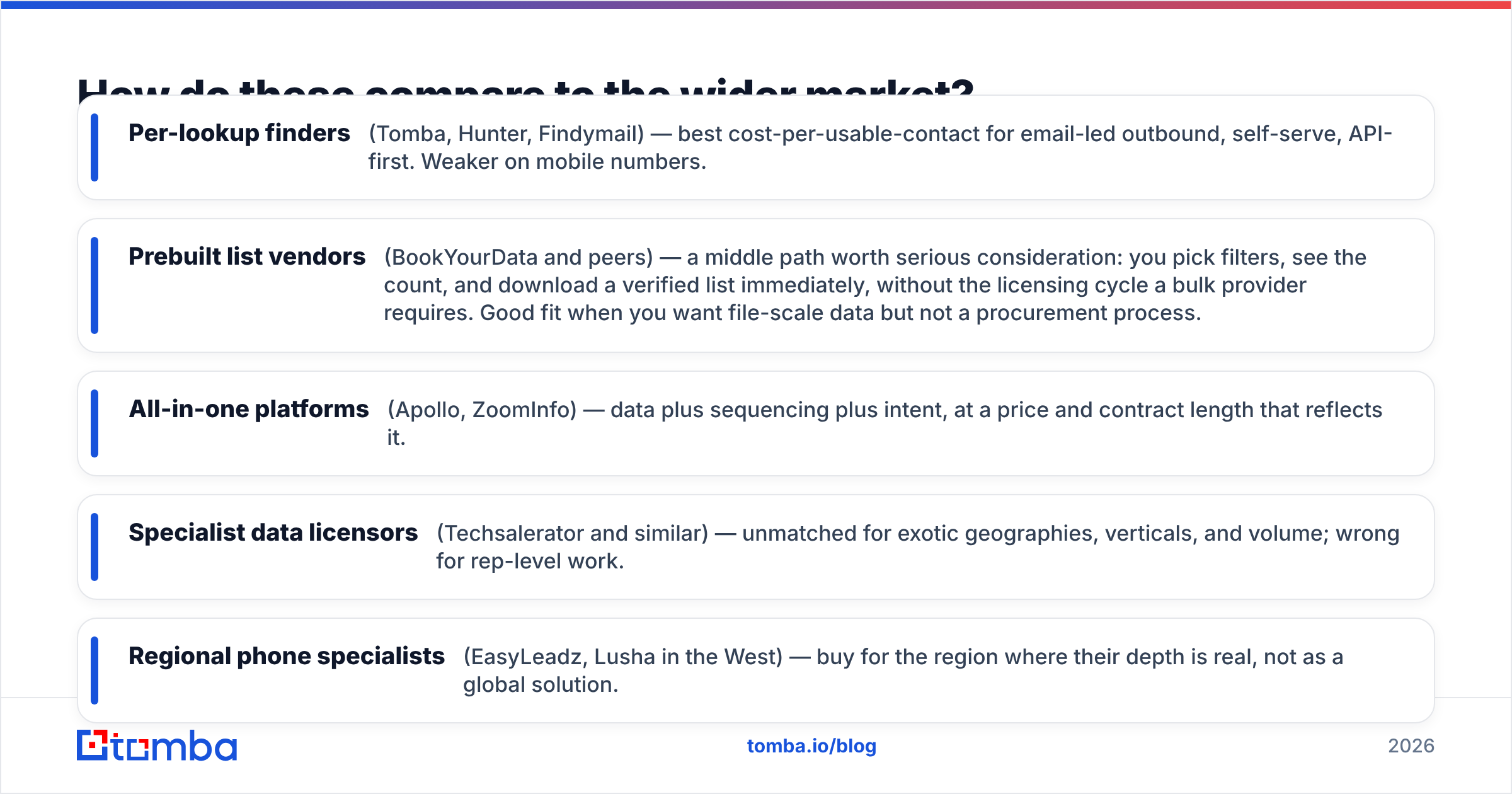
- Per-lookup finders (Tomba, Hunter, Findymail) — best cost-per-usable-contact for email-led outbound, self-serve, API-first. Weaker on mobile numbers.
- Prebuilt list vendors (BookYourData and peers) — a middle path worth serious consideration: you pick filters, see the count, and download a verified list immediately, without the licensing cycle a bulk provider requires. Good fit when you want file-scale data but not a procurement process.
- All-in-one platforms (Apollo, ZoomInfo) — data plus sequencing plus intent, at a price and contract length that reflects it.
- Specialist data licensors (Techsalerator and similar) — unmatched for exotic geographies, verticals, and volume; wrong for rep-level work.
- Regional phone specialists (EasyLeadz, Lusha in the West) — buy for the region where their depth is real, not as a global solution.
Cross-check any shortlist against real reviews on G2 rather than vendor case studies, and weight reviews from companies your size and in your region. A glowing enterprise review tells a 5-person team almost nothing.
How do you decide in ten minutes?#
Answer three questions.
What channel? Phone-first in APAC → EasyLeadz. Email-first anywhere → neither; use a finder plus verifier stack.
What volume and destination? Under a few thousand contacts, into a rep's hands → self-serve tool. Six figures, into a warehouse → data licensor.
What is your time-to-value tolerance? Need records today → self-serve. Can absorb a two-to-four-week procurement cycle for better unit economics at scale → licensor.
If you answer "email, moderate volume, today," both vendors in this comparison are the wrong shape and you should not force the fit. Run the same accounts through two or three candidates, verify the output, and compare cost per connected contact. That number, and not the sticker price, is the only fair scoreboard — and it is the number most teams never actually calculate before signing.
Ready to test the email side properly? Start with the Tomba Email Finder on your own account list — the free tier gives you 25 searches a month with no card, Starter runs $49/mo, and verification is built into the same workflow so you are measuring usable contacts from day one. Point it at the same 100 accounts you would hand to EasyLeadz or scope with Techsalerator, verify all three outputs, and let the pass rate pick the winner for you.
Related guides#
Ready to find emails that actually work?
Join 150,000+ professionals who stopped guessing and started sending. Free credits on signup — no credit card required.
Get the Tomba newsletter
Practical outbound tactics and product updates — once every two weeks.
About the author