EasyLeadz vs VC-Backed Sales Data Tools: Which Wins in 2026?
EasyLeadz is bootstrapped and credit-priced. Apollo, ZoomInfo, and Lusha are VC-backed and seat-priced. Here is how the two models actually differ on coverage, cost, exports, and renewal risk.
TL;DR
- "EasyLeadz vs VC-backed" is really a pricing-model fight: credit packs you buy as needed versus seat licenses you commit to for a year.
- EasyLeadz (the Mr. E product) is strongest on India and APAC mobile numbers, weakest on deep firmographics and workflow tooling.
- VC-backed platforms — Apollo, ZoomInfo, Lusha, Cognism — win on database breadth, intent signals, and CRM integration depth, and charge for it with seats, minimums, and export caps.
- The hidden cost of VC-backed tools is rarely the sticker price. It is seat minimums, export limits, and the renewal uplift you did not model.
- If you mostly need verified work emails on demand, a credit-based finder like Tomba at $49/mo beats both models on cost per usable contact. Run a 200-contact bake-off before you sign anything.
What does "EasyLeadz vs VC-backed" actually mean?#
It means two different bets about how you should buy B2B contact data.
EasyLeadz is bootstrapped. It sells contact discovery — mostly direct dials and work emails — through credit packs and a Chrome extension. There is no army of AEs, no six-figure enterprise motion, no quarterly push to expand your seat count. You buy credits, you burn them, you buy more.
VC-backed platforms — Apollo.io, ZoomInfo, Lusha, Cognism, Seamless.AI — are built on a different economic engine. They raised money to build very large databases and then need to grow revenue per account fast enough to justify the valuation. That shapes the product: seat licensing, annual contracts, export caps that push you to a higher tier, and a steady stream of adjacent features (intent, sequencing, dialers, scoring) bundled to raise the price floor.
Neither model is dishonest. They optimize for different buyers. The question is which one matches how your team actually prospects.
What is EasyLeadz and who is it for?#
EasyLeadz is an India-headquartered contact intelligence company. Its flagship product, Mr. E, sits as a browser extension over LinkedIn and company sites and returns direct phone numbers and work emails for the profile you are viewing. Pricing runs on credit packs rather than seats, and the free tier is small but real.
Where it genuinely outperforms: APAC and Indian mobile coverage. If your ICP is a VP of Engineering in Bengaluru or a founder in Gurugram, EasyLeadz will usually beat a US-centric database on direct-dial hit rate. That is not a marketing claim — it is a function of where the data was sourced and maintained.
Where it falls short:
- Firmographic depth. You get a contact, not a full account record. Employee-count history, tech stack, funding events, and org charts are thin or absent.
- Workflow. There is no native sequencer, dialer, or meaningful scoring layer. It is a lookup tool, and it expects your CRM and sending stack to do the rest.
- Bulk operations. Large list enrichment is possible but not the primary design center. Teams processing tens of thousands of rows per month tend to outgrow it.
- Western Europe and North America. Coverage is respectable but not category-leading. Test it against your own list before you assume parity.
The honest profile: EasyLeadz is a specialist. Buy it for a region and a job to be done, not as a system of record.
What do VC-backed data platforms do differently?#
They sell you a platform, not a lookup.
ZoomInfo pairs contacts with company hierarchies, intent topics, scoops, and websites-visitor data. Apollo bolts a sequencer and dialer onto a 200M+ contact database so an SDR can prospect and send in one tab. Lusha leans on a clean extension plus CRM push. Cognism markets phone-verified mobile numbers and DNC-scrubbed lists for regulated markets.
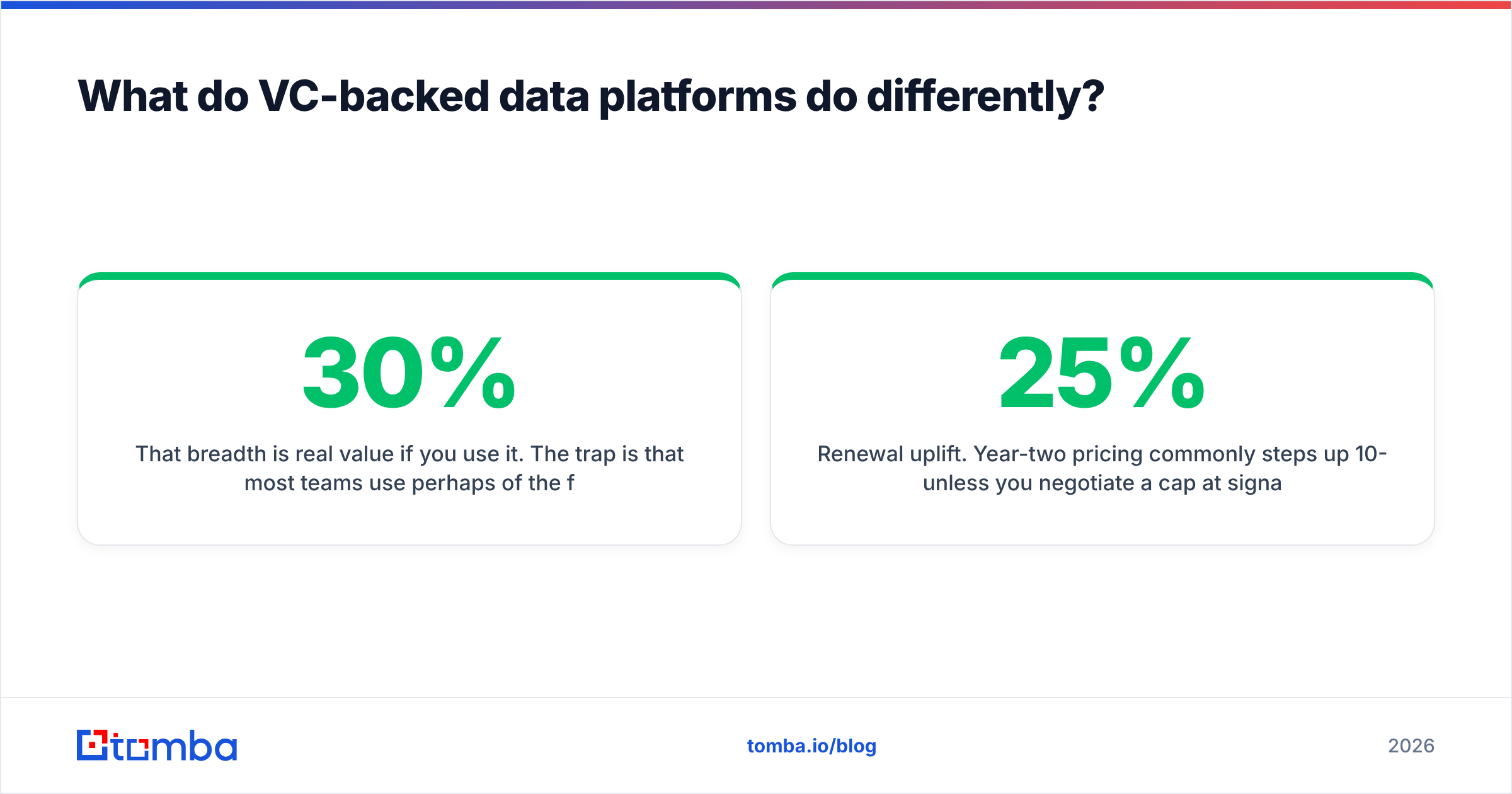
That breadth is real value if you use it. The trap is that most teams use perhaps 30% of the feature surface and pay for 100% of it. Three structural costs show up on VC-backed contracts that credit-based tools simply do not have:
- Seat minimums. Many enterprise data contracts start at three to five seats. If you have two people prospecting, you are paying for phantom users.
- Export and credit caps by tier. The database might contain 100M contacts, but your plan may only let you export a few thousand records a year. The gap between "access" and "extract" is where upsell lives.
- Renewal uplift. Year-two pricing commonly steps up 10-25% unless you negotiate a cap at signature. Model it now, not eleven months from now.
Read the actual reviews on G2's lead intelligence category before you commit — the recurring complaints across vendors cluster around exports, contract flexibility, and data decay, not raw database size.
How do EasyLeadz and VC-backed tools compare side by side?#
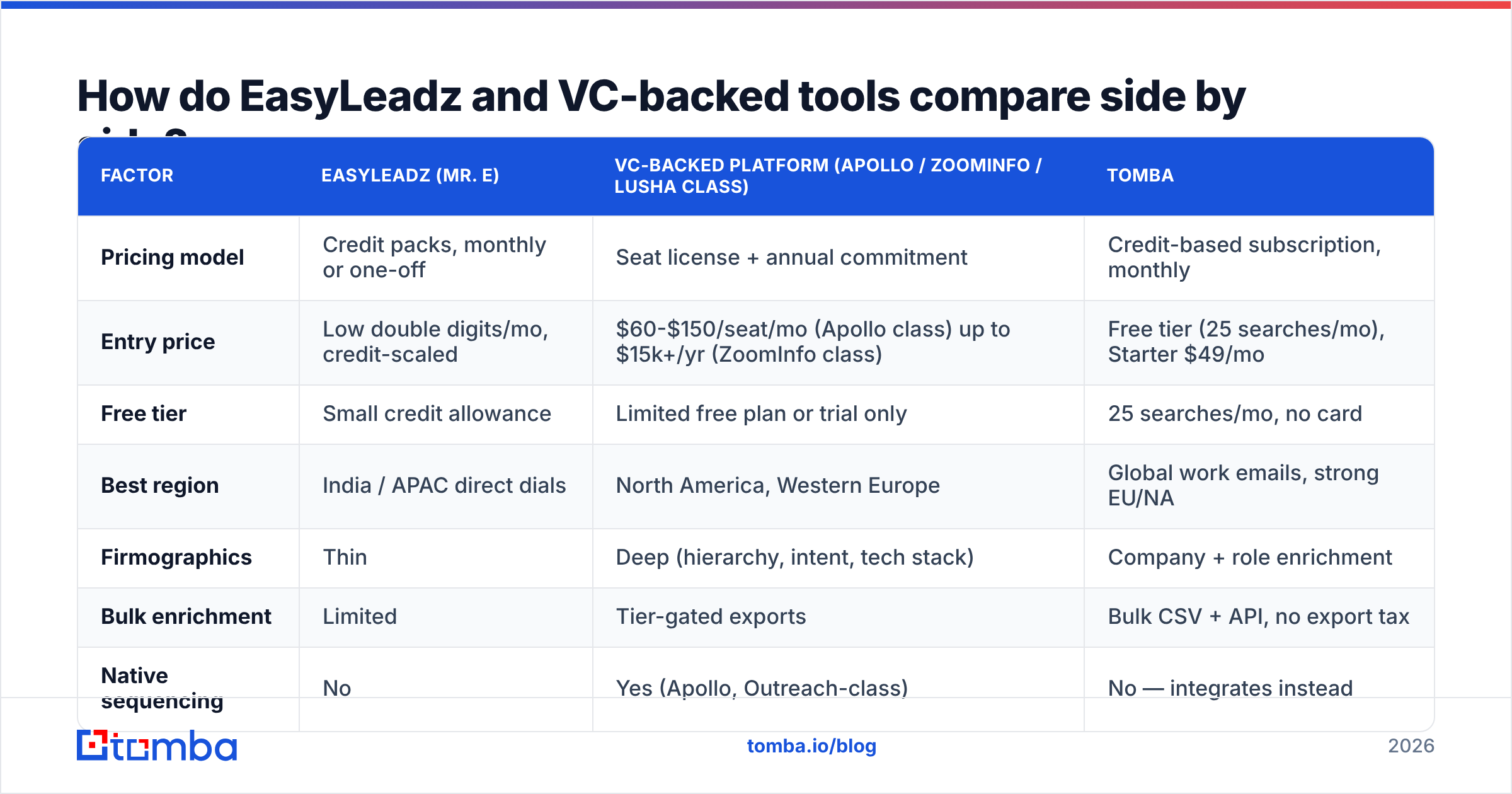
Here is the practical comparison. Prices are list prices at time of writing and move frequently — confirm on each vendor's page before you budget.
| Factor | EasyLeadz (Mr. E) | VC-backed platform (Apollo / ZoomInfo / Lusha class) | Tomba |
|---|---|---|---|
| Pricing model | Credit packs, monthly or one-off | Seat license + annual commitment | Credit-based subscription, monthly |
| Entry price | Low double digits/mo, credit-scaled | $60-$150/seat/mo (Apollo class) up to $15k+/yr (ZoomInfo class) | Free tier (25 searches/mo), Starter $49/mo |
| Free tier | Small credit allowance | Limited free plan or trial only | 25 searches/mo, no card |
| Best region | India / APAC direct dials | North America, Western Europe | Global work emails, strong EU/NA |
| Firmographics | Thin | Deep (hierarchy, intent, tech stack) | Company + role enrichment |
| Bulk enrichment | Limited | Tier-gated exports | Bulk CSV + API, no export tax |
| Native sequencing | No | Yes (Apollo, Outreach-class) | No — integrates instead |
| API access | Available, basic | Often enterprise-tier only | On all paid plans |
| Contract | Month-to-month | Usually 12 months | Month-to-month |
| Renewal risk | Low | Medium-high (uplift + seat expansion) | Low |

The pattern is consistent across the category: bootstrapped tools compete on cost per contact and flexibility, VC-backed tools compete on breadth and workflow consolidation. You are choosing which risk you would rather carry — thinner data, or a contract you cannot exit.
Which one has better data accuracy?#
Neither wins globally. Accuracy is regional, and any vendor claiming a single flat percentage across all geographies is quoting a marketing number.
What actually determines your hit rate:
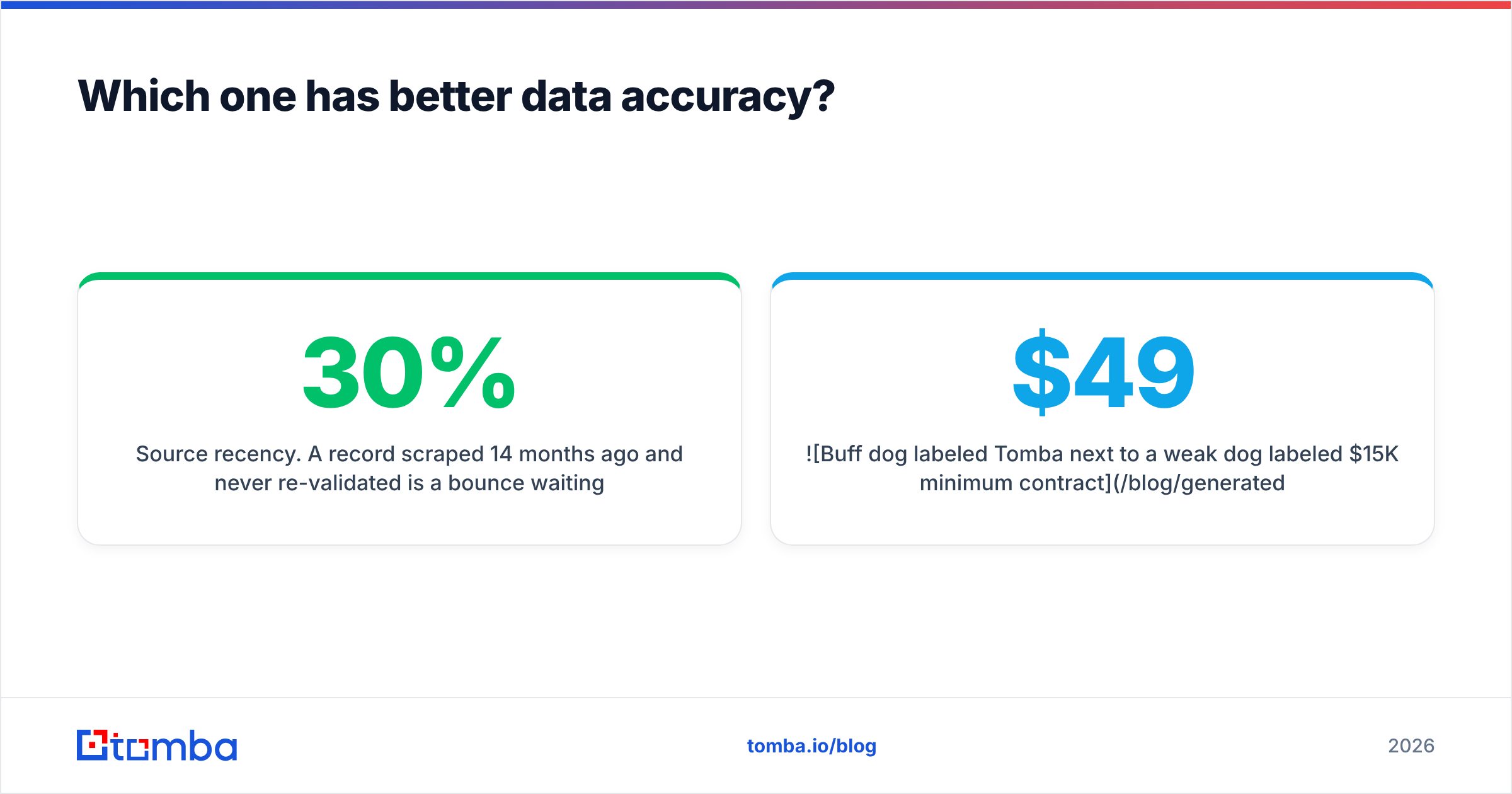
- Source recency. A record scraped 14 months ago and never re-validated is a bounce waiting to happen. B2B contact data decays roughly 25-30% per year as people change jobs.
- Verification depth. SMTP-level checking at query time beats a pattern guess stored in a database. Ask every vendor whether the address is verified at delivery or at ingestion.
- Catch-all handling. A large share of corporate domains accept everything at the gateway. Tools that mark these "valid" inflate their accuracy stats. A dedicated catch-all verifier is the only honest way to handle them.
- Region. EasyLeadz's India coverage and ZoomInfo's US coverage are not comparable on the same list. Test on your list, not theirs.

The practical move: take 200 real target contacts from your ICP, run them through each shortlisted tool, and send a verification pass over the results. Count deliverable addresses, not returned rows. A tool that returns 190 records with 130 deliverable loses to one that returns 150 with 141 deliverable — and it loses badly once you factor in what bounces do to your sender reputation.

What are the hidden costs of a VC-backed contract?#
Five line items that never appear in the demo deck:
- Unused seats. You bought five, three people log in weekly. At $120/seat/mo that is $2,880/yr of pure waste.
- Export ceilings. The plan that fits your budget often caps annual exports well below what a real outbound program consumes, forcing a mid-year upgrade at non-discounted rates.
- Verification you still have to buy. Most contact databases hand you an address with a confidence label, not a verified result. Teams routinely add a separate email verifier on top — a second line item.
- Onboarding and admin time. Enterprise platforms take real hours to configure: field mapping, dedupe rules, permission sets. Budget a week of RevOps time, minimum.
- Exit friction. Auto-renewal clauses with 30-60 day notice windows are standard. Miss the window and you have bought another year.
Against a month-to-month credit tool, the entire list above is zero. That is the actual argument for the bootstrapped side of the "EasyLeadz vs VC-backed" question — not that the data is better, but that the cost is bounded and reversible.
Is EasyLeadz better than a VC-backed platform for your team?#
Match the tool to the shape of your motion:
- You sell into India or Southeast Asia and need direct dials. EasyLeadz first. Check its current plans on the EasyLeadz site, start on a small credit pack, and validate mobile connect rates before scaling.
- You run a 10+ SDR team in North America with intent-based territories. A VC-backed platform earns its price. You will use the hierarchy data, the intent topics, and the sequencer, and the consolidation genuinely saves tool sprawl.
- You are a founder, agency, or 1-3 person outbound team. Neither. Seat pricing punishes you and specialist regional data is too narrow. A credit-based email finder plus a sending tool of your choice costs a fraction and covers the 80% case.
- You are enriching an existing CRM list, not discovering net-new. Skip discovery platforms entirely. You need data enrichment and verification throughput, and you should be buying it by the row.
- You need phone and email in one pass. Compare EasyLeadz against a combined stack — a phone finder alongside an email finder often beats a bundled platform on cost per verified contact.
One more consideration that rarely gets airtime: vendors like BookYourData occupy a genuinely different lane — pre-built, pay-once list purchase rather than per-lookup discovery. If your motion is "buy a clean 5,000-contact list for a campaign and be done," that model can be cheaper than either subscription approach. Evaluate it on the same deliverability bar as everything else.
How do you run a fair 30-day bake-off?#
Do this before any contract signature. It takes a day of setup and saves five figures.
- Build a frozen test list. 200 contacts matching your real ICP, pulled from a source none of the vendors provided. Same list to every tool.
- Measure four numbers per tool: match rate (records returned), verified rate (deliverable after independent verification), cost per verified contact, and time to first usable export.
- Verify independently. Do not accept the vendor's own confidence score as the verification. Run every returned address through a neutral checker — a free email checker handles spot checks, and a bulk pass handles the full list.
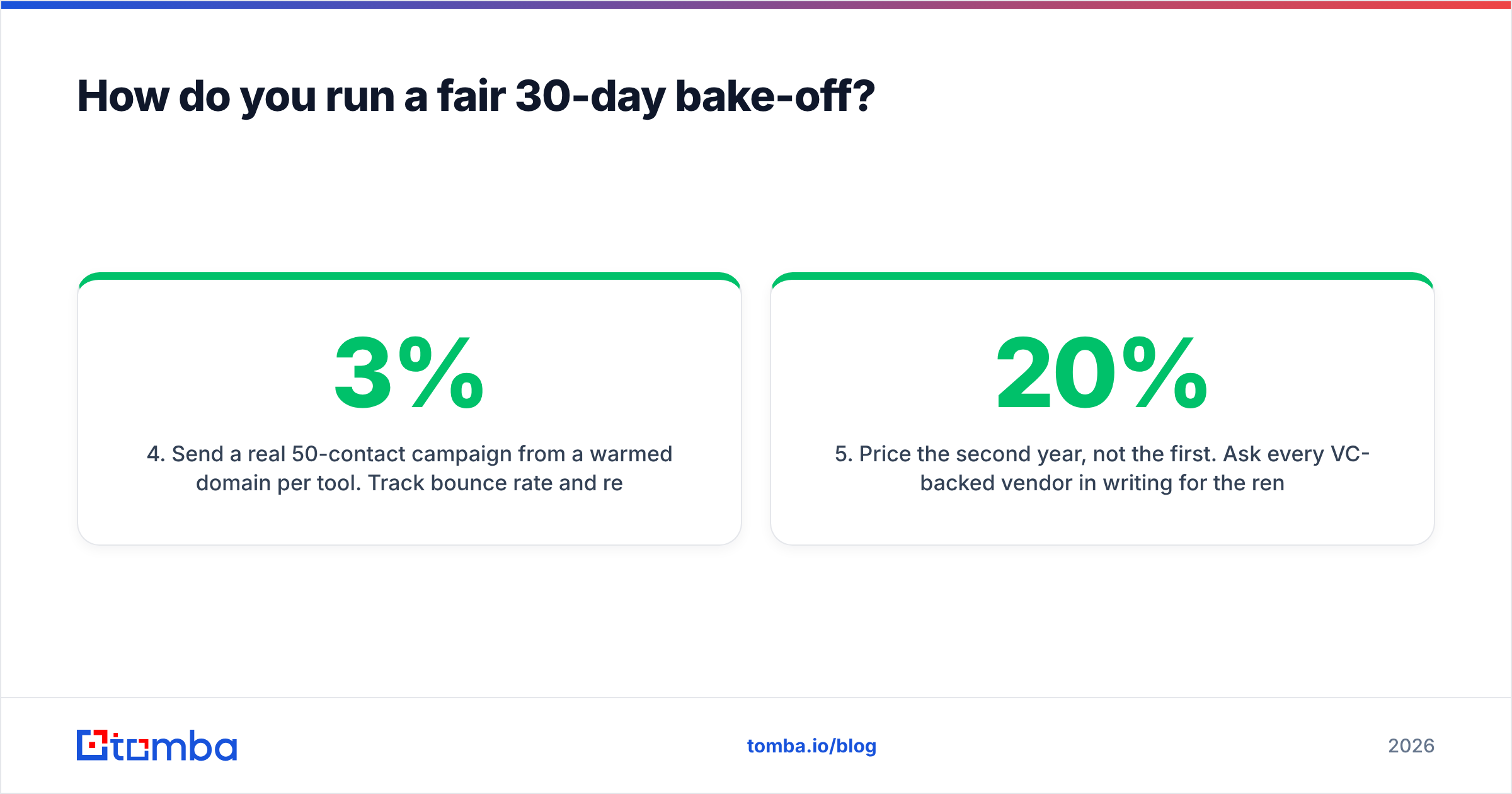
- Send a real 50-contact campaign from a warmed domain per tool. Track bounce rate and reply rate. Bounce rate above 3% disqualifies the source regardless of match rate.
- Price the second year, not the first. Ask every VC-backed vendor in writing for the renewal cap and the export limit in the contract. If they will not put the cap in the paper, price the deal assuming a 20% uplift.
- Score cost per meeting, not cost per record. A tool that costs 3x per contact but converts at 4x is cheaper. Records are the input; meetings are the output you actually buy.
Whatever you conclude, document the numbers. Six months later, when a rep insists "the data is bad," you will have a baseline to argue from — and a reason to re-run the test rather than churn on instinct.
Where does the money actually go?#
Strip the branding away and every tool in this comparison sells the same three things: coverage, verification, and workflow. VC-backed platforms charge a premium for workflow and lock it behind seats. EasyLeadz charges for regional coverage and skips workflow. The cheapest path for most teams is to buy coverage and verification cheaply, and let your existing CRM and sending tool handle the workflow you already paid for.
That is where credit-based finders keep winning on unit economics. Tomba's pricing is a useful benchmark: a free tier at 25 searches/mo, Starter at $49/mo, Growth at $99/mo, Pro at $249/mo, with API access on every paid plan rather than gated to enterprise. No seat minimums, no annual lock, no export tax — and month-to-month means a failed bake-off costs you one month, not one year.
Try it against your own list. Take the same 200 contacts you would send to any vendor's trial and run them through the Tomba Email Finder on the free tier. Compare deliverable addresses and cost per verified contact against whatever EasyLeadz or your VC-backed incumbent returns. If the numbers favor them for your region, buy theirs. If they favor Tomba, you just saved a year of seat fees on a test that cost nothing.
Related guides#
Ready to find emails that actually work?
Join 150,000+ professionals who stopped guessing and started sending. Free credits on signup — no credit card required.
Get the Tomba newsletter
Practical outbound tactics and product updates — once every two weeks.
About the author