EasyLeadz vs Voila Norbert: Which Email Finder Wins in 2026?
EasyLeadz sells direct mobile numbers. Voila Norbert sells clean bulk email finding. They solve different problems at similar prices — here's which one actually fits your outbound motion in 2026.
TL;DR
- EasyLeadz (Mr. E) is a contact-intelligence tool built around direct mobile numbers, strongest on India and APAC data, sold as per-contact credits through a LinkedIn Chrome extension.
- Voila Norbert is a classic email finder + verifier — name + domain in, verified email out — with straightforward monthly lead tiers and a well-regarded bulk CSV flow.
- They are not really the same product. Choosing between them is choosing between phone-first prospecting and email-first prospecting.
- On pure email coverage in North America and EMEA, Norbert is the safer pick; on APAC mobile numbers, EasyLeadz has data most Western vendors simply don't hold.
- If you want both channels plus an API, verification, and enrichment on one credit pool, a consolidated platform like Tomba usually costs less than running two point tools.
What are EasyLeadz and Voila Norbert, exactly?#
Start here, because the "vs" framing hides how different these two products are.
EasyLeadz is best known for Mr. E, its browser extension. You open a LinkedIn profile, click the extension, and it reveals a direct dial or mobile number — plus a work email where available. The company is India-headquartered and its data moat reflects that: coverage of Indian, South-East Asian, and Middle Eastern contacts is materially better than what US-first databases return. Credits are consumed per contact revealed, and a reveal that returns nothing typically doesn't burn a credit.
Voila Norbert has been around since 2014 and does one thing with unusual focus: give it a person's name and a company domain, and it returns their business email with a confidence score. It layers on an email verification service, a bulk CSV uploader, an API, and integrations with the usual suspects (Zapier, HubSpot, Salesforce, Pipedrive). No LinkedIn scraping, no phone numbers, no intent data. It's a utility, and it behaves like one.
So the honest framing is: EasyLeadz is a contact database with a phone bias. Voila Norbert is an email lookup engine. If you compare them on a single spec sheet without holding that in mind, you will pick the wrong one.

How do EasyLeadz and Voila Norbert compare head to head?#
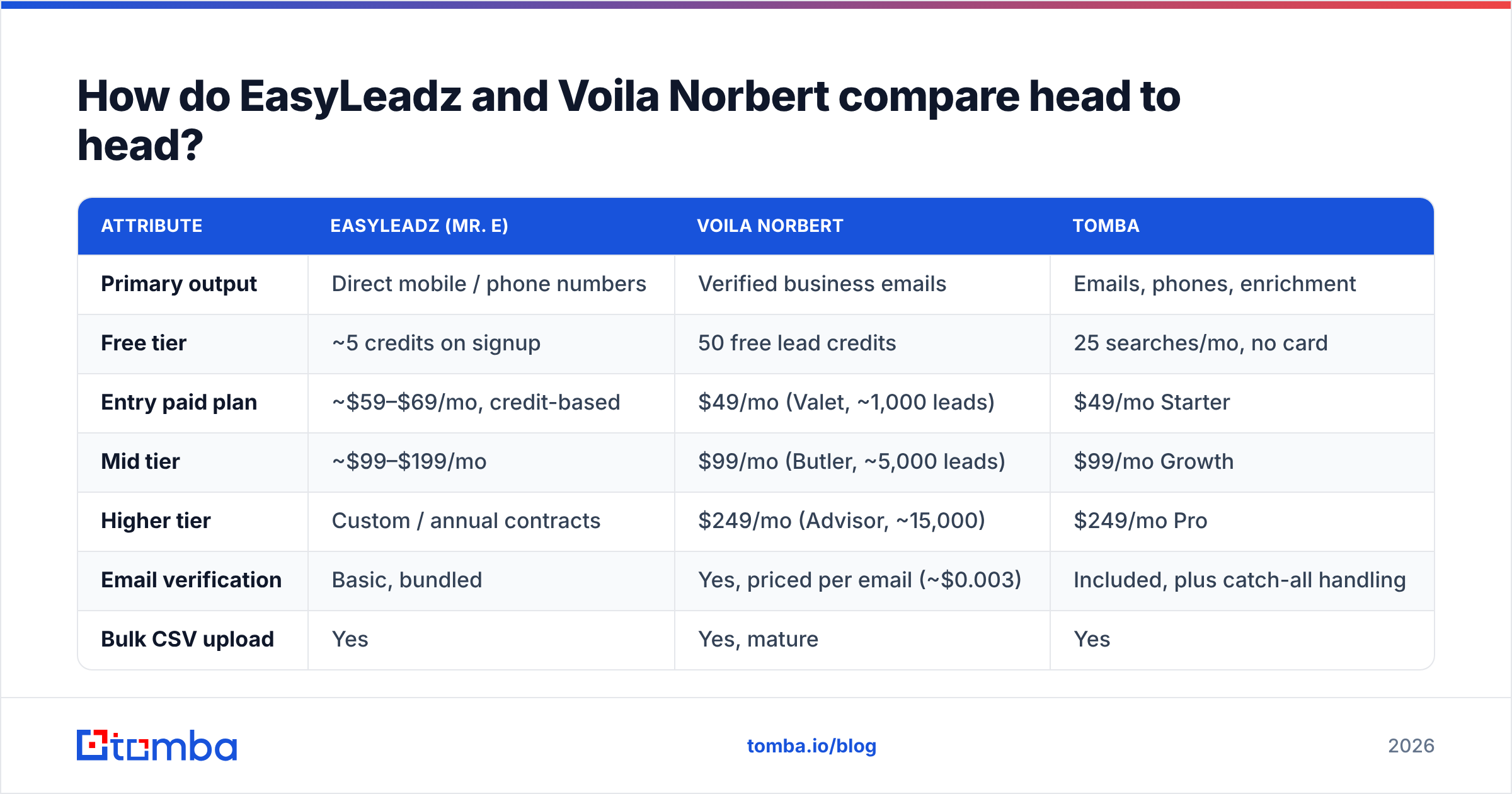
Here's the practical breakdown. Pricing moves — treat these as directional and confirm on each vendor's page before you buy.
| Attribute | EasyLeadz (Mr. E) | Voila Norbert | Tomba |
|---|---|---|---|
| Primary output | Direct mobile / phone numbers | Verified business emails | Emails, phones, enrichment |
| Free tier | ~5 credits on signup | 50 free lead credits | 25 searches/mo, no card |
| Entry paid plan | ~$59–$69/mo, credit-based | $49/mo (Valet, ~1,000 leads) | $49/mo Starter |
| Mid tier | ~$99–$199/mo | $99/mo (Butler, ~5,000 leads) | $99/mo Growth |
| Higher tier | Custom / annual contracts | $249/mo (Advisor, ~15,000) | $249/mo Pro |
| Email verification | Basic, bundled | Yes, priced per email (~$0.003) | Included, plus catch-all handling |
| Bulk CSV upload | Yes | Yes, mature | Yes |
| Public API | Yes | Yes | Yes, plus CLI and MCP |
| LinkedIn extension | Core workflow | No | Yes |
| Geographic sweet spot | India, APAC, MENA | North America, Western Europe | Global, 100+ countries |
| Credit rollover | Usually no | No | Plan-dependent |
| Best for | Phone-led outbound in APAC | Email-led outbound in US/EU | Teams that need both |
Two things jump out of that table.
First, the entry prices are nearly identical — everyone has converged around $49–$69 for a starter seat. Price is not your differentiator here; data is.
Second, the units are not comparable. Norbert sells "leads" (one lead = one email found). EasyLeadz sells "credits" (one credit = one contact revealed, phone included). A 1,000-lead Norbert plan and a 200-credit EasyLeadz plan can cost the same and produce wildly different pipeline depending on whether your reps dial or write.
Which one finds more emails?#
For North American and Western European B2B contacts, Voila Norbert wins on email specifically. That's its entire product surface: pattern detection, SMTP validation, confidence scoring. Independent reviews on G2 consistently put Norbert's hit rate in the 60–75% range on clean, well-formed lists — meaning name spelled correctly, domain correct, person still employed there.
EasyLeadz returns emails too, but they're a secondary output. Its email hit rate on US/EU contacts trails Norbert's, and the confidence signal is less granular. Where EasyLeadz flips the result is APAC: search a mid-market SaaS company in Bengaluru or Jakarta and EasyLeadz will frequently return a valid contact where Norbert returns nothing at all.

A caveat that applies to every vendor in this category, including Tomba: published accuracy numbers are marketing numbers. They're measured on the vendor's own test list, which is usually skewed toward the domains they cover best. The only benchmark that matters is your ICP. Take 100 real accounts from your target list, run them through each free tier, and count.
That test costs you an hour and saves you a year of paying for a database that doesn't cover your market.
How should you actually run a bake-off?#
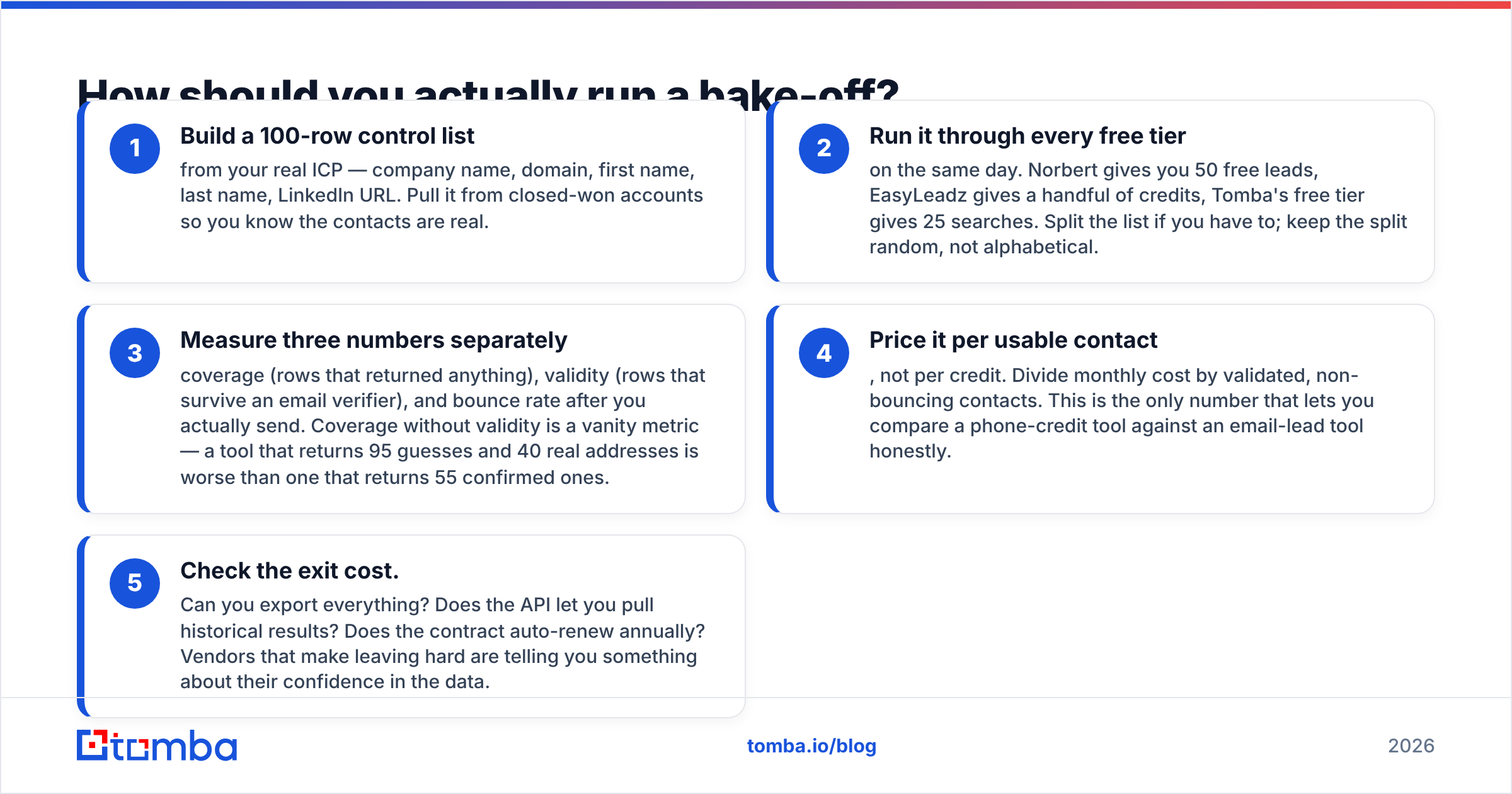
Don't eyeball it. Use a repeatable process — five steps, and it works for any pair of tools in this category.
- Build a 100-row control list from your real ICP — company name, domain, first name, last name, LinkedIn URL. Pull it from closed-won accounts so you know the contacts are real.
- Run it through every free tier on the same day. Norbert gives you 50 free leads, EasyLeadz gives a handful of credits, Tomba's free tier gives 25 searches. Split the list if you have to; keep the split random, not alphabetical.
- Measure three numbers separately: coverage (rows that returned anything), validity (rows that survive an email verifier), and bounce rate after you actually send. Coverage without validity is a vanity metric — a tool that returns 95 guesses and 40 real addresses is worse than one that returns 55 confirmed ones.
- Price it per usable contact, not per credit. Divide monthly cost by validated, non-bouncing contacts. This is the only number that lets you compare a phone-credit tool against an email-lead tool honestly.
- Check the exit cost. Can you export everything? Does the API let you pull historical results? Does the contract auto-renew annually? Vendors that make leaving hard are telling you something about their confidence in the data.
Most teams skip step 3 and buy on step 2's raw hit-rate screenshot. That's how you end up with a 12% bounce rate and a suspended sending domain three weeks into a campaign.
Is EasyLeadz worth it for phone numbers?#
If your motion involves dialing, yes — with conditions.
EasyLeadz's mobile-number coverage in India is genuinely differentiated. Western data vendors buy or scrape most of their phone data from the same handful of upstream sources, which is why RocketReach, Lusha, and Apollo often return the same number for the same contact. EasyLeadz's sourcing is different, and for APAC targets you'll see numbers the others don't have.
The conditions:
- Compliance is on you. Direct-dial mobile numbers carry regulatory weight — TCPA in the US, GDPR legitimate-interest documentation in the EU, DNC registries in India and elsewhere. Buying the data doesn't buy you the right to call it. Read HubSpot's guide to GDPR-compliant outreach before you build a dialer list.
- Credits burn fast. Per-contact pricing feels cheap until a rep reveals 200 profiles in an afternoon researching one account.
- US/EU phone depth is thinner than the India numbers suggest. Test your specific geography.
If you need phone data alongside email on a single plan rather than a second vendor, Tomba's phone finder covers the same job from the same credit pool — worth benchmarking against EasyLeadz on your own region before committing to two subscriptions.

Is Voila Norbert still competitive in 2026?#
Mostly, and its strengths are the boring kind that hold up.
What it does well: the single-lookup UX is fast and unambiguous. The bulk uploader handles messy CSVs without complaint. Confidence scores are honest — Norbert will tell you it's guessing rather than dress up a permutation as a verified hit. Pricing is transparent and published, which is rarer in this category than it should be. Support is responsive.
Where it's showing its age:
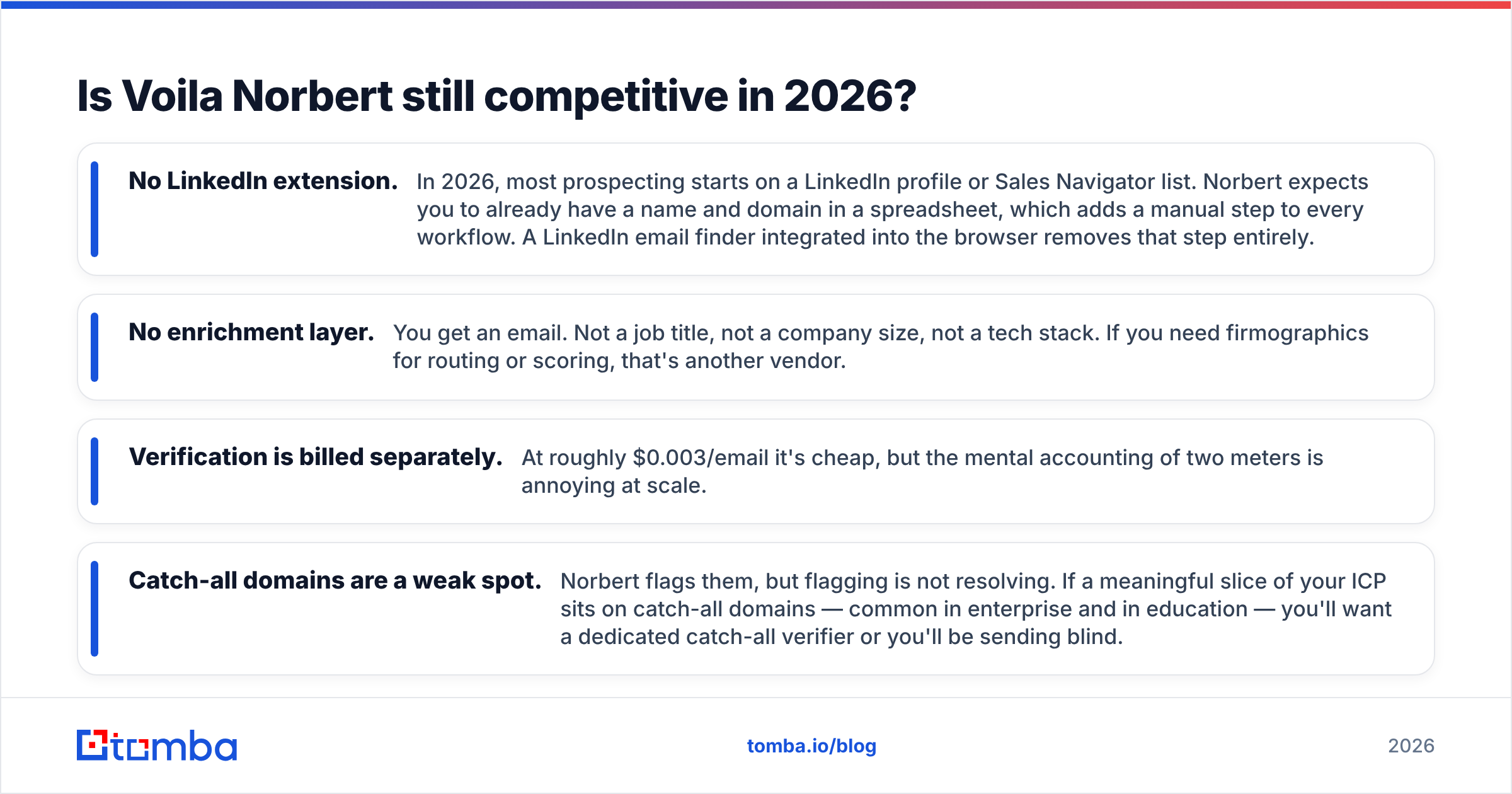
- No LinkedIn extension. In 2026, most prospecting starts on a LinkedIn profile or Sales Navigator list. Norbert expects you to already have a name and domain in a spreadsheet, which adds a manual step to every workflow. A LinkedIn email finder integrated into the browser removes that step entirely.
- No enrichment layer. You get an email. Not a job title, not a company size, not a tech stack. If you need firmographics for routing or scoring, that's another vendor.
- Verification is billed separately. At roughly $0.003/email it's cheap, but the mental accounting of two meters is annoying at scale.
- Catch-all domains are a weak spot. Norbert flags them, but flagging is not resolving. If a meaningful slice of your ICP sits on catch-all domains — common in enterprise and in education — you'll want a dedicated catch-all verifier or you'll be sending blind.
None of these are fatal. Norbert is a good tool doing a narrow job well. The question is whether a narrow job justifies its own line item in your stack.

Which should you choose?#
Pick by motion, not by feature count.
Choose EasyLeadz if: your reps dial more than they write, your ICP is concentrated in India, South-East Asia, or the Middle East, and you have a documented compliance process for phone outreach. The extension-driven workflow suits SDRs who prospect account-by-account rather than in bulk.
Choose Voila Norbert if: you run email-led outbound into North America or Western Europe, you already have target lists with names and domains, and you want a simple, predictable per-lead cost with no upsell pressure. It's also the easier tool to hand to a non-technical marketer.
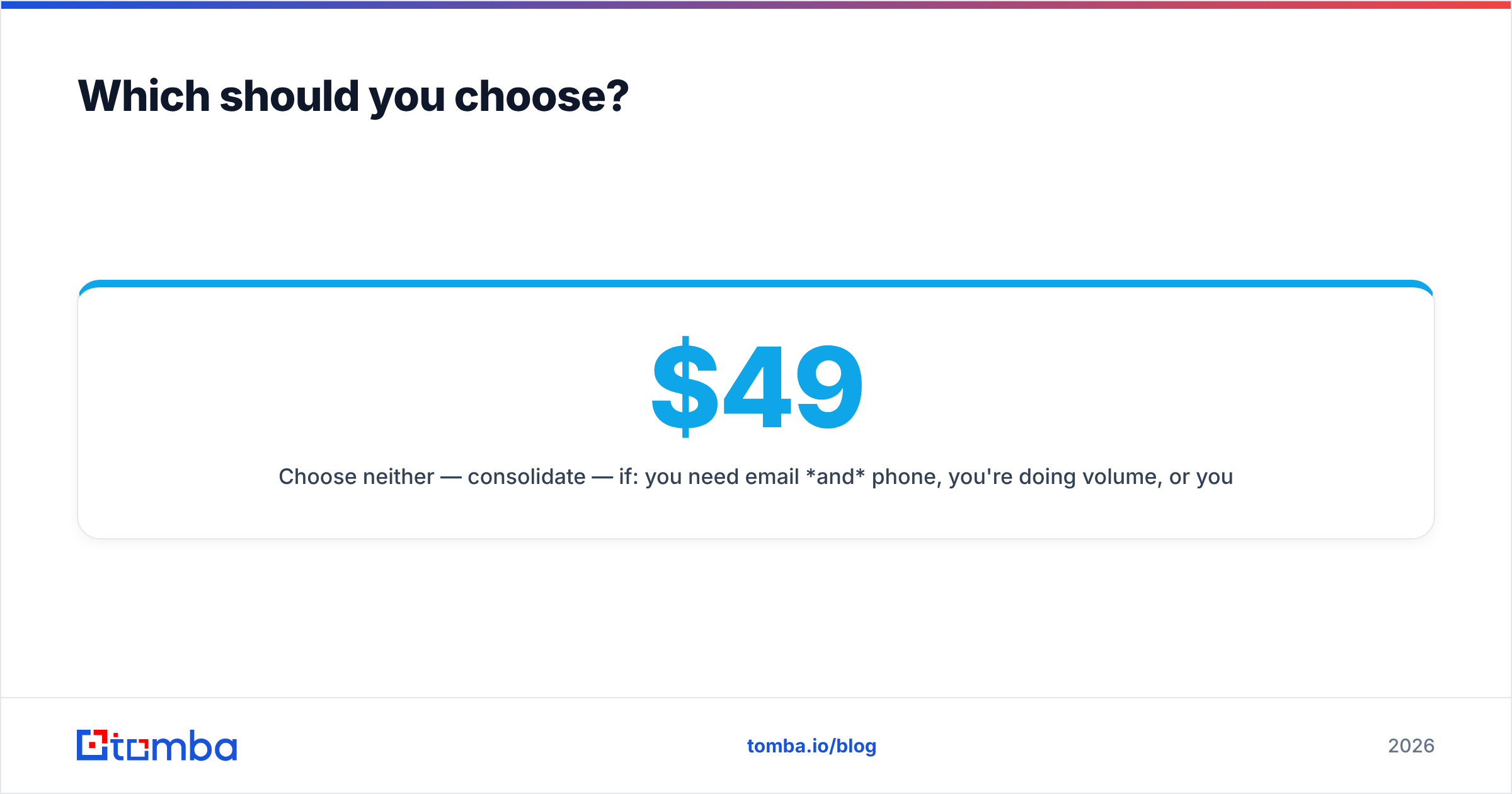
Choose neither — consolidate — if: you need email and phone, you're doing volume, or you're wiring data into an app. Two point tools at $49–$99 each is $100–$200/month for two partial datasets and two credit balances you have to reconcile. Tomba's pricing puts email finding, verification, catch-all handling, domain search, phone lookup, and enrichment on one plan — Free (25 searches/mo), Starter $49, Growth $99, Pro $249, Enterprise custom — with an API, CLI, and Chrome extension against the same credits.
The consolidation argument isn't just about price. It's about one confidence standard. When emails come from vendor A and phones from vendor B, you have two definitions of "verified," two coverage gaps, and no single place to debug why a campaign bounced.
What's the honest verdict?#
There's no universal winner here, and any post that declares one is selling you something.
EasyLeadz and Voila Norbert are both competent tools that were built for different continents and different channels. If someone tells you EasyLeadz "beats" Norbert, ask them which market they tested in. If someone says Norbert is more accurate, ask them whether they counted phone numbers.
What you should take away: run the 100-row bake-off described above before you spend anything. Measure validated contacts, not raw hits. Price per usable record. And be skeptical of any accuracy figure — including ours — that wasn't measured on your own list.
Ready to test a third option on the same list? Run your control set through the Tomba Email Finder alongside EasyLeadz and Voila Norbert. The free tier gives you 25 searches with no card required — enough to see whether one platform covering email, verification, catch-all, and phone beats stitching two specialists together. Whatever you conclude, you'll have made the call on data instead of a pricing page.
Related guides#
Ready to find emails that actually work?
Join 150,000+ professionals who stopped guessing and started sending. Free credits on signup — no credit card required.
Get the Tomba newsletter
Practical outbound tactics and product updates — once every two weeks.
About the author