9 Best Ecanvasser Alternatives in 2026 for Field Teams
Ecanvasser is solid door-knocking software, but it is not the only option — and often not the cheapest. Here are 9 Ecanvasser alternatives compared on pricing, canvassing features, data quality, and who each one actually fits.
TL;DR
- Ecanvasser is a field-organizing platform built around door-to-door canvassing, territory maps, and volunteer coordination. It works well for campaigns and advocacy groups, less well for commercial field sales teams that need CRM depth and pipeline reporting.
- The most common reasons teams switch: quote-only pricing, per-seat costs that punish large volunteer rosters, thin native integrations, and no built-in way to enrich the contacts you collect at the door.
- Best political/advocacy replacements: Qomon, NationBuilder, Impactive, CallHub, Reach.
- Best commercial field-sales replacements: SPOTIO, SalesRabbit, Badger Maps, Map My Customers.
- Whichever platform you pick, the canvassing app is only the collection layer. If you want those door-collected names to turn into working email addresses, you still need a verification and enrichment layer like Tomba's email finder underneath it.
What is Ecanvasser, and who actually uses it?#
Ecanvasser is field-organizing software. You upload or build a contact universe, cut it into territories, send canvassers out with a mobile app, and they record responses at the door — supporter, undecided, opposed, not home. Back at HQ, a dashboard shows knock counts, sentiment breakdowns, and heat maps by district.
Its core users are political campaigns, advocacy organizations, unions, HOAs, and community groups. The Ecanvasser product leans into that identity: survey builder, walk lists, volunteer management, and reporting oriented toward turnout rather than revenue.
That focus is both the strength and the reason people go looking for something else. If your team is knocking doors to sell solar, roofing, pest control, or fiber, you will feel the gaps quickly: no real deal pipeline, no commission tracking, no quota views, and limited native connections to the CRM your revenue org already lives in.
Why do teams look for Ecanvasser alternatives?#
Five patterns come up repeatedly in user reviews on G2 and in migration conversations:
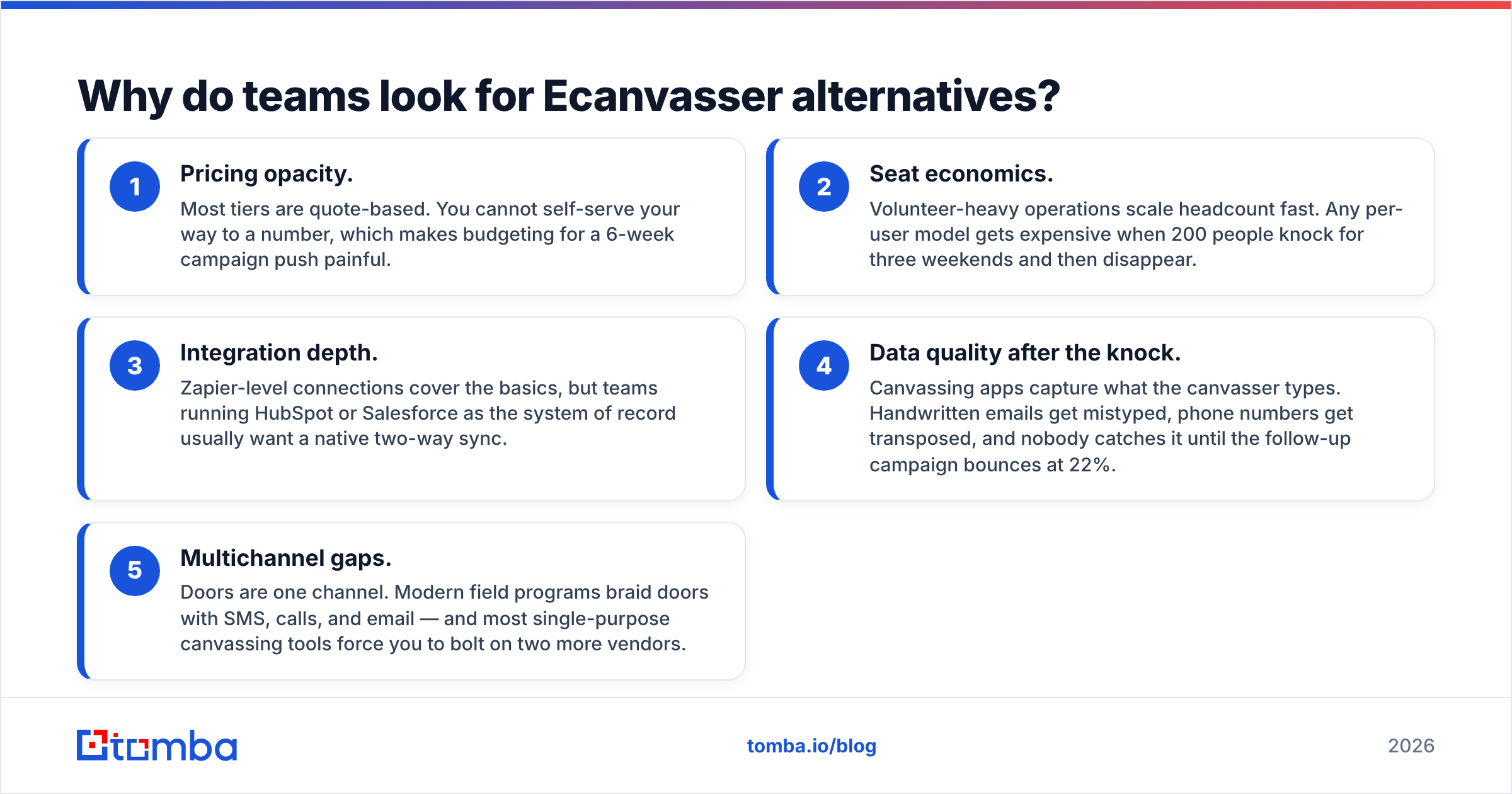
- Pricing opacity. Most tiers are quote-based. You cannot self-serve your way to a number, which makes budgeting for a 6-week campaign push painful.
- Seat economics. Volunteer-heavy operations scale headcount fast. Any per-user model gets expensive when 200 people knock for three weekends and then disappear.
- Integration depth. Zapier-level connections cover the basics, but teams running HubSpot or Salesforce as the system of record usually want a native two-way sync.
- Data quality after the knock. Canvassing apps capture what the canvasser types. Handwritten emails get mistyped, phone numbers get transposed, and nobody catches it until the follow-up campaign bounces at 22%.
- Multichannel gaps. Doors are one channel. Modern field programs braid doors with SMS, calls, and email — and most single-purpose canvassing tools force you to bolt on two more vendors.
If your reason for switching is #1 or #2, you want a tool with published pricing. If it is #4 or #5, the platform swap matters less than the data layer you add underneath it — more on that below.
What should you look for in a canvassing platform?#
Score every candidate against these six criteria before you sit through a demo. Weight them for your own use case; a union local and a roofing company will not rank them the same way.
- Offline reliability. Canvassers work basements, rural routes, and dead zones. If the app cannot queue responses offline and sync later, you will lose data every single shift.
- Territory cutting. Can you draw turf on a map, split it by street segment or parcel, and assign it to a person in under a minute? Manual list-splitting is where field ops quietly loses hours.
- Pricing model transparency. Published per-user, per-contact, or credit pricing beats "contact sales" every time — especially for seasonal programs with volunteer surges.
- Data hygiene tooling. Duplicate detection, address normalization, and — critically — email and phone validation. A canvassing tool that happily stores
john@gmial.comis costing you a follow-up. - Integration surface. Native CRM sync, a documented REST API, and webhooks. If the vendor's API docs are behind a sales gate, treat that as a warning sign.
- Multichannel follow-up. Doors generate consent and context; email and SMS convert it. Check whether follow-up is native, partner-based, or entirely your problem.
Which Ecanvasser alternatives are worth comparing in 2026?#
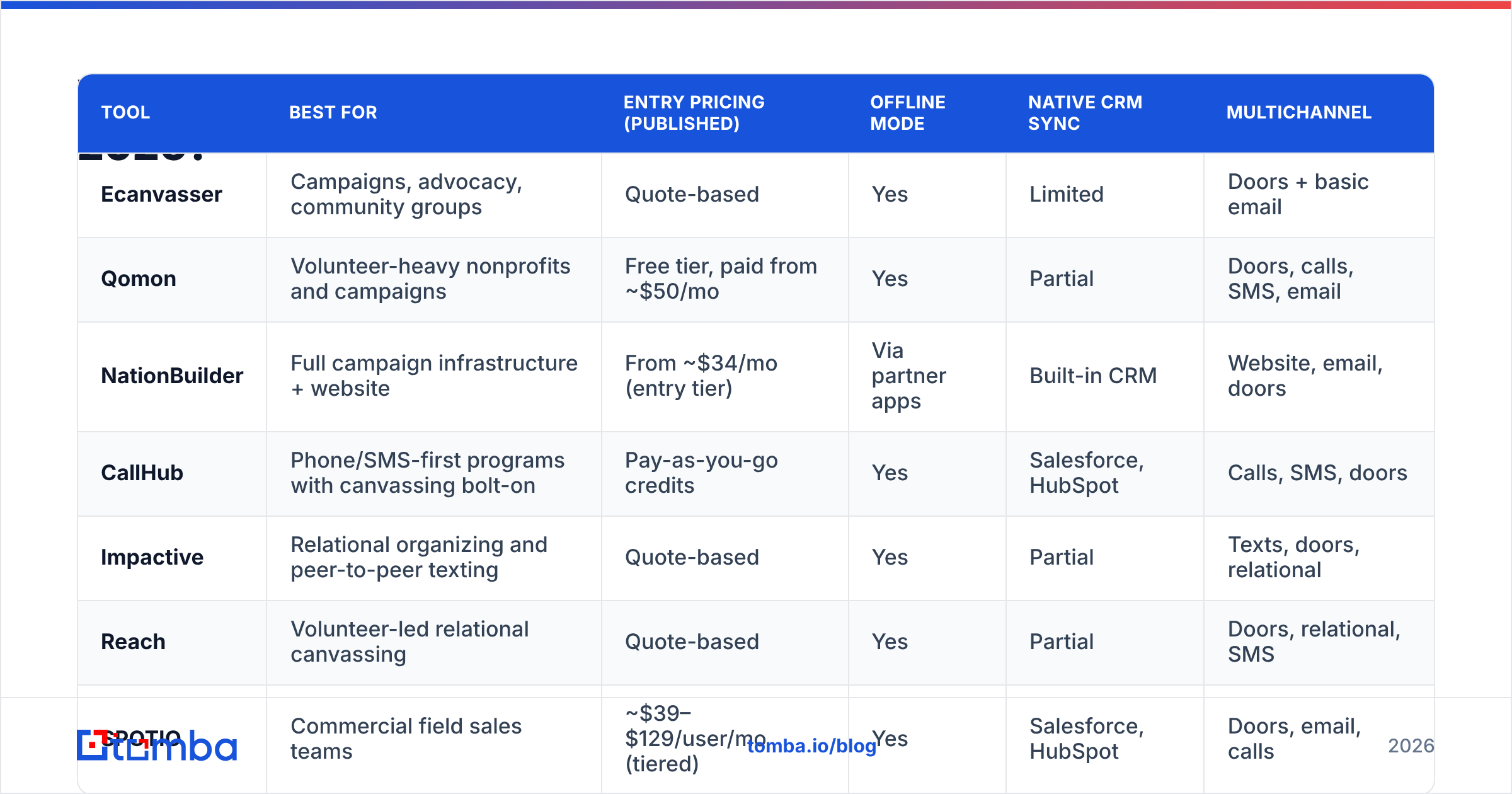
Here is the head-to-head. Pricing reflects publicly listed figures at the time of writing — vendors change tiers often, so confirm on the vendor's own pricing page before you commit budget.
| Tool | Best for | Entry pricing (published) | Offline mode | Native CRM sync | Multichannel |
|---|---|---|---|---|---|
| Ecanvasser | Campaigns, advocacy, community groups | Quote-based | Yes | Limited | Doors + basic email |
| Qomon | Volunteer-heavy nonprofits and campaigns | Free tier, paid from ~$50/mo | Yes | Partial | Doors, calls, SMS, email |
| NationBuilder | Full campaign infrastructure + website | From ~$34/mo (entry tier) | Via partner apps | Built-in CRM | Website, email, doors |
| CallHub | Phone/SMS-first programs with canvassing bolt-on | Pay-as-you-go credits | Yes | Salesforce, HubSpot | Calls, SMS, doors |
| Impactive | Relational organizing and peer-to-peer texting | Quote-based | Yes | Partial | Texts, doors, relational |
| Reach | Volunteer-led relational canvassing | Quote-based | Yes | Partial | Doors, relational, SMS |
| SPOTIO | Commercial field sales teams | ~$39–$129/user/mo (tiered) | Yes | Salesforce, HubSpot | Doors, email, calls |
| SalesRabbit | Home services door-to-door (solar, roofing) | From ~$25/user/mo | Yes | Multiple | Doors, digital contracts |
| Badger Maps | Outside reps optimizing routes | ~$58–$95/user/mo | Partial | Salesforce, HubSpot | Route + CRM logging |
Qomon#
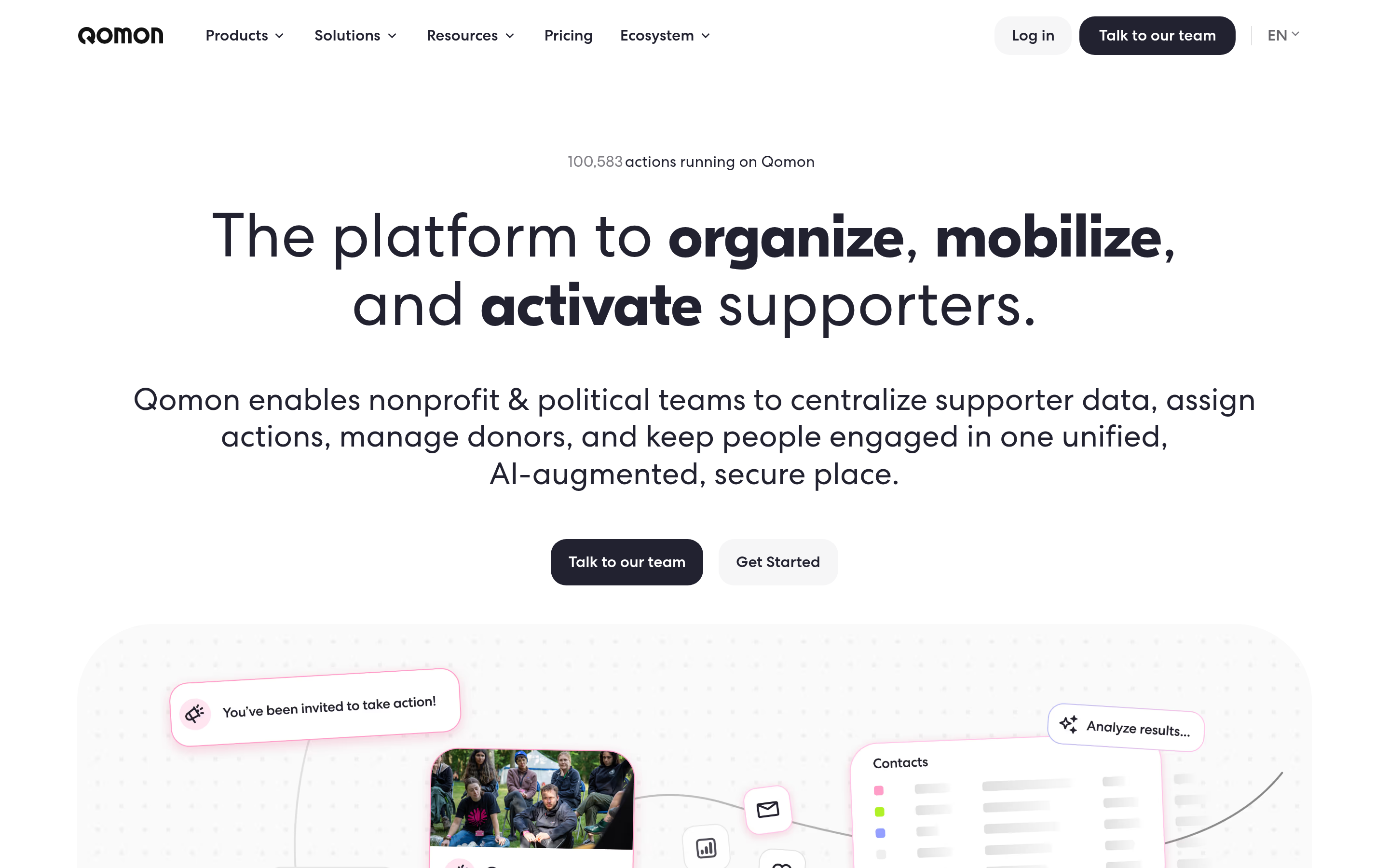
The closest like-for-like swap for most advocacy and campaign users. Qomon combines a mobile canvassing app, volunteer management, and multichannel messaging in one place, and — unlike most of this category — it publishes a free tier you can actually test with a small team. Territory drawing is straightforward and the mobile app handles offline sync cleanly.
Where it lags: reporting is less granular than NationBuilder's, and non-EU teams occasionally hit gaps in address data coverage.
NationBuilder#
Less a canvassing app than a full campaign operating system. NationBuilder gives you a website, donation processing, an email tool, and a supporter CRM — with canvassing as one module rather than the main event. If you are consolidating five vendors into one, it is the strongest argument on this list.
Where it lags: the door-knocking mobile experience is not as polished as purpose-built canvassing apps, and the learning curve is real. Budget onboarding time.
CallHub#

Start here if the phone is your primary channel and doors are secondary. Credit-based pricing means you pay for volume rather than seats, which is genuinely better economics for volunteer surges. Canvassing lives alongside predictive dialers, peer-to-peer SMS, and voice broadcasting.
Where it lags: the canvassing module is younger than the calling stack. Do a pilot before committing your whole field program.
Impactive and Reach#
Both are built on the relational-organizing thesis: volunteers contacting people they already know converts better than cold door-knocking. Both handle turf canvassing too, but their differentiator is the friend-to-friend layer. If your program depends on volunteer networks rather than paid canvassers, they outperform generic tools.
Where they lag: quote-only pricing, and both are strongly US-focused.
SPOTIO, SalesRabbit, Badger Maps, and Map My Customers#
This is the commercial cluster — and if you are a field sales org that landed on Ecanvasser by accident, one of these is almost certainly the better fit.
- SPOTIO is the most complete: territory management, activity tracking, sales pipeline, and a genuinely useful autoplay sequence feature for follow-ups.
- SalesRabbit owns home services. Solar, roofing, and pest control teams pick it for lead cards, digital contracts, and rep leaderboards.
- Badger Maps solves a narrower problem — route optimization for outside reps — and solves it well. It is not a canvassing tool so much as a driving-efficiency tool that logs to your CRM.
- Map My Customers sits between the two: mapping plus lightweight pipeline, priced mid-market.
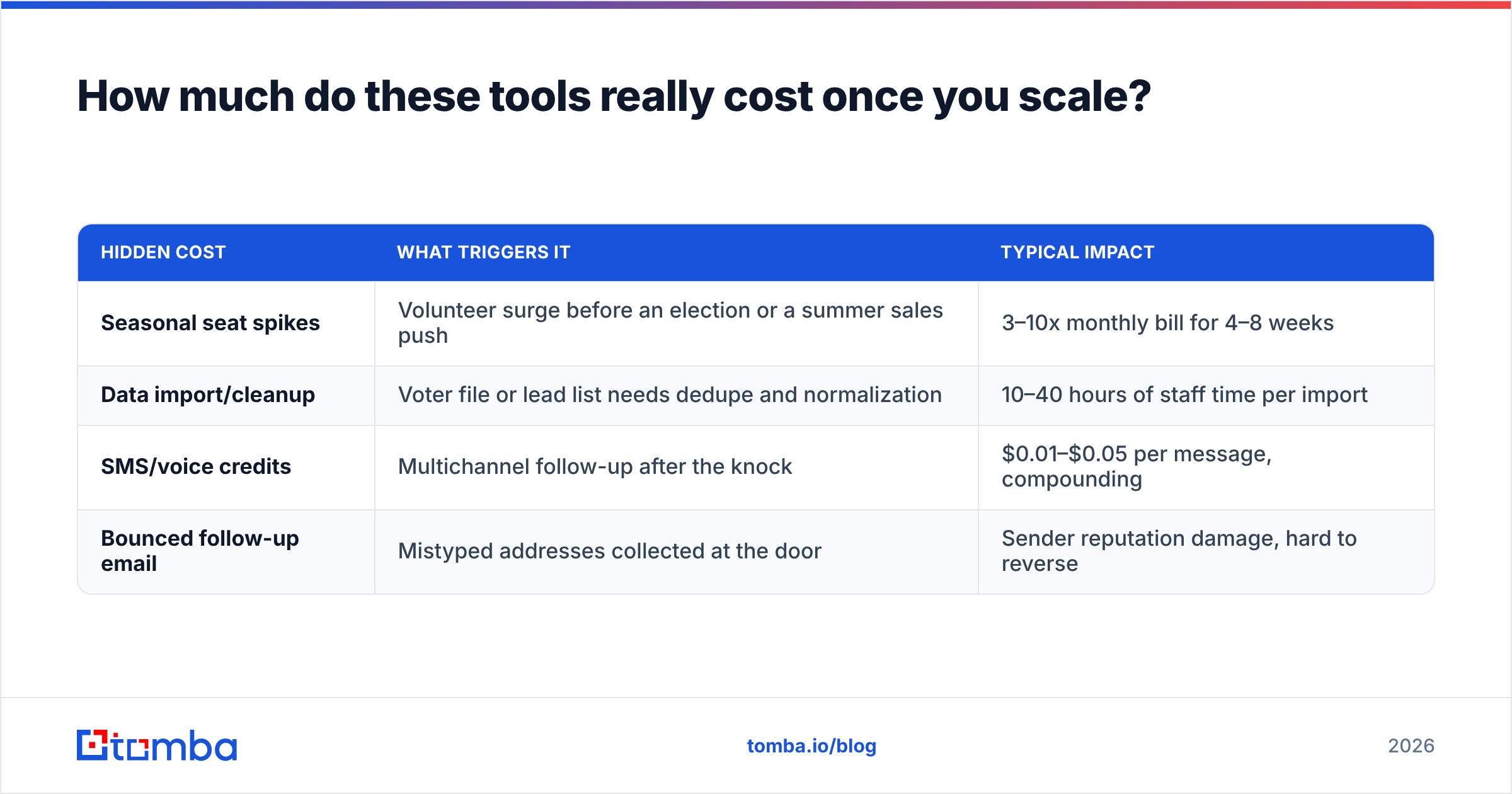
How much do these tools really cost once you scale?#
The sticker price is rarely the total. Three costs hide behind the demo:
| Hidden cost | What triggers it | Typical impact |
|---|---|---|
| Seasonal seat spikes | Volunteer surge before an election or a summer sales push | 3–10x monthly bill for 4–8 weeks |
| Data import/cleanup | Voter file or lead list needs dedupe and normalization | 10–40 hours of staff time per import |
| SMS/voice credits | Multichannel follow-up after the knock | $0.01–$0.05 per message, compounding |
| Bounced follow-up email | Mistyped addresses collected at the door | Sender reputation damage, hard to reverse |
That last row is the one teams underestimate. A canvasser typing an email into a phone in the rain produces typos at a rate somewhere north of 10%. Send to that list unverified and you will torch your sender reputation inside two sends — and no canvassing platform on this list will warn you before it happens.
The fix is boring and cheap: run every collected address through an email verifier before it enters your sending tool. Verification costs fractions of a cent per record. Rebuilding a burned domain costs weeks.
Is a canvassing app enough, or do you need a data layer too?#
You need both, and they solve different problems.
The canvassing app answers where do we knock and what happened there. It is a collection and coordination tool. What it does not do is tell you the correct email address for the office manager at the business you just visited, or fill in the 40% of records where the canvasser only captured a name and a company.
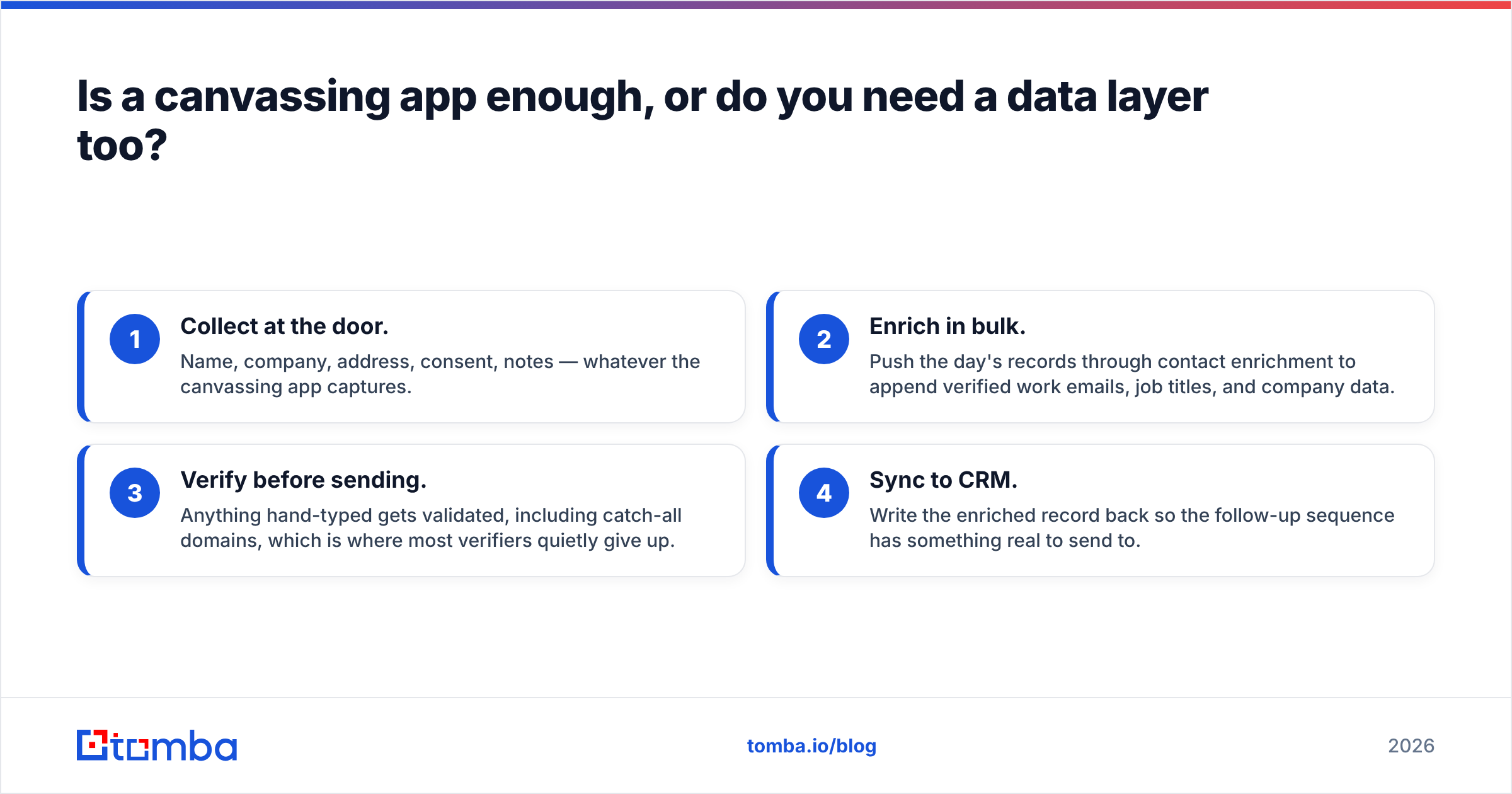
That is an enrichment problem, and it is where a dedicated data provider earns its keep. The workflow that works:
- Collect at the door. Name, company, address, consent, notes — whatever the canvassing app captures.
- Enrich in bulk. Push the day's records through contact enrichment to append verified work emails, job titles, and company data.
- Verify before sending. Anything hand-typed gets validated, including catch-all domains, which is where most verifiers quietly give up.
- Sync to CRM. Write the enriched record back so the follow-up sequence has something real to send to.
Steps 2 and 3 are what most teams skip, and it is the single biggest reason field programs report weak follow-up conversion. You can automate the whole loop through the Tomba API so enriched records land in your CRM the same night the canvassers check in — no manual CSV shuffling on Monday morning.
For teams processing thousands of records after a weekend push, the bulk email finder handles the volume in one job rather than one lookup at a time.
Which Ecanvasser alternative should you pick?#
Short answers by situation:
- You run a political or advocacy campaign and want the closest swap with transparent pricing → Qomon. Free tier means you can validate it with one turf before you commit.
- You want to consolidate website, donations, email, and canvassing into one vendor → NationBuilder. Accept the learning curve.
- Your program is phone-first with doors as support → CallHub. Credit pricing beats seat pricing for volunteer surges.
- Your volunteers contact their own networks → Impactive or Reach.
- You are a commercial field sales team → SPOTIO for general B2B, SalesRabbit for home services, Badger Maps if the real problem is drive time.
- Your actual problem is that follow-up bounces and half your records are incomplete → the canvassing app is not the bottleneck. Add verification and enrichment first, then re-evaluate whether you need to switch platforms at all.
That last point deserves emphasis. Plenty of teams migrate platforms, spend six weeks on data import, and end up with the same conversion numbers — because the thing that was broken was the data, not the door-knocking software.
How do you migrate without losing a season?#
If you do switch, run it in this order:
- Export everything from Ecanvasser first — contacts, survey responses, turf definitions, and user roles. Confirm the export includes historical responses, not just current contact state.
- Dedupe and normalize offline before importing anywhere. Address formatting inconsistencies are the number one import failure.
- Verify the contactable fields. Run emails and phones through validation so you are not migrating garbage into a new system. Use a free email checker for spot tests and a bulk job for the full file.
- Pilot one turf on the new platform for two weekends before cutting over the whole program.
- Keep the old system read-only for one full cycle. Do not cancel until you have confirmed reporting parity.
Budget two weeks for a small program, six for anything with more than 50,000 contacts.
Ready to fix the follow-up, not just the app?#
Switching canvassing platforms fixes coordination. It does not fix the fact that half the contacts your team collects are incomplete, mistyped, or missing a working email address entirely.
Run your canvassing exports through Tomba's Email Finder to turn names and companies into verified, deliverable work emails — then push them straight into your CRM or sequencing tool. The free tier gives you 25 searches a month to test the workflow on a single turf; paid plans start at $49/mo, with full Tomba pricing published up front so you are not waiting on a quote to build your budget.
Pick the canvassing app that fits your field ops. Then make sure the data coming out of it is actually worth following up on.
Related guides#
Ready to find emails that actually work?
Join 150,000+ professionals who stopped guessing and started sending. Free credits on signup — no credit card required.
Get the Tomba newsletter
Practical outbound tactics and product updates — once every two weeks.
About the author