eGrabber vs SMARTe in 2026: Which B2B Data Tool Wins?
eGrabber is desktop list-building software. SMARTe is a cloud contact-data platform. They solve overlapping problems in completely different ways — here is how they compare on data quality, pricing, and workflow fit.
TL;DR
- eGrabber (LeadGrabber Pro) is Windows desktop software that scrapes lists from LinkedIn, directories, and web pages, then appends business emails and phones. It is a list-building machine, not a database.
- SMARTe is a cloud contact-data platform with a Chrome extension, a searchable B2B database, and a heavy focus on mobile numbers plus GDPR/CCPA compliance documentation.
- The real split is architecture: eGrabber runs on your machine and bills as an annual per-seat license; SMARTe runs in the browser and bills per seat with credit limits.
- Neither is cheap, and neither is API-first. If your workflow is "enrich a CRM record the moment it appears," a dedicated email finder with a real API is usually the better core layer.
- Run a 200-contact bake-off before you sign anything. Measure verified-deliverable rate, not "records returned."
What are eGrabber and SMARTe, exactly?#
They are not the same category of product, even though they compete for the same budget line.
eGrabber has been around since the 1990s, and it shows — in good and bad ways. Its flagship, LeadGrabber Pro, is installed software. You point it at a LinkedIn search result, a member directory, an association page, or a conference attendee list, and it parses the page into structured rows: name, title, company, location. Then it runs an append pass to guess and validate business emails and phone numbers, and pushes the result to CSV, Excel, Salesforce, or HubSpot.
Think of it like a very good industrial juicer. You supply the fruit — the page, the list, the directory — and it extracts what's usable. It doesn't come with fruit.
SMARTe is the opposite model. SMARTe is a cloud platform with its own contact database (the company markets coverage in the hundreds of millions of contacts across North America, EMEA, and APAC), a Chrome extension that reveals contact details while you browse LinkedIn or a company site, and filtering to build lists by title, industry, headcount, geography, and technology signals. It ships with the fruit already in the bowl.
That difference cascades into everything else — cost structure, data freshness, compliance posture, and how easily either tool fits into an automated stack.
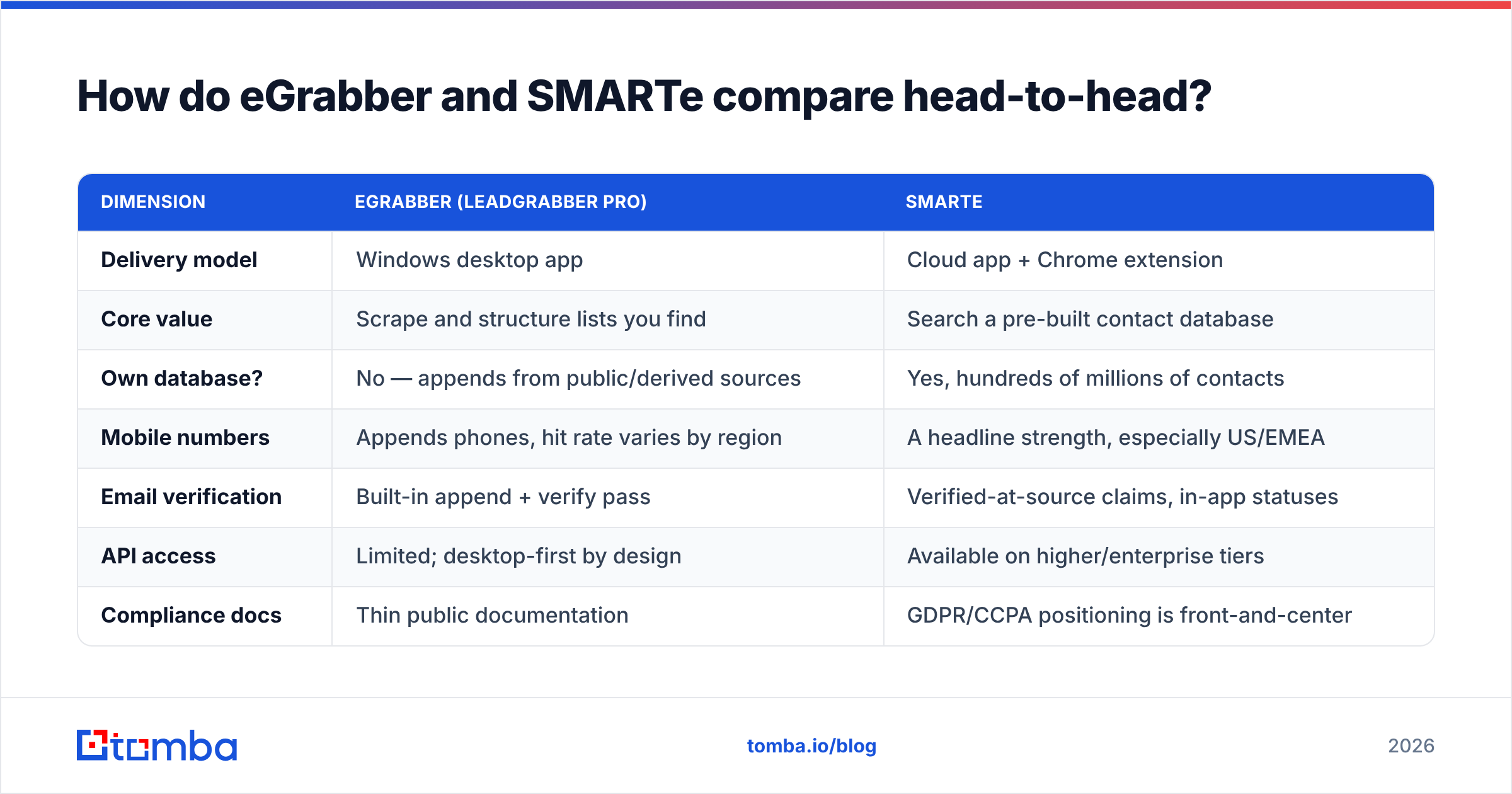
How do eGrabber and SMARTe compare head-to-head?#
| Dimension | eGrabber (LeadGrabber Pro) | SMARTe |
|---|---|---|
| Delivery model | Windows desktop app | Cloud app + Chrome extension |
| Core value | Scrape and structure lists you find | Search a pre-built contact database |
| Own database? | No — appends from public/derived sources | Yes, hundreds of millions of contacts |
| Mobile numbers | Appends phones, hit rate varies by region | A headline strength, especially US/EMEA |
| Email verification | Built-in append + verify pass | Verified-at-source claims, in-app statuses |
| API access | Limited; desktop-first by design | Available on higher/enterprise tiers |
| Compliance docs | Thin public documentation | GDPR/CCPA positioning is front-and-center |
| Pricing model | Annual per-seat license | Per-seat subscription with credit caps |
| Free option | Trial only | Free tier with limited credits |
| Best for | One-off niche lists, association data, staffing | Repeatable ICP search, mobile-heavy outbound |
Two things jump out of that table.
First, eGrabber wins on weird sources. If your ICP lives in a state licensing board directory, a 2019 conference PDF, or a regional trade association member page, SMARTe's database probably has thin coverage and eGrabber's parser will happily chew through it. That is a genuine moat, and it's why staffing and recruiting teams still buy it.
Second, SMARTe wins on repeatability. If your motion is "pull 500 VP-of-Ops contacts at 50–500 headcount US SaaS companies every Monday," you want a filterable database, not a scraper you have to feed manually.
Which one has better data accuracy?#
Neither vendor will hand you an independently audited number, so treat every published accuracy claim — including this post's framing of it — as a hypothesis to test.
Here's what actually drives accuracy for each:
- eGrabber's accuracy depends on your input. Because it derives emails from patterns plus verification, a clean source page with correct spelling and current employers produces good output. A stale directory produces confidently formatted garbage. Garbage in, well-structured garbage out.
- SMARTe's accuracy depends on refresh cadence. Database vendors decay at roughly 25–30% per year as people change jobs. The question isn't "is the record right?" — it's "when was this record last re-verified?" Ask for the refresh policy in writing.
- Catch-all domains break both. Roughly a fifth of business domains accept every address at the SMTP layer, which means a naive verifier marks them "valid" and your bounce rate finds out later. This is where a dedicated catch-all verifier earns its keep regardless of which list tool you pick.
- Region matters more than brand. Both tools are strongest in North America. EMEA coverage is decent for SMARTe and patchy for eGrabber. APAC is thin for both, though SMARTe invests there more visibly.
- "Verified" is not one thing. Syntax-valid, MX-valid, SMTP-accepted, and human-confirmed are four different standards. Vendors use the same word for all four.

The practical takeaway: run every list from either tool through an independent email verifier before it touches your sending domain. A second-opinion verification pass costs a few dollars per thousand and routinely strips 8–15% of records that the sourcing tool called deliverable. That is cheaper than one deliverability incident.
What does each one actually cost?#
This is where the comparison gets uncomfortable, because both vendors are sales-led and both obscure list prices.
eGrabber sells annual per-seat licenses. Historically LeadGrabber Pro has been quoted in the low thousands of dollars per seat per year, with append credits bundled and additional credits sold separately. There is no meaningful free tier — you get a limited trial. Because it's a desktop license, adding a fifth SDR means buying a fifth seat outright.
SMARTe publishes a free tier with a small monthly credit allowance and then moves to per-seat subscriptions, typically quoted annually, with credit ceilings per user and API access reserved for higher tiers. Expect the sales conversation to anchor on seats and annual commitment.
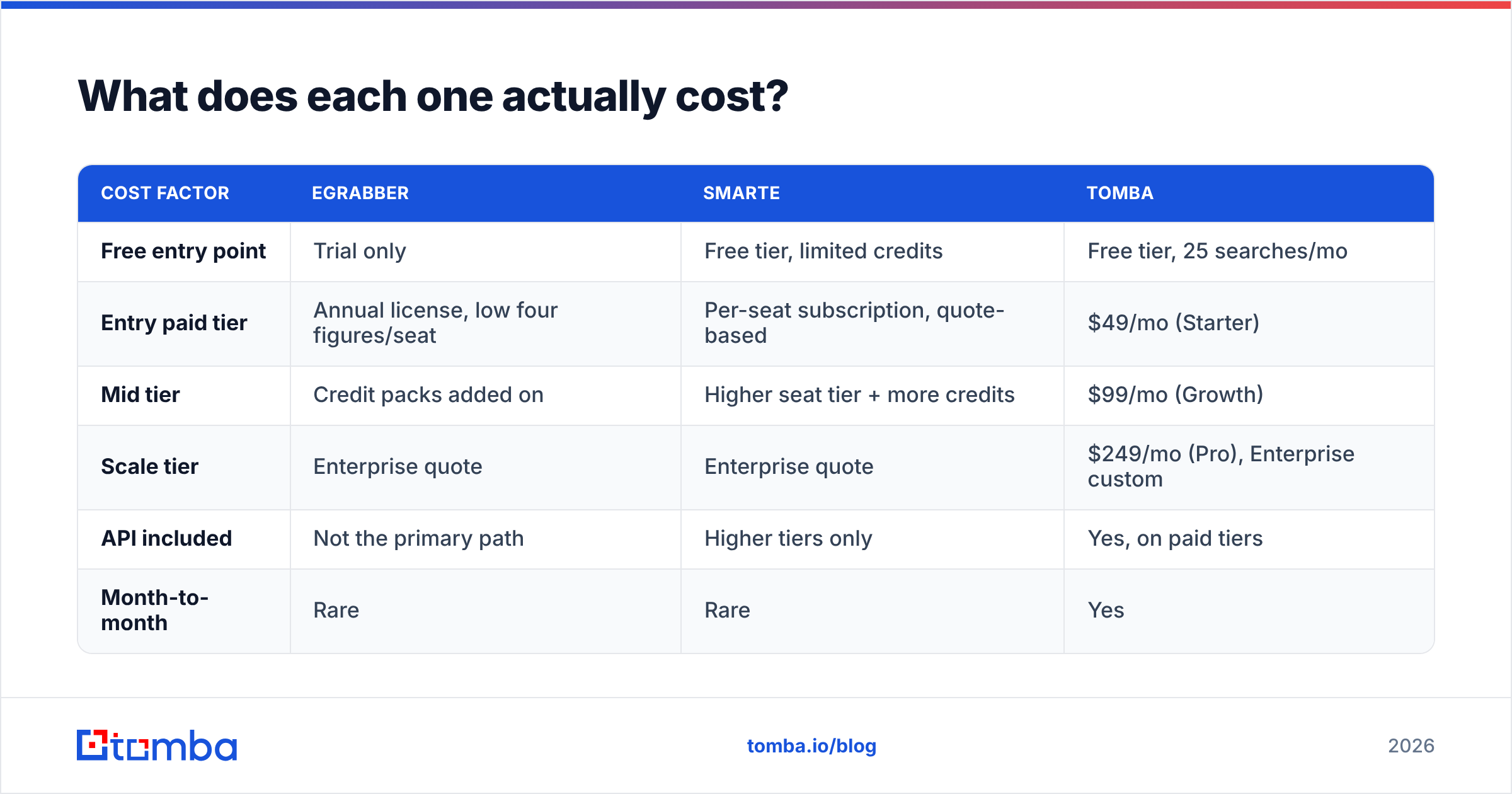
| Cost factor | eGrabber | SMARTe | Tomba |
|---|---|---|---|
| Free entry point | Trial only | Free tier, limited credits | Free tier, 25 searches/mo |
| Entry paid tier | Annual license, low four figures/seat | Per-seat subscription, quote-based | $49/mo (Starter) |
| Mid tier | Credit packs added on | Higher seat tier + more credits | $99/mo (Growth) |
| Scale tier | Enterprise quote | Enterprise quote | $249/mo (Pro), Enterprise custom |
| API included | Not the primary path | Higher tiers only | Yes, on paid tiers |
| Month-to-month | Rare | Rare | Yes |
The structural point matters more than the exact figures, which change: eGrabber and SMARTe both push annual commitments, and both meter usage by seat. That's fine if you have a fixed team of five SDRs working a fixed motion. It's expensive and awkward if your usage is spiky, programmatic, or shared across engineering, marketing, and sales.
If your bottleneck is "we need 3,000 verified emails this quarter, then maybe 200 next quarter," seat-based annual licensing is the wrong shape. Usage-based pricing fits spiky demand better, and month-to-month means a bad quarter doesn't cost you a year.
Who should pick eGrabber?#
Buy eGrabber if three or more of these describe you:
- Your ICP hides in non-standard sources. Association directories, licensing boards, event attendee lists, niche industry portals. Nothing else parses these as well.
- You're in staffing, recruiting, or a fragmented vertical. eGrabber's original market was recruiters, and the product still reflects that. Candidate-style list building from resumes and profiles is a real strength.
- You work on Windows and don't mind desktop software. No Mac client, no browser-first workflow. If your team is on MacBooks, this is a hard stop.
- You want a one-time-ish cost, not a metered meter. A license you own psychologically beats a credit counter for some buyers, even when the math is worse.
- You don't need automation. If nobody on your team will ever say the words "webhook" or "enrichment API," the desktop constraint costs you nothing.
Skip it if you need multi-user collaboration, a shared list library, real compliance documentation for EU prospecting, or programmatic enrichment.
Who should pick SMARTe?#
Buy SMARTe if this sounds like your quarter:
- You need mobile numbers, not just emails. This is SMARTe's loudest differentiator and the main reason teams choose it over generic database vendors. If your motion is cold calling plus email, phone coverage is worth paying for — and pairing it with a phone validator before dialing keeps connect rates honest.
- You prospect into the EU and want compliance paperwork. SMARTe leans hard into GDPR/CCPA positioning. Whether that satisfies your legal team is their call, but at least there's documentation to review.
- Your reps live in LinkedIn. The Chrome extension reveal-while-browsing flow is the daily-driver workflow, and it's good.
- You want repeatable ICP searches. Filter, save, export, repeat. That's the product.
- You have budget for seats. SMARTe is not a bootstrapper tool. Read current reviews on G2 before you commit — the pattern in user feedback tells you more about support and data freshness than any vendor page will.
Skip it if your target accounts are tiny, regional, or absent from mainstream databases — the coverage gap will frustrate you and eGrabber's scraping model will serve you better.
Where do both fall short — and what fills the gap?#
Both tools optimize for a human building a list. Neither optimizes for a system enriching a record.
That gap shows up in four concrete ways:
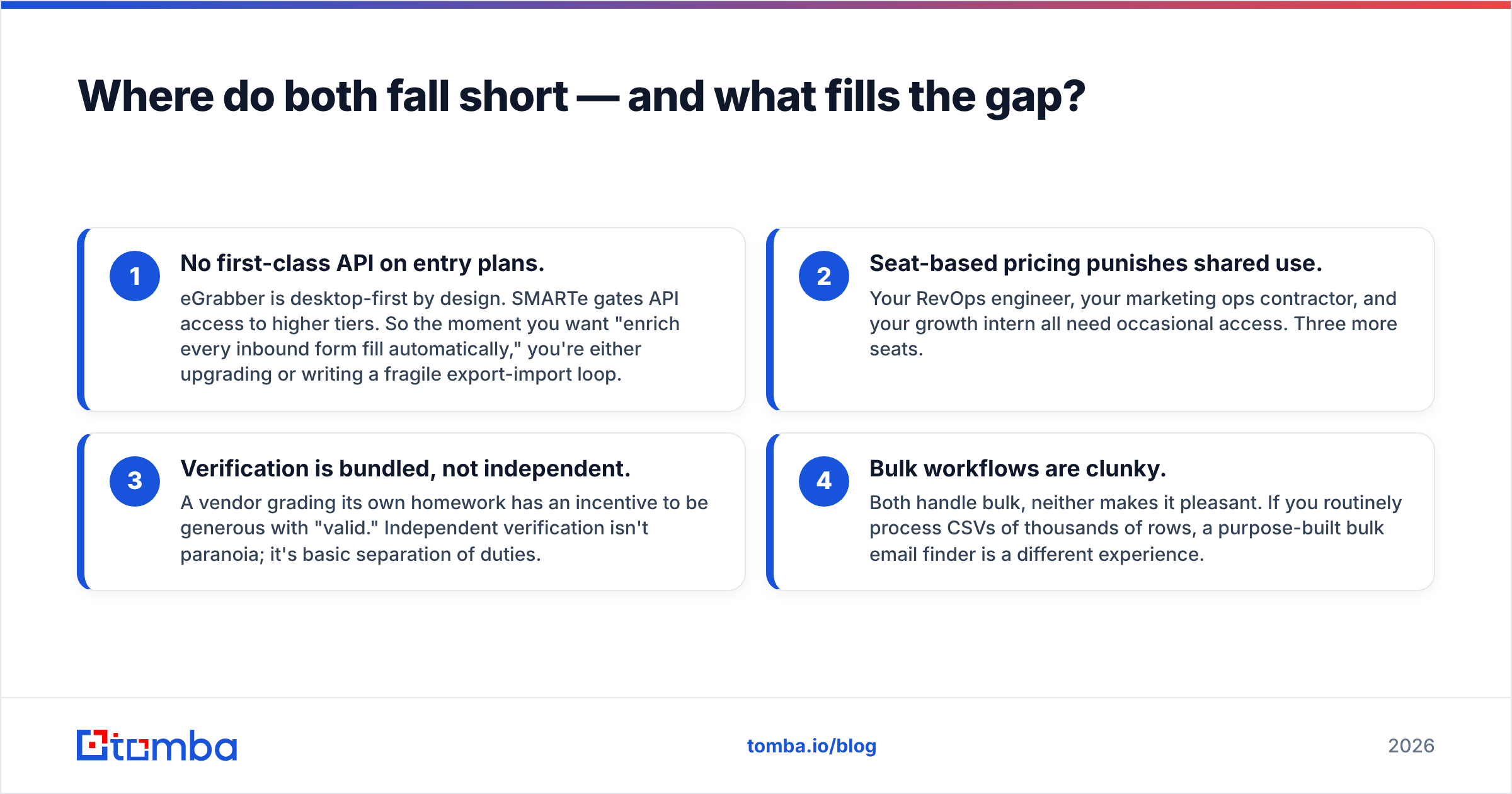
- No first-class API on entry plans. eGrabber is desktop-first by design. SMARTe gates API access to higher tiers. So the moment you want "enrich every inbound form fill automatically," you're either upgrading or writing a fragile export-import loop.
- Seat-based pricing punishes shared use. Your RevOps engineer, your marketing ops contractor, and your growth intern all need occasional access. Three more seats.
- Verification is bundled, not independent. A vendor grading its own homework has an incentive to be generous with "valid." Independent verification isn't paranoia; it's basic separation of duties.
- Bulk workflows are clunky. Both handle bulk, neither makes it pleasant. If you routinely process CSVs of thousands of rows, a purpose-built bulk email finder is a different experience.


The common fix teams land on is a two-layer stack: keep a sourcing tool for the thing it's uniquely good at (eGrabber for weird directories, SMARTe for mobile-heavy database search), and put an API-first finder and verifier underneath as the layer everything else calls. The Tomba API is one option for that layer — domain search, email finding, verification, and enrichment through the same endpoints, priced by usage rather than seats. HubSpot's own research on data decay makes the case for continuous re-verification rather than quarterly list buys, and continuous only works if it's programmatic.
How do you run a fair eGrabber vs SMARTe bake-off?#
Do not evaluate on demo data. Vendors demo the accounts they cover best.
The 200-contact protocol:
- Pick 200 real target accounts from your actual pipeline — mixed size, mixed geography, including at least 30 accounts you consider hard.
- Ask both vendors for those exact 200 during trial. Same list, same roles, same day.
- Score coverage separately from accuracy. Coverage = how many of the 200 returned any contact. Accuracy = how many returned contacts survive independent verification.
- Run every returned email through a third-party verifier you control. Record the strip rate per vendor. This single number will decide your purchase.
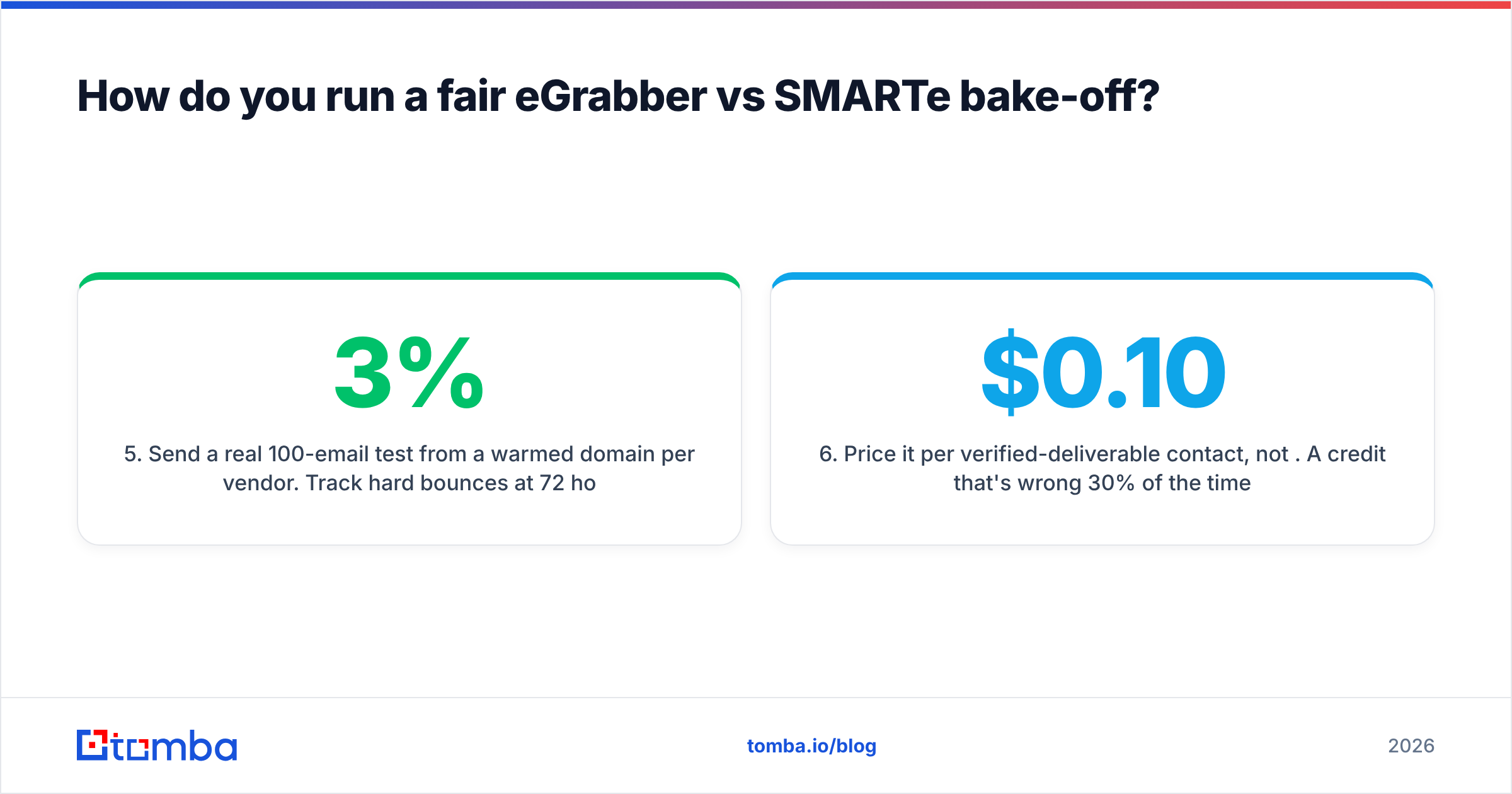
- Send a real 100-email test from a warmed domain per vendor. Track hard bounces at 72 hours. Bounce rate above 3% is a fail regardless of what the tool promised.
- Price it per verified-deliverable contact, not per credit. A $0.10 credit that's wrong 30% of the time costs $0.14 per usable record; a $0.12 credit that's wrong 5% costs $0.126.
That last calculation is the whole evaluation, compressed. Cost per usable record is the only metric that survives contact with a sending domain.
eGrabber vs SMARTe: what's the verdict?#
If you must pick one: SMARTe for most modern B2B teams, eGrabber for niche-source list building.
SMARTe is the better fit for the standard outbound motion — cloud-native, browser-based, strong mobile coverage, real compliance documentation, repeatable ICP search. eGrabber is the specialist tool you buy when mainstream databases genuinely don't cover your market, and in that scenario nothing replaces it.
If you can pick one and a half: pair whichever one fits your sourcing quirk with an independent, usage-priced finder and verifier as your always-on layer. That's how you stop paying annual seat fees for capacity you use three weeks a quarter.
Start with the free tier — 25 searches a month is enough to test whether Tomba's Email Finder returns your hard accounts before you spend a dollar. Feed it the 30 toughest names on your list, verify what comes back, and compare the strip rate against whatever eGrabber and SMARTe quoted you. If a $49/mo Starter plan with a real API covers 80% of your need, the annual enterprise contract just became a much smaller conversation.
Related guides#
Ready to find emails that actually work?
Join 150,000+ professionals who stopped guessing and started sending. Free credits on signup — no credit card required.
Get the Tomba newsletter
Practical outbound tactics and product updates — once every two weeks.
About the author