Email Check vs Warpleads: Which Email Data Tool Wins in 2026?
One tool proves an inbox exists. The other hands you thousands of leads at once. Here's an honest breakdown of email check vs Warpleads — accuracy, pricing, export limits, and which one your pipeline actually needs.
TL;DR
- "Email check" tools and Warpleads are not really competitors — one confirms an address is deliverable, the other hands you volume. Buying one and expecting the other's job to be done is how bounce rates hit 12%.
- Warpleads is built around bulk B2B lead exports: large lists, fast, often with unlimited-export style plans. Great for filling a top-of-funnel. Weak as a single source of verified truth.
- Email checkers (including free ones) do SMTP-level validation on addresses you already have. Cheap, precise, useless for sourcing.
- If you only pay for one thing, pay for a stack that does both: find, then verify, then export. That's the practical middle ground.
- Real cost comparison below, plus the accuracy question nobody in either category likes answering: catch-all domains.
What exactly are we comparing here?#
Short answer: a scalpel versus a shovel.
"Email check" is a category, not a single vendor. It covers every tool whose job is to take an address you already possess — sarah.chen@acme.com — and tell you whether a message sent there will land. Syntax check, MX record lookup, SMTP handshake, disposable-domain flag, role-account flag. Free versions like Tomba's free email checker run one address at a time; paid verifiers run millions.
Warpleads sits on the other side of the workflow. It's a B2B lead database and export platform — you filter by industry, title, geography, company size, and pull lists out in bulk. Its selling point has consistently been export volume rather than per-record forensics. You don't go to Warpleads with an address you want checked; you go there when your list is empty and your SDRs are idle.
That distinction matters because the two failure modes are completely different. A verifier that's wrong costs you a bounce. A database that's wrong costs you a quarter of wasted sequencing, plus the domain reputation damage from mailing 3,000 dead contacts.
How does each one actually get its data?#
The sourcing model explains almost every downside you'll hit later.
- Email checkers source nothing. They're a validation layer. Input quality is your problem entirely — garbage in, confidently-labeled garbage out. What they add is a live signal at the moment you ask.
- Warpleads-style databases source from aggregation. Scraped public profiles, licensed third-party panels, partner data swaps, and user contributions. The record was true at some point; the question is when.
- Pattern-based finders (the engine behind most email finder products) infer the address from a verified company pattern — if
first.last@acme.comholds across 40 confirmed employees, the 41st is a high-confidence guess, then SMTP-tested. - Waterfall enrichment chains several of the above, taking the first source that returns a verified hit. Highest accuracy, highest cost per record.
- Live crawl hits the company's own site, press pages, and author bylines in real time. Very fresh, very narrow coverage.
Databases decay at roughly 25–30% per year — that's the widely cited B2B contact churn figure, and job-change rates since 2023 have not made it better. A record exported today from any static database is a snapshot, not a fact. Which is exactly why "email check vs Warpleads" is a false binary for most teams: the export needs the check.
Email check vs Warpleads: how do they compare head to head?#
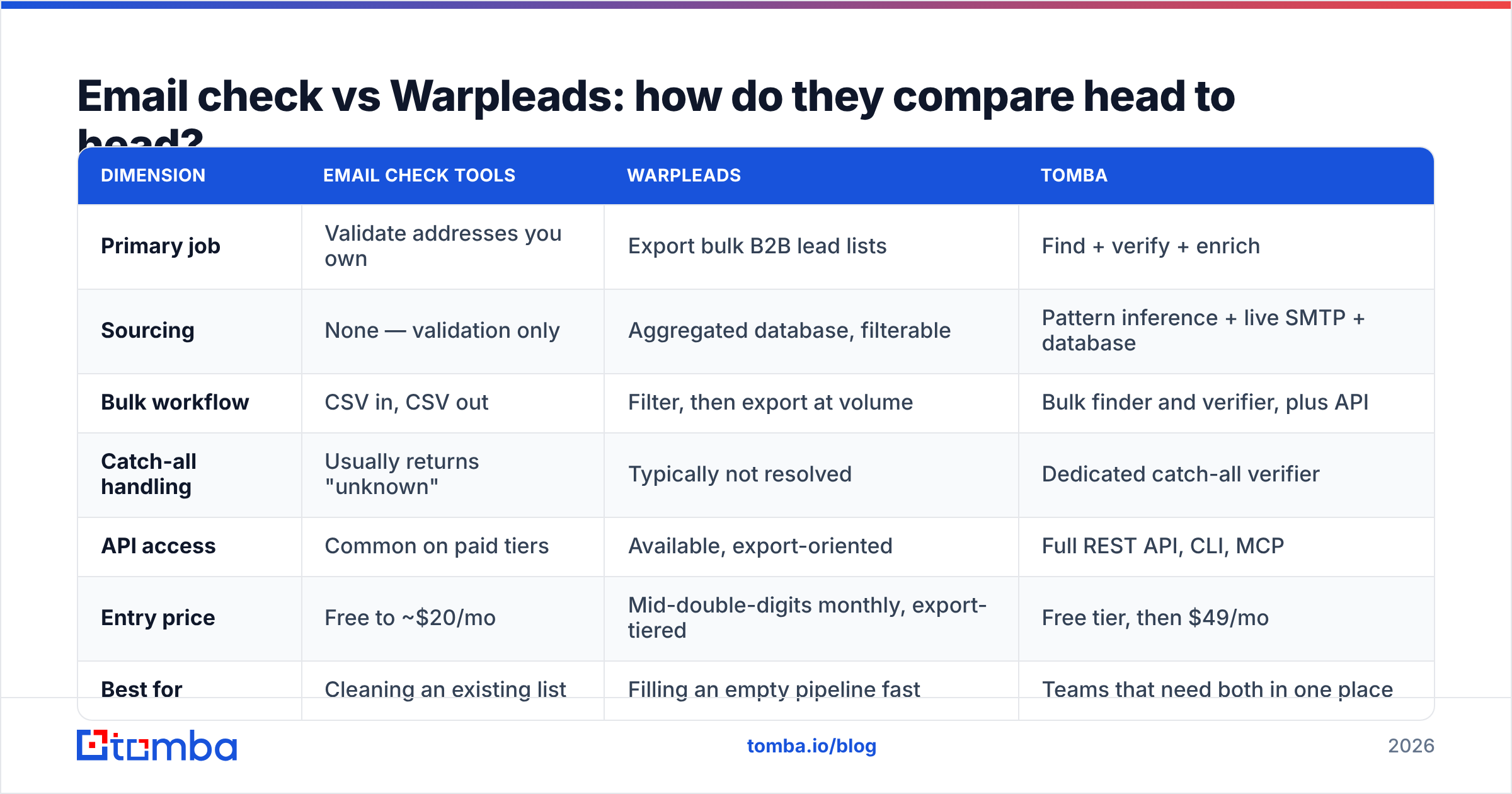
Here's the practical breakdown. Treat pricing as directional and confirm on each vendor's own page before you buy — plans in this category change quarterly.
| Dimension | Email check tools | Warpleads | Tomba |
|---|---|---|---|
| Primary job | Validate addresses you own | Export bulk B2B lead lists | Find + verify + enrich |
| Sourcing | None — validation only | Aggregated database, filterable | Pattern inference + live SMTP + database |
| Bulk workflow | CSV in, CSV out | Filter, then export at volume | Bulk finder and verifier, plus API |
| Catch-all handling | Usually returns "unknown" | Typically not resolved | Dedicated catch-all verifier |
| API access | Common on paid tiers | Available, export-oriented | Full REST API, CLI, MCP |
| Entry price | Free to ~$20/mo | Mid-double-digits monthly, export-tiered | Free tier, then $49/mo |
| Best for | Cleaning an existing list | Filling an empty pipeline fast | Teams that need both in one place |

The column that decides most purchases is row three: bulk workflow. A verifier that only accepts 5,000-row CSVs is a bottleneck when your database exports 50,000 at a time. A database with unlimited exports is a liability when your verification tool charges per credit and you're feeding it unfiltered rows.
Which one is more accurate?#
Wrong question — but the honest answer is that verification-first tools win on precision and databases win on recall, and you need both numbers.
Precision is "of the addresses this tool called valid, how many actually delivered?" Good verifiers sit in the 95–99% band on standard mailbox domains. That number is genuinely achievable because the SMTP handshake is a live test, not a guess.
Recall is "of the people I wanted to reach, how many did the tool produce an address for?" Databases like Warpleads win here by design — they're optimized to return a row rather than return nothing. But a returned row is not a verified row, and vendors that report "coverage" and vendors that report "accuracy" are describing two different products.

Then there's the case that quietly wrecks both categories: catch-all domains. A catch-all server accepts mail for every address at the domain, including asdkjh@company.com, so the SMTP test tells you nothing. Roughly a fifth of B2B domains are configured this way, and it's more common the further upmarket you go. Standard verifiers return "unknown" and either bill you anyway or leave you guessing. That's why a dedicated catch-all verifier exists as a separate product — it uses secondary signals (pattern confidence, historical engagement, alternate MX probing) to resolve addresses that a plain handshake can't.
If your ICP is enterprise, ask both vendors this exact question before you pay: what percentage of my target domains will come back "unknown," and do you charge me for those?
What does each actually cost you per usable lead?#
Sticker price is the wrong metric. Cost per usable, verified, deliverable contact is the metric.
Run the math. Say you export 10,000 rows from a database at a plan cost of roughly $80/month. If 70% of those rows are current and correct, you have 7,000 usable contacts — about $0.011 each, which sounds excellent. Now add verification at $0.004–0.007 per address across all 10,000 rows (you have to check the bad ones to find out they're bad), and you're at roughly $0.020 per usable contact. Still fine.
Now run it without verification. You mail 10,000 addresses, 3,000 bounce, your bounce rate is 30%, and your sending domain is toast inside two weeks. Google and Yahoo's bulk-sender requirements put the hard ceiling at 0.3% spam complaints, and mailbox providers treat sustained high bounce rates as a spam signal. The cost of skipping verification is not the verification fee — it's the domain.
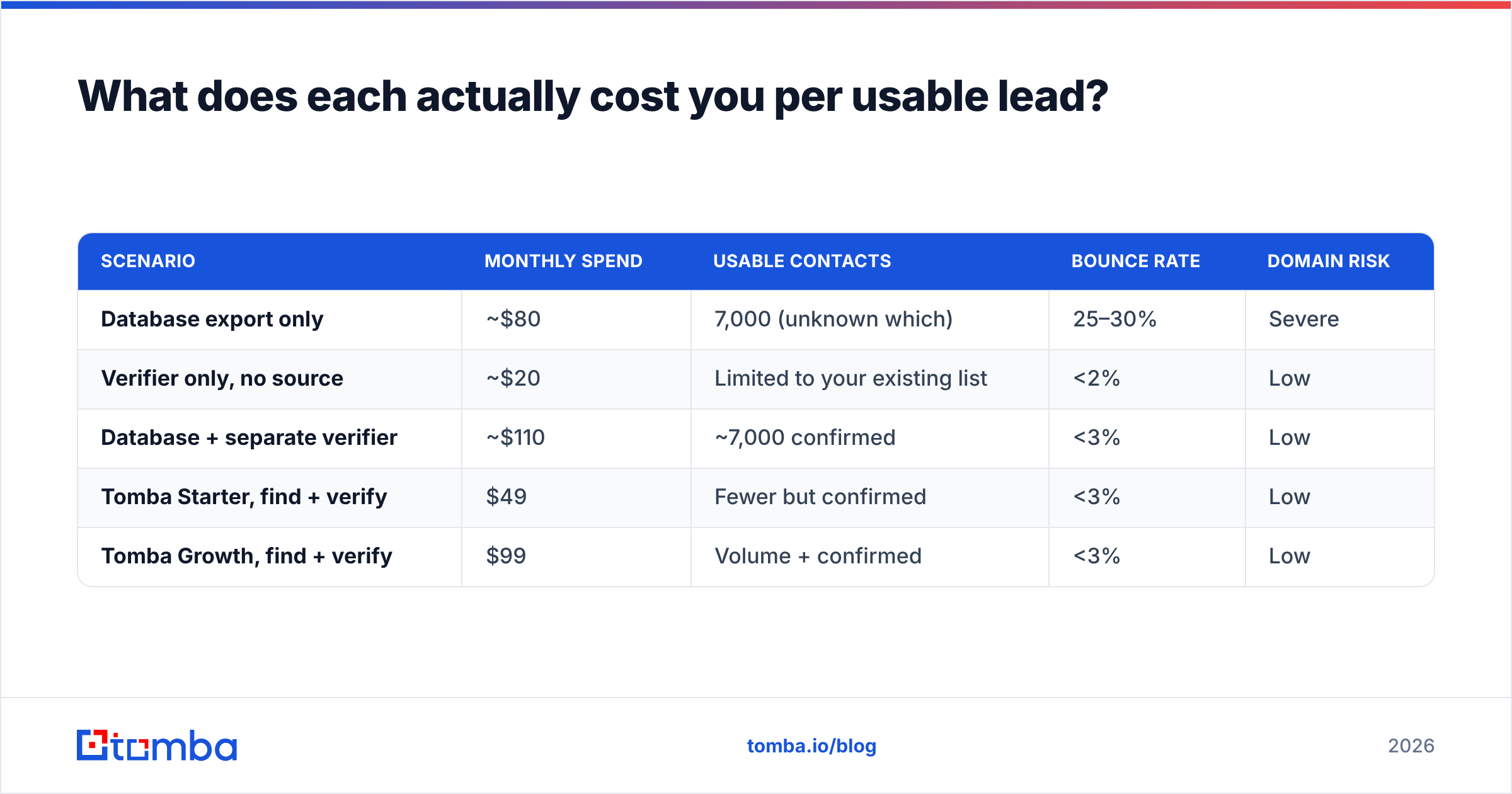
| Scenario | Monthly spend | Usable contacts | Bounce rate | Domain risk |
|---|---|---|---|---|
| Database export only | ~$80 | 7,000 (unknown which) | 25–30% | Severe |
| Verifier only, no source | ~$20 | Limited to your existing list | <2% | Low |
| Database + separate verifier | ~$110 | ~7,000 confirmed | <3% | Low |
| Tomba Starter, find + verify | $49 | Fewer but confirmed | <3% | Low |
| Tomba Growth, find + verify | $99 | Volume + confirmed | <3% | Low |
Note the third and fifth rows. Two vendors, two dashboards, two credit systems, two support queues — versus one. The consolidation argument isn't about price, it's about the operational tax of stitching a CSV between two tools every Monday morning. See current Tomba pricing for the exact credit allocations per tier.
When should you pick Warpleads?#
Be fair to it — there are clear cases where a volume-first database is the right buy.
- You're pre-product-market-fit and testing segments. You need 5,000 contacts across six verticals to find out which one replies. Precision matters less than breadth. Export, verify cheaply, test, throw away the losers.
- Your ICP is broad and mid-market. Standard mailbox domains, predictable naming patterns, high database coverage. This is where aggregated data performs best.
- You already own a verification layer. If you're paying for a verifier anyway, the marginal value of a high-volume source is real. Warpleads is a respected source in this bracket, and unlimited-style export plans genuinely change the unit economics of high-volume outbound.
- You need list-building speed over list-building nuance. Filters and export beat one-by-one lookup when the deadline is Friday.
Where it gets uncomfortable: narrow ICPs, non-US geographies, recently-founded companies, and anyone whose title changed in the last six months. Those are the records that come back stale, and no export volume fixes a stale record.
When should you pick verification-first?#
- Your list already exists. Inherited CRM data, event scans, webinar signups, a partner's contact dump. There's nothing to source — there's something to clean. Run it through an email verifier and stop.
- Your domain reputation is already damaged. You need bounce rate under control this week. Verification is the fastest lever that exists.
- You sell high-ACV into a short list. Fifty named accounts don't need a database. They need the right person's real address, confirmed.
- Compliance pressure is real. Verified, sourced-at-request data has a cleaner provenance story than a bulk export of aggregated records — worth a conversation with legal if you sell into the EU.
Where does Tomba fit between the two?#
Honestly: Tomba is the middle path, and that's a real trade-off rather than a free win.
The pitch is that finding and verifying happen in one system, so a contact never leaves the platform unverified. Domain search pulls every discoverable address at a company, the finder infers individual addresses from confirmed patterns, and the verifier and catch-all layer resolve them before they hit your sequencer. The bulk email finder handles list-scale work, and the Tomba API covers the case where you want enrichment inside your own product rather than in a dashboard.
The trade-off is coverage. A find-then-verify model returns fewer rows than a raw database export, because it declines to hand you an address it can't stand behind. If your growth model needs 100,000 contacts a month regardless of quality, a volume database will produce more rows than Tomba will. If your model needs 5,000 contacts that actually deliver, the ranking flips.
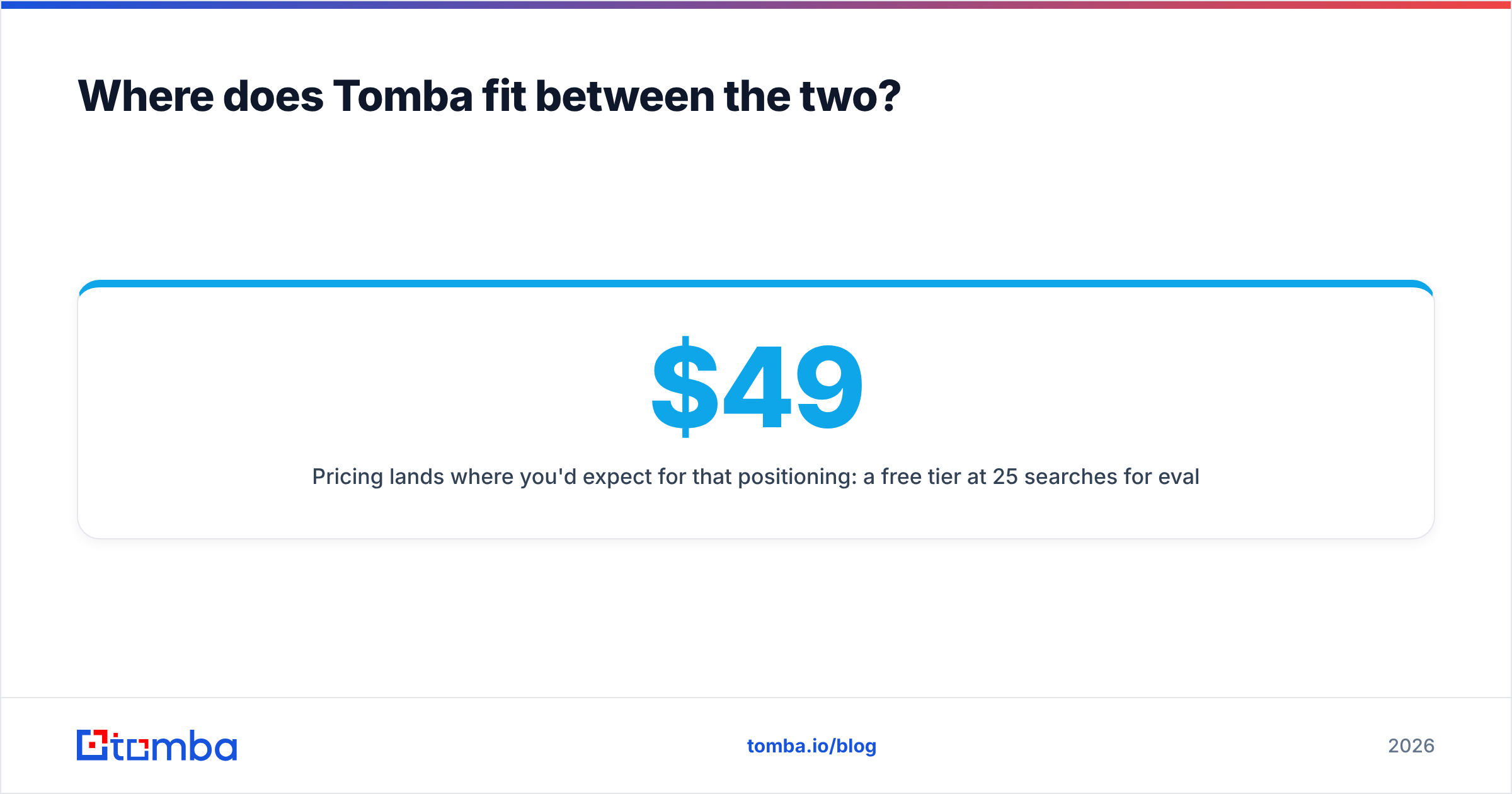
Pricing lands where you'd expect for that positioning: a free tier at 25 searches per month for evaluation, Starter at $49/mo, Growth at $99/mo, Pro at $249/mo, Enterprise custom. No separate verification vendor to bolt on.
What should you actually do this week?#
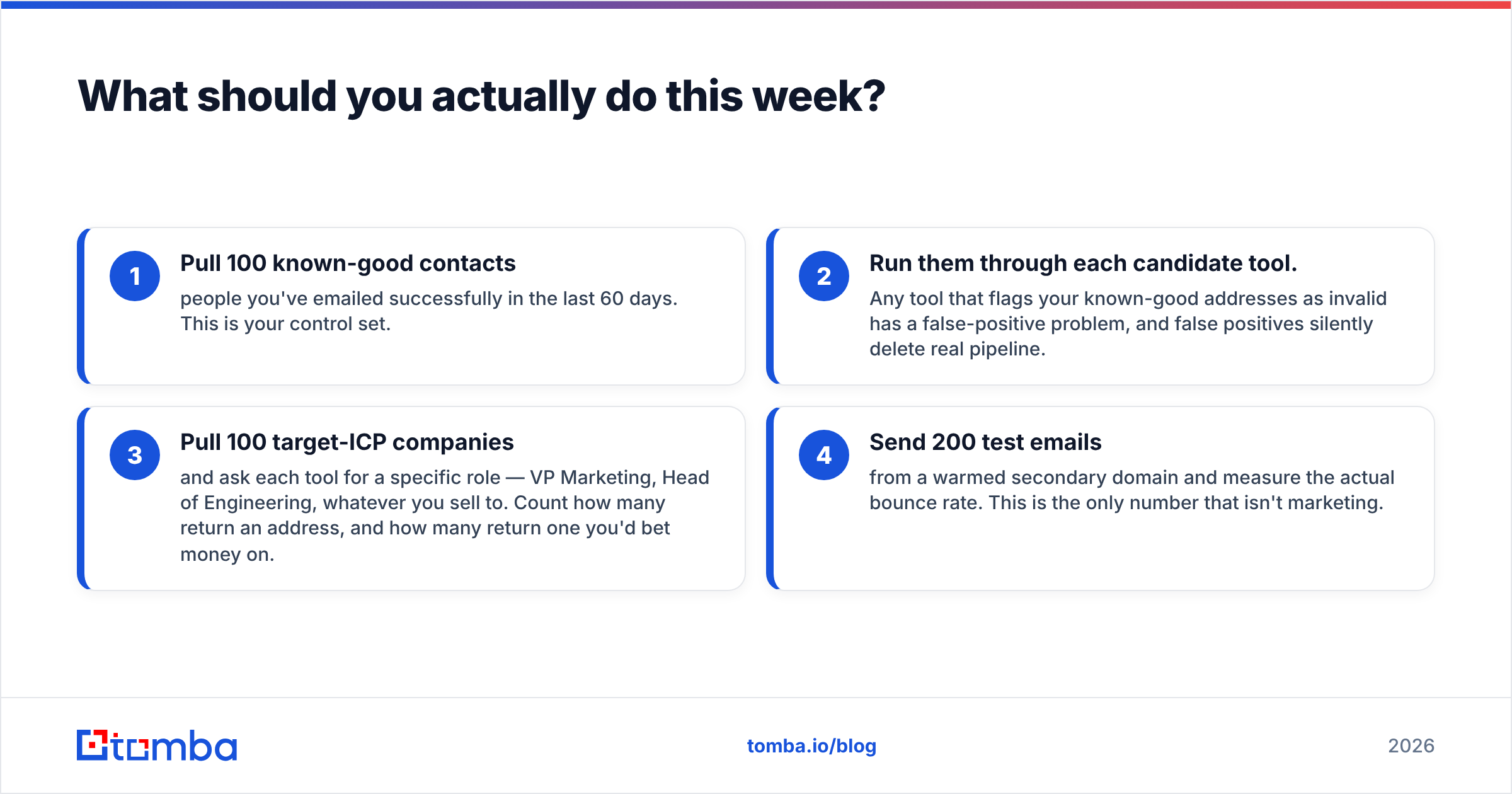
A four-step test that costs almost nothing:
- Pull 100 known-good contacts — people you've emailed successfully in the last 60 days. This is your control set.
- Run them through each candidate tool. Any tool that flags your known-good addresses as invalid has a false-positive problem, and false positives silently delete real pipeline.
- Pull 100 target-ICP companies and ask each tool for a specific role — VP Marketing, Head of Engineering, whatever you sell to. Count how many return an address, and how many return one you'd bet money on.
- Send 200 test emails from a warmed secondary domain and measure the actual bounce rate. This is the only number that isn't marketing.
Do that and the email check vs Warpleads question answers itself for your ICP, which is the only ICP that matters. Independent reviews on G2 and Capterra are useful for narrowing the shortlist, and Warpleads' own site is the right place to confirm current export limits — but neither substitutes for a bounce test on your own data.
One more thing worth internalizing: HubSpot's research on database decay has been saying the same thing for a decade. Your list rots whether you look at it or not. Whichever side of this comparison you land on, verification isn't a one-time purchase — it's a recurring hygiene cost, like backups.
Ready to stop choosing between coverage and accuracy?#
If your team is currently paying one vendor to find contacts and another to prove they exist, you're paying the integration tax twice. Start with the Tomba Email Finder — the free tier gives you 25 searches a month, enough to run the 100-contact control test above and see the verification status on every result before you spend anything. If it holds up on your ICP, Starter at $49/mo covers most small outbound teams; if it doesn't, you've learned something real about your data for free. Either way, run the bounce test before you renew anything.
Related guides#
Ready to find emails that actually work?
Join 150,000+ professionals who stopped guessing and started sending. Free credits on signup — no credit card required.
Get the Tomba newsletter
Practical outbound tactics and product updates — once every two weeks.
About the author