Email Checker vs Leadzen.ai 2026: Verifier vs Lead Data
One tool cleans lists, the other builds them. Here is how Email Checker and Leadzen.ai actually compare on accuracy, pricing, coverage and workflow fit in 2026 — plus when neither is the right buy.
TL;DR
- These two tools do not compete. Email Checker is a verification service that cleans a list you already have; Leadzen.ai is a lead-intelligence platform that builds the list in the first place.
- If your bounce rate is the problem, buy a verifier. If your pipeline is empty, buy a data platform. Buying the wrong one wastes a quarter.
- Email Checker's strength is pay-as-you-go simplicity: no seat licence, credits that do not expire on a monthly cliff, and a usable free single-address check.
- Leadzen.ai's strength is breadth — company and contact records, phone numbers, LinkedIn-driven prospecting — but it is a subscription commitment and coverage skews toward India and APAC.
- If you need both jobs done under one login and one bill, a combined finder-plus-verifier (Tomba starts free at 25 searches, then $49/mo) usually beats stitching two point tools together.
What are Email Checker and Leadzen.ai?#
Think of it like a kitchen. A verifier is the sink where you wash the vegetables. A lead-intelligence platform is the market where you buy them. You can argue about which is better only if you have forgotten what each one is for.
- Email Checker is a UK-based email verification service. You paste an address or upload a list, it runs syntax, domain, MX and SMTP-level checks, and returns a valid / invalid / unknown status. It sells credits rather than seats, and offers a free single-address lookup on the homepage that most people use as a smoke test before they pay for anything.
- Leadzen.ai is a B2B lead-intelligence and prospecting platform. It combines a searchable contact and company database with a Chrome extension that pulls details while you browse LinkedIn or company sites, plus filters for industry, headcount, geography and role. It sells subscriptions, usually per user, with credit allowances attached.
- The overlap is thin but real: Leadzen returns email addresses, and those addresses need to be trustworthy, so it applies its own validity scoring. Email Checker never sources an address — it only judges one.
- The gap is the reason most teams end up paying for two products: a discovery tool that half-verifies, and a verifier that never discovers.
That framing matters because most "X vs Y" searches for this pair come from someone who has already bought one, watched a campaign underperform, and assumed the other tool is the fix. Sometimes it is. Often the real fix is a single pipeline that finds and validates in one pass.
How do Email Checker and Leadzen.ai compare head to head?#
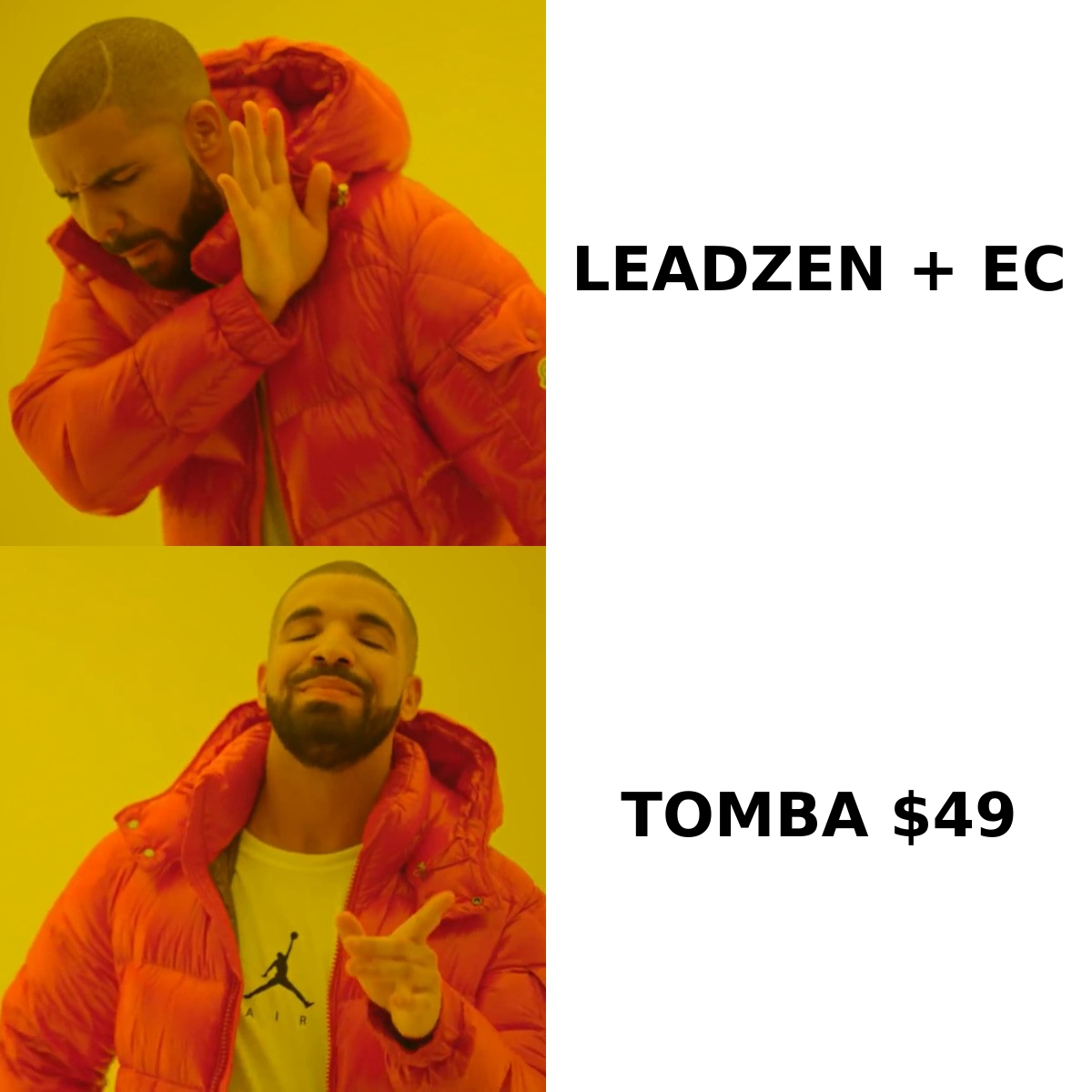
Here is the honest side-by-side. Pricing for both vendors changes and is region-dependent — treat the rows below as shape, not as a quote, and confirm on each vendor's own page before you buy.
| Attribute | Email Checker | Leadzen.ai | Tomba |
|---|---|---|---|
| Primary job | Verify existing addresses | Find leads and contact data | Find + verify in one flow |
| Sourcing | None — you bring the list | Database + LinkedIn extension | Domain search, name lookup, extension |
| Verification depth | Syntax, MX, SMTP, role/disposable flags | Validity scoring on returned records | Dedicated verifier + catch-all handling |
| Phone numbers | No | Yes | Yes (phone finder) |
| Pricing model | Credit packs, pay-as-you-go | Per-seat subscription with credit tiers | Free tier, then $49 / $99 / $249 per month |
| Free entry point | Free single-address check | Limited trial credits | 25 searches per month, no card |
| Bulk workflow | CSV upload | CSV export from search results | Bulk find + bulk verify, plus API |
| API access | Yes | Yes, on higher tiers | Yes on all paid plans |
| Geographic strength | Global (verification is geography-neutral) | Strongest in India / APAC | Global, with EU and US depth |
| Best for | Cleaning inherited or scraped lists | Building lists in APAC markets | End-to-end outbound data |

Two rows deserve a second look. Geographic strength is the one buyers most often ignore: Leadzen's coverage is genuinely strong for Indian and wider APAC companies, and noticeably thinner for mid-market European firms. If your ICP is German manufacturers, a database built around a different region will feel broken no matter how good the UI is. And pricing model decides your cost curve — credit packs are cheaper when usage is lumpy, subscriptions are cheaper when usage is steady and high.
Which one is more accurate — and what does accuracy even mean here?#
They are measuring different things, so a single accuracy number is misleading.
For a verifier like Email Checker, accuracy means: when you say an address is valid, does it accept mail? The failure modes are false "valid" results (which produce bounces) and an inflated "unknown" bucket (which produces indecision). Independent, apples-to-apples verifier benchmarks are rare, and most vendor-published numbers are run on the vendor's own test list.
For a discovery platform like Leadzen.ai, accuracy means: of the addresses you return for this ICP, what share are real, current, and belong to the person named? That number is dominated by data freshness. A contact record that was correct 18 months ago and has not been re-checked is not a data-quality problem you can verify your way out of — the person has changed jobs.

The practical test is cheaper than any benchmark chart. Take 100 known-good contacts from your own CRM — people you have actually emailed in the last 90 days. Run them through each tool. Count:
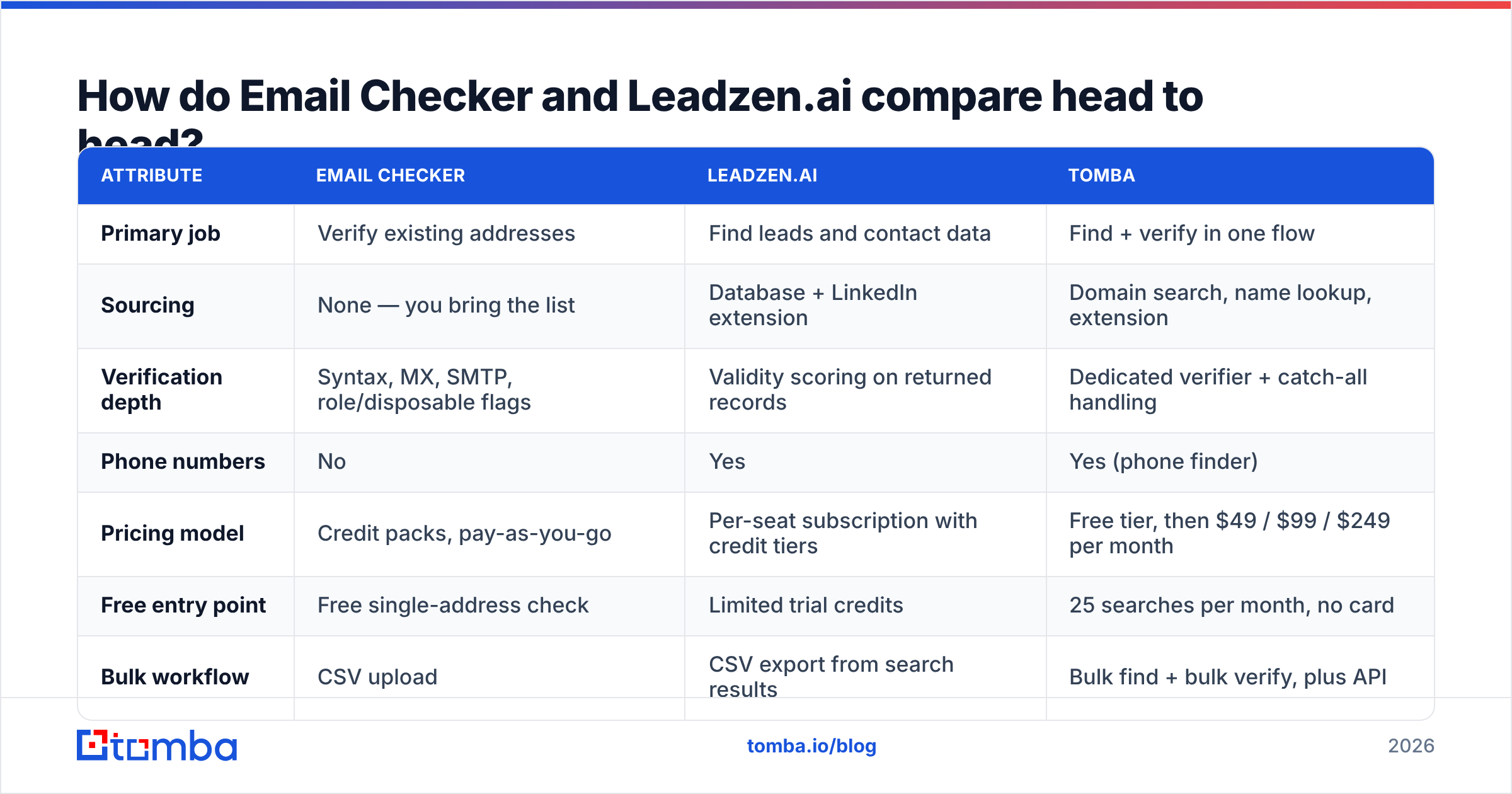
- True positives — correct addresses returned or confirmed valid.
- False valids — addresses marked deliverable that you know bounced.
- Unknowns — the catch-all and greylisted bucket, which is where verifiers quietly hide their uncertainty.
- Misses — contacts the discovery tool could not find at all.
- Stale records — right domain, wrong person, usually a job-change casualty.
Whichever tool wins on your list wins, full stop. That test costs about an hour and one small credit pack, and it beats every comparison post on the internet, including this one.
What about catch-all domains?#
This is where most verification comparisons fall apart. A catch-all domain accepts mail for every address at that domain, so an SMTP check cannot tell you whether jane.doe@ exists or whether the server is simply saying yes to everything. Depending on your market, catch-alls can be 20–35% of your B2B list — and they are over-represented at exactly the enterprise accounts you want.
Basic verifiers, Email Checker included, will return these as "unknown" or "accept-all". That is honest, but it hands the decision back to you. You then choose between mailing them (risking bounces and sender reputation damage) or discarding them (throwing away a third of your enterprise pipeline).
Better handling means going past the SMTP handshake — cross-referencing pattern data, historical sends, and multiple sources to produce a confidence score instead of a shrug. If catch-alls are a large slice of your list, evaluate tools specifically on this. A dedicated catch-all verifier is worth more to an enterprise-focused team than any other feature on the spec sheet.

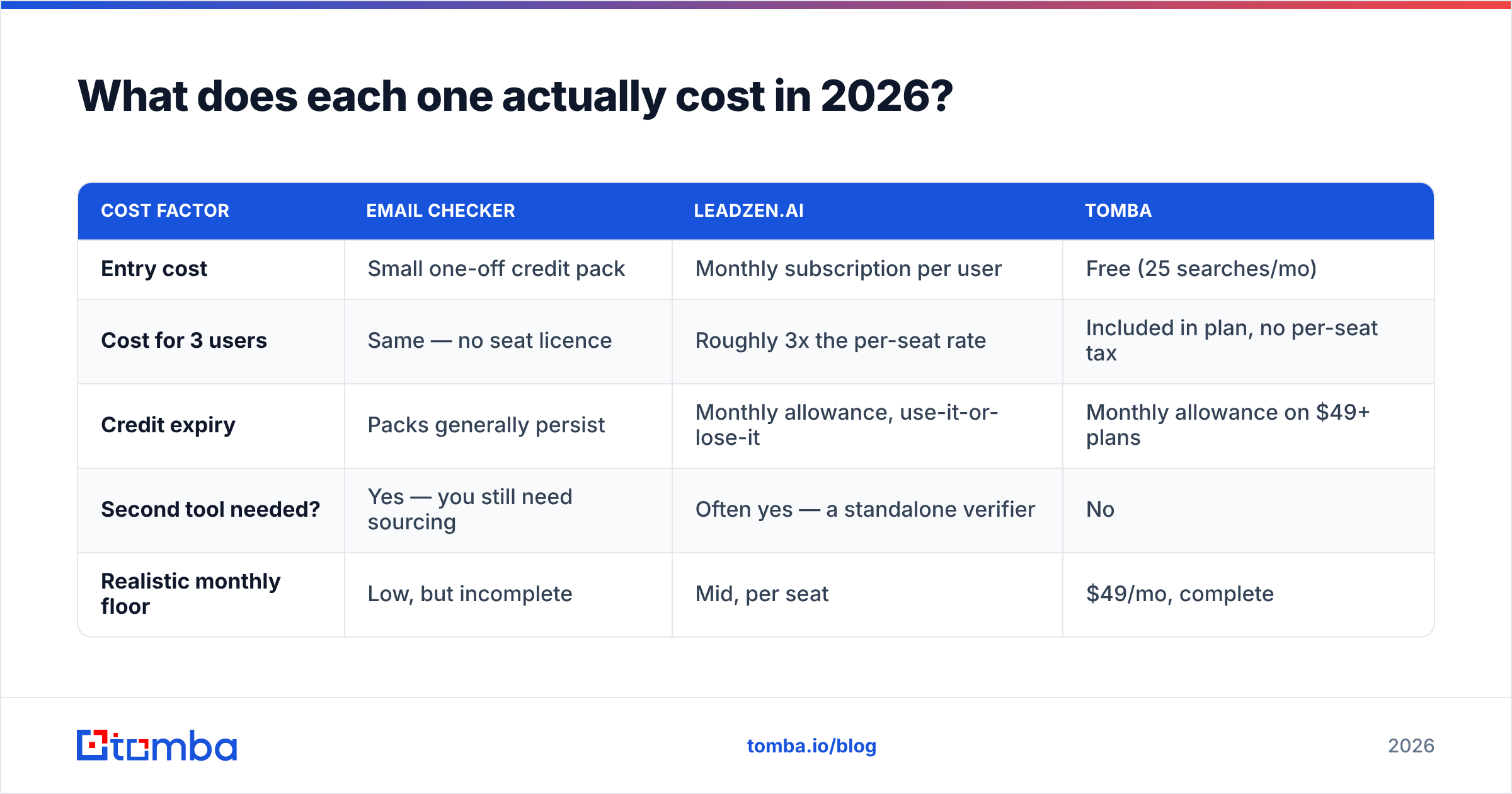
What does each one actually cost in 2026?#
Model total cost, not sticker price. The three variables that move the number are seats, credit expiry, and rework.
| Cost factor | Email Checker | Leadzen.ai | Tomba |
|---|---|---|---|
| Entry cost | Small one-off credit pack | Monthly subscription per user | Free (25 searches/mo) |
| Cost for 3 users | Same — no seat licence | Roughly 3x the per-seat rate | Included in plan, no per-seat tax |
| Credit expiry | Packs generally persist | Monthly allowance, use-it-or-lose-it | Monthly allowance on $49+ plans |
| Second tool needed? | Yes — you still need sourcing | Often yes — a standalone verifier | No |
| Realistic monthly floor | Low, but incomplete | Mid, per seat | $49/mo, complete |
The trap is the "second tool needed" row. A team that buys Leadzen for sourcing and then adds a verifier for hygiene is running two contracts, two credit systems, two CSV round-trips, and two support queues. That workflow tax rarely shows up in the buying spreadsheet and always shows up in the SDR's week. Compare it against consolidated Tomba pricing before you sign either contract — not because one vendor is bad, but because the arithmetic of two subscriptions surprises people.
Who should buy Email Checker?#
Buy it if all of these are true:
- You already have the list. Inherited CRM data, a conference export, a scraped set, a partner's database.
- Your volume is spiky. You clean 40,000 records in March and nothing in April. Credit packs suit that pattern far better than a subscription.
- You do not need phone numbers or firmographics. You want deliverability, not enrichment.
- You want zero onboarding. Upload, wait, download. No seats to provision, no admin to train.
Skip it if your core problem is that you do not have enough contacts to email. No verifier creates leads. It is a filter, and filters make lists smaller.
Who should buy Leadzen.ai?#
Buy it if all of these are true:
- Your ICP concentrates in India or APAC. This is Leadzen's genuine home-field advantage and the strongest single reason to pick it.
- You prospect inside LinkedIn. The extension workflow is where the product feels best, and if your reps live in Sales Navigator all day it fits their habits.
- You need phones as well as emails. Multi-channel outbound needs both, and a pure verifier gives you neither.
- You have steady, predictable volume. Subscriptions reward consistent usage and punish seasonality.
Skip it if you are a one-person team with occasional needs, or if your target accounts are concentrated in North America and Western Europe where other databases have deeper coverage. Read recent verified reviews on G2 filtered to your company size before committing — coverage complaints cluster by region and headcount, and the aggregate star rating hides that.
Is there a better option than either?#
For a large share of outbound teams, yes — because the real requirement is one pipeline that goes from "I know the company" to "I have a verified address I can safely mail."
That pipeline has four steps, and buying it as one product removes three handoffs:
- Discover the company's email pattern. A domain search returns the addresses and the dominant format for a domain, which is the input everything else depends on.
- Resolve the specific person. Feed a first name, last name and domain into an email finder and get the individual address rather than a generic inbox.
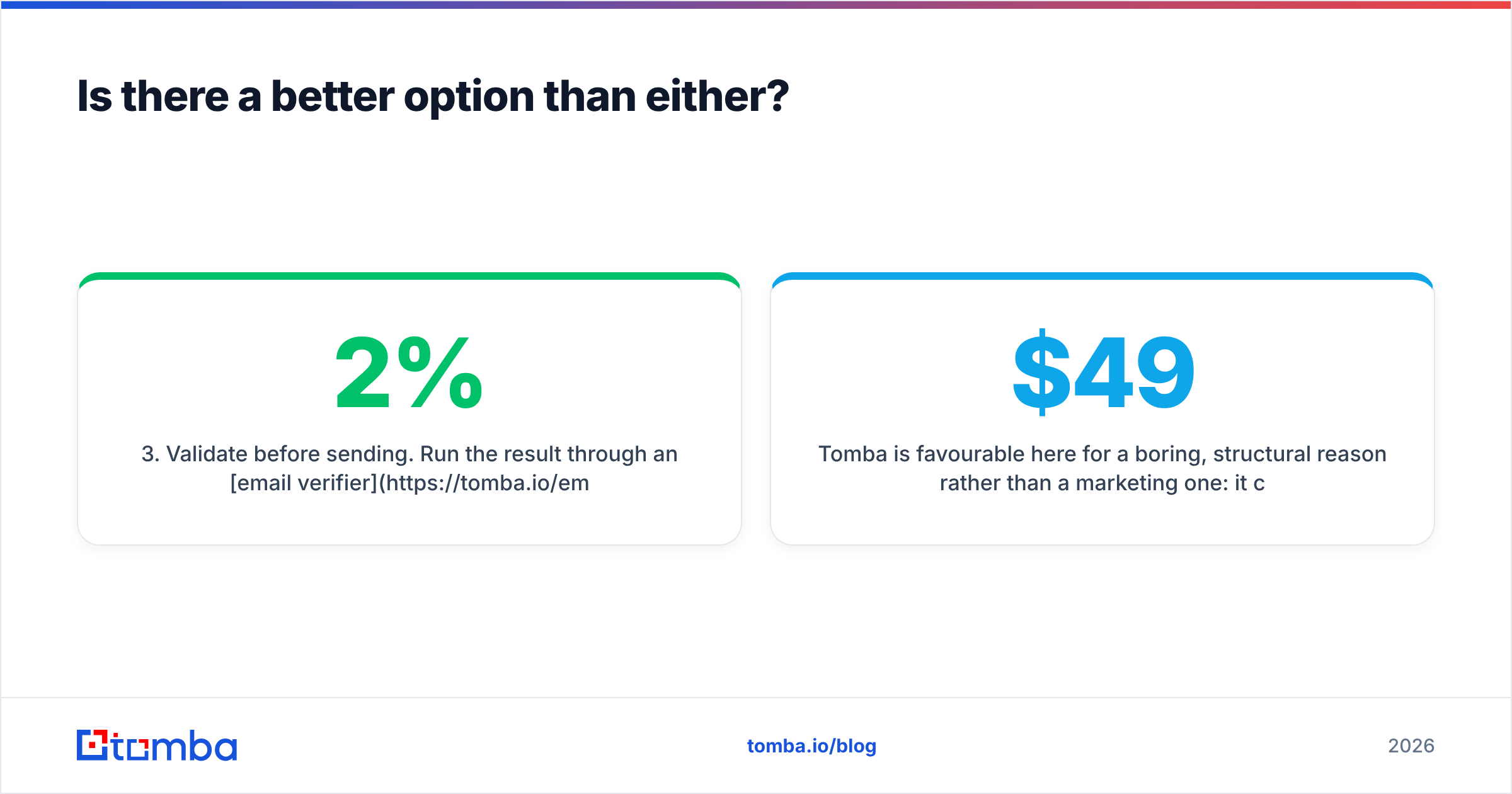
- Validate before sending. Run the result through an email verifier, including proper catch-all treatment, so your bounce rate stays under 2%.
- Scale it without CSV ping-pong. Push the whole flow through the Tomba API or a bulk job so enrichment happens inside your CRM instead of inside a spreadsheet a rep forgot to re-upload.
Tomba is favourable here for a boring, structural reason rather than a marketing one: it covers all four steps under one bill, with a free tier at 25 searches per month, $49/mo at Starter, $99/mo at Growth and $249/mo at Pro. Email Checker covers step three well. Leadzen.ai covers steps one and two well in its home regions. Neither covers all four, which is why so many teams end up owning both — and why owning both is usually more expensive than owning one thing that does the job end to end.
None of this makes either tool a bad product. It makes them point solutions, and point solutions are the right call only when you genuinely have a point problem.
How should you run the evaluation?#
Do not evaluate on features. Evaluate on your own data, in this order:
- Define one ICP slice. 100 accounts, one region, one company-size band. Vague ICPs produce vague test results.
- Run the same slice through each trial. Email Checker's free check and Leadzen's trial credits are enough for a directional read; Tomba's free tier gives you 25 searches without a card.
- Score coverage and correctness separately. Coverage is "did it find anything." Correctness is "was it right." A tool can win one and lose the other badly.
- Send a 50-contact test campaign. Measure bounce rate, not vendor-reported validity. Your ESP is the only judge whose opinion matters.
- Price the winner at 12 months, not 1. Include seats you will add, credits you will overrun, and the second tool you will need if the first one only does half the job.
Teams that run this in a week make better decisions than teams that read comparison pages for a month. The data quality question is empirical, and your list is the only test set that counts.
The bottom line#
Email Checker vs Leadzen.ai is not a fair fight because they are not in the same weight class or even the same sport. Choose Email Checker when you have leads and need them clean. Choose Leadzen.ai when you need APAC-heavy leads and phone coverage and you can justify a per-seat subscription. Choose neither when what you actually need is a single, verified, end-to-end contact pipeline.
If that last sentence describes you, start with the Tomba Email Finder. Run 25 free searches against your real target accounts this week, push the results through the built-in verifier, and compare the bounce rate against whatever you are using now. If the numbers do not beat your current stack, you have lost an hour. If they do, you have just collapsed two contracts into one.
Related guides#
Ready to find emails that actually work?
Join 150,000+ professionals who stopped guessing and started sending. Free credits on signup — no credit card required.
Get the Tomba newsletter
Practical outbound tactics and product updates — once every two weeks.
About the author