Email Compliance Best Practices for B2B Outreach in 2026
CAN-SPAM, GDPR, CASL and the 2026 sender rules now overlap in ways that quietly kill cold email programs. Here's what actually keeps your outreach legal and landing.
TL;DR
- Compliance is not one law. CAN-SPAM (US), GDPR (EU/UK), CASL (Canada), and the 2024–2026 mailbox-provider sender rules each govern a different layer, and you must satisfy all four for a global list.
- CAN-SPAM permits cold B2B email without prior consent. GDPR and CASL generally do not — GDPR needs a documented lawful basis, CASL needs consent or a narrow business-relationship exemption.
- The rules that actually get your domain throttled in 2026 are not statutes at all: they're Google and Yahoo's bulk-sender requirements — authenticated mail, one-click unsubscribe, and spam complaints under 0.3%.
- Data provenance is now a compliance artifact. If you can't say where a contact record came from, you can't answer a GDPR access request or defend a CASL audit.
- Build compliance into the data layer — suppression lists, consent timestamps, source attribution, verification — rather than bolting a disclaimer onto the footer.
Why do email compliance best practices keep changing?#
Because three separate systems now regulate your inbox access, and they moved at different speeds.
Think of it like driving a truck across borders. There's the law of each country you pass through (CAN-SPAM, GDPR, CASL, Australia's Spam Act). There's the condition of your vehicle (authentication, list hygiene, sending infrastructure). And there's the customs officer who can turn you around regardless of paperwork (Gmail, Outlook, Yahoo). Most teams obsess over the first and get stopped by the third.
Between 2024 and 2026, the third layer hardened fastest. Google and Yahoo's bulk-sender requirements went from advisory to enforced, then broadened: SPF and DKIM alignment, DMARC on the sending domain, one-click unsubscribe headers on commercial mail, and a spam-complaint rate held under 0.3%. Microsoft followed with its own enforcement on high-volume senders to Outlook and Hotmail domains. None of that is legislation. All of it will kill your program faster than a regulator will.
Meanwhile, EU data protection authorities kept fining for the boring stuff — no lawful basis recorded, no response to deletion requests, purchased lists with no provenance. The fines rarely make headlines because they're issued against mid-market B2B companies, not household names.
What does each major email law actually require?#
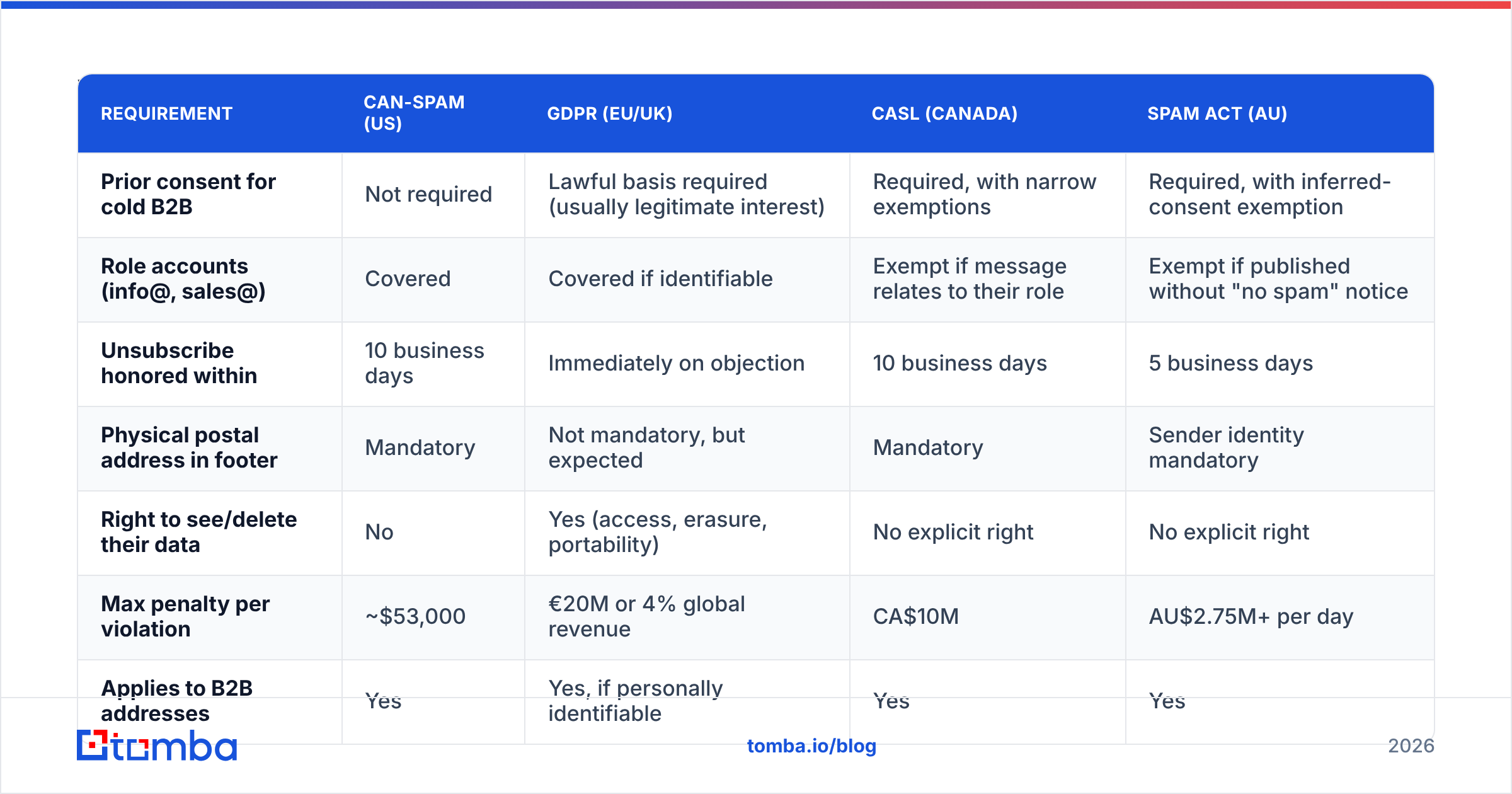
Here's the practical split. Read it by the geography of your recipient, not your company.
| Requirement | CAN-SPAM (US) | GDPR (EU/UK) | CASL (Canada) | Spam Act (AU) |
|---|---|---|---|---|
| Prior consent for cold B2B | Not required | Lawful basis required (usually legitimate interest) | Required, with narrow exemptions | Required, with inferred-consent exemption |
| Role accounts (info@, sales@) | Covered | Covered if identifiable | Exempt if message relates to their role | Exempt if published without "no spam" notice |
| Unsubscribe honored within | 10 business days | Immediately on objection | 10 business days | 5 business days |
| Physical postal address in footer | Mandatory | Not mandatory, but expected | Mandatory | Sender identity mandatory |
| Right to see/delete their data | No | Yes (access, erasure, portability) | No explicit right | No explicit right |
| Max penalty per violation | ~$53,000 | €20M or 4% global revenue | CA$10M | AU$2.75M+ per day |
| Applies to B2B addresses | Yes | Yes, if personally identifiable | Yes | Yes |
Two nuances people get wrong constantly.
First, GDPR applies to firstname.lastname@company.com because that identifies a person. It does not meaningfully apply to info@company.com, which identifies a business. That single distinction changes how you should structure a European prospecting list — lean on role-based addresses via domain search where the message genuinely relates to a business function, and reserve named contacts for cases where you can document why the outreach is proportionate.
Second, CAN-SPAM's permissiveness is real but shallow. It lets you send unsolicited commercial email. It does not let you use deceptive subject lines, hide who you are, harvest addresses through automated scraping of websites that prohibit it, or ignore an opt-out. Those last two are where "we're CAN-SPAM compliant" teams actually get caught. The FTC's own CAN-SPAM guidance is short and worth reading in full — it's under 2,000 words.

What are the seven email compliance best practices that matter most?#
These are ordered by how much risk they remove per hour of work.
Authenticate every sending domain properly. SPF, DKIM, and DMARC are non-negotiable in 2026. Start DMARC at
p=noneto collect reports, then move top=quarantineonce your reports are clean. Misaligned DKIM is the single most common reason legitimate B2B mail lands in spam. Check your record with an SPF checker before you send anything at volume.Record a lawful basis at the moment of collection, not at send time. For each contact, store: source (which tool, which page, which event), timestamp, and the basis you're relying on. Legitimate interest requires a documented balancing test — a short written note explaining why your outreach is proportionate to the recipient's reasonable expectations. Retrofitting this after a complaint arrives is not possible.
Make unsubscribe one click and honor it globally. Add the
List-UnsubscribeandList-Unsubscribe-Postheaders so mailbox providers can render a native unsubscribe button. Then propagate every opt-out to a central suppression list that all your tools read from — not just the sequencer that sent the message. Cross-tool suppression leaks are the most common self-inflicted violation.Verify before you send, every time. High bounce rates aren't just a deliverability problem; they're evidence of poor list provenance if a regulator ever asks. Run addresses through an email verifier so you're not sending to abandoned mailboxes or spam traps. Keep hard bounces under 2%.
Never buy a static list. Purchased CSVs come with no provenance chain, no consent record, and frequently include recycled spam traps. Under GDPR you inherit the seller's compliance failures. Under CASL you can be liable for messages sent to addresses you had no relationship with. Sourcing contacts yourself, one query at a time, with a recorded source, is both safer and more accurate.
Keep your identity honest end to end. The
Fromname, the subject line, the reply-to address, and the physical address must all describe the same real entity. Impersonating a colleague, using a lookalike domain, or writing subject lines that imply an existing relationship ("Re: our call") crosses from bad practice into deception under CAN-SPAM.Set and enforce a data retention window. Contacts you've never engaged shouldn't sit in your CRM forever. A 24-month retention policy for unengaged prospect records is defensible and dramatically shrinks your exposure surface. Automate the purge; don't rely on someone remembering.
How do consent standards differ across regions in practice?#
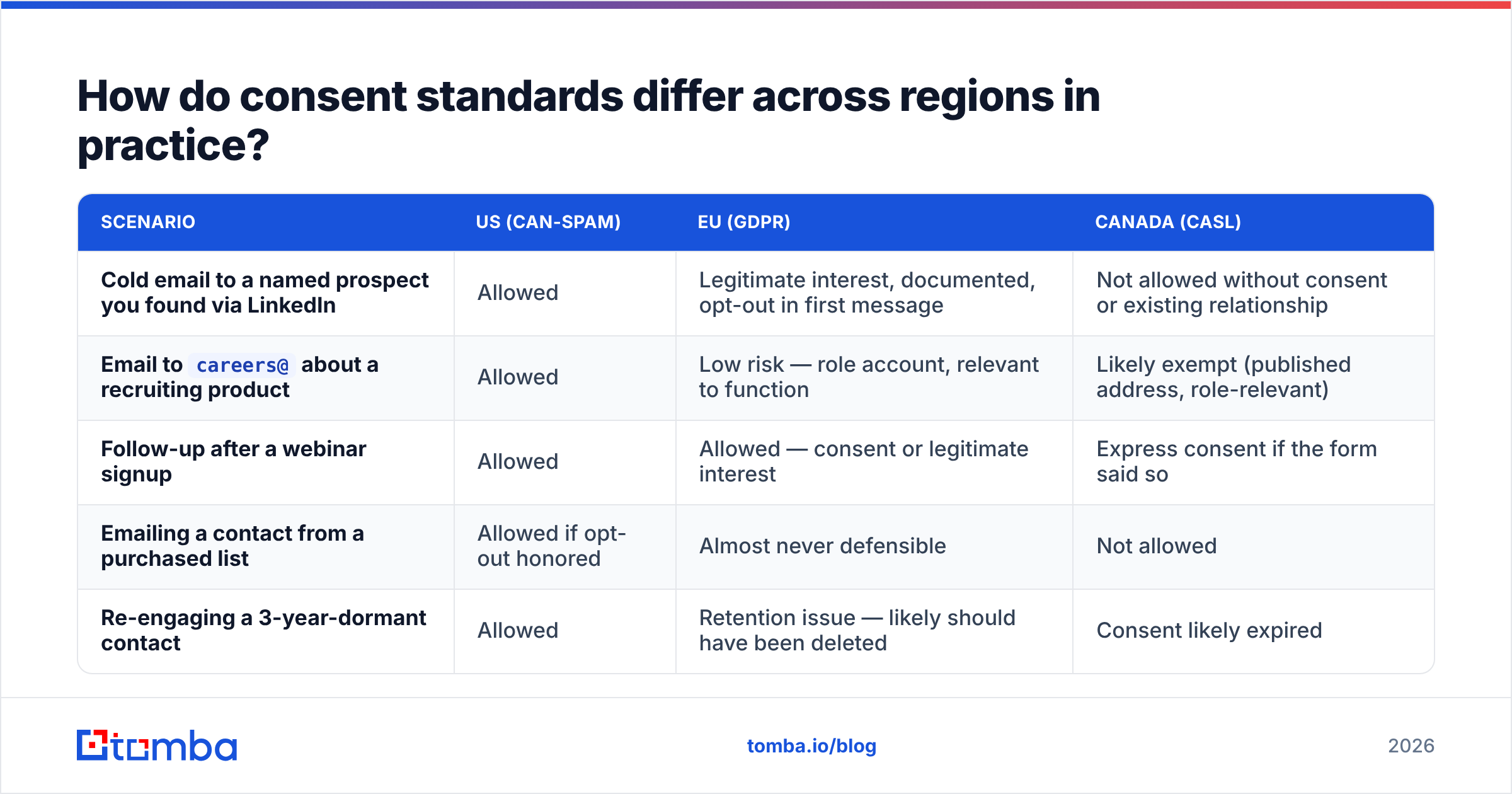
The gap between "legal in Chicago" and "legal in Berlin" is wider than most sequencers assume.
| Scenario | US (CAN-SPAM) | EU (GDPR) | Canada (CASL) |
|---|---|---|---|
| Cold email to a named prospect you found via LinkedIn | Allowed | Legitimate interest, documented, opt-out in first message | Not allowed without consent or existing relationship |
Email to careers@ about a recruiting product |
Allowed | Low risk — role account, relevant to function | Likely exempt (published address, role-relevant) |
| Follow-up after a webinar signup | Allowed | Allowed — consent or legitimate interest | Express consent if the form said so |
| Emailing a contact from a purchased list | Allowed if opt-out honored | Almost never defensible | Not allowed |
| Re-engaging a 3-year-dormant contact | Allowed | Retention issue — likely should have been deleted | Consent likely expired |
The practical takeaway: run one global standard rather than three. If your process satisfies GDPR — documented source, documented basis, immediate opt-out, honest identity — it satisfies CAN-SPAM automatically and gets you most of the way to CASL. Building three parallel workflows is how teams end up with suppression leaks.
For the sequencing side of the equation, this pairs closely with your broader email deliverability posture — the same signals that regulators treat as evidence of good faith are the signals mailbox providers use to decide whether you reach the inbox.
What do Google, Yahoo, and Microsoft require now?#
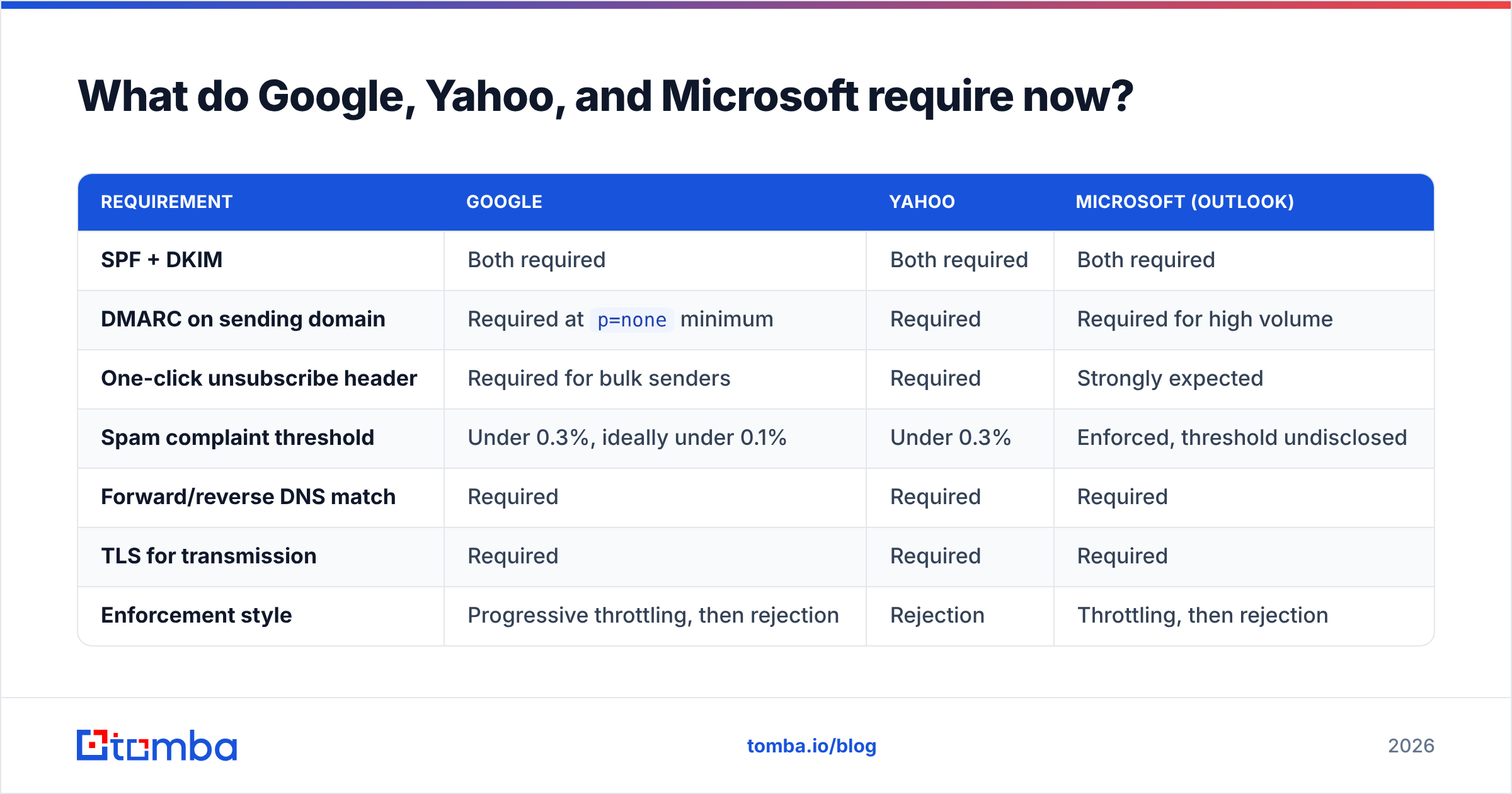
This is the layer that shuts programs down within days rather than months.
| Requirement | Yahoo | Microsoft (Outlook) | |
|---|---|---|---|
| SPF + DKIM | Both required | Both required | Both required |
| DMARC on sending domain | Required at p=none minimum |
Required | Required for high volume |
| One-click unsubscribe header | Required for bulk senders | Required | Strongly expected |
| Spam complaint threshold | Under 0.3%, ideally under 0.1% | Under 0.3% | Enforced, threshold undisclosed |
| Forward/reverse DNS match | Required | Required | Required |
| TLS for transmission | Required | Required | Required |
| Enforcement style | Progressive throttling, then rejection | Rejection | Throttling, then rejection |
Note the asymmetry: a regulator sends you a letter. Gmail just stops delivering. There's no appeal queue, no notification, and your open rates look normal because the mail that does land still gets opened. You find out weeks later from a flat pipeline.
Two habits catch this early. Monitor your domain in Google Postmaster Tools — it's free and shows your actual spam rate and domain reputation as Google sees it. And check whether your sending IP or domain has landed on a public blocklist using a blacklist checker before you assume the problem is your copy.

Is cold email still legal for B2B in 2026?#
Yes, in most markets, with conditions — and the conditions are getting more specific rather than more restrictive.
In the United States, cold B2B email remains explicitly lawful. In the EU and UK, business-to-business outreach under legitimate interest remains lawful when you can show a genuine relevance between what you sell and what the recipient does, and when you make objecting trivially easy. UK ICO guidance has consistently treated corporate subscribers differently from individual subscribers under PECR — B2B cold email to a company address is permitted where an opt-out is offered.
What has changed is the evidentiary burden. "We thought it was fine" is no longer a position. Regulators and mailbox providers both now expect you to produce a record. That record is what separates a compliant program from a lucky one.
Where teams still get into trouble:
- Automated scraping at scale. Pulling addresses from sites whose terms prohibit it creates liability independent of email law. Use tools that source from public, permissible signals and disclose their data sources rather than opaque scrapers.
- Personal-inbox targeting. Emailing someone's Gmail or personal address about a work product moves you out of B2B territory and into consumer protection rules everywhere.
- Sending from a domain you can't afford to burn. Never run cold outreach from your primary corporate domain. Use a dedicated, authenticated sending domain so a reputation hit doesn't take down your transactional and internal mail.
How do you build compliance into your data workflow?#
Compliance survives contact with reality only when it lives in the data layer. Bolting a footer disclaimer onto a sequence is theatre.
Structure your prospect record with four mandatory fields beyond the contact details themselves:
- Source — the specific tool or page the record came from, not "web."
- Collected at — an ISO timestamp.
- Basis — consent, legitimate interest, or existing business relationship.
- Suppression status — a single boolean read by every outbound tool you run.
Then enforce three gates before anything sends. Gate one: is the address verified and non-catch-all? Use a catch-all verifier so you're not guessing on domains that accept everything. Gate two: is the record present on any suppression list, including customer-support opt-outs and unsubscribes from other campaigns? Gate three: is the record within your retention window?
If you're sourcing at volume, do this at the point of enrichment rather than the point of send. A bulk email finder that returns a confidence score and a source alongside each address gives you the audit trail automatically; a scraper that returns a bare string gives you a liability. The same logic applies to data enrichment — enriched fields need provenance too, because a GDPR access request covers everything you hold about a person, not just their email address.
For teams running this programmatically, wiring the checks into your own stack via an email verification API means the gate can't be skipped by a rep in a hurry. Human discipline degrades; a failing API call doesn't.
What does a compliant cold email actually look like?#
Structurally, five elements, none of which cost you conversion:
- A
Fromname and address that identify your real company. No lookalike domains, no personal-sounding aliases for a corporate send. - A subject line that describes the message honestly. No fake
Re:orFwd:prefixes. - A first-message opt-out. One line, plain language, at the bottom. "If this isn't relevant, reply 'no' and I'll close your file" works and is more human than a footer link — though you still need the
List-Unsubscribeheader for bulk sends. - A physical postal address. Required by CAN-SPAM and CASL. A registered business address is fine.
- Relevance you could defend out loud. If you couldn't explain to the recipient's face why you contacted them specifically, your legitimate-interest argument is weak, and so is your reply rate. These fail together.
Vendors in this space handle the trade-off differently. Tools like BookYourData, which sells pre-built B2B contact lists with stated accuracy guarantees, and search-based finders that resolve addresses on demand, sit at different points on the provenance spectrum — pre-built lists optimize for immediate volume, on-demand search optimizes for a per-record source trail. Both are legitimate; they suit different compliance postures. If your primary market is the EU, the per-record trail matters more. If you're US-only and moving fast, list-based sourcing carries less regulatory weight. Cross-check any vendor's actual reviews on G2 before committing budget.
Your compliance checklist before the next send#
Run this once per quarter, not once per year:
- SPF, DKIM, and DMARC pass on every sending domain, with alignment verified
List-UnsubscribeandList-Unsubscribe-Postheaders present on bulk sends- Central suppression list read by every tool, including your CRM and support desk
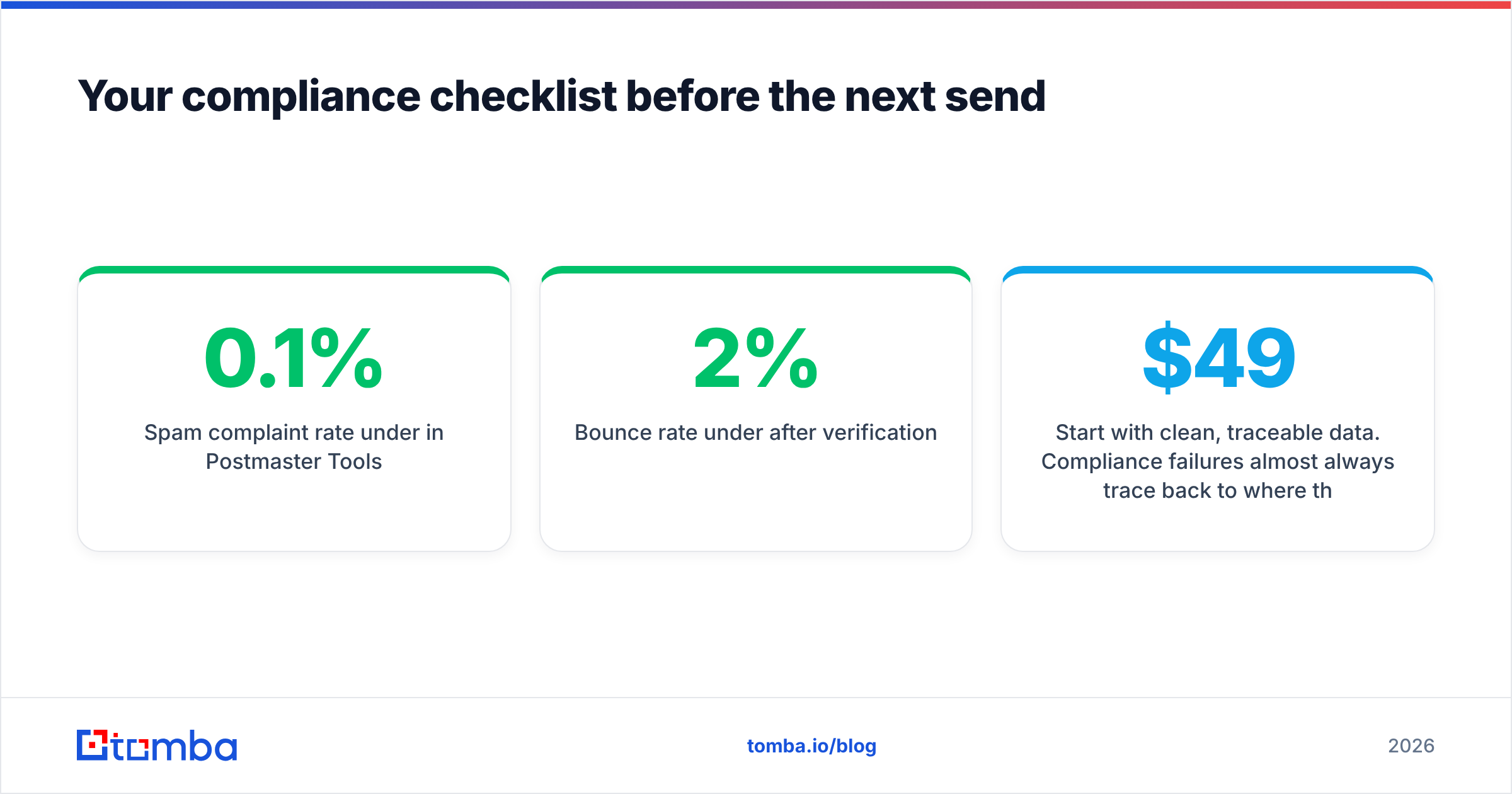
- Spam complaint rate under 0.1% in Postmaster Tools
- Bounce rate under 2% after verification
- Every contact record carries source, timestamp, and lawful basis
- Retention policy defined and automatically enforced
- A named person who owns responses to access and deletion requests
- Dedicated sending domain, separate from your corporate mail
- Written legitimate-interest assessment on file for EU outreach
If you fail more than two of these, fix the data layer before you touch the copy. Better subject lines on a non-compliant list just accelerate the damage.
Start with clean, traceable data. Compliance failures almost always trace back to where the contact came from — not to what the message said. Tomba's Email Finder returns verified professional addresses with a confidence score and a source signal for each result, so every record in your CRM arrives with the provenance a GDPR or CASL response requires. The free tier includes 25 searches per month; paid plans start at $49/mo for Starter, $99/mo for Growth, and $249/mo for Pro — see full Tomba pricing for credit limits and API access. Build the audit trail while you build the list, and you'll never have to reconstruct it under pressure.
Related guides#
Ready to find emails that actually work?
Join 150,000+ professionals who stopped guessing and started sending. Free credits on signup — no credit card required.
Get the Tomba newsletter
Practical outbound tactics and product updates — once every two weeks.
About the author