Email Hippo vs Generect: Verifier vs Lead Database in 2026
Email Hippo verifies addresses you already own. Generect finds new ones. Comparing them head-to-head only makes sense once you know which half of the pipeline is actually leaking — here's the breakdown.
TL;DR
- Email Hippo and Generect are not really competitors. Email Hippo is a deep email verification engine; Generect is a B2B lead database and finder built around LinkedIn-shaped queries. Comparing them is comparing a smoke detector to a house.
- Pick Email Hippo if you already have lists — from a CRM, a form, an event scan, a legacy database — and your problem is bounce rate, sender reputation, and fraud signals.
- Pick Generect if your problem is empty pipeline: you need net-new contacts, company filters, and enriched records that did not exist in your CRM this morning.
- The expensive mistake is buying both and paying twice for overlapping verification, since most modern finders verify at the point of discovery.
- If you want find + verify + enrich under one API and one bill, a consolidated tool (Tomba, Findymail, BookYourData, and similar) usually beats stitching a verifier to a database.
What do Email Hippo and Generect actually do?#
Start with the category confusion, because it drives most of the bad purchases here.
Email Hippo is a UK-based email verification company that has been running since 2014. Its products split into a free single-address checker (Core), a bulk/list product, and an API-first service aimed at real-time validation inside signup forms and fraud workflows. The differentiator it markets is depth per address: not just "does this mailbox exist" but signals around disposability, role accounts, domain age, and risk scoring.
Generect sits on the other side of the funnel. It is a lead generation data platform: you search by company, title, seniority, geography, or LinkedIn-derived attributes, and it returns contact records — work emails, sometimes personal emails, sometimes phones — with real-time validation applied before delivery. It leans heavily on API access and is popular with agencies and dev-heavy GTM teams building their own prospecting pipes.
Here is the split in plain terms:
- Email Hippo answers "is this address safe to send to?" — input is an address you already possess.
- Generect answers "who should I email at this company?" — input is a company, a role, or a filter set.
- Email Hippo's value is risk reduction — fewer bounces, fewer spam traps, cleaner sender reputation.
- Generect's value is coverage — more qualified contacts entering the top of the funnel each week.
- Email Hippo prices per check. You pay for volume of addresses validated.
- Generect prices per plan/credit tier. You pay for volume of records exported.
If you read those six lines and immediately knew which side your pain lives on, you can stop reading and go buy that one. Most teams do not, which is why the rest of this exists.

How do Email Hippo and Generect compare feature by feature?#
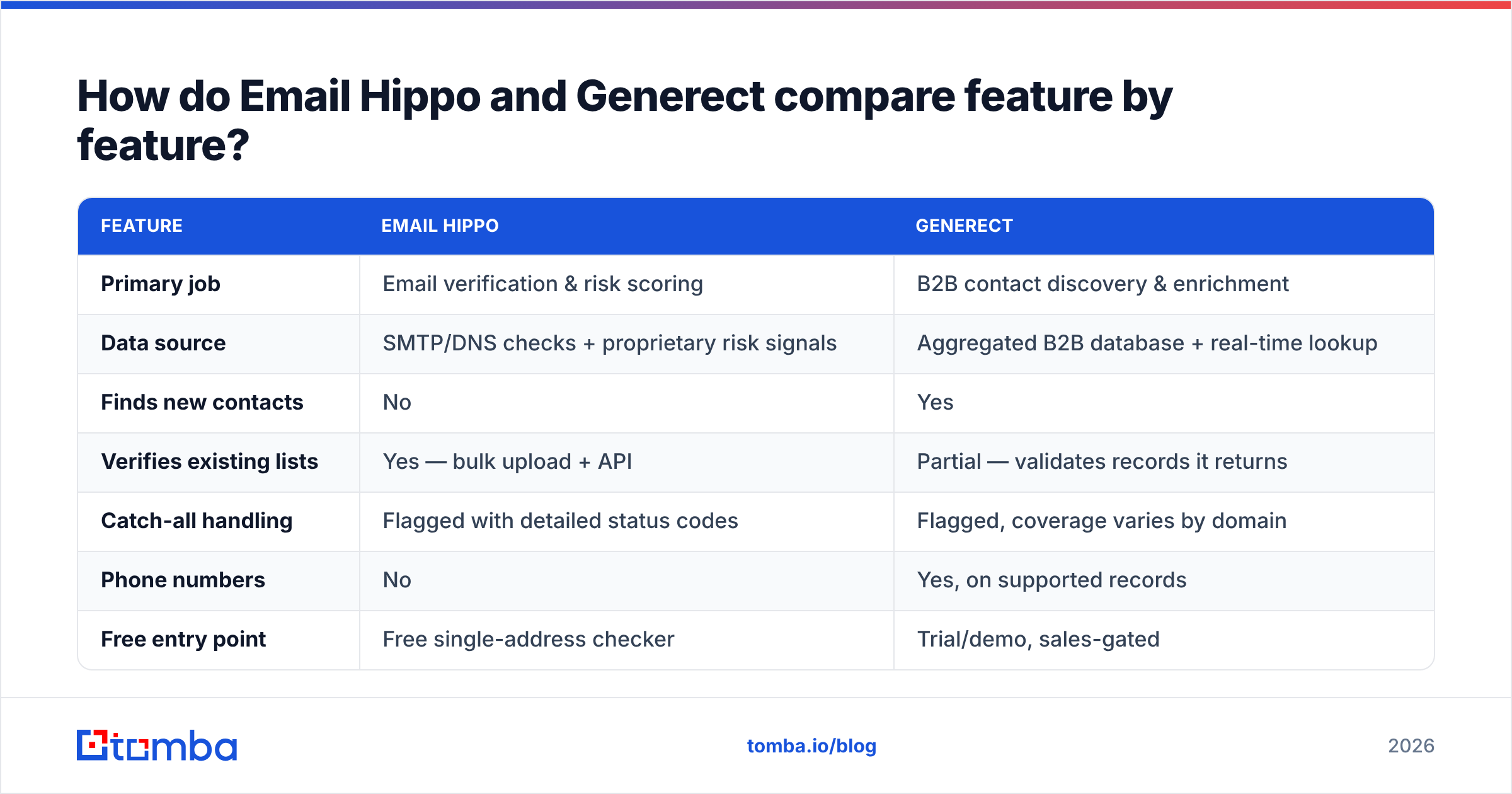
Vendor pricing and packaging change often, so treat every number below as directional and confirm on the vendor's own page before you sign anything. What matters more than the exact dollar figure is the shape of what you get.
| Feature | Email Hippo | Generect |
|---|---|---|
| Primary job | Email verification & risk scoring | B2B contact discovery & enrichment |
| Data source | SMTP/DNS checks + proprietary risk signals | Aggregated B2B database + real-time lookup |
| Finds new contacts | No | Yes |
| Verifies existing lists | Yes — bulk upload + API | Partial — validates records it returns |
| Catch-all handling | Flagged with detailed status codes | Flagged, coverage varies by domain |
| Phone numbers | No | Yes, on supported records |
| Free entry point | Free single-address checker | Trial/demo, sales-gated |
| Pricing model | Credit packs, pay-per-check | Subscription tiers / API credits |
| Typical buyer | Marketing ops, fraud/risk, ESP admins | SDR teams, agencies, growth engineers |
| API-first? | Yes, mature and documented | Yes, core to the product |
| Best for | List hygiene at scale | Net-new pipeline generation |
Two things stand out.
First, the overlap is thin. Generect validates what it hands you, but it is not a list-hygiene product — you cannot dump 400,000 legacy CRM records into it and expect a full hygiene report with risk codes. Email Hippo will do exactly that, and do it well.
Second, the gap is wide. Email Hippo will never tell you who the VP of Engineering at a 300-person fintech in Berlin is. If that is the question, no amount of verification depth helps.
Which one is more accurate — and accurate at what?#
"Accuracy" means two different things for these two tools, and conflating them is how buyers end up disappointed.
For a verifier like Email Hippo, accuracy is classification accuracy: of the addresses marked deliverable, what percentage actually deliver? Of those marked undeliverable, how many were false negatives you just threw away? Good verifiers land in the 95–99% band on clean corporate domains and degrade on catch-all, greylisted, and heavily-protected domains (Microsoft 365 tenants with aggressive SMTP behavior are the classic headache).
For a finder like Generect, accuracy is match accuracy: of the records returned, what share are the right person at the right company with a currently-valid address? This number is always lower than verification accuracy, because it compounds two risks — wrong person and dead mailbox.

The practical implication: never benchmark them against each other with one test. Run two tests.
- Verifier test: take 500 addresses you know the outcome for (recent sends with confirmed opens vs confirmed hard bounces). Feed them in. Score classification, not confidence.
- Finder test: take 100 named people you can confirm independently. Ask the tool to find them. Score coverage (how many returned anything) separately from precision (how many were right).
Most vendors publish accuracy claims computed on their own favorable sample. Your list is not their sample. A 300-record pilot on your actual ICP beats every marketing page, including this one.
What do Email Hippo and Generect cost in practice?#
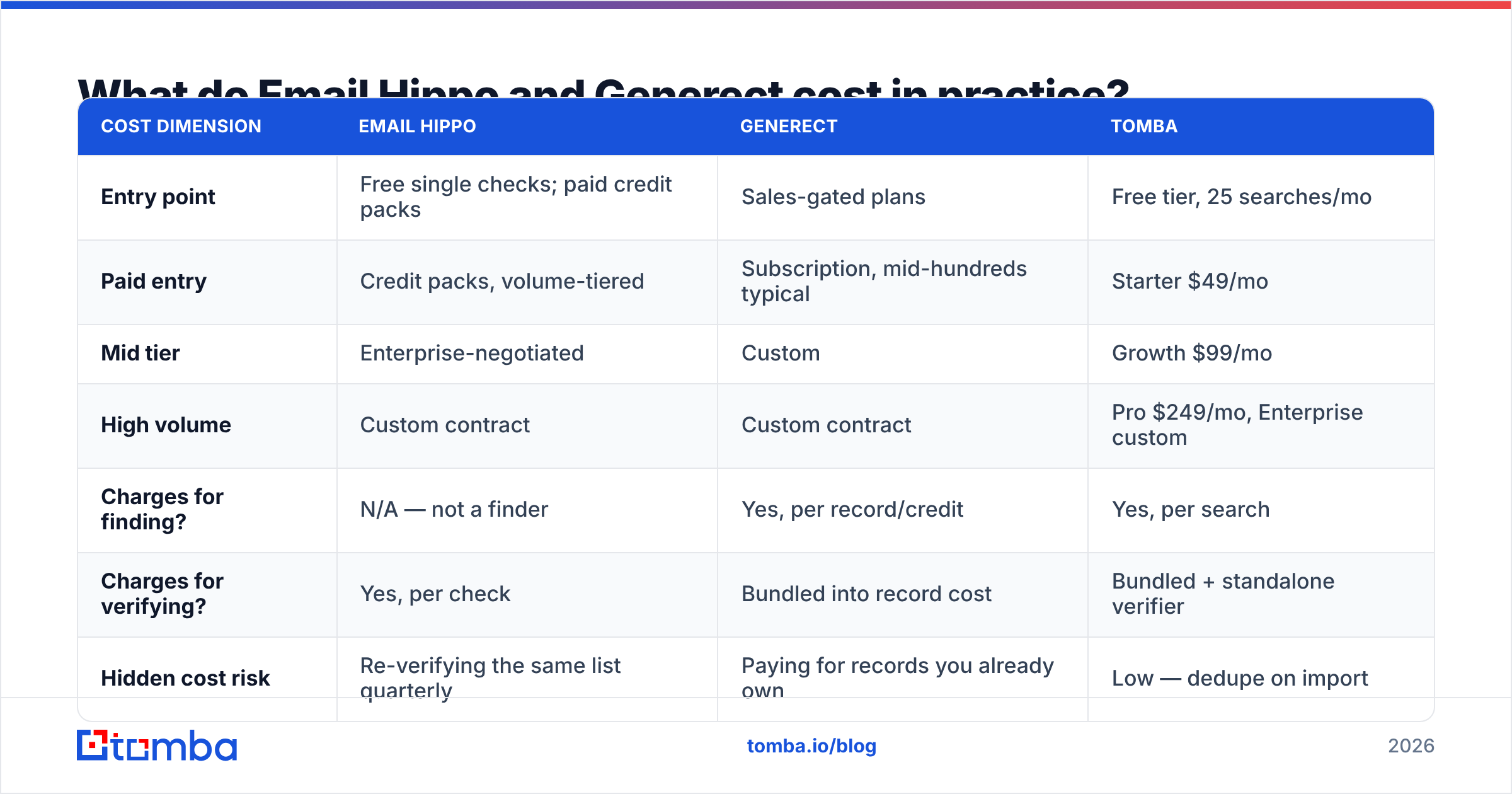
Pricing pages move; the underlying economics do not. Here is how the cost model actually behaves at scale, with Tomba included as a consolidated reference point.
| Cost dimension | Email Hippo | Generect | Tomba |
|---|---|---|---|
| Entry point | Free single checks; paid credit packs | Sales-gated plans | Free tier, 25 searches/mo |
| Paid entry | Credit packs, volume-tiered | Subscription, mid-hundreds typical | Starter $49/mo |
| Mid tier | Enterprise-negotiated | Custom | Growth $99/mo |
| High volume | Custom contract | Custom contract | Pro $249/mo, Enterprise custom |
| Charges for finding? | N/A — not a finder | Yes, per record/credit | Yes, per search |
| Charges for verifying? | Yes, per check | Bundled into record cost | Bundled + standalone verifier |
| Hidden cost risk | Re-verifying the same list quarterly | Paying for records you already own | Low — dedupe on import |
The line that bites teams is the last one. If you run Generect for discovery and Email Hippo for hygiene, you are frequently paying to verify addresses that were already validated at the point of discovery. That is fine at 2,000 records a month and genuinely wasteful at 200,000.
The counter-argument is real too: data decays at roughly 22–30% per year in B2B, so an address verified in March is not the same asset in November. Re-verification before a big send is not waste — re-verification the week you bought the record usually is.
How do they handle catch-all domains?#
This is where verification vendors separate from each other, and it deserves its own section because catch-all domains are now a huge share of enterprise email.
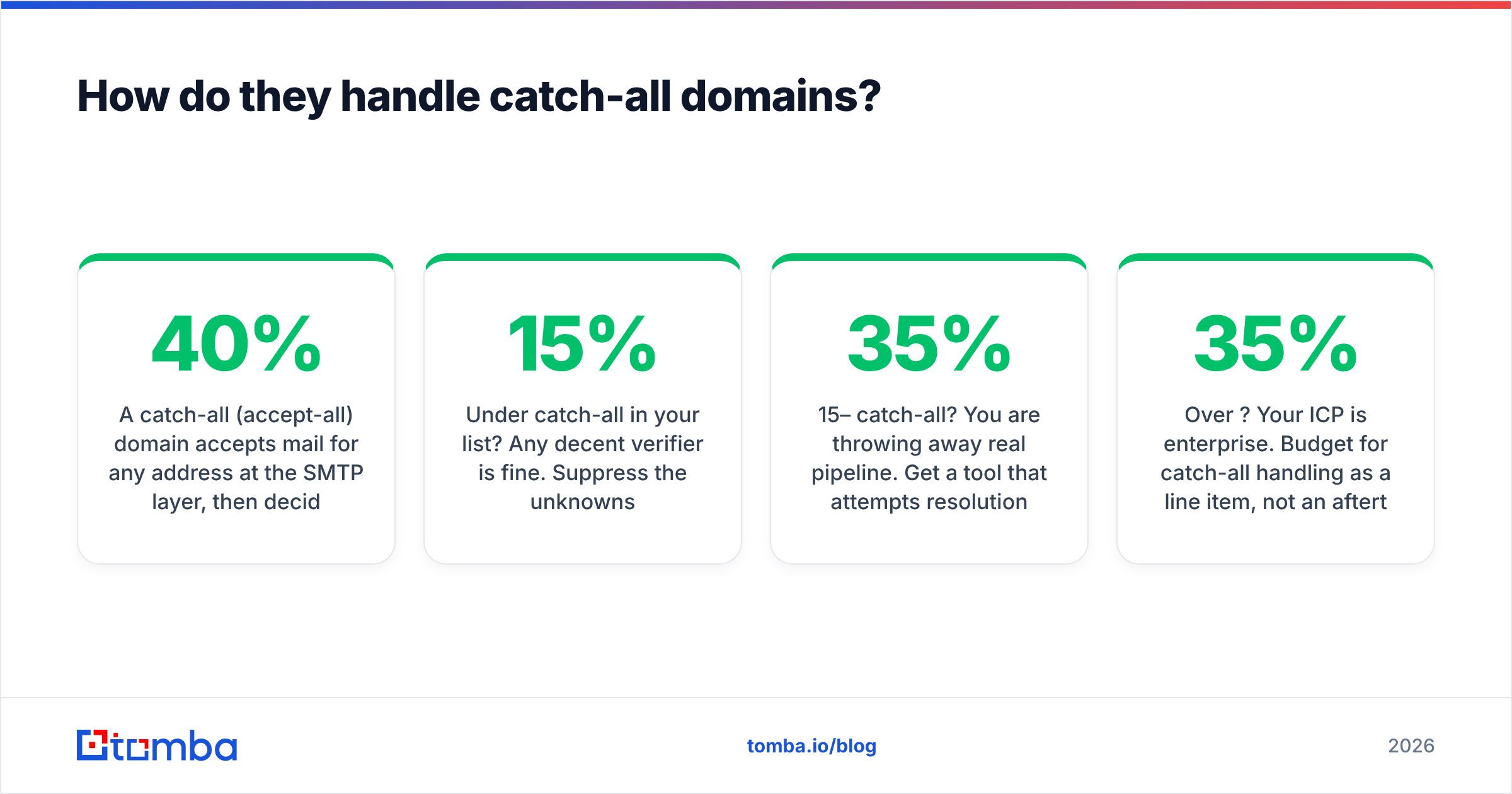
A catch-all (accept-all) domain accepts mail for any address at the SMTP layer, then decides internally whether to deliver or silently drop it. Standard verification returns "unknown" and hands you the risk. Depending on the industry, 20–40% of corporate domains behave this way.
Email Hippo's status taxonomy is one of its stronger features — it gives you granular reason codes rather than a binary yes/no, which lets you build your own risk thresholds. Generect flags catch-alls in its output but is not primarily in the business of resolving them.
If catch-all resolution is your bottleneck, a dedicated catch-all verifier that attempts pattern inference and cross-source confirmation will do more for your bounce rate than switching general-purpose verifiers. The decision tree is short:
- Under 15% catch-all in your list? Any decent verifier is fine. Suppress the unknowns.
- 15–35% catch-all? You are throwing away real pipeline. Get a tool that attempts resolution.
- Over 35%? Your ICP is enterprise. Budget for catch-all handling as a line item, not an afterthought.
Which one fits your workflow — verification-first or data-first?#
Think about where your process actually starts.
Verification-first teams already have contacts. Inbound-heavy SaaS companies, event marketers with badge-scan lists, ecommerce brands with years of signups, anyone migrating ESPs. Your list exists; it is just dirty. Every send is a coin flip on email deliverability. Email Hippo is built for you, and its API-in-the-signup-form pattern — validate before the record ever enters your database — is the highest-ROI implementation of a verifier there is. Clean at the door and you never need a big cleanup project.
Data-first teams have a target account list and no contacts. Outbound SDR orgs, agencies running lead gen for clients, founders doing their first 100 cold emails. Generect's filtering and API access make it a reasonable engine, particularly if you are piping records into your own sequencer rather than clicking around a UI.
Both-problems teams — which is most of the market — face the consolidation question. Two vendors means two contracts, two APIs, two failure modes, two support queues, and a manual seam where records move from one to the other. That seam is where CSV exports go to die.

Where does Tomba fit into the comparison?#
Honest framing: Tomba is not the deepest fraud-risk verifier on the market, and Email Hippo has more specialised risk signals for that specific job. If your use case is payments fraud screening or regulated signup flows, evaluate a dedicated risk vendor.
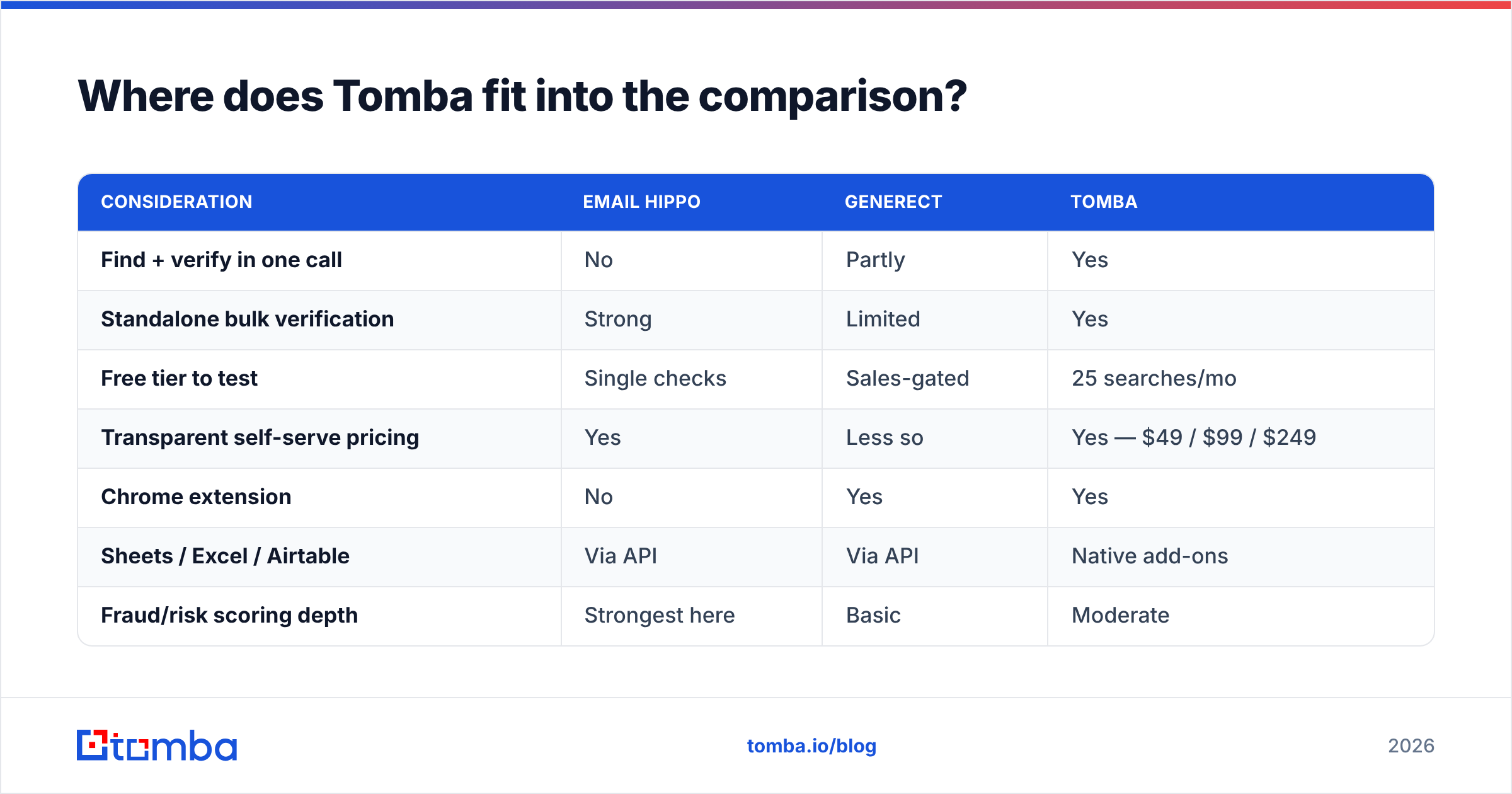
What Tomba does is collapse the seam. The email finder discovers addresses by domain, name, or company; the email verifier validates them in the same request cycle; and the same credits cover domain search, catch-all checks, phone lookup, and enrichment. One API key, one bill, one dedupe layer.

| Consideration | Email Hippo | Generect | Tomba |
|---|---|---|---|
| Find + verify in one call | No | Partly | Yes |
| Standalone bulk verification | Strong | Limited | Yes |
| Free tier to test | Single checks | Sales-gated | 25 searches/mo |
| Transparent self-serve pricing | Yes | Less so | Yes — $49 / $99 / $249 |
| Chrome extension | No | Yes | Yes |
| Sheets / Excel / Airtable | Via API | Via API | Native add-ons |
| Fraud/risk scoring depth | Strongest here | Basic | Moderate |
The honest verdict by scenario:
- You only need hygiene on lists you already own → Email Hippo. Buy it, do not overthink it.
- You only need net-new B2B contacts and you build your own pipes → Generect is a legitimate option; also price-check the broader field on G2 before committing, since this category is crowded and pricing varies wildly.
- You need both, at SMB-to-mid-market volume → consolidate. Two vendors at 5,000 records a month is operational overhead you will not recover.
- You need both, at genuine enterprise volume with compliance requirements → keep them separate. At that scale, best-of-breed beats convenience, and you have the engineering time to maintain the seam.
What should you check before you commit?#
Run this list before any contract, regardless of which way you lean.
- Pilot on your own data. 300–500 records minimum. Vendor benchmarks are marketing.
- Check the credit rollover policy. Do unused credits expire monthly? Most do. That changes effective cost more than headline price.
- Test the API, not the UI. If you will integrate it, the docs and rate limits matter more than the dashboard.
- Ask what happens to unknowns. Are you charged for a result you cannot use? Some vendors charge for every check; others only for confident results.
- Confirm GDPR/compliance posture if you sell into the EU. Data provenance is a real procurement blocker for lead databases specifically.
- Measure bounce rate 30 days later, not on day one. The whole point is deliverability, and that only shows up in the send data.
Ready to stop paying two vendors for one pipeline?#
If your honest answer is "I need to find contacts and keep my bounce rate under 2%," running a discovery tool and a verification tool as separate line items is the expensive path. Start with the Tomba Email Finder — the free tier gives you 25 searches a month with no card, enough to run the pilot described above against your own ICP. Paid plans start at $49/mo with verification, domain search, and catch-all checks included rather than billed separately. Compare the results against whatever you are running now, look at the bounce data 30 days out, and let that decide it. See full Tomba pricing or read the Tomba API docs if you would rather test it in code first.
Related guides#
Ready to find emails that actually work?
Join 150,000+ professionals who stopped guessing and started sending. Free credits on signup — no credit card required.
Get the Tomba newsletter
Practical outbound tactics and product updates — once every two weeks.
About the author