Email Hippo vs Leadzenai: Which B2B Data Tool Wins in 2026?
Email Hippo verifies addresses you already have. Leadzen.ai finds contacts you don't. Here's how the two compare on accuracy, pricing, coverage and workflow fit in 2026 — and when neither is the right pick.
Email Hippo vs Leadzenai is a comparison of two different jobs. One tool cleans the list you already have. The other builds the list you don't. Here's how to tell which problem is yours.
TL;DR
- They are not the same category. Email Hippo is a deep email verification engine. Leadzen.ai is a prospecting and lead-intelligence database. Comparing them head-to-head only makes sense if you're deciding which problem to solve first.
- Pick Email Hippo if you already own a large list and your bounce rate is the fire — its multi-stage SMTP and risk scoring is genuinely thorough, and it has an assurance/compliance angle most verifiers skip.
- Pick Leadzen.ai if you have no list at all and need Indian and APAC contact coverage, phone numbers, and a LinkedIn-side workflow.
- Neither covers the full loop. Verification without discovery leaves you list-poor; discovery without verification leaves you bounce-rich. Most teams end up paying for two tools.
- The honest third option is a platform that does find + verify + enrich on one credit pool — which is where Tomba, Findymail, and a handful of others sit.
What is Email Hippo, and what does it actually do?#
Email Hippo is a UK-based email verification specialist. It has been around far longer than most of the tools in this space, and its product line reflects that: a bulk verification interface (historically branded MORE), a real-time verification API for signup forms, and a compliance/assurance layer aimed at regulated industries.
What it does well is depth per address. A single check runs through syntax validation, domain and MX record lookups, disposable-domain detection, role-account flagging, and mailbox-level SMTP probing. It then returns a risk score. So you get more than a valid/invalid flag — you also learn how sure the verdict is. For teams sending high-volume marketing mail, that grading beats a binary answer. You can hold back the "risky" bucket instead of deleting it or blasting it.
What it does not do is find anyone. Email Hippo takes an address as input. If you don't have addresses, it has nothing to work with. That single fact drives most of this comparison.
Where Email Hippo tends to frustrate people:
- Catch-all domains remain fuzzy. Every verifier struggles here, and Email Hippo is honest about it — but "unknown" results still cost credits and still leave you guessing. If a large share of your target accounts run catch-all servers (common in enterprise and in Google Workspace shops), you'll want a dedicated catch-all verifier approach on top.
- Per-credit cost climbs at volume compared to the newer budget verifiers.
- The UI feels engineered, not designed. Powerful, but not the tool your SDRs will love opening every morning.
What is Leadzen.ai, and who is it built for?#
Leadzen.ai is an India-headquartered B2B lead intelligence platform. Its pitch is discovery. You search a database of companies and professionals, then filter by industry, geography, headcount, designation and technology. From there you pull contact details — email addresses and, notably, phone numbers.
Its real differentiator is regional. Most Western data vendors have thin, stale coverage of Indian, Southeast Asian and Middle Eastern mid-market companies. Leadzen.ai treats that region as the core market rather than the long tail. If your ICP is a 200-person manufacturing firm in Pune or a SaaS company in Bengaluru, Leadzen.ai will usually surface contacts that a US-centric database returns empty on.
It also ships a browser extension for LinkedIn-side prospecting, list building, and a basic outreach layer. That makes it closer to Apollo or Lusha in shape than to Email Hippo.
Where Leadzen.ai tends to frustrate people:
- Verification is a feature, not a discipline. Records are checked, but you don't get the forensic per-address risk breakdown a specialist verifier produces.
- Coverage outside its core geography thins fast. North American and Western European coverage exists but is not the reason to buy it.
- Pricing and packaging are less transparent than the self-serve Western tools — expect a sales conversation for anything past the entry tier.

Email Hippo vs Leadzenai: which one solves your bottleneck?#
"Which is better" is the wrong question about 80% of the time. Here's the framing that actually helps.
Ask what your bottleneck is right now:
- "My emails bounce and my domain reputation is suffering." That's a verification problem. Email Hippo is a legitimate answer. So is a cheaper specialist verifier if you don't need the compliance layer.
- "I have no one to email." That's a discovery problem. Email Hippo cannot help you at all. Leadzen.ai can, if your market is APAC/India.
- "I have a list, but it's stale and half of it is missing job titles." That's an enrichment problem. Neither tool is purpose-built for it; you want a data enrichment endpoint.
- "I need both, and I need it to run on autopilot." That's a pipeline problem, and it's where a single find-plus-verify platform beats stitching two vendors together with Zapier.
Most teams misdiagnose. They buy a verifier because bounce rate is the visible metric. Six months later they learn the real constraint was list size. The reverse happens too: a team buys a prospecting database, sends to the export without checking it, and a 12% bounce rate torches the sending domain.
How do Email Hippo, Leadzen.ai and Tomba compare on features and price?#
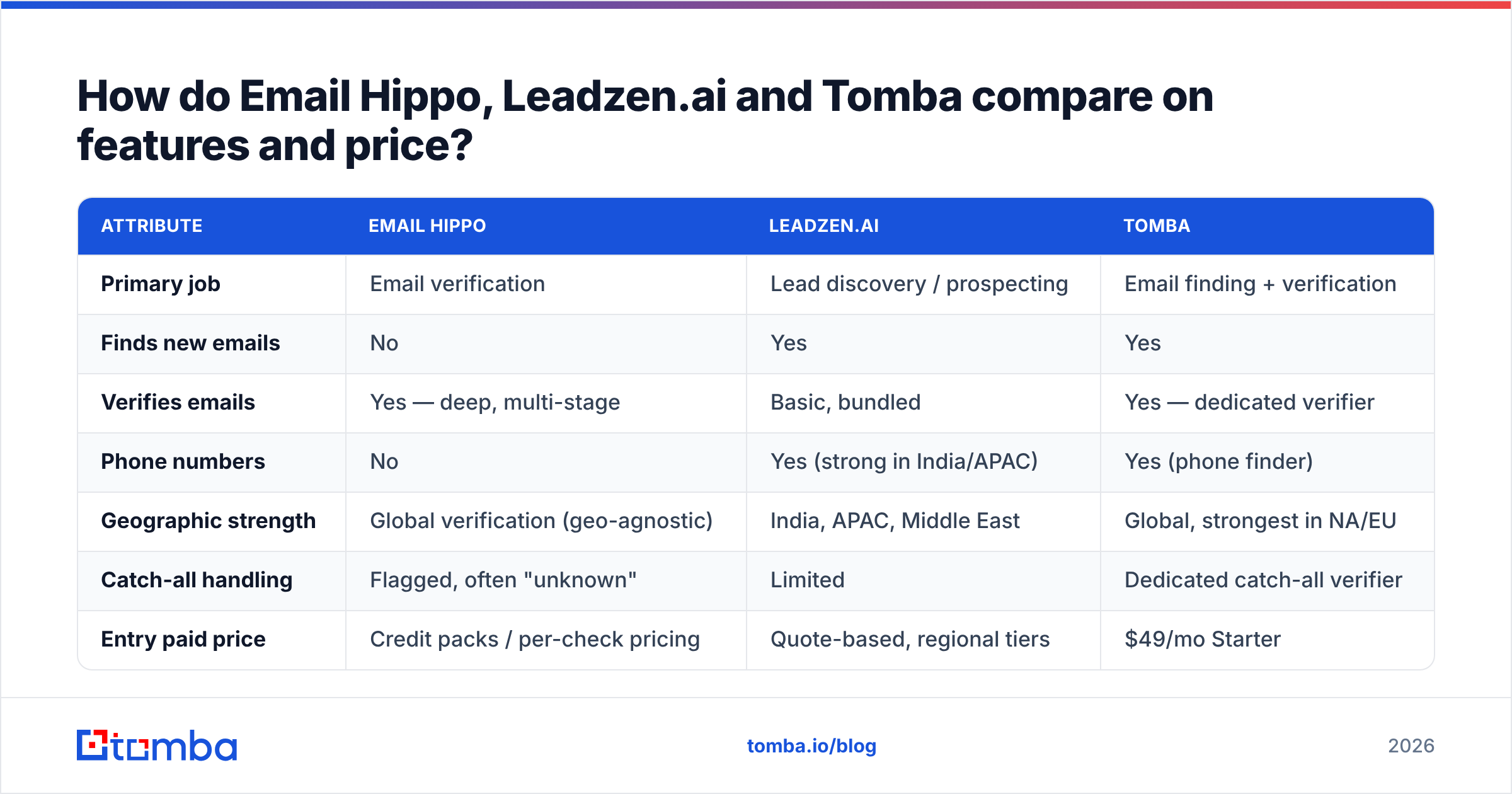
Here's the Email Hippo vs Leadzenai side-by-side, with Tomba added as the combined option. Treat pricing as directional — all three vendors adjust tiers, and Leadzen.ai in particular quotes regionally.
| Attribute | Email Hippo | Leadzen.ai | Tomba |
|---|---|---|---|
| Primary job | Email verification | Lead discovery / prospecting | Email finding + verification |
| Finds new emails | No | Yes | Yes |
| Verifies emails | Yes — deep, multi-stage | Basic, bundled | Yes — dedicated verifier |
| Phone numbers | No | Yes (strong in India/APAC) | Yes (phone finder) |
| Geographic strength | Global verification (geo-agnostic) | India, APAC, Middle East | Global, strongest in NA/EU |
| Catch-all handling | Flagged, often "unknown" | Limited | Dedicated catch-all verifier |
| Entry paid price | Credit packs / per-check pricing | Quote-based, regional tiers | $49/mo Starter |
| Free tier | Limited trial checks | Limited trial | 25 searches/mo, free forever |
| API | Yes, mature | Yes | Yes, REST + CLI + MCP |
| Bulk CSV workflow | Yes | Yes | Yes |
| Chrome extension | No | Yes | Yes |
| Best for | Cleaning big existing lists | Building APAC pipeline | Full find→verify loop |
The pattern is easy to read: Email Hippo owns the right-hand side of the funnel, Leadzen.ai owns the left-hand side of a specific region, and combined tools try to own both.

How accurate is each tool in practice?#
Accuracy claims in this market are close to meaningless without a defined test. Every vendor publishes a number in the mid-to-high 90s. Every one of those numbers is measured against a list the vendor picked.
What you should actually measure, on your own data:
- Hit rate — of 100 target prospects, how many addresses did the tool return at all? This is where discovery tools separate. A verifier scores zero here by definition.
- Deliverability rate — of the addresses returned, what percentage actually landed? Send a small seeded batch through a warmed domain and count hard bounces.
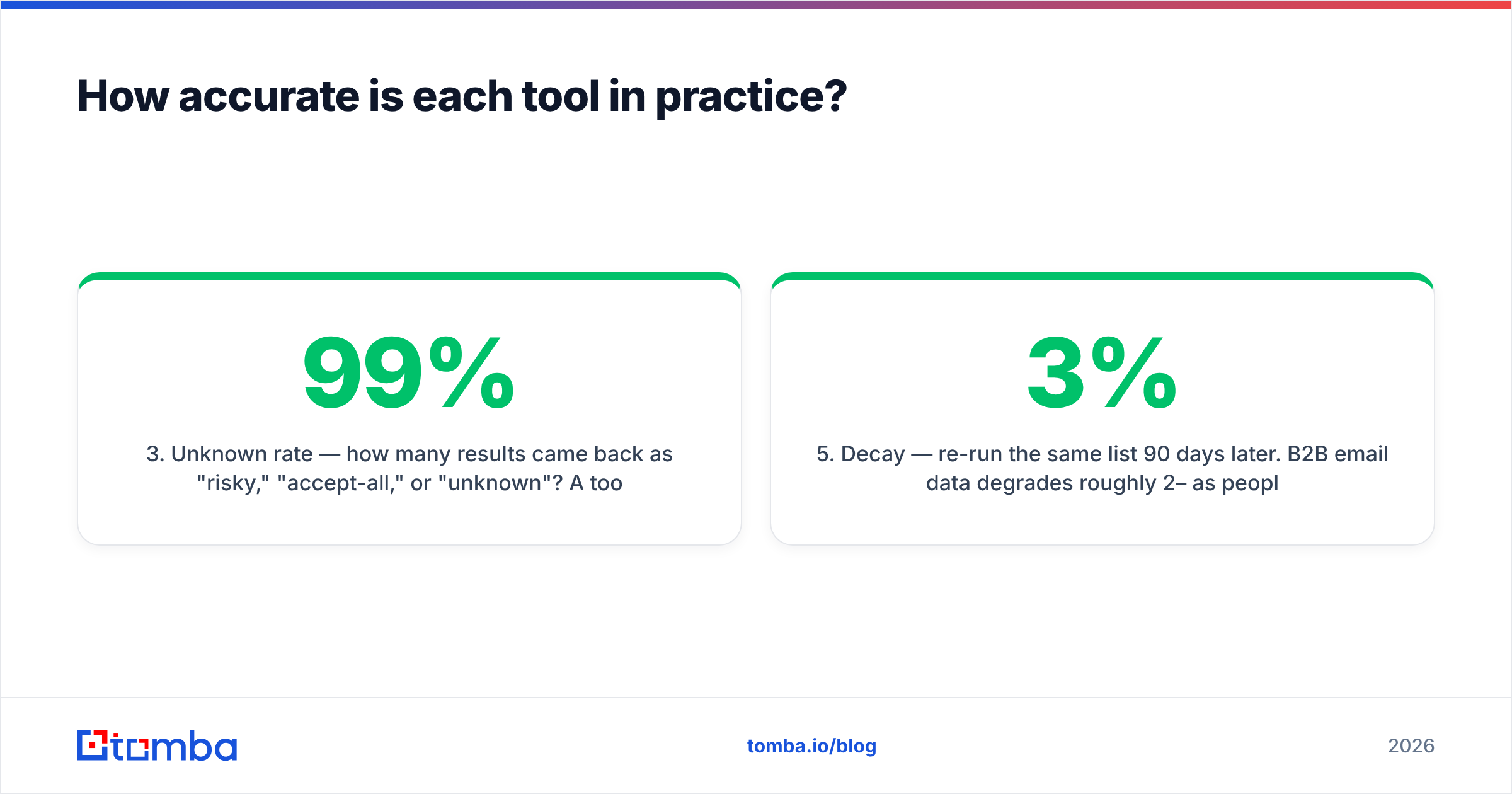
- Unknown rate — how many results came back as "risky," "accept-all," or "unknown"? A tool with 99% accuracy on 60% of your list and a shrug on the other 40% is not a 99% tool.
- Cost per delivered contact — divide total spend by contacts that actually received mail. This is the only number that survives contact with a CFO.
- Decay — re-run the same list 90 days later. B2B email data degrades roughly 2–3% per month as people change jobs; a database that doesn't refresh will quietly rot.
Run that on a 200-row sample before you commit to an annual contract with anyone. It costs an afternoon and routinely overturns the vendor ranking you expected.

On the specifics: Email Hippo's verdicts are conservative. That's the right bias, because the tool would rather mark an address risky than tell you to send. Leadzen.ai's returned emails are strong for its home market and weaker for Western enterprises, going by the reports users leave on G2. Neither pattern is a scandal. Both are what you'd predict from how each product is built.
What does the total cost of a two-tool stack look like?#
This is where the "which is better" question resolves into arithmetic.
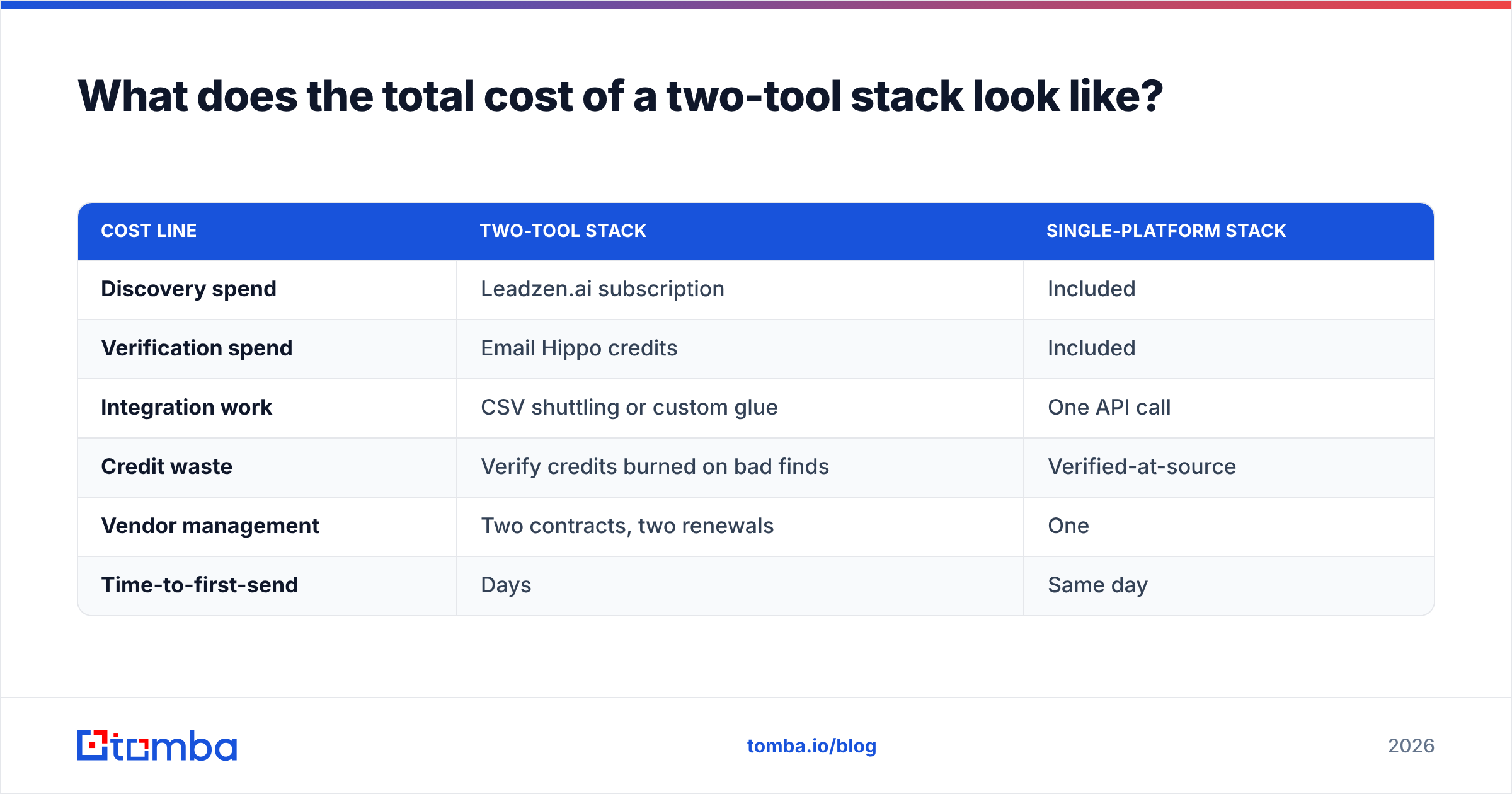
Buy Leadzen.ai to find contacts and Email Hippo to verify them, and you pay twice per contact — once for discovery, once for validation. Then add the hidden cost of moving data between them. That hidden cost is real: someone exports a CSV, someone imports it, someone reconciles the columns, someone forgets to re-verify the batch from three weeks ago.
| Cost line | Two-tool stack | Single-platform stack |
|---|---|---|
| Discovery spend | Leadzen.ai subscription | Included |
| Verification spend | Email Hippo credits | Included |
| Integration work | CSV shuttling or custom glue | One API call |
| Credit waste | Verify credits burned on bad finds | Verified-at-source |
| Vendor management | Two contracts, two renewals | One |
| Time-to-first-send | Days | Same day |
For a small team, a two-tool stack at roughly $150–$250/month combined is defensible if each tool is genuinely best-in-class for your situation. For most teams sending under 10,000 cold emails a month, it's over-buying. One platform at $49–$99/month covers find emails and verify emails on a single credit pool. Same workload, less operational drag — see Tomba pricing for how the tiers break down.

When should you actually choose Email Hippo?#
Choose Email Hippo when all of these are true:
- You already have the list. Inherited database, event scans, years of inbound signups, a CRM nobody has cleaned since 2021.
- The list is large. Hundreds of thousands of rows, where per-address depth compounds into real savings on sending infrastructure and reputation.
- You operate under compliance pressure. Financial services, healthcare, insurance — where being able to show why you sent to an address matters as much as whether it bounced.
- You need real-time form validation. Blocking junk signups at the point of entry is a different job from batch cleaning, and Email Hippo's API handles it well.
Don't choose Email Hippo if your problem is "I need more prospects." It will do its job perfectly and you'll still have an empty pipeline.
When should you actually choose Leadzen.ai?#
Choose Leadzen.ai when:
- Your ICP is Indian, South Asian, or broader APAC. This is the strongest single argument for the tool and it's a good one. Western databases genuinely under-serve this market.
- You need phone numbers alongside emails. Multi-channel outbound in these regions leans harder on phone than in North America, and Leadzen.ai reflects that.
- You prospect from LinkedIn. The extension workflow is where the product feels most natural.
- You want discovery and light outreach in one place and can accept that the verification layer is adequate rather than forensic.
Don't choose Leadzen.ai as your verification system of record. Always run exported lists through a dedicated verifier — including a catch-all finder pass — before a cold send, whatever database they came from.
What are the alternatives worth shortlisting?#
If neither tool maps cleanly onto your problem, the shortlist worth twenty minutes:
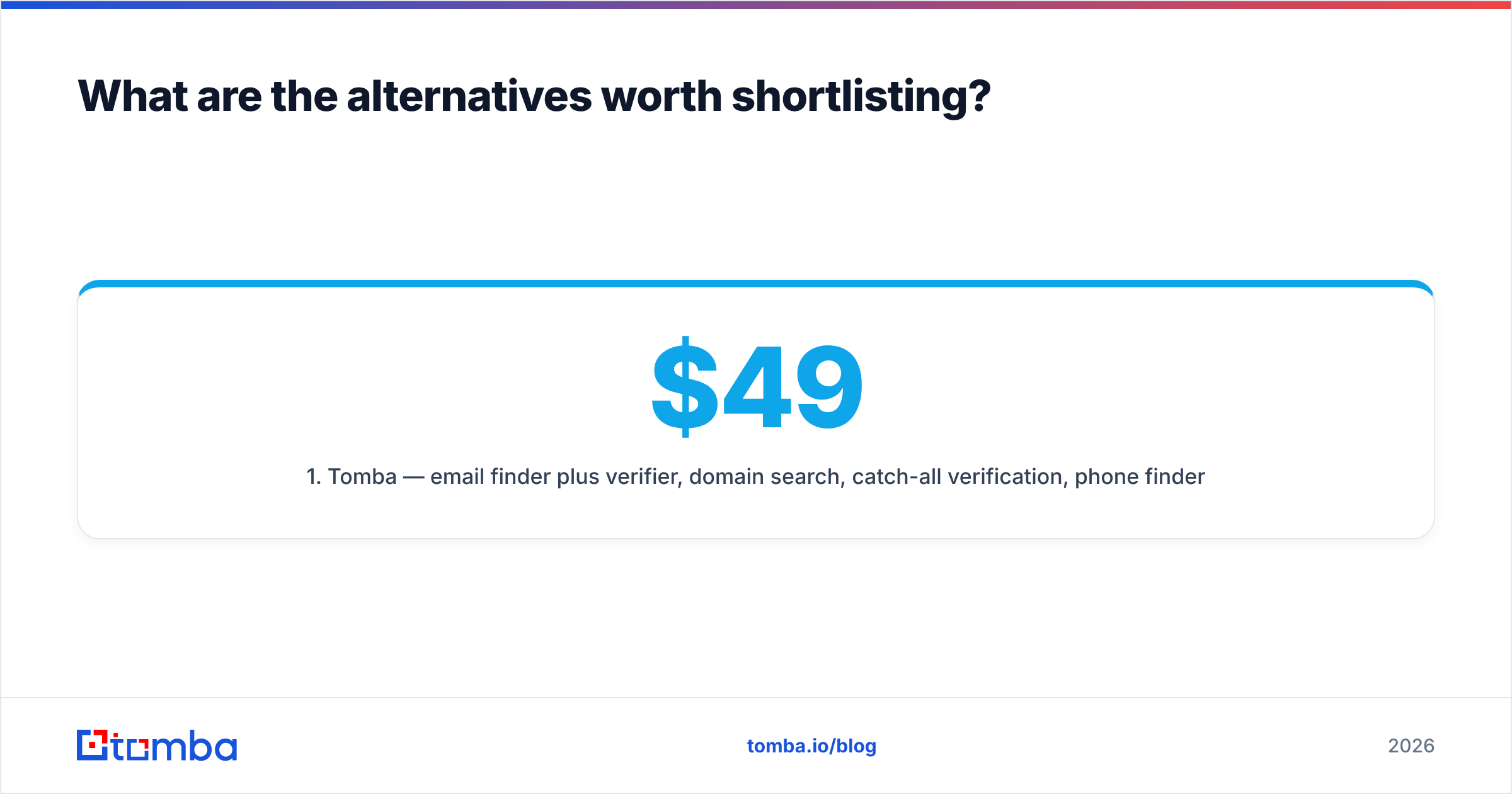
- Tomba — email finder plus verifier, domain search, catch-all verification, phone finder and enrichment on one credit pool. Free tier of 25 searches/month, Starter at $49/mo, Growth at $99/mo, Pro at $249/mo. Strongest fit when you want the whole find→verify loop under one API.
- BookYourData — a well-regarded pay-as-you-go B2B contact database with a verified-data guarantee. Good pick if you prefer buying lists outright over subscribing, and a genuinely solid option for teams that don't want a monthly commitment.
- ZeroBounce / Bouncer — pure verifiers in the Email Hippo lane, often at lower per-credit cost with less compliance tooling.
- Apollo / Lusha — prospecting databases in the Leadzen.ai lane with deeper North American coverage and shallower APAC coverage.
- Findymail — waterfall email finding aimed at cold-email agencies, priced per valid email found.
Match the tool to the bottleneck, not to the review score.
What should you do next?#
Run the five-metric test above on a 200-row sample of your real ICP, with whichever two tools are on your shortlist. Measure hit rate, deliverability, unknown rate, cost per delivered contact, and 90-day decay. Whatever the marketing pages say, your own data will pick the winner in an afternoon.
If your bottleneck is finding verified addresses rather than auditing the ones you have, start with the Tomba Email Finder. Search by domain, name, or company. Every result comes back with a confidence score and SMTP verification. Run it in bulk or through the API, with no second vendor to stitch in. The free tier gives you 25 searches a month — enough to settle Email Hippo vs Leadzenai on your own list before you spend a rupee or a pound.
Related guides#
Ready to find emails that actually work?
Join 150,000+ professionals who stopped guessing and started sending. Free credits on signup — no credit card required.
Get the Tomba newsletter
Practical outbound tactics and product updates — once every two weeks.
About the author