Emailable vs Salesbot (2026): Which Tool Wins for You?
Emailable verifies the list you already have. Salesbot tries to work it for you. Here is an honest, category-by-category breakdown of which one earns your budget in 2026 — and the layer both of them leave uncovered.
Emailable vs Salesbot is an odd matchup. One tool cleans the list you already have. The other tries to work it for you. Here is what each one is good at, what it costs in 2026, and the gap both of them leave open.
TL;DR
- These two tools are not really competitors. Emailable is a dedicated email verification and list-hygiene platform. Salesbot is an AI outbound assistant. The head-to-head only matters when one budget line has to cover both.
- If your problem is bounces, buy verification. If your problem is too few conversations, a bot will not fix a bad list. It will just send bad emails faster.
- Verifiers win on measurable output: bounce rate, catch-all resolution, and API latency. AI outbound wins on reply handling, sequencing, and rep hours saved.
- Neither product solves the step before both of them: getting correct contact data. That is a finder and enrichment job.
- Cheapest sane stack in 2026: a finder/verifier on one API (Tomba starts free, then $49/mo) plus the sending layer you already own. Add an AI agent once your bounce rate is under 2%.
What are Emailable and Salesbot, actually?#
Start here, because the naming collision does real damage to buying decisions.
Emailable is an email verification platform. You upload a list or hit an API, and it tells you whether each address is deliverable, undeliverable, risky, or unknown. It runs SMTP-level checks, syntax and MX validation, role-account detection, and disposable-domain flagging. It also tries to resolve catch-all domains, which is the part people actually pay for. It plugs into ESPs so you can clean a list before a send. That is the whole job, and it does that job well.
Salesbot is the fuzzier name. Depending on the vendor, it means an AI sales assistant or a conversational outbound agent. It drafts messages, sequences follow-ups, answers inbound questions, qualifies leads, and logs activity in your CRM.
Zoho ships a feature called Salesbot inside its CRM. Several standalone AI-SDR startups use the same name. Before you compare pricing, confirm which product you are looking at. Search the exact domain, then check whether the vendor files itself under G2's email verification category or an AI-SDR one.
So the honest framing: one tool protects your sender reputation, the other tries to replace part of a rep's day. They sit at opposite ends of the same pipeline.
Emailable vs Salesbot: how do they compare head-to-head?#
Treat this as a category comparison, not a spec sheet. Pricing moves; verify on the vendor's own page before you sign.
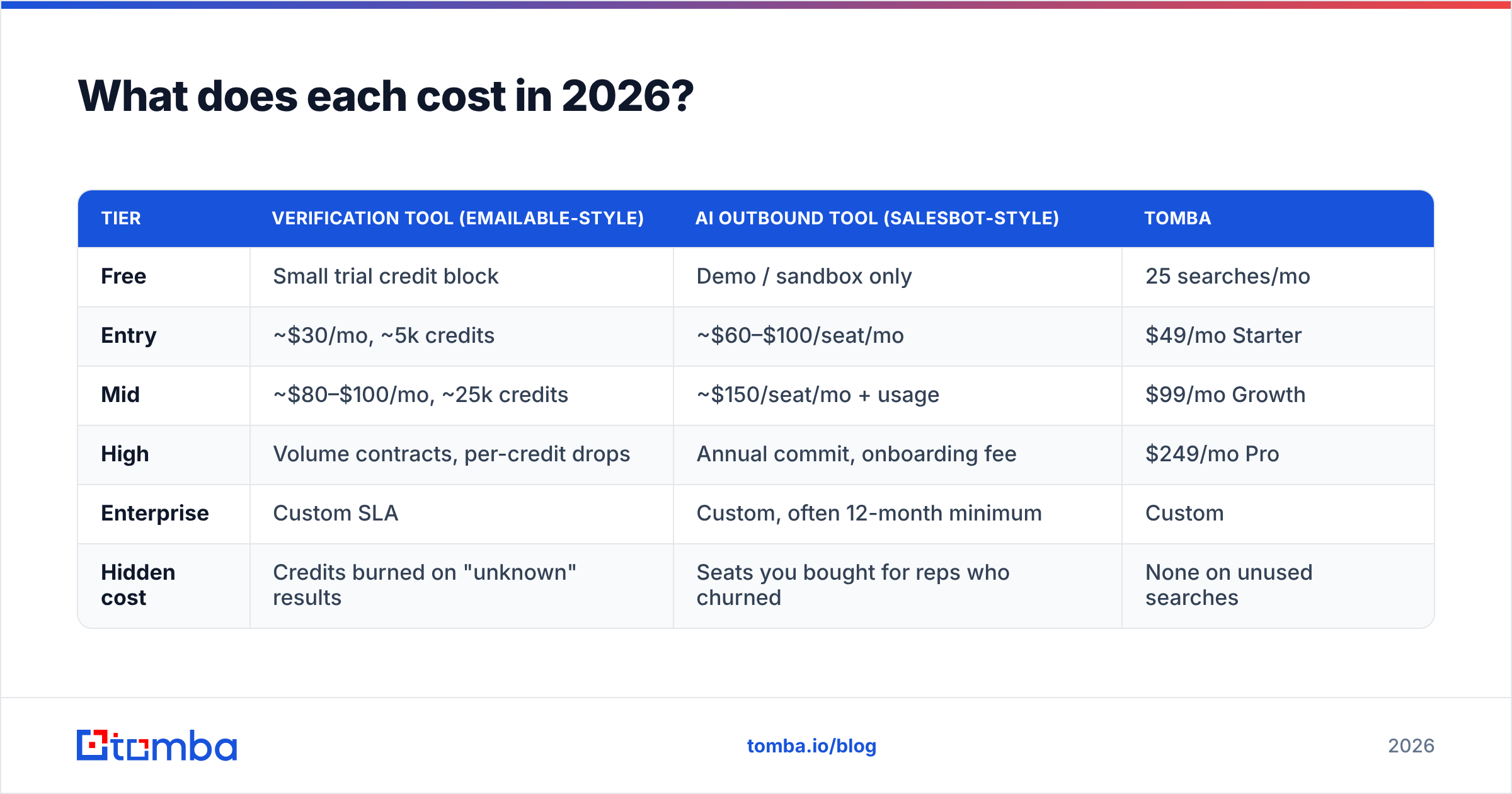
| Dimension | Emailable (verification) | Salesbot (AI outbound) | Tomba (find + verify) |
|---|---|---|---|
| Primary job | Clean the list you already have | Work the list you already have | Build and validate the list |
| Finds new emails | No | Rarely; usually needs a data source | Yes — domain, name, or company |
| Catch-all handling | Core strength; explicit catch-all logic | Not applicable | Catch-all verifier included |
| Bounce-rate impact | Direct and measurable | Indirect (can make it worse at scale) | Direct — verification before export |
| Sends email | No | Yes, that is the point | No — pairs with your sender |
| API-first | Yes | Varies by vendor | Yes — Tomba API, CLI, MCP |
| Free tier | Limited trial credits | Usually demo only | 25 searches/mo, free |
| Entry paid price | Roughly $30/mo for a small credit block | Typically per-seat, often $60–$150/seat/mo | $49/mo Starter |
| Best for | ESP hygiene, high-volume senders | Teams drowning in follow-up | Teams that need contacts, not just cleaning |
| Worst fit | Anyone with no list yet | Anyone with a dirty list | Teams wanting a full sending suite |
The pattern in that table is the whole article: verification is cheap, narrow, and measurable. AI outbound is expensive, broad, and only pays off once the inputs are clean.
Which one is more accurate — and accurate at what?#
"Accuracy" means something different for each product. That is why vendor claims are so hard to compare.
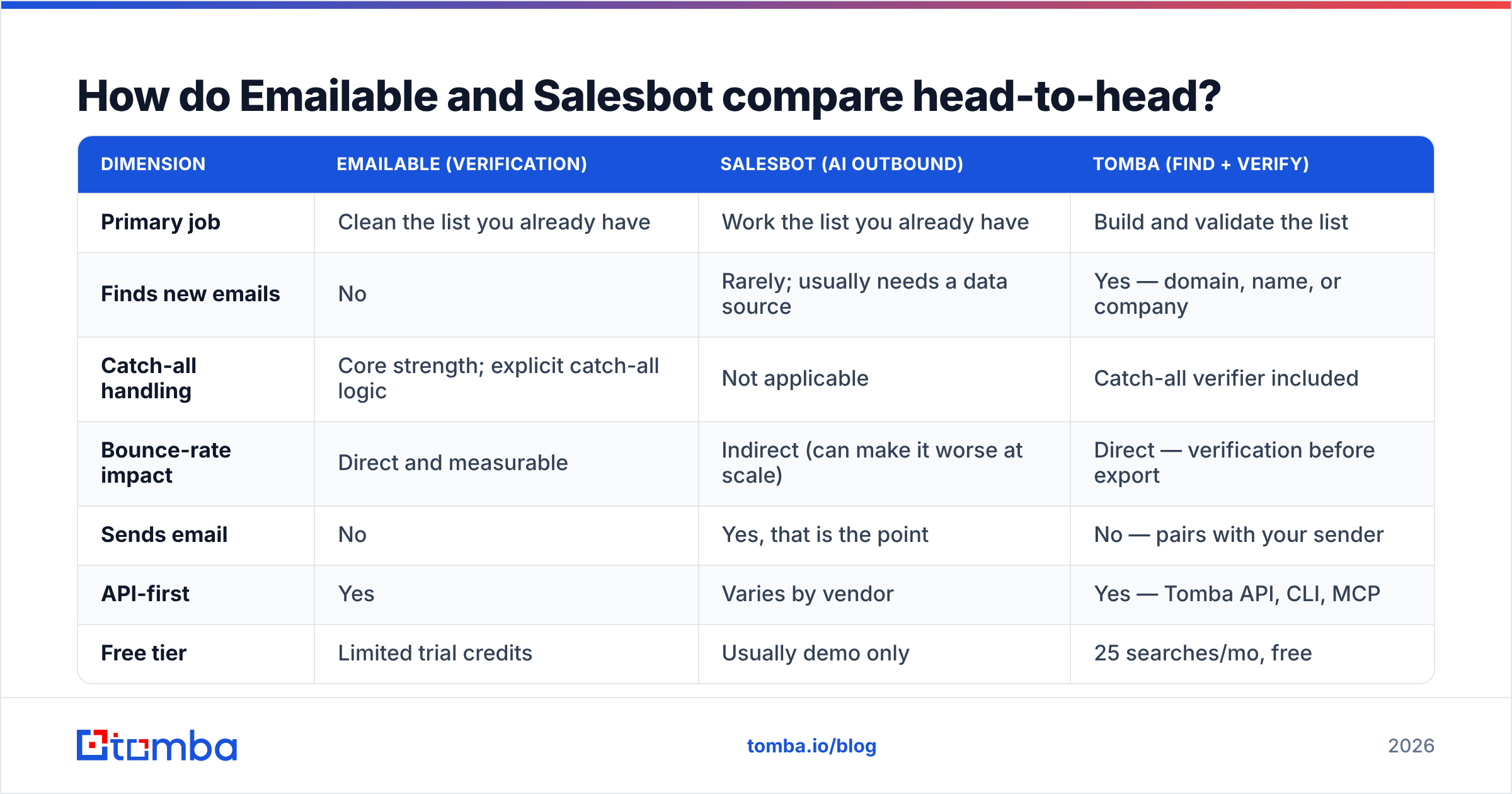
- Verification accuracy is falsifiable. Send to 10,000 addresses the tool marked valid and count hard bounces. Under 2% is good. Under 1% is excellent. Dedicated verifiers usually land in that range on standard domains.
- Catch-all accuracy is where verifiers separate. Catch-all domains accept every address at the SMTP layer, so a naive checker just returns "unknown". Roughly 20–30% of B2B domains are catch-all. That is a quarter of your enterprise TAM, not a rounding error.
- AI outbound "accuracy" is really relevance. Did the bot pick the right prospect, cite the right trigger, and avoid inventing a detail? There is no bounce-rate equivalent, so it gets judged by reply rate and by how often a human rewrites the draft.
Two more factors decide the winner, and neither shows up on a feature page.
- Freshness beats cleverness. A stale address still passes SMTP checks. If the person left nine months ago, the send is wasted anyway. Recency of the data matters more than the model writing the copy.
- Bounce codes are the ground truth. Your ESP acts on the SMTP reply codes in RFC 5321, not on a vendor dashboard. Read your bounce logs.
Run your own 500-row control test on both tools, using a list where you already know the answers. Every published accuracy number came from a list the vendor picked.
What does each cost in 2026?#
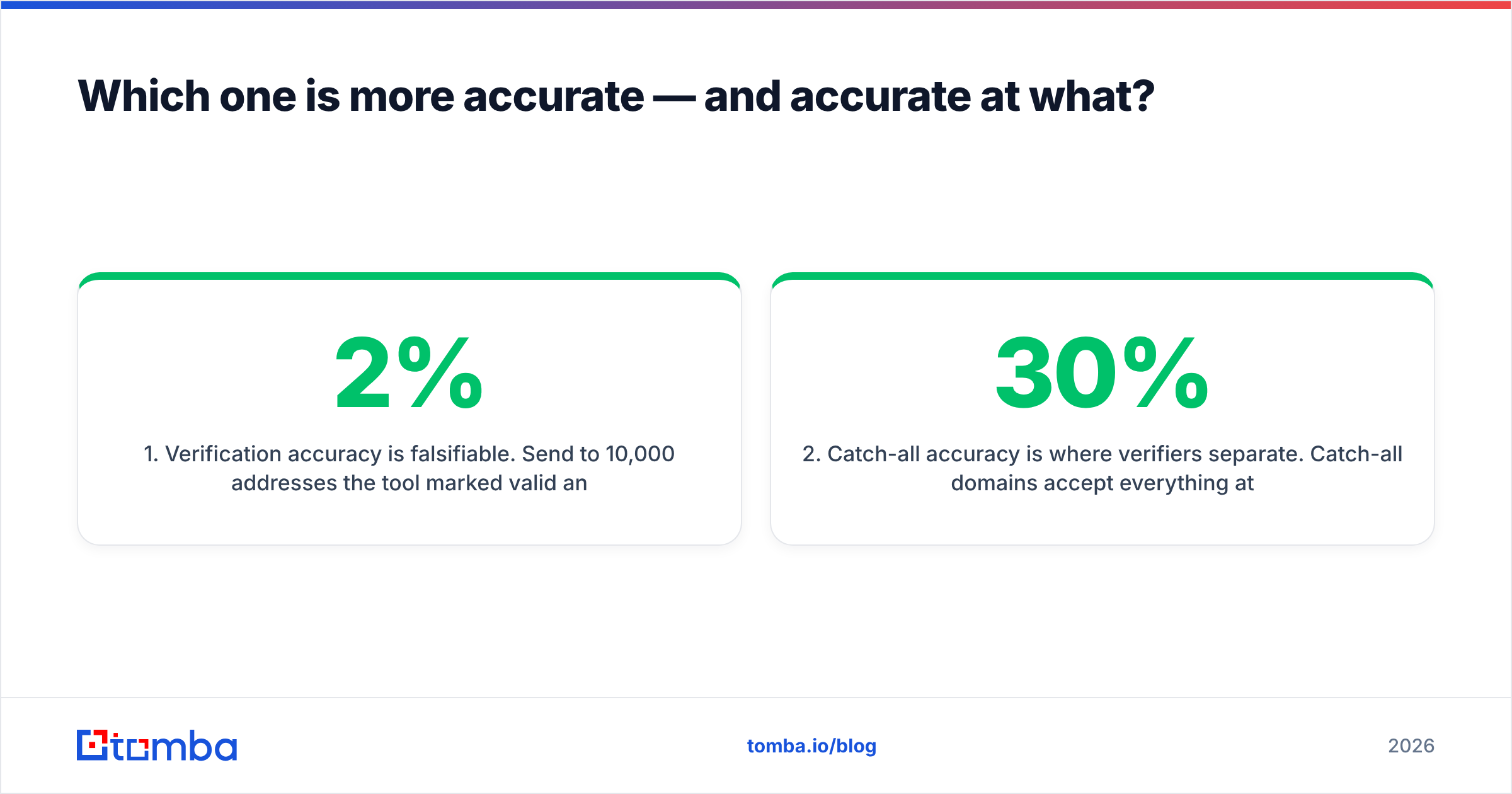
Pricing structures differ enough that headline numbers mislead. Verification is credit-based and roughly linear. AI outbound is per-seat and steps up hard.
| Tier | Verification tool (Emailable-style) | AI outbound tool (Salesbot-style) | Tomba |
|---|---|---|---|
| Free | Small trial credit block | Demo / sandbox only | 25 searches/mo |
| Entry | ~$30/mo, ~5k credits | ~$60–$100/seat/mo | $49/mo Starter |
| Mid | ~$80–$100/mo, ~25k credits | ~$150/seat/mo + usage | $99/mo Growth |
| High | Volume contracts, per-credit drops | Annual commit, onboarding fee | $249/mo Pro |
| Enterprise | Custom SLA | Custom, often 12-month minimum | Custom |
| Hidden cost | Credits burned on "unknown" results | Seats you bought for reps who churned | None on unused searches |
Two cost traps worth naming. First, some verification vendors charge for "unknown" results. You pay a credit and learn nothing, which quietly inflates your real cost per valid email. Ask about it explicitly. Second, per-seat AI tools price on headcount, not usage. A five-rep team pays for five seats even if two reps are still ramping. Compare Tomba pricing per usable contact rather than per month, and the ranking often flips.
Who should pick Emailable?#
Pick a dedicated verifier when list hygiene is your actual bottleneck. Concretely:
- You already have volume. Newsletter of 200k, a CRM with years of accumulated records, an ESP warning you about bounce rates. Cleaning is the highest-ROI thing you can buy.
- Your sender reputation is at risk. Once mailbox providers start throttling you, nothing else in the stack matters. Bounce suppression is remedial care, and it works.
- You need an ESP-native workflow. Verification tools plug directly into major senders so cleaning happens on import, not as a monthly chore.
- Compliance cares about data quality. Documented validation on every record is easier to defend in an audit than "we bought a list."
What you should not expect: new contacts. A verifier is a filter, not a source. If you feed it 5,000 addresses and 1,700 are bad, you now have 3,300 addresses — not 5,000 good ones.
Who should pick Salesbot?#
Pick an AI outbound agent when human hours, not data, are the constraint:
- Follow-up is where deals die. If reps send one email and stop, an agent that reliably sends four more will beat any data upgrade.
- Inbound replies pile up unanswered. Conversational qualification genuinely saves time here, and the risk is low because the prospect already raised a hand.
- You have a repeatable ICP and message. AI is good at scaling a message that already works. It is bad at discovering one.
- CRM logging is a mess. Auto-logging activity into your CRM removes a real tax on rep time.
The failure mode is predictable. Teams buy an AI SDR to paper over a thin pipeline, point it at scraped data, and multiply their bounce and complaint rates. More volume through a broken list is not more pipeline. It is faster reputation damage. Your sender reputation is the asset the bot is spending.
Where do both tools fall short?#
Both skip the same step, and it is the expensive one: sourcing the contact.
Emailable can tell you sarah.chen@acme.com is deliverable. It cannot tell you that Acme's VP of Engineering is Sarah Chen, or that the company uses first.last@ as its pattern. Salesbot can write Sarah a sequence. It cannot find her either. Most AI agents assume a data source is already wired in.
That gap is why teams end up with three subscriptions: a data provider, a verifier, and a sender. The consolidation opportunity is in the first two. A tool that finds the address and validates it in the same call removes a whole integration and a whole invoice:
- Domain-level discovery — give it
acme.com, get the mapped team with roles and confidence scores via domain search. - Pattern inference — detect that a company uses
f.last@before you guess, using a company email pattern check. - Verification in the same response — no export/re-import loop between two vendors.
- Catch-all resolution — the 20–30% of domains that a basic checker abandons as "unknown."
- Bulk plus API — bulk lead generation for list builds, API for product-embedded lookups.
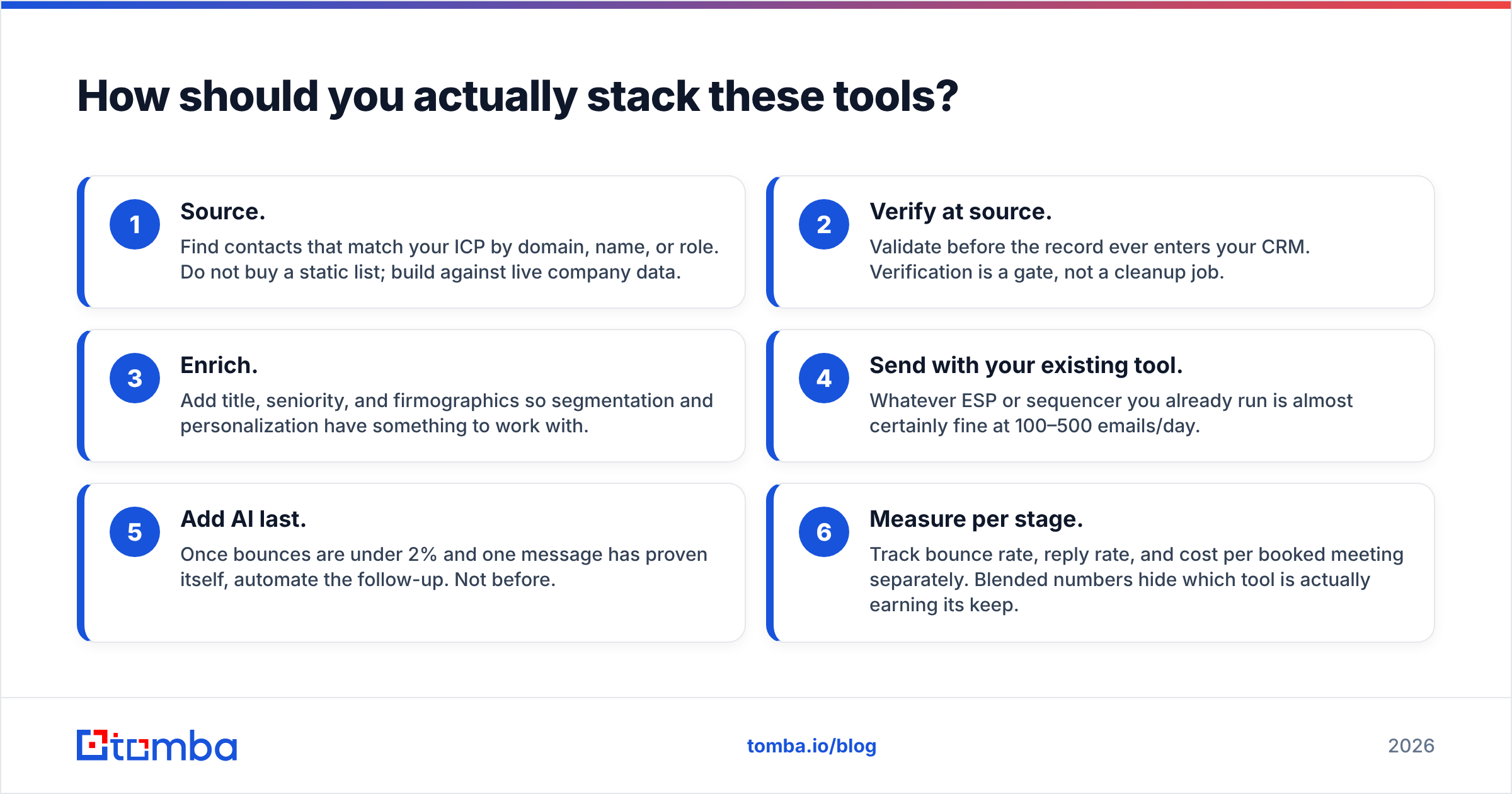
How should you actually stack these tools?#
A sane 2026 order of operations:
- Source. Find contacts that match your ICP by domain, name, or role. Do not buy a static list; build against live company data.
- Verify at source. Validate before the record ever enters your CRM. Verification is a gate, not a cleanup job.
- Enrich. Add title, seniority, and firmographics so segmentation and personalization have something to work with.
- Send with your existing tool. Whatever ESP or sequencer you already run is almost certainly fine at 100–500 emails/day.
- Add AI last. Once bounces are under 2% and one message has proven itself, automate the follow-up. Not before.
- Measure per stage. Track bounce rate, reply rate, and cost per booked meeting separately. Blended numbers hide which tool is actually earning its keep.
Skip step 5 for a quarter and most teams still hit their number. Skip step 2 and nothing downstream works.
Frequently asked questions#
Is Emailable a Salesbot competitor? No. The Emailable vs Salesbot framing only holds when one budget line has to cover both stages. They occupy different parts of the pipeline.
Can one tool replace both? Partially. Find-plus-verify platforms cover sourcing and validation; you still need a sending layer. No single product credibly does data, deliverability, and AI conversation well.
Which one improves deliverability more? Verification, without contest. AI outbound can only harm email deliverability by increasing volume on unvalidated addresses.
What about free options? Free checkers handle spot checks fine — a free email checker is enough to sanity-test a single address. For thousands of rows you need credits and an API.
How often should I re-verify? Every 90 days for active outbound lists. B2B data decays at roughly 2–3% per month as people change jobs.
The practical next step#
Decide what is actually broken before you compare vendors. Bounces high? Buy verification. Follow-up nonexistent? Buy automation. Pipeline empty? Neither one will help — you need contacts. That is the real answer to Emailable vs Salesbot: the winner depends on which stage is broken.
If it is the third case, start where the data starts. The Tomba Email Finder locates professional addresses by domain, name, or company and returns a verification verdict in the same response, so sourcing and hygiene collapse into one step instead of two subscriptions. The free tier gives you 25 searches a month to test it against a list you already know the answers to, and Starter is $49/mo when you are ready to scale. Run your own control test — that is the only benchmark that counts.
Related guides#
Ready to find emails that actually work?
Join 150,000+ professionals who stopped guessing and started sending. Free credits on signup — no credit card required.
Get the Tomba newsletter
Practical outbound tactics and product updates — once every two weeks.
About the author