Emailable vs ZoomInfo: Email Verification or Full Data?
Emailable verifies emails cheaply. ZoomInfo sells a full B2B database at 100x the price. Here's which one your outbound motion actually needs in 2026 — and the cheaper third path most teams miss.
TL;DR
- Emailable and ZoomInfo are not really competitors. Emailable is an email verification service (~$0.006–0.01 per check). ZoomInfo is a full B2B data platform with contacts, intent, and firmographics starting around $15,000/year.
- If your problem is "my bounce rate is 9% and Google is throttling me," buy Emailable. If your problem is "I don't know who to email at 4,000 target accounts," Emailable does nothing for you.
- ZoomInfo's contract structure — annual commitment, credit caps, per-seat pricing, aggressive renewals — is the single most common complaint in G2 reviews, not data quality.
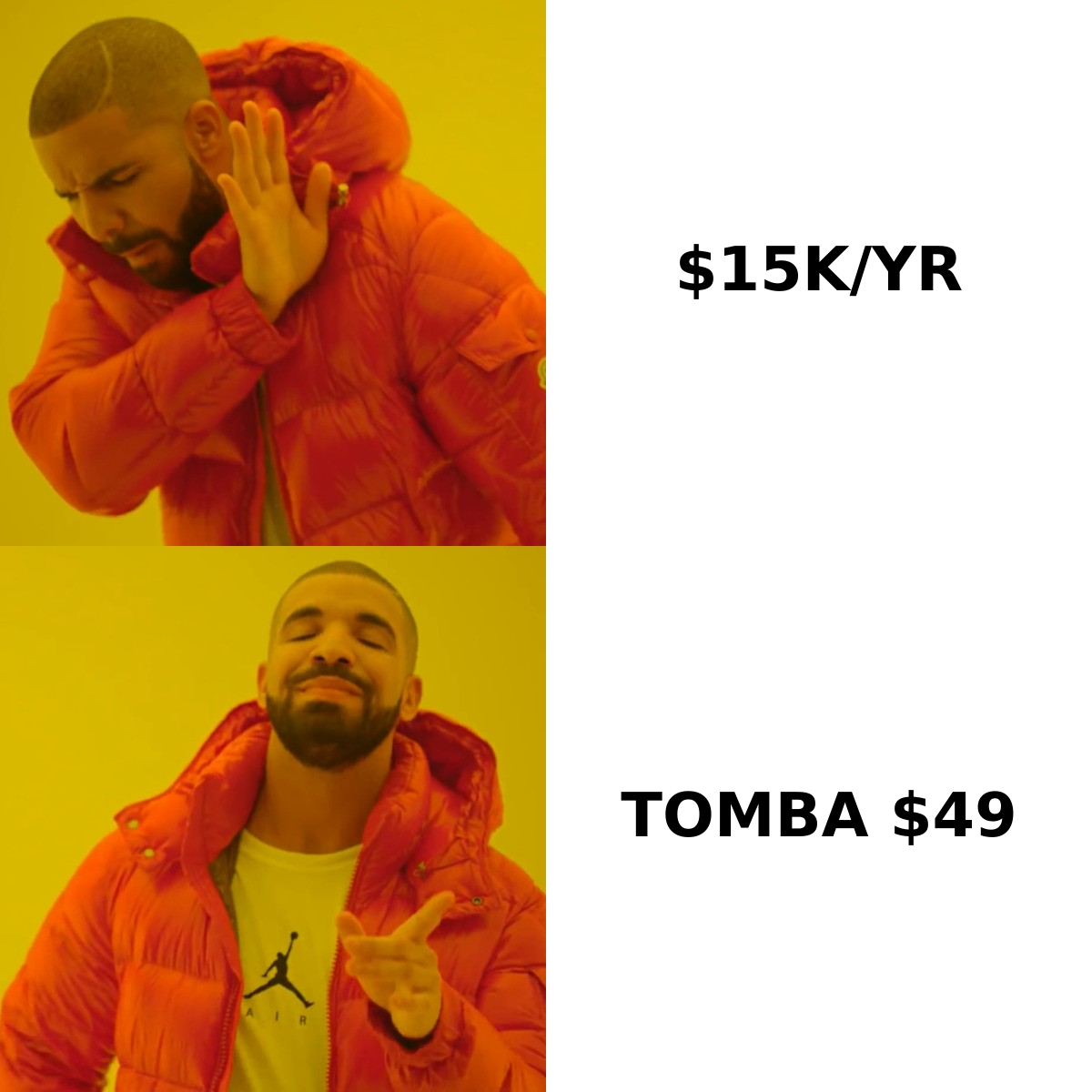
- Most teams under 50 reps don't need either extreme. A combined finder + verifier (Tomba at $49/mo, or BookYourData for pre-built lists) covers 80% of the job at 2% of the cost.
- The real decision isn't Emailable vs ZoomInfo. It's: do you need discovery, hygiene, or both — and are you willing to pay enterprise pricing for the first one.
What do Emailable and ZoomInfo actually do?#
They solve different halves of the same funnel.
Emailable takes a list of email addresses you already have and tells you whether they're deliverable. It runs syntax checks, MX record lookups, SMTP handshakes, role-account detection (info@, sales@), disposable-domain flags, and catch-all identification. You upload a CSV, get back a scored file. That's the product. It's fast, it's cheap, and it doesn't pretend to be anything else.
ZoomInfo (zoominfo.com) sells you the contacts in the first place. It's a database of roughly 100M+ business contacts with job titles, direct dials, company revenue, tech stack, org charts, and buying-intent signals sourced from a co-op of contributing users plus web crawling. Verification is a byproduct of maintaining that database — not a standalone product you buy.
The confusion happens because both companies use the word "accuracy" in their marketing. But accuracy means opposite things here. Emailable's accuracy = "did we correctly classify this address as valid or invalid?" ZoomInfo's accuracy = "is this person still the VP of Engineering at this company?" One is a mailbox test. The other is a currency-of-record problem.
Here's the practical framing: Emailable is a filter. ZoomInfo is a faucet. A filter with no water source is useless. A faucet with no filter floods your sender reputation.
How do Emailable and ZoomInfo compare on price and features?#
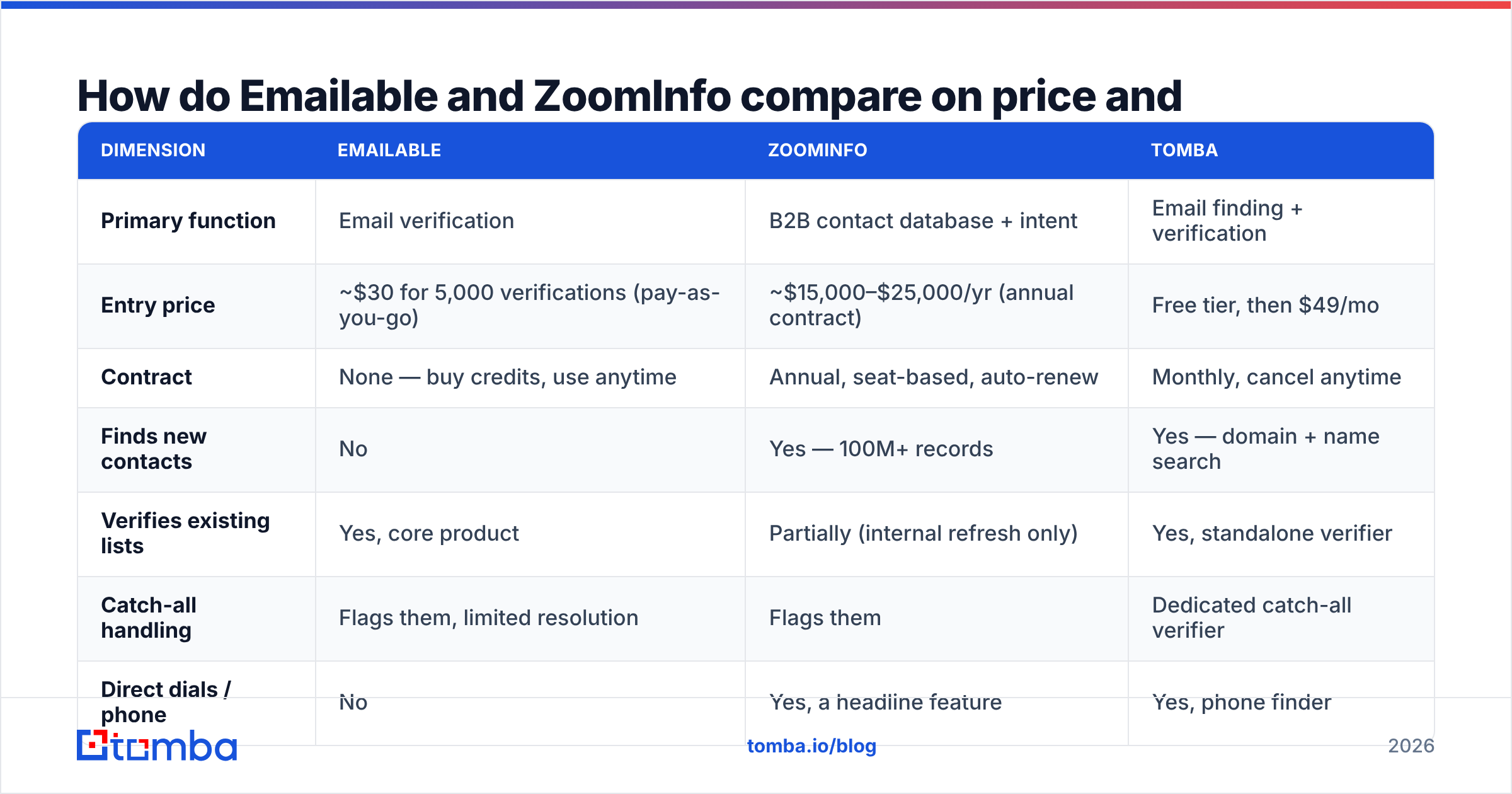
| Dimension | Emailable | ZoomInfo | Tomba |
|---|---|---|---|
| Primary function | Email verification | B2B contact database + intent | Email finding + verification |
| Entry price | ~$30 for 5,000 verifications (pay-as-you-go) | ~$15,000–$25,000/yr (annual contract) | Free tier, then $49/mo |
| Contract | None — buy credits, use anytime | Annual, seat-based, auto-renew | Monthly, cancel anytime |
| Finds new contacts | No | Yes — 100M+ records | Yes — domain + name search |
| Verifies existing lists | Yes, core product | Partially (internal refresh only) | Yes, standalone verifier |
| Catch-all handling | Flags them, limited resolution | Flags them | Dedicated catch-all verifier |
| Direct dials / phone | No | Yes, a headline feature | Yes, phone finder |
| Intent data | No | Yes (ZoomInfo Intent, WebSights) | No |
| CRM sync | Via Zapier/API | Native Salesforce, HubSpot, Outreach | Native HubSpot, Salesforce, Pipedrive |
| API | Yes, well documented | Yes, enterprise-tier add-on | Yes, included on all paid plans |
| Best for | Cleaning lists before send | Enterprise ABM at scale | SMB/mid-market outbound |
| Free trial | 250 free verifications | Demo + limited trial, sales-gated | 25 searches/mo, no card |
The price gap isn't a typo. Verification is a commodity — dozens of vendors run essentially the same SMTP checks, so pricing has compressed to fractions of a cent. Contact data is not a commodity. Maintaining 100M records with quarterly job-change churn costs real money, and ZoomInfo prices accordingly.
What that table doesn't show: ZoomInfo's real cost is rarely the sticker price. Credit overages, additional seats, and add-on modules (Intent, Chorus, Engage) routinely push a $15k quote to $40k+. Buyers on G2 consistently flag the renewal negotiation, not the data, as the pain point. Budget for the total contract, not the line item.
Which one fixes a high bounce rate?#
Emailable. Full stop. ZoomInfo will not fix your bounce rate — it might even make it worse.
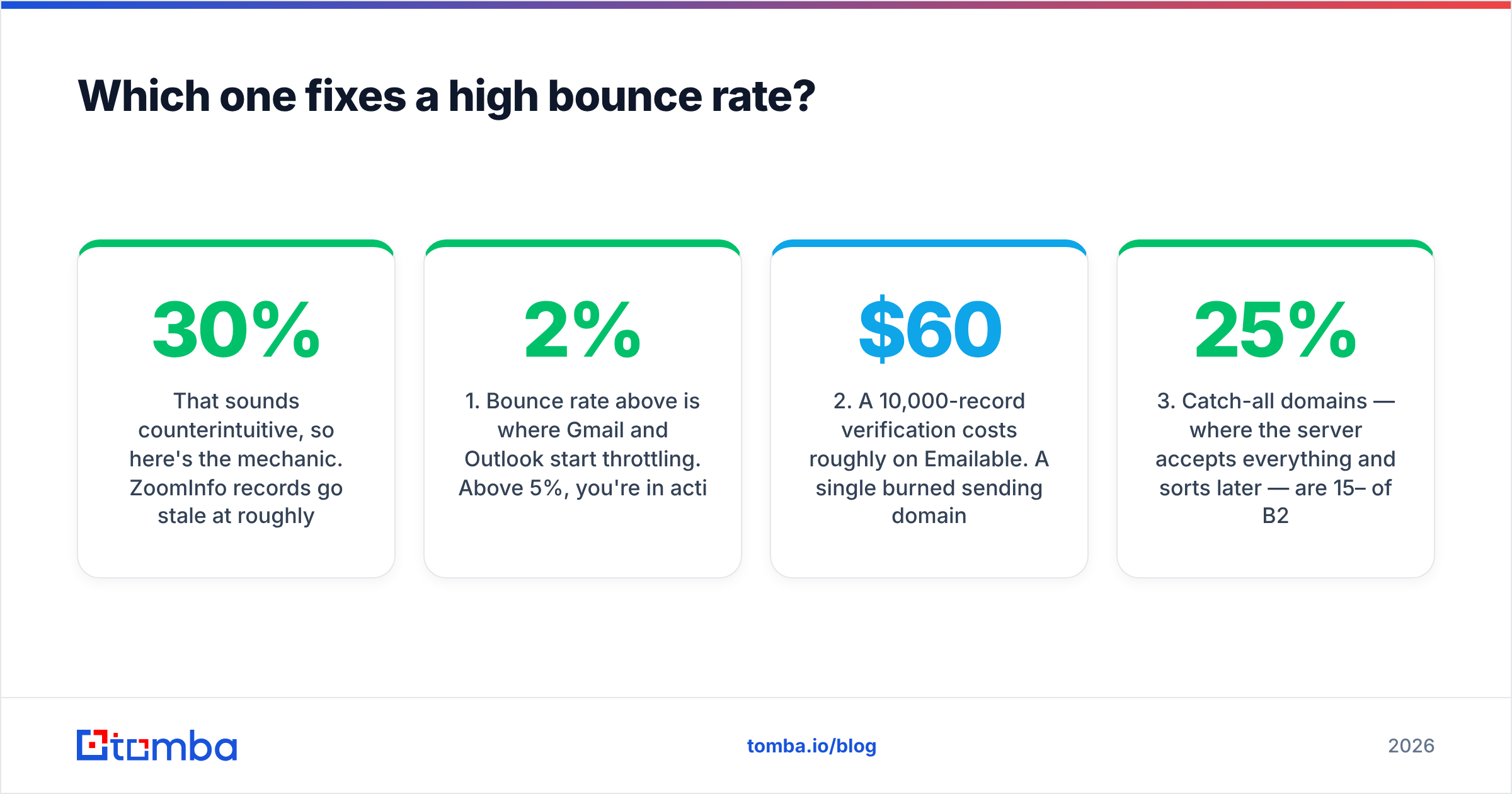
That sounds counterintuitive, so here's the mechanic. ZoomInfo records go stale at roughly 25–30% per year because people change jobs. If you export 10,000 contacts in January and blast them in September, a meaningful chunk are dead mailboxes. ZoomInfo doesn't re-verify at export time in the way a dedicated verifier does. You're getting a snapshot, not a live check.
That's why the standard enterprise workflow is both: pull from ZoomInfo, then run the export through a verifier before it touches your sending domain. If you skip that step, you learn about it from Google Postmaster Tools when your reputation drops to "Low."
A few numbers that anchor the decision:
- Bounce rate above 2% is where Gmail and Outlook start throttling. Above 5%, you're in active deliverability damage.
- A 10,000-record verification costs roughly $60 on Emailable. A single burned sending domain costs weeks of warmup.
- Catch-all domains — where the server accepts everything and sorts later — are 15–25% of B2B domains. No verifier resolves these with certainty; the honest ones flag them as "unknown" and let you decide. A catch-all verifier that uses pattern confidence rather than pure SMTP gets you further than a binary valid/invalid flag.
- Role accounts (info@, support@, hello@) verify as valid but convert near zero and raise spam-complaint risk. Filter them out separately.
- Re-verify anything older than 90 days. Verification is not a one-time event; it's a recurring hygiene task tied to your list, not your vendor.
If bounce rate is your only problem, stop reading comparison posts and go buy verification credits. Emailable, ZeroBounce, NeverBounce, and Tomba's email verifier all land within a few percentage points of each other on accuracy tests. Pick on price and API ergonomics.
Which one should you buy if you need new contacts?#
Neither, probably — unless you're genuinely enterprise.
ZoomInfo earns its price in one specific scenario: you have a large sales org running account-based motions, you need org charts and direct dials to reach executives who never answer email, and you want intent signals to prioritize which of 5,000 accounts to work this quarter. If you have 40 AEs and an ABM budget, ZoomInfo's TAM coverage and Salesforce integration justify the contract. That's a real use case and it's why the company is worth billions.
But most teams reading a "vs" post aren't that. If you're a 3–15 person GTM team, the ZoomInfo contract is a tax on capability you won't use. You'll pay for intent data you never operationalize and seats that sit idle.
The middle path looks like this:
- You know the target companies. Use domain search to pull every discoverable email at those domains, filtered by department and seniority. This is the highest-ROI move for anyone with a defined ICP account list.
- You know the person, not the address. Name + domain into an email finder returns the address with a confidence score and the sources it was verified against.
- You're working LinkedIn. A LinkedIn finder converts profile URLs into verified work emails without exporting a Sales Navigator list into a scraper.
- You want a pre-built list, not a search tool. BookYourData sells pay-as-you-go verified B2B lists with no subscription — a genuinely different model that suits teams doing one-off campaigns rather than continuous prospecting.
- You need volume. Bulk email finder processes CSVs of names and domains in one pass, which is what most people actually want when they say "I need a list."
What does the honest accuracy picture look like?#
Every vendor in this space publishes accuracy numbers that flatter themselves, and none of them are comparable because the test sets differ.
Here's what holds up under scrutiny:
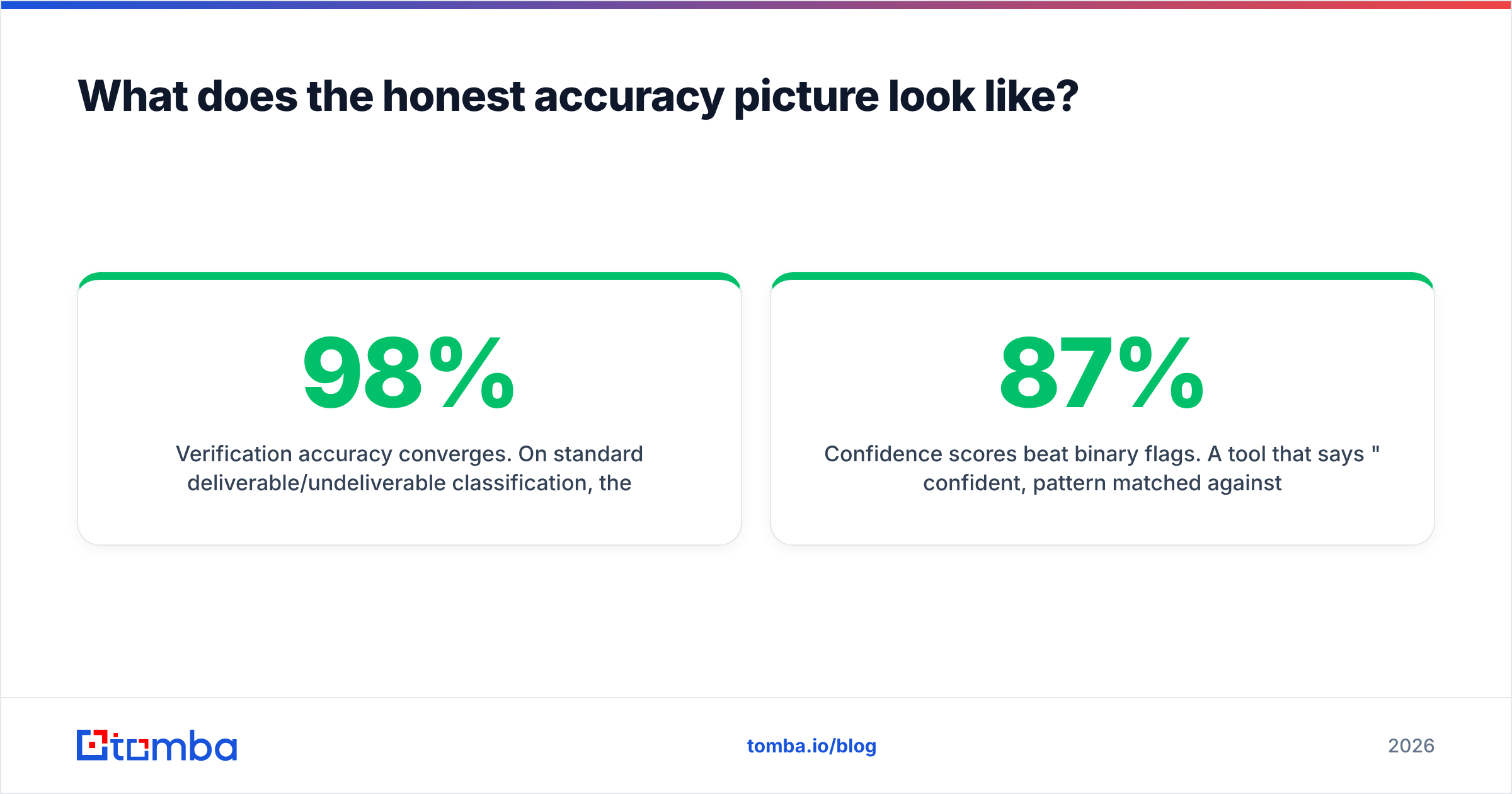
Verification accuracy converges. On standard deliverable/undeliverable classification, the top verifiers cluster in the 95–98% range. The differences that matter are in edge-case handling: how they treat catch-alls, greylisted servers, and Microsoft 365 tenants that block SMTP probing. Microsoft in particular has hardened against verification traffic, which is why "unknown" rates on Outlook-hosted domains have climbed across every vendor since 2024. If a verifier claims 99%+ on a list heavy with corporate Microsoft domains, it's either guessing on catch-alls or the test set was soft.
Discovery accuracy is where the spread is real. Finding an email that exists is harder than validating one you have. Coverage varies enormously by geography (US/UK strong, APAC and LATAM thin), company size (enterprise well-covered, sub-50-employee companies patchy), and role (marketing and sales over-represented, engineering and operations under-represented). ZoomInfo's advantage is genuine here — the contributory-network model gives it depth that pure-crawl providers can't match at the enterprise end. Its disadvantage is that the same model produces stale records at the long tail.
Confidence scores beat binary flags. A tool that says "87% confident, pattern matched against 12 known addresses at this domain, MX valid, catch-all domain" gives you something to act on. A tool that says "VALID" tells you nothing about whether it guessed. When you're comparing vendors, ask what they return on a catch-all domain — the answer separates serious tools from ones that round up.
Test on your own data. Take 200 addresses you already know the outcome for — from a past campaign where you have bounce logs — and run them through each candidate. Vendor benchmarks are marketing. Your bounce log is evidence. Tomba publishes its data sources so you can evaluate the methodology rather than the claim.
Is there a cheaper alternative to both?#
Yes, and the math is not close for teams under ~50 reps.
The reason ZoomInfo and Emailable both exist as separate purchases is historical: discovery and verification were built by different companies at different times. In 2026 there's no technical reason to buy them separately. A tool that finds an address can verify it in the same call — it's already talking to the same MX server.
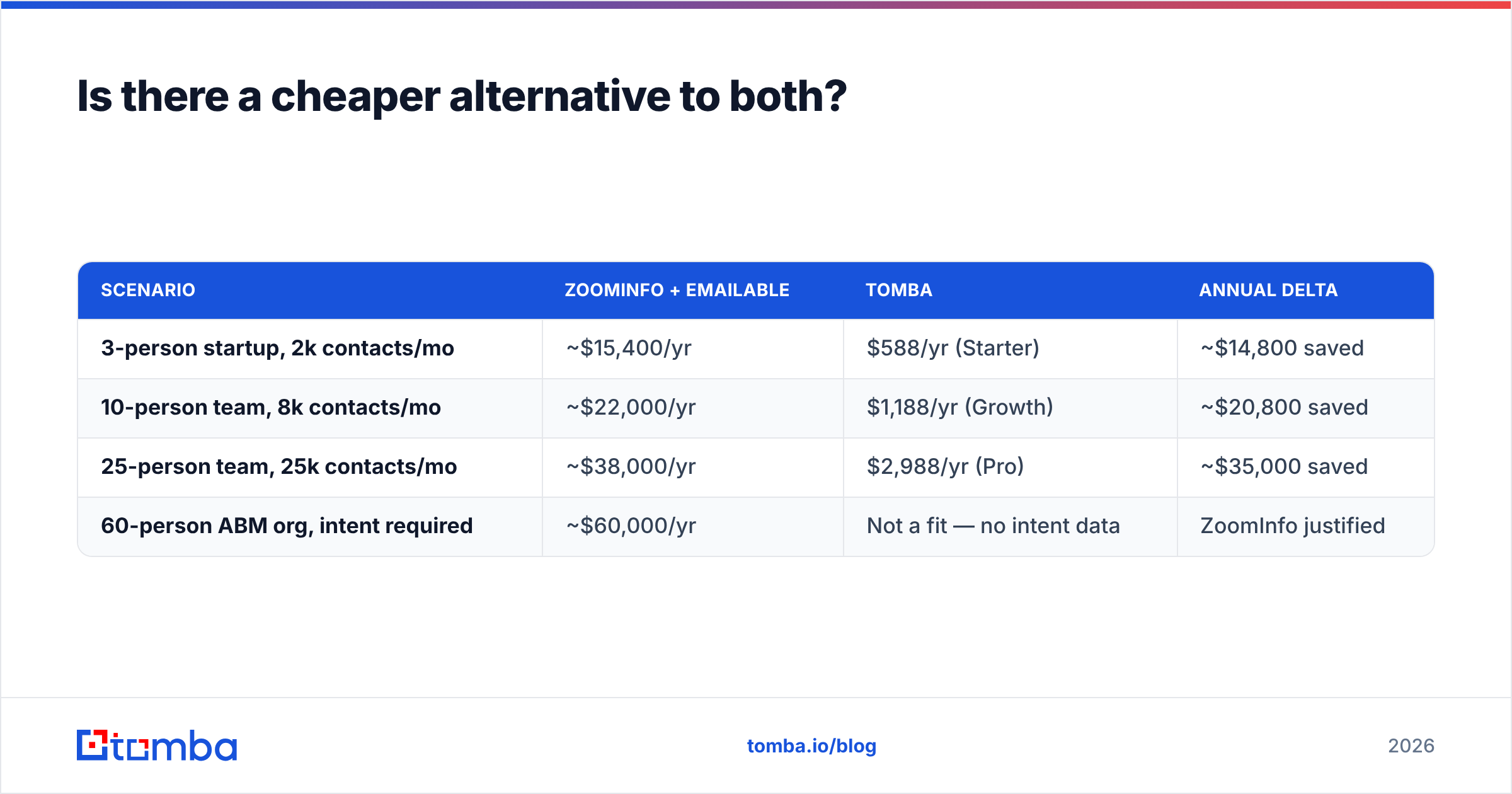
| Scenario | ZoomInfo + Emailable | Tomba | Annual delta |
|---|---|---|---|
| 3-person startup, 2k contacts/mo | ~$15,400/yr | $588/yr (Starter) | ~$14,800 saved |
| 10-person team, 8k contacts/mo | ~$22,000/yr | $1,188/yr (Growth) | ~$20,800 saved |
| 25-person team, 25k contacts/mo | ~$38,000/yr | $2,988/yr (Pro) | ~$35,000 saved |
| 60-person ABM org, intent required | ~$60,000/yr | Not a fit — no intent data | ZoomInfo justified |
Read the last row carefully. This isn't a post arguing ZoomInfo is a bad product. At real enterprise scale with an ABM motion that consumes intent data, it does things no $99/month tool does. The argument is that the majority of buyers comparing these two are being sold enterprise infrastructure for a mid-market problem.
What you give up going the cheaper route: intent signals, org-chart visualization, conversation intelligence, and the "one vendor for everything" procurement story. What you keep: verified emails, phone numbers, data enrichment, CRM sync, and an API you can hit from day one without a sales call. Full Tomba pricing is public, which is itself a meaningful difference from a sales-gated quote.
How should you actually decide?#
Run this sequence:
- Write down the bottleneck in one sentence. "My emails bounce" and "I don't know who to email" are different problems with different vendors. If you can't state it cleanly, you're not ready to buy.
- Check your existing data first. Export your CRM, dedupe it, and verify it. Many teams discover they already own 6,000 usable contacts buried under 4,000 dead ones. That's a $50 fix, not a $20,000 one.
- Price the full contract, not the entry tier. For ZoomInfo, ask explicitly about credit limits, overage rates, seat minimums, and renewal uplift. Get it in writing.
- Trial on identical inputs. Same 200 rows through every candidate. Compare hit rate, bounce rate on actual sends, and how each tool labels catch-alls.
- Check the exit. Monthly billing and public pricing mean you can leave. Annual enterprise contracts with auto-renew clauses mean you're committed through a budget cycle whether the tool works or not.
- Decide on discovery first, hygiene second. Hygiene is a commodity you can swap vendors on in an afternoon. Discovery is where your pipeline actually comes from — spend your evaluation time there.
The pattern I see most often: teams buy ZoomInfo because a board member recommended it, use maybe 20% of the platform, then quietly let it lapse at renewal and replace it with a finder plus a verifier for a tenth of the price. Skip the expensive middle step.
Ready to test the cheaper path?#
Start with the Tomba Email Finder. The free tier gives you 25 searches a month with no credit card, which is enough to run a real comparison against whatever quote you're holding. Feed it your target domains, check the confidence scores and sources against contacts you can independently confirm, and see how much of the ZoomInfo value proposition you actually needed.
If the answer is "all of it" — you're an enterprise ABM team and intent data drives your quarter — then buy ZoomInfo with confidence, and run every export through a verifier before it hits your sending domain. If the answer is "I just needed verified emails at companies I already identified," you now know that costs $49 a month, not $15,000 a year.
Related guides#
Ready to find emails that actually work?
Join 150,000+ professionals who stopped guessing and started sending. Free credits on signup — no credit card required.
Get the Tomba newsletter
Practical outbound tactics and product updates — once every two weeks.
About the author