Emailchaser vs Seamless.AI: Which Email Finder Wins in 2026?
One is a lightweight cold email sender with a finder bolted on. The other is a 1.3-billion-record AI database with annual contracts. Here's which one actually fits your outbound motion — and when neither does.
Emailchaser vs Seamless.AI comes down to one question: do you need a sender, or do you need a database? Here is the short answer first, then the detail.
TL;DR
- Emailchaser is a cold email sending platform with an email finder attached. You buy it to send sequences. The data is a convenience, not the product.
- Seamless.AI is the opposite: a large AI-indexed contact database with 1.3B+ records. It sells mostly on annual contracts, and you get a sales call before you see a number.
- Neither is a pure, transparent data provider. Emailchaser's finder is thin at volume. Seamless.AI's data is broad but noisy, and its credit model draws the most complaints in its G2 reviews.
- Already have a sender (Instantly, Smartlead, Lemlist)? Then a dedicated finder like Tomba at $49/mo is the cheaper third path.
- Pick Emailchaser if you want one monthly tool that does everything at small scale. Pick Seamless.AI if you need US-heavy volume, have budget, and will run your own verification pass.
Emailchaser vs Seamless.AI: what are they, actually?#
They get compared because both promise "find the email, send the email." That's where the similarity ends.
Emailchaser (emailchaser.com) is a cold email outreach tool built around simplicity. You connect a Google Workspace or Microsoft 365 inbox, build a sequence, and send. It bundles an email finder and a Chrome extension, so you don't have to buy data separately at the low end. The pitch is "one tool, no stack." It ships fewer features than Outreach or Salesloft on purpose, and it is priced for solo founders and small agencies.
Seamless.AI (seamless.ai) is a B2B contact database. It claims a real-time AI search engine that crawls the open web to build and refresh records. You also get browser extensions, a Chrome plugin for LinkedIn, and CRM integrations. It sells to SDR teams that need volume: thousands of contacts a month, US-heavy, with job titles and direct dials attached. It's a data company that has added light workflow, not a sending platform.
So the honest framing is simple. Emailchaser is a sender with data attached. Seamless.AI is data with workflow attached. Compare them feature-for-feature and you get a tie of mismatched columns. Compare them on what job you're hiring them for and the answer gets obvious fast.
How do Emailchaser and Seamless.AI compare on pricing?#
This is where most buying decisions actually get made, and the two products behave very differently.
Emailchaser publishes its pricing. Plans start in the sub-$50/mo range for a single-inbox setup and scale by inbox count and contact volume. You can sign up, pay by card, and cancel. No call.
Seamless.AI does not publish standard pricing. There's a free tier with a small monthly credit allowance, and then you talk to sales. Reported contract sizes in public review threads cluster in the $1,500–$15,000/year range, depending on seats and credits. Most deals are annual, paid upfront. That's not a scandal; it's normal enterprise data pricing. But it is a very different purchase from a $49 card charge, so budget the review cycles.
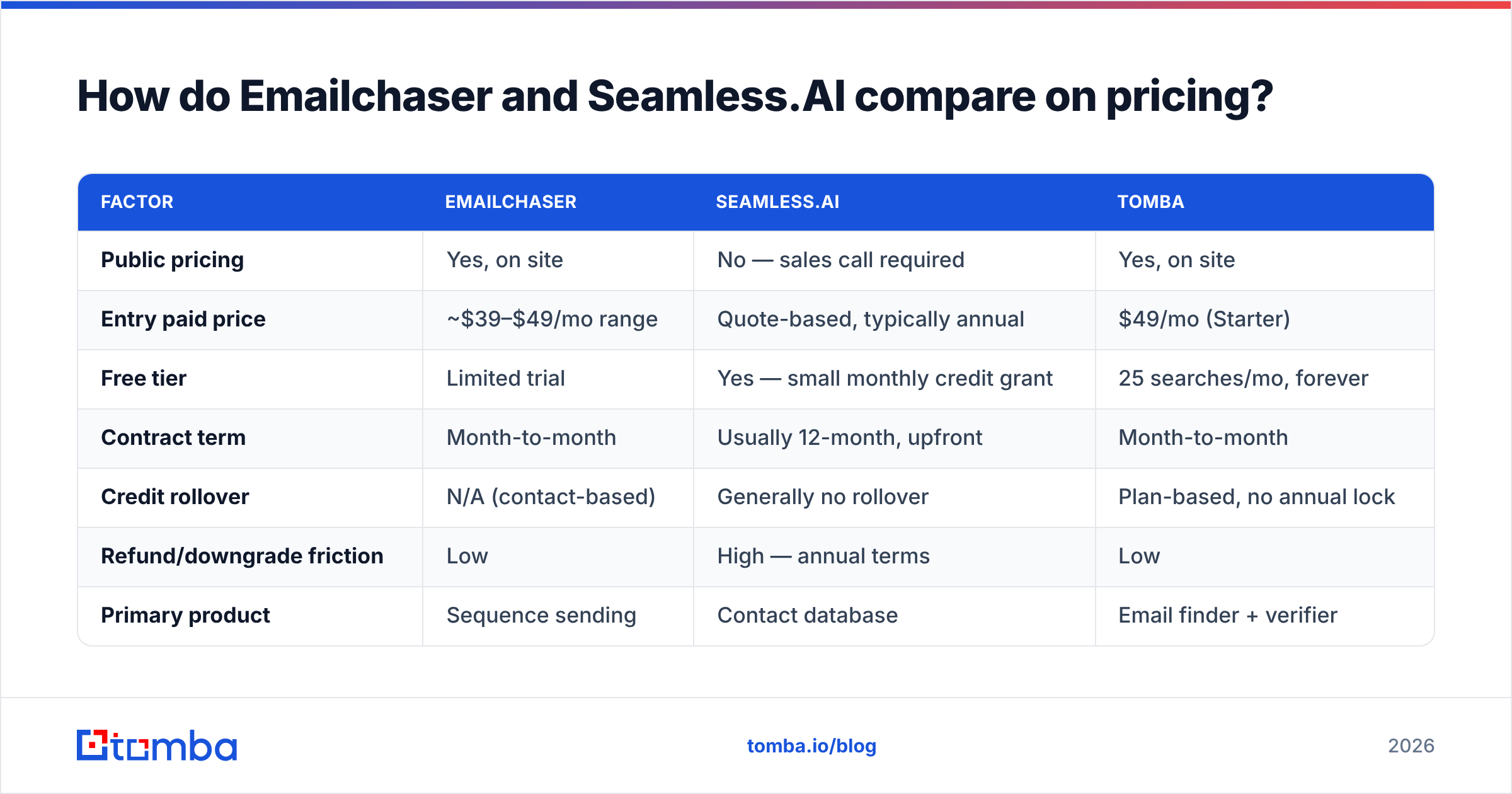
| Factor | Emailchaser | Seamless.AI | Tomba |
|---|---|---|---|
| Public pricing | Yes, on site | No — sales call required | Yes, on site |
| Entry paid price | ~$39–$49/mo range | Quote-based, typically annual | $49/mo (Starter) |
| Free tier | Limited trial | Yes — small monthly credit grant | 25 searches/mo, forever |
| Contract term | Month-to-month | Usually 12-month, upfront | Month-to-month |
| Credit rollover | N/A (contact-based) | Generally no rollover | Plan-based, no annual lock |
| Refund/downgrade friction | Low | High — annual terms | Low |
| Primary product | Sequence sending | Contact database | Email finder + verifier |
| Database size claim | Not published | 1.3B+ contacts, 121M+ companies | Domain-driven, pattern + verification |
Two things to take from that table.
First, the cheapest sticker price isn't the cheapest total cost. Emailchaser at $39/mo looks unbeatable until you hit its data ceiling. Then you pay a second vendor for contacts anyway, and you're running two bills.
Second, credit rollover matters more than credit price. Seamless.AI's model resets unused credits, so a slow month is money burned. Ask any data vendor for the rollover policy in writing before you sign. Compare that against transparent Tomba pricing, where the tiers and limits are on the page.
Which one has better data accuracy?#
Neither vendor will hand you an independent accuracy audit. So here's how to reason about it honestly.
Seamless.AI's model is web-crawl-plus-AI-inference. It searches public sources in real time and assembles a record. The strength is coverage. If a person has any public professional footprint, Seamless will usually produce something.
The weakness is that inferred data is guessed data. The most consistent theme across Seamless.AI reviews on G2 is that coverage is impressive and precision is not: stale titles, people who left two years ago, and personal Gmail addresses where a work email was expected. The users who like it treat the output as a candidate list, not a send list.
Emailchaser's finder is smaller and more pattern-driven. It does the standard thing: identify the company's email format, apply the name, check the result. That works well when the format is common and the domain accepts verification probes. It degrades on catch-all domains, on companies with mixed formats after an acquisition, and on names with non-ASCII spelling. Email finding is not Emailchaser's core business, so don't expect the depth of a specialist.

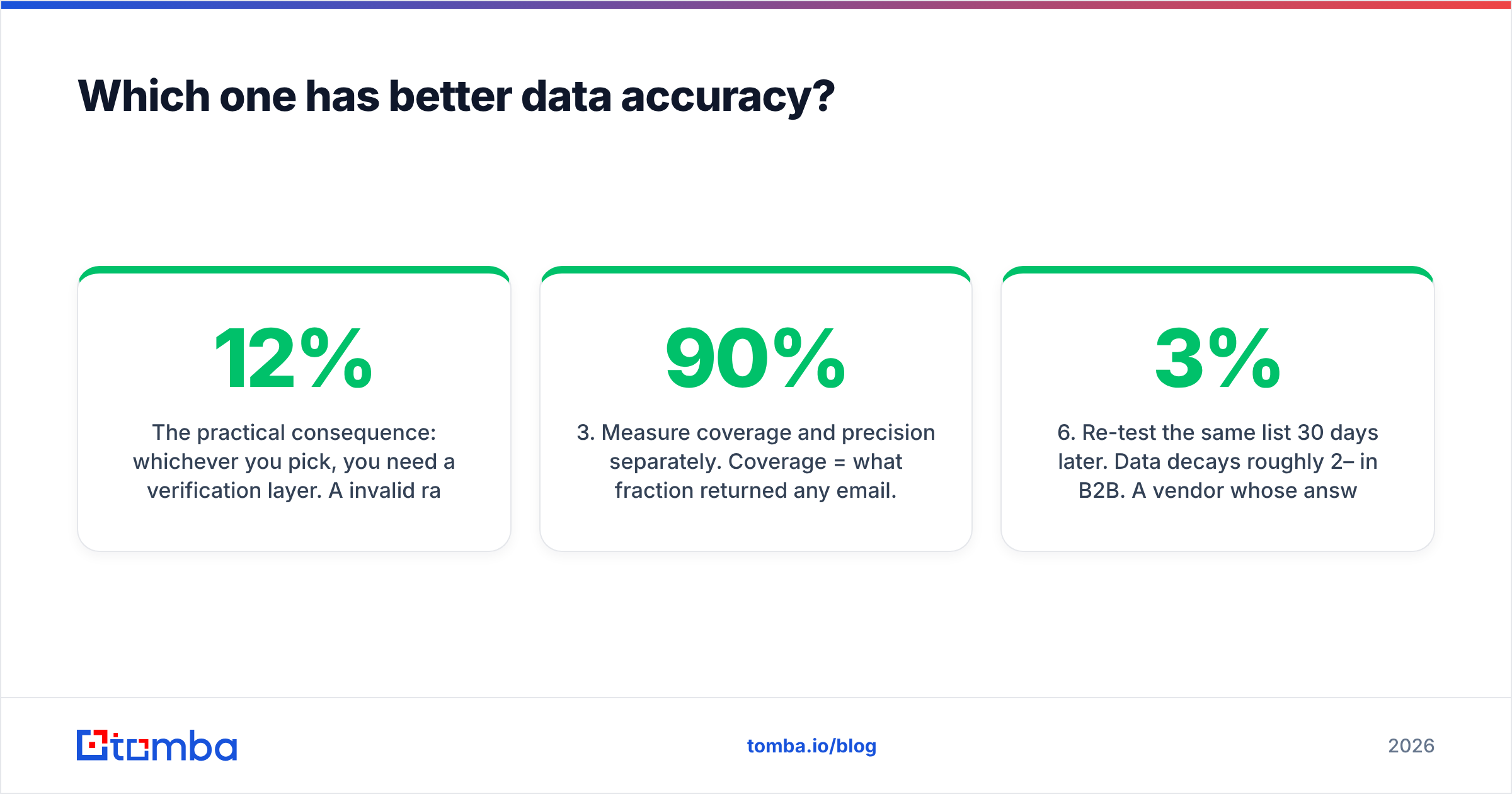
The practical consequence: whichever you pick, you need a verification layer. A 12% invalid rate on a 3,000-contact send is 360 bounces. That is enough to damage sender reputation on a young domain.
Run every export through a dedicated email verifier before it touches your sequencer. Use a catch-all verifier for domains that return "accept-all." Those are the ones that quietly wreck bounce rates, because both tools will happily mark them valid.
Here's the accuracy checklist worth running on any vendor trial, in order:
- Build a known-answer set. Pull 50 contacts whose emails you have already confirmed — past customers, colleagues, people who replied to you. Never test on strangers. You can't grade what you can't verify.
- Split by domain type. 20 from large enterprises, 20 from SMBs under 200 employees, 10 from catch-all domains. Vendors that look identical on Fortune 500 data diverge hard on the long tail.
- Measure coverage and precision separately. Coverage is what fraction returned any email. Precision is what fraction of those were correct. A tool with 90% coverage and 70% precision is worse than 60% coverage and 97% precision, because the first one costs you deliverability.
- Check the non-US slice. If you sell into EMEA or APAC, test it directly. Seamless.AI is North-America-weighted by design. That's a real limit, not a flaw.
- Time the enrichment. Run 500 contacts and clock it. A finder that takes 40 minutes per batch changes how your team works.
- Re-test the same list 30 days later. B2B data decays about 2–3% per month. A vendor whose answers drift wildly in a month is guessing, not sourcing.
Is Emailchaser or Seamless.AI better for cold outreach?#
Different jobs, so let's split it.
If you need to send: Emailchaser wins by definition. Seamless.AI has no real sequencing engine; it plugs into your sender rather than replacing it. If your requirement is "one login, one bill, sequences going out by Friday," Emailchaser is the shorter path. It handles inbox connection, sending schedules, follow-up steps, and reply detection in a UI simple enough for a non-technical founder.
If you need volume data: Seamless.AI wins. Emailchaser's finder is not built to hand you 5,000 net-new contacts in a territory sliced by headcount and tech stack. Seamless.AI is. Its filters, its Chrome extension over LinkedIn, and its CRM push are designed for an SDR team building lists at scale.
If you need both, cheaply: Neither is optimal, and this is where most readers actually sit. The modern outbound stack has separated into three layers: data, verification, and sending. Buying a bundled tool means accepting the weaker half of the bundle.
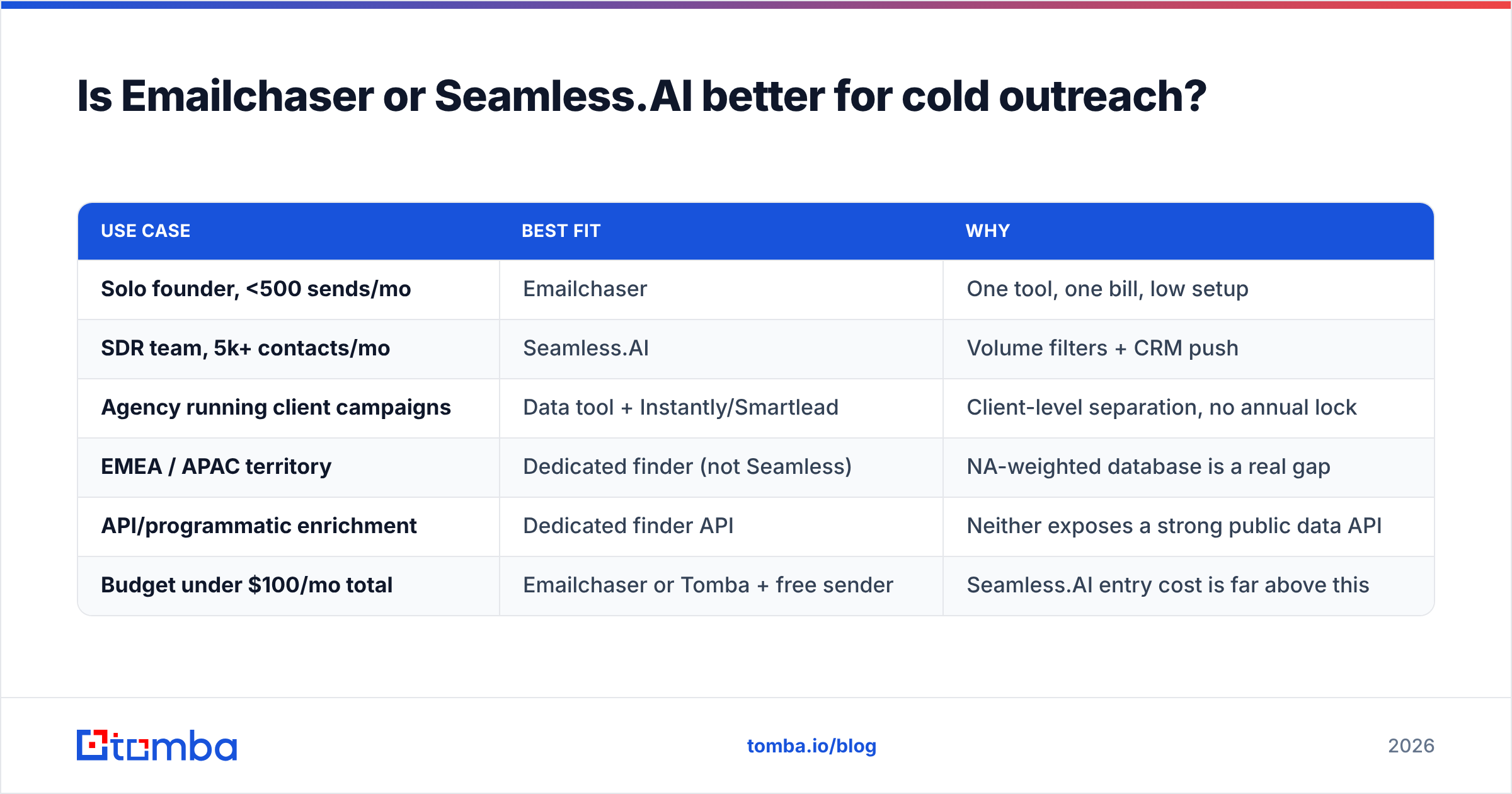
| Use case | Best fit | Why |
|---|---|---|
| Solo founder, <500 sends/mo | Emailchaser | One tool, one bill, low setup |
| SDR team, 5k+ contacts/mo | Seamless.AI | Volume filters + CRM push |
| Agency running client campaigns | Data tool + Instantly/Smartlead | Client-level separation, no annual lock |
| EMEA / APAC territory | Dedicated finder (not Seamless) | NA-weighted database is a real gap |
| API/programmatic enrichment | Dedicated finder API | Neither exposes a strong public data API |
| Budget under $100/mo total | Emailchaser or Tomba + free sender | Seamless.AI entry cost is far above this |

What are the real limitations of each tool?#
Emailchaser's ceiling is scale. It is built to be simple, and simplicity has a price: fewer deliverability controls, thinner analytics, and limited multi-inbox rotation next to purpose-built senders. The finder won't keep up once you prospect into hundreds of new accounts a month. It's also a small company. That's fine for most buyers, but if procurement wants SOC 2 documentation and a named CSM, that's a different conversation.
Seamless.AI's ceiling is trust and terms. Three recurring complaints show up in public review corpora, none of them secret:
- Credit accounting. Users report credits spent on searches that returned unusable or duplicate records. Whatever the intent, your real cost-per-usable-contact ends up higher than your cost-per-credit.
- Annual commitment friction. Getting out mid-term is hard. Buy it like any annual SaaS: pilot hard during the trial, and get the exit terms in the contract.
- Data freshness on the long tail. Big-company records are fine. Sub-100-employee companies, recently funded startups, and non-US contacts drift more.
And a limit they share: neither fits programmatic enrichment well. Hitting an API from your own app, enriching a Postgres table nightly, or running enrichment inside a Clay-style workflow is a specific job with specific tooling. That's the gap a dedicated provider fills. A documented email finder API with predictable per-call pricing behaves very differently from a seat-based database license.
Is there a better third option than Emailchaser or Seamless.AI?#
For a large share of buyers, yes. It's not a trick answer; it's a structural one.
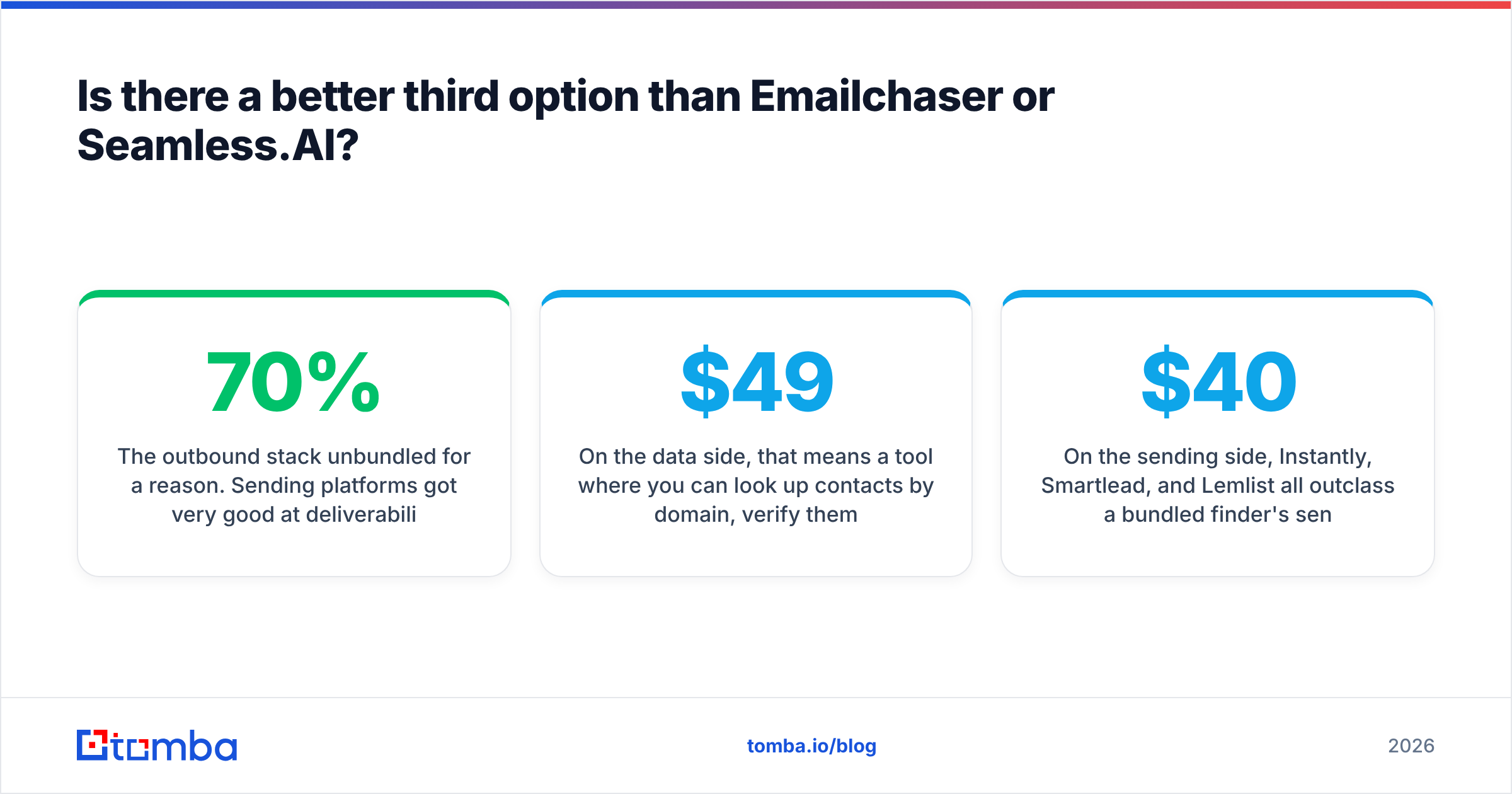
The outbound stack unbundled for a reason. Sending platforms got very good at deliverability: inbox rotation, warmup, spintax, reply classification. Data providers got very good at coverage and verification. Tools that try to do both usually do one of them at 70%.
So the third option is this: pick the best sender for your budget, pick a dedicated data provider, and connect them.
On the data side, you want a tool where you can look up contacts by domain, verify them before export, and pay a clear monthly rate. Tomba's email finder sits in that slot. There's a free tier of 25 searches/mo to test with, then Starter at $49/mo, Growth at $99/mo, and Pro at $249/mo — all month-to-month.
You also get domain search for mapping a whole company's contacts, a catch-all verifier for the domains that break other tools, phone finder, and bulk processing for list-sized jobs. If you're moving away from Seamless specifically, the Seamless.AI alternative breakdown covers the migration path.
On the sending side, Instantly, Smartlead, and Lemlist all outclass a bundled finder's sending features, and several have free or sub-$40 entry tiers.
Total cost for that split stack often lands below a Seamless.AI annual contract and above Emailchaser's sticker, with better output on both halves. If you're a solo operator sending 200 emails a month, that math doesn't hold, and Emailchaser's simplicity is the right call. Be honest about which one you are.
One more note. If your bottleneck is verified contact data rather than tooling, a pre-built list provider may get you further. BookYourData, for example, sells verified B2B contacts pay-as-you-go with no subscription, which suits one-off campaign builds better than either model here.
How should you run the evaluation?#
Don't buy on a demo. Settle the Emailchaser vs Seamless.AI question with a 10-day bake-off:
- Day 1–2: Build your 50-contact known-answer set. Pull the same list from both tools' free tiers.
- Day 3: Score coverage and precision separately. Anything under 90% precision gets a verification layer added to the plan, and its cost added to the comparison.
- Day 4–6: Send 100 emails from each source through the same sequencer, same copy, same inbox. Track bounce rate. That number reveals data quality; open rate does not.
- Day 7–10: Price the whole stack, not the tool. Data + verification + sending + any annual commitment, divided by usable contacts per month. That's your real cost-per-contact.
Whatever you conclude, get the bounce rate under 3% before you scale. Everything else in outbound — copy, timing, targeting — is downstream of whether the address was real.
Ready to fix the data layer first? Start with Tomba Email Finder — 25 free searches a month, no card, no sales call. Find and verify a batch against your current list, compare the bounce rates side by side, and let the numbers pick your vendor. If it wins, Starter is $49/mo, month-to-month, and it plugs into whichever sender you already trust.
Related guides#
Ready to find emails that actually work?
Join 150,000+ professionals who stopped guessing and started sending. Free credits on signup — no credit card required.
Get the Tomba newsletter
Practical outbound tactics and product updates — once every two weeks.
About the author