EmailListVerify vs SMARTe: Which B2B Data Tool Wins in 2026?
EmailListVerify cleans lists. SMARTe builds them. They get compared constantly, but they solve opposite halves of the same problem — here's which one your outbound stack actually needs, and what it costs.
TL;DR
- EmailListVerify and SMARTe are not really competitors. EmailListVerify is a bulk email verification engine; SMARTe is a B2B contact data platform that supplies emails and mobile numbers. One cleans a list, the other creates it.
- If your problem is "my bounce rate is 9% and my domain is getting flagged," EmailListVerify is the cheaper, faster fix — pay-as-you-go credits, no sales call, no seat minimums.
- If your problem is "I have no list at all, and I need direct dials for enterprise accounts in EMEA and APAC," SMARTe is the better fit — but pricing is quote-only and you should budget for an annual contract.
- Neither tool covers the full loop on its own. Most teams end up paying twice: once for discovery, once for verification.
- A combined platform (find, verify, enrich, catch-all check) usually costs less than stitching two vendors together, which is where Tomba's $49/mo Starter plan tends to undercut both.
What is EmailListVerify and what is SMARTe?#
Different jobs. That's the whole comparison in one sentence, and the reason most "EmailListVerify vs SMARTe" articles are useless — they line up feature checkboxes for products that sit at opposite ends of the pipeline.
EmailListVerify (emaillistverify.com) is a list-hygiene tool. You upload a CSV of addresses you already own — from a webinar signup, a scraped list, an old CRM export — and it runs syntax checks, MX lookups, SMTP handshakes, disposable-domain detection, role-account flagging, and catch-all classification. It returns each address as valid, invalid, unknown, or risky. There is a bulk uploader, a real-time API, and integrations with the usual ESPs. It does not find a single new contact.
SMARTe is on the other side. It's a sales intelligence and contact data provider: a searchable database of company and people records with work emails, mobile numbers, job titles, and firmographics, plus a Chrome extension that pulls contacts off LinkedIn and company sites into your CRM. Its differentiator is international coverage — North America plus meaningful depth in EMEA and APAC, with a compliance story built around GDPR and CCPA. It does not exist to clean a list you already have.
So the honest framing: EmailListVerify answers "is this address safe to send to?" SMARTe answers "who should I be sending to?"

How the two tools split the outbound pipeline#
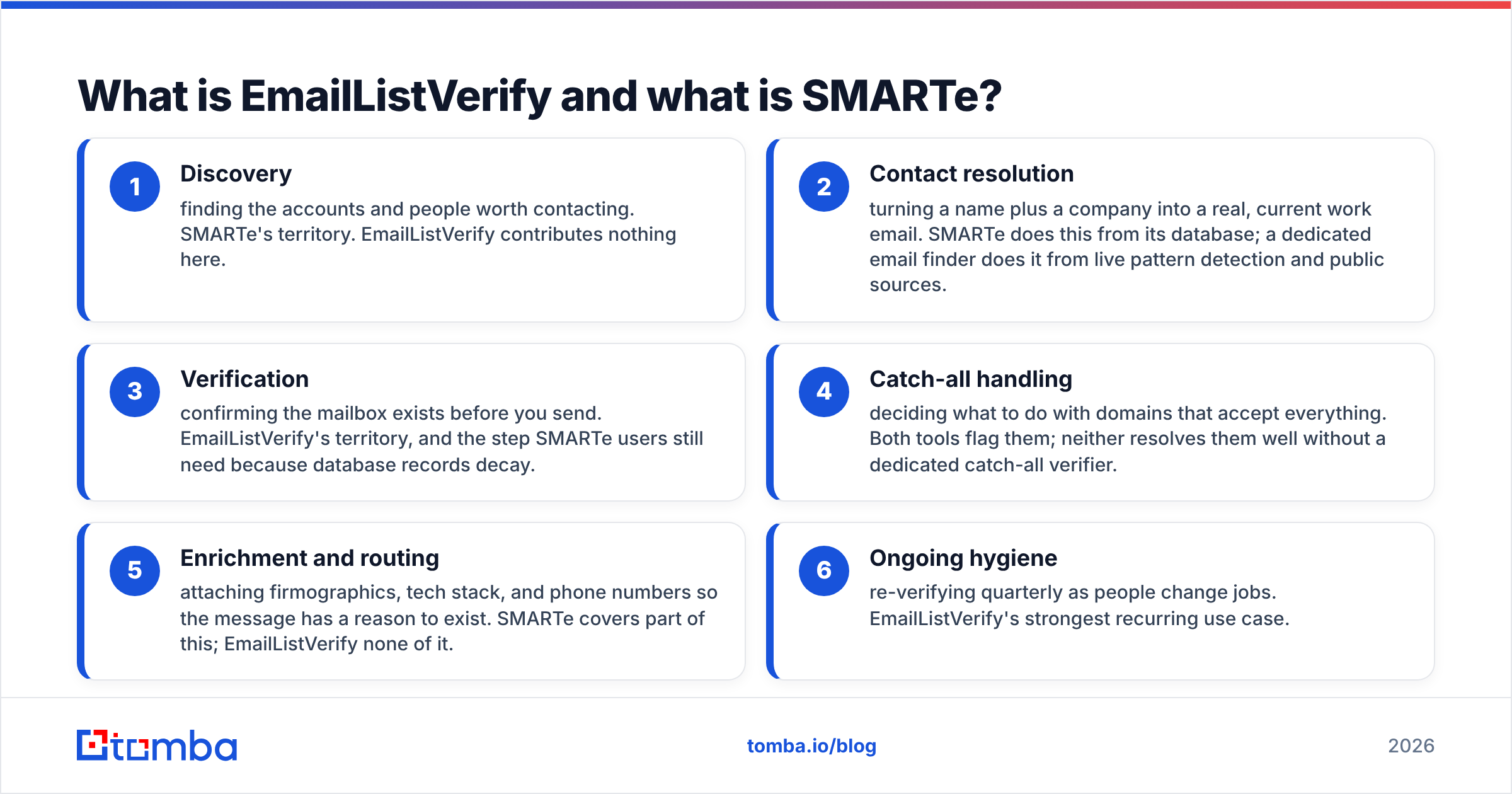
- Discovery — finding the accounts and people worth contacting. SMARTe's territory. EmailListVerify contributes nothing here.
- Contact resolution — turning a name plus a company into a real, current work email. SMARTe does this from its database; a dedicated email finder does it from live pattern detection and public sources.
- Verification — confirming the mailbox exists before you send. EmailListVerify's territory, and the step SMARTe users still need because database records decay.
- Catch-all handling — deciding what to do with domains that accept everything. Both tools flag them; neither resolves them well without a dedicated catch-all verifier.
- Enrichment and routing — attaching firmographics, tech stack, and phone numbers so the message has a reason to exist. SMARTe covers part of this; EmailListVerify none of it.
- Ongoing hygiene — re-verifying quarterly as people change jobs. EmailListVerify's strongest recurring use case.
Look at that list and the buying decision gets simple. You're not picking a winner. You're deciding which gap is currently costing you more money.
Which one has better data accuracy?#
They report accuracy in units that can't be compared directly, so be skeptical of any head-to-head accuracy claim — including the ones in vendor marketing.
EmailListVerify advertises around 99% accuracy. Read that carefully: it means when we say an address is valid, it usually is. That's a precision claim about verification verdicts, not a claim about finding addresses. In practice, verification vendors are broadly reliable on standard mailboxes and diverge hard on two things — catch-all domains and providers that throttle or lie to SMTP probes (Microsoft 365 tenants are the classic case). Any verifier that returns a confident "valid" on a catch-all domain is guessing.
SMARTe's accuracy is a coverage and freshness claim: what percentage of the contacts in its database still work, and how many of your target accounts it can cover at all. Independent user reviews on G2's sales intelligence category show the pattern that hits every database vendor — strong coverage in core markets, thinner results in niche verticals and small companies, and records that drift as people change roles. SMARTe's international depth is a real edge over US-centric databases; the trade-off is that any static database is a snapshot, and B2B contact data decays somewhere in the range of 2–3% per month.

The practical consequence: SMARTe records still need verification before you send. That is not a knock on SMARTe specifically — it's true of every database provider, including the expensive ones. It's also the single biggest reason teams end up holding both a data subscription and a verification subscription, and why a platform that does live lookup plus verification in one call removes a step rather than adding one.
If you want to sanity-check any vendor's claim yourself, take 200 known-good addresses from your own CRM (people who replied in the last 30 days), run them through the tool, and measure how many come back as invalid or unknown. False negatives are where verifiers quietly cost you pipeline.
EmailListVerify vs SMARTe: how do they compare feature by feature?#
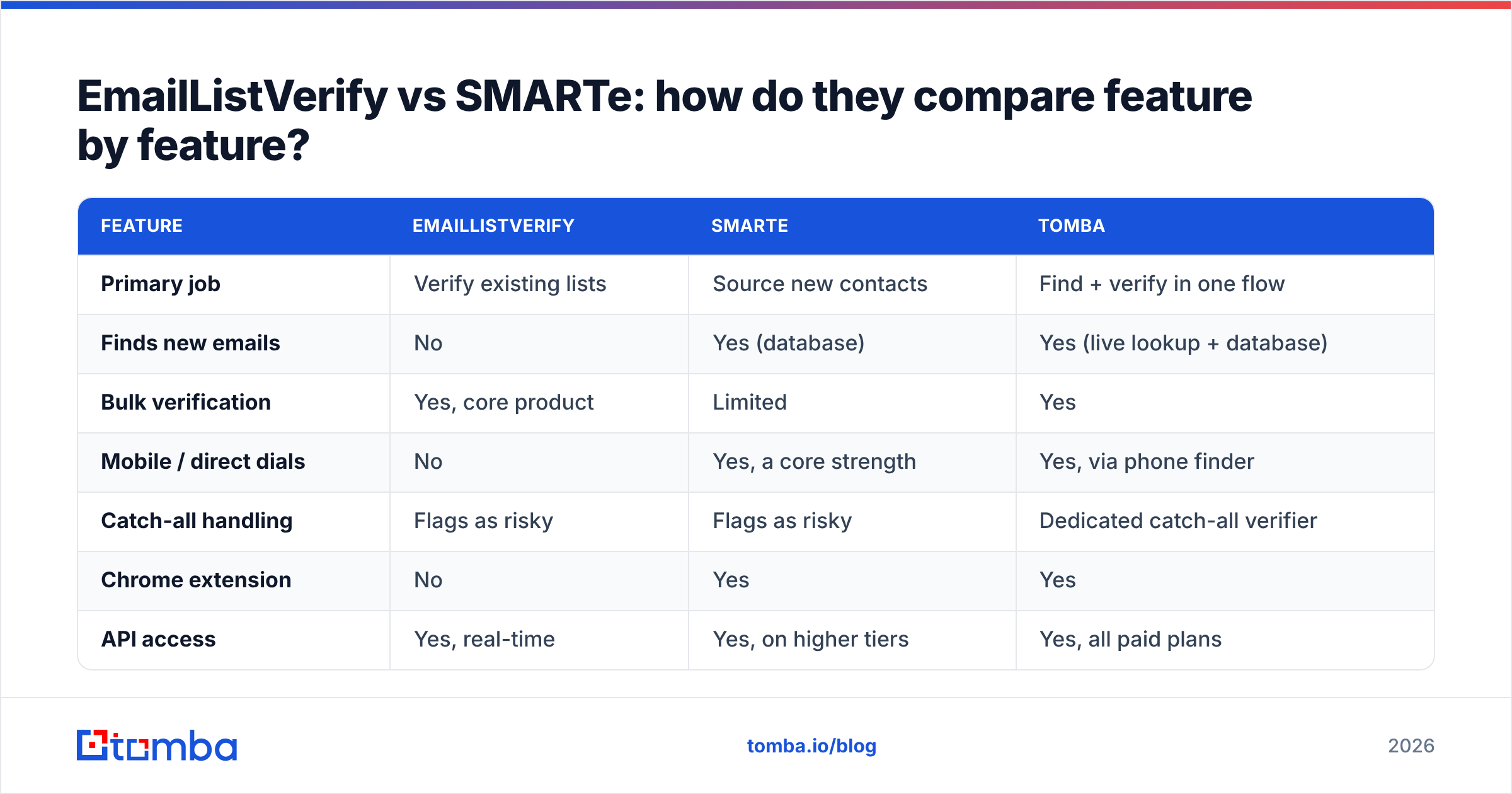
| Feature | EmailListVerify | SMARTe | Tomba |
|---|---|---|---|
| Primary job | Verify existing lists | Source new contacts | Find + verify in one flow |
| Finds new emails | No | Yes (database) | Yes (live lookup + database) |
| Bulk verification | Yes, core product | Limited | Yes |
| Mobile / direct dials | No | Yes, a core strength | Yes, via phone finder |
| Catch-all handling | Flags as risky | Flags as risky | Dedicated catch-all verifier |
| Chrome extension | No | Yes | Yes |
| API access | Yes, real-time | Yes, on higher tiers | Yes, all paid plans |
| Free tier | ~100 trial credits | Limited free credits | 25 searches/mo |
| Entry price | Pay-as-you-go credits | Quote only | $49/mo Starter |
| Contract | None required | Typically annual | Monthly or annual |
| Geographic strength | Global (verification is geo-agnostic) | NA + EMEA + APAC | Global |
| Best for | Cleaning lists you already own | Enterprise ABM outside the US | SMB/mid-market outbound end to end |

Two rows deserve a note. Contract is the one that surprises people: EmailListVerify credits never require a conversation with a rep, while SMARTe follows the standard data-vendor motion — demo, scoping call, annual commitment. If you need something running this afternoon, that difference matters more than any feature.
Catch-all handling is the other. Both tools mark catch-all domains as risky and stop there. That's the correct conservative default, but it means every enterprise domain running a catch-all MX gets dumped into a bucket you can't send to — often 15–25% of a B2B list. Resolving those addresses instead of discarding them is where a specialized catch-all finder changes the economics of a campaign.
What does each one actually cost?#
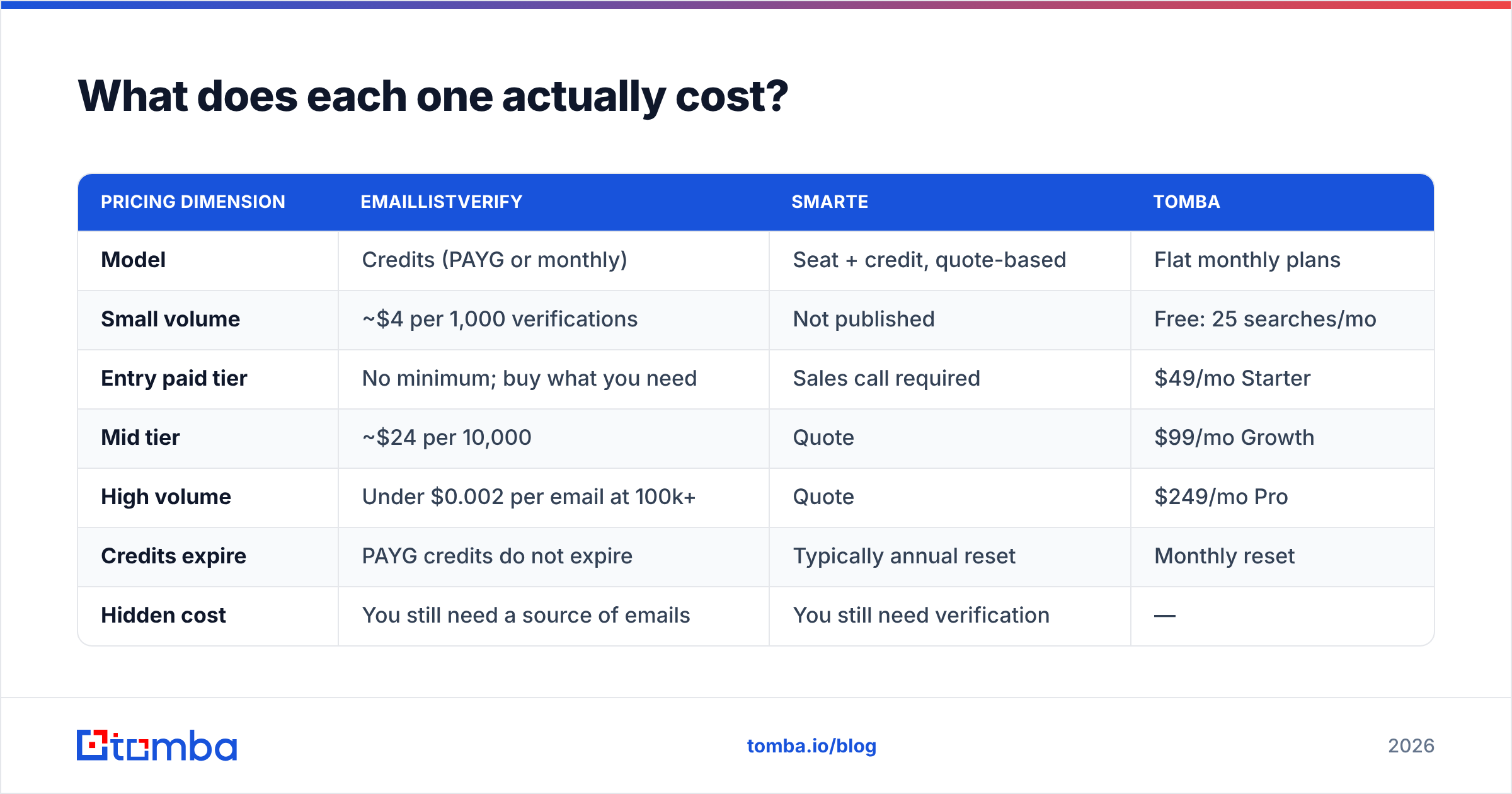
| Pricing dimension | EmailListVerify | SMARTe | Tomba |
|---|---|---|---|
| Model | Credits (PAYG or monthly) | Seat + credit, quote-based | Flat monthly plans |
| Small volume | ~$4 per 1,000 verifications | Not published | Free: 25 searches/mo |
| Entry paid tier | No minimum; buy what you need | Sales call required | $49/mo Starter |
| Mid tier | ~$24 per 10,000 | Quote | $99/mo Growth |
| High volume | Under $0.002 per email at 100k+ | Quote | $249/mo Pro |
| Credits expire | PAYG credits do not expire | Typically annual reset | Monthly reset |
| Hidden cost | You still need a source of emails | You still need verification | — |
Prices move; check each vendor's page before you commit. But the shape is stable and it tells you a lot.
EmailListVerify is genuinely cheap at the unit level and honest about it — a 50,000-address list costs less than one SDR's lunch budget for the month. The hidden cost isn't the price, it's the scope: verification credits do nothing to fill your pipeline.
SMARTe doesn't publish pricing, which is standard for database vendors and standard for a reason — pricing scales with seats, credits, geography, and export rights, and they'd rather scope it than post it. Expect a mid-four-figure to five-figure annual number for a real team, and expect exports to be metered. That's not a criticism; it's how the category works. It does mean SMARTe is a poor fit for a two-person startup that wants to test outbound this quarter.
For context on the flat-rate alternative, Tomba pricing runs Free (25 searches/mo), Starter at $49/mo, Growth at $99/mo, Pro at $249/mo, and custom Enterprise — with finding, verification, and enrichment drawing on the same credit pool instead of two separate invoices.

Who should choose EmailListVerify?#
Pick EmailListVerify if:
- You already have the list. Inbound signups, event scans, an inherited CRM, a partner list. The addresses exist; you just don't trust them.
- Your bounce rate is the emergency. Anything above 3% puts your sender reputation at risk, and a one-time bulk clean is the fastest possible fix.
- You want zero commitment. Buy credits, use them whenever, no seat count, no renewal conversation.
- You need verification inside an existing workflow. The real-time API drops into a signup form to block junk at the point of entry.
Skip it if you expected it to generate leads. It won't, and no amount of credits changes that.
Who should choose SMARTe?#
Pick SMARTe if:
- You sell outside the US. This is the strongest argument for SMARTe over US-heavy databases. EMEA and APAC coverage is where it earns its price.
- You need mobile numbers. If your motion is call-first or call-and-email, direct dials are worth more than another email column.
- Compliance review is part of your buying process. GDPR/CCPA posture is a first-class part of SMARTe's pitch, which matters when legal has a veto.
- You're doing account-based motions at enterprise scale and need consistent org charts across a target account list, not one-off lookups.
Skip it if you're a small team that needs 500 good contacts this month, or if you can't get budget approval for an annual contract.
Do you actually need both — or neither?#
Most teams that compare these two end up buying both, then discover the workflow is worse than the sum of its parts: export from SMARTe, reformat the CSV, upload to EmailListVerify, wait, download, re-merge, push to the sequencer. Every hand-off is a place where records get dropped, deduplicated wrong, or silently stale by the time they're sent.
The alternative worth pricing out is a single platform that runs discovery and verification in the same call. That's the gap Tomba is built for: domain search to map every contact at a target company, an email finder that returns a confidence score with each address, a built-in email verifier so nothing leaves unchecked, bulk email finder processing for list-scale work, and phone data alongside. One credit pool, one API, no CSV round-trip.
Where does it not win? If you need deep firmographic intelligence across thousands of accounts in Japan and Germany with intent signals layered on top, a dedicated database like SMARTe still does something Tomba doesn't try to do. And if all you own is a 400,000-address legacy list that needs a one-time scrub, EmailListVerify's per-unit price is hard to beat. Honest tools have edges.
What's the verdict for 2026?#
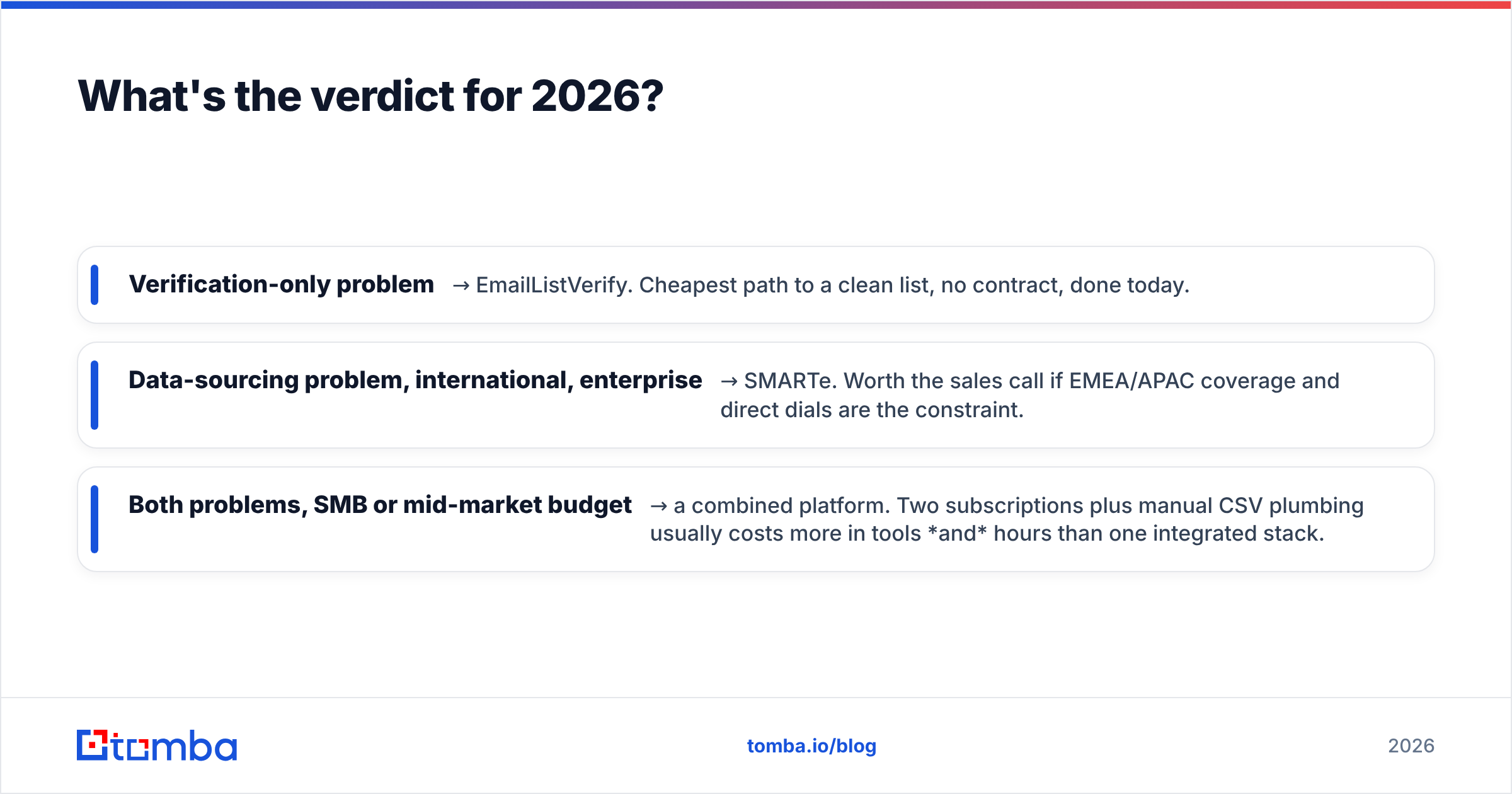
- Verification-only problem → EmailListVerify. Cheapest path to a clean list, no contract, done today.
- Data-sourcing problem, international, enterprise → SMARTe. Worth the sales call if EMEA/APAC coverage and direct dials are the constraint.
- Both problems, SMB or mid-market budget → a combined platform. Two subscriptions plus manual CSV plumbing usually costs more in tools and hours than one integrated stack.
The mistake to avoid is buying a verifier and expecting pipeline, or buying a database and expecting deliverability. They're different failure modes with different price tags, and knowing which one is actually bleeding you is the whole decision.
Start by finding contacts you can trust before you spend anything on cleaning them up. The Tomba Email Finder returns verified work emails with a confidence score on every result, includes catch-all handling, and starts free at 25 searches per month — enough to benchmark it against your own CRM data before you talk to anyone's sales team.
Related guides#
Ready to find emails that actually work?
Join 150,000+ professionals who stopped guessing and started sending. Free credits on signup — no credit card required.
Get the Tomba newsletter
Practical outbound tactics and product updates — once every two weeks.
About the author