EmailValidation.io vs Generect: Which Fits Your Stack?
One tool validates the emails you already have. The other builds the list in the first place. Here is where EmailValidation.io and Generect actually compete, where they don't, and which one belongs in your outbound stack.
EmailValidation.io vs Generect is an odd matchup. One tool checks the emails you already own. The other goes out and finds new ones. This guide shows where each one wins, and which one your stack actually needs.
TL;DR
- EmailValidation.io vs Generect is not a true head-to-head. One is a verification API that scores emails you already have. The other is a lead-data API that produces contacts and company records from LinkedIn-style search.
- Bounce problem? EmailValidation.io is the closer fit. Empty list? Generect is the closer fit.
- Buying both means two contracts, two credit systems, and two sets of rate limits to babysit. That is exactly why combined platforms exist.
- Neither vendor publishes a hard, independently audited accuracy number. Run a 500-row seed test against known-good addresses before you commit to annual billing.
- Tomba covers finding, verifying, catch-all handling, and enrichment on one credit pool from $49/mo. For most small outbound teams, that is the practical middle path.
EmailValidation.io vs Generect: what does each tool do?#
They solve two different halves of the same pipeline. Confusing them is the single most common buying mistake in this category.
EmailValidation.io is a real-time email verification API. You send it an address. It returns a structured verdict: syntax validity, MX record presence, SMTP acceptance, disposable-domain flag, role-account flag, free-provider flag, and usually a confidence score. It does not know who works at Stripe. It only knows whether jane@stripe.com is likely to accept mail. Its natural home is a signup form, a CRM hygiene job, or a pre-send gate in your sequencer.
Generect sits at the other end. It is a B2B lead-data provider with an API-first pitch. Run a LinkedIn-style search by title, headcount, geography, or industry. Get back structured people and company records. Then pull contact details for those records — work email, sometimes phone. It is built for teams that want lists from code, not clicks, and it markets hard to agencies and dev-heavy growth teams.
So the honest framing of EmailValidation.io vs Generect is not "which is better." It is "which gap in my pipeline costs me the most money right now?"

EmailValidation.io vs Generect: how do they actually differ?#
Here is the side-by-side on the attributes that change your architecture, not the ones that fill a feature grid.
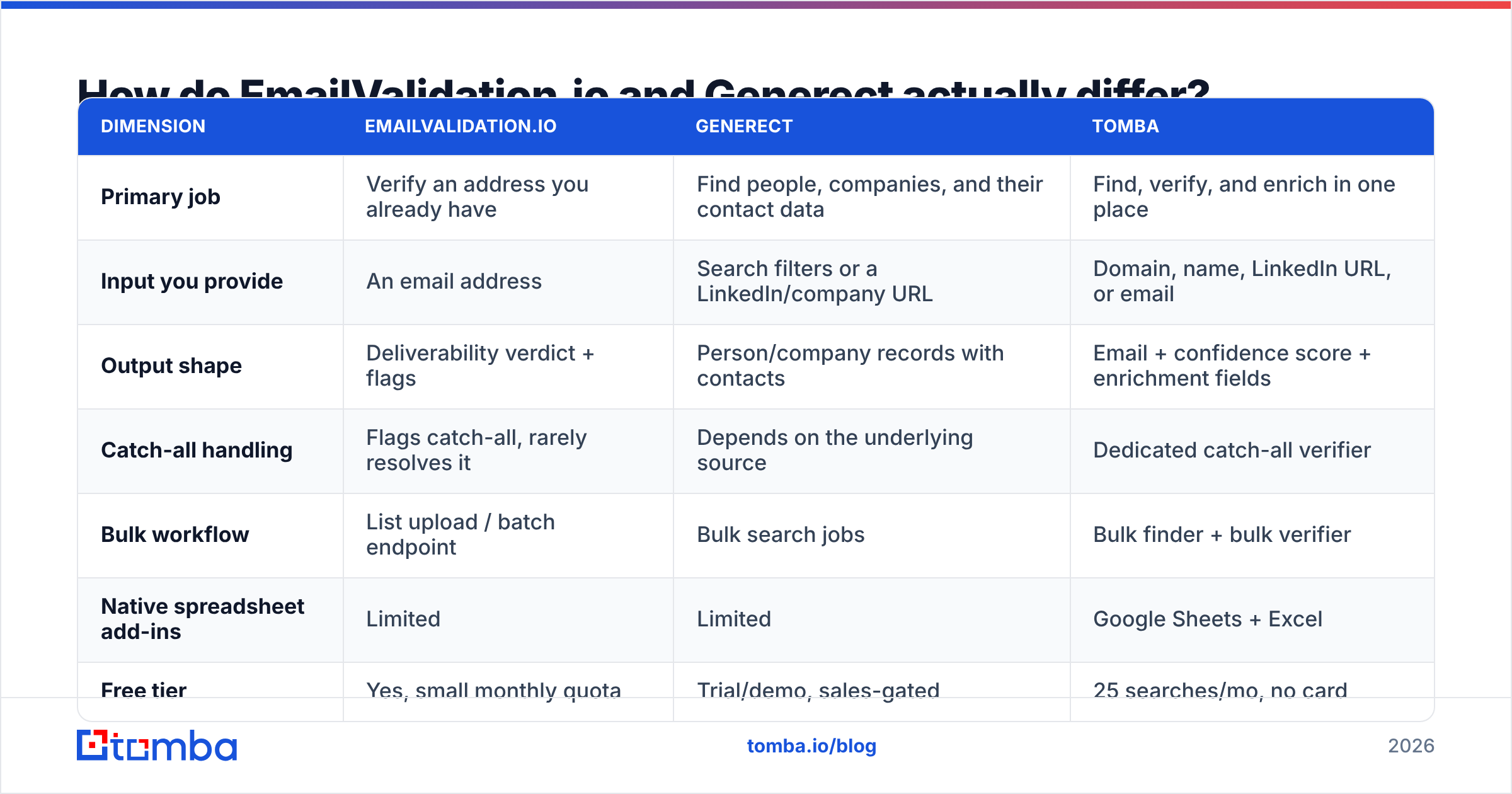
| Dimension | EmailValidation.io | Generect | Tomba |
|---|---|---|---|
| Primary job | Verify an address you already have | Find people, companies, and their contact data | Find, verify, and enrich in one place |
| Input you provide | An email address | Search filters or a LinkedIn/company URL | Domain, name, LinkedIn URL, or email |
| Output shape | Deliverability verdict + flags | Person/company records with contacts | Email + confidence score + enrichment fields |
| Catch-all handling | Flags catch-all, rarely resolves it | Depends on the underlying source | Dedicated catch-all verifier |
| Bulk workflow | List upload / batch endpoint | Bulk search jobs | Bulk finder + bulk verifier |
| Native spreadsheet add-ins | Limited | Limited | Google Sheets + Excel |
| Free tier | Yes, small monthly quota | Trial/demo, sales-gated | 25 searches/mo, no card |
| Entry paid plan | Low-cost credit packs | Quote-driven, volume-tiered | $49/mo Starter |
| Best for | Form validation, CRM hygiene | Programmatic list building | End-to-end outbound prospecting |
Two rows deserve extra attention.
Pricing transparency. EmailValidation.io publishes credit-based tiers you can read without talking to anyone. Generect leans quote-driven and volume-tiered. That is normal for lead-data vendors. It also means your real cost depends on negotiation, and on how many records you burn per useful contact. Budget for the second number, not the first.
Catch-all domains. This is where verification APIs of all stripes get quietly unreliable. A catch-all server accepts everything at SMTP time. So a pure SMTP check returns "accept" for asdfghjkl@company.com just as happily as for the real CFO. Any tool that returns "valid" on a catch-all domain without saying so is selling you optimism. Trust the ones that flag it honestly, or that resolve it with pattern and source evidence, like a dedicated catch-all verifier.
EmailValidation.io vs Generect: which one is more accurate?#
Accuracy means two different things here. You cannot compare the numbers directly.
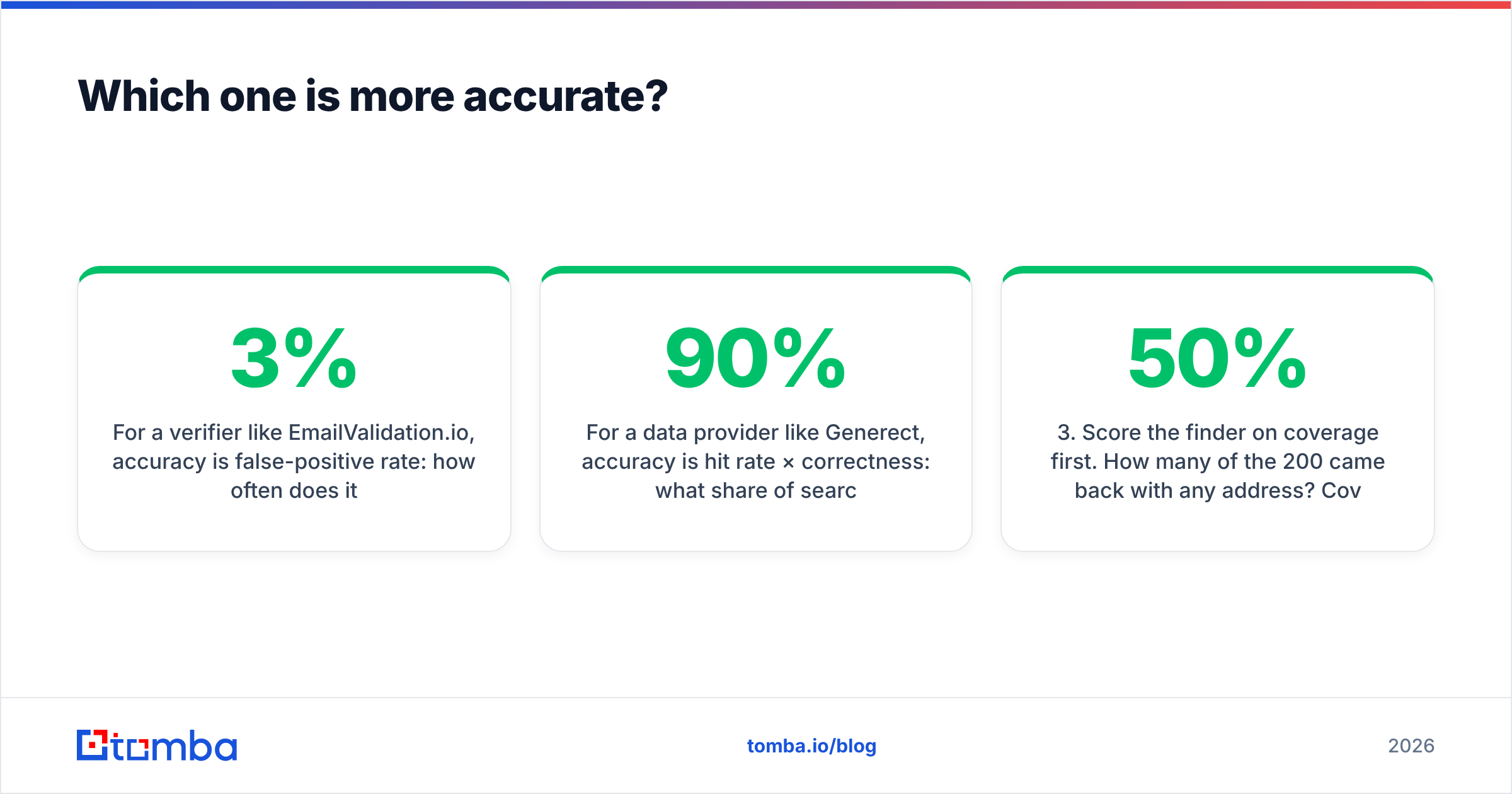
For a verifier like EmailValidation.io, accuracy is the false-positive rate. How often does it say "deliverable" for an address that then bounces? A good verifier keeps hard bounces under roughly 2–3% on a clean B2B list. Vendors rarely publish audited figures. Treat marketing percentages as claims, not evidence.
For a data provider like Generect, accuracy is hit rate × correctness. What share of searched contacts come back with an email at all? And what share of those emails belong to the right human at the right company? A 90%-correct provider with a 40% hit rate leaves more of your ICP untouched than an 85%-correct provider with a 70% hit rate.

Run this test before you sign anything. It takes an afternoon:
- Build a 200-row truth set. Use contacts you have emailed successfully in the last 90 days. You know those addresses work.
- Blind the file. Strip the emails and keep name + company domain. Feed the names to the finder and the emails to the verifier.
- Score the finder on coverage first. How many of the 200 came back with any address? Coverage below 50% on your ICP is disqualifying, whatever the accuracy claims say.
- Score the verifier on false positives. Every known-good address marked "invalid" or "risky" is a lead you would have thrown away.
- Add 20 deliberately fake addresses. Anything that passes them as deliverable will inflate your bounce rate.
- Repeat on one catch-all-heavy vertical — agencies, universities, large enterprises. That is where the averages fall apart.
That six-step test tells you more than any G2 grid. Still, cross-check current user sentiment on G2 before you commit. Both categories churn fast, and last year's leader is often this year's support-ticket backlog.
EmailValidation.io vs Generect: what does each one cost?#
The sticker price is rarely the real price. What matters is cost per usable contact after failures.
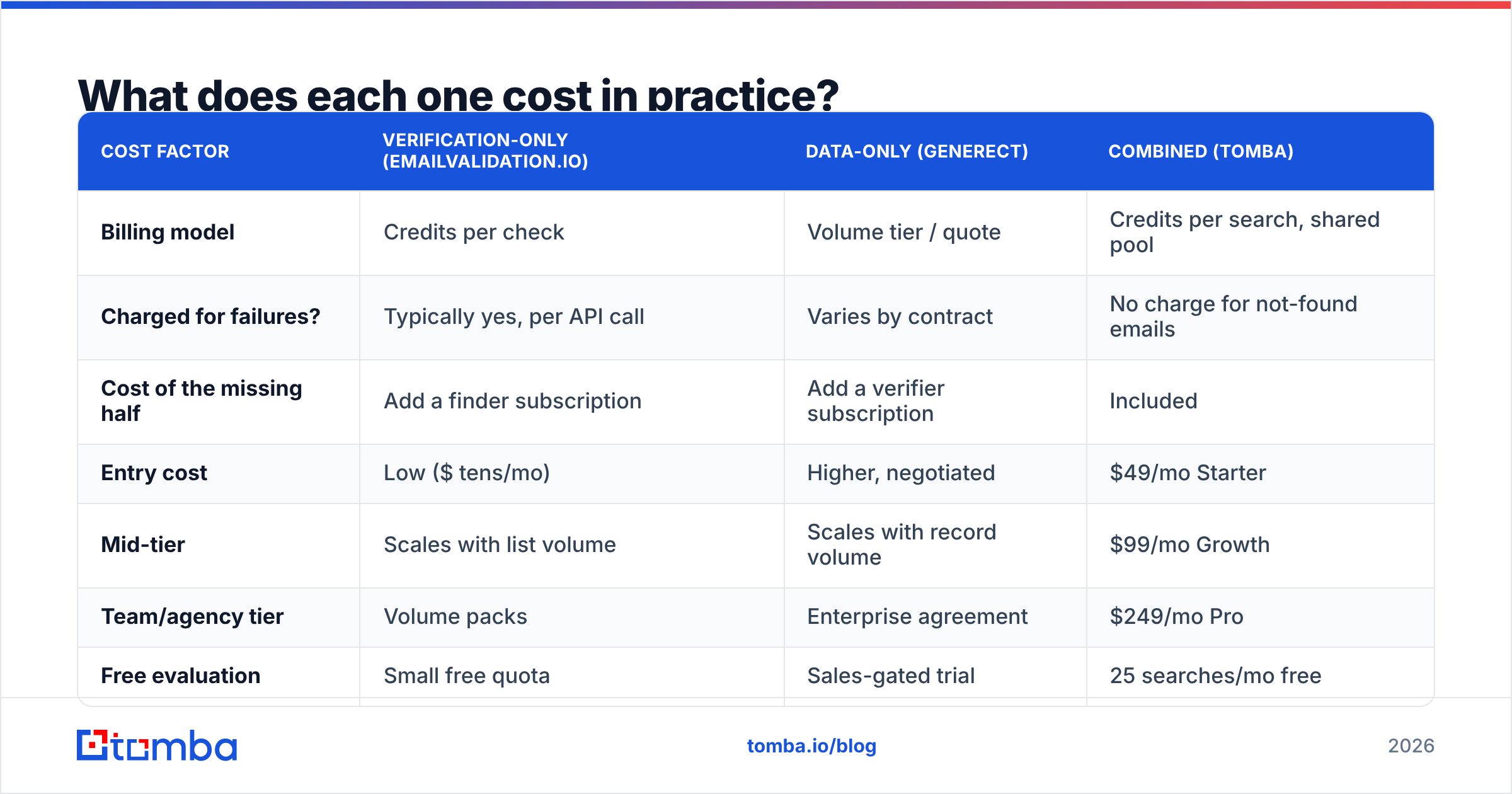
| Cost factor | Verification-only (EmailValidation.io) | Data-only (Generect) | Combined (Tomba) |
|---|---|---|---|
| Billing model | Credits per check | Volume tier / quote | Credits per search, shared pool |
| Charged for failures? | Typically yes, per API call | Varies by contract | No charge for not-found emails |
| Cost of the missing half | Add a finder subscription | Add a verifier subscription | Included |
| Entry cost | Low ($ tens/mo) | Higher, negotiated | $49/mo Starter |
| Mid-tier | Scales with list volume | Scales with record volume | $99/mo Growth |
| Team/agency tier | Volume packs | Enterprise agreement | $249/mo Pro |
| Free evaluation | Small free quota | Sales-gated trial | 25 searches/mo free |
Work the math on your own numbers. Say you prospect 3,000 new contacts a month. You need roughly 3,000 finder credits plus 3,000 verification credits. Two vendors means two minimums, two overage policies, and two places for a failed request to silently eat budget. A single pool — see current Tomba pricing for the tiers — removes that reconciliation work entirely.
One more line item people forget: engineering time. Two APIs means two auth schemes, two retry policies, two rate-limit backoffs, and a join step to reconcile records. If your only developer is also your founder, that is the most expensive row in the table.

Which should you pick for your use case?#
Pick by the job you actually need done this quarter.
- Big list, bounce problem. Choose EmailValidation.io or any dedicated email verifier. Your list already exists. You need a gate before it hits your sending domain. Verify, suppress the invalids, and park the risky ones in a low-volume segment.
- No list, one developer. Generect is the stronger fit. Its value is turning filters into structured people and company records at scale, which a UI-first email finder will not do.
- No list, no developer. Neither is ideal. You want a UI with a browser extension and spreadsheet add-ins. A combined platform wins on time-to-first-campaign.
The next three cases are where the EmailValidation.io vs Generect decision usually breaks down, because you end up needing both halves at once.
- Agency running many client domains. You need both halves plus per-client separation. Two vendors doubles the admin. Look hard at a single-vendor bulk workflow such as bulk lead generation instead.
- In-product signup validation. This is pure verification territory. Latency matters more than data breadth. A lean real-time endpoint beats a rich data API every time.
- Catch-all-heavy verticals. Neither a generic verifier nor a raw data feed solves this alone. Without explicit catch-all resolution, you will throw away 20–30% of valid contacts as "risky."
Where does Tomba fit between them?#
Tomba occupies the overlap the two vendors leave open. It finds addresses and verifies them under one account, one API key, and one credit pool.

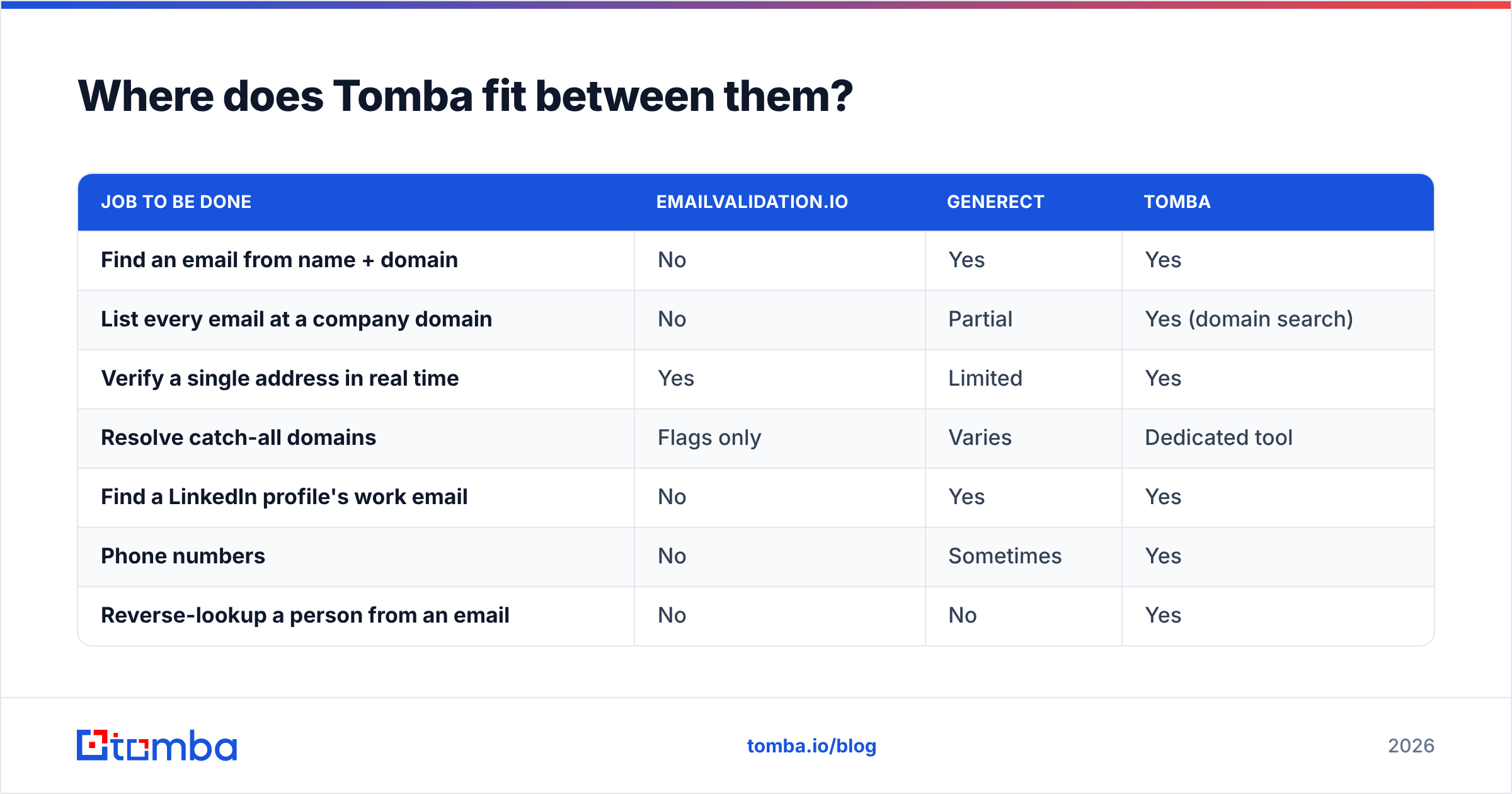
Concretely, the pieces map like this:
| Job to be done | EmailValidation.io | Generect | Tomba |
|---|---|---|---|
| Find an email from name + domain | No | Yes | Yes |
| List every email at a company domain | No | Partial | Yes (domain search) |
| Verify a single address in real time | Yes | Limited | Yes |
| Resolve catch-all domains | Flags only | Varies | Dedicated tool |
| Find a LinkedIn profile's work email | No | Yes | Yes |
| Phone numbers | No | Sometimes | Yes |
| Reverse-lookup a person from an email | No | No | Yes |
| One API for all of the above | No | No | Yes |
The practical difference shows up in the code. With a split stack you write a finder call, persist the result, write a verifier call, then reconcile the two responses. You also have to handle the case where the finder's confidence and the verifier's verdict disagree. With a single provider, the Tomba API returns the address and its verification state in one response, so that disagreement never happens.
Where Tomba is not the answer: deep firmographic intent signals, technographic filters, or a full sales-engagement sequencer. Tomba is a contact-data layer. Pair it with your sequencer of choice rather than expecting it to replace one.
What should you check before you sign a contract?#
Five things, in order of how often they cause regret:
- Are you charged for misses? Some APIs bill every call, found or not. On a 40%-hit-rate ICP, that doubles your effective cost per contact.
- What is the rate limit on your tier? A 10-requests-per-second cap turns a 50,000-row enrichment job into an overnight batch. Ask for the number in writing.
- How does the vendor handle GDPR requests? Both categories touch personal data. Check the DPA, the lawful basis, and the opt-out path. Ask where the data comes from and how often it is refreshed. Tomba documents its data sources publicly, and any vendor that will not should raise an eyebrow.
- Is the free tier real or sales-gated? A self-serve free tier lets you run the six-step test above without a call. A gated demo means you are evaluating a salesperson, not a product.
- What happens to unused credits? Monthly reset versus rollover changes annual cost a lot if your prospecting is seasonal.
What's the verdict?#
If you can only buy one, buy the one that fixes your current bottleneck. Bounce rate above 5% on a list you already own? EmailValidation.io does that job cleanly and cheaply. Empty pipeline, a developer on staff, and a need to build lists from code? Generect is built for exactly that shape of work.
If you are buying both, stop and price the combined option first. The two-vendor stack is defensible at high volume, where specialised tooling earns its keep. For teams doing a few thousand contacts a month it is mostly duplicated overhead: two invoices, two integrations, two support queues, and a reconciliation step nobody owns.
Here is the most common outcome we see in an EmailValidation.io vs Generect evaluation. Teams start with a verifier, because bounces hurt right away. Six months later they find their real constraint was never data hygiene. Nobody had enough of the right contacts to email in the first place.
Ready to test the combined approach? Start with the Tomba Email Finder — 25 free searches a month, no card required. Feed it the same 200-row truth set you would use on anyone else. Check the coverage and the verification verdicts side by side, and let your own data decide. If the numbers hold up on your ICP, the Starter plan at $49/mo replaces both halves of the stack you were about to buy separately.
Related guides#
Ready to find emails that actually work?
Join 150,000+ professionals who stopped guessing and started sending. Free credits on signup — no credit card required.
Get the Tomba newsletter
Practical outbound tactics and product updates — once every two weeks.
About the author