EmailValidation.io vs SalesIntel: Data Quality Compared
One is a cheap verification API priced in fractions of a cent. The other is a human-verified B2B database sold on annual contracts. Here is which one your pipeline actually needs — and when you need neither.
TL;DR
- EmailValidation.io and SalesIntel solve different problems. EmailValidation.io checks whether an address you already have is deliverable. SalesIntel gives you contacts you did not have, with human research behind them.
- Comparing "EmailValidation.io vs SalesIntel" on price is misleading: one charges fractions of a cent per API call, the other sells annual seats with credit minimums and a sales call attached.
- If your list already exists (CRM exports, form fills, scraped data), a verification API is the cheaper fix. If your list does not exist yet, verification alone will not save you.
- Most teams end up needing three things — discovery, verification, and enrichment — and buying two separate vendors for them is where budgets quietly leak.
- A combined finder-plus-verifier stack (Tomba, and prebuilt-list vendors like BookYourData for specific niches) usually beats bolting a cheap validator onto an expensive database.
What are EmailValidation.io and SalesIntel?#
They sit at opposite ends of the same pipeline, which is why buyers confuse them.
- EmailValidation.io is a verification API. You send it an address, it returns syntax checks, MX record status, disposable-domain flags, role-account detection, free-provider detection, and an SMTP-level deliverability verdict. It does not find anyone. It grades what you feed it. See the official docs for the current response schema.
- SalesIntel is a B2B contact database. It sells firmographic and contact records — emails, direct dials, technographics, intent signals — with a heavy marketing emphasis on human verification by research analysts rather than pure automated scraping. Their pitch lives at salesintel.io.
- The buying motion is completely different. EmailValidation.io is self-serve, credit-card, API-key-in-five-minutes. SalesIntel is a demo, a scoping call, an annual contract, and per-seat licensing.
- The failure modes are different too. A verifier fails by returning "valid" on an address that later bounces. A database fails by not having the person at all, or by having them at a job they left 14 months ago.
- Neither one writes your sequences. Both are inputs. Neither improves a bad offer.
If you are evaluating EmailValidation.io vs SalesIntel as substitutes, step back: you are probably shopping for "fewer bounces and more meetings," and those are two purchases, not one.

How do EmailValidation.io and SalesIntel compare head-to-head?#
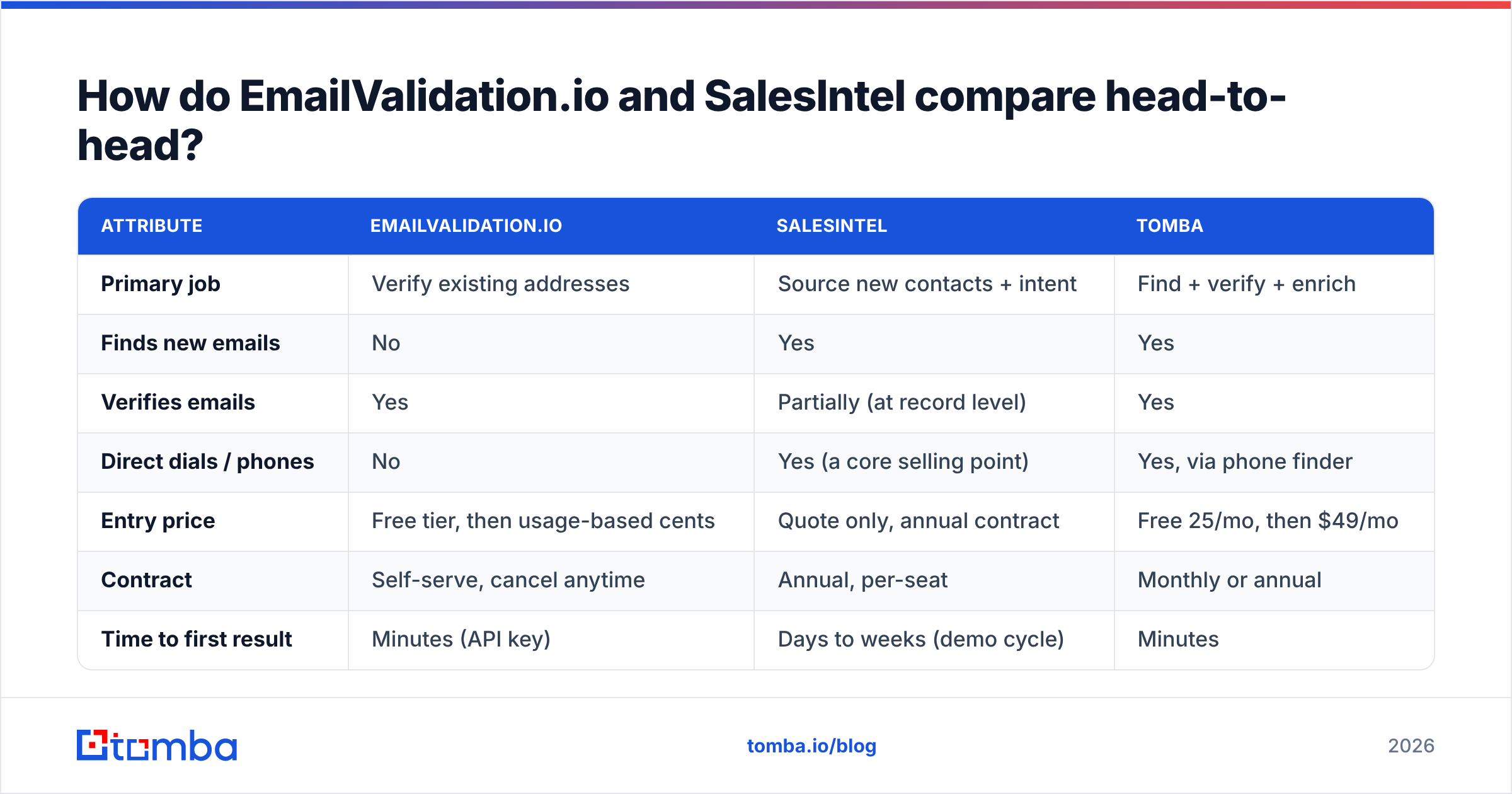
Here is the honest side-by-side. Pricing for SalesIntel is not published; the figures below reflect what buyers commonly report on review sites, so treat them as directional and confirm on a call.
| Attribute | EmailValidation.io | SalesIntel | Tomba |
|---|---|---|---|
| Primary job | Verify existing addresses | Source new contacts + intent | Find + verify + enrich |
| Finds new emails | No | Yes | Yes |
| Verifies emails | Yes | Partially (at record level) | Yes |
| Direct dials / phones | No | Yes (a core selling point) | Yes, via phone finder |
| Entry price | Free tier, then usage-based cents | Quote only, annual contract | Free 25/mo, then $49/mo |
| Contract | Self-serve, cancel anytime | Annual, per-seat | Monthly or annual |
| Time to first result | Minutes (API key) | Days to weeks (demo cycle) | Minutes |
| API access | Yes, core product | Yes, usually higher tier | Yes on all paid plans |
| Bulk list handling | CSV + batch endpoints | Platform exports with credit caps | Bulk finder and verifier |
| Best fit | Devs cleaning known lists | Enterprise ABM teams in the US | SMB to mid-market outbound |

The row that decides most evaluations is "finds new emails." If that column matters to you, EmailValidation.io is out of the running before pricing even enters the conversation — not because it is weak, but because it was never built for that job.
Which one is more accurate — and accurate at what?#
Accuracy means two different things here, and vendors exploit the ambiguity.
Verification accuracy is measured as: of the addresses marked deliverable, what percentage actually accept mail? Good verification APIs, EmailValidation.io included, land in the 95–98% range on standard domains. The number collapses on catch-all domains, where the receiving server accepts everything at the SMTP handshake and decides later. No verifier can resolve a true catch-all with certainty — anyone claiming otherwise is selling you a guess with confidence styling. This is why a dedicated catch-all verifier exists as a separate discipline rather than a checkbox.
Database accuracy is measured as: of the records sold to you, what percentage are the right person, at the right company, at the right address, today? This is where SalesIntel's human-in-the-loop research is a genuine differentiator, particularly for direct dials, which decay faster than emails and cannot be verified by any automated method that does not involve dialing.

Two practical consequences:
- A verified address is not a correct address. EmailValidation.io can confirm
j.smith@acme.comaccepts mail while J. Smith left Acme in 2024 and the mailbox is now a forwarding rule to an admin. Deliverable, useless. - A researched record still needs verification before send. Human verification happens at a point in time. If the record was checked seven months ago, run it through an email verifier before it enters a sequence. Data decay in B2B is commonly estimated at 2–3% per month, and that compounds fast.
What does each actually cost in practice?#
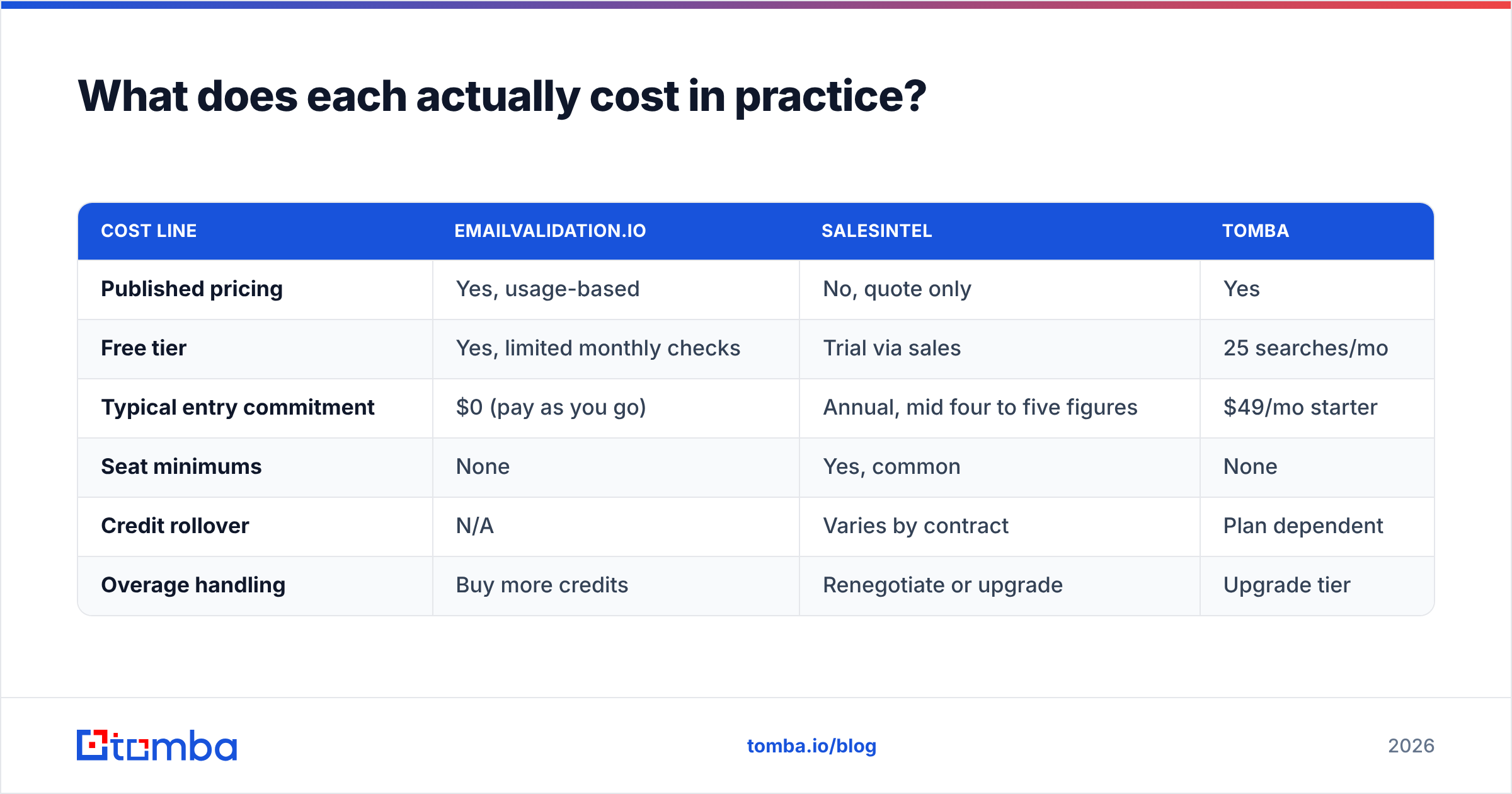
| Cost line | EmailValidation.io | SalesIntel | Tomba |
|---|---|---|---|
| Published pricing | Yes, usage-based | No, quote only | Yes |
| Free tier | Yes, limited monthly checks | Trial via sales | 25 searches/mo |
| Typical entry commitment | $0 (pay as you go) | Annual, mid four to five figures | $49/mo starter |
| Seat minimums | None | Yes, common | None |
| Credit rollover | N/A | Varies by contract | Plan dependent |
| Overage handling | Buy more credits | Renegotiate or upgrade | Upgrade tier |
For a small team, the real comparison is not "which product is cheaper" but "which contract shape survives a bad quarter." A usage-based verifier costs nothing in a month you do not prospect. A per-seat annual database costs the same whether your SDRs use it daily or forget the login.
Enterprise teams reverse that logic: they want a single vendor with security review, SOC 2 paperwork, CRM sync, and a support SLA, and they will pay a premium to avoid stitching four tools together. That is a legitimate reason to pay SalesIntel prices, and it is the reason review sites like G2 show polarised sentiment on data vendors — the same product looks like a bargain to one buyer and a tax to another.
Compare that shape against transparent Tomba pricing — Free, $49/mo Starter, $99/mo Growth, $249/mo Pro — where the plan is visible before a sales call and you can leave next month.
Who should choose EmailValidation.io?#
Choose it when all of the following are true:
- You already have the addresses. Signup lists, webinar registrations, CRM records, partner data, event scans.
- You need a programmatic check, not a UI. Your use case is a form-validation hook or a nightly hygiene job, not a rep opening a dashboard.
- You do not need phone numbers or firmographics. Adding those means a second vendor anyway.
- Volume is spiky. Usage-based billing means a 400k-record cleanup in March does not lock you into a March-sized bill in July.
- You want it live today. Nothing in the procurement process should take longer than reading the docs.
A common and sensible pattern: put a lightweight validity check on your signup form so typos never enter the database, then run a deeper batch verification on the full list quarterly. If you just want a manual spot-check, a free email checker covers one-off lookups without an API key.
Who should choose SalesIntel?#
Choose it when the bottleneck is coverage, not hygiene:
- You sell into US mid-market and enterprise accounts where direct dials materially change connect rates.
- You run account-based motions and need to map a buying committee, not just find one contact.
- Intent data feeds your prioritisation and you have the process maturity to act on it within days, not weeks.
- You have budget authority for an annual contract and a RevOps owner who will enforce adoption.
- Research-on-demand matters to you — the ability to request a human to source a contact you cannot find is a real feature, and few competitors offer it.
Where it disappoints: teams that buy a large database, export 30,000 contacts in month one, blast them, torch their sender reputation, and then blame the data. Volume access without verification discipline is a liability, not an asset.

Is there a middle option that covers both jobs?#
Yes, and it is where most SMB and mid-market teams land after running this comparison.
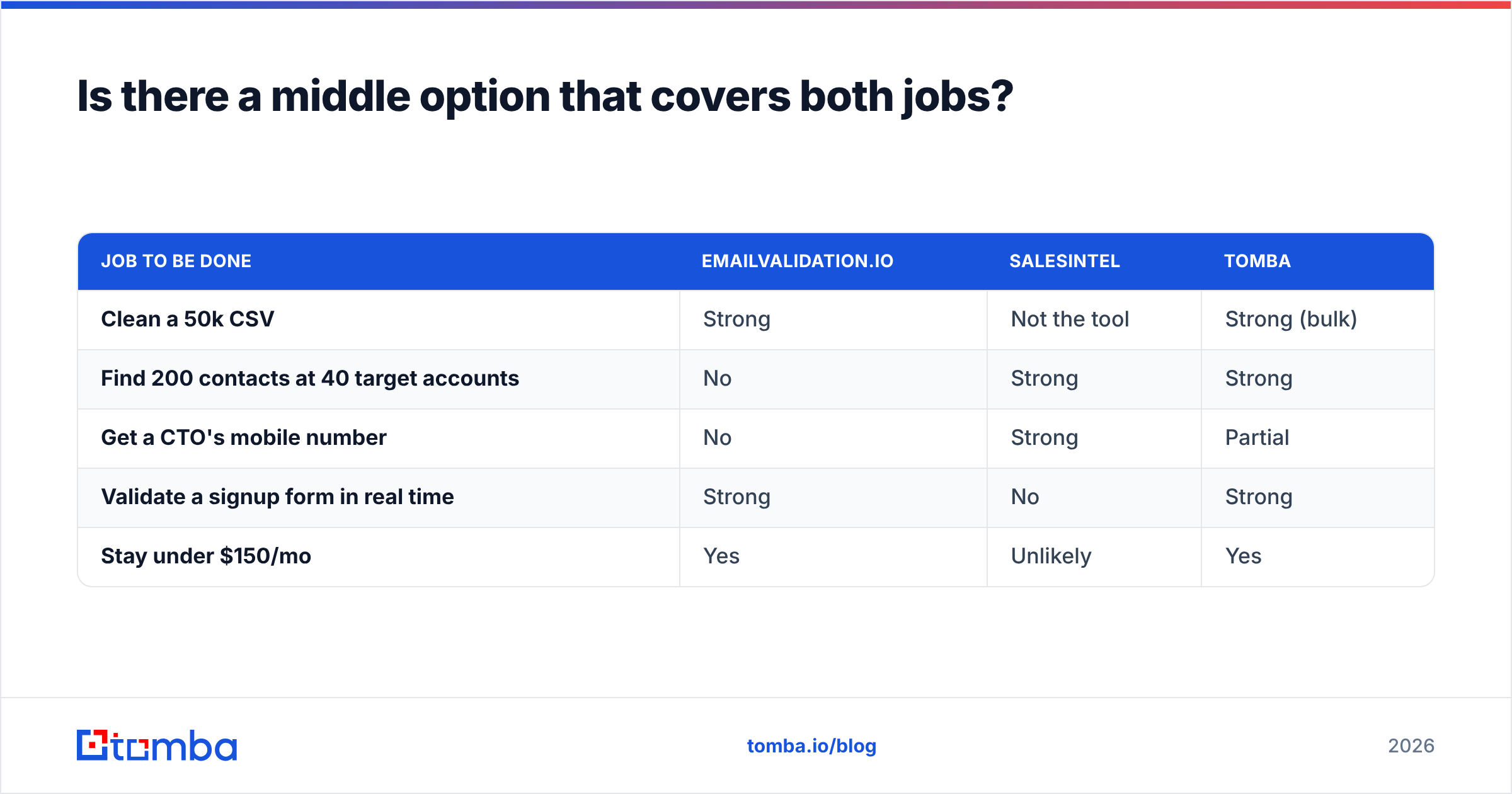
The gap between the two products is obvious once you name it: EmailValidation.io verifies but does not discover; SalesIntel discovers but costs like a platform. A finder-plus-verifier tool does both jobs at self-serve pricing.
That is Tomba's position. The email finder resolves a name plus domain into a professional address, domain search pulls every discoverable contact at a company, verification runs on the same credits, and the Tomba API exposes all of it if you are automating. For teams that prefer buying a prebuilt list for a specific vertical rather than searching account by account, BookYourData is a solid peer worth pricing alongside — different model, honest results, and stronger where you want a filtered list delivered ready to load.
| Job to be done | EmailValidation.io | SalesIntel | Tomba |
|---|---|---|---|
| Clean a 50k CSV | Strong | Not the tool | Strong (bulk) |
| Find 200 contacts at 40 target accounts | No | Strong | Strong |
| Get a CTO's mobile number | No | Strong | Partial |
| Validate a signup form in real time | Strong | No | Strong |
| Stay under $150/mo | Yes | Unlikely | Yes |
How do you build a stack that uses the right tool for each job?#
A workable sequence for a team of two to ten reps:
- Define the account list first. Firmographic filters, not names. If you cannot describe the account, no data vendor will fix that.
- Discover contacts at those accounts. Domain search or a database export. This is the step EmailValidation.io does not perform.
- Verify every address immediately before send — not at import time. A record verified 90 days ago is a guess.
- Segment catch-all domains into their own track. Send them lower volume, watch reply rates, and never let them drag your primary domain's reputation down.
- Enrich only what you will use. Contact enrichment on 50,000 records you will never sequence is spend with no return; enrich the 800 you will actually touch this quarter.
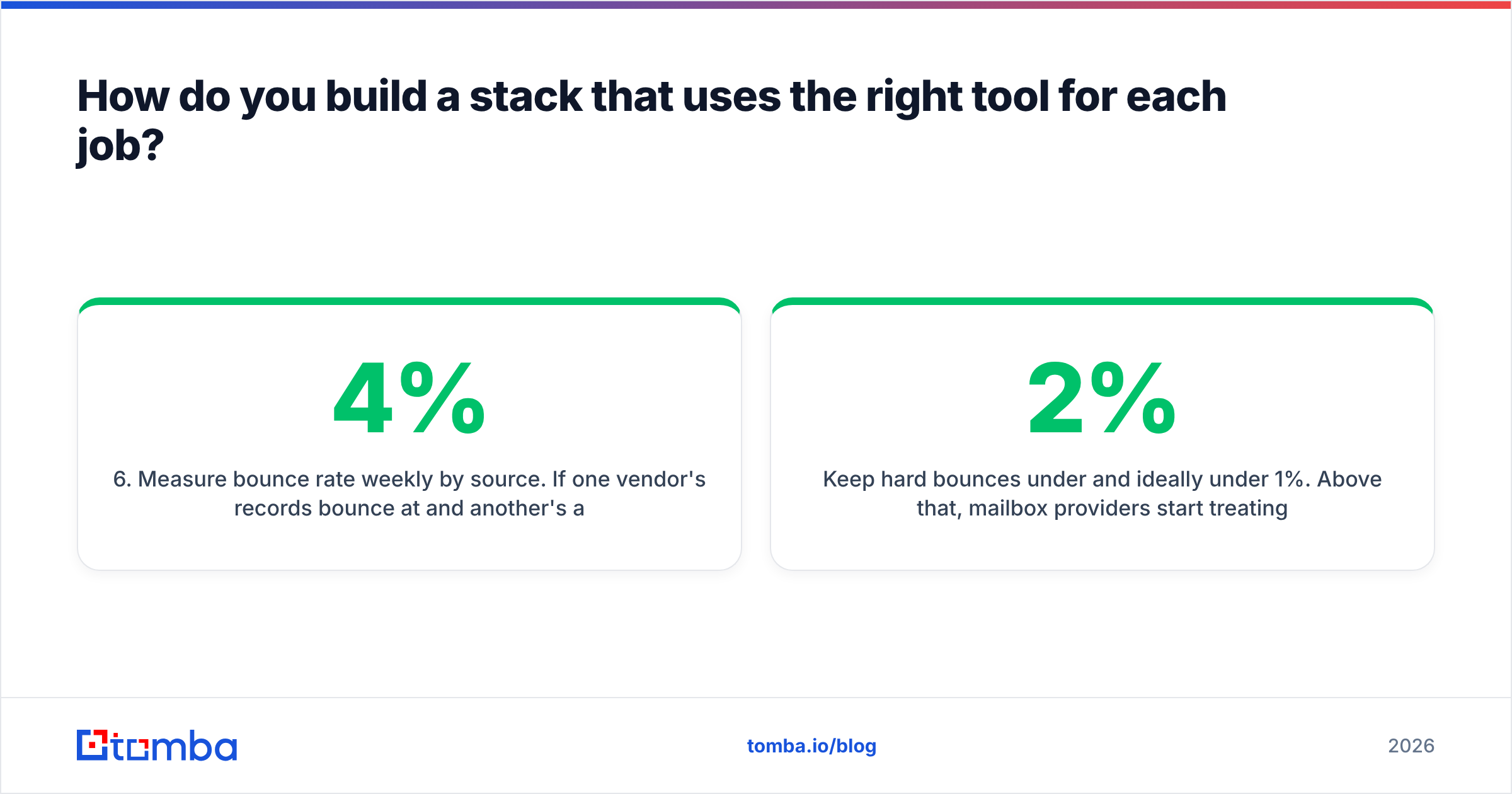
- Measure bounce rate weekly by source. If one vendor's records bounce at 4% and another's at 0.8%, you have your renewal answer without a spreadsheet debate.
Keep hard bounces under 2% and ideally under 1%. Above that, mailbox providers start treating your domain as a list-quality problem, and no amount of copy testing recovers it.
What is the verdict on EmailValidation.io vs SalesIntel?#
Buy EmailValidation.io if your problem is hygiene. It is cheap, fast to integrate, self-serve, and honest about what it does. It is a component, not a platform, and it is priced accordingly.
Buy SalesIntel if your problem is coverage and you sell enterprise. Human-verified records and direct dials justify the contract when a single closed deal covers the year. They do not justify it when your ACV is $4,000 and your SDR team is one person.
Buy neither if you are a small team doing outbound. You will pay a database price for discovery and a second bill for verification, and both will sit half-used. A combined tool covers the same ground at a fraction of the commitment.
Start with the Tomba Email Finder — 25 free searches a month, no card, no demo call — and run it against 20 accounts you already know. Compare the hit rate and bounce rate against whatever quote is sitting in your inbox. That test takes an afternoon and settles the argument better than any comparison page, including this one.
Related guides#
Ready to find emails that actually work?
Join 150,000+ professionals who stopped guessing and started sending. Free credits on signup — no credit card required.
Get the Tomba newsletter
Practical outbound tactics and product updates — once every two weeks.
About the author