EmailValidation.io vs Seamless.AI: Which One Do You Need?
One verifies addresses you already have. The other sells you a contact database. Here is how EmailValidation.io and Seamless.AI actually differ on accuracy, pricing, and API depth — and which one your pipeline needs.
TL;DR
- EmailValidation.io and Seamless.AI are not competitors. One is a verification API that tells you whether an address is deliverable; the other is a contact database that hands you addresses in the first place.
- If your problem is bounce rate, EmailValidation.io (or any solid verifier) is the cheaper, faster fix. If your problem is "I have no list", a verifier does nothing for you.
- Seamless.AI sells seat-based licenses and does not publish pricing publicly — you go through a demo and a quote. EmailValidation.io publishes pay-as-you-go credit pricing on its site.
- Buying both means paying twice for one workflow. Tools that combine finding and verification in a single credit pool — Tomba's email finder plus its built-in email verifier — usually cost less than the pair.
- Verdict: pick EmailValidation.io if you only need SMTP-level hygiene at API scale. Pick Seamless.AI if you want a big-database prospecting seat for a rep team. Pick a combined platform if you want both without the double bill.
What are EmailValidation.io and Seamless.AI, exactly?#
EmailValidation.io is a single-purpose email verification API. You send it an address, it runs syntax parsing, MX record lookup, disposable-domain detection, role-account detection, and an SMTP handshake, and it returns a structured verdict — deliverable, undeliverable, risky, or unknown. There is no UI-heavy prospecting layer. It is a plumbing tool for developers and RevOps teams who already have addresses and need to know which ones will bounce.
Seamless.AI is the opposite shape. It is a B2B contact database and prospecting search engine: you filter by title, industry, headcount, or technology, and it returns people with emails and phone numbers, then pushes them into your CRM or sequencer. Its pitch is coverage and speed of list-building, not deliverability forensics.
So the honest framing of "EmailValidation.io vs Seamless.AI" is not "which tool is better". It is "which half of the pipeline is currently broken for you". Those are different purchases, and confusing them is how teams end up with a $10K annual contract that never fixed the bounce problem they bought it for.

Is comparing a verifier to a database a category error?#
Partly — but only partly, and the overlap is where the real decision lives.
Seamless.AI does not just dump raw strings at you. It claims to validate contacts as it surfaces them, which means a share of the verification job is already priced into your seat. EmailValidation.io does not just check syntax either; a proper SMTP-level check is the same primitive that sits underneath any database's "verified" badge.
The overlap creates three practical questions:
- Is the database's built-in validation good enough to skip a dedicated verifier? In most audits, no. Database-side validation tends to be a cached verdict from whenever the record was last touched, not a live check at export time. B2B email decays roughly 2–3% per month as people change jobs, so a record validated eight months ago is materially riskier than one checked this morning.
- Does a verifier replace a database? Never. A verifier is subtractive — it can only shrink a list you already own.
- Does either replace the other's pricing model? No, and this matters more than features. Verification is priced per credit and scales linearly. Prospecting databases are priced per seat and scale with headcount. A five-person SDR team pays five times for the same underlying data access.
How do they compare feature by feature?#
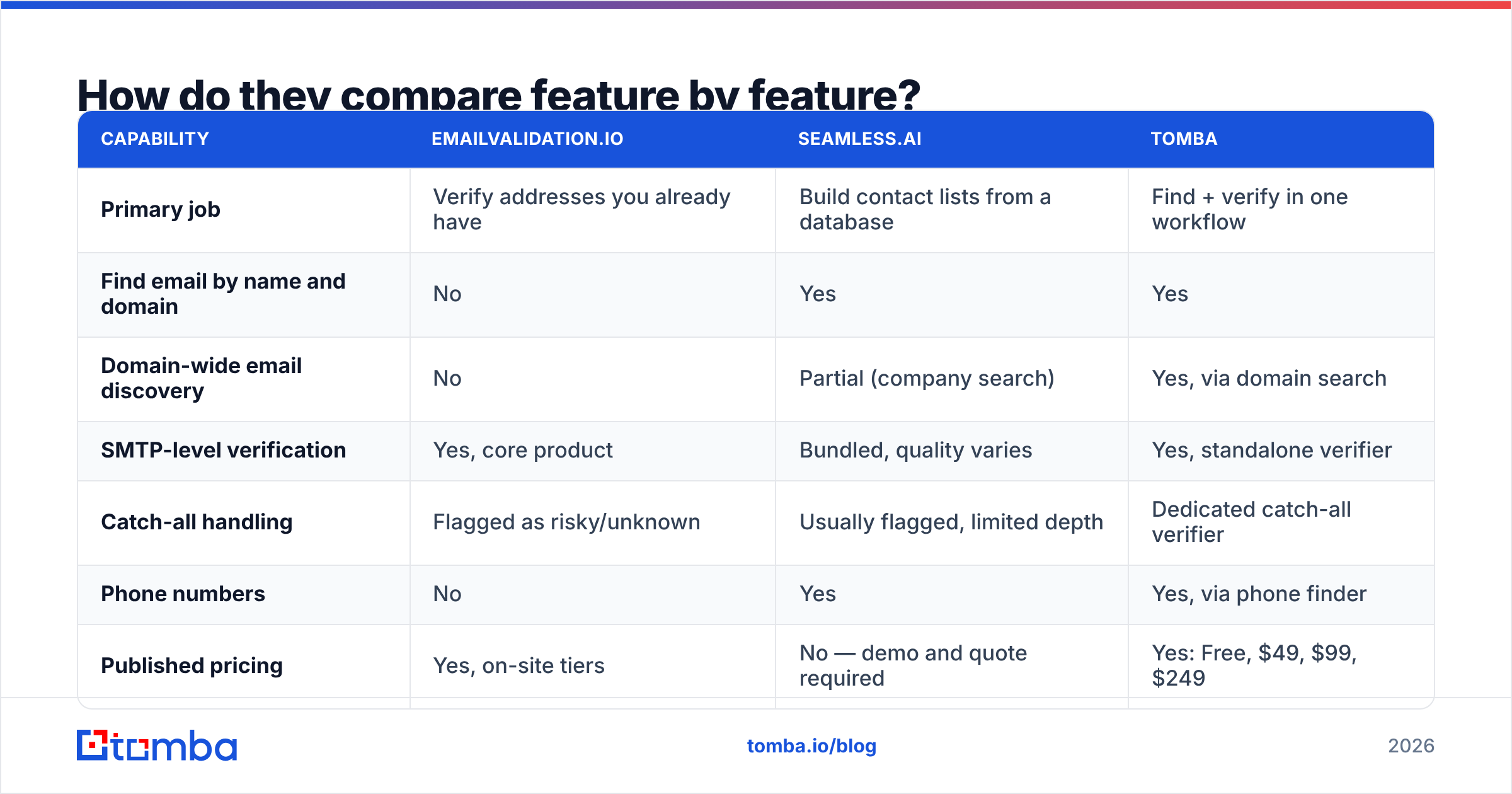
Here is the head-to-head on what each tool actually does, with a combined finder-plus-verifier platform in the third column for reference.
| Capability | EmailValidation.io | Seamless.AI | Tomba |
|---|---|---|---|
| Primary job | Verify addresses you already have | Build contact lists from a database | Find + verify in one workflow |
| Find email by name and domain | No | Yes | Yes |
| Domain-wide email discovery | No | Partial (company search) | Yes, via domain search |
| SMTP-level verification | Yes, core product | Bundled, quality varies | Yes, standalone verifier |
| Catch-all handling | Flagged as risky/unknown | Usually flagged, limited depth | Dedicated catch-all verifier |
| Phone numbers | No | Yes | Yes, via phone finder |
| Published pricing | Yes, on-site tiers | No — demo and quote required | Yes: Free, $49, $99, $249 |
| Pricing model | Pay-as-you-go credits | Per-seat annual license | Credit-based, seats not metered separately |
| API-first | Yes | API available, secondary to UI | Yes, full REST API |
| Best fit | Engineering and RevOps hygiene | SDR teams needing volume lists | Teams needing both halves |
The pattern is consistent across every audit of this pair: EmailValidation.io wins on depth-per-dollar in its narrow lane; Seamless.AI wins on raw list volume; neither covers the full loop from "I know the company" to "I have a verified inbox".
Which one is more accurate — and how would you even know?#
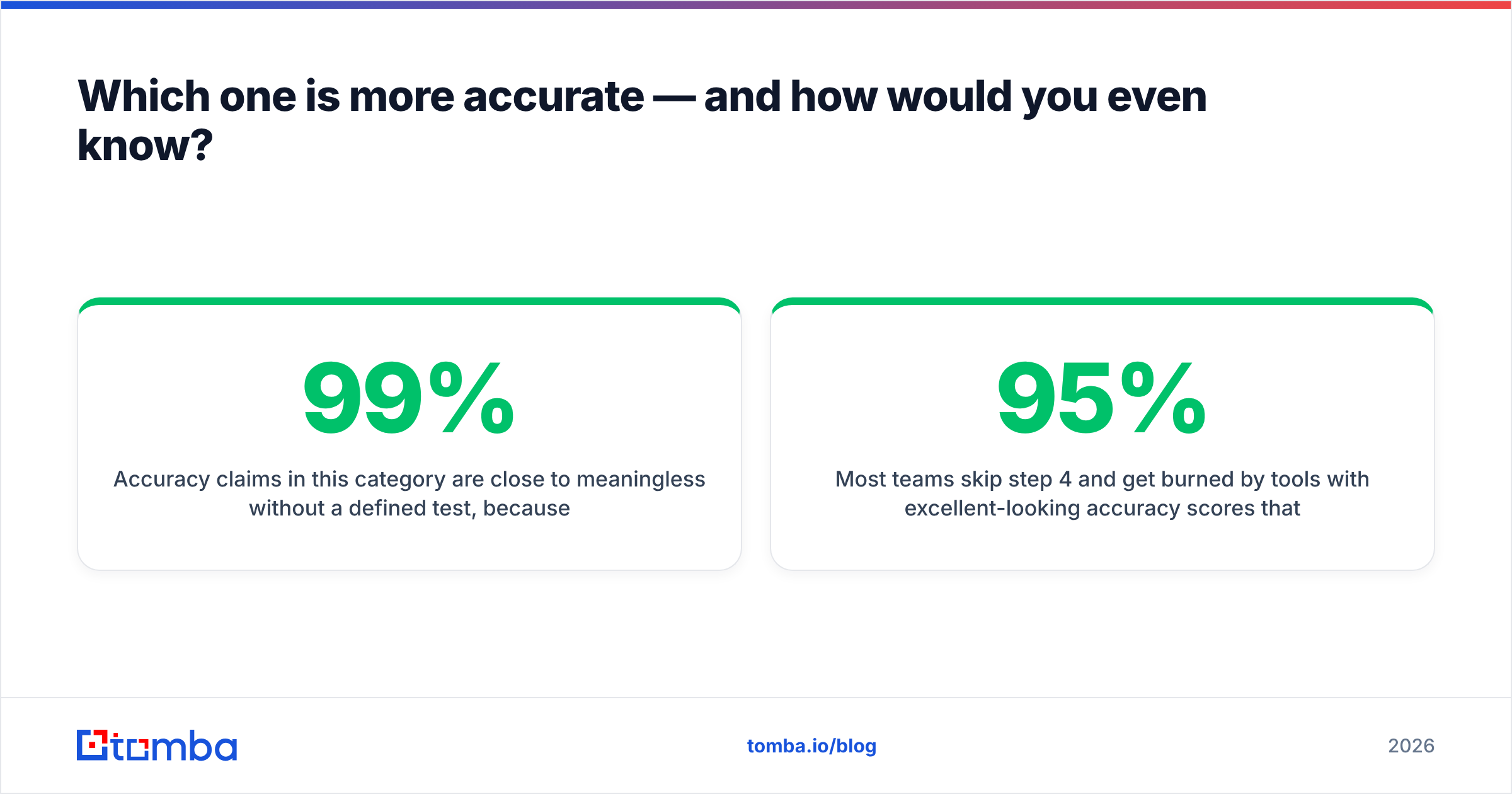
Accuracy claims in this category are close to meaningless without a defined test, because vendors measure different things. A verifier's "99% accuracy" usually means: of the addresses it labeled deliverable, 99% did not hard bounce. A database's "accuracy" usually means: of the records returned, some percentage matched a live person at export time. Those are not the same number and cannot be compared directly.

Run your own test before you sign anything. It takes an afternoon:
- Build a 200-address control set from domains you can independently confirm — press pages, conference speaker lists, GitHub commit histories.
- Split it 50/50 into addresses you know are live and addresses you know are dead (people who left, disbanded teams).
- Push both halves through each tool and record the verdicts.
- Measure two numbers, not one: false-positive rate (dead addresses marked deliverable — this is what burns your domain) and coverage (share of the set the tool refused to judge, returning "unknown").
- Weight false positives 5x. An "unknown" verdict costs you one skipped send. A false positive costs you a hard bounce, and enough of those move your sender reputation in a direction that takes weeks to undo.
Most teams skip step 4 and get burned by tools with excellent-looking accuracy scores that achieve them by labeling a third of the list "unknown". A verifier that judges 95% of your list at 97% precision beats one that judges 60% at 99%.
For catch-all domains — the ones that accept every address at the SMTP layer and reveal nothing — no verifier can give you a clean binary answer through the handshake alone. Tools differ in how honestly they say so. EmailValidation.io returns these as risky rather than pretending. Anything that confidently marks a catch-all as "valid" is guessing, and you should treat that as a red flag during your test.
What does each one actually cost?#
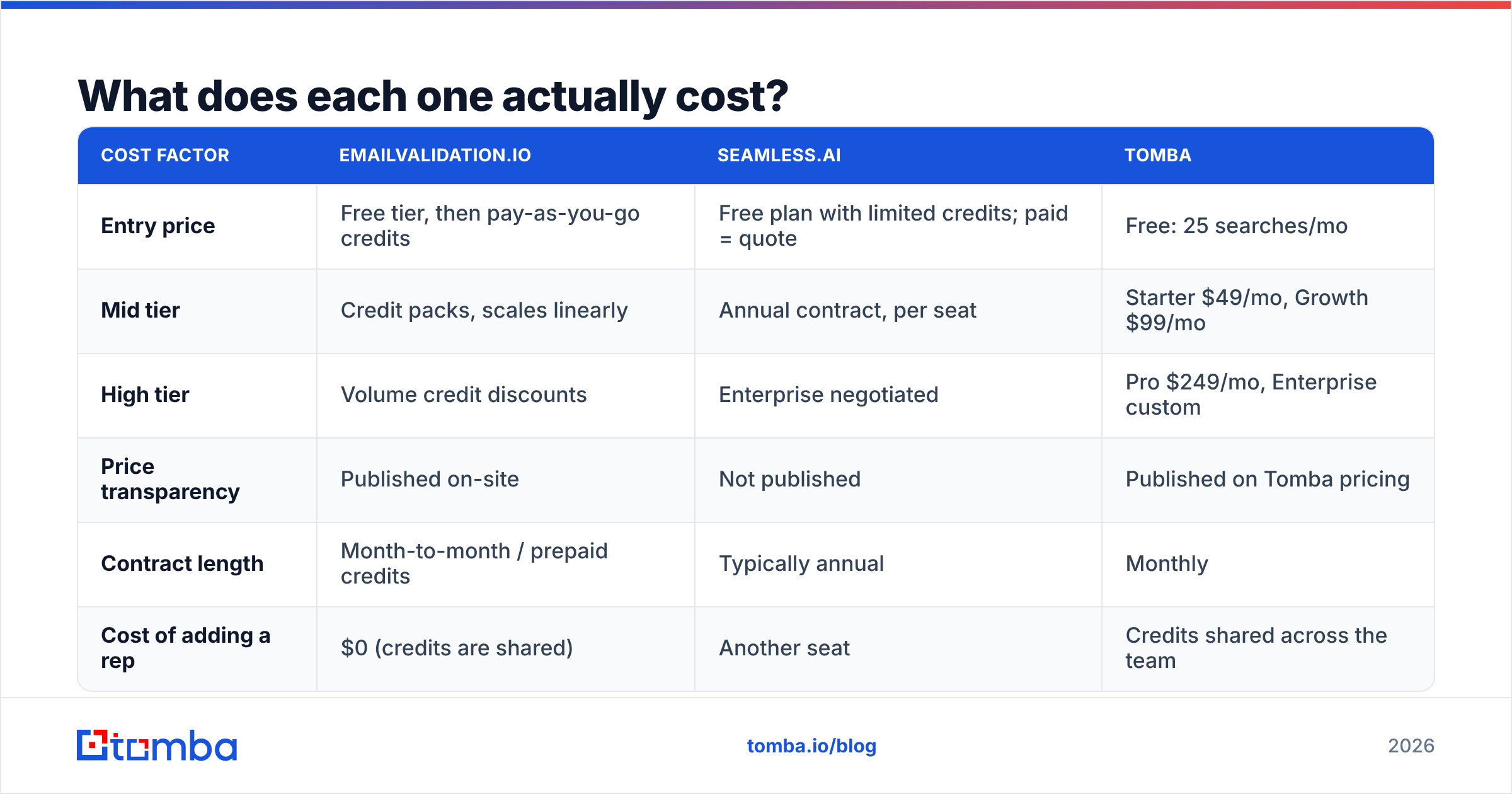
This is where the comparison becomes concrete, and where the two products diverge hardest.
| Cost factor | EmailValidation.io | Seamless.AI | Tomba |
|---|---|---|---|
| Entry price | Free tier, then pay-as-you-go credits | Free plan with limited credits; paid = quote | Free: 25 searches/mo |
| Mid tier | Credit packs, scales linearly | Annual contract, per seat | Starter $49/mo, Growth $99/mo |
| High tier | Volume credit discounts | Enterprise negotiated | Pro $249/mo, Enterprise custom |
| Price transparency | Published on-site | Not published | Published on Tomba pricing |
| Contract length | Month-to-month / prepaid credits | Typically annual | Monthly |
| Cost of adding a rep | $0 (credits are shared) | Another seat | Credits shared across the team |
Two implications you should not gloss over.
First, seat-based pricing punishes growth in a way credit pricing does not. If you go from three SDRs to eight, a credit-based verifier costs you exactly the same unless your volume changes. A seat-based database costs you 2.6x. Model that before you sign a 12-month term.
Second, the "free" plans are not comparable. A verification free tier gives you enough credits to test integration. A database free tier gives you enough credits to feel the pull of the paywall. Neither tells you anything about production economics. Estimate your real monthly volume — contacts found plus contacts verified — and price both tools at that number.

Who should choose EmailValidation.io?#
Pick it when all of the following are true:
- You already have a list source. A scraper, an existing CRM, an events export, inbound signups. Verification only adds value on top of supply.
- You want an API, not a dashboard. EmailValidation.io is built for the engineer who wants a clean JSON response inside a signup form or an ETL job, not for a rep clicking through filters.
- Your bounce rate is the visible symptom. If you're seeing 4%+ hard bounces and inbox placement is slipping, a dedicated verifier is the highest-leverage fix available for the money.
- You want linear, predictable spend. Credits are easy to forecast and easy to cap.
Where it will disappoint you: it will not tell you who to email, it will not give you phone numbers, and it will not enrich a record with title, company size, or LinkedIn profile. It does one job.
Who should choose Seamless.AI?#
Pick it when:
- List-building is the bottleneck, not deliverability. Your reps burn hours a week hunting contacts manually.
- You need phone plus email, and your motion is genuinely multichannel — cold calling alongside sequences.
- You have a team large enough to justify seats and a budget process that can absorb an annual contract.
- You value a search UI over an API. Seamless.AI's strength is a rep sitting in the tool and filtering, not a nightly batch job.
Where it will disappoint you: pricing opacity makes it hard to compare, per-seat costs escalate as you hire, and the bundled validation is generally not a substitute for a live verification pass before you send. Read current user reviews on G2 with an eye for comments about data freshness and contract terms rather than star averages — the useful signal in this category is always in the two- and three-star reviews.
Where does a combined tool fit in this comparison?#
The uncomfortable answer to "EmailValidation.io vs Seamless.AI" is that most teams buying either one end up needing the other within six months. You buy the database, bounce rates climb, you add a verifier. Or you buy the verifier, clean your list down to 3,000 usable contacts, and realize you need a supply of new ones.

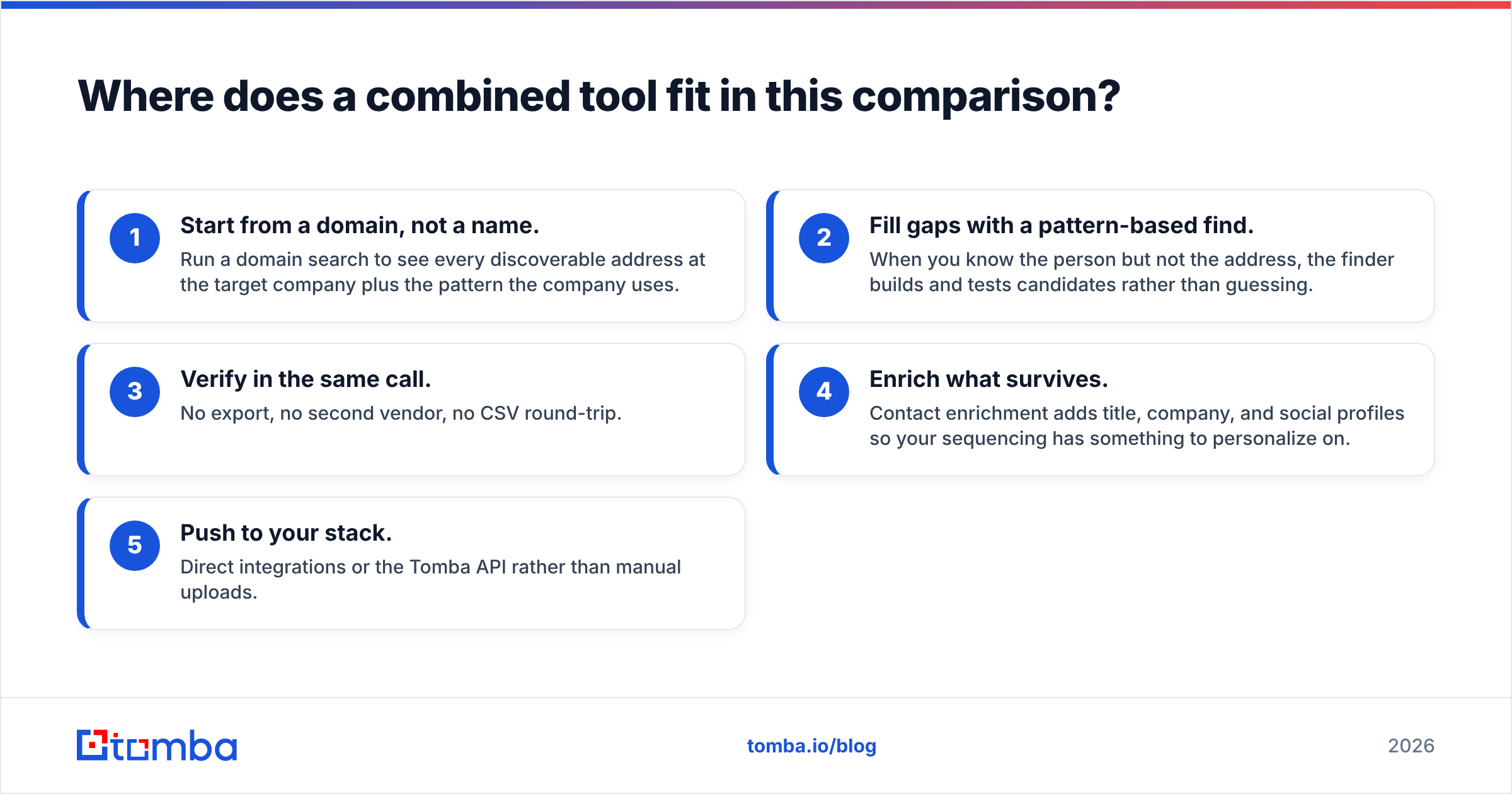
That's the case for a platform that owns both halves on one credit pool. Concretely, the workflow looks like this:
- Start from a domain, not a name. Run a domain search to see every discoverable address at the target company plus the pattern the company uses.
- Fill gaps with a pattern-based find. When you know the person but not the address, the finder builds and tests candidates rather than guessing.
- Verify in the same call. No export, no second vendor, no CSV round-trip.
- Enrich what survives. Contact enrichment adds title, company, and social profiles so your sequencing has something to personalize on.
- Push to your stack. Direct integrations or the Tomba API rather than manual uploads.
At $49/mo for Starter and $99/mo for Growth, that lands well below the combined cost of a per-seat database license plus a separate verification credit pack — and it removes the operational tax of keeping two vendors, two credit balances, and two support queues in sync.
None of this means EmailValidation.io is a bad product. It is a focused, well-scoped API that does exactly what it says. It just isn't in a fight with Seamless.AI, and framing it that way leads people to buy the wrong thing.
What's the final verdict?#
- Bounce problem, engineering team, existing list → EmailValidation.io. Cheapest correct answer.
- No list, funded SDR team, multichannel motion, comfortable with an annual seat contract → Seamless.AI.
- Both problems at once, which is the common case → a combined finder plus verifier, so you pay one bill and run one workflow.
Whatever you pick, do the 200-address test first, weight false positives five times heavier than unknowns, and price the tool at your actual monthly volume rather than the tier the sales page nudges you toward.
If you want to find addresses and confirm they're deliverable without stitching two vendors together, start with the Tomba Email Finder. The free tier gives you 25 searches a month with no card, verification is built into the same credit pool, and the API, Chrome extension, and Sheets add-on all run off one key — so you can benchmark it against your own control list this afternoon rather than waiting on a demo slot.
Related guides#
Ready to find emails that actually work?
Join 150,000+ professionals who stopped guessing and started sending. Free credits on signup — no credit card required.
Get the Tomba newsletter
Practical outbound tactics and product updates — once every two weeks.
About the author