EmailVerifyIO vs Warpleads (2026): Which Data Tool Wins?
One tool cleans lists, the other builds them. Here is an honest, side-by-side breakdown of EmailVerify.io vs Warpleads on pricing, accuracy, catch-all handling, and where a combined finder-plus-verifier beats both.
EmailVerifyIO vs Warpleads is a comparison of two different jobs, not two rival products. One tool cleans the list you already own. The other builds a list you do not have yet. This guide covers what each one does, what it costs, and when a single finder-plus-verifier stack beats buying both.
TL;DR
- EmailVerifyIO and Warpleads are not real competitors. EmailVerify.io cleans a list you already have. Warpleads gives you a list to clean.
- If your bounce rate is above 3% and you already have contacts, buy verification. If you have a clean sending setup and no contacts, buy data.
- Warpleads sells volume: export-heavy plans and on-demand scraping. EmailVerify.io sells pay-as-you-go credits for bulk list hygiene at a low per-email cost.
- Neither one covers the full loop. You still need to find the right person, then confirm the address is deliverable. A combined finder plus verifier stack usually costs less than running both.
- Our take: buy the tool that removes your current bottleneck, then consolidate. Paying two vendors for two halves of one job is the most common waste in outbound budgets.
EmailVerifyIO vs Warpleads: what does each tool do?#
They sit at opposite ends of the same pipeline.
EmailVerify.io is a bulk email verification service. You upload a CSV or hit the API. It returns a deliverability verdict per address: valid, invalid, catch-all/accept-all, disposable, role-based, or unknown. It does syntax checks, MX record lookups, SMTP handshakes, and disposable-domain matching. It does not find anyone. It has no database of companies or contacts. Its job is to stop you from mailing addresses that bounce.
Warpleads is a B2B lead generation platform. It gives you a large contact database plus on-demand scraping. Its main commercial hook is export volume: plans built around exporting a lot of leads rather than metering every credit. It bundles some verification into the export flow. Its job is to fill your CRM.
So the honest framing here is not "which tool is better." It is: which gap in your outbound machine costs you the most money right now?
Here is the pipeline, and where each tool lives:
- Define the ICP — job titles, company size, tech stack, geography. Neither tool does this for you; it comes from your closed-won data.
- Source contacts — this is Warpleads' territory. A database plus scraper turns "500 fintech CTOs in Germany" into rows.
- Enrich the record — add company domain, LinkedIn URL, phone, headcount. Warpleads does some of this; dedicated data enrichment tools do more.
- Verify deliverability — this is EmailVerify.io's territory. Every address gets an SMTP-level verdict before it touches your sending domain.
- Segment and send — sequencer territory (Instantly, Smartlead, Reply.io). Neither tool sends mail.
- Feed results back — bounces, replies, and closed deals should update your ICP and your suppression list. Both tools export data; neither closes the loop for you.
Steps 2 and 4 are the ones people confuse. You cannot verify your way out of having no leads. You cannot export your way out of a burned sending domain.

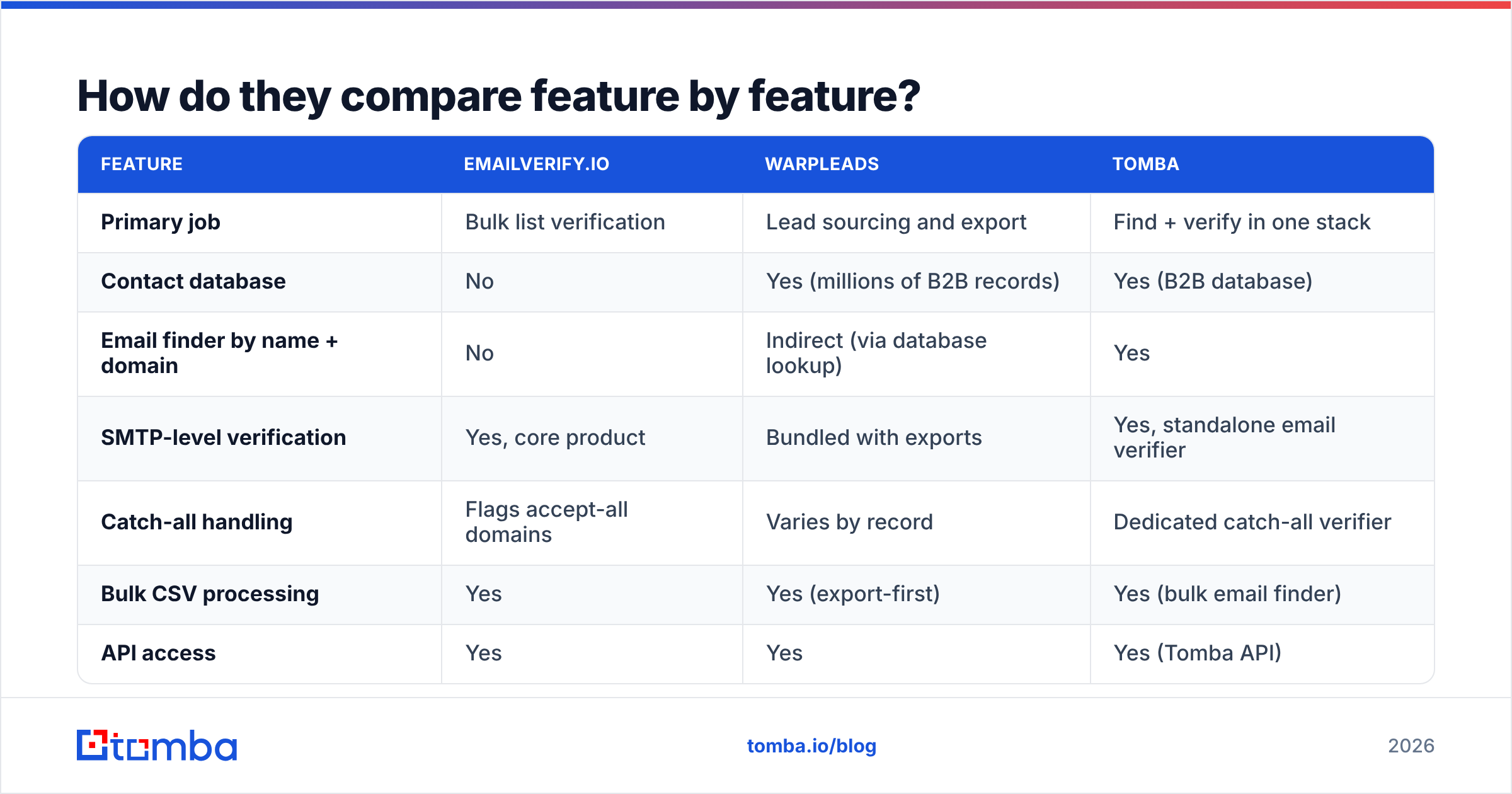
How do they compare feature by feature?#
| Feature | EmailVerify.io | Warpleads | Tomba |
|---|---|---|---|
| Primary job | Bulk list verification | Lead sourcing and export | Find + verify in one stack |
| Contact database | No | Yes (millions of B2B records) | Yes (B2B database) |
| Email finder by name + domain | No | Indirect (via database lookup) | Yes |
| SMTP-level verification | Yes, core product | Bundled with exports | Yes, standalone email verifier |
| Catch-all handling | Flags accept-all domains | Varies by record | Dedicated catch-all verifier |
| Bulk CSV processing | Yes | Yes (export-first) | Yes (bulk email finder) |
| API access | Yes | Yes | Yes (Tomba API) |
| Pricing model | Pay-as-you-go credits | Monthly, export-volume tiers | Free tier + monthly plans from $49 |
| Free tier | Trial credits | Limited trial | 25 searches/month, no card |
| Best for | Cleaning inherited or scraped lists | Filling an empty CRM fast | Teams that need both without two invoices |
Two things stand out.
First, the overlap is thin. The only cell where both tools compete is verification. Even there they do different things: EmailVerify.io verifies your list at scale, while Warpleads verifies its own records as part of delivering them. If you bring a 200,000-row list from a trade show, Warpleads is not the tool for it.
Second, the two pricing models are hard to compare per unit. Credit-based verification is cheap per email and scales linearly. Export-volume plans are flat-rate, so they only pay off if you export near the ceiling. A team that exports 2,000 leads a month on an unlimited plan pays a huge effective price per lead.
Which one is more accurate?#
Each tool defines accuracy differently, so they need separate answers.
For EmailVerify.io, accuracy means bounce prevention. The measurable outcome is simple: of the addresses it marked valid, how many actually bounced? Good verification services stay under 2-3% bounce on marked-valid addresses. Any dedicated verifier — EmailVerify.io, ZeroBounce, NeverBounce, Bouncer — will hit that band on ordinary domains. The easy cases are not the differentiator. The hard ones are.
For Warpleads, accuracy means record freshness. The measurable outcome is this: of the contacts it exported, how many still work at that company, in that role, with that address? B2B data decays roughly 20-30% per year through job changes alone, and no vendor is immune. Volume-first platforms face a real tension here. The plans that make unlimited export attractive are also the plans that make it expensive to re-verify every record on every export.
Ask any vendor these three questions before you sign:
- What is your bounce guarantee, in writing? Some verifiers credit you back for bounces above a threshold. Some do not. Ask for the number.
- How do you treat catch-all domains? This is the single biggest source of disagreement between verification tools. See the next section.
- When was this record last verified? Not "when was it added." A 2023 record re-exported in 2026 is still a 2023 record.
The chart above is why we push people to test on their own list instead of trusting marketing pages. Accuracy on a generic sample says very little about accuracy on your ICP. A tool that is excellent on US SaaS companies can be mediocre on European manufacturers, and vice versa.
Run the same 500-row sample through every tool you are evaluating. Same rows, same day. Compare the valid/invalid/unknown split, then send to a subset and measure the real bounce rate. That test costs you an afternoon and settles arguments that otherwise run for a quarter.
How do they handle catch-all domains?#
This is where verification tools separate. It deserves its own section, because it is where most people get burned.
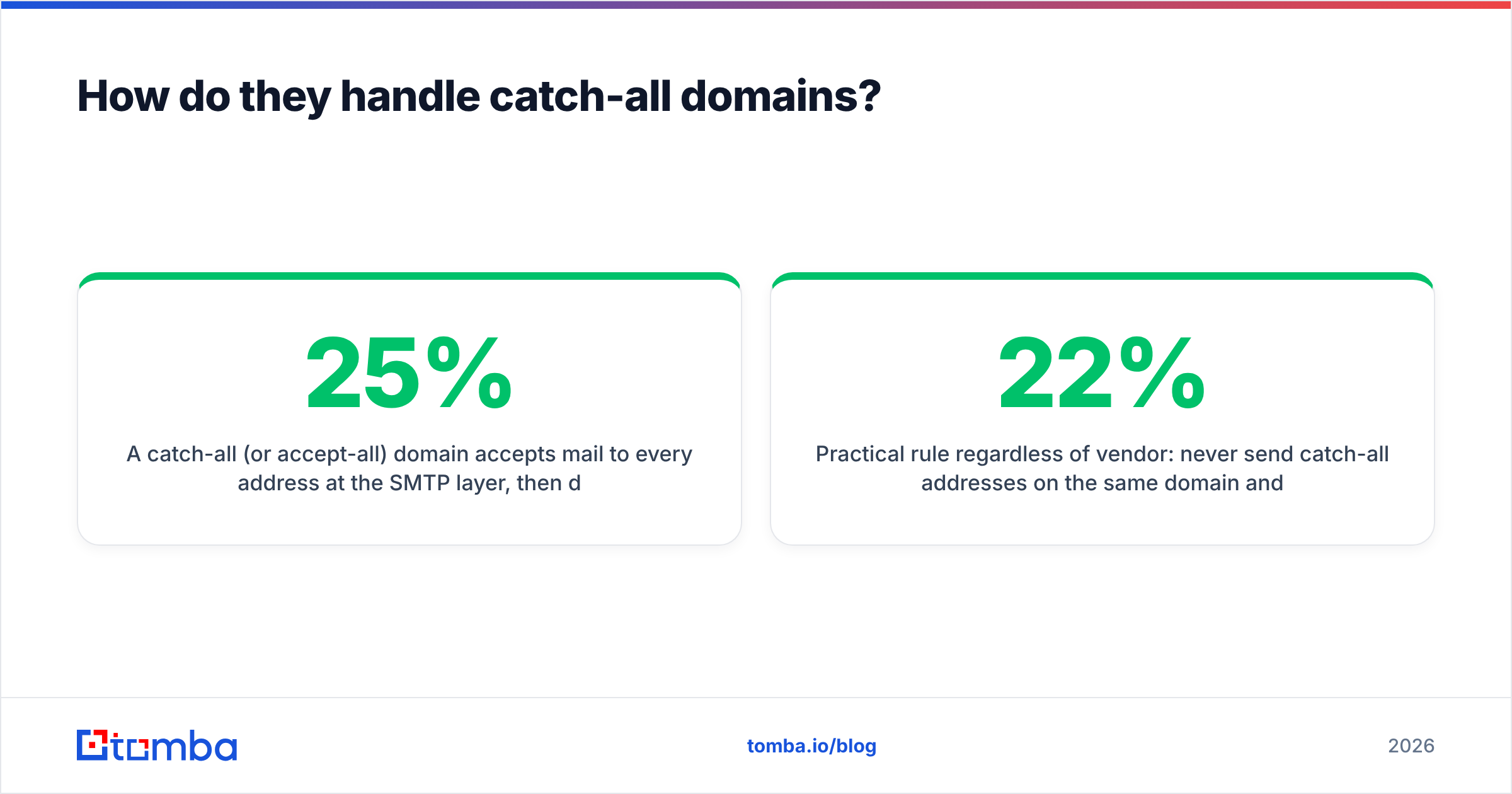
A catch-all (or accept-all) domain accepts mail to every address at the SMTP layer. It then decides internally whether to deliver or discard it. anything@company.com returns a positive SMTP response even when no such mailbox exists. Roughly 20-25% of business domains work this way, and the share climbs among enterprises using Microsoft 365 with aggressive filtering.
Three possible responses from a verifier:
- Mark as "unknown" or "risky" and move on. Safe, honest, and useless — you still do not know whether to send.
- Mark as valid because SMTP said yes. Optimistic. It inflates the "valid" count on the dashboard and produces surprise bounces later.
- Apply a secondary signal — pattern confidence, historical engagement data, cross-source corroboration — to produce a graded confidence score.
Option 3 is what you actually want. It is also the most expensive to build, which is why fewer vendors do it well. Tomba built a dedicated catch-all finder for exactly this case. It ships as a separate product because it is a separate technical problem from ordinary verification.
Here is a practical rule that holds for any vendor. Never send catch-all addresses on the same domain and IP as your verified-valid sends. Segment them into a slower sequence on a warmed secondary domain. If catch-alls are 22% of your list and 40% of them are dead, you have just protected your primary sender reputation from a 9% bounce spike.
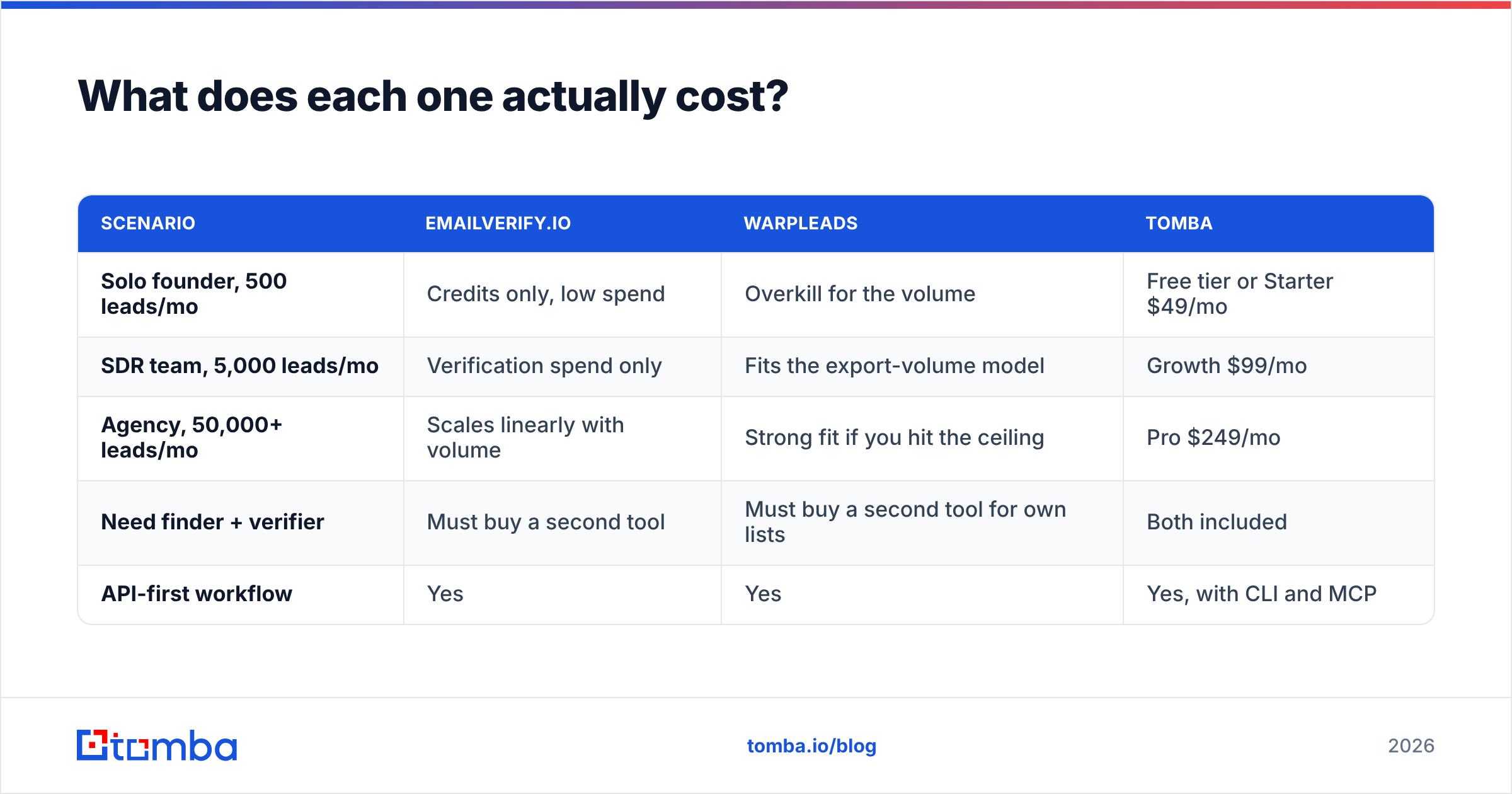
What does each one actually cost?#
| Scenario | EmailVerify.io | Warpleads | Tomba |
|---|---|---|---|
| Solo founder, 500 leads/mo | Credits only, low spend | Overkill for the volume | Free tier or Starter $49/mo |
| SDR team, 5,000 leads/mo | Verification spend only | Fits the export-volume model | Growth $99/mo |
| Agency, 50,000+ leads/mo | Scales linearly with volume | Strong fit if you hit the ceiling | Pro $249/mo |
| Need finder + verifier | Must buy a second tool | Must buy a second tool for own lists | Both included |
| API-first workflow | Yes | Yes | Yes, with CLI and MCP |
Vendor pricing moves constantly. Treat any figure you read in a blog post — including this one — as a starting point, then confirm it on the vendor's own page. What does not move is the structure of the decision.
The trap is the two-invoice stack. A team buys Warpleads for sourcing. Then it discovers the exported addresses still need independent verification before a big send, so it buys EmailVerify.io too. Now it pays two vendors, maintains two API integrations, and reconciles two sets of credits. The combined bill routinely beats a single platform that does both, and the operational overhead hurts more than the money.
Before you sign anything, do this arithmetic. Take your total monthly spend and divide it by the number of leads that actually entered a sequence. Not leads exported. Not credits purchased. Leads sequenced. That number is your true cost per usable contact, and it is usually two to four times the headline price.
Is there a better option than either?#
For most teams running outbound at normal volume, yes. Most teams need both halves of the job.
The specific case for consolidating:
- You need to find, not just verify. If your workflow is "here is a company, get me the head of engineering," a pure verifier cannot help. An email finder plus domain search covers this directly.
- You need verification on your own lists. Database-bundled verification only covers records the database gave you. Anything from a webinar, a partner list, or a scrape needs standalone verification.
- You want one API. Two vendors means two auth schemes, two rate limits, two failure modes, and two invoices for finance to chase.
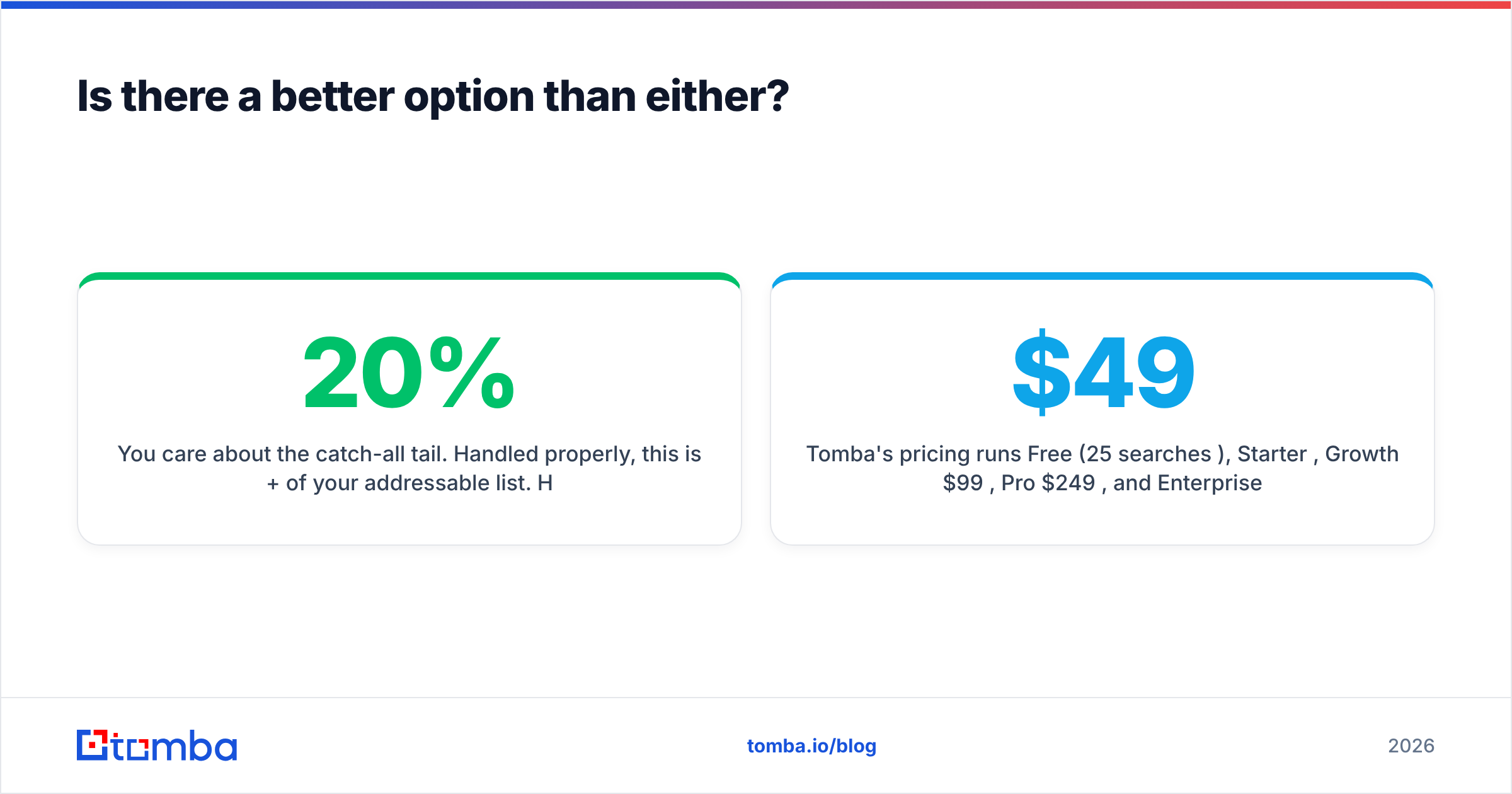
- You care about the catch-all tail. Handled properly, this is 20%+ of your addressable list. Handled badly, it is your bounce rate.
Tomba's pricing runs Free (25 searches/month), Starter $49/mo, Growth $99/mo, Pro $249/mo, and Enterprise custom — see Tomba pricing for current limits. Finder, verifier, domain search, catch-all verification, phone finder, and enrichment all sit on the same credit pool. That removes the reconciliation problem entirely.
To be fair to the alternatives: say your only problem is a 300,000-row legacy list that needs cleaning once. A pay-as-you-go verifier like EmailVerify.io is genuinely the cheaper answer, and you should buy that. And if you want a curated, human-verified purchased list instead of a self-serve database, BookYourData is a well-regarded option with a different model worth pricing out. Buy the tool that matches the shape of your problem.
Independent review platforms like G2 are useful for a sanity check on support responsiveness and billing complaints. Take star ratings on data accuracy with more caution. Reviewers rarely control for ICP, and ICP is the variable that dominates.
How should you decide?#
Answer three questions honestly.
1. What is your current bounce rate? Pull it from your sequencer. Above 5%, you have an urgent verification problem. Mailbox providers keep getting stricter, and the Google and Yahoo bulk sender rules turned bounce discipline into a hard gate. Buy verification first, before you buy another lead.
2. How many qualified contacts sit in your CRM right now? If the answer is under two weeks of sequencing capacity, sourcing is your bottleneck, not hygiene. Buy data first.
3. Where do your leads come from in six months? If the plan is "the same database forever," an export-volume plan makes sense. If the plan involves your own scraping, event lists, inbound, and partner referrals, you need standalone verification no matter which database you buy. That pushes you toward a platform that does both.
Then run the 500-row bake-off described earlier. Real data on your ICP beats any comparison article, this one included.
One last operational note. Whatever you choose, keep a permanent suppression list of every hard bounce, unsubscribe, and complaint across all tools. Vendors change. Your suppression list is yours, and rebuilding it after a domain reset is a painful lesson to learn twice.
Ready to stop paying two vendors for one job?#
If you have been weighing EmailVerifyIO vs Warpleads because you need contacts and clean addresses, the answer is probably neither on its own. Start with the Tomba Email Finder. It finds verified professional addresses by name, domain, or company, with SMTP verification and catch-all confidence scoring built into the same lookup. The free tier gives you 25 searches a month with no card. That is enough to run the bake-off on your own ICP and see the numbers before you commit a budget.
Related guides#
Ready to find emails that actually work?
Join 150,000+ professionals who stopped guessing and started sending. Free credits on signup — no credit card required.
Get the Tomba newsletter
Practical outbound tactics and product updates — once every two weeks.
About the author