EMEA B2B Data Provider Guide: Coverage, GDPR, and Real Cost
Most EMEA data vendors look identical on a pricing page and behave nothing alike on a German, Nordic, or Gulf domain. Here is how coverage, GDPR posture, and real cost per usable contact actually differ in 2026.
TL;DR
- An EMEA B2B data provider is judged on three things: coverage depth per country, lawful-basis posture under GDPR, and cost per usable contact — not headline database size.
- Coverage collapses unevenly. A vendor with strong UK and DACH data can be near-useless in the Nordics, Poland, Turkey, or the GCC, and no pricing page tells you that.
- Enterprise-tier vendors (Cognism, ZoomInfo, Dun & Bradstreet) sell annual contracts starting around $15k–$30k. Self-serve tools (Tomba, Lusha, BookYourData) start under $100/mo and let you test the same territory in an afternoon.
- Catch-all domains are the EMEA tax: French, German, and Dutch mid-market companies run them constantly, so verification quality matters more than raw record counts.
- Test before you sign: pull 100 contacts from your two hardest countries, verify them independently, then divide list price by the count that survives.
What is an EMEA B2B data provider?#
An EMEA B2B data provider sells contact and company records for Europe, the Middle East, and Africa — business emails, direct dials, job titles, firmographics, and increasingly intent or technographic signals — under a licence that lets you prospect into them.
The analogy: buying EMEA data is like buying produce from a wholesaler who sources from thirty farms. The catalogue looks uniform. The tomatoes from one farm are fine, the ones from another arrived three weeks ago, and two farms don't ship at all this season. The wholesaler's total tonnage tells you nothing about whether the crate you ordered is any good.
That is exactly the failure mode with EMEA data. Vendors advertise a global total — "200M+ contacts", "70M verified emails" — that is dominated by US records. Your actual question is narrower: how many decision-makers can this vendor give me at 50–500 employee companies in Sweden, Poland, and the UAE, and how many of those emails will land?
Four dimensions separate real EMEA providers from US vendors with a Europe checkbox:
- Per-country depth — records for Portugal or Romania, not just UK/DACH/France.
- Lawful basis and notification — whether the vendor documents legitimate interest, honours suppression, and sends Article 14 notices on your behalf.
- Local identifier coverage — VAT numbers, company registry IDs (Companies House, Handelsregister, KVK, SIREN), and local NACE codes.
- Verification against catch-all and greylisting infrastructure — the norm across European mid-market mail servers.
Miss any one and you get a list that is technically large and practically dead.
Why is EMEA data harder than US data?#
Because "EMEA" is not a market. It is roughly 100 countries, 24 official EU languages, dozens of privacy regimes stacked on top of GDPR, and mail infrastructure that behaves differently from the Google/Microsoft duopoly most US-built tools assume.
The concrete problems:
- Fragmented sources. The US has a deep, cheap layer of aggregated professional data. Europe has national registries with different formats, different access rules, and different refresh cycles. A vendor good at Companies House scraping is not automatically good at the Greek registry.
- Catch-all everywhere. Many European SMBs run
@company.dedomains that accept every address at the SMTP layer. Standard verification returns "accept-all", most tools return "unknown", and unvetted lists route straight into spam traps. A serious catch-all verifier is not a nice-to-have here. - Direct dials are legally fenced. Germany's UWG restricts unsolicited B2B calls, and several markets maintain do-not-call registries that a US vendor may not screen against.
- Name and encoding mess. Ø, ç, ü, ł, and Arabic transliteration break naive email-pattern generators.
bjorn.sorensen@andbjørn.sørensen@are different addresses, and the wrong guess bounces. - Slower title drift, faster company churn. European tenure is longer, so job data ages more slowly — but company data (funding, restructuring, registry changes) moves fast enough that six-month-old firmographics mislead.

The practical consequence: EMEA data quality is a per-country property, and any vendor evaluation that averages across the region is measuring the wrong thing.
Which EMEA B2B data providers matter in 2026?#
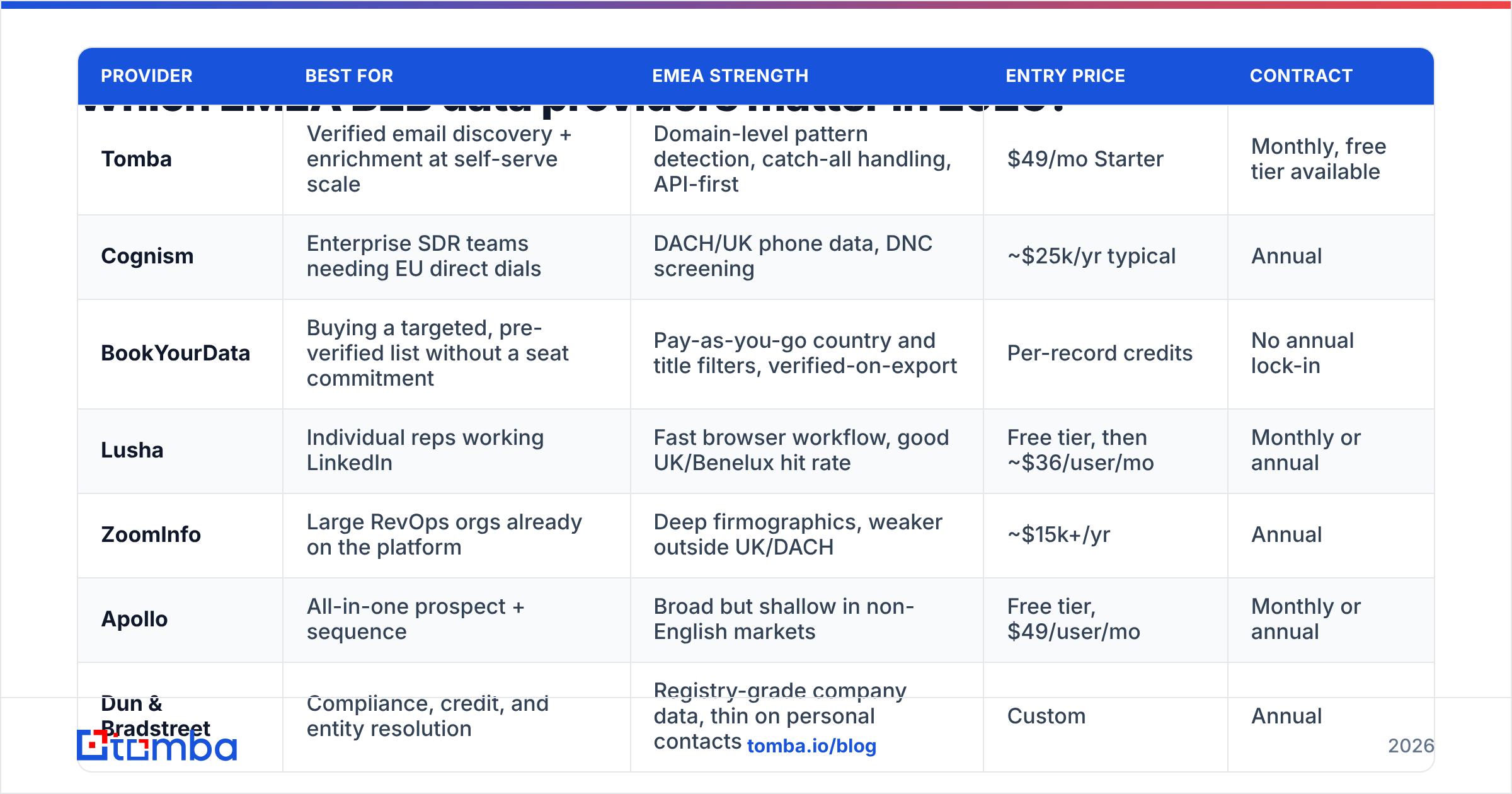
Here is the honest landscape. Every vendor below is real and has genuine strengths; none of them wins everywhere.
| Provider | Best for | EMEA strength | Entry price | Contract |
|---|---|---|---|---|
| Tomba | Verified email discovery + enrichment at self-serve scale | Domain-level pattern detection, catch-all handling, API-first | $49/mo Starter | Monthly, free tier available |
| Cognism | Enterprise SDR teams needing EU direct dials | DACH/UK phone data, DNC screening | ~$25k/yr typical | Annual |
| BookYourData | Buying a targeted, pre-verified list without a seat commitment | Pay-as-you-go country and title filters, verified-on-export | Per-record credits | No annual lock-in |
| Lusha | Individual reps working LinkedIn | Fast browser workflow, good UK/Benelux hit rate | Free tier, then ~$36/user/mo | Monthly or annual |
| ZoomInfo | Large RevOps orgs already on the platform | Deep firmographics, weaker outside UK/DACH | ~$15k+/yr | Annual |
| Apollo | All-in-one prospect + sequence | Broad but shallow in non-English markets | Free tier, $49/user/mo | Monthly or annual |
| Dun & Bradstreet | Compliance, credit, and entity resolution | Registry-grade company data, thin on personal contacts | Custom | Annual |
Two things fall out of that table immediately.
First, the price cliff is real. There is roughly a 20x gap between self-serve tooling and enterprise seats. That gap does not buy 20x better emails — it buys direct dials, intent data, CRM-native workflows, and a support contract. If your EMEA motion is email-led, you are paying a large premium for phone infrastructure you will not dial.
Second, "no annual contract" is a category, not a discount. BookYourData and Tomba both let you buy exactly what you need this quarter. That matters enormously in EMEA, where you often discover mid-campaign that Italy converts and Finland doesn't, and you want to reallocate budget without a renewal conversation.
How do you compare cost per usable contact?#
Stop comparing list prices. Compare cost per contact that survives verification and your ICP filter.
The formula:
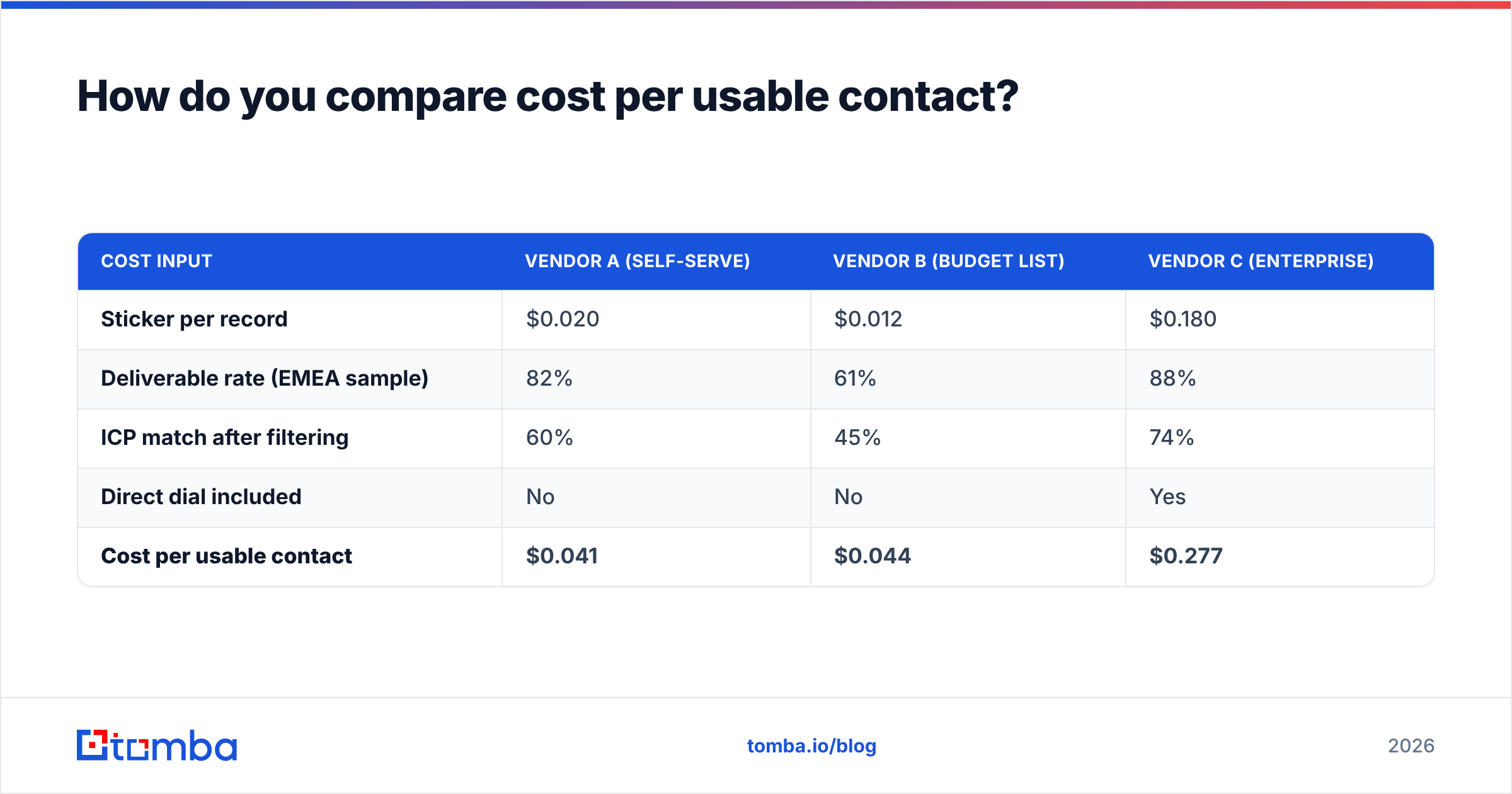
Effective cost = (plan price ÷ credits) ÷ (valid rate × ICP match rate)
Run it with real numbers. Say a vendor charges $99/mo for 5,000 credits — $0.0198 per lookup. Sounds cheap. Now apply an 82% deliverable rate and a 60% ICP match after you drop the wrong titles and company sizes: your true cost is $0.040 per usable contact, double the sticker.
Now the same maths on a "cheaper" vendor at $0.012 per record with a 61% deliverable rate and 45% ICP match: $0.044. The expensive-looking option won.
| Cost input | Vendor A (self-serve) | Vendor B (budget list) | Vendor C (enterprise) |
|---|---|---|---|
| Sticker per record | $0.020 | $0.012 | $0.180 |
| Deliverable rate (EMEA sample) | 82% | 61% | 88% |
| ICP match after filtering | 60% | 45% | 74% |
| Direct dial included | No | No | Yes |
| Cost per usable contact | $0.041 | $0.044 | $0.277 |
The enterprise column is not "bad" — it is a different purchase. You are buying a dial-ready record. If your reps make 60 calls a day into France and Germany, $0.28 is defensible. If they send email, it is not.
Before you build this table for real, decide how you will measure the deliverable rate. Using the vendor's own confidence score is circular. Export a sample and run it through an independent email verifier, or send a small warmed test batch and count hard bounces. Anything else is marketing arithmetic.
Is GDPR compliance actually solved by your vendor?#
No. It is shared, and the part that bites you is the part vendors cannot do for you.
Under GDPR, B2B outreach in the EU typically relies on legitimate interest (Article 6(1)(f)) rather than consent — but that only holds if you can show a balancing test, honour objections immediately, and satisfy the Article 14 notification duty when you collect personal data indirectly. That last one is where most outbound teams are exposed. If you obtained someone's work email from a data vendor, you owe them notice — normally within a month, or at first contact.

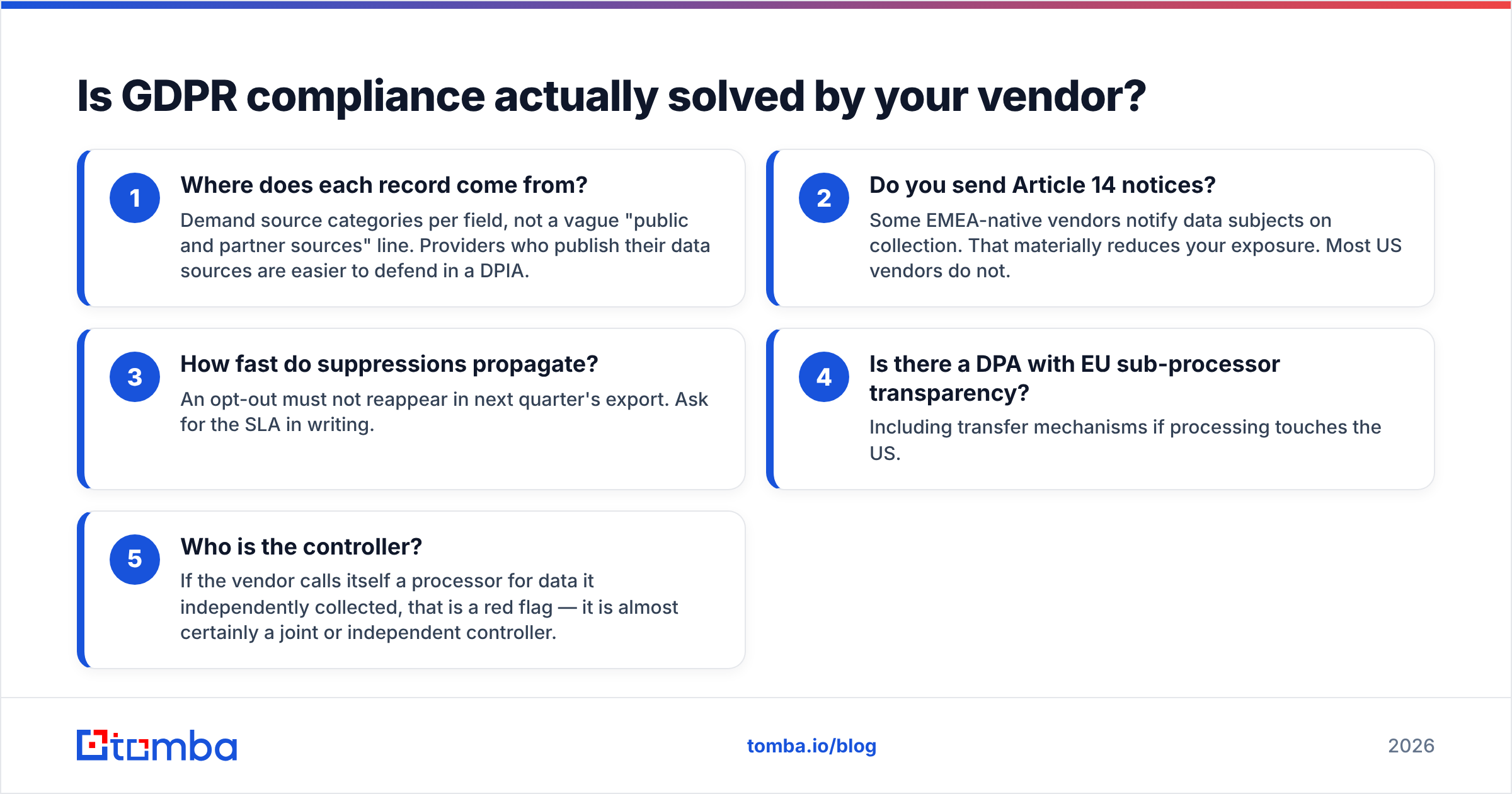
What to actually ask a prospective EMEA B2B data provider:
- Where does each record come from? Demand source categories per field, not a vague "public and partner sources" line. Providers who publish their data sources are easier to defend in a DPIA.
- Do you send Article 14 notices? Some EMEA-native vendors notify data subjects on collection. That materially reduces your exposure. Most US vendors do not.
- How fast do suppressions propagate? An opt-out must not reappear in next quarter's export. Ask for the SLA in writing.
- Is there a DPA with EU sub-processor transparency? Including transfer mechanisms if processing touches the US.
- Who is the controller? If the vendor calls itself a processor for data it independently collected, that is a red flag — it is almost certainly a joint or independent controller.
Also note what GDPR does not cover. The ePrivacy Directive governs electronic marketing, and several member states apply stricter national rules: Germany treats unsolicited commercial email harshly under UWG, and Italy and Spain have their own layers. Country-level legal review beats a region-wide assumption.
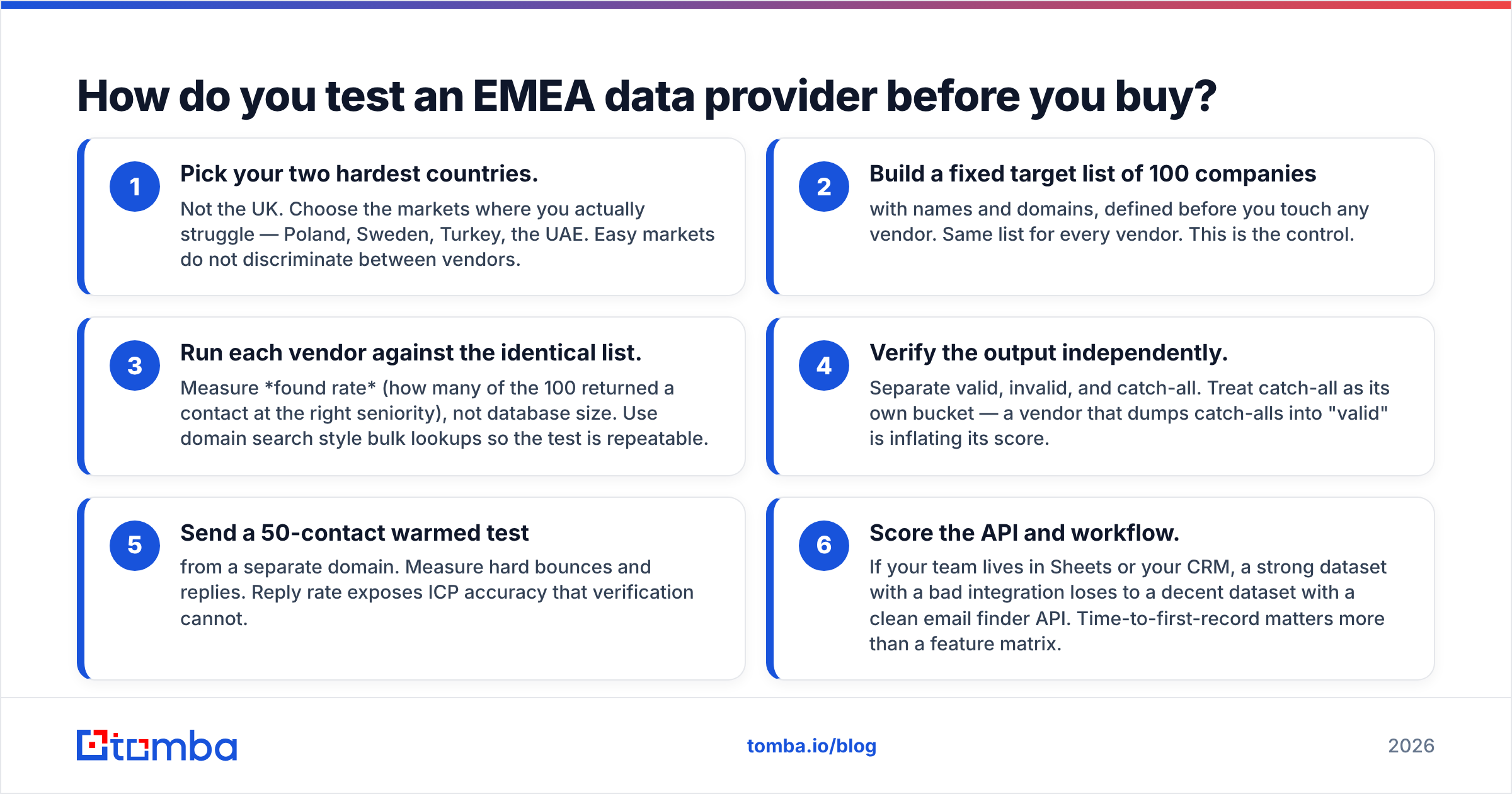
How do you test an EMEA data provider before you buy?#
Run a five-day bake-off. It costs almost nothing and it will overturn at least one assumption you currently hold.
- Pick your two hardest countries. Not the UK. Choose the markets where you actually struggle — Poland, Sweden, Turkey, the UAE. Easy markets do not discriminate between vendors.
- Build a fixed target list of 100 companies with names and domains, defined before you touch any vendor. Same list for every vendor. This is the control.
- Run each vendor against the identical list. Measure found rate (how many of the 100 returned a contact at the right seniority), not database size. Use domain search style bulk lookups so the test is repeatable.
- Verify the output independently. Separate valid, invalid, and catch-all. Treat catch-all as its own bucket — a vendor that dumps catch-alls into "valid" is inflating its score.
- Send a 50-contact warmed test from a separate domain. Measure hard bounces and replies. Reply rate exposes ICP accuracy that verification cannot.
- Score the API and workflow. If your team lives in Sheets or your CRM, a strong dataset with a bad integration loses to a decent dataset with a clean email finder API. Time-to-first-record matters more than a feature matrix.
Record the results in a simple grid: found rate, valid rate, catch-all rate, bounce rate, reply rate, cost per usable contact. The winner is usually not the vendor with the biggest logo, and it is frequently different per country — which is why many EMEA teams run two providers, a broad self-serve tool for email discovery and a specialist for phone data or a specific territory.
Which provider fits which team?#
- Founder-led or small outbound team, email-first, mixed EMEA territories. Self-serve wins. You need per-domain discovery, honest catch-all handling, and no annual minimum. Start on a free tier and scale by usage.
- SDR team dialling DACH and the UK. Cognism's phone data and DNC screening justify the enterprise price. Pair it with a cheaper email source rather than paying enterprise rates for both channels.
- One-off campaign into a new country. A per-record list purchase from a pay-as-you-go provider beats a subscription you will not renew.
- RevOps enriching an existing CRM of 200k records. You need a bulk enrichment pipeline and match-rate transparency, not seat licences. Look at data enrichment and bulk endpoints, and negotiate on match rate, not volume.
- Regulated industry or credit exposure. Registry-grade company data from D&B or a national provider, with contact data layered separately.
Cross-check any shortlist against real user reviews on G2 — filter by reviewer region, because a five-star review from a US mid-market buyer says nothing about Dutch coverage.
What should you do next?#
Pick the two countries you keep failing in, build the 100-company control list, and run the bake-off this week. The exercise takes an afternoon and reliably saves five figures on a contract you were about to sign for the wrong reason.
If your EMEA motion is email-led — most are, given the calling restrictions — start with the discovery layer rather than a platform. The Tomba Email Finder resolves contacts by domain, name, or company with catch-all-aware verification built in, runs through an API, Sheets, or the browser extension, and starts free at 25 searches a month before Starter at $49/mo. Full Tomba pricing is public, monthly, and has no annual minimum, so you can test Poland and Finland side by side and cancel the half that does not work.
Measure cost per usable contact, not per credit. That single change in metric will pick your EMEA B2B data provider for you.
Related guides#
Ready to find emails that actually work?
Join 150,000+ professionals who stopped guessing and started sending. Free credits on signup — no credit card required.
Get the Tomba newsletter
Practical outbound tactics and product updates — once every two weeks.
About the author