Endole Alternatives 2026: 7 Better UK Company Data Tools
Endole is strong on UK filings and credit risk, weak on contact data. Here are 7 Endole alternatives compared on coverage, emails, pricing model and who each one actually suits.
TL;DR
Endole is a UK company-information platform. It runs on Companies House data, credit scores and filed accounts. It is a research and risk tool first, a prospecting tool second.
Most teams who search for Endole alternatives want one of three things: cheaper credit checks, wider country coverage, or real contact data.
No single tool wins on all three. Creditsafe and Red Flag Alert beat Endole on risk depth. Cognism and BookYourData beat it on contacts. Companies House Search wins on price and nothing else.
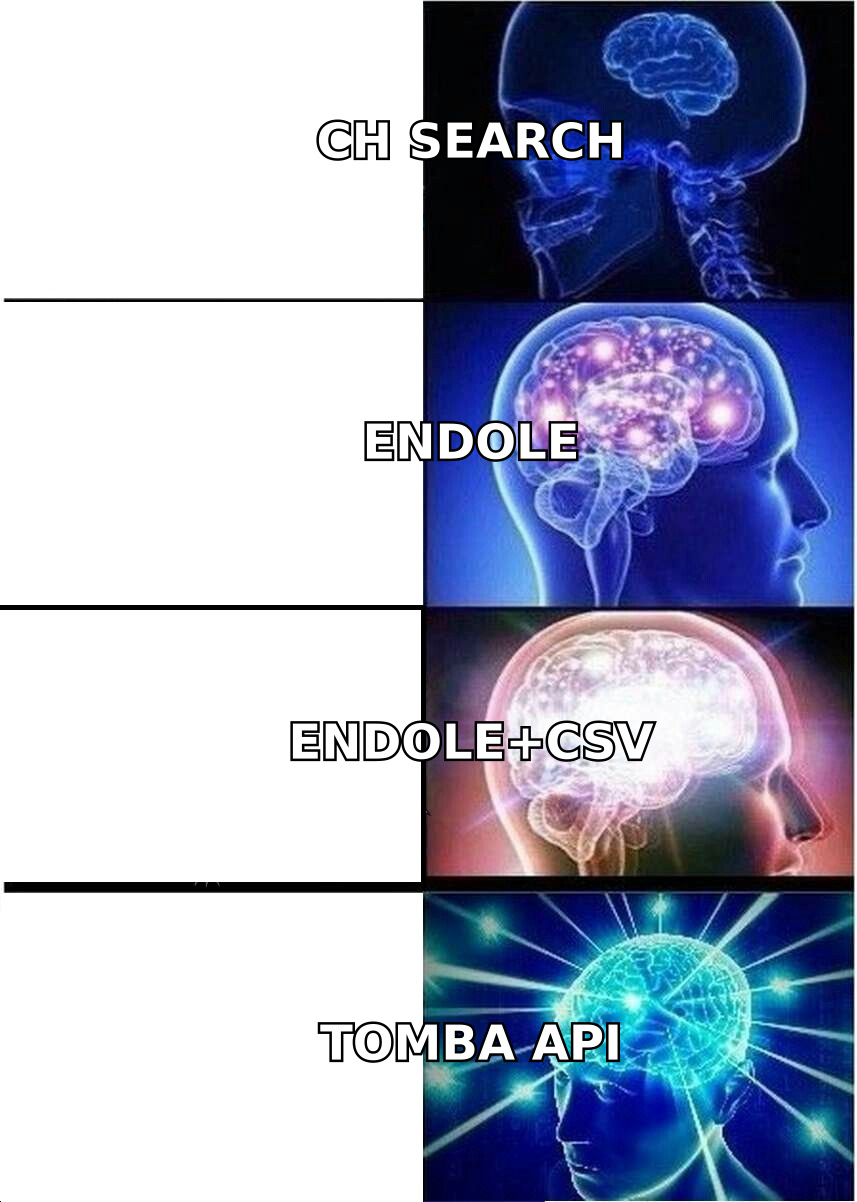
Does your Endole work end with "now find who to email at these 400 companies"? An email finder such as Tomba closes that gap cheaply.
Budget with open eyes. Credit-risk suites are quote-based, usually £1,500–£10,000 a year. Contact-data tools start near $49–$99 a month.
What is Endole and who actually uses it?#
Endole is a UK business information service. It takes Companies House filings and puts them in a searchable interface. That means directors, shareholdings, accounts, charges and group structures. On top of that it adds credit scores, estimated turnover and industry benchmarks.
Endole Explorer is the paid tier for sales and research teams. The public company pages are free, and Google indexes them heavily. That is usually how you land on one while checking a supplier.
Three groups use it seriously:
Credit and finance teams who check whether a new customer will pay. They use the score, the CCJ history and the filed accounts.
Corporate development and M&A researchers who map group ownership, directorships and shareholder trails across UK entities.
Sales and marketing teams who build UK target lists by SIC code, turnover band, region and headcount.
That third group is where the friction starts, and it drives most of the demand for Endole alternatives. Endole tells you which companies match your filter. It does not tell you who to contact there. The director records are legal officers. They are rarely the marketing manager or head of ops you need.
Why do teams look for Endole alternatives?#
The complaints are consistent. You see them in G2 reviews, procurement threads and RevOps Slack groups. Four patterns explain most searches for Endole alternatives.
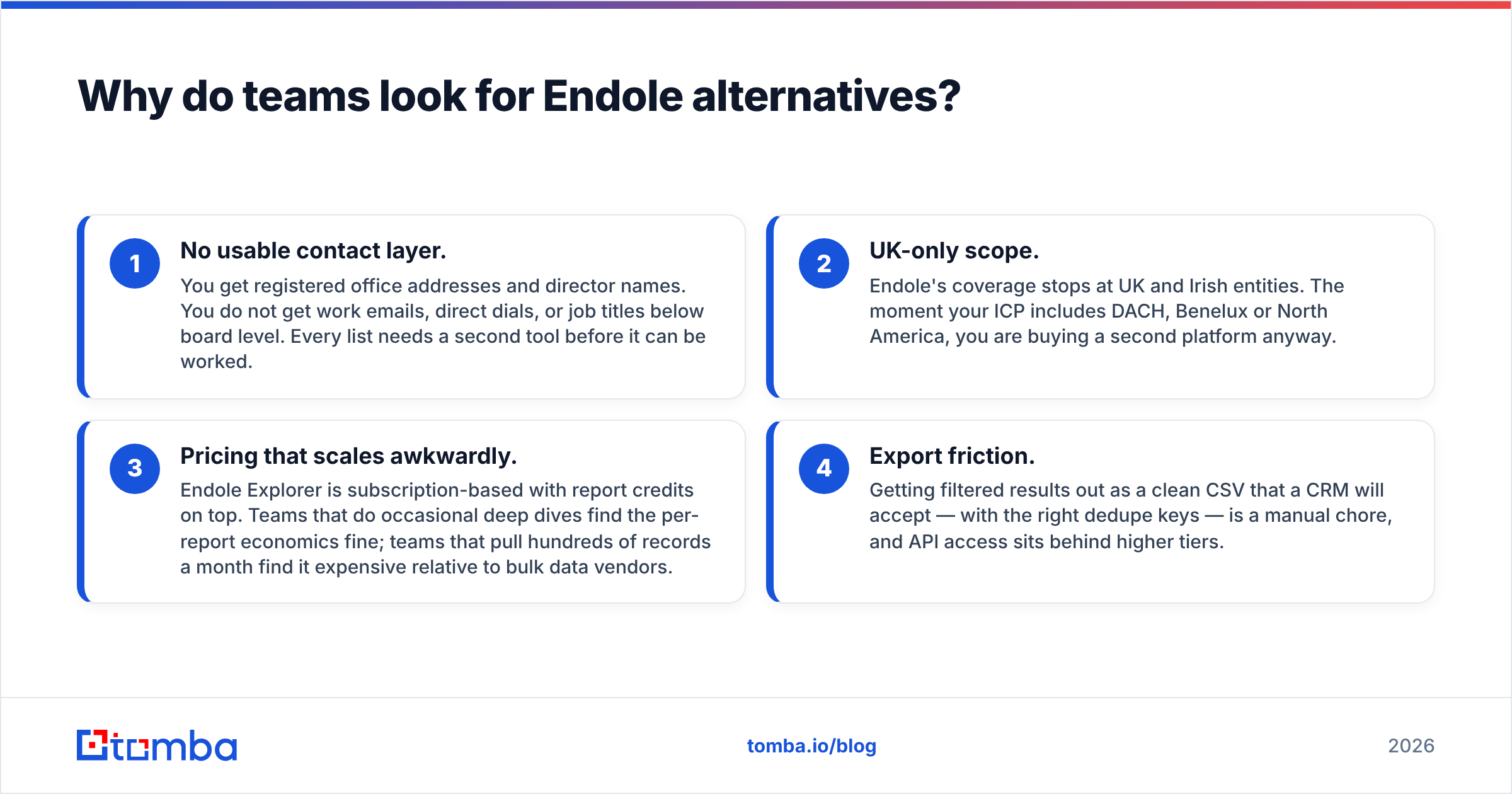
No usable contact layer. You get registered office addresses and director names. You do not get work emails, direct dials or job titles below board level. Every list needs a second tool before you can work it.
UK-only scope. Endole covers UK and Irish entities. If your ICP includes DACH, Benelux or North America, you will buy a second platform anyway.
Pricing that scales awkwardly. Endole Explorer is a subscription with report credits on top. Occasional deep dives are cheap enough. Pulling hundreds of records a month is not.
Export friction. Clean CSV exports that your CRM will accept take manual work. API access sits behind higher tiers.
If only one of those four hurts, you do not need to replace Endole. Bolt something onto it instead. If two or more hurt, a real switch makes sense.
Which Endole alternatives are worth comparing in 2026?#
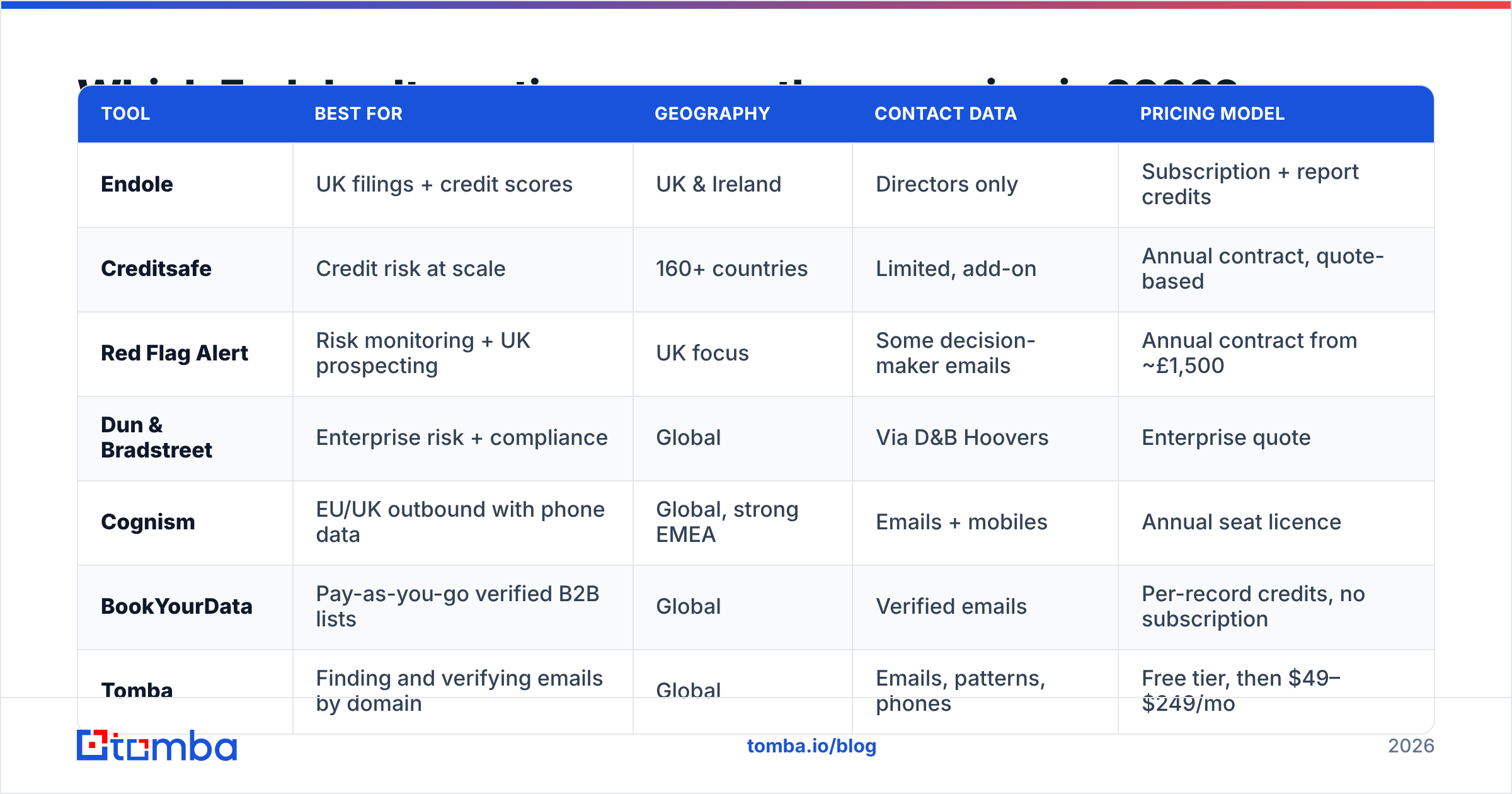
Here is the honest landscape. I have split these Endole alternatives by what each tool is truly good at. They are not interchangeable.
| Tool | Best for | Geography | Contact data | Pricing model |
|---|---|---|---|---|
| Endole | UK filings + credit scores | UK & Ireland | Directors only | Subscription + report credits |
| Creditsafe | Credit risk at scale | 160+ countries | Limited, add-on | Annual contract, quote-based |
| Red Flag Alert | Risk monitoring + UK prospecting | UK focus | Some decision-maker emails | Annual contract from ~£1,500 |
| Dun & Bradstreet | Enterprise risk + compliance | Global | Via D&B Hoovers | Enterprise quote |
| Cognism | EU/UK outbound with phone data | Global, strong EMEA | Emails + mobiles | Annual seat licence |
| BookYourData | Pay-as-you-go verified B2B lists | Global | Verified emails | Per-record credits, no subscription |
| Tomba | Finding and verifying emails by domain | Global | Emails, patterns, phones | Free tier, then $49–$249/mo |
| Companies House Search | Free statutory filings | UK only | None | Free |
Two things jump out. First, nothing here replaces Endole one for one. The risk tools drop the prospecting angle. The prospecting tools drop the filings. Second, a risk suite costs roughly ten times what a contact tool costs. So stacking two cheap tools often beats one enterprise contract on price.
Which alternatives are strongest on credit and risk?#
Creditsafe is the most common straight swap. Its UK dataset matches Endole's, and it covers 160+ countries. Its alerts are more mature too: score changes, CCJs and gazette notices. The catch is commercial. Expect an annual contract, a sales call, and a quote based on seats and report volume. If risk is the main job, this is the upgrade path.
Red Flag Alert sits closer to Endole in spirit. It is UK-centric, mixes risk scoring with prospecting filters, and includes some decision-maker contacts. Its growth-risk model often flags trouble earlier than a plain credit score. That matters if you sell on 60-day terms. Pricing starts above Endole Explorer, but it includes prospecting seats.
Dun & Bradstreet is the enterprise answer. The D&B DUNS number is still the standard ID for procurement, supplier onboarding and compliance. If your finance team already asks for DUNS numbers, the case makes itself. If they do not, you are paying for plumbing you will never touch.
Companies House Search deserves an honest mention. The official register gives you filings, officers, charges and a free API. It lacks the layer Endole adds: scoring, estimated turnover, bulk filters and list building. For a one-off check on a single company, it is all you need. It is also free.
Which alternatives actually give you contacts?#
This is where most Endole refugees land. The real job was never "research this company". It was "reach the right person at 300 companies like this one". Contact data is the gap most Endole alternatives get hired to fill.
Cognism is the heavyweight for EMEA outbound. Phone-verified mobile numbers (its Diamond Data set) are the real differentiator. GDPR-aware notification workflows matter for UK and EU calling. It is a seat-based annual licence, so it suits a funded SDR team more than a two-person agency.
BookYourData goes the other way on pricing. You buy credits as you go, with no annual commitment. Emails are verified and filtered by job title, industry, country and company size. Need a clean 2,000-contact list for one campaign? Its per-record model is the least painful way to buy list data. It also states accuracy guarantees up front, which most list vendors do not.
Tomba solves a narrower problem well. You already know the companies. You need the people. Feed it a domain and domain search returns the emails tied to that domain. It also returns the company's pattern, such as first.last@ or finitial.last@. The email finder takes a name and a domain and returns one address with a confidence score. Every result runs through SMTP-level checks. The email verifier can re-check lists you already own before you send.
The practical pattern is simple. Export your filtered company list from Endole, Creditsafe or Companies House. Keep the domain column. Run it through a bulk email finder. You now have a workable outbound list, and you never bought a second data suite.

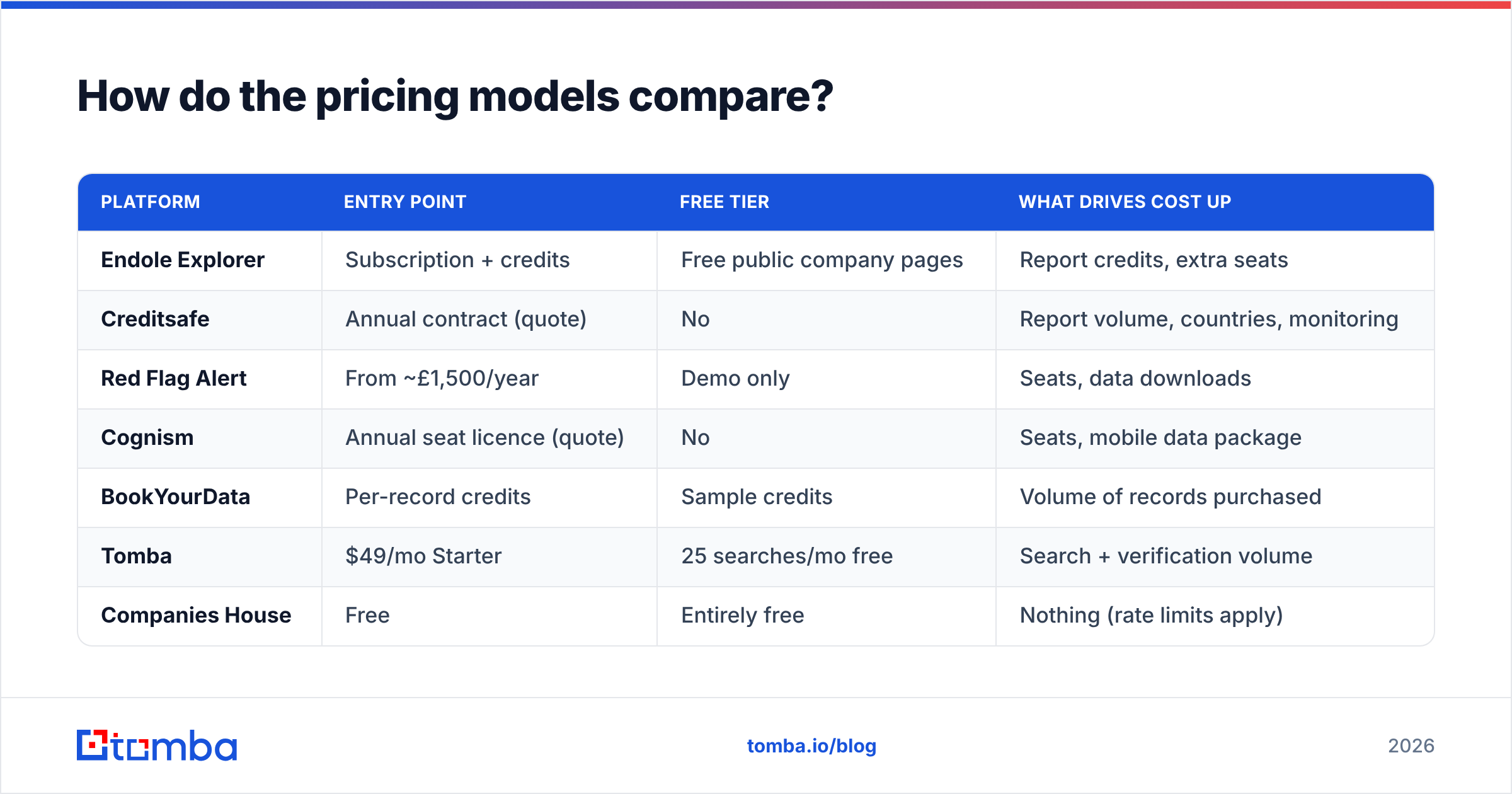
How do the pricing models compare?#
The Endole alternatives above are not sold the same way, so a straight price match is hard. Here is a like-for-like view of entry cost and what pushes the bill up.
| Platform | Entry point | Free tier | What drives cost up |
|---|---|---|---|
| Endole Explorer | Subscription + credits | Free public company pages | Report credits, extra seats |
| Creditsafe | Annual contract (quote) | No | Report volume, countries, monitoring |
| Red Flag Alert | From ~£1,500/year | Demo only | Seats, data downloads |
| Cognism | Annual seat licence (quote) | No | Seats, mobile data package |
| BookYourData | Per-record credits | Sample credits | Volume of records purchased |
| Tomba | $49/mo Starter | 25 searches/mo free | Search + verification volume |
| Companies House | Free | Entirely free | Nothing (rate limits apply) |
Two budgeting notes. First, risk platforms rarely publish prices, so allow two to four weeks for procurement. Second, contact tools are priced by volume, so your real cost tracks hit rate. A tool that finds 55% of contacts at $0.02 a search costs more per usable contact than one at 75% and $0.03. Ask for a trial on your domains, not the vendor's demo list.
Tomba's pricing is public. Free covers 25 searches a month. Starter is $49, Growth $99 and Pro $249, with custom Enterprise above that. Check what happens to unused credits before you commit.
Which Endole alternatives fit your use case?#
You check credit before extending terms. Pick Creditsafe for international coverage. Pick Red Flag Alert if you are UK-only and want earlier warning signs. Stay on Endole if volume is low and the scores are good enough.
You research group structures and ownership. Endole is genuinely strong here. Add Companies House for primary-source filings instead of switching.
You build UK target lists for outbound. Keep a company-data source for filtering, then add contacts. Endole plus an email finder works. So does Red Flag Alert alone, if you want one contract.
You run multi-country outbound with heavy calling. Cognism. The EMEA mobile coverage justifies the seat price if your team really dials.
You need a one-off list with no contract. BookYourData for ready-made verified records. Tomba if you want to control the input list and enrich domains you have already qualified.
You are enriching a CRM, not prospecting. Skip the suites. Point a data enrichment job at the accounts you already have and fill the gaps.
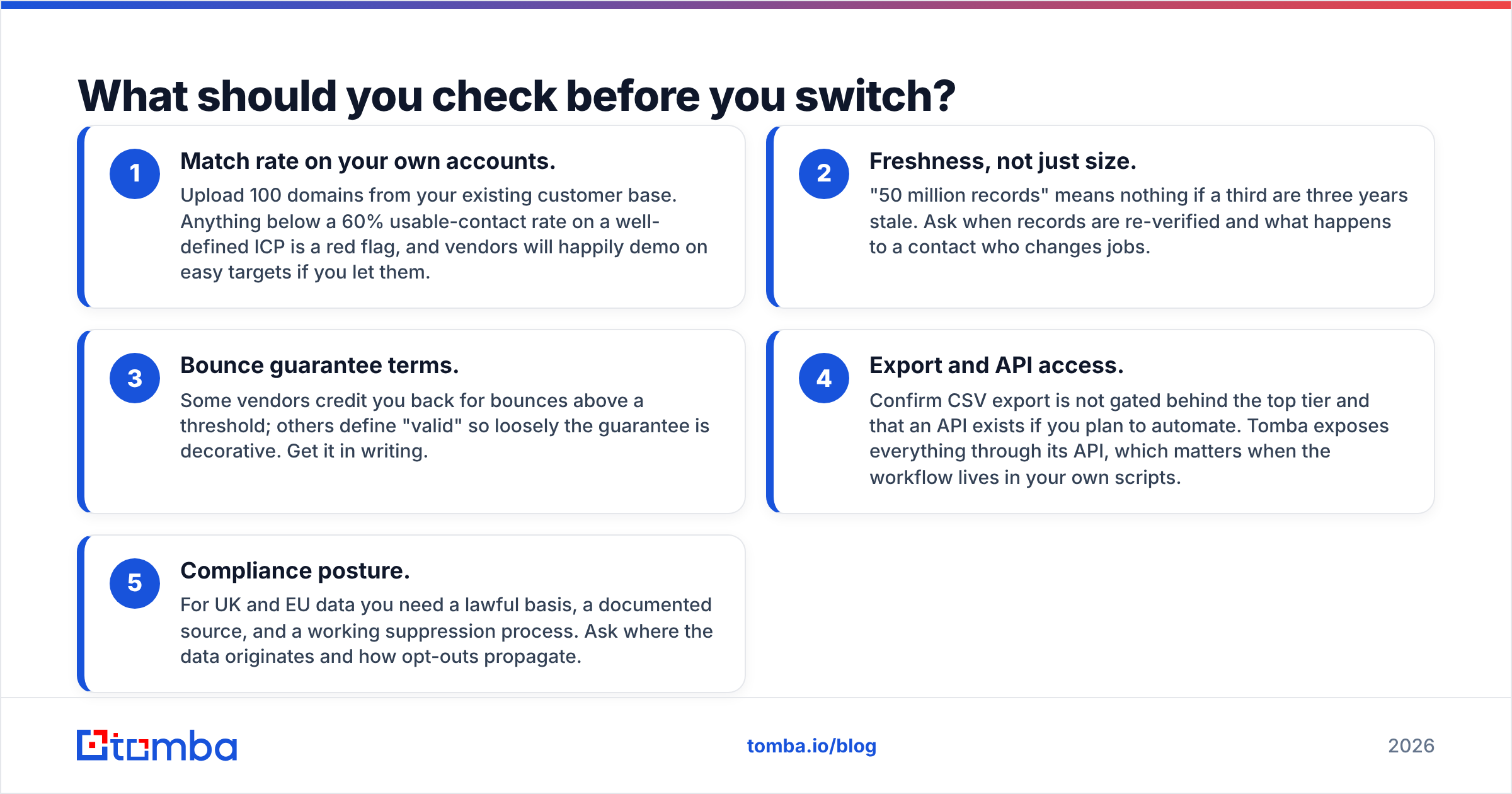
What should you check before you switch?#
Run these five checks on every tool you shortlist. They reveal more than any feature matrix.
Match rate on your own accounts. Upload 100 domains from your customer base. Below a 60% usable-contact rate on a clear ICP is a red flag. Vendors will demo on easy targets if you let them.
Freshness, not just size. "50 million records" means nothing if a third are three years old. Ask how often records are re-verified. Ask what happens when a contact changes job.
Bounce guarantee terms. Some vendors credit you back for bounces above a threshold. Others define "valid" so loosely that the guarantee means nothing. Get it in writing.
Export and API access. Check that CSV export is not locked to the top tier. Check that an API exists if you plan to automate. Tomba exposes everything through its API, which helps when the workflow lives in your own scripts.
Compliance posture. UK and EU data needs a lawful basis, a documented source and a working suppression process. Ask where the data comes from, and how opt-outs spread.
Is Endole still worth keeping?#
Often, yes — as one layer, not the whole stack. Endole does UK statutory data and credit scoring well. It is also cheap next to enterprise risk suites. What it will not do is hand you a person to contact. No amount of filtering fixes that, which is why most Endole alternatives get bought as an add-on rather than a replacement.
For most UK-focused sales teams in 2026, the cheapest correct answer is a two-tool stack. Keep a company-data and risk source for qualification. Attach a contact layer priced by usage, not by seat. That combination usually costs less than one mid-tier enterprise contract. It also gives you a list you can work on Monday morning.
Ready to close the contact gap? Run your Endole export through the Tomba Email Finder. Paste a domain and get verified work emails back, plus the company's email pattern. You get 25 free searches a month, so you can test it on your own target list before you pay.
Related guides#
Ready to find emails that actually work?
Join 150,000+ professionals who stopped guessing and started sending. Free credits on signup — no credit card required.
Get the Tomba newsletter
Practical outbound tactics and product updates — once every two weeks.
About the author