Endole Pricing Reviews Pros and Cons: Full 2026 Guide
Endole sells UK company data on a credit-and-seat model that looks cheap until you need contacts. Here's what the plans actually cost, where the data holds up, and when a different tool wins.
Here is the short version of Endole pricing reviews pros and cons. Endole is very good at UK company data. It is very weak at contact data. This guide covers what the plans cost. It also covers what buyers praise, what they regret, and when a cheaper tool wins.
TL;DR
- Endole is a UK company-data platform. It is built on Companies House filings, credit scores, and financials — not a contact database. Pricing starts near £30–£40/month for single-user report access. Explorer, the list-building tier, runs into four figures a year.
- Reasons to buy: deep UK filing history, credit risk scoring, and clear group-structure maps. Global databases handle all three badly.
- Reasons to skip: almost no verified work emails, UK-only data, and report unlocks that burn credits fast. Explorer quotes are not published either.
- Reviews on G2 and Capterra are thin next to Dun & Bradstreet or Creditsafe. So you buy on your own trial, not on crowd proof.
- Most outbound teams pair Endole for company data with a dedicated email finder for the contact layer.
What is Endole and who actually uses it?#
Endole is a UK business intelligence service. It turns public Companies House data into something usable: company profiles, filing history, directors, shareholders, group structures, credit scores, and financial trends. Think of it as a raw filing cabinet turned into a well-organised library. The documents are the same. Only one of them is easy to search.
The typical buyer falls into three camps:
- Credit and risk teams who decide whether to give payment terms to a UK limited company.
- Corporate finance, M&A, and accountancy firms researching targets, group ownership, and shareholders.
- Sales and marketing teams using Endole Explorer to build UK company lists. They filter by turnover, SIC code, region, employee count, and growth signals.
That third group is where the pricing confusion starts. Endole sells Explorer as a prospecting product. But the output is a company list, not a contact list with verified emails. If your workflow ends at "which companies should we target," Endole is a fair answer. If it ends at "email the finance director this week," you need a second tool.
What does Endole pricing actually look like in 2026?#
Endole does not publish a full price grid for its higher tiers. That is the most common complaint in reviews. Here is the honest state of it:
- Free tier — basic company profiles, registered address, incorporation date, and headline filing dates on endole.co.uk. Enough to check that a company exists and who runs it.
- Individual / Lite subscriptions — roughly £30–£40 per month for one user. You get report access and a monthly credit allowance for detailed documents.
- Endole Explorer — the list-building and analytics product. It is priced per seat, sold annually, and quoted by sales. Real quotes land in the low-to-mid four figures a year for small teams. The number grows with seats and export volume.
- Enterprise / API — custom, usage-based, negotiated.
The mechanic to watch is credits. Detailed reports, full financials, and document downloads all spend credits. Overages are billed on top of the subscription. A month of heavy diligence can quietly double your invoice.

How does the credit model bite?#
These patterns show up again and again in user feedback:
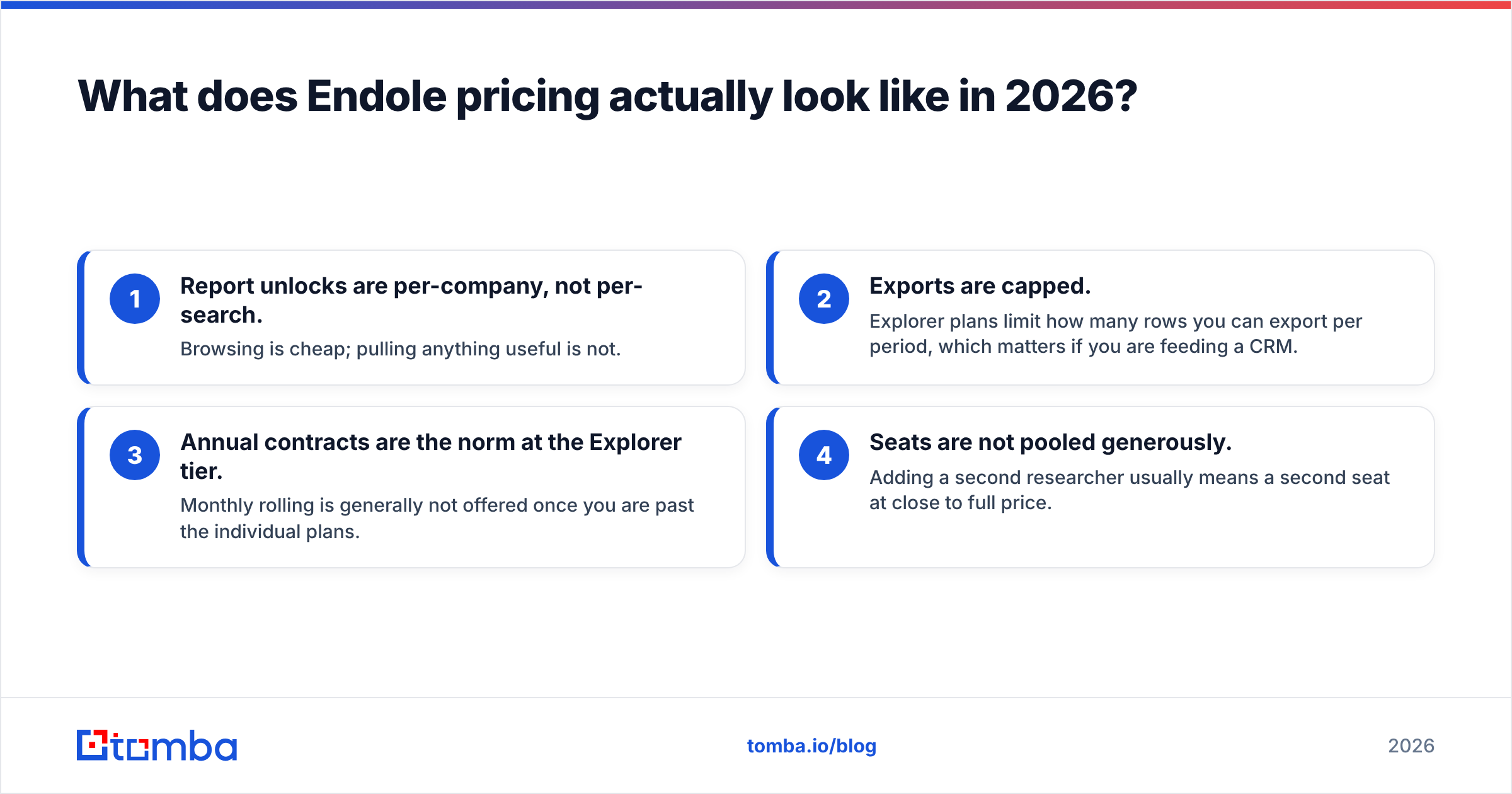
- Report unlocks are per-company, not per-search. Browsing is cheap. Pulling anything useful is not.
- Exports are capped. Explorer plans limit how many rows you can export per period. That matters if you feed a CRM.
- Annual contracts are the norm at the Explorer tier. Monthly rolling is rare once you pass the individual plans.
- Seats are not pooled generously. A second researcher usually means a second seat at close to full price.
How does Endole pricing compare to the alternatives?#
Here is the honest side-by-side. Prices are indicative list rates as of early 2026. They move with contract terms and region.
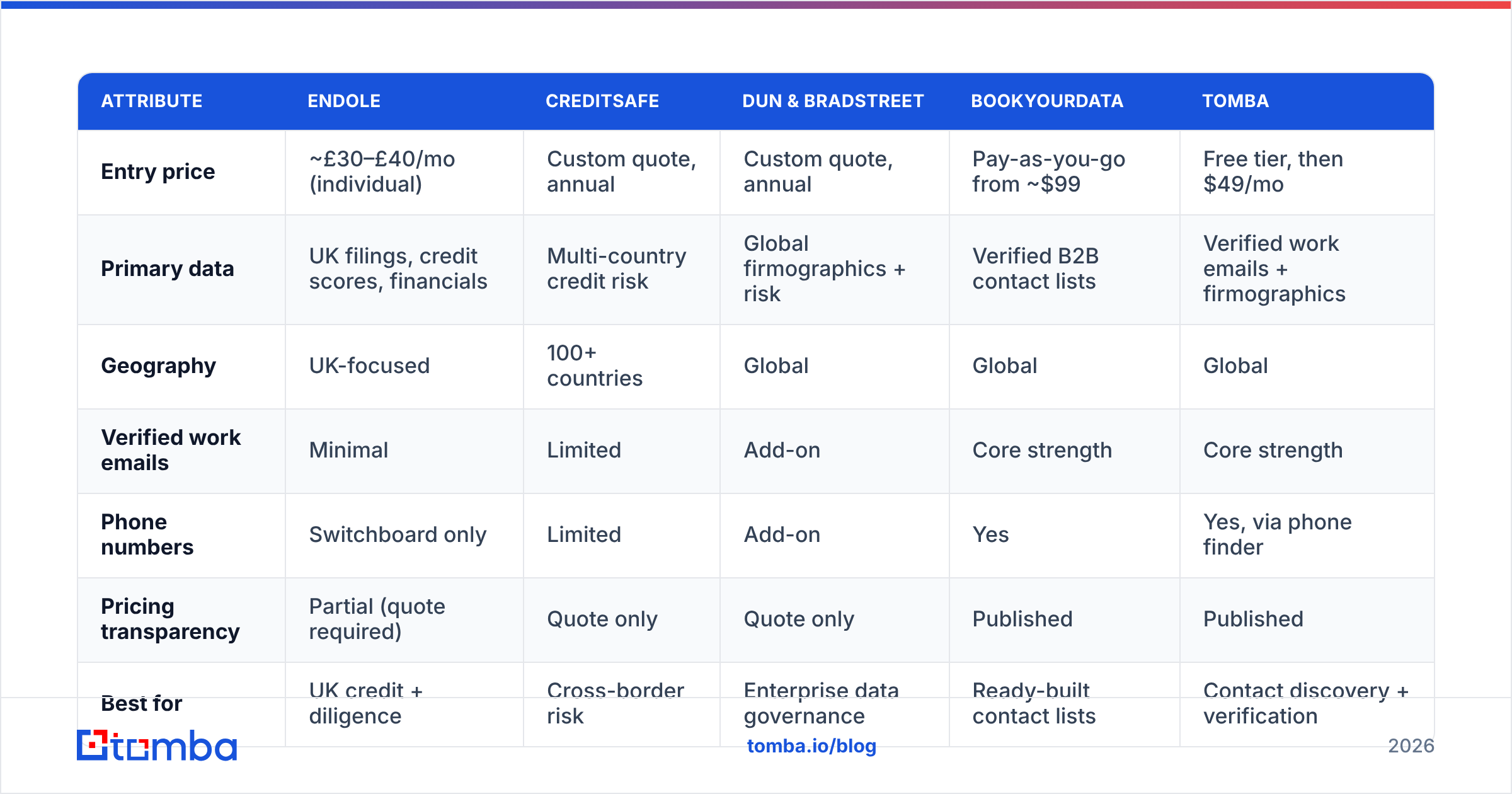
| Attribute | Endole | Creditsafe | Dun & Bradstreet | BookYourData | Tomba |
|---|---|---|---|---|---|
| Entry price | ~£30–£40/mo (individual) | Custom quote, annual | Custom quote, annual | Pay-as-you-go from ~$99 | Free tier, then $49/mo |
| Primary data | UK filings, credit scores, financials | Multi-country credit risk | Global firmographics + risk | Verified B2B contact lists | Verified work emails + firmographics |
| Geography | UK-focused | 100+ countries | Global | Global | Global |
| Verified work emails | Minimal | Limited | Add-on | Core strength | Core strength |
| Phone numbers | Switchboard only | Limited | Add-on | Yes | Yes, via phone finder |
| Pricing transparency | Partial (quote required) | Quote only | Quote only | Published | Published |
| Best for | UK credit + diligence | Cross-border risk | Enterprise data governance | Ready-built contact lists | Contact discovery + verification |
| Free trial | Free profile tier | Demo | Demo | Sample data | 25 searches/mo free |
The table makes the positioning clear. Endole and Creditsafe compete on risk and filings. BookYourData and Tomba compete on the contact layer. Dun & Bradstreet sits above both, at enterprise prices. Treating them as swaps for each other is how you end up with a renewal you regret.
What do Endole reviews say — the pros?#
Public reviews on G2 and Capterra all point the same way, and so does practitioner chatter. Here is the pro half of the Endole pricing reviews pros and cons picture:
- Filing depth. Full document history, charges, insolvency markers, and director timelines are all there. For UK due diligence, that is genuinely strong.
- Group structure mapping. Parent and subsidiary links are drawn clearly. Rebuilding those chains by hand from raw filings is slow work.
- Credit scoring that non-analysts can read. Risk bands and suggested credit limits are written in plain English.
- Explorer's filters are good. Turnover bands, SIC codes, employee ranges, incorporation date, and region combine well for a UK target list.
- Fair value at the low end. For a solo accountant or broker, £30-ish a month beats the enterprise credit bureaus by a wide margin.
- Clean UI. Reviewers say it is faster and less cluttered than legacy credit-bureau tools.
What are the cons buyers keep flagging?#
Three of them are deal-breakers for outbound teams:
- No real contact layer. You get switchboard numbers and generic info@ addresses. Named work emails are almost absent. That is fatal if Endole is your only tool.
- UK-only. Irish and some other coverage exists in patches. But the moment your ICP crosses a border, you are back to square one.
- Opaque Explorer pricing. You have to book a call to learn the number. Reviewers say so, loudly.
The rest are cost and data issues you can plan around:
- Credit burn. Teams routinely underestimate report use in the first quarter.
- Annual lock-in. There is little room to scale down mid-term if usage drops.
- Data recency lag. Endole sits downstream of Companies House. For small companies, filings can run up to nine months behind reality. That is a limit of the source, not an Endole failure. It still shapes what you can trust.
- Thin review volume. Fewer public reviews than the big bureaus means less independent signal before you commit.

Is Endole worth it for sales prospecting?#
Only as half a stack. Here is the practical decision framework:
Buy Endole if: your market is UK limited companies, you need credit risk or filing depth to qualify accounts, and you already have a way to get named contacts.
Skip Endole if: you sell abroad, your ICP includes sole traders or non-UK entities, or your bottleneck is "who do I email" rather than "which company is solvent."
Pair it if: you run UK-focused account-based outbound. Endole builds the account list. A domain search turns each domain into real people. An email verifier keeps your bounce rate down before you send.
Most UK outbound teams end up here. Endole answers which companies. A tool like Tomba answers who works there, at what address, and whether that address will bounce. For the second half of that stack, the B2B database and data enrichment layers turn a static company list into a working pipeline.
What does the combined cost look like?#
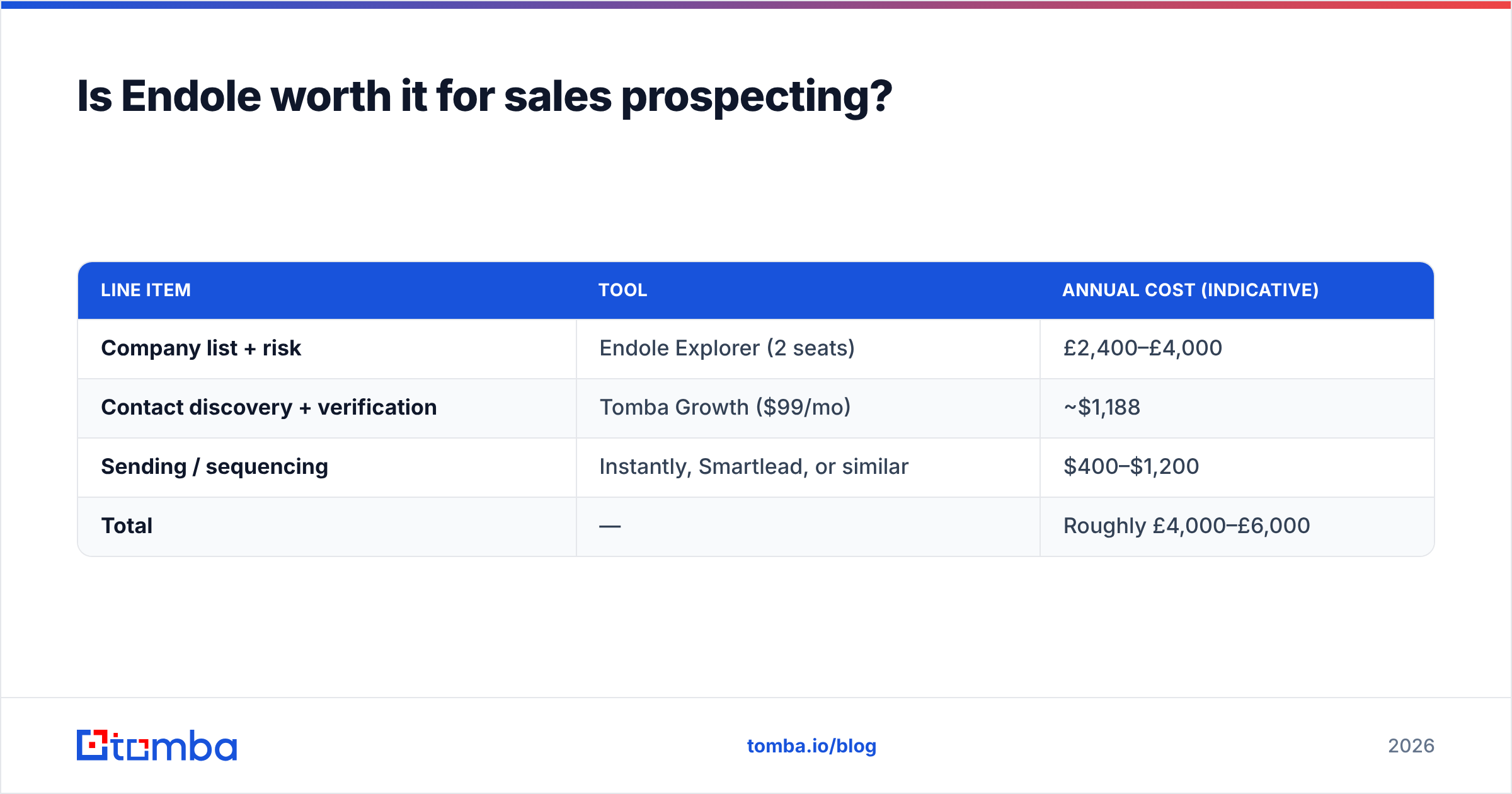
A realistic UK outbound stack for a three-person team:
| Line item | Tool | Annual cost (indicative) |
|---|---|---|
| Company list + risk | Endole Explorer (2 seats) | £2,400–£4,000 |
| Contact discovery + verification | Tomba Growth ($99/mo) | ~$1,188 |
| Sending / sequencing | Instantly, Smartlead, or similar | $400–$1,200 |
| Total | — | Roughly £4,000–£6,000 |
Compare that with a single enterprise contract from a global data vendor. Those often start north of £15,000 a year for the same UK depth plus contacts. The modular route usually wins on cost. The price is managing two vendors instead of one.
What should you ask before signing?#
Treat the sales call as a data audit, not a demo. These questions change the outcome:
- What exactly consumes a credit? Get it in writing: search, profile view, financial report, document download.
- What is the export cap per seat, per month? And what happens on overage.
- What share of UK companies in my SIC codes have full financials? Micro-entity filings are thin. Ask for the rate on your segment, not the global number.
- Can I downgrade seats mid-term? Usually no. The answer still tells you how flexible the account team is.
- Is there API access on my tier? If you plan to sync to a CRM, this decides automation versus copy-paste.
- What is the refresh cadence? Ask how soon a new Companies House filing shows up in Explorer.
Then run a two-week trial on a real segment. Pick 50 accounts you actually want. Count how many you could contact from Endole data alone. That number is your ROI input, not the demo.
How do you fill the contact gap Endole leaves?#
The gap is specific. You have a domain, a company name, and often a director's name from the filings. What you need is a deliverable work email.
That is a solved problem. Export the directors' names and company domains from Endole. Run them through a bulk email finder. Verify the results, then push them into your CRM. Directors' names are one field Endole does supply well, because Companies House requires them. So the handoff is cleaner than it sounds.
For scale, the bulk email finder handles list-sized jobs. The Tomba API wires the enrichment step straight into the pipeline that already ingests your Endole exports. Tomba pricing runs Free (25 searches/mo), Starter $49/mo, Growth $99/mo, Pro $249/mo, and Enterprise custom. So you can test the pairing at zero cost before you commit budget.
Endole pricing reviews pros and cons: the verdict#
Endole is a good product asked to do a job it was never built for. As UK company intelligence — filings, credit, structure — it earns its price. That is truest at the individual tier, where it undercuts the big bureaus. As a prospecting database, it stops one step short. A list of companies without a list of people is a research artifact, not a pipeline.
So the Endole pricing reviews pros and cons math is simple for outbound teams. Budget for two tools and stop asking one to do both. The combined cost still sits well below a single enterprise data contract. And each tool is best in class at its half of the job.
Ready to close the contact gap? Take your Endole company export. Drop the domains into the Tomba Email Finder. See how many verified work emails come back on the free tier — 25 searches, no card, before you decide anything.
Related guides#
Ready to find emails that actually work?
Join 150,000+ professionals who stopped guessing and started sending. Free credits on signup — no credit card required.
Get the Tomba newsletter
Practical outbound tactics and product updates — once every two weeks.
About the author