Endole vs Jet Leads Pro: Which B2B Data Tool Wins in 2026?
Endole sells UK company intelligence. Jet Leads Pro sells prospecting lists. They solve different halves of the same problem — and only one of them gets you a deliverable inbox. Here is the honest breakdown.
TL;DR
- They are not the same category. Endole is a UK company-intelligence platform built on Companies House filings — accounts, directors, credit signals, group structures. Jet Leads Pro is a lead-list and prospecting product. Comparing them feature-for-feature is like comparing a land registry to a phone book.
- Pick Endole if your qualification criteria are financial — turnover bands, filing history, director changes, credit risk, SIC codes. Nothing in a generic lead tool matches that depth for UK limited companies.
- Pick Jet Leads Pro if you need volume contacts fast and your ICP is defined by role and industry rather than balance sheet health.
- Neither is an email deliverability layer. Company records go stale slowly; people move jobs every 18–24 months. Whichever you buy, you still need verification before a send.
- The cheapest working stack is usually two tools, not one: a firmographic source for targeting plus a dedicated finder/verifier for contact data.
What is Endole and who actually uses it?#
Endole is a UK business-information service. Its raw material is public record — the filings every UK limited company submits to Companies House — layered with analysis: financial summaries, credit indicators, director networks, ownership structures, and industry benchmarking. You can see the free public tier at endole.co.uk.
The typical buyer is not a cold-email SDR. It is:
- Credit and finance teams checking whether a prospective customer can pay
- M&A and corp-dev analysts mapping who owns what
- Field sales in high-ACV UK markets where a company's filed turnover decides whether it is worth a meeting
- Compliance and KYC functions confirming directors and registered addresses
That shapes everything. Endole's strength is depth on the entity. It answers "is this company real, solvent, growing, and who controls it?" with better evidence than almost any US-built sales database can manage for UK SMEs, because it is reading the same statutory filings a UK accountant would.
Its weakness follows directly: statutory filings do not contain your buyer's work email or mobile. They contain directors — not the Head of Demand Gen you actually want to reach.
What is Jet Leads Pro and what problem does it solve?#
Jet Leads Pro sits in the crowded lead-list category — tools that let you filter a contact database by title, industry, geography, and company size, then export a CSV or push into a sequencer. Products in this bracket compete on three things: how many records they claim, how fresh those records are, and how much a credit costs.
Be skeptical of headline record counts from any vendor in this tier, Jet Leads Pro included. A "200 million contacts" claim usually means 200 million rows ever collected, not 200 million rows that are currently accurate. Before you commit, check the vendor's current listing on G2 and — more importantly — run your own sample test, which we cover below.
The honest framing: Jet Leads Pro is a breadth play. Endole is a depth play. If you evaluate them as competitors, you will pick wrong. Evaluate them as candidates for two different jobs.

Endole vs Jet Leads Pro: how do they compare head to head?#
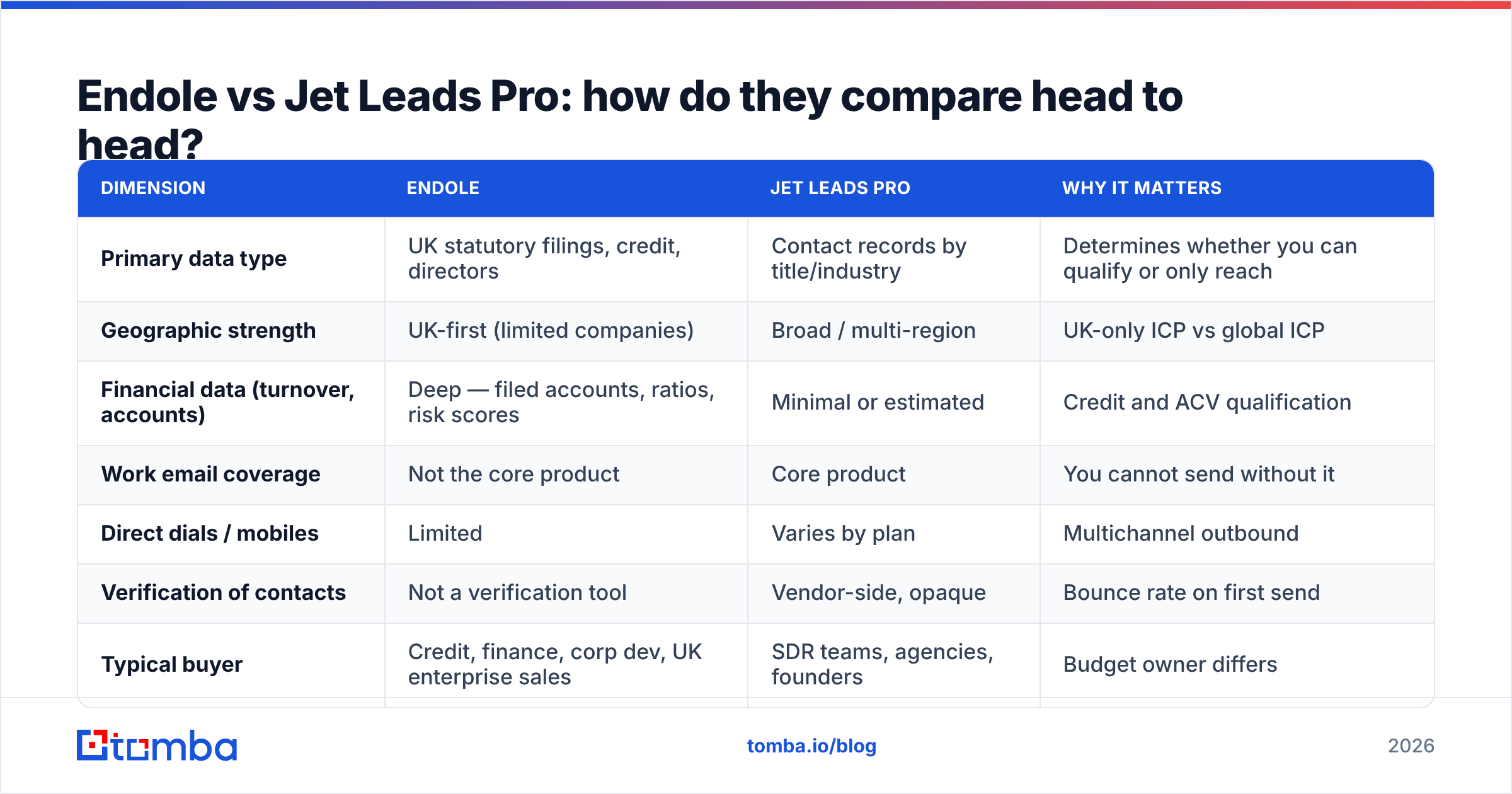
Here is the practical side-by-side. Treat pricing as directional — both vendors quote by seat, credit pack, and contract length, so confirm current numbers before you sign.
| Dimension | Endole | Jet Leads Pro | Why it matters |
|---|---|---|---|
| Primary data type | UK statutory filings, credit, directors | Contact records by title/industry | Determines whether you can qualify or only reach |
| Geographic strength | UK-first (limited companies) | Broad / multi-region | UK-only ICP vs global ICP |
| Financial data (turnover, accounts) | Deep — filed accounts, ratios, risk scores | Minimal or estimated | Credit and ACV qualification |
| Work email coverage | Not the core product | Core product | You cannot send without it |
| Direct dials / mobiles | Limited | Varies by plan | Multichannel outbound |
| Verification of contacts | Not a verification tool | Vendor-side, opaque | Bounce rate on first send |
| Typical buyer | Credit, finance, corp dev, UK enterprise sales | SDR teams, agencies, founders | Budget owner differs |
| Export / API | Yes, plan-dependent | Yes, credit-metered | Whether it fits your ops stack |
| Best fit | "Should we sell to this company?" | "Who do we email at this company?" | Two different questions |
The row that decides most evaluations is work email coverage. If your motion is outbound email, a platform that gives you flawless firmographics and no reachable contacts has not moved you closer to a reply. Conversely, a list of 8,000 contacts at companies that filed dormant accounts last year is volume without qualification.
Which one is better for UK outbound in 2026?#
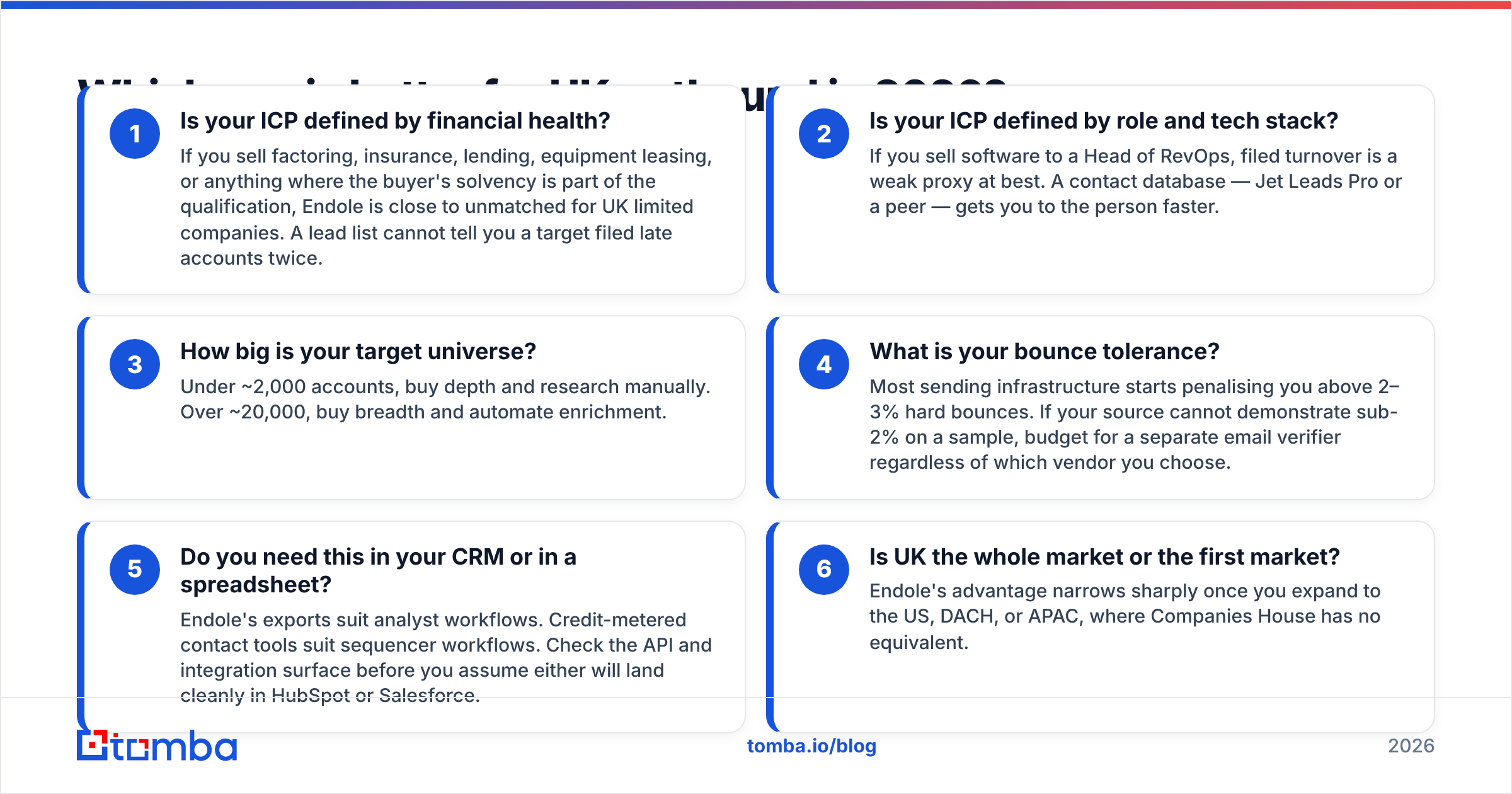
Neither, alone. Here is the decision logic, in order:
- Is your ICP defined by financial health? If you sell factoring, insurance, lending, equipment leasing, or anything where the buyer's solvency is part of the qualification, Endole is close to unmatched for UK limited companies. A lead list cannot tell you a target filed late accounts twice.
- Is your ICP defined by role and tech stack? If you sell software to a Head of RevOps, filed turnover is a weak proxy at best. A contact database — Jet Leads Pro or a peer — gets you to the person faster.
- How big is your target universe? Under ~2,000 accounts, buy depth and research manually. Over ~20,000, buy breadth and automate enrichment.
- What is your bounce tolerance? Most sending infrastructure starts penalising you above 2–3% hard bounces. If your source cannot demonstrate sub-2% on a sample, budget for a separate email verifier regardless of which vendor you choose.
- Do you need this in your CRM or in a spreadsheet? Endole's exports suit analyst workflows. Credit-metered contact tools suit sequencer workflows. Check the API and integration surface before you assume either will land cleanly in HubSpot or Salesforce.
- Is UK the whole market or the first market? Endole's advantage narrows sharply once you expand to the US, DACH, or APAC, where Companies House has no equivalent.
What does a realistic stack look like?#
The pattern that works for UK-focused outbound teams is three layers, and it rarely comes from one vendor.
Layer 1 — Account selection. Pull the target company universe. This is where Endole earns its fee if financial qualification matters, or where a filtered export from a lead tool works if it does not. Output: a list of domains, not a list of people.
Layer 2 — Contact discovery. Take those domains and find the specific humans in the roles you sell to. A domain search run against your account list returns the people and email patterns per company, which is a fundamentally different operation than filtering a pre-built list. It also means your contact data is generated against your accounts rather than whoever happened to be in the vendor's crawl.
Layer 3 — Verification and enrichment. Every address gets checked before it enters a sequence, including the awkward ones — catch-all domains that accept everything at SMTP and bounce later. A catch-all verifier matters more in the UK mid-market than most teams expect, because a large share of SME domains sit behind catch-all Microsoft 365 configurations.
Skip layer 3 and layers 1 and 2 stop mattering. Deliverability is the gate; everything upstream is only as valuable as the percentage that actually lands.
How do you test either tool before you pay?#
Run the same 50-record test on every vendor on your shortlist. It takes an afternoon and it has settled more procurement arguments than any feature matrix.
- Build a control set. Pick 50 companies you already know well — existing customers, churned accounts, competitors' customers. You know the ground truth for these.
- Ask each vendor for those exact 50. Not a curated demo list. Yours. A vendor that resists this is telling you something.
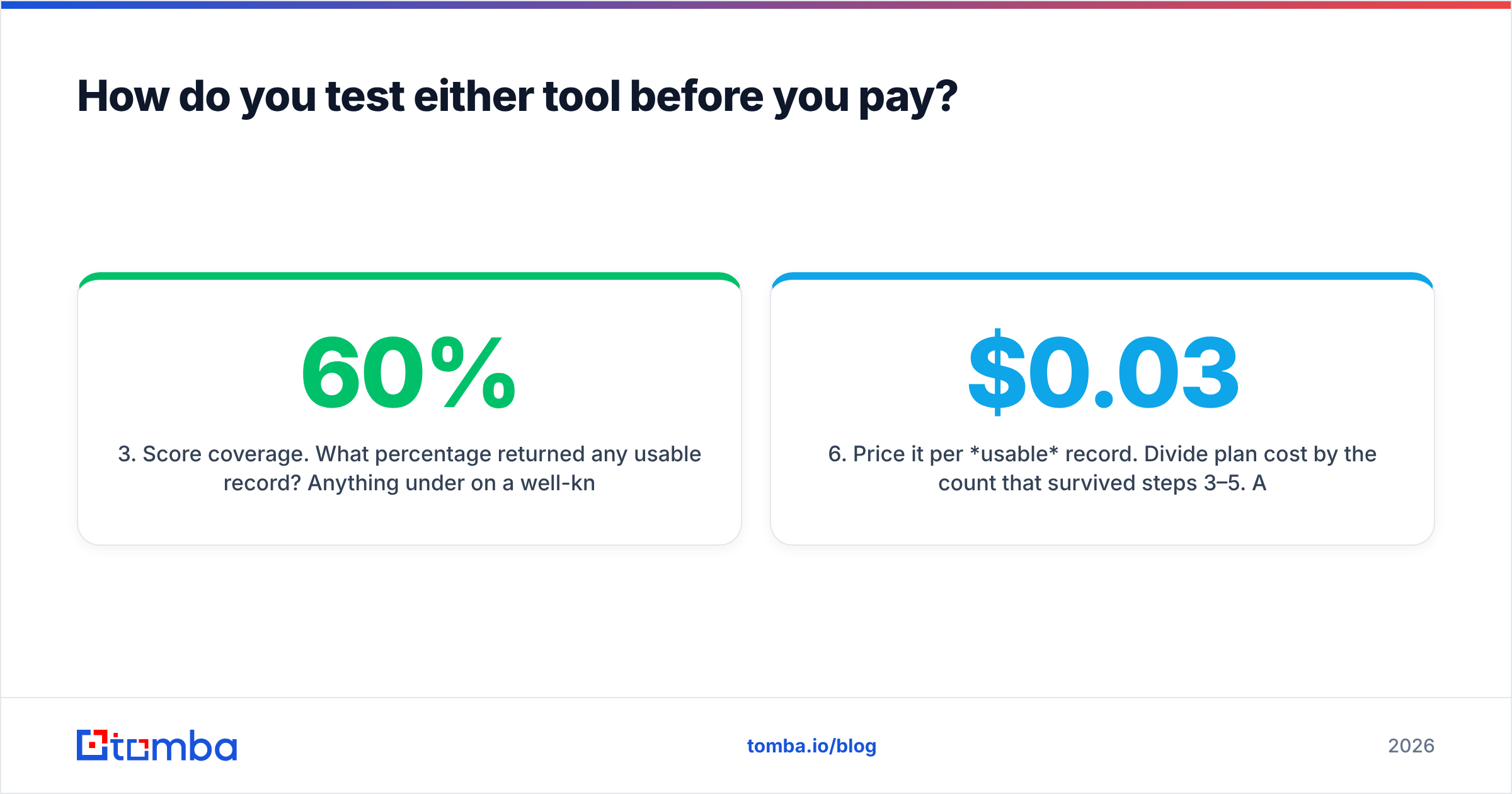
- Score coverage. What percentage returned any usable record? Anything under 60% on a well-known ICP is a red flag.
- Score accuracy, not coverage. Of the returned contacts, how many are correct job title, correct company, correct email format? Run them through a free email checker or a bulk verifier and count valid, catch-all, and invalid.
- Score freshness. Pick 10 records and check the person on LinkedIn. Still there? Data that is 18 months stale looks identical to fresh data in a CSV.
- Price it per usable record. Divide plan cost by the count that survived steps 3–5. A "$0.03 per credit" tool at 40% usable is more expensive than a "$0.08 per credit" tool at 90%.
That last calculation flips vendor rankings surprisingly often. Advertised credit prices are close to meaningless without a validity rate attached.
Where does Tomba fit in this comparison?#
Honestly: Tomba is not an Endole competitor, and it does not pretend to be. It will not tell you a UK company's filed turnover or flag a director disqualification. If credit risk is your qualification criterion, buy Endole and do not let anyone talk you out of it.
Tomba competes on the contact layer — the part where Jet Leads Pro and its peers operate, and the part where Endole stops. The differences that matter in practice:
- Search-on-demand rather than static list. You query a domain or a name and get a result generated against live sources, instead of filtering a snapshot that was assembled months ago.
- Verification is built into the same workflow. Finding and validating are not separate purchases from separate vendors with separate credit pools.
- Transparent pricing. Free tier at 25 searches/month, Starter at $49/mo, Growth at $99/mo, Pro at $249/mo, Enterprise custom. Full Tomba pricing is public — no "contact sales to learn the number" gate.
- Ops-native access. Tomba API, CLI, Sheets, Excel, and CRM integrations mean the contact layer can be wired into the same pipeline that produced your account list.
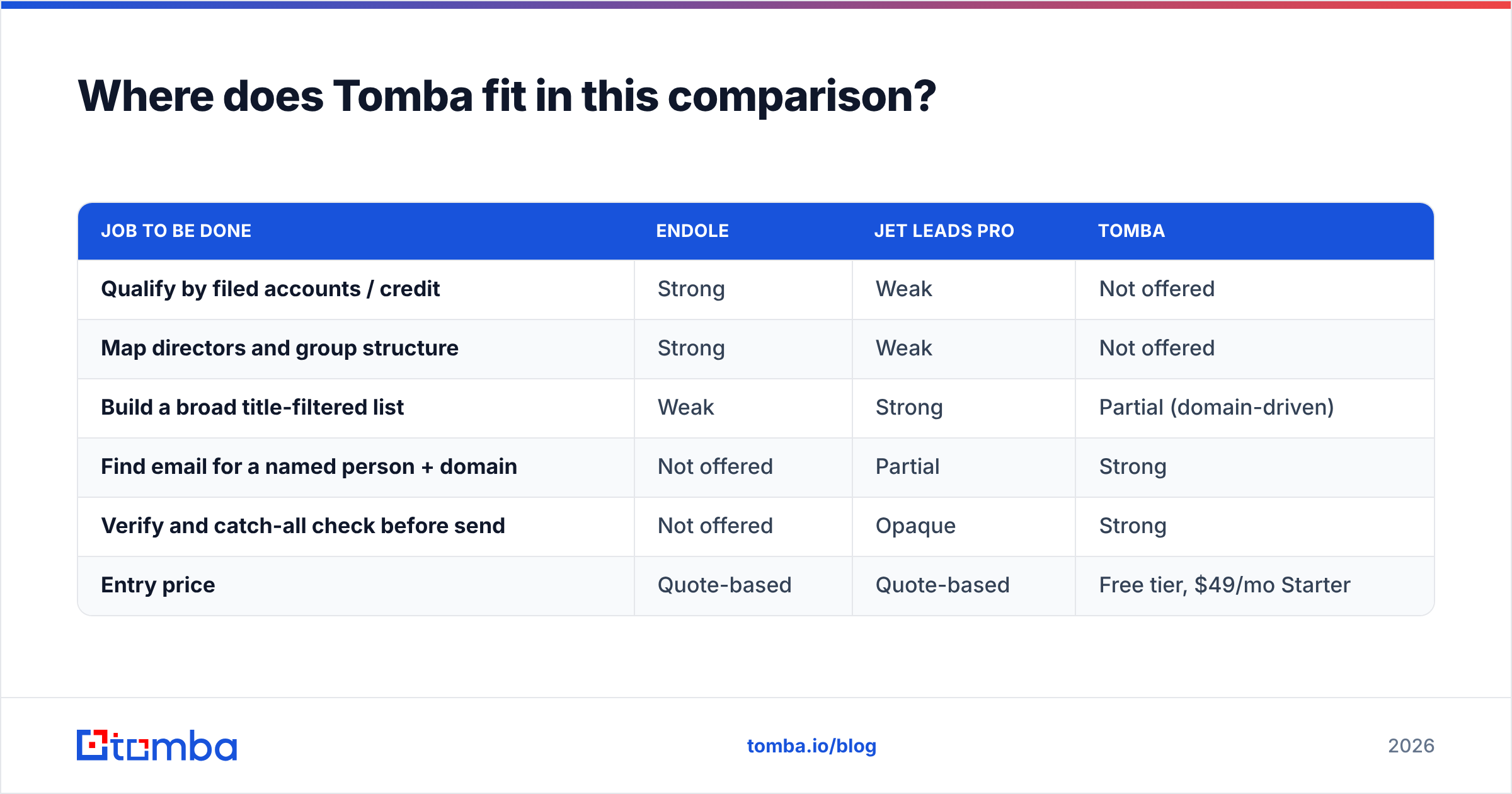
Here is how the three sit together on the jobs that actually appear in a UK outbound workflow:
| Job to be done | Endole | Jet Leads Pro | Tomba |
|---|---|---|---|
| Qualify by filed accounts / credit | Strong | Weak | Not offered |
| Map directors and group structure | Strong | Weak | Not offered |
| Build a broad title-filtered list | Weak | Strong | Partial (domain-driven) |
| Find email for a named person + domain | Not offered | Partial | Strong |
| Verify and catch-all check before send | Not offered | Opaque | Strong |
| Entry price | Quote-based | Quote-based | Free tier, $49/mo Starter |
Read that table as a shopping list, not a scoreboard. Two green columns in different rows beat one vendor that is amber everywhere.
What are the common mistakes teams make here?#
Buying breadth when the problem was targeting. If reply rates are low, adding 50,000 more contacts multiplies the problem. Tighten the ICP first — that is an Endole-shaped job in the UK, or a manual research job anywhere else.
Buying depth when the problem was reach. Some teams over-invest in company intelligence and then spend hours per account guessing email formats by hand. That is a solved problem: an email finder handles it in seconds per contact.
Trusting a vendor's "verified" badge. Verification standards vary wildly between providers. Re-verify at your own layer. It costs a fraction of the domain reputation you would otherwise burn.
Ignoring catch-all domains. These pass a naive SMTP check and then bounce or silently drop. In UK SME segments they are common enough to distort your entire deliverability picture.
Comparing list prices instead of cost per meeting booked. The only metric that survives contact with a quarter-end review.
The verdict#
If your qualification criteria are financial and your market is UK limited companies, Endole is the stronger product and there is no close substitute. If you need contacts at volume and your ICP is defined by role, a lead-list tool like Jet Leads Pro is the faster route to a sequenceable file — just test it against your own 50 accounts before you trust the record count.
Neither replaces the contact-accuracy layer. Whichever you pick, the last step before a send should be finding and verifying the specific address you are about to use.
Start there and the rest of the stack gets cheaper: run your target domains through the Tomba Email Finder on the free tier, verify what comes back, and compare the usable-record rate against whatever your incumbent vendor delivers. If Tomba wins on that number, it wins on cost per meeting too — and if it does not, you will have a defensible reason to renew the incumbent. Either way you stop guessing.
Related guides#
Ready to find emails that actually work?
Join 150,000+ professionals who stopped guessing and started sending. Free credits on signup — no credit card required.
Get the Tomba newsletter
Practical outbound tactics and product updates — once every two weeks.
About the author