Endole vs Kipplo (2026): Which UK Company Data Tool Wins?
Endole and Kipplo both sell UK company data, but they solve different problems. Here is an honest breakdown of coverage, contact quality, pricing and where each one leaves a gap in your outbound stack.
Endole vs Kipplo comes down to one question: do you need to research UK companies, or just list them? Endole is built for depth. Kipplo is built for speed. This guide compares both on data, pricing and contact quality — and shows where each one leaves a hole in your outbound.
TL;DR
Endole is a UK business intelligence and credit-risk platform built on Companies House filings. Use it when you need to understand a company: accounts, directors, financial health, group structure.
Kipplo is a lead-generation layer over UK company records. You filter, build a list, and export it into your outbound tool.
Neither is a contact-data tool. Both hand you companies and, at best, a switchboard number. Named decision-maker emails are the gap.
Sell to UK SMEs on financial signals? Endole is the better research spine. Want lists fast and cheap? Kipplo.
A realistic 2026 stack pairs one of these for the company layer with a dedicated email finder for the person layer. Most teams under-invest in that second half.
What are Endole and Kipplo, exactly?#
They sound like competitors because both sell UK company data. But they do not solve the same job.
Endole is a business information platform. Its core value is depth on UK-registered firms. You get filed accounts, balance-sheet trends, credit scores and risk bands, director histories, group and shareholder structures, and county-court judgments.
Sales teams use it. So do credit controllers, insolvency practitioners, and anyone checking a company before signing a contract. The Endole Explorer product wraps that database in a search-and-list interface with saved segments and exports.
Kipplo sits closer to the prospecting end. The pitch is simple. Filter UK companies by what a seller cares about — industry, size, location, incorporation date, financial thresholds — then export a list you can work today. It is a thinner, faster product with less analytical depth and a lower price.
The mental model for Endole vs Kipplo: one is a reference library, the other is a list builder. You can build lists from a library. You can do light research in a list builder. But each one fights you outside its lane.
Both sit downstream of the same public source: the Companies House register. That matters more than any feature chart. It caps how different either dataset can be at the company level. The real difference lives in enrichment, scoring, UI, refresh speed, and what each vendor layers on top.
How does the underlying data differ?#
Same river, different filters.
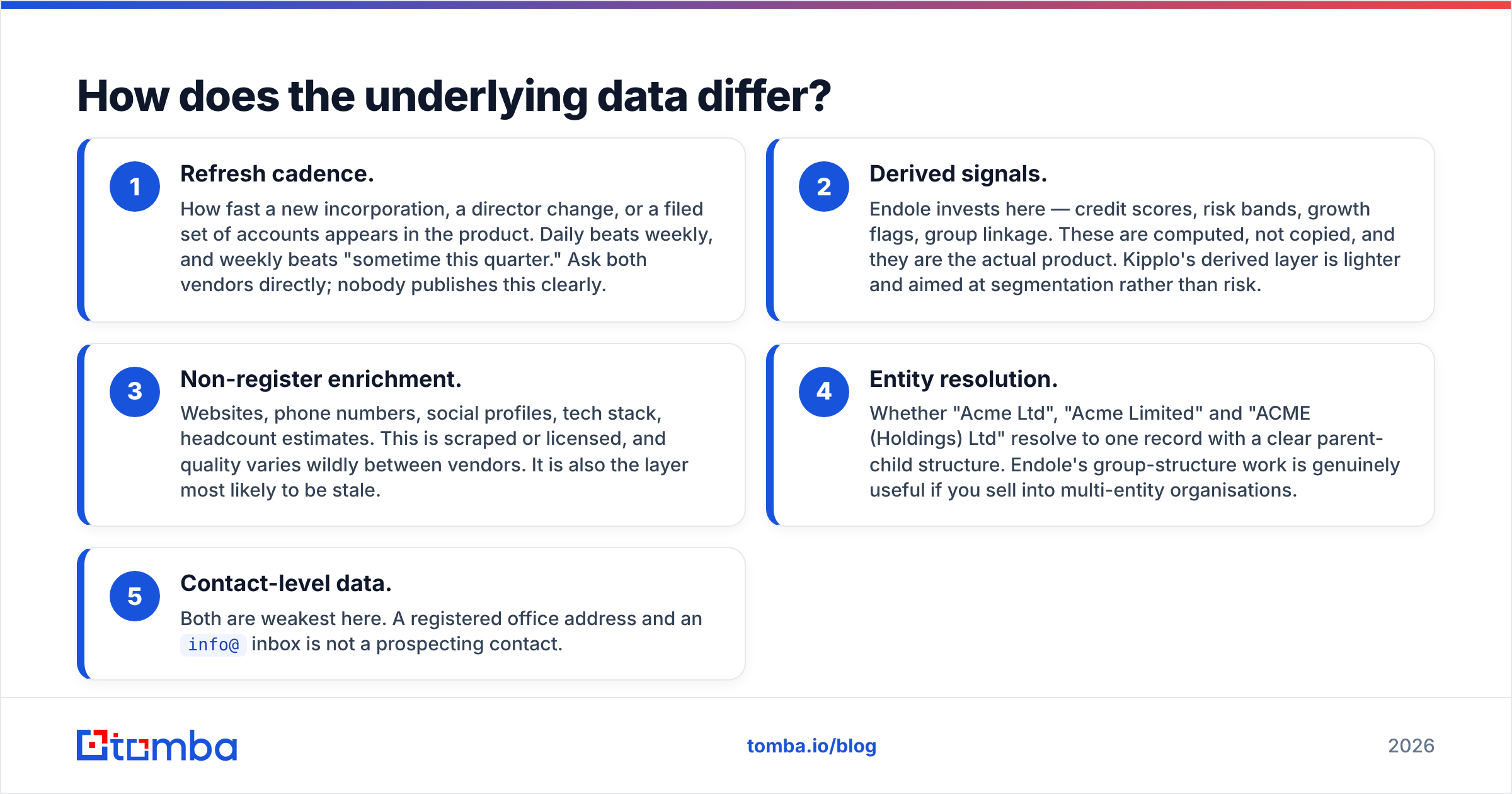
Companies House gives every UK provider the same raw material. Registration numbers, SIC codes, registered addresses, officer appointments, filing history, and accounts where a company files them. Five things separate the vendors.
Refresh cadence. How fast does a new incorporation, director change or filed account show up? Daily beats weekly. Weekly beats "sometime this quarter." Ask both vendors directly, because nobody publishes this clearly.
Derived signals. Endole invests here. Credit scores, risk bands, growth flags and group linkage are computed, not copied. That work is the actual product. Kipplo's derived layer is lighter and aimed at segmentation, not risk.
Non-register enrichment. Websites, phone numbers, social profiles, tech stack, headcount. This data is scraped or licensed, and quality varies a lot. It is also the layer most likely to be stale.
Entity resolution. Do "Acme Ltd", "Acme Limited" and "ACME (Holdings) Ltd" resolve to one record with a clear parent? Endole's group-structure work is useful if you sell into multi-entity firms.
Contact-level data. Both are weakest here. A registered office address and an
info@inbox is not a prospecting contact.
That last point quietly wrecks campaigns. You export 800 well-targeted UK companies. Then you find you have 800 company records and almost zero named humans to email.

Which one gives you better contact data?#
Neither, honestly. Plan for that instead of being surprised by it.
UK company registers must expose officers — directors and secretaries — plus a registered address. They are not required to expose work email addresses, and they never will. So any UK company-data tool that shows you an email is doing one of two things. It scraped a generic mailbox from the website, or it guessed a pattern that may not be verified.
Generic mailboxes have their place. They work for very small firms where the owner reads hello@. They fail once you target a 200-person business and need the Head of Operations by name.
The fix is to treat the two layers separately:
- Company layer — Endole or Kipplo tells you which businesses to chase, and why now.
- Person layer — a dedicated finder names the individual at that domain and confirms the address is deliverable.
A domain search does the work neither platform was built for. Feed it a company domain. Get back the named contacts and the firm's email pattern. Then run every result through an email verifier before it touches your sequence. Two API calls turn that 800-company export into an 800-prospect list.
Endole vs Kipplo: how do they compare head to head?#
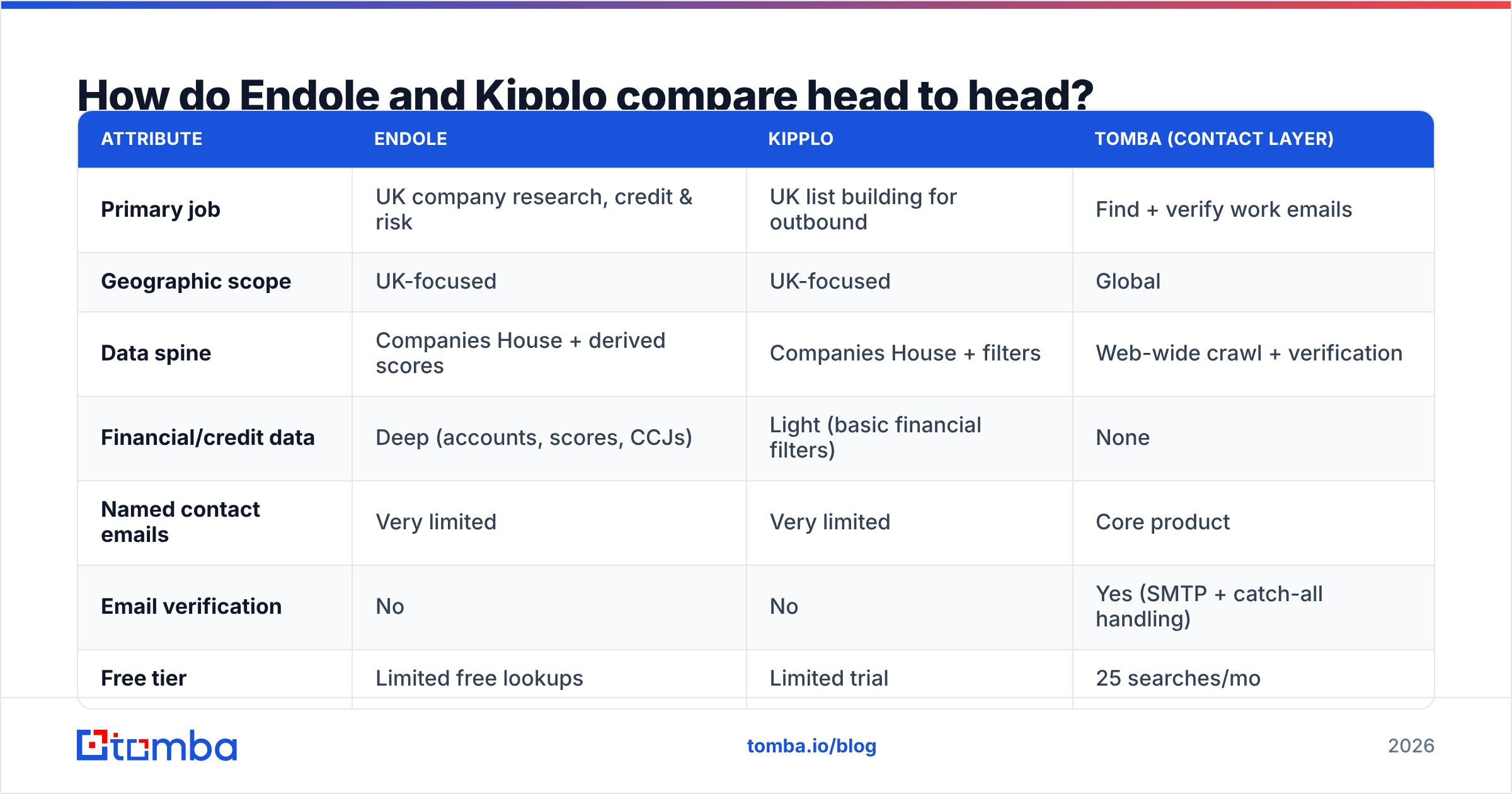
Pricing moves and is partly quote-based. Treat the figures below as directional, and check the vendor's own pricing page before you buy. Tomba sits in the table as the contact-layer reference point, not as a swap for company intelligence.
| Attribute | Endole | Kipplo | Tomba (contact layer) |
|---|---|---|---|
| Primary job | UK company research, credit & risk | UK list building for outbound | Find + verify work emails |
| Geographic scope | UK-focused | UK-focused | Global |
| Data spine | Companies House + derived scores | Companies House + filters | Web-wide crawl + verification |
| Financial/credit data | Deep (accounts, scores, CCJs) | Light (basic financial filters) | None |
| Named contact emails | Very limited | Very limited | Core product |
| Email verification | No | No | Yes (SMTP + catch-all handling) |
| Free tier | Limited free lookups | Limited trial | 25 searches/mo |
| Entry paid price | Low-to-mid two figures/mo | Lower than Endole | $49/mo Starter |
| Mid tier | Mid three figures/mo (business plans) | Mid two-to-three figures/mo | $99/mo Growth |
| API access | Available (enterprise-leaning) | Limited | Yes, on all paid tiers |
| Bulk export | Yes, credit/plan limited | Yes | Yes, bulk finder + verifier |
| Best for | Due diligence, credit teams, ABM research | SMB list building, agencies | Turning companies into contactable people |
Two things stand out. First, the two UK tools overlap far less than the 'vs' framing implies. A credit analyst would never pick Kipplo. A two-rep agency rarely needs Endole's risk depth. Second, the contact column is empty on both sides. That is why so many teams run one of these alongside a finder, not instead of one.
For outside views, G2 is the usual first stop. Category coverage for UK-specific data tools is thin, so read the review counts before you trust the scores.
Is Endole better than Kipplo for UK prospecting?#
It depends on whether you qualify on financial signals or firmographic ones.
Choose Endole if:
- You sell something where the buyer's solvency matters: finance, insurance, leasing, large-contract services, factoring.
- Your triggers are filing events. Newly filed accounts, a jump in turnover, a new director, a change of registered office.
- You need to map group structures before an ABM push into a parent company.
- You need defensible data for a credit or compliance decision, not just a list.
Choose Kipplo if:
- You need volume lists quickly, and you qualify mostly on SIC code, region and size.
- You are an agency or small team, and the Endole subscription is hard to justify per seat.
- Your outbound is high-volume and you qualify on reply, not before send.
- You want a simpler UI and a shorter path from filter to CSV.
Choose neither as your whole stack if:
- You sell outside the UK. Both are UK-first by design, so a global ICP hits the coverage cliff fast.
- Your real bottleneck is contactability rather than targeting.
What do both tools leave on the table?#
Four gaps, roughly in order of what they cost you.
1. The person layer. Already covered, but worth repeating, because it is the expensive one. A company list with no named contacts is a research artefact, not a pipeline.
2. Deliverability hygiene. Company records go stale quietly. A director resigns. A firm rebrands. A domain moves. Neither platform checks whether an address built from their data still accepts mail. Unverified sends push bounce rates up. Cross roughly 3% bounce on a domain, and mailbox providers throttle everything you send, including your good mail.
3. Non-registered businesses. Sole traders, partnerships and unincorporated firms do not file at Companies House. If much of your ICP is non-registered, both tools have a structural blind spot.
4. Workflow integration. Exporting CSVs and re-importing them into a CRM is where lists go to die. Check which native integrations exist before you assume the data will flow. A proper API skips the spreadsheet round-trip.

How do you build a stack that actually converts?#
Here is the sequence that works, whichever UK platform you pick.
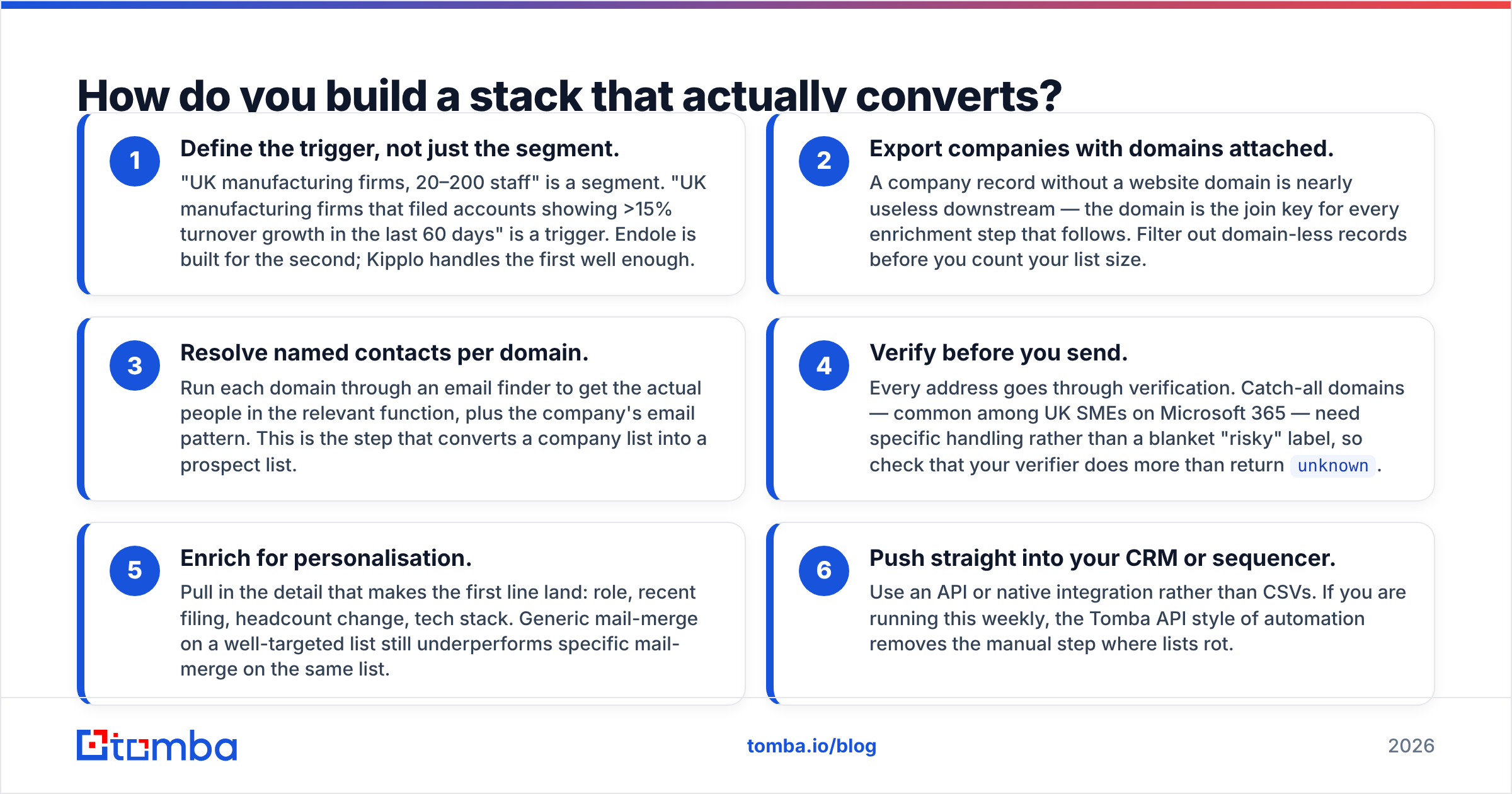
Define the trigger, not just the segment. "UK manufacturing firms, 20–200 staff" is a segment. "UK manufacturers that filed 15% turnover growth in the last 60 days" is a trigger. Endole is built for the second. Kipplo handles the first.
Export companies with domains attached. The domain is the join key for every enrichment step that follows. Drop domain-less records before you count your list size.
Resolve named contacts per domain. Run each domain through an email finder to get the right people plus the firm's email pattern. This turns a company list into a prospect list.
Verify before you send. Every address goes through verification. Catch-all domains are common among UK SMEs on Microsoft 365, so check that your verifier does more than return
unknown.Enrich for personalisation. Pull the detail that makes the first line land: role, recent filing, headcount change, tech stack.
Push straight into your CRM or sequencer. Use an API or native integration instead of CSVs. If you run this weekly, the Tomba API style of automation removes the step where lists rot.
Teams that skip steps 3 and 4 conclude that UK data does not work. The data is usually fine. The contact layer was never built.
What does this cost in practice?#
Budget for two line items, not one.
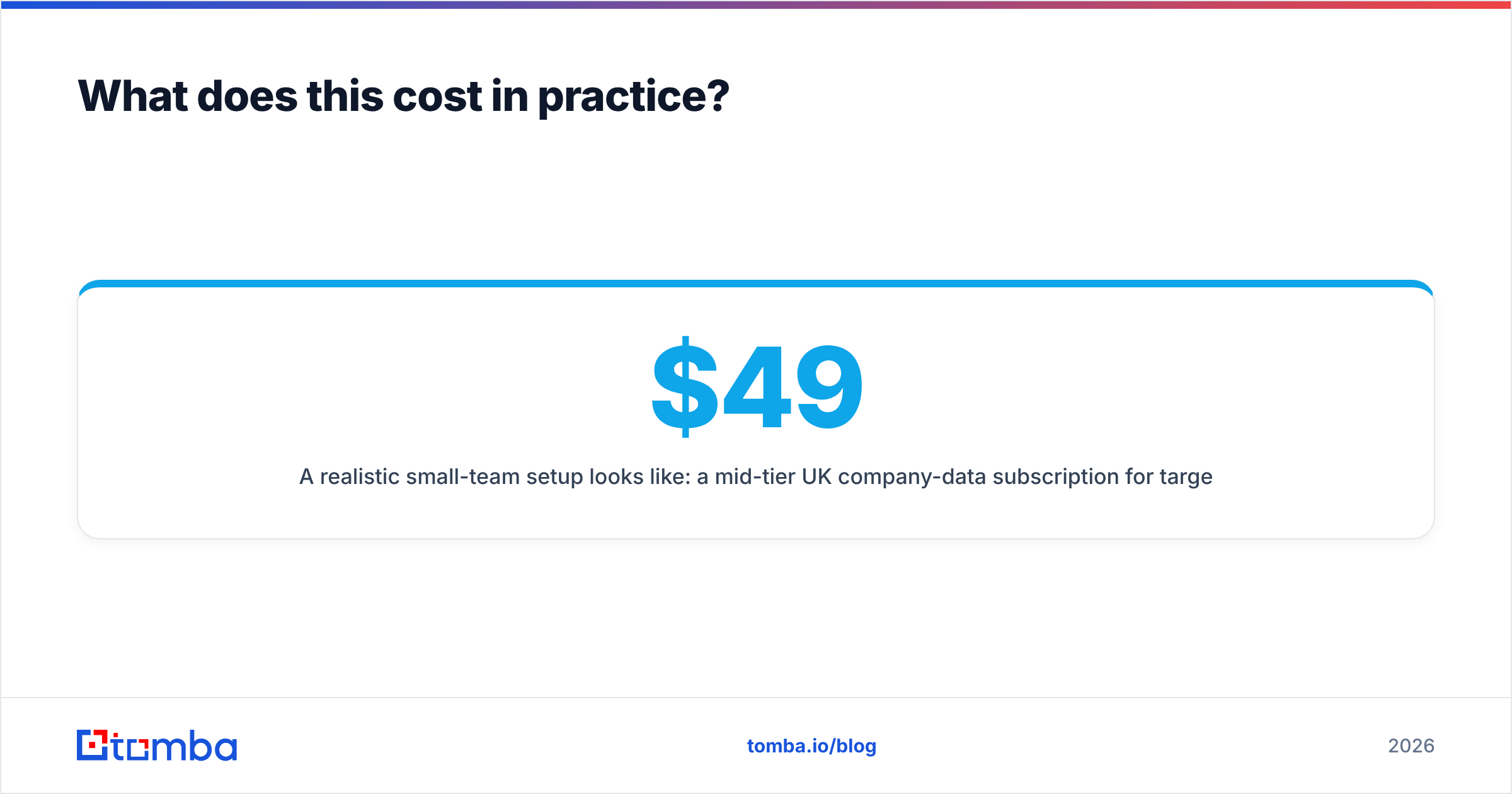
A realistic small-team setup pairs a mid-tier UK company-data plan for targeting with a contact-finding tool for the person layer. On the contact side, the Tomba pricing ladder runs a free tier at 25 searches/mo, Starter at $49/mo, Growth at $99/mo, Pro at $249/mo, and custom Enterprise. So the person layer usually costs less than the company-intelligence layer, not more.
Running fewer than a few hundred prospects a month? Start on the free tier of both, then upgrade whichever side runs out of credits first. That tells you where the real bottleneck sits, far better than a feature matrix does.
Which should you pick?#
| Your situation | Pick |
|---|---|
| Credit risk, due diligence, group mapping | Endole |
| Fast UK list building on a small budget | Kipplo |
| Financial-trigger-based outbound | Endole + a contact finder |
| High-volume UK SMB outbound | Kipplo + a contact finder |
| Any ICP outside the UK | Neither — use a global data source |
| Bottleneck is bounces, not targeting | Fix verification first |
The honest verdict on Endole vs Kipplo: no single tool wins. Endole wins on depth. Kipplo wins on speed and price. Both lose the moment you need a named human's inbox — and every outbound campaign reaches that moment.
Pick the company layer that matches how you qualify. Then close the contact gap on purpose. Tomba's Email Finder takes the domains from either export and returns verified, named work emails with confidence scores, through the UI, bulk upload, or API. So the list you spent an afternoon building actually reaches somebody. Start free with 25 searches a month and test it against your last export.
Related guides#
Ready to find emails that actually work?
Join 150,000+ professionals who stopped guessing and started sending. Free credits on signup — no credit card required.
Get the Tomba newsletter
Practical outbound tactics and product updates — once every two weeks.
About the author