Endole vs Lead411 (2026): UK Company Data vs US Sales Intel
Endole maps UK company filings and financial risk. Lead411 sells US contact records with intent signals. They barely overlap — here is which one your pipeline actually needs, and where a dedicated email finder beats both.
TL;DR
- Endole and Lead411 are not really competitors. Endole is a UK company-intelligence platform built on Companies House filings, credit scores and ownership structures. Lead411 is a US-centric B2B contact database with verified emails, direct dials and Bombora intent data.
- Pick Endole if your ICP is UK limited companies and you need financial health, directorships, group structures or credit risk before you sell.
- Pick Lead411 if you need named contacts, mobile numbers and buying-intent signals for North American outbound at scale.
- Neither is a great pure email finder. Endole rarely surfaces personal work emails at all; Lead411 charges per seat whether or not you use the volume.
- The cheapest working stack for most teams is a company-data source (Endole or Companies House) plus a dedicated, pay-for-what-you-use email finder for the contact layer.
What is Endole, and who actually uses it?#
Endole is a UK business intelligence platform. Its core dataset is public: every limited company registered at Companies House, plus filed accounts, charges, directorships, shareholdings and group hierarchies. Endole's job is to make that mess usable — it normalises filings, derives financial ratios, builds credit scores, links directors across companies, and exposes the whole thing through a searchable interface called Endole Explorer and a set of report products.
The typical Endole user is not an SDR. It is:
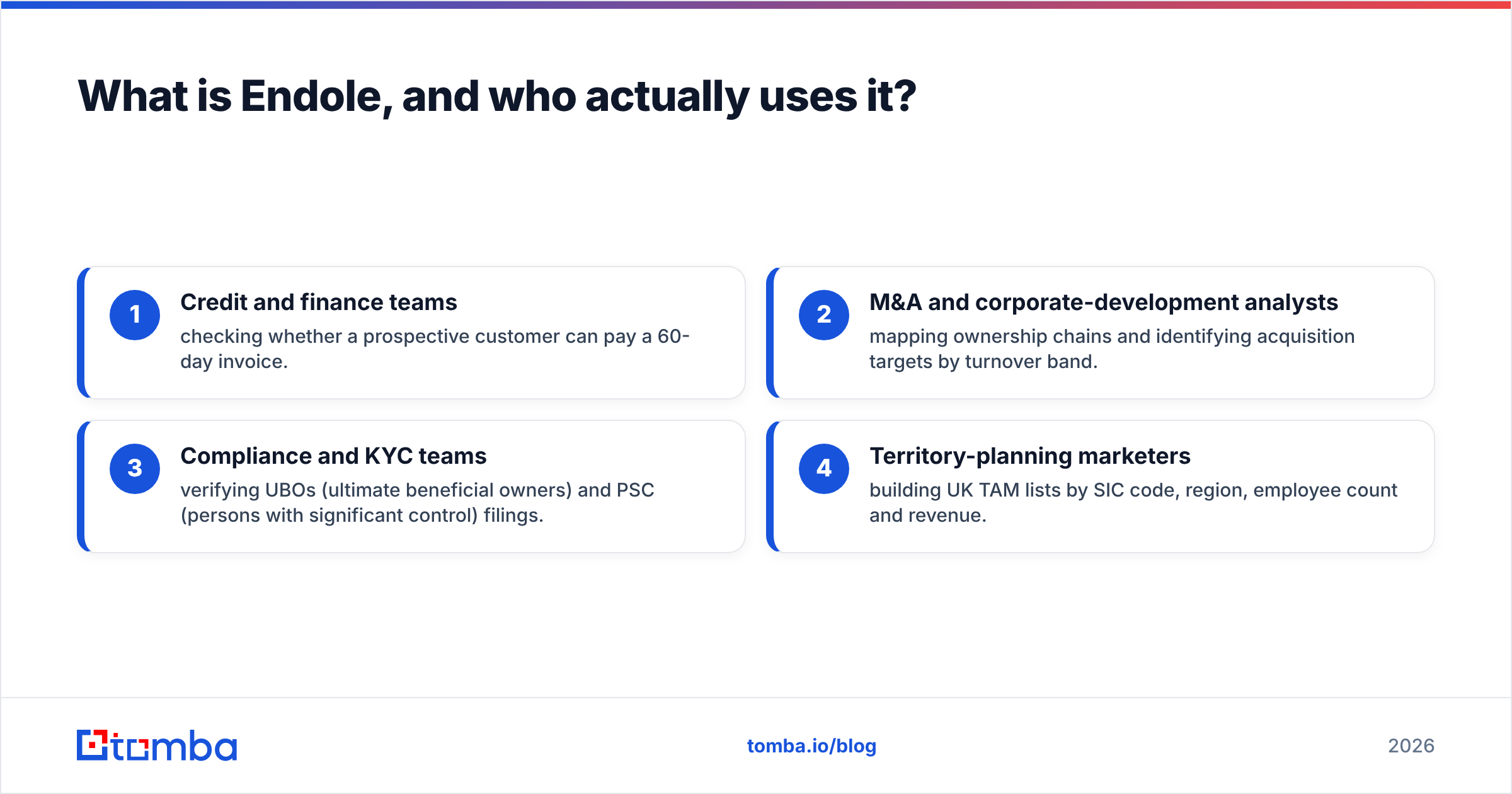
- Credit and finance teams checking whether a prospective customer can pay a 60-day invoice.
- M&A and corporate-development analysts mapping ownership chains and identifying acquisition targets by turnover band.
- Compliance and KYC teams verifying UBOs (ultimate beneficial owners) and PSC (persons with significant control) filings.
- Territory-planning marketers building UK TAM lists by SIC code, region, employee count and revenue.
What Endole is genuinely good at is depth on UK entities. If you want every construction firm in Yorkshire with turnover between £2m and £10m, filed accounts within the last 14 months, and no outstanding county court judgments, Endole will produce that list. That is a hard query to run anywhere else without paying enterprise money.
What Endole does not do well is give you a person to email. You'll get director names and a registered office address. You will not reliably get firstname.lastname@company.co.uk, and you will almost never get a mobile number. That gap is the whole reason this comparison exists.

What is Lead411, and how is it different?#
Lead411 is a B2B sales intelligence platform in the same broad category as ZoomInfo, Apollo and Cognism. Its pitch is contact data: verified business emails, direct-dial and mobile numbers, org charts, technographics, and growth/intent triggers.
Three things define Lead411's positioning:
- "Unlimited" data on its headline plan. Lead411's Basic Plus Unlimited plan advertises unlimited email views with a capped monthly export allowance — historically in the low hundreds of exports per user per month, with add-on packs above that. Read the export cap carefully; "unlimited" refers to viewing, not downloading.
- Bombora-powered intent. Higher tiers layer third-party intent topics on top of the contact record, so you can filter accounts researching your category this week.
- Growth triggers. Funding rounds, hiring spikes, executive changes, IPO filings — packaged as alerts you can route to a sequence.
Its data centre of gravity is North America. Coverage of UK SMEs, and especially of the sub-50-employee limited companies that dominate Endole's index, thins out fast. Reviewers on G2 consistently praise Lead411's direct dials and pricing versus ZoomInfo while flagging non-US coverage and CRM sync friction as weak spots.
Endole vs Lead411: how do they compare head to head?#
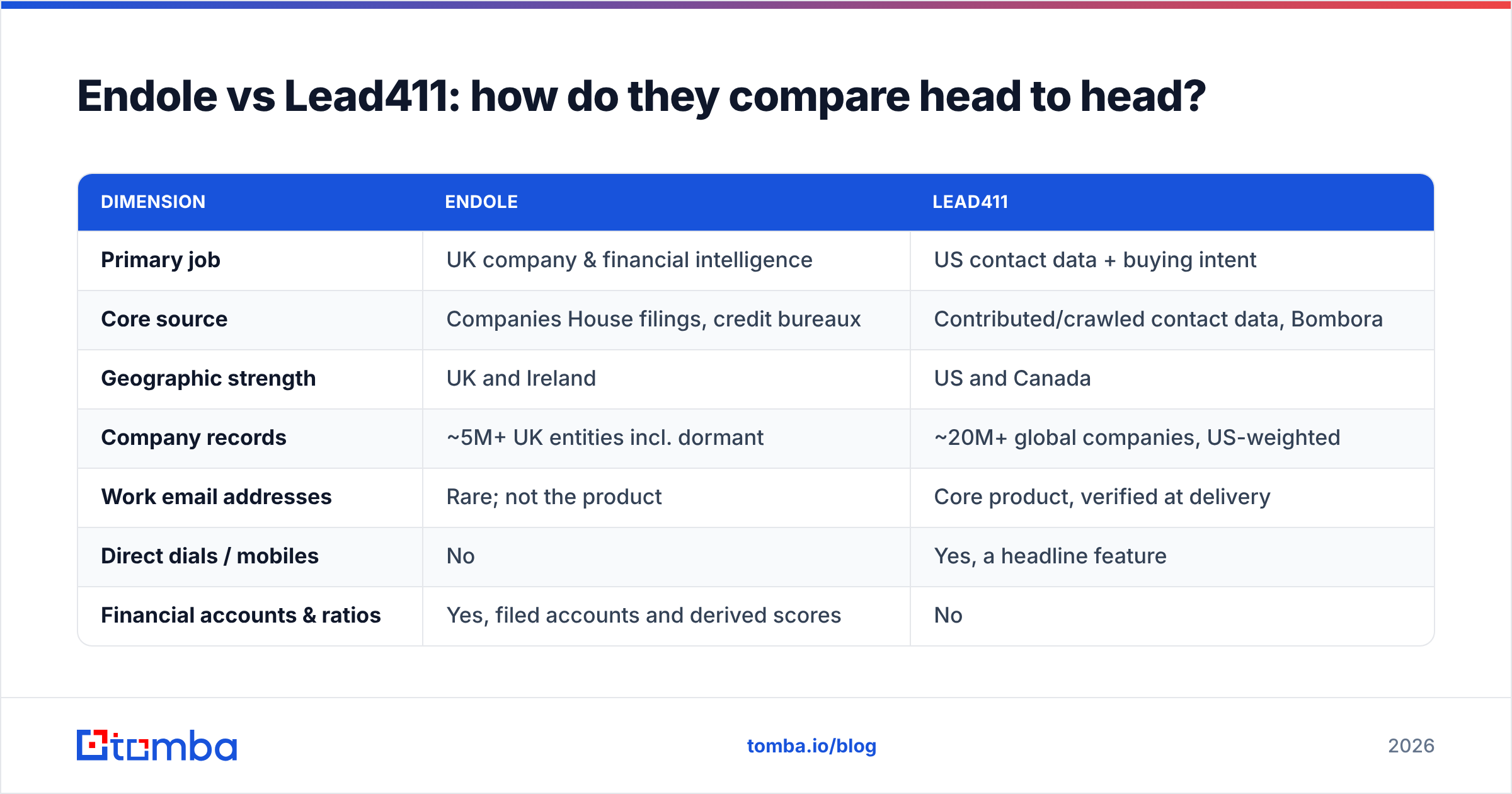
Here is the practical comparison. Treat pricing as directional — both vendors quote per-seat and per-package deals that move, so confirm on their own pages before you budget.
| Dimension | Endole | Lead411 |
|---|---|---|
| Primary job | UK company & financial intelligence | US contact data + buying intent |
| Core source | Companies House filings, credit bureaux | Contributed/crawled contact data, Bombora |
| Geographic strength | UK and Ireland | US and Canada |
| Company records | ~5M+ UK entities incl. dormant | ~20M+ global companies, US-weighted |
| Work email addresses | Rare; not the product | Core product, verified at delivery |
| Direct dials / mobiles | No | Yes, a headline feature |
| Financial accounts & ratios | Yes, filed accounts and derived scores | No |
| Credit risk score | Yes | No |
| Directors, PSCs, group structure | Yes, deep | Shallow (exec titles only) |
| Buying-intent signals | No | Yes (Bombora topics on higher tiers) |
| Pricing model | Report credits + Explorer subscription | Per-seat annual, export caps per seat |
| Entry cost | Low tens of £/month; pay-per-report available | ~$99/user/mo billed annually, typical |
| Free option | Free company profile pages on the web | Free trial with limited exports |
| API | Yes, commercial | Yes, on higher tiers |
| Best for | Credit, KYC, M&A, UK TAM sizing | US outbound prospecting at volume |
The table makes the real answer obvious: these tools sit at different points in the same funnel. Endole tells you which companies are worth approaching and whether they can pay. Lead411 tells you which human to call and when they're in-market. A UK enterprise sales team doing both jobs properly would need something from each column — or a third approach we'll get to.
Which one wins on data accuracy?#
Accuracy means different things for each tool, so a single winner is misleading.
Endole's accuracy is inherited. Its company data is as accurate as Companies House, which is to say: structurally reliable, temporally lagging. Small UK companies can file abridged accounts up to nine months after year-end, so a "current" turnover figure may describe a business as it was 18 months ago. Endole is transparent about filing dates — use them. Credit scores are modelled, which means they're opinions, not facts, and they can lag a sudden collapse or recovery.
Lead411's accuracy is operational. Contact data decays roughly 2–3% per month as people change jobs; that's the industry baseline everyone in this category fights. Lead411 verifies emails at delivery, which helps, but exported records still age in your CRM from day one. The failure mode is different from Endole's: not stale financials, but a bounced send and a hit to sender reputation.
That second failure mode is the expensive one. A wrong revenue band costs you a badly prioritised account. A 12% bounce rate costs you the domain. If you're pulling contact data from any vendor — Lead411 included — run it through an email verifier before it touches a sequence, especially for records that have been sitting in a saved list for more than a month.
What does each one cost in practice?#
Endole and Lead411 charge on incompatible axes, which makes direct comparison awkward. Endole is essentially consumption-priced: an Explorer subscription for search and monitoring, plus credits for detailed reports. A single analyst doing occasional due-diligence work can run Endole for the price of a team lunch. A marketing team exporting tens of thousands of UK company records will pay a lot more, and will need a data licence conversation.
Lead411 is seat-priced with a volume cap. You commit annually per user, get an export allowance, and buy add-on credit packs when you blow through it. Cost per seat is meaningfully below ZoomInfo, which is Lead411's main commercial argument — but it's still a fixed cost per rep, whether that rep exports 400 contacts or four.
That distinction matters most for small teams and for spiky workloads. Consider three scenarios:
- A 2-person UK finance team running 30 credit checks a month: Endole, cheap, done. Lead411 solves nothing here.
- A 10-rep US outbound team running 3,000 contacts a month: Lead411's per-seat model is defensible, and the intent layer earns its keep if you actually route on it.
- A 3-person founder-led team selling into UK SMEs: neither model fits well. You need a few hundred verified emails a month against companies you've already qualified — and paying 10 seats' worth of platform to get them is absurd.
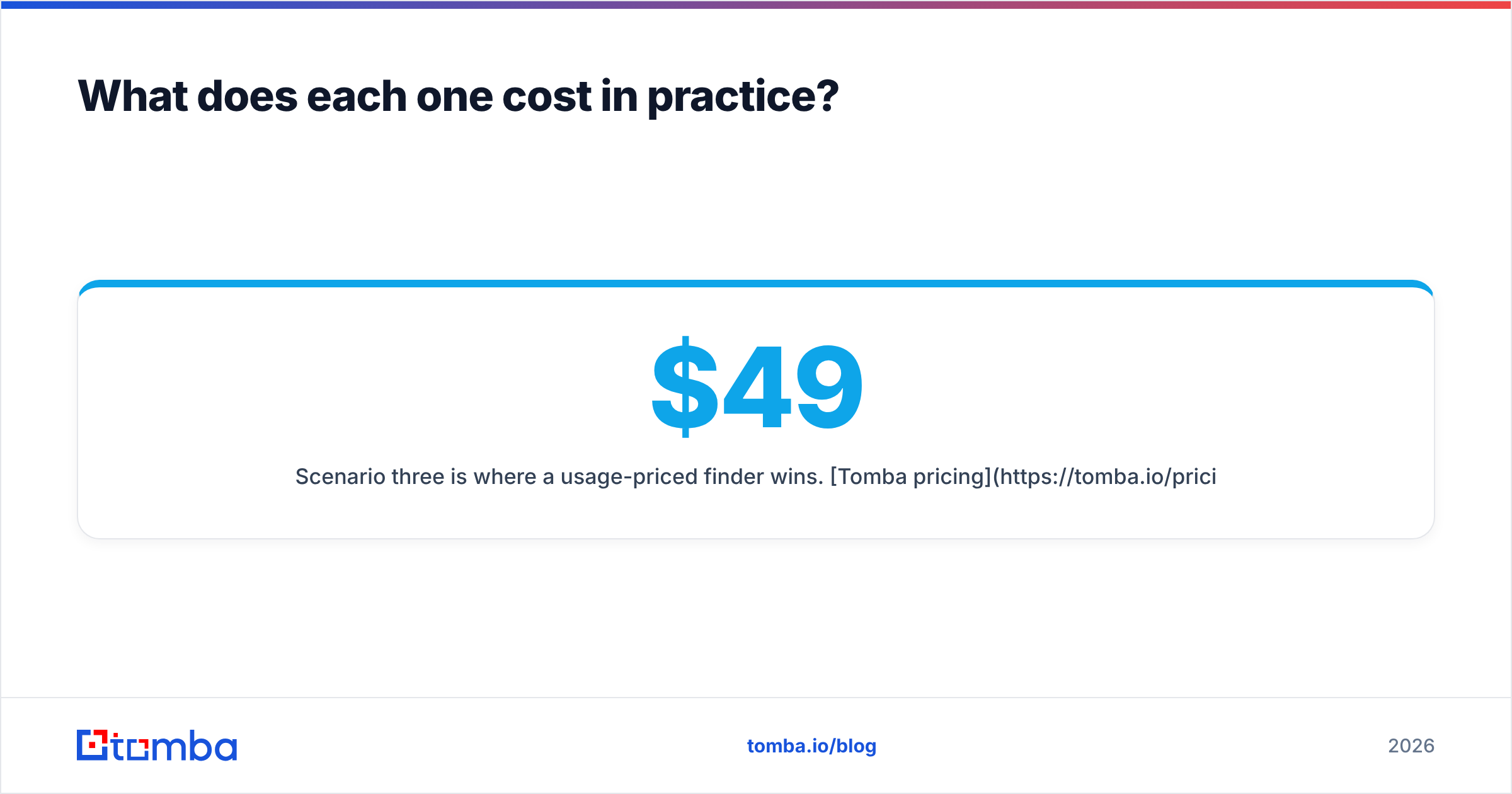
Scenario three is where a usage-priced finder wins. Tomba pricing starts free at 25 searches a month, then $49/mo for Starter, $99/mo for Growth and $249/mo for Pro — priced on searches, not headcount, so a two-person team and a ten-person team pay the same for the same volume.

Can you use Endole and an email finder instead of Lead411?#
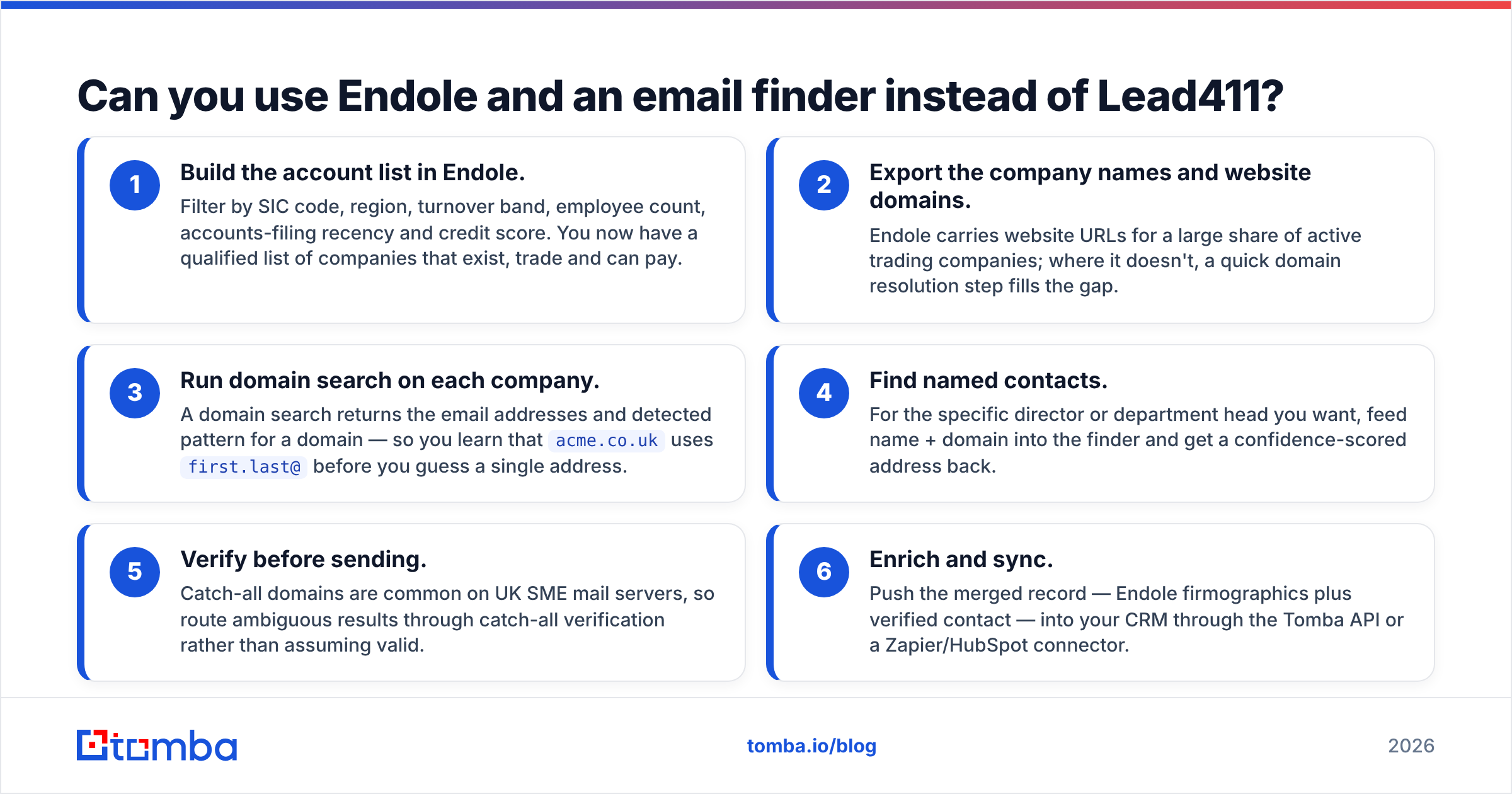
Yes, and for UK-focused teams this is frequently the better stack. The workflow:
- Build the account list in Endole. Filter by SIC code, region, turnover band, employee count, accounts-filing recency and credit score. You now have a qualified list of companies that exist, trade and can pay.
- Export the company names and website domains. Endole carries website URLs for a large share of active trading companies; where it doesn't, a quick domain resolution step fills the gap.
- Run domain search on each company. A domain search returns the email addresses and detected pattern for a domain — so you learn that
acme.co.ukusesfirst.last@before you guess a single address. - Find named contacts. For the specific director or department head you want, feed name + domain into the finder and get a confidence-scored address back.
- Verify before sending. Catch-all domains are common on UK SME mail servers, so route ambiguous results through catch-all verification rather than assuming valid.
- Enrich and sync. Push the merged record — Endole firmographics plus verified contact — into your CRM through the Tomba API or a Zapier/HubSpot connector.
This stack costs less than a single Lead411 seat for most UK SMB use cases, and the company qualification is better because it's grounded in filed accounts rather than modelled firmographics. What you give up is intent data and direct dials. If those two things drive your motion, Lead411 is genuinely hard to replicate cheaply — Bombora topic data is not something you can bolt on for $49.
Which should you choose in 2026?#
Here's the decision in plain terms.
Choose Endole if: your ICP is UK limited companies; you need credit risk, filed financials, group structure or PSC data; your buyers are finance, compliance, insolvency, M&A or UK territory planners; you'd rather pay per report than per seat.
Choose Lead411 if: your ICP is North American; you need mobile numbers as much as emails; you want intent and growth triggers built into the prospecting UI rather than bolted on; you have enough reps that per-seat pricing amortises; you're actively shopping a cheaper ZoomInfo replacement.
Choose neither — or supplement both — if: you need contact data in variable volume, across mixed geographies, without a per-seat commitment. That's the gap dedicated finders fill, and it's why plenty of teams run Lead411 for the US and a usage-priced finder for everything else, or run Endole for qualification and a finder for the contact layer.
One honest caveat on all three paths: no vendor's coverage is uniform. Test on your ICP before you sign anything. Take 100 real target accounts, run them through each tool's trial, and measure hit rate and bounce rate — not the vendor's published database size, which tells you nothing about your specific segment. If you're evaluating alternatives more broadly, comparison pages like Capterra's sales intelligence category are useful for shortlisting, but they are no substitute for a 100-account bake-off.
It's also worth checking what each platform does with UK data specifically. Endole's own company search is free to browse at the profile level, so you can sanity-check coverage on a dozen target accounts in ten minutes without talking to sales. Very few vendors in this category let you do that.
Start with the contact layer#
If your bottleneck is company qualification, Endole solves it. If your bottleneck is US contact volume with intent, Lead411 solves it. But if the actual problem is that you have a good account list and no reliable way to reach the people on it, neither one is the efficient answer.
The Tomba Email Finder handles that layer directly: give it a name and domain, or just a domain, and get confidence-scored professional addresses back, with verification and catch-all handling in the same workflow. Start on the free tier at 25 searches a month to test hit rate against your own target list, and move to Starter at $49/mo when the numbers hold up. No per-seat contract, no annual commitment, and no paying for intent topics you were never going to route on.
Related guides#
Ready to find emails that actually work?
Join 150,000+ professionals who stopped guessing and started sending. Free credits on signup — no credit card required.
Get the Tomba newsletter
Practical outbound tactics and product updates — once every two weeks.
About the author