Endole vs Pubrio (2026): Which B2B Data Platform Wins?
Endole vs Pubrio, compared. Endole reads UK company filings. Pubrio finds global buyers and contacts. Here is which one belongs in your 2026 stack, and the gap both of them leave open.

Endole vs Pubrio is a fair matchup to test, but the two tools do different jobs. Endole reads UK filings. Pubrio hunts buyers and contacts across the globe. Here is how to pick.
TL;DR
- Endole is a UK company data tool. It sits on Companies House filings, accounts, directors and credit scores. It suits credit, risk, finance and UK-only research. It is not built for a global sales team.
- Pubrio is an AI sales data tool. You get contact records, company search, buying signals and AI list building. It aims at outbound revenue teams.
- They barely overlap. The real endole vs pubrio question is simple. Do you need to vet a UK company, or reach a person inside it?
- Both leave the same hole. Neither hands you a proven work email for the exact person you picked. Endole rarely gives one at all. Pubrio gives one you must still check.
- A 2026 stack needs layers. Pick one tool for research. Endole for UK depth, Pubrio for global signals. Then run the short list through a finder and a verifier.
Endole vs Pubrio: what are these two tools?#
Both sell B2B company data, so they land on the same short list. That label hides two very different products.
Endole is a UK business data service. Its raw material is the public register. That means accounts, charges, directors, group trees and filing history from Companies House. Endole adds credit scores, revenue estimates, industry codes and a search tool for UK lists. Did Acme Ltd file late? Who signs for it? Is £50k of credit sane? Endole answers that in a few clicks.
Pubrio is newer and AI-first. It runs the other way round. You describe your ideal customer. The tool finds matching firms across the globe. It layers on intent and tech signals. Then it hands reps contact records and draft outreach. It is a prospecting engine, not a filing archive.
So the honest framing of endole vs pubrio is this. Deep records in one country, or wide reach and buying signals in many. Do not choose on price alone. You may end up buying the wrong type of tool.
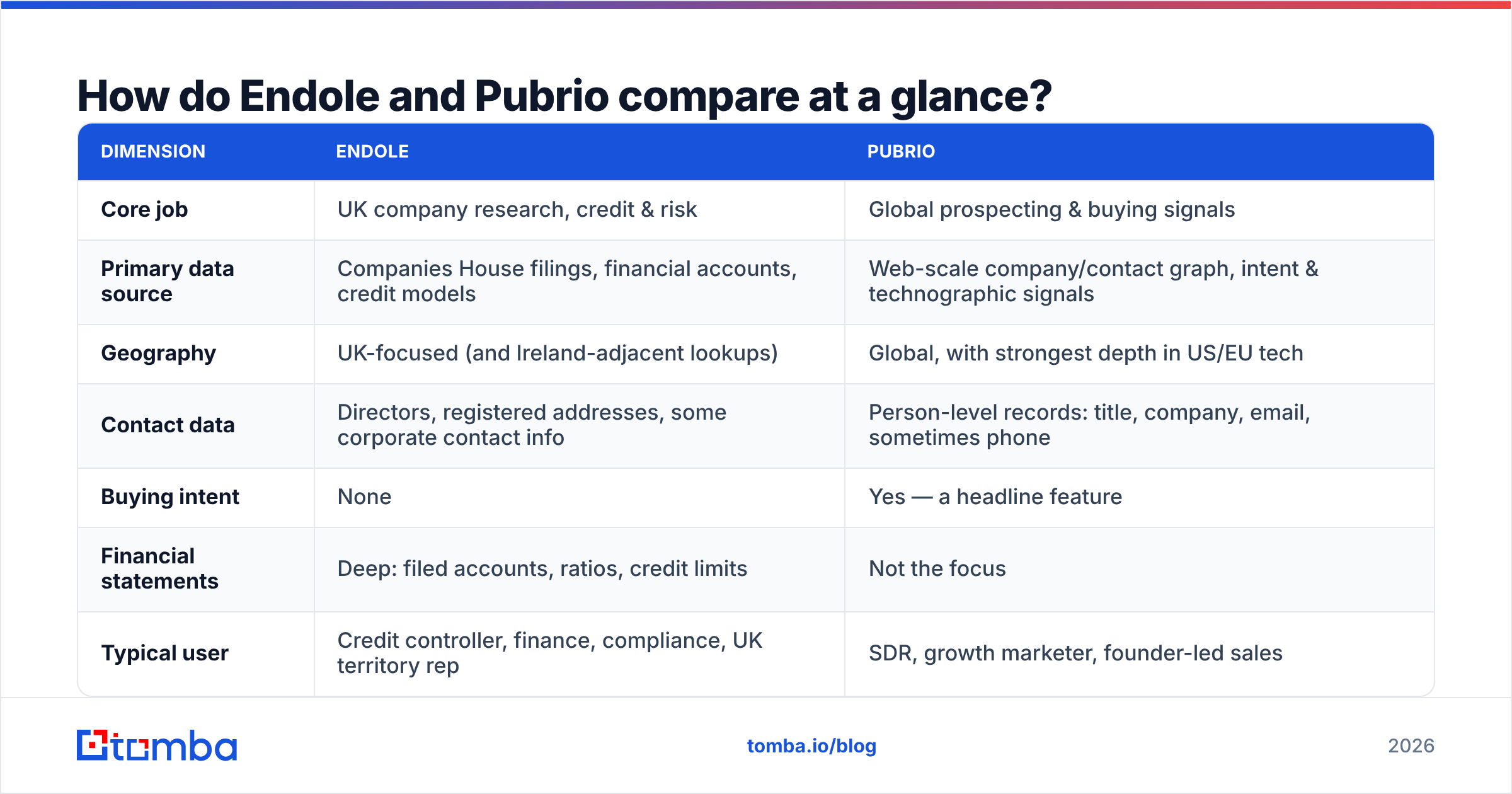
Endole vs Pubrio at a glance#
| Dimension | Endole | Pubrio |
|---|---|---|
| Core job | UK company research, credit & risk | Global prospecting & buying signals |
| Primary data source | Companies House filings, financial accounts, credit models | Web-scale company/contact graph, intent & technographic signals |
| Geography | UK-focused (and Ireland-adjacent lookups) | Global, with strongest depth in US/EU tech |
| Contact data | Directors, registered addresses, some corporate contact info | Person-level records: title, company, email, sometimes phone |
| Buying intent | None | Yes — a headline feature |
| Financial statements | Deep: filed accounts, ratios, credit limits | Not the focus |
| Typical user | Credit controller, finance, compliance, UK territory rep | SDR, growth marketer, founder-led sales |
| List building | Filter UK universe by SIC, size, region, financials | Filter global universe by ICP, tech stack, intent |
| API access | Available on higher tiers | Available on higher tiers |
| Email verification | Not a core function | Some validation, quality varies by domain |
Do both columns look useful? That is a real signal. Plenty of teams buy one of each. They stop pretending that a single vendor covers both jobs.
What is Endole best at?#
Endole wins on proof. Every number traces back to a filed document. A risk officer will ask where a figure came from. You point at an account filed on a set date, not at a model guess.
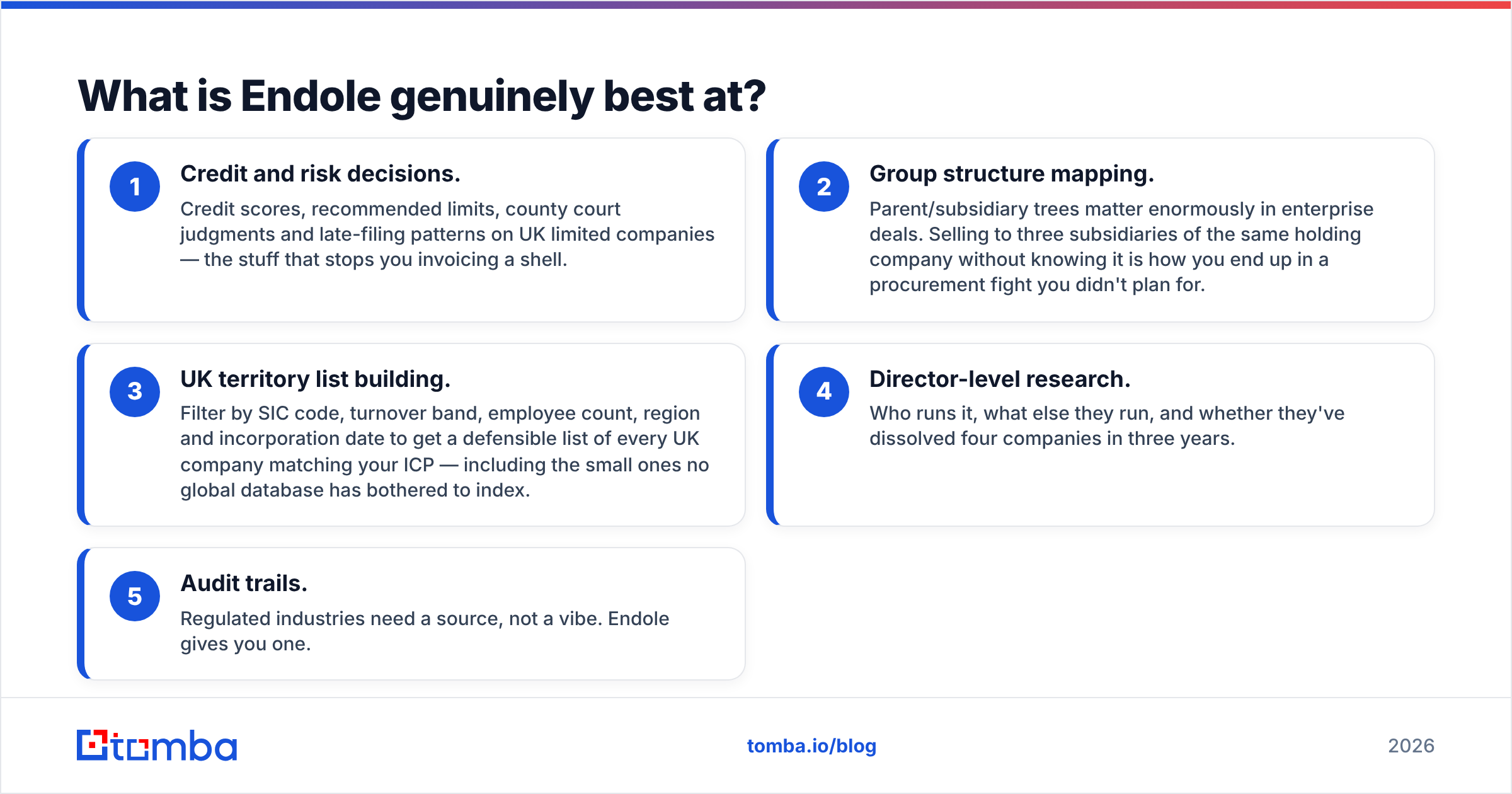
Endole earns its seat when you need these five things:
- Credit and risk calls. Credit scores, safe limits, court judgments and late filing habits on UK firms. This is the data that stops you invoicing a shell.
- Group structure maps. Parent and subsidiary trees matter in big deals. Sell to three arms of one group by mistake, and you land in a hard procurement fight.
- UK list building. Filter by SIC code, turnover, staff count, region and start date. You get a solid list of every UK firm that fits your ICP. Even the tiny ones show up.
- Director research. Who runs it? What else do they run? Have they closed four firms in three years?
- Audit trails. Rules-heavy teams need a source, not a hunch. Endole gives them one.
Endole will not tell you that the head of RevOps just started to shop your category. It has no view on buying intent. It will not hand you a work email for a mid-level manager. It is a register, and registers do not list firstname.lastname@.
What is Pubrio best at?#
Pubrio wins on speed. It is built for the rep who must build a list at 9am and send by 2pm.
Users on review sites such as G2 point to these strong points:
- ICP search. Describe the buyer instead of hand-building filters. The tool returns matching accounts.
- Signal layers. Intent topics, hiring news and tech checks cut 10,000 firms down to a few hundred.
- Person records. Job title, level, team and contact details. The list you export is one you can act on.
- AI drafts. The tool writes a first pass from the record. Useful as a start. Risky if you send it as is.
- Browser flow. Grab a contact while you view a company page. No need to switch tabs.
The trade-offs are the usual ones for this class of tool. Intent data is a guess with odds attached. It shows that a firm looked around. It does not prove your buyer did. Contact cover is patchy outside the US and Western Europe. Email accuracy also drifts. Records rot by 2 to 3% each month as people change jobs. No vendor rechecks a whole database that often.
That last point costs real money. Stale records turn into bounces. Bounces then hurt your sender score.
Endole vs Pubrio pricing: what does each one cost?#
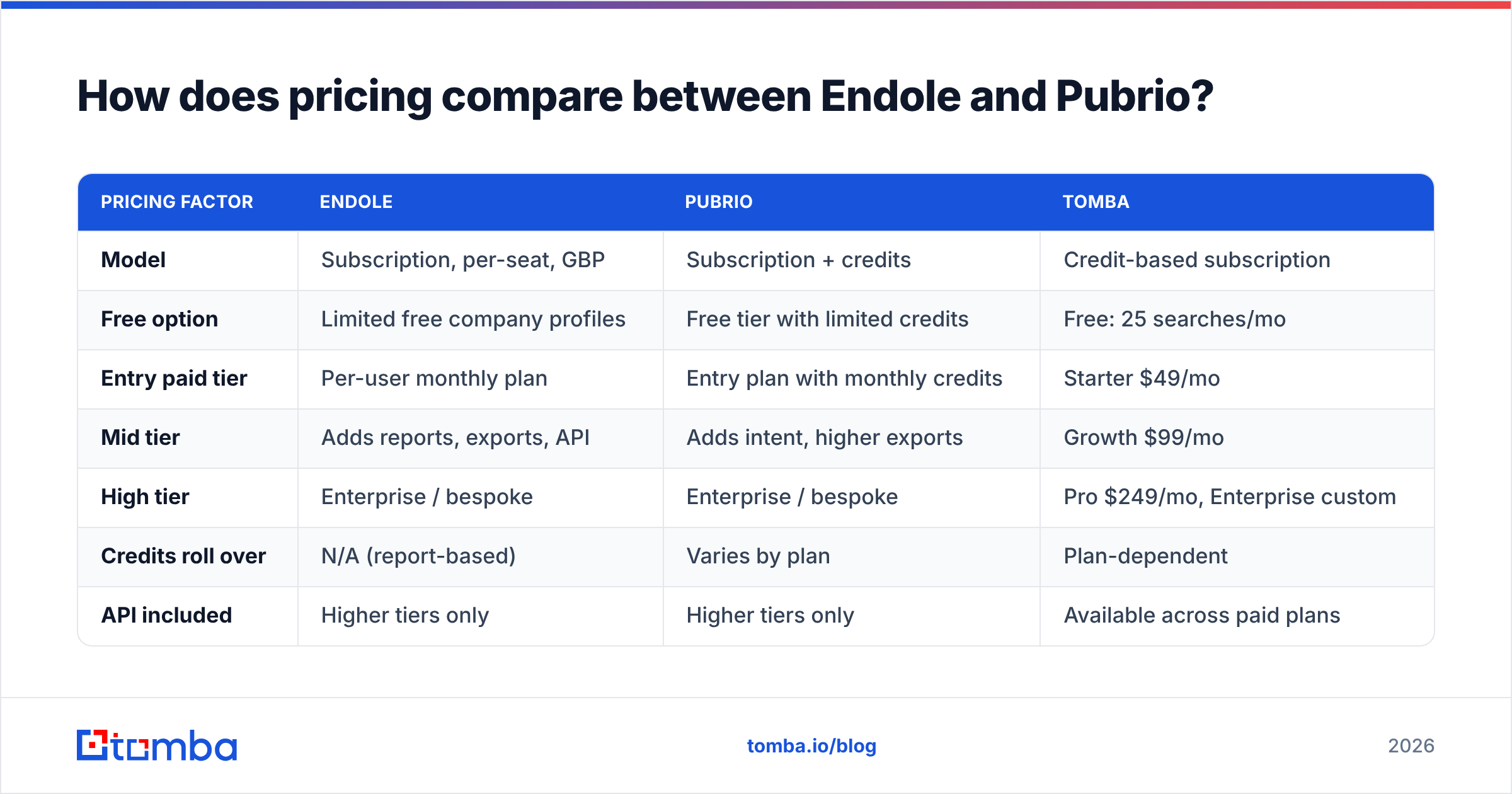
Endole vs Pubrio pricing is hard to pin down. Both vendors change plans more often than blog posts get updated. So here is the shape of each plan, not numbers that go stale in a quarter. Check each vendor page before you set a budget.
| Pricing factor | Endole | Pubrio | Tomba |
|---|---|---|---|
| Model | Subscription, per-seat, GBP | Subscription + credits | Credit-based subscription |
| Free option | Limited free company profiles | Free tier with limited credits | Free: 25 searches/mo |
| Entry paid tier | Per-user monthly plan | Entry plan with monthly credits | Starter $49/mo |
| Mid tier | Adds reports, exports, API | Adds intent, higher exports | Growth $99/mo |
| High tier | Enterprise / bespoke | Enterprise / bespoke | Pro $249/mo, Enterprise custom |
| Credits roll over | N/A (report-based) | Varies by plan | Plan-dependent |
| API included | Higher tiers only | Higher tiers only | Available across paid plans |
| Currency | GBP | USD | USD |
Two things to watch in a deal:
Seats or credits. Endole charges per seat. That punishes wide, light use. Five people with three lookups a month still cost you five seats. Pubrio charges credits. That punishes deep exports. One power user can drain a team budget in an afternoon. Model your real usage before you sign for a year.
The bounce tax. No vendor puts this on a price page. Say 12% of your exported emails bounce, and you send 5,000 a month. That is 600 wasted sends. The harm to your inbox rate costs far more than the credits. So compare tools on usable records, not on exported records. Our full Tomba pricing page uses the same logic.
Which one has better contact data for cold email?#
Pubrio, clearly. But read the asterisk first.
On contact data, the endole vs pubrio gap is wide. Endole is not really in this race. Register data gives you an office address and named directors. That is great for a letter to the company secretary. It is useless for a sequence to the VP of Engineering. If you need staff below board level, Endole alone will not get you there.
Pubrio does compete here. Its records are built for outbound. The catch is proof. Contact data decays in five clear ways:
- Job moves. People move. A record that was right in January is wrong by June.
- Guessed patterns. Many tools infer
first.last@domain.comfrom a known company style. Often right. Sometimes badly wrong on mixed domains. - Catch-all domains. Some servers accept every address, so junk looks valid. Only a catch-all verifier can tell a real mailbox from a blanket accept.
- Role inboxes.
info@,sales@andsupport@pad the stats and reply to nobody. - Stale enrichment. A record filled in two years ago and never checked still counts as a record.
The fix is dull and it works. Treat any export as a guess. That goes for Pubrio and for every rival. Run it through a separate email verifier before it hits your sequencer. Teams that do this see bounce rates fall from double digits to under 3%. That is the gap between the inbox and the spam folder.

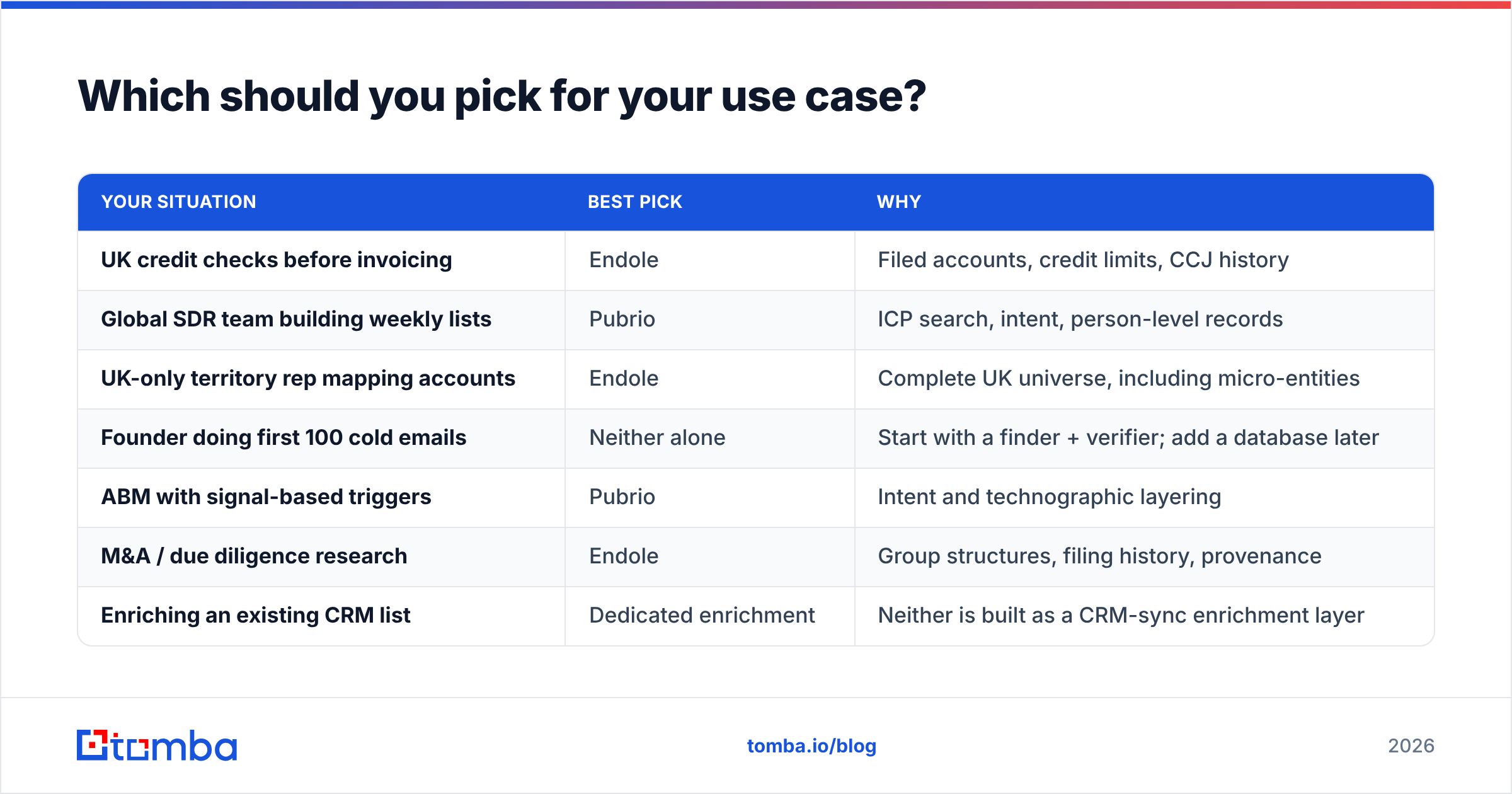
Endole vs Pubrio by use case: which should you pick?#
| Your situation | Best pick | Why |
|---|---|---|
| UK credit checks before invoicing | Endole | Filed accounts, credit limits, CCJ history |
| Global SDR team building weekly lists | Pubrio | ICP search, intent, person-level records |
| UK-only territory rep mapping accounts | Endole | Complete UK universe, including micro-entities |
| Founder doing first 100 cold emails | Neither alone | Start with a finder + verifier; add a database later |
| ABM with signal-based triggers | Pubrio | Intent and technographic layering |
| M&A / due diligence research | Endole | Group structures, filing history, provenance |
| Enriching an existing CRM list | Dedicated enrichment | Neither is built as a CRM-sync enrichment layer |
| Budget under $100/mo, need emails | Tomba | Starter $49/mo, finder + verifier included |
The grid makes the pattern clear. Endole answers one question. Should we do business with this firm? Pubrio answers a second. Which firms should we talk to? Neither answers the third. What is this person's live work email?
What is missing from both, and how do you fill the gap?#
The missing layer is a proven work email at the moment you press send.
Endole tells you Acme Ltd is solvent and that Jane Okafor is a director. Pubrio tells you Acme is looking at your category and that Tom Reyes runs RevOps. Neither proves that t.reyes@acme.co.uk takes mail today.
That is the job of a dedicated finder. It is why most mature stacks run three layers, not one:
- Research layer. Endole, Pubrio, or both. It depends on your map and on whether you need risk data or intent data.
- Contact layer. A finder turns a name and a domain into a live address. A domain search then maps who else works there and what the email pattern really is.
- Proof layer. SMTP checks, catch-all tests and role filters run before anything reaches your sending tool.
At volume, the layer that pays off most is the one you can automate. A Tomba API call inside your workflow replaces export, upload, verify and re-import with one step. Every record is checked as it enters your CRM. That beats a check at send time, which is days too late.
Weighing endole vs pubrio right now? Run the same test on both. Pull 100 records from each. Verify them on your own. Count how many are live and correctly titled. That number is what you are really buying, not the feature grid. In our tests the research tool wins on breadth and loses on freshness. That is exactly why the proof layer exists.
Start with the layer that decides if your email lands. Run any Endole or Pubrio export through the Tomba Email Finder and verifier first. The free tier gives you 25 searches a month, enough to test your current list. Starter is $49 a month when you want to run it across a team. Compare the bounce rate before and after. That one number settles the vendor debate faster than any feature chart.
Related guides#
Ready to find emails that actually work?
Join 150,000+ professionals who stopped guessing and started sending. Free credits on signup — no credit card required.
Get the Tomba newsletter
Practical outbound tactics and product updates — once every two weeks.
About the author