Endole vs Seamless.AI 2026: UK Filings or US Contact Volume?
One tool sells you UK company filings and credit risk. The other sells you a billion-row contact database. They barely overlap — and picking wrong costs you a quarter of pipeline. Here is the honest breakdown.
TL;DR
- Endole vs Seamless.AI is not a real head-to-head. Endole is a UK company-intelligence and credit-risk database built on Companies House filings. Seamless.AI is a US-centric contact database. It guesses and serves work emails and phone numbers at volume.
- Pick Endole if your ICP is UK limited companies. It tells you turnover, directors, group structure, and whether the account will pay its invoices.
- Pick Seamless.AI if you need thousands of US contact records fast, and you have the budget to clean what comes out.
- Neither is a great email-accuracy engine on its own. Seamless.AI's real-time "AI search" returns a lot of guessed addresses. Endole barely publishes personal emails at all.
- The cheap fix: use either tool to pick accounts. Then run a dedicated finder plus verifier on the contact layer. That is where a tool like Tomba (free tier, then $49/mo) slots in, for a fraction of a full seat.
What are Endole and Seamless.AI, exactly?#
They solve different halves of the same problem. That is why comparing them feels awkward until you name the halves.
Endole is a UK business-information platform. It ingests public filings from Companies House. On top of that it layers financials, credit scores, director histories, group structures, industry benchmarks, and a search suite for prospecting. Do you sell to UK SMEs — insurance, lending, accountancy, B2B services, recruitment? Then Endole answers which companies are worth calling and are they financially stable.
Seamless.AI is a US-headquartered sales-intelligence platform. Its pitch is a real-time search engine. It assembles contact records — work email, mobile, title, company — on demand. You also get a Chrome extension, a list builder, a buyer-intent add-on, and a writer tool. It answers who do I contact and what's their email, at high volume, mostly in North America.
So the honest framing of Endole vs Seamless.AI is not "which is better." It is this: do you have an account-selection problem or a contact-coverage problem?

Endole vs Seamless.AI: how do they compare head-to-head?#
Here is the side-by-side on the attributes that change your workflow. Pricing figures move, so confirm on the vendor's own page before you sign.
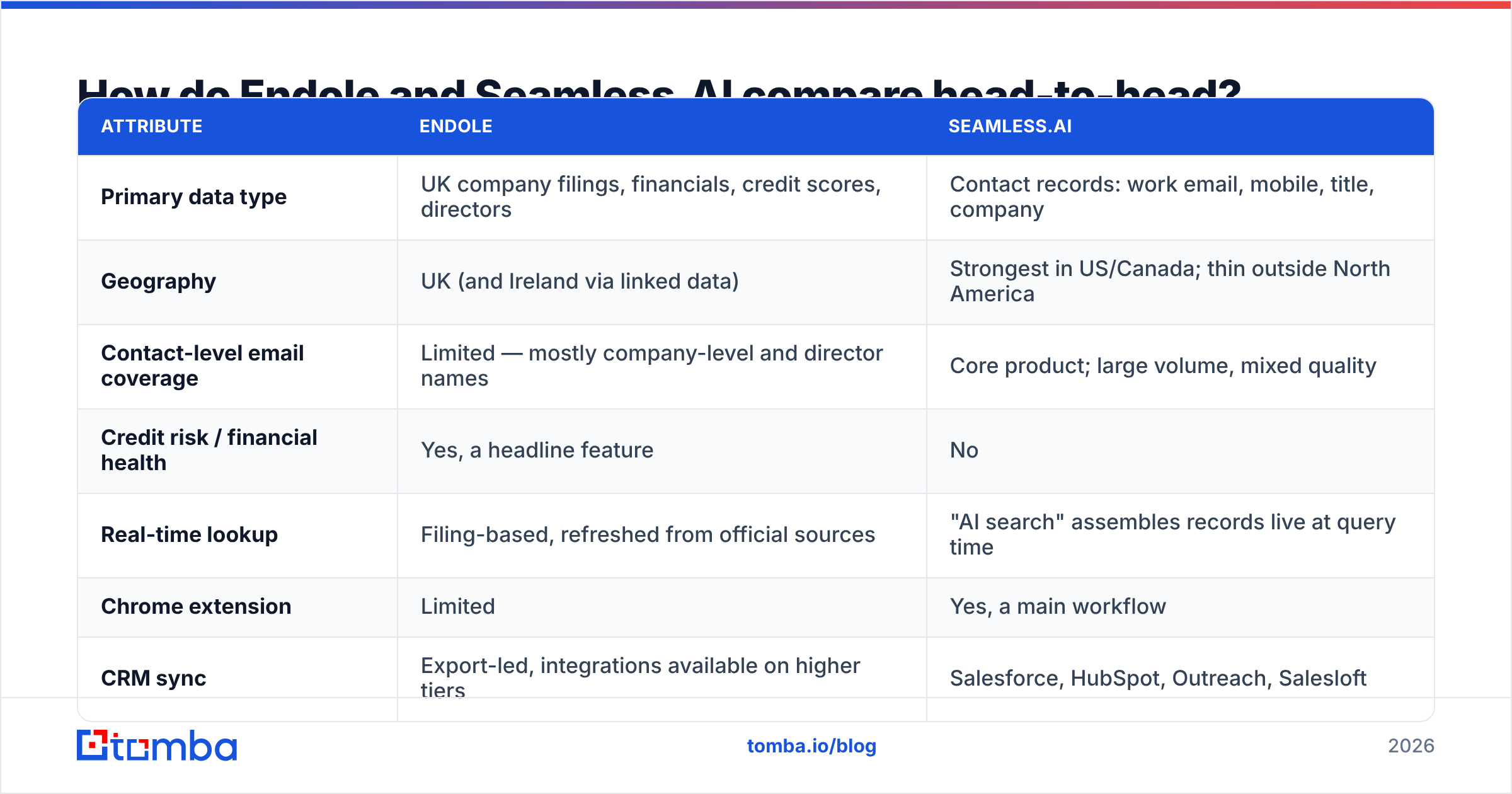
| Attribute | Endole | Seamless.AI |
|---|---|---|
| Primary data type | UK company filings, financials, credit scores, directors | Contact records: work email, mobile, title, company |
| Geography | UK (and Ireland via linked data) | Strongest in US/Canada; thin outside North America |
| Contact-level email coverage | Limited — mostly company-level and director names | Core product; large volume, mixed quality |
| Credit risk / financial health | Yes, a headline feature | No |
| Real-time lookup | Filing-based, refreshed from official sources | "AI search" assembles records live at query time |
| Chrome extension | Limited | Yes, a main workflow |
| CRM sync | Export-led, integrations available on higher tiers | Salesforce, HubSpot, Outreach, Salesloft |
| Pricing model | Published subscription tiers, UK-market pricing | Quote-based seats + credit packs; free trial credits |
| Typical buyer | UK credit, finance, and SME sales teams | US SDR teams running high-volume outbound |
| Biggest complaint in reviews | Depth beyond UK is limited | Credit burn and email accuracy variance |
Two things fall out of that table.
First, there is almost no feature overlap in the middle. Endole will not give you the VP of Engineering's mobile number. Seamless.AI will not tell you that an account filed abbreviated accounts. Nor that its net assets are falling, or that a director dissolved two companies in 2024.
Second, the failure modes are different. Endole fails as "great account, no way to reach a human." Seamless.AI fails as "3,000 contacts, and a meaningful slice of the emails bounce."
Endole vs Seamless.AI: which one has better data accuracy?#
The question splits per tool, so answer it in two parts.
Endole's accuracy is Companies House accuracy plus modelling. Filings are official. So registered address, SIC code, incorporation date, and directors are as reliable as UK public records get. The modelled layer is a different story. Credit score, estimated turnover, and group linkage are projections. For small companies filing abbreviated accounts, those projections point the right way rather than land on the number. Treat the score as a triage signal, not a verdict.
Seamless.AI's accuracy is a volume trade. The platform builds records at query time instead of serving a static file. That genuinely helps freshness. But pattern-derived addresses stay guesses until something confirms them. Scan the Seamless.AI reviews on G2 and the pattern holds across years. People like the speed and the volume. Critical reviews keep naming bounced emails, wrong mobiles, and credits spent on records that went nowhere.
That is not a reason to avoid it. It is a reason to never send to a raw export. Any list from any provider — Endole, Seamless.AI, Apollo, or a scraper — should hit an email verifier before it hits your sequencer. A 4% bounce rate is the difference between inboxing and getting throttled. Your sender reputation does not care where the bad address came from.
The specific trap on both platforms is catch-all domains. A catch-all server accepts every address at SMTP level. Naive verification then marks the address "valid", and you find out it was fake when nobody replies. Does a big share of your ICP run catch-all? It is common in enterprise and in UK professional services. Then you need a catch-all verifier, not a generic syntax-and-MX check.
Endole vs Seamless.AI: what does each actually cost?#
Pricing on both sides is less transparent than it should be. That opacity is part of the evaluation.
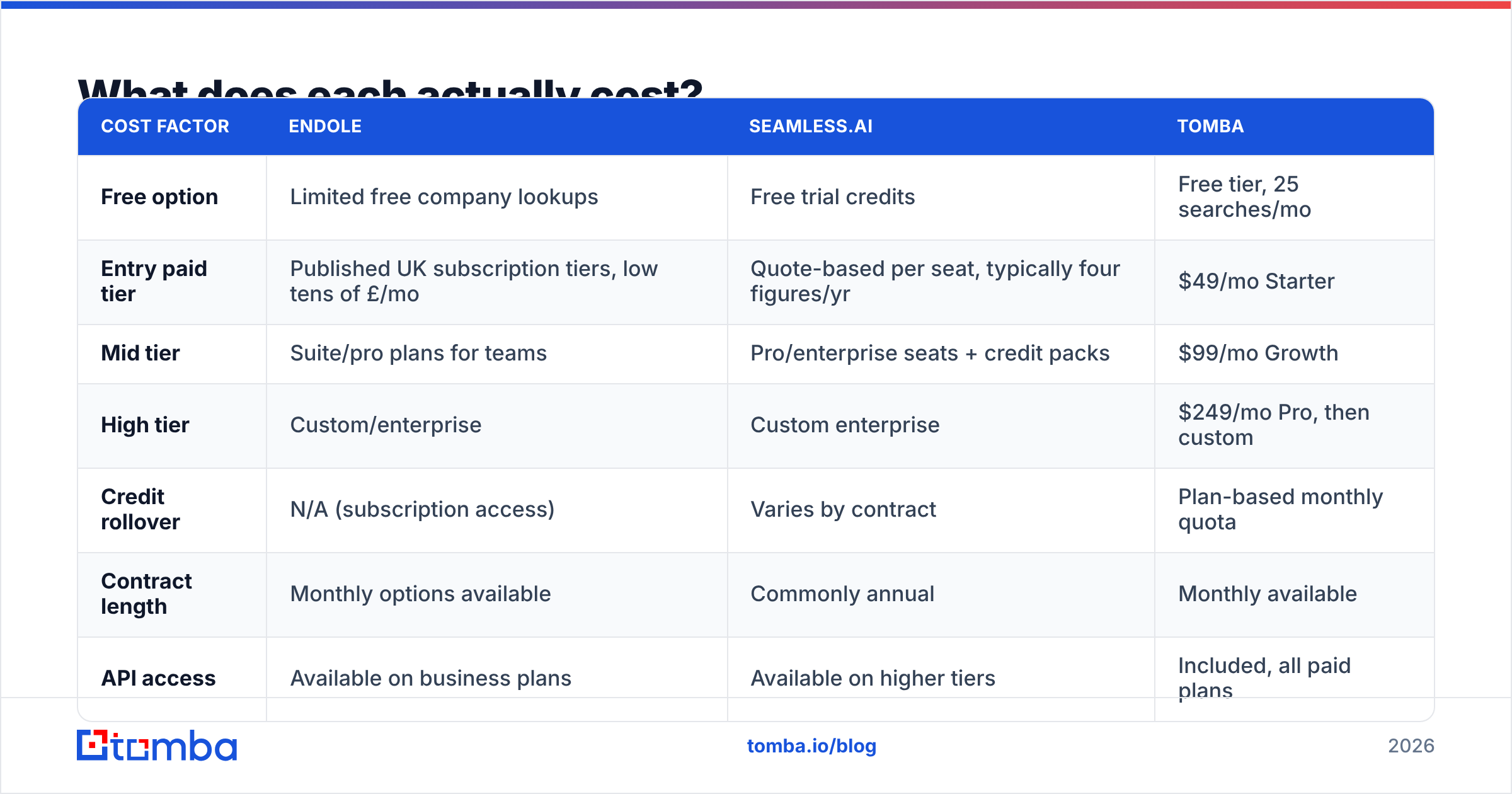
| Cost factor | Endole | Seamless.AI | Tomba |
|---|---|---|---|
| Free option | Limited free company lookups | Free trial credits | Free tier, 25 searches/mo |
| Entry paid tier | Published UK subscription tiers, low tens of £/mo | Quote-based per seat, typically four figures/yr | $49/mo Starter |
| Mid tier | Suite/pro plans for teams | Pro/enterprise seats + credit packs | $99/mo Growth |
| High tier | Custom/enterprise | Custom enterprise | $249/mo Pro, then custom |
| Credit rollover | N/A (subscription access) | Varies by contract | Plan-based monthly quota |
| Contract length | Monthly options available | Commonly annual | Monthly available |
| API access | Available on business plans | Available on higher tiers | Included, all paid plans |
The line item that surprises teams is the third column of their own stack. Buyers rarely replace one tool with the other. They end up paying for Endole and a contact source, or Seamless.AI and a verification vendor. Model all three seats when you model the real cost.
That is also where the pricing asymmetry bites. A per-seat sales-intelligence contract prices as if it is your whole GTM data layer. A focused finder and verifier prices like a utility. If Endole already handles account selection, you do not need a second platform-sized contract for contacts. You need an API and a credit pool. Compare Tomba pricing against a per-seat quote. For teams under ten reps, the arithmetic usually decides itself.
Who should choose Endole?#
Endole is the right call in a narrower set of cases than its marketing suggests. That is fine. Narrow and correct beats broad and vague.
- UK-only ICP. Is more than 70% of your target list UK limited companies? Then no US-first platform matches Endole's depth. Seamless.AI's UK coverage is thin next to it.
- Credit risk matters to the deal. Lending, insurance, leasing, factoring, staffing, and anyone extending payment terms. Knowing an account's financial health early beats another 500 contact records.
- Territory and account planning. Filters on turnover band, employee count, SIC code, and filing recency build genuinely good territory lists.
- Compliance-sensitive prospecting. Official-record sourcing is easier to defend under UK GDPR scrutiny than "we bought a list."
- You already have a contact layer. Endole plus a finder is a strong, cheap stack. Endole alone leaves you calling switchboards.
Who should choose Seamless.AI?#
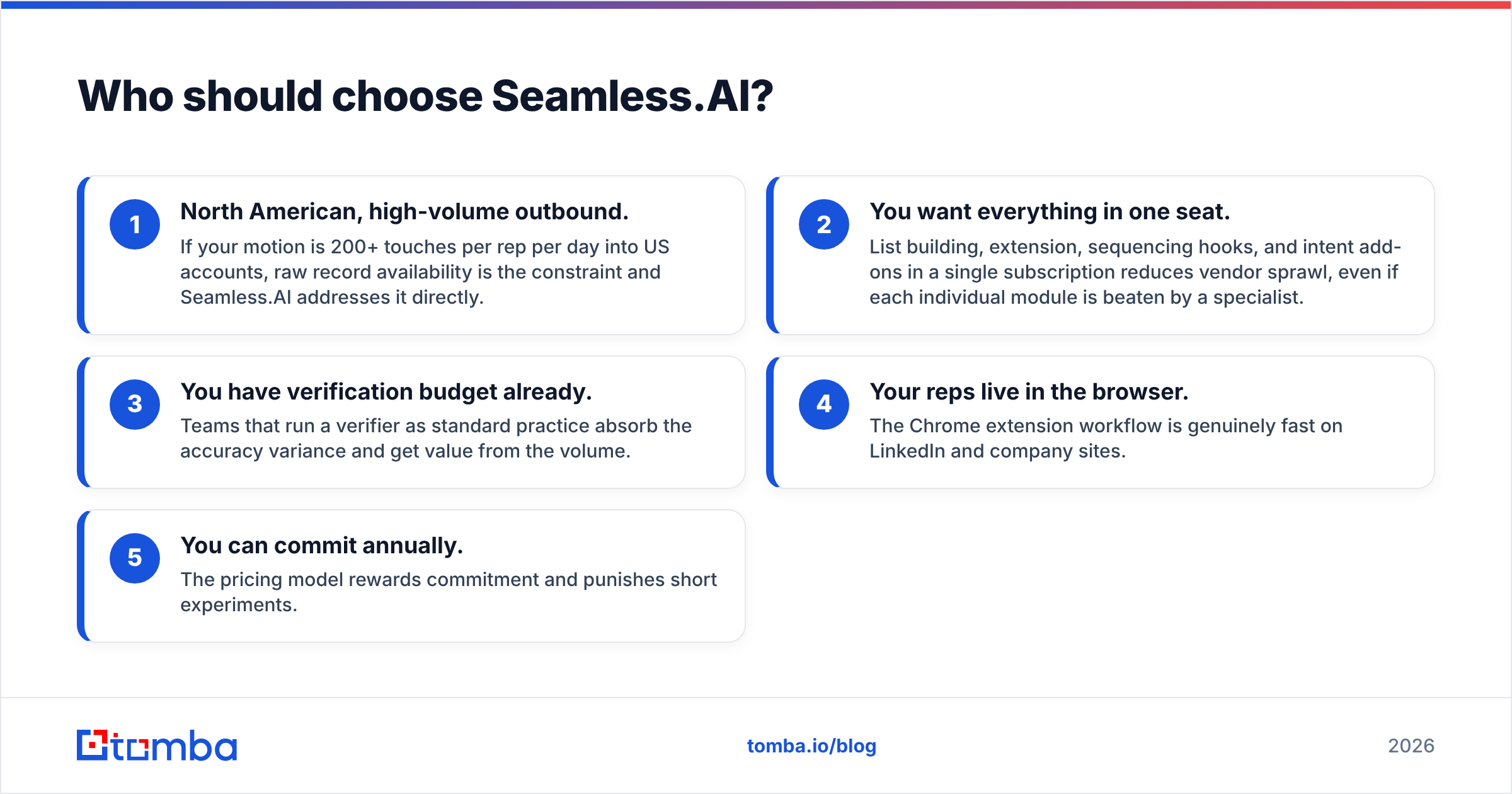
- North American, high-volume outbound. Does your motion run 200+ touches per rep per day into US accounts? Raw record availability is the constraint, and Seamless.AI attacks it directly.
- You want everything in one seat. List building, extension, sequencing hooks, and intent add-ons ship in one subscription. That cuts vendor sprawl, even though a specialist beats each single module.
- You have verification budget already. Teams that run a verifier as standard practice absorb the accuracy variance and get value from the volume.
- Your reps live in the browser. The Chrome extension workflow is genuinely fast on LinkedIn and company sites.
- You can commit annually. The pricing model rewards commitment and punishes short experiments.
Is your sticking point price-per-verified-contact rather than features? Then read the Seamless.AI alternative breakdown before you sign an annual term. The per-record economics change a lot once you unbundle finding from the rest of the suite.

Is there a middle ground in the Endole vs Seamless.AI debate?#
Yes. It is the setup most teams land on after a year of paying for both.
Split the job into three layers and buy the best-fit tool for each:
- Account layer — who is worth targeting. Endole for the UK, a US equivalent or your CRM's firmographics for North America. This is where credit risk, turnover band, and headcount live.
- Contact layer — who to reach and how. A dedicated email finder plus domain search pulls every published address at a target company. Add a phone finder where dials matter. Run bulk lead generation once the list is defined, rather than burning credits one record at a time.
- Hygiene layer — will it actually deliver. Verification, catch-all handling, dedupe, and suppression before anything enters the sequencer.
This beats one-vendor consolidation for one reason. Each layer fails differently, and you want to swap one without renegotiating the others. It is the same logic as not buying your CRM, your email tool, and your data from a single vendor for a bundle discount. The discount evaporates the moment one module underperforms and you are locked in.
The swap is small in practice. Keep Endole for UK account selection. Drop the second platform-sized seat. Put a finder plus verifier behind an API. Most teams do this with a Google Sheets or HubSpot integration and never open a separate UI again.
What should you actually do this quarter?#
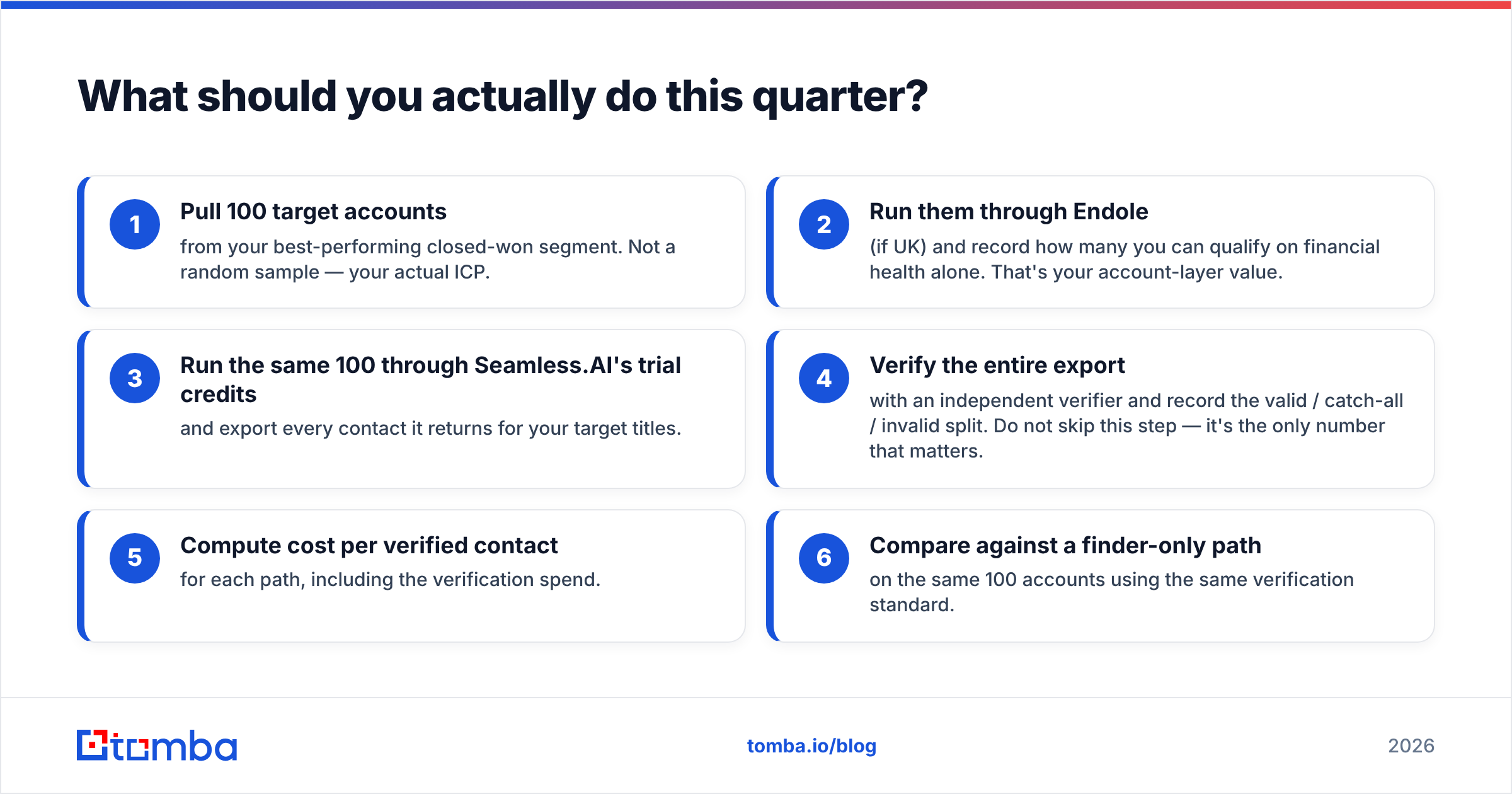
Here is a concrete test. It takes under a week and settles Endole vs Seamless.AI with data instead of opinion:
- Pull 100 target accounts from your best-performing closed-won segment. Not a random sample — your actual ICP.
- Run them through Endole (if UK) and count how many you can qualify on financial health alone. That is your account-layer value.
- Run the same 100 through Seamless.AI's trial credits. Export every contact it returns for your target titles.
- Verify the entire export with an independent verifier. Record the valid / catch-all / invalid split. Do not skip this step; it is the only number that matters.
- Compute cost per verified contact for each path, including the verification spend.
- Compare against a finder-only path on the same 100 accounts, using the same verification standard.
Whatever wins step 5 is your answer. It is usually not the tool with the biggest database. It is the one with the best ratio of usable records to money spent. Did step 4 reveal a large catch-all block? Then hygiene tooling, not more volume, is the limit on your pipeline.
The verdict#
Endole wins on UK account intelligence. Seamless.AI wins on US contact volume. Neither wins on email accuracy, and that is the layer your bounce rate is made of.
So the Endole vs Seamless.AI call comes down to geography and job. UK-focused? Endole plus a focused finder is cheaper, more accurate, and easier to defend than a US-first platform seat. North America and high volume? Seamless.AI earns its keep, provided you verify everything and price verification into the contract from day one.
The stack that beats both is boring: good account selection, a finder that returns confidence scores rather than guesses, and a verifier that understands catch-all domains.
Start with the contact layer, because it is the cheapest to fix. Run your next 100 target accounts through the Tomba Email Finder. The free tier gives you 25 searches to test coverage against your own ICP before you spend anything. Paid plans start at $49/mo, with API access included. If the verified-contact rate beats your current vendor, you have found the layer to unbundle.
Related guides#
Ready to find emails that actually work?
Join 150,000+ professionals who stopped guessing and started sending. Free credits on signup — no credit card required.
Get the Tomba newsletter
Practical outbound tactics and product updates — once every two weeks.
About the author