Endole vs Vainu 2026: Company Data Platforms Compared
Endole owns UK company financials. Vainu owns Nordic sales triggers. Neither hands you a verified inbox. Here is how the two compare on coverage, pricing, CRM fit — and what you still have to bolt on.
Endole vs Vainu comes down to one question: do you need UK financial data or Nordic buying signals? Endole reads UK company filings. Vainu tracks live company signals across the Nordics. This guide compares the two on coverage, price, CRM fit — and the contact data that neither one hands you.
TL;DR
- Endole is a UK company-data engine. It turns Companies House filings into financials, credit risk, ownership graphs, and a search layer for prospecting. Outside the UK and Ireland, it goes quiet.
- Vainu is a Nordic sales-intelligence platform. It leads with company signals — hiring, funding, tech stack, news. Those signals land in your CRM as ready-to-use fields.
- They barely overlap on geography. If your ICP is UK SMEs, Endole wins by default. If it is Finland, Sweden, Norway, Denmark, or the Netherlands, Vainu wins.
- Neither is a contact-data tool. Both give you accounts. You still need names, verified emails, and phone numbers before anyone can run a sequence.
- Budget reality: Endole starts in the low hundreds per year. Vainu is quote-based and seat-priced, and usually lands in the four-to-five-figure range.
What are Endole and Vainu, actually?#
Both are sold as "company data platforms." That phrase hides more than it reveals. Think of maps. Endole is a land registry: it tells you who owns what, what it is worth, and whether the mortgage is late. Vainu is live traffic data: it tells you which roads just got busy, so you know where to point the car now.
Endole ingests UK statutory filings and public records. It packages them for three audiences: credit and risk teams, corporate finance researchers, and sales teams prospecting in the UK through Endole Explorer. Its data spine is Companies House, enriched with accounts history, director networks, group structures, and industry benchmarks.
You can look up a company you have never heard of and see turnover trends, shareholder funds, charges, and county-court judgments in under a minute.
Vainu was built in Helsinki for outbound sales teams. Its pitch is simple. Static company facts are a commodity, and the real value sits in change. A company that just posted 12 engineering roles, raised a Series A, opened a second warehouse, or swapped its e-commerce platform is worth a call today.
Vainu indexes company websites, news, registries, and job boards. It turns those events into filters you can search. Then it syncs the result to HubSpot, Salesforce, Pipedrive, or Dynamics, so reps see the signal where they already work.
The practical distinction:
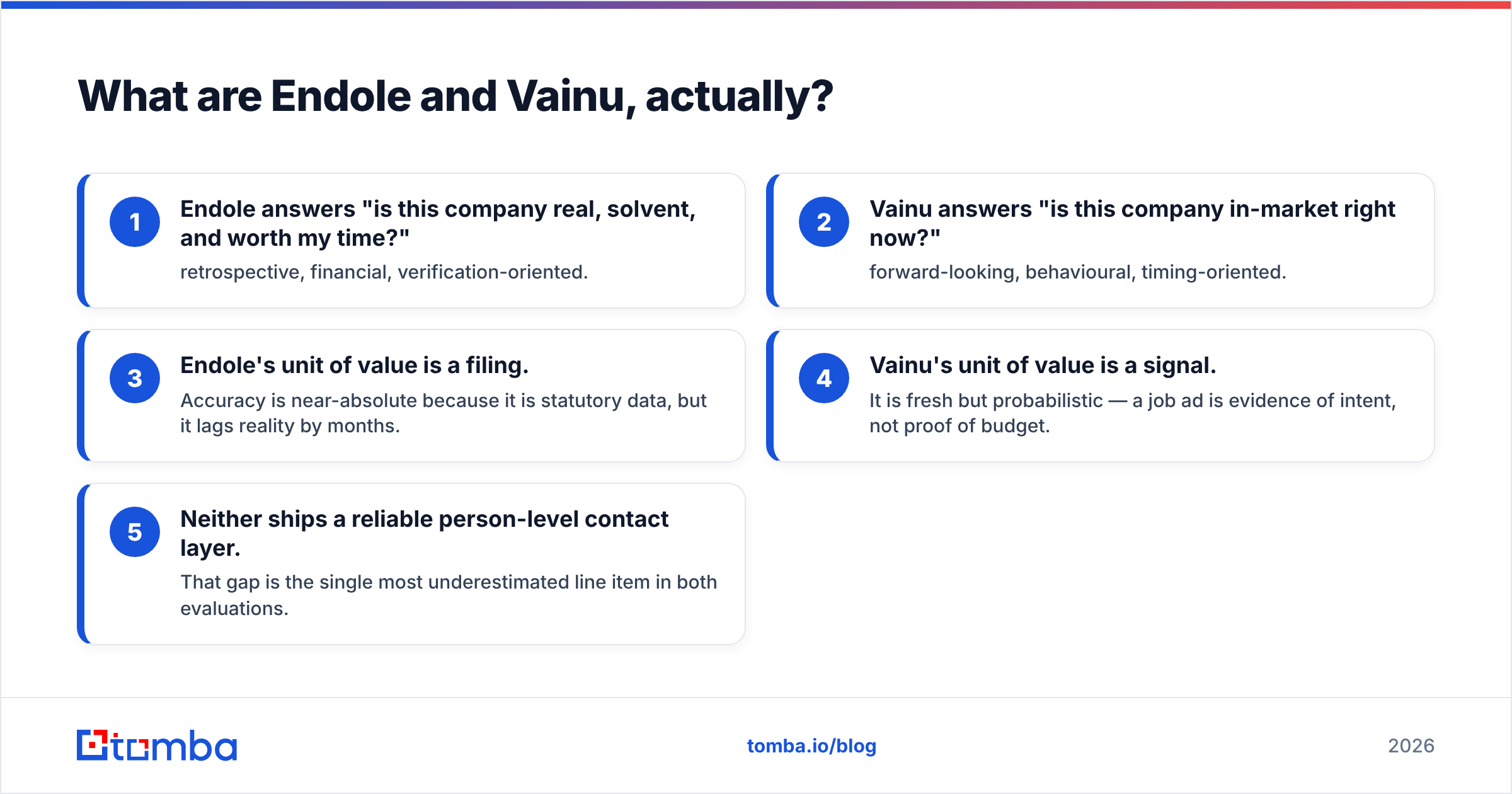
- Endole answers "is this company real, solvent, and worth my time?" It looks backward, at money and proof.
- Vainu answers "is this company in-market right now?" It looks forward, at behaviour and timing.
- Endole's unit of value is a filing. Statutory data is close to exact, but it lags reality by months.
- Vainu's unit of value is a signal. It is fresh, but it is still a good guess. A job ad shows intent, not budget.
- Neither ships a reliable person-level contact layer. That gap is the most underestimated line item in both evaluations.

Endole vs Vainu: how do they compare head to head?#
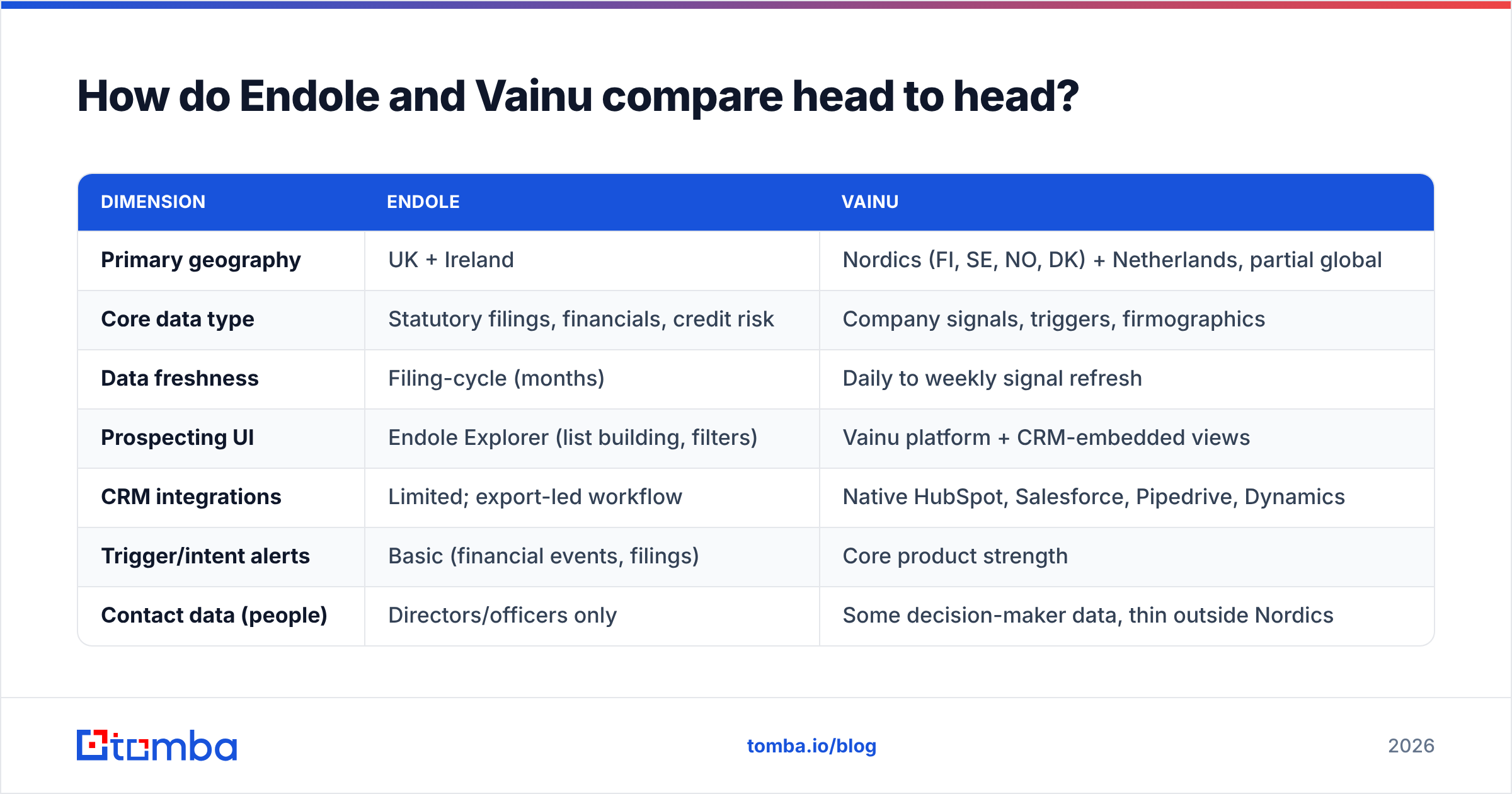
| Dimension | Endole | Vainu |
|---|---|---|
| Primary geography | UK + Ireland | Nordics (FI, SE, NO, DK) + Netherlands, partial global |
| Core data type | Statutory filings, financials, credit risk | Company signals, triggers, firmographics |
| Data freshness | Filing-cycle (months) | Daily to weekly signal refresh |
| Prospecting UI | Endole Explorer (list building, filters) | Vainu platform + CRM-embedded views |
| CRM integrations | Limited; export-led workflow | Native HubSpot, Salesforce, Pipedrive, Dynamics |
| Trigger/intent alerts | Basic (financial events, filings) | Core product strength |
| Contact data (people) | Directors/officers only | Some decision-maker data, thin outside Nordics |
| Verified work emails | No | Not a core capability |
| API access | Yes, paid tier | Yes, on higher plans |
| Pricing model | Self-serve subscription tiers | Quote-based, seat + data volume |
| Typical annual spend | Low hundreds (GBP) | Four to five figures |
| Best for | UK credit checks, SME prospecting, due diligence | Nordic outbound, timing-based ABM, CRM enrichment |
Pricing on both platforms changes and is partly negotiated. Confirm current numbers on endole.co.uk and vainu.com before you build a business case. Independent user reviews for both sit on G2.
The table makes the decision look easy, and for most teams it is. The complexity shows up when your ICP straddles both regions. It also shows up when you assumed either tool would hand you a ready-to-send contact list.
Which one has better data coverage?#
Wrong question. Ask: better coverage of what, where? Coverage is where Endole vs Vainu stops being a fair fight, because each one owns a different map.
Endole's UK coverage is effectively complete, because it comes from a mandatory public register. Every incorporated UK entity is in there — roughly five million active companies, plus dissolved history. If a company filed it, Endole can show it.
The limit is depth of commercial insight. Micro-entity accounts, which most UK SMEs file, are cut back to almost nothing. You will see fixed assets and shareholder funds. You will not see revenue for a large slice of the small-business market. That is a UK filing rule, not an Endole failure, but it still dents your qualification model.
Vainu's Nordic coverage is deep and genuinely hard to copy. Finnish and Swedish registry data, combined with technology and topic tags scraped from websites, is a real moat. Its coverage claims stretch to tens of millions of companies worldwide. Treat those non-core markets as a basic company index, not a signal engine. The trigger quality that justifies Vainu's price sits in the Nordics and the Netherlands.
A blunt rule of thumb: if more than 70% of your target accounts sit in one platform's home region, buy that platform and stop the evaluation. If your pipeline is split across Europe, neither tool alone is enough. Look at a broader B2B database as the base layer, with one of these as a regional specialist.
What does each one cost in practice?#
Endole is self-serve and cheap by B2B data standards. Published plans run from a light individual tier up to business tiers with more report credits, bulk exports, and API access. Teams doing UK credit checks often run it for less than one seat on an enterprise data platform.
The pricing risk is credit creep. Heavy report pulling and bulk exports push you up tiers faster than you planned.
Vainu is enterprise-shaped. Expect a per-seat platform fee, a data volume component, and an implementation conversation. Onboarding costs real time too. Trigger setup and CRM field mapping is not a weekend project, and the platform only pays back when someone owns the workflow. Teams that buy Vainu and leave triggers on defaults end up with a very expensive company database.
Do the total-cost math honestly:
- Platform fee — the number on the quote.
- Seats — who needs access, versus who just needs the data in the CRM.
- Enrichment volume — records refreshed per month, and what happens when you go over.
- Contact-data top-up — the cost of turning accounts into reachable people, which neither platform fully covers.
- Ops time — mapping, dedupe, and list hygiene, usually 0.25 FTE in the first quarter.
That fourth line is where most evaluations go wrong.
Do Endole or Vainu give you contact details?#
Not in the way an outbound team needs. This is the central gap in both products, and it is worth being precise about it.
Endole surfaces directors and officers — the people legally registered against the company. That helps a lot with owner-managed SMEs, where the director is the buyer. It is close to useless for a 400-person manufacturer, where you need the Head of Procurement, not the non-executive chair. Companies House does not publish work email addresses either, so you get a name and a service address.
Vainu includes some decision-maker data in its core markets. But it is not positioned or priced as a contact database, and coverage thins fast outside the Nordics. Its own documentation frames contacts as a complement to the account-signal product, which is the honest framing.
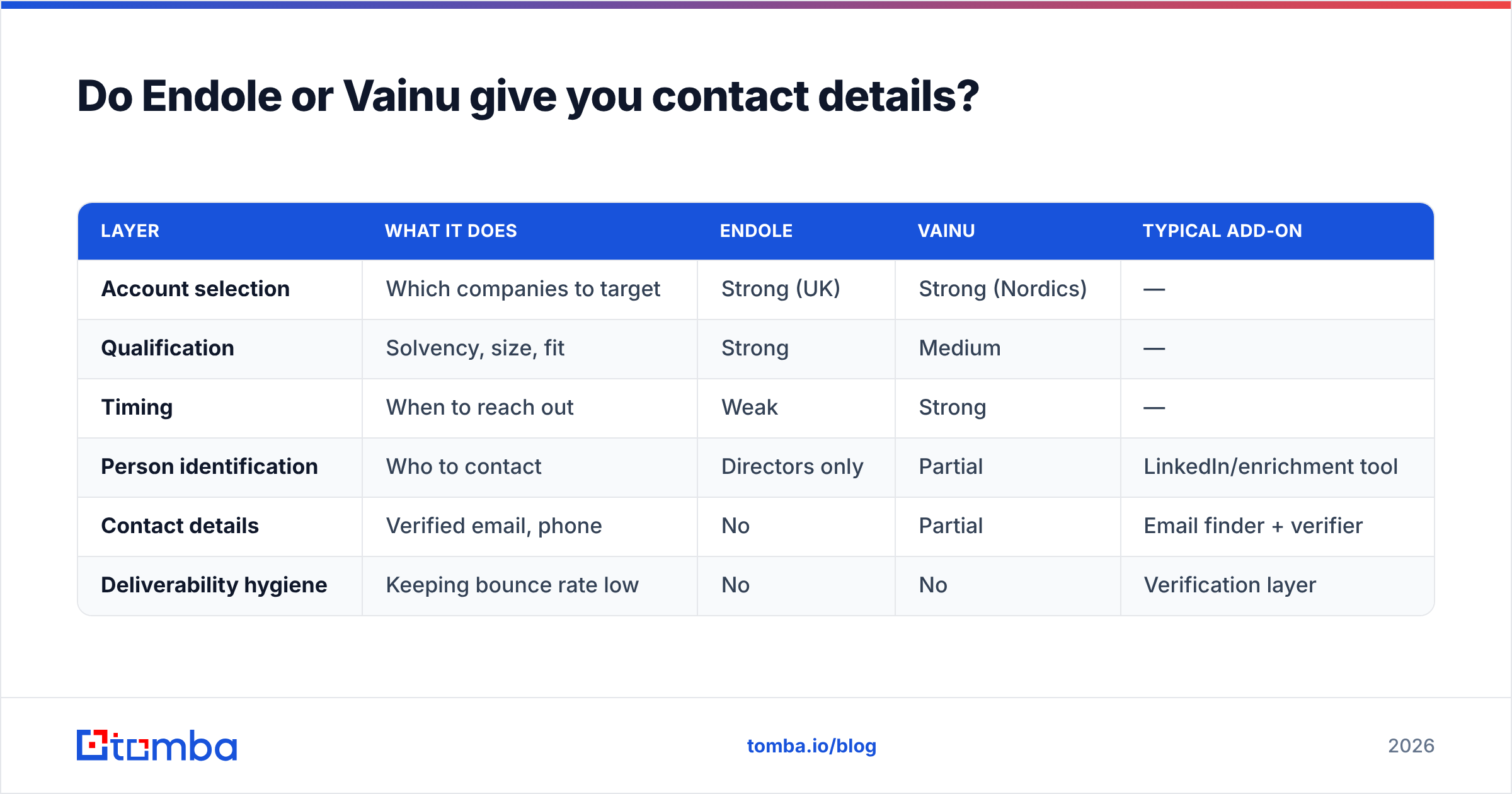
So the real stack looks like this:
| Layer | What it does | Endole | Vainu | Typical add-on |
|---|---|---|---|---|
| Account selection | Which companies to target | Strong (UK) | Strong (Nordics) | — |
| Qualification | Solvency, size, fit | Strong | Medium | — |
| Timing | When to reach out | Weak | Strong | — |
| Person identification | Who to contact | Directors only | Partial | LinkedIn/enrichment tool |
| Contact details | Verified email, phone | No | Partial | Email finder + verifier |
| Deliverability hygiene | Keeping bounce rate low | No | No | Verification layer |
You will fill rows 4 through 6 whichever platform you buy. A domain search turns an account list into the actual people at that domain, with their email patterns.
An email verifier then strips out the catch-alls and dead boxes before your sequencing tool sees them. Skip that step and a beautifully qualified list still produces a 14% bounce rate and a burned sending domain.

Which should you choose for UK or Nordic outbound?#
Choose Endole if:
- Your ICP is UK-registered, especially SMEs and owner-managed businesses.
- You need credit risk, solvency, or group-structure data before you sell.
- You sell into finance, insurance, lending, procurement, or professional services, where financial health is a hard qualifier.
- Budget is tight and you want a self-serve tool you can cancel next month.
Choose Vainu if:
- Your ICP sits in Finland, Sweden, Norway, Denmark, or the Netherlands.
- Timing matters more than solvency. You sell software, staffing, logistics, or services, where a trigger event opens the door.
- You have a CRM your reps genuinely live in, and someone to own the field mapping.
- You can justify a four-to-five-figure annual commitment against a pipeline target.
Choose neither (yet) if:
- Your targets are spread across Europe or North America. You need a broader base layer first.
- Your real bottleneck is reachable contacts, not account selection. Buying an account-data platform to fix a contact-data problem is a common and expensive mistake.
If you are still shortlisting, read how each one stacks up against nearby tools. Our breakdown of Vainu alternatives covers where the signal-based model does and does not justify its cost.
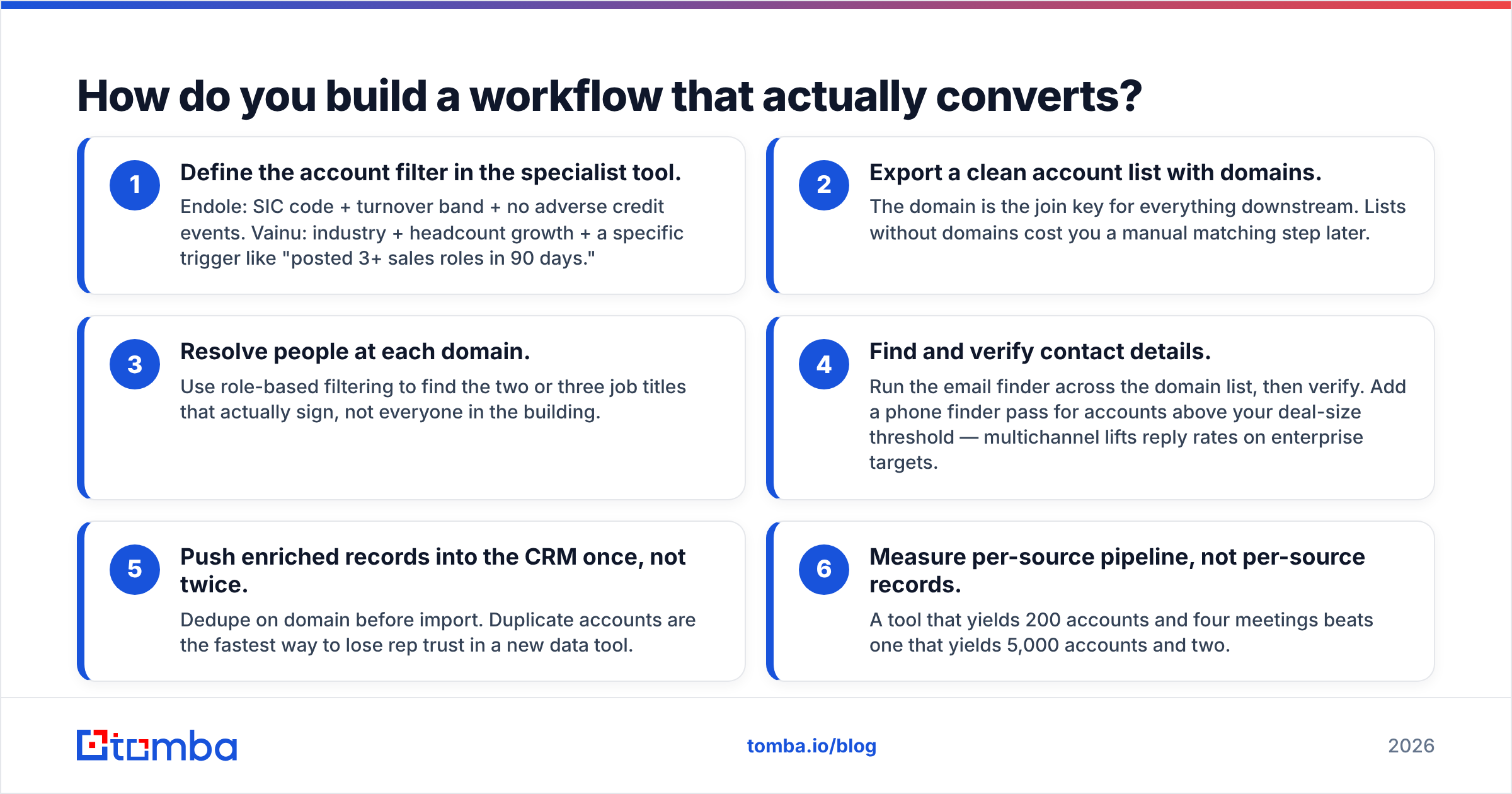
How do you build a workflow that actually converts?#
Here is a stack that works whichever platform you pick:
- Define the account filter in the specialist tool. Endole: SIC code + turnover band + no adverse credit events. Vainu: industry + headcount growth + a trigger like "posted 3+ sales roles in 90 days."
- Export a clean account list with domains. The domain is the join key for everything downstream. Lists without domains cost you a manual matching step later.
- Resolve people at each domain. Filter by role. Find the two or three job titles that actually sign, not everyone in the building.
- Find and verify contact details. Run the email finder across the domain list, then verify. Add a phone finder pass for accounts above your deal-size threshold, since multichannel lifts reply rates on enterprise targets.
- Push enriched records into the CRM once, not twice. Dedupe on domain before import. Duplicate accounts are the fastest way to lose rep trust in a new tool.
- Measure pipeline per source, not records per source. A tool that yields 200 accounts and four meetings beats one that yields 5,000 accounts and two.
Teams skip step 4 because the account list looks finished. It is not. An account list is a target. A verified contact record is an action.
Is there a scenario where you need both?#
Yes, one. A UK-headquartered company selling into the Nordics, or the reverse, where credit checks and timing signals both drive the sale. In that case, run Endole for the UK segment and Vainu for the Nordic segment. Then standardise on a single enrichment and verification layer across both, so your CRM does not end up with two clashing data schemas.
That last point matters more than it sounds. Account data from two sources arrives with different field names, date formats, and confidence labels. Your scoring model then breaks quietly. Normalise at the enrichment step instead. A single data enrichment pipeline, fed by both exports, keeps one schema and one source of truth for contactability.
The bottom line#
Endole vs Vainu is not really a head-to-head fight. They are regional specialists that share a category label. Endole is the better buy for UK financial qualification, at a price that needs no business case. Vainu is the better buy for Nordic timing-based outbound, if you have the budget and the discipline to configure it. Pick by geography first, use case second, price third.
What neither will do is put a verified email address in front of your reps. That last mile — turning a qualified account into a person you can reach, at an address that will not bounce — is a separate job.
Start there. Run your Endole or Vainu export through the Tomba Email Finder to turn account domains into verified, deliverable contacts. The free tier covers 25 searches a month, so you can test match rates on your own list first. Paid plans start at $49/mo — see Tomba pricing for the full breakdown. Account data tells you where to knock. Verified contact data is what gets the door open.
Related guides#
Ready to find emails that actually work?
Join 150,000+ professionals who stopped guessing and started sending. Free credits on signup — no credit card required.
Get the Tomba newsletter
Practical outbound tactics and product updates — once every two weeks.
About the author