Endole vs ZoomInfo 2026: UK Company Data vs Global B2B
Endole owns UK filings depth. ZoomInfo owns global contact reach. Here is which one actually fits your pipeline in 2026 — and the cheaper stack most teams end up building instead.
Endole vs ZoomInfo is a choice between depth and reach. Endole knows UK companies inside out. ZoomInfo knows people, in almost every market. Here is how that plays out in practice.
TL;DR
- They are not really rivals. Endole is a UK company-records tool built on Companies House filings. ZoomInfo is a global contact database built for outbound sales teams.
- Pick Endole if you sell to UK limited companies and care about accounts, directors, group structure, and credit risk.
- Pick ZoomInfo if you sell abroad, need direct dials and job titles, and can fund a five-figure yearly contract.
- Neither is a good email finder. Endole gives you generic company contacts. ZoomInfo gives you contacts that go stale fast, behind credit and export caps.
- The common 2026 stack: one cheap source for company data, plus a dedicated email finder and email verifier for contacts. It costs a fraction of one ZoomInfo seat.
What are Endole and ZoomInfo, exactly?#
They solve different halves of the same problem.
Endole is a UK business data platform. It is built on public record: Companies House filings, annual accounts, charges, director appointments, shareholdings, and group ownership. On top of that it adds credit scores and estimated turnover. Its search tool, Endole Explorer, filters every UK company by SIC code, region, staff band, and financial size. Think of it as a searchable copy of the UK register.
ZoomInfo is a global go-to-market data platform. It is built on people. Each record holds a job title, a work email, a direct dial, and often a mobile number. The data comes from a shared contributor network, web crawling, and partner feeds. Around that sit buying signals, tech-stack data, website visitor tracking, and AI account scoring in the Copilot tier.
Here is the analogy that lands best. Endole is the land registry: exact, structured, and slow to change. ZoomInfo is the phone book, plus a scanner that listens for who is about to move house. Wider, faster, and noisier.
That one difference drives almost every trade-off below.
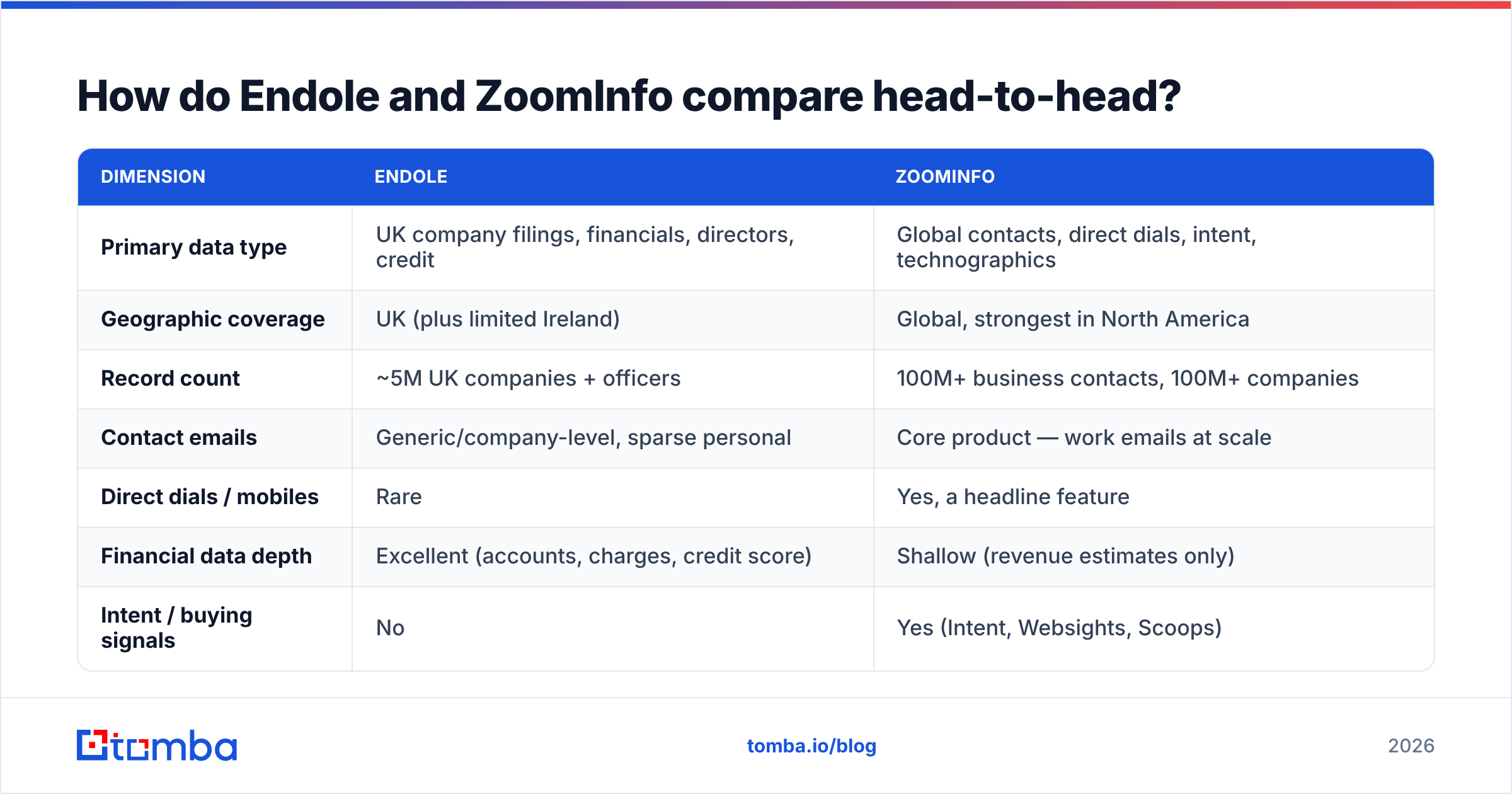
Endole vs ZoomInfo: how do they compare head-to-head?#
| Dimension | Endole | ZoomInfo |
|---|---|---|
| Primary data type | UK company filings, financials, directors, credit | Global contacts, direct dials, intent, technographics |
| Geographic coverage | UK (plus limited Ireland) | Global, strongest in North America |
| Record count | ~5M UK companies + officers | 100M+ business contacts, 100M+ companies |
| Contact emails | Generic/company-level, sparse personal | Core product — work emails at scale |
| Direct dials / mobiles | Rare | Yes, a headline feature |
| Financial data depth | Excellent (accounts, charges, credit score) | Shallow (revenue estimates only) |
| Intent / buying signals | No | Yes (Intent, Websights, Scoops) |
| Pricing model | Published, low-cost annual subscription tiers | Custom quote, seats + credits |
| Typical annual spend | Hundreds of pounds | Commonly reported at $15,000+ |
| Contract length | Monthly/annual, low friction | Annual, often multi-year with auto-renewal |
| CRM sync | Limited, export-driven | Deep (Salesforce, HubSpot, Dynamics) |
| Best for | UK credit, research, compliance, territory sizing | Multi-region outbound and ABM teams |
Read that table twice before you shortlist. Do you sell only to UK small businesses? Then half of ZoomInfo's pitch — global reach, intent, tech data — is spend you will never touch. Do you sell to US software buyers? Then Endole is not even in the race.
Which one has better data coverage?#
It depends on which axis you measure.
- Company breadth. ZoomInfo wins on volume, with 100M+ company profiles worldwide. Endole covers about 5 million UK firms. But it covers nearly all of them, down to dormant micro-companies ZoomInfo has never seen.
- Company depth. Endole wins. Filed accounts, charges, court judgments, shareholders, and group structure come straight from the register. ZoomInfo's revenue and headcount are estimates. For private UK firms they are often a full band out.
- Contact coverage. ZoomInfo wins, and it is not close. Endole shows directors and a general company address. It will not hand you the work email of a Head of Ops.
Two more axes matter, and buyers often skip them.
- Freshness. Call it a draw. Endole is as fresh as Companies House. Filings can lag a year, but nothing is invented. ZoomInfo refreshes contacts all the time. Even so, B2B contact data decays by 2-3% a month as people change jobs. A record touched nine months ago is a coin flip.
- Verification. Both leave it to you. ZoomInfo does not promise that an email will accept mail today. Endole does not promise personal emails at all. Run a bulk verify pass before any send.
Note the practical result. Neither platform removes the need for a contact-accuracy step. Endole leaves a hole where the person's email should be. ZoomInfo fills that hole with a value that may be nine months old. Both paths end in the same place: a verification queue.
How does the pricing really work?#
This is where the two split most sharply. It is also where most buyer regret starts.
Endole publishes its plans. You can see the price, pay by card, and cancel without a procurement cycle. Credit reports and bulk data exports cost extra. For a two-person research team, a year of Endole often costs about the same as one month of enterprise sales software.
ZoomInfo does not publish prices. Every deal is a quote built from three numbers:
- Seats — priced per user, with features locked by tier (Copilot, SalesOS, MarketingOS, TalentOS).
- Credits — how many contact records you can reveal and export each year.
- Add-ons — Intent, Websights, Enrich, and Engage each carry their own line item.
Reviews on G2 raise the same three points again and again. The yearly commitment is large. Export caps bite sooner than expected. Auto-renewal clauses catch teams who thought they could walk away at month twelve. None of that makes ZoomInfo bad value. For a 20-rep team that hits quota on its data, it can be excellent. It does mean the choice is a budget call, not a feature call.
Now compare the contact-layer route. Tomba runs a free tier at 25 searches a month, Starter at $49/mo, Growth at $99/mo, and Pro at $249/mo, with custom Enterprise pricing. Full Tomba pricing is public, and the API carries no seat tax. That does not replace ZoomInfo's buying signals. It does replace the one line item most teams buy ZoomInfo for: a valid email for a named person at a named company.
Who should choose Endole?#
Choose Endole when the company is the unit of analysis, not the person.
- UK credit and risk teams. Filed accounts, charges, and CCJs sit in one place, with a score attached. ZoomInfo has no equal here.
- Territory and market sizing. Filter the whole UK register by SIC code and turnover band. You get a market size you can defend to a board.
- M&A and corporate research. Group structures, shareholdings, and director networks are Endole's home turf.
- Compliance and KYB checks. Official-source data beats guessed data when someone will audit the answer later.
- UK sellers on a tight budget. If your list is "UK manufacturers turning over £2-10M", Endole builds it for a rounding error of a ZoomInfo contract.
Where Endole leaves you short: you finish with company names, websites, and director names. You get no reliable way to email those directors. That gap is easy to close. Feed the domains into a domain search to pull the company's verified email pattern and known addresses. Then resolve each name against that pattern. It takes two steps, and it still costs less than the gap-free option.
Who should choose ZoomInfo?#
Choose ZoomInfo when the person is the unit of analysis and you sell beyond the UK.
- Multi-region outbound teams. One contract covering North America, EMEA, and APAC is hard to copy with point tools.
- Teams that live on the phone. Direct dials and mobiles are ZoomInfo's strongest edge. Few rivals match the hit rate.
- ABM programmes that need intent. Knowing which accounts are researching your category is a real signal. A filings database cannot give you that.
- Large RevOps teams. Native Salesforce and HubSpot enrichment, dedupe, and lead routing at scale justify a lot of the price.
Where ZoomInfo leaves you short: UK private-company financials, ownership data, and cost predictability. And as your seat count grows, so does the bill. The price scales with headcount, not with value delivered.
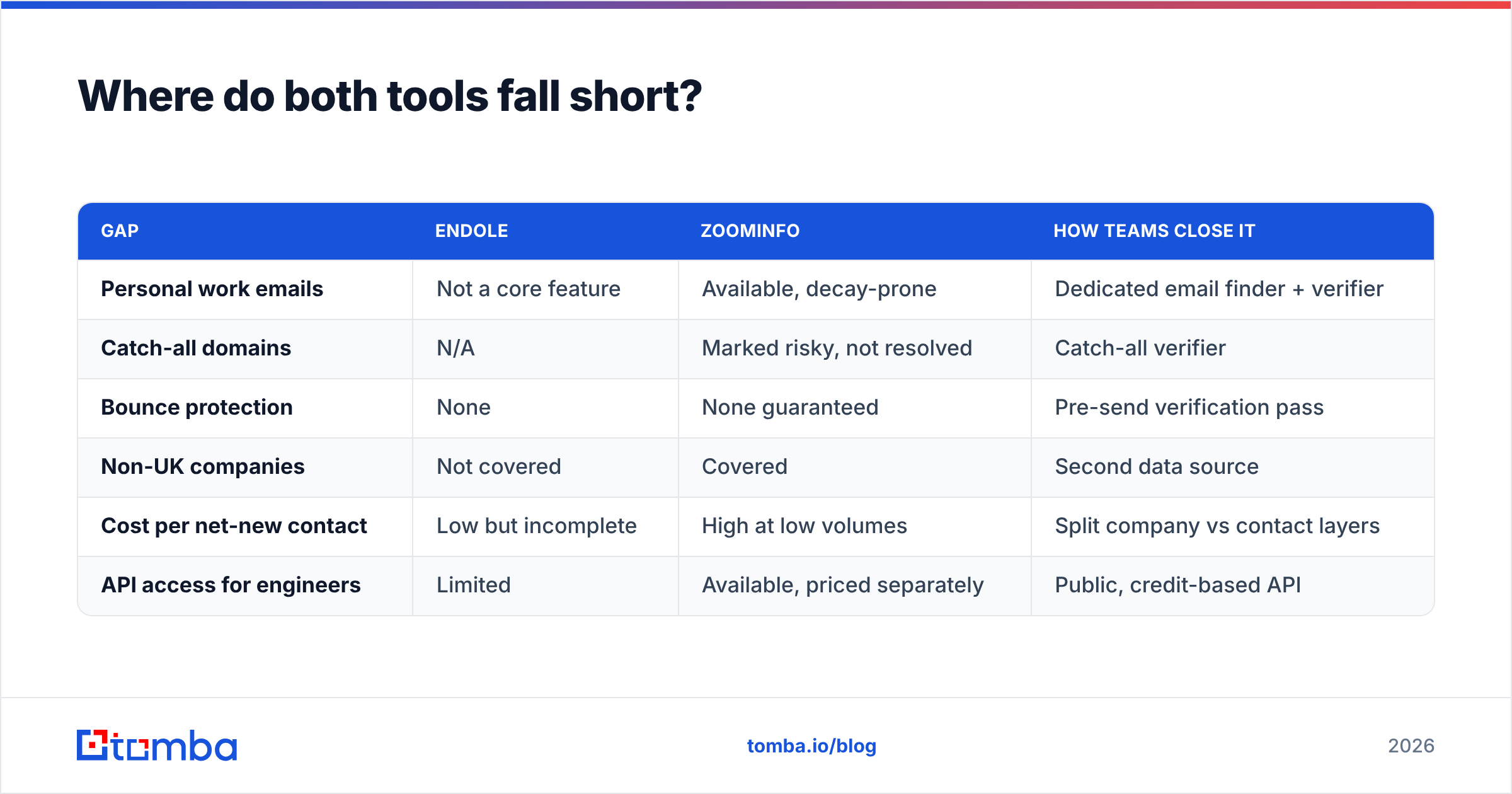
Where do both tools fall short?#
Both platforms sell you a list. Neither sells you deliverability.
That gap wrecks more campaigns than bad targeting does. Say a ZoomInfo export is 12% invalid. You do not just waste 12% of your sends. Your bounce rate climbs past the point where Google and Microsoft start filtering the other 88%. Endole exports have a different problem. They point you at info@ inboxes that nobody reads.
Plan around these gaps, whichever one you buy:
| Gap | Endole | ZoomInfo | How teams close it |
|---|---|---|---|
| Personal work emails | Not a core feature | Available, decay-prone | Dedicated email finder + verifier |
| Catch-all domains | N/A | Marked risky, not resolved | Catch-all verifier |
| Bounce protection | None | None guaranteed | Pre-send verification pass |
| Non-UK companies | Not covered | Covered | Second data source |
| Cost per net-new contact | Low but incomplete | High at low volumes | Split company vs contact layers |
| API access for engineers | Limited | Available, priced separately | Public, credit-based API |
Most teams land in the same place by year two. Keep the cheap official source for company data. Drop the expensive all-in-one. Buy the contact layer from a specialist. It looks messier on an architecture diagram, and it costs far less.
Can you use Endole and a contact tool together?#
Yes. For UK-focused teams it is usually the best return on offer.
The setup takes about an hour:
- Build the account list in Endole. Filter by SIC code, region, turnover band, staff count, and filing date. Export company names and websites.
- Find the decision-makers. Directors come from Endole. Functional roles, such as Head of Marketing or IT Manager, come from LinkedIn or your own research.
- Find the emails. Run each domain and person name through an email finder API. You get the address and a confidence score, instead of a guessed pattern.
- Verify before sending. SMTP checks catch the invalid addresses. They also flag catch-all domains, so you can route those to a safer sequence.
- Enrich and sync. Push the clean records into your CRM. Data enrichment fills in job title, company size, and social profiles.
At a few thousand contacts a month, the added cost is two figures, not five. The added engineering is two API calls.
Sell outside the UK? The same pattern holds. Swap Endole for a company-data source that covers your market. The contact layer stays the same.
Endole vs ZoomInfo: which one wins in 2026?#
Neither wins alone. That is the honest answer.
Endole wins on UK company truth, clear pricing, and data you can defend. ZoomInfo wins on global contact reach, phone data, and buying signals. If someone tells you one beats the other outright, they sell one of them.
The decision tree is short:
- UK only, company-level questions? Endole. Budget an hour to bolt on a contact layer.
- Global, person-level outbound with real budget? ZoomInfo. Negotiate your export credits harder than the seat price.
- UK only outbound on a startup budget? Endole plus a specialist email tool. This setup beats both on cost per booked meeting.
- Global outbound on a startup budget? Skip both. Build lists from your own research. Spend the money on accuracy at the contact layer.
Whatever you pick, treat contract length as a feature. A published, monthly price is worth real money next to a twelve-month deal you cannot exit. That is doubly true in a year when your target market may shift twice.
Close the contact gap without a five-figure contract. Whichever company-data source you pick, you still need a valid email for the person you want to reach. Tomba Email Finder turns names and domains into verified work emails with a confidence score. It is backed by SMTP verification and a public API. It is free for 25 searches a month, then $49/mo, with no seats and no auto-renewal surprises. Point it at your Endole export or your ZoomInfo list, and see how much survives verification.
Related guides#
Ready to find emails that actually work?
Join 150,000+ professionals who stopped guessing and started sending. Free credits on signup — no credit card required.
Get the Tomba newsletter
Practical outbound tactics and product updates — once every two weeks.
About the author