Enrichley vs ZoomInfo 2026: Data, Pricing, and the Verdict
One is a lightweight, credit-based enrichment tool. The other is a seat-and-contract data giant. Here is how Enrichley and ZoomInfo actually compare on coverage, cost, contracts, and match rates in 2026 — and when a cheaper third option wins.
TL;DR
- Enrichley is a lightweight, self-serve enrichment tool built around credits and API calls. You sign up, buy a bucket of credits, and enrich. No sales call, no annual lock-in.
- ZoomInfo is an enterprise B2B data platform sold on annual contracts with per-seat licensing, credit caps, and a formal procurement cycle. Public list pricing does not exist.
- The real decision is not "which has better data." It is how much data you actually consume per month and whether you can tolerate a 12-month commitment.
- Under roughly 20,000 enriched records a year, an annual ZoomInfo contract is almost always the wrong shape. Above that — plus intent, org charts, and CRM-native workflows — ZoomInfo starts earning its price.
- If you mainly need verified work emails and firmographics rather than intent signals and conversation intelligence, a focused finder like Tomba covers 80% of the job at a fraction of the cost.
What are Enrichley and ZoomInfo?#
They are not the same category of product, which is exactly why the comparison keeps coming up.
ZoomInfo is a full go-to-market data platform. It sells a contact and company database, buying-intent signals, org charts, technographics, conversation intelligence (via its Chorus acquisition), and a sales engagement layer. It is bought by RevOps and sales leadership, provisioned per seat, and wired into Salesforce or HubSpot as the system of record for contact data. You can read the vendor's own positioning at zoominfo.com, and there is a neutral company overview on Wikipedia.
Enrichley sits at the other end of the spectrum: a self-serve enrichment layer. You give it an email, a domain, or a partial record, and it returns filled-in fields — job title, company size, industry, social profiles, sometimes a verified email. It is credit-metered, API-first, and aimed at growth teams, agencies, and technical operators who want to enrich a list without booking a demo.
That structural difference drives everything else. One is a platform you commit to. The other is a utility you meter.
Because Enrichley is a younger, fast-moving product, confirm its current tier names and credit rates on its own site before you commit budget — vendor pricing pages in this category change more often than review sites update.
How do Enrichley and ZoomInfo compare head-to-head?#
| Dimension | Enrichley | ZoomInfo | Tomba |
|---|---|---|---|
| Product type | Self-serve enrichment API/UI | Enterprise GTM data platform | Email finder + verification suite |
| Purchase model | Credit packs, monthly | Annual contract, per seat | Monthly plans, no contract |
| Entry price | Low, credit-based (verify current rate) | Not published; commonly quoted mid five figures/yr | Free tier, then $49/mo |
| Free tier | Trial credits | No true free tier | 25 searches/mo |
| Contact database | Enrichment-on-demand, no large browsable DB | 100M+ contacts, browsable with filters | Domain + name lookup, catch-all handling |
| Buyer intent data | No | Yes (core differentiator) | No |
| Org charts / hierarchy | Limited | Yes | No |
| Email verification | Basic | Included | Dedicated verifier + catch-all verifier |
| Phone numbers | Limited | Yes, including direct dials | Yes, via phone finder |
| CRM sync | Via API / Zapier | Native, bidirectional | Native HubSpot, Salesforce, Pipedrive |
| API access | Yes, first-class | Yes, usually a paid add-on | Yes, on all paid plans |
| Time to first value | Minutes | 2–6 weeks (procurement + onboarding) | Minutes |
| Best for | Enrichment of an existing list | Enterprise outbound at scale | Finding and verifying B2B emails |
The table is the argument. Enrichley and Tomba are both "swipe your card and start" tools. ZoomInfo is a purchase decision with legal review attached.

What does each one actually cost in 2026?#
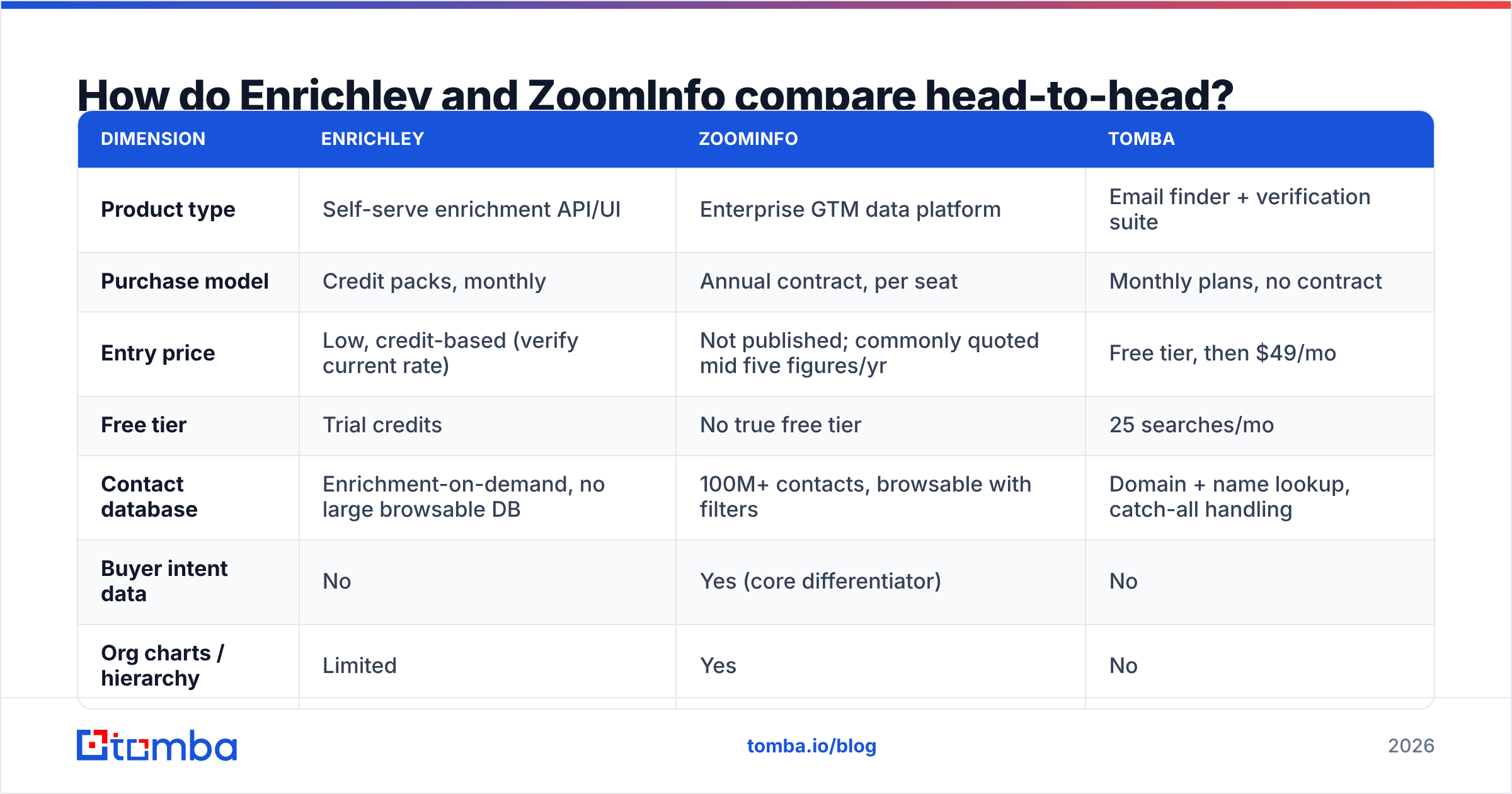
ZoomInfo does not publish list prices, and that is deliberate. Pricing is quoted per seat, per module, and per credit block, then negotiated. Buyer reports aggregated on G2 and procurement marketplaces consistently land in the same territory: entry contracts in the low five figures annually, mid-market deployments in the $25,000–$40,000 range, and enterprise builds well past that once intent, Chorus, and Engage are bundled.
More important than the headline number are the terms that surface late in the cycle:
- Annual minimum, billed up front or quarterly. Month-to-month is rarely offered. If your outbound program is paused in Q3, you still pay.
- Credit caps per seat. Exports are metered. Teams routinely burn a year's credits in five months and then buy an overage block at a worse rate.
- Seat sprawl. Every SDR who needs a Chrome extension is another seat. Costs scale with headcount, not with usage.
- Auto-renewal windows. Standard terms include a notice period — miss it and you are in for another year. Read the clause before signing, not after.
- Module unbundling. Intent, org charts, and the API frequently sit outside the base license. The demo shows everything; the quote covers a subset.
Enrichley's model inverts all five. You buy credits, you spend credits, and when you stop spending, you stop paying. There is no notice period to miss. The trade is depth: you are not getting intent signals or a browsable database of 100 million contacts for the price of a credit pack, and you should not expect to.
For reference on the third path, Tomba pricing runs a free tier at 25 searches per month, Starter at $49/mo, Growth at $99/mo, and Pro at $249/mo, with Enterprise quoted. That is the same "no contract" logic as Enrichley, applied to a finder-plus-verifier stack rather than a general enrichment API.
Which one has better data accuracy?#
Accuracy is the wrong single question. Split it into three:
- Coverage — does the provider have a record for this person at all?
- Match rate — of the rows you submit, what percentage come back enriched?
- Correctness — of the rows that come back, what percentage are still true today?
ZoomInfo wins coverage almost by definition. A database built over two decades with a contributory network and a research operation will have more records than a younger enrichment layer, especially in North American mid-market and enterprise accounts. That is its moat.
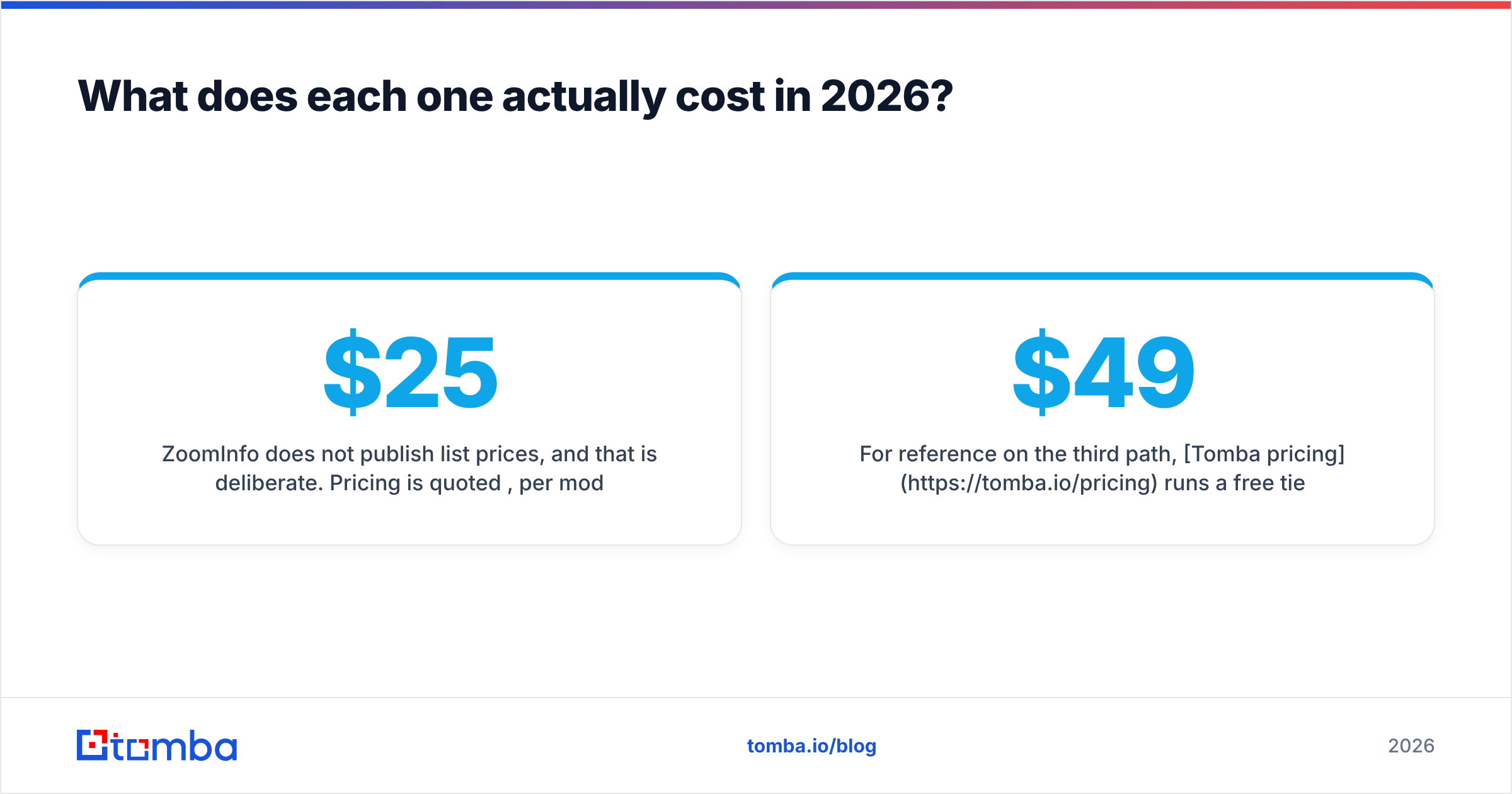
Where ZoomInfo gets criticized in review threads is correctness decay. B2B contact data rots at roughly 25–30% per year through job changes alone. A large database is a large surface area for stale rows. Buyers report finding contacts who left the company two roles ago, and direct dials routing to a disconnected extension. The database being big does not make any individual row fresh.
Enrichley-class tools tend to have narrower coverage but pull from live sources at query time, which can make individual records fresher — at the cost of returning nothing at all for harder targets, particularly outside the US and in companies under 50 employees.
The practical consequence: whichever provider you pick, verify before you send. Do not treat a match as a deliverable address. Run the output through an email verifier and route catch-all domains to a catch-all verifier rather than guessing. A 3% bounce rate is the difference between a warm sending domain and one that quietly stops reaching inboxes.
How should you actually test both before buying?#
Do not evaluate on the vendor's sample list. Evaluate on yours.
- Build a 200-row truth set. Pull real accounts from your ICP, including the awkward ones: sub-50-employee companies, non-US domains, and roles below VP.
- Submit the same file to every vendor. Same columns, same order, same day. Anything else is not a comparison.
- Measure match rate and correctness separately. Match rate is what the vendor reports. Correctness is what you confirm by verification and manual spot-check on 30 random rows.
- Price the result per usable record, not per credit. A tool with a 60% match rate at half the price beats an 85% match rate at triple the price — until you factor in the hours your team spends filling the gap.
- Test the API, not just the UI. If enrichment will live inside a workflow, the UI experience is irrelevant. Check rate limits, latency, and error semantics on the API or its equivalent.
That five-step test takes an afternoon and routinely saves five figures. Nobody who runs it regrets it.
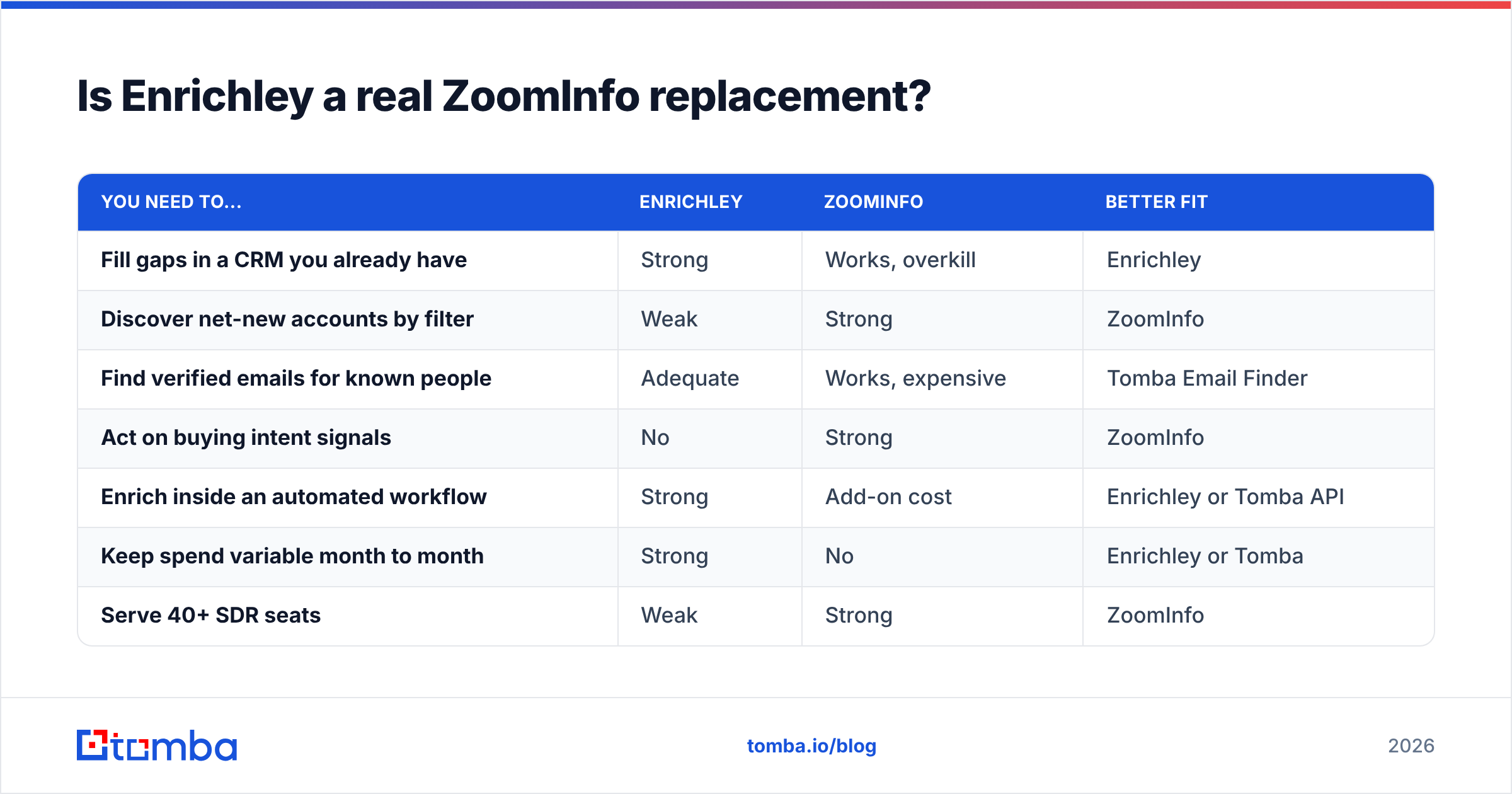
Is Enrichley a real ZoomInfo replacement?#
For most teams asking the question, partially — and that is fine.
Enrichley replaces the enrichment job: taking known records and filling in missing fields. It does not replace the discovery job: browsing a database of 100 million contacts, filtering by revenue band and technographic, and exporting a net-new list you had no prior knowledge of. Nor does it replace intent, which is genuinely hard to source and is the single most defensible thing ZoomInfo sells.
So the honest framing is:
| You need to... | Enrichley | ZoomInfo | Better fit |
|---|---|---|---|
| Fill gaps in a CRM you already have | Strong | Works, overkill | Enrichley |
| Discover net-new accounts by filter | Weak | Strong | ZoomInfo |
| Find verified emails for known people | Adequate | Works, expensive | Tomba Email Finder |
| Act on buying intent signals | No | Strong | ZoomInfo |
| Enrich inside an automated workflow | Strong | Add-on cost | Enrichley or Tomba API |
| Keep spend variable month to month | Strong | No | Enrichley or Tomba |
| Serve 40+ SDR seats | Weak | Strong | ZoomInfo |
If two or more of your top rows land in the ZoomInfo column, take the demo. If they cluster in the first column, an annual contract is buying capability you will not use.
What do teams actually get wrong here?#
Three failure patterns show up repeatedly.
Buying coverage you cannot process. A team signs a contract that grants 50,000 exports a year, then sends 8,000 emails. The unused 42,000 records were paid for at full price. Match the license to your actual sending capacity, which is bounded by mailbox count and warmup — not by ambition.
Skipping verification because the vendor "already verifies." Every provider claims verification. Every provider still ships stale rows, because the verification happened at ingestion, not at export. Verify at send time. It is the cheapest insurance in the stack.
Confusing enrichment with prospecting. Enrichment improves records you already have. Prospecting creates records you do not. Tools optimized for one are rarely great at the other, and buying an enrichment tool to solve a pipeline problem produces a very clean database and no meetings. If your gap is net-new contacts, look at domain search or a filterable database rather than an enrichment API.
There is also a procurement pattern worth naming: teams comparing Enrichley and ZoomInfo often skip the middle of the market entirely. Providers like BookYourData, which sells verified B2B contact lists on a pay-as-you-go basis, occupy a genuinely useful middle ground for teams that want net-new records without an annual platform commitment. Worth a look before you assume it is a binary choice.
Where does Tomba fit in this comparison?#
Tomba is not trying to be ZoomInfo. It is a focused stack for the part of the funnel where most teams actually leak money: finding and confirming the right work email.
The email finder resolves a name plus a domain into a deliverable address. Domain search pulls every discoverable address at a company. The verifier and catch-all verifier separate real mailboxes from accept-all domains — the failure mode that silently destroys sender reputation. Phone finder, data enrichment, and the API round it out, and everything is available on a $49/mo Starter plan with a free tier to test against your own truth set first.
Where Tomba beats an enterprise contract: cost, speed to value, and no procurement cycle. Where it does not compete: buyer intent, org charts, and conversation intelligence. If those three are central to your motion, ZoomInfo is the correct purchase and no amount of credit-based tooling substitutes for it.
A pattern that works well in practice: use a self-serve finder and verifier as the default layer for day-to-day prospecting, and reserve enterprise data spend for the specific accounts and signals that justify it. Most teams discover the enterprise layer covers 15% of their volume and 70% of their spend.
Which should you choose?#
Choose ZoomInfo if you have 15+ reps, a defined enterprise ICP concentrated in North America, budget approval for an annual commitment, and intent data is part of your account prioritization. Negotiate hard, cap the auto-renewal, and get the API included in writing.
Choose Enrichley if your job is filling in a CRM you already own, your volume is variable, and you want an API you can wire up this afternoon without a signature. Verify current credit rates on the vendor site before committing.
Choose Tomba if the bottleneck is getting verified, deliverable email addresses at a predictable cost — with the verification, catch-all handling, and bulk tooling in one place rather than stitched across three vendors.
Start with the free tier and run your own 200-row truth set against it. Give Tomba Email Finder the same accounts you would hand a ZoomInfo rep in a demo, verify every result, and compare cost per usable record. If the numbers favor an enterprise contract, you will have real evidence to negotiate with. If they do not, you just saved a year of budget.
Related guides#
Ready to find emails that actually work?
Join 150,000+ professionals who stopped guessing and started sending. Free credits on signup — no credit card required.
Get the Tomba newsletter
Practical outbound tactics and product updates — once every two weeks.
About the author