Enrow vs SalesIntel (2026): Which B2B Email Data Wins?
Enrow sells verification accuracy. SalesIntel sells human-verified contact records. They solve different halves of the same problem — and the wrong pick burns either your budget or your domain.
Enrow vs SalesIntel comes down to one question: do you need to check emails you already have, or buy the contacts in the first place? Enrow does the first job. SalesIntel does the second. Pick the wrong one and you either pay for data you never use or burn your sending domain.
TL;DR
- Enrow is a verification-first tool. It takes emails you already have, or finds them from a name and domain, then tells you which ones are safe to send to. That includes catch-all domains. It is not a database.
- SalesIntel is a database-first vendor. It sells contact records: human-verified emails, direct dials, company data, and intent. You buy them on an annual seat-and-credit contract.
- The pricing gap is the real story. Enrow is self-serve and costs tens of dollars a month. SalesIntel is quoted and annual. For a small team it often lands in five figures per year.
- Neither is a complete stack alone. Enrow gives you no leads. SalesIntel gives you no independent check before you press send.
- Need to find an email, confirm it, and export it? A combined finder plus verifier like Tomba does both jobs at $49/mo, with no procurement cycle.
What are Enrow and SalesIntel, actually?#
They get compared because both promise "accurate B2B emails." They arrive at that promise from opposite directions.
Enrow is a French email-verification and email-finding API. Its pitch is accuracy on the hard cases. Catch-all domains are the big one. Standard SMTP checks return "unknown" there, and most vendors shrug. Enrow runs deeper logic to turn those unknowns into a usable verdict. You feed it a list or call the API, and it returns valid, invalid, or risky. Some plans add a finder that guesses and checks an address from a first name, last name, and company domain.
SalesIntel is a US B2B data platform. It runs a contact and company database with human-verified records, and a research team re-confirms those contacts on a rolling cycle. You also get direct-dial phone numbers, tech stack data, and buyer intent through partners. You search by title, industry, employee count, tech stack, or intent signal. Then you export the results or push them to your CRM.
That difference matters more than any feature grid. Enrow answers "is this address real?" SalesIntel answers "who should I be emailing at all?"

Enrow vs SalesIntel: how do they differ structurally?#
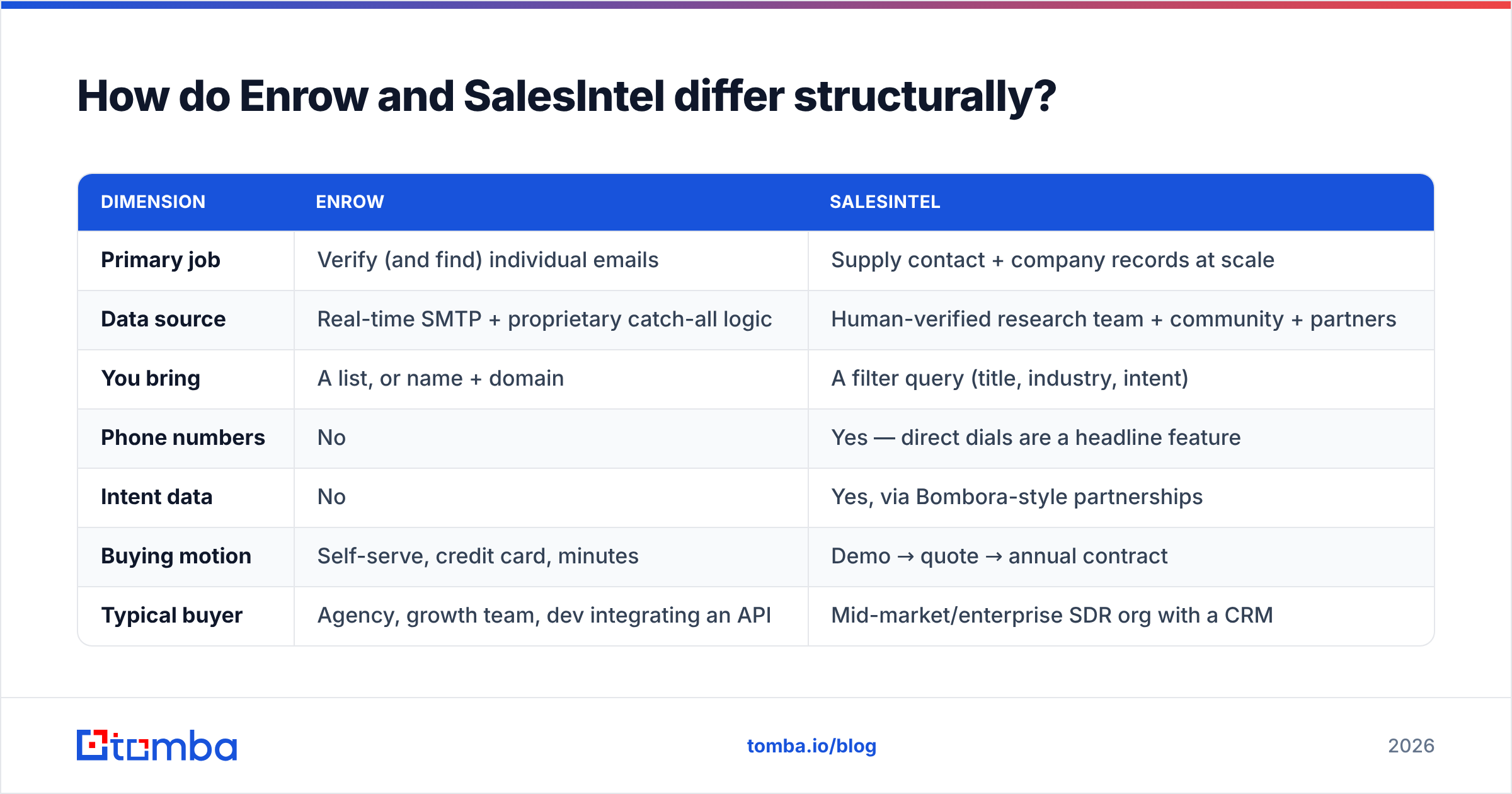
| Dimension | Enrow | SalesIntel |
|---|---|---|
| Primary job | Verify (and find) individual emails | Supply contact + company records at scale |
| Data source | Real-time SMTP + proprietary catch-all logic | Human-verified research team + community + partners |
| You bring | A list, or name + domain | A filter query (title, industry, intent) |
| Phone numbers | No | Yes — direct dials are a headline feature |
| Intent data | No | Yes, via Bombora-style partnerships |
| Buying motion | Self-serve, credit card, minutes | Demo → quote → annual contract |
| Typical buyer | Agency, growth team, dev integrating an API | Mid-market/enterprise SDR org with a CRM |
| Contract floor | Monthly, cancel anytime | Annual, seat-based minimums |
Read that table as a fork, not a scoreboard. A three-person agency sends 4,000 cold emails a month. A 25-rep SDR team runs account-based plays. The two are not shopping for the same thing.
Which one is more accurate on email data?#
Accuracy means two different things here, and vendors use that to their advantage.
Enrow's accuracy is verification accuracy. Of the addresses you submit, how many did it classify correctly? Enrow claims the best results on catch-all domains, which is where most verifiers quietly fail. That claim is easy to test. Take 500 addresses you already know the answer for, run them through, and count. Any verifier that fails that test is not worth paying for.
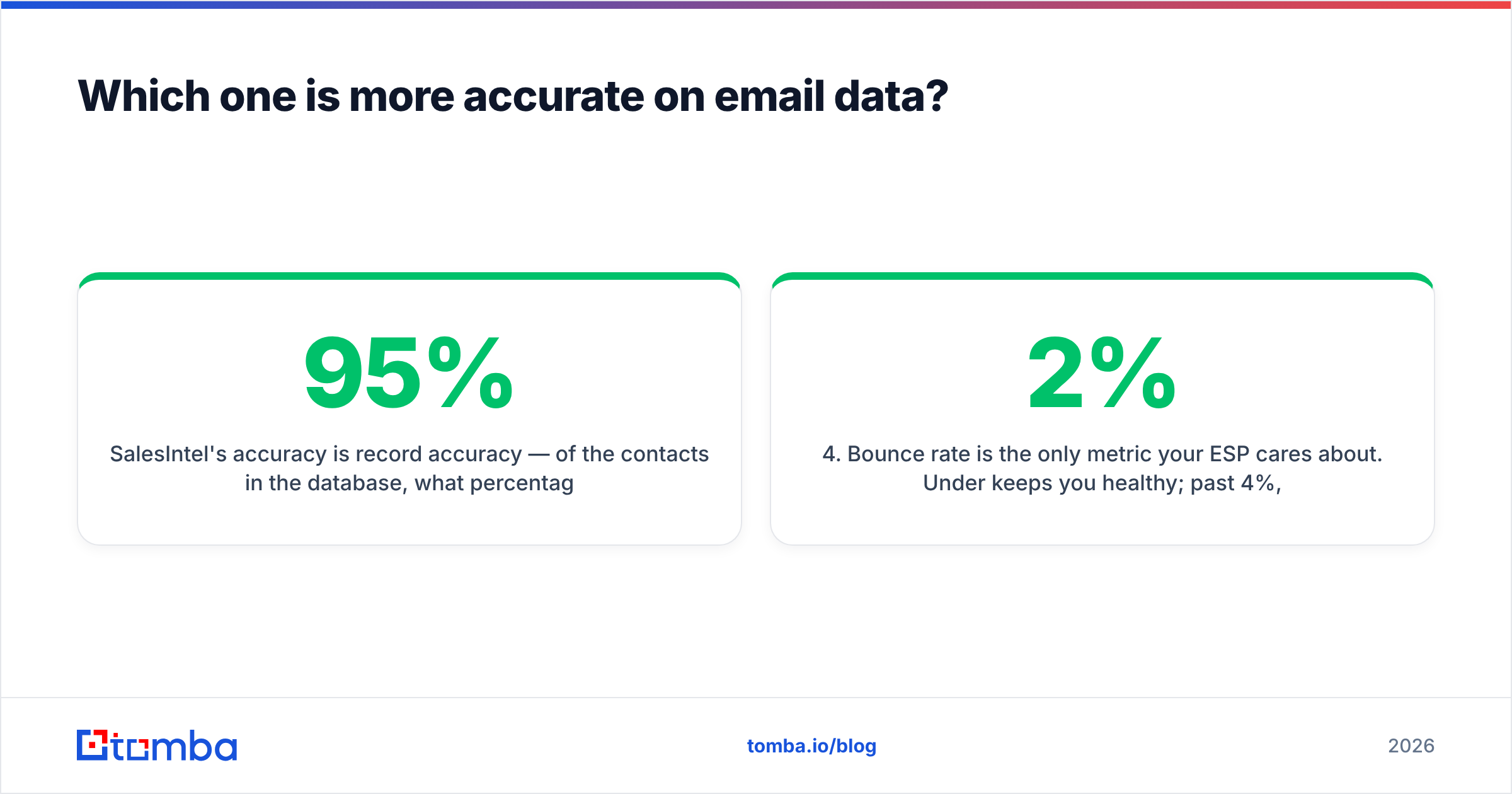
SalesIntel's accuracy is record accuracy. Of the contacts in the database, how many still work there with a live email? SalesIntel markets 95%+ accuracy backed by human re-checks. The honest caveat: every database decays. Roughly 25–30% of B2B contacts change roles each year. Re-verification is a race against that decay, not a cure. A record checked nine months ago is a guess today.

The practical consequence: a database's "verified" flag is a timestamp, not a guarantee. Some teams export from a database and send with no fresh check. They are the ones filing deliverability tickets three weeks later. If you buy SalesIntel, you still want a verification layer. If you buy Enrow, you still need somewhere to get contacts.
A few more things are worth knowing before you compare percentages:
- Sample composition decides the number. Benchmarks run on Gmail-heavy consumer lists look great. The same tool on catch-all company domains often collapses. Ask what the test set looked like.
- "Risky" is not a free pass. Some vendors inflate accuracy by dumping unclear addresses into a "risky" bucket and leaving it out of the math. Check whether unknowns count against the score.
- Coverage and accuracy trade off. A tool that only returns addresses it is sure about scores beautifully. It also finds half as many people. Compare hit rate and accuracy together, never separately.
- Bounce rate is the only metric your ESP cares about. Under 2% keeps you healthy. Past 4%, Google and Microsoft start to throttle you. Your vendor dashboard has no say in it.
Enrow vs SalesIntel: how does pricing compare?#
This is where most evaluations end.
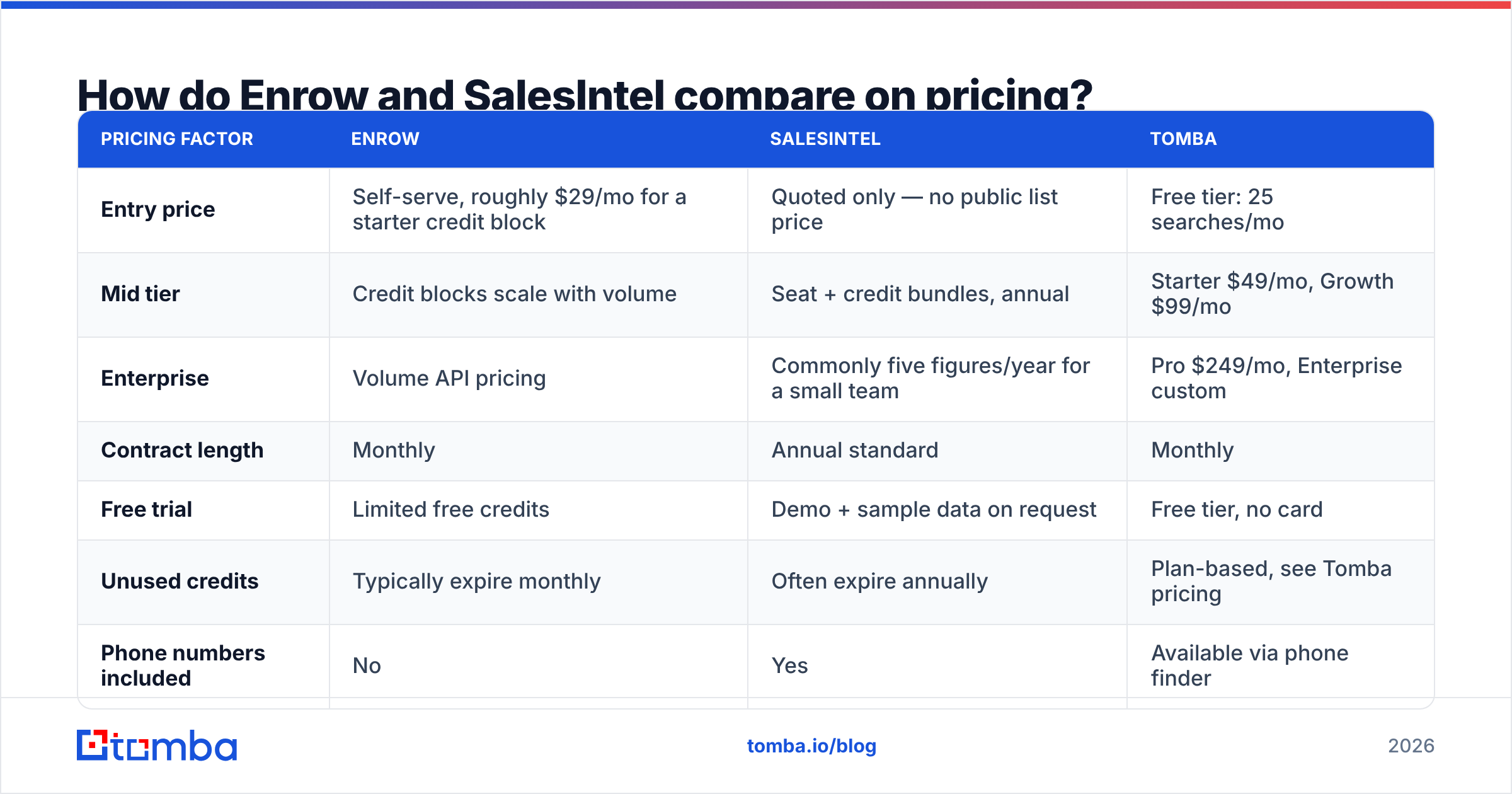
| Pricing factor | Enrow | SalesIntel | Tomba |
|---|---|---|---|
| Entry price | Self-serve, roughly $29/mo for a starter credit block | Quoted only — no public list price | Free tier: 25 searches/mo |
| Mid tier | Credit blocks scale with volume | Seat + credit bundles, annual | Starter $49/mo, Growth $99/mo |
| Enterprise | Volume API pricing | Commonly five figures/year for a small team | Pro $249/mo, Enterprise custom |
| Contract length | Monthly | Annual standard | Monthly |
| Free trial | Limited free credits | Demo + sample data on request | Free tier, no card |
| Unused credits | Typically expire monthly | Often expire annually | Plan-based, see Tomba pricing |
| Phone numbers included | No | Yes | Available via phone finder |
Prices move, so check each vendor's page before you commit. But the shape is stable, and the shape should drive your decision:
- Enrow is a line item. You can expense it, test it in an afternoon, and cancel it in a click.
- SalesIntel is a procurement event. Demo, security review, legal, annual commitment. That overhead is fine when you're buying intent data and direct dials for a full SDR org. It is absurd when all you needed was 3,000 verified emails a month.
Here is the failure I see over and over. A seven-person startup signs a $14k annual data contract. It uses 18% of the credits. Then it renews out of habit. Check your last 90 days of real usage before you sign anything annual.
When should you pick Enrow?#
Pick Enrow when verification is the constraint and you already have a lead source.
- You have a scraped or purchased list and need to clean it before it touches your sending domain.
- Catch-all domains are eating your market. Most verifiers flag those domains "unknown." A tool that resolves them instead grows the list you can actually work.
- You're building a product and want a verification endpoint behind your own signup flow or enrichment pipeline.
- Your budget is a credit card, not a PO. No annual commitment, no seat math.
- You already pay for a data source. An existing database, Sales Navigator exports, or inbound signups. You just need the last-mile check.
Where Enrow leaves you exposed: it does not build your list. You still need a way to source leads upstream. You also get no phone numbers and no intent signals.
When should you pick SalesIntel?#
Pick SalesIntel when the constraint is knowing who to contact and you have a real budget behind a real sales org.
- You run multi-channel outbound. Direct dials matter if half your motion is cold calling and half is email. Few email-first tools give you usable phone data.
- Intent data changes your prioritization. If you can act on surging accounts within 48 hours, intent is worth paying for. If you can't, it's an expensive dashboard.
- You need research on demand. SalesIntel will task a human team to verify contacts at accounts you name. That helps in niche markets where automated sources come up empty.
- Compliance and procurement matter. Enterprise buyers often need documented sourcing, DPAs, and a vendor who will sit through a security review. That is a fair reason to pay more.
- Your CRM is the system of record and you want native HubSpot or Salesforce sync instead of CSV shuffling.
Where SalesIntel leaves you exposed: cost per usable contact if you underuse credits, thin coverage outside North America, and the standing need to re-check exports before you send.

Is there a middle option between the two?#
Yes, and it's where a lot of teams land after trying both.
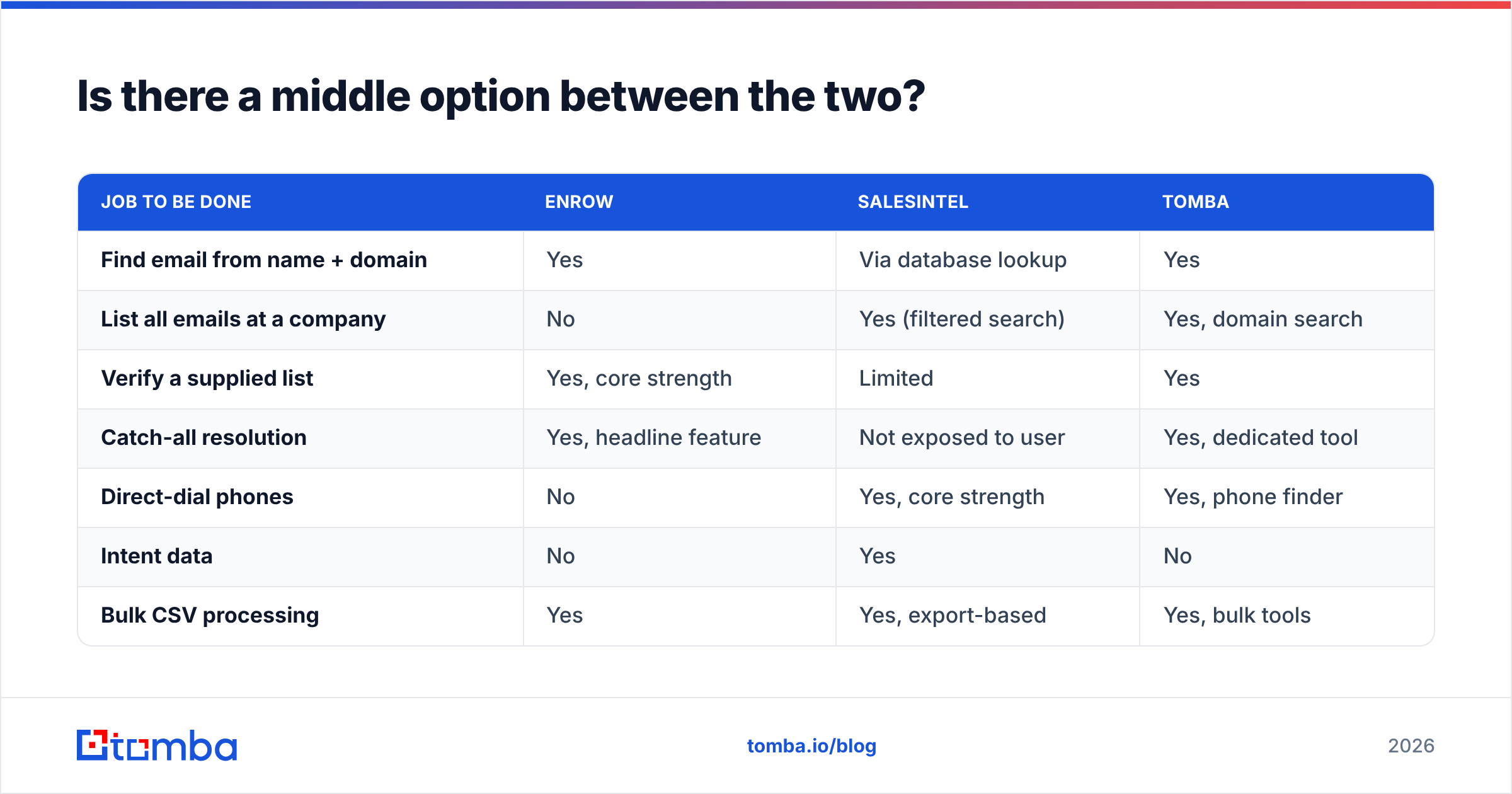
The gap in Enrow vs SalesIntel is obvious once you name it. Enrow verifies but doesn't source. SalesIntel sources but leaves verification to you. Buying both means two contracts, two credit pools, and a CSV round-trip between them.
A combined finder and verifier removes that step. Tomba's email finder resolves an address from a name and company domain. Domain search returns every address it can find at a company, with the pattern and a confidence score. The email verifier, including a dedicated catch-all verifier, runs the deliverability check in the same place. Nothing to export between find and verify.
| Job to be done | Enrow | SalesIntel | Tomba |
|---|---|---|---|
| Find email from name + domain | Yes | Via database lookup | Yes |
| List all emails at a company | No | Yes (filtered search) | Yes, domain search |
| Verify a supplied list | Yes, core strength | Limited | Yes |
| Catch-all resolution | Yes, headline feature | Not exposed to user | Yes, dedicated tool |
| Direct-dial phones | No | Yes, core strength | Yes, phone finder |
| Intent data | No | Yes | No |
| Bulk CSV processing | Yes | Yes, export-based | Yes, bulk tools |
| API + CLI + MCP | API | API | API, CLI, MCP, Sheets, Excel |
| Starts at | ~$29/mo | Quoted, annual | Free, then $49/mo |
Tomba is not the pick if you need buyer intent scoring or a research team you can task by hand. That is genuinely SalesIntel's territory. It is the pick if your daily job is simpler: find a company, find the right contact, confirm the address is deliverable, and push it into your sequence.
One more option is worth knowing. If you want a pre-built, pay-once list instead of a subscription, BookYourData sells verified B2B lists on a credit model with a bounce guarantee. That buying motion suits one-off campaigns better than any of the three above.
How should you run the evaluation?#
Do not decide from feature pages. Run this in one week:
- Build a 200-row truth set. Pull contacts you can confirm yourself: customers, partners, and people you emailed in the last 60 days. Add 20 you know have left their company.
- Run the same 200 through each tool. Measure hit rate and accuracy separately. Hit rate is how many returned an address. Accuracy is how many were right.
- Weight your target domain mix. If 40% of your targets are catch-all, your test set should be 40% catch-all. Otherwise you are testing the wrong thing.
- Send a 100-contact pilot. Watch bounce rate and sender reputation in Google Postmaster Tools. A vendor's dashboard number means nothing next to your real bounce rate.
- Price it per usable contact. Not per credit. Divide the total annual cost by the contacts that were correct and deliverable. That number reorders the vendors more often than not.
Cross-check what you find against real reviews on G2. Filter to companies your size. Enterprise reviewers and solo operators describe very different products.
The verdict#
Choose Enrow if you have leads and need them clean. It fits best when catch-all domains block a real chunk of your list and you want an API you can wire up this afternoon.
Choose SalesIntel if you're a funded sales org that needs direct dials, intent, and human research. You also need pipeline that justifies an annual contract.
Choose neither if your real need is simpler: find verified work emails at companies you have already picked, cheaply, without a demo call. That covers most outbound teams. It does not need a five-figure contract or a second tool to clean the output.
Start with the Tomba Email Finder free tier. You get 25 searches a month with no card. Run it against your own truth set next to whichever of these two you're weighing. Find, verify, and export in one place. If the numbers say a specialist tool wins for your ICP, you will have proof instead of a vendor's slide.
Related guides#
Ready to find emails that actually work?
Join 150,000+ professionals who stopped guessing and started sending. Free credits on signup — no credit card required.
Get the Tomba newsletter
Practical outbound tactics and product updates — once every two weeks.
About the author