Enrow vs Snappy Leads (2026): Which Email Finder Wins?
Enrow leans on verification accuracy, Snappy Leads on waterfall coverage. We break down hit rates, bounce risk, real pricing and API depth — then name the better fit for your outbound motion.
TL;DR
- Enrow is built around one promise: emails that do not bounce. It runs a find-then-verify chain and refuses to bill you for results it cannot stand behind, which makes it a deliverability-first tool rather than a volume tool.
- Snappy Leads is built around coverage. It waterfalls across multiple data sources and adds phone numbers, so you get more rows filled — with more variance in what those rows are worth.
- Pricing is credit-based on both sides, and both entry tiers land under $50/mo. The real cost difference shows up in wasted credits, not sticker price.
- Pick Enrow if bounce rate is your bottleneck and your ICP lives at companies with clean, discoverable email patterns. Pick Snappy Leads if you need phone plus email and you are willing to verify separately.
- If you need both — high hit rate and verification and a real API — a consolidated platform like Tomba usually beats stitching two point tools together.
What are Enrow and Snappy Leads?#
Two tools solve the same painful step in outbound: you have a name and a company, you need a mailbox that accepts mail.
Enrow positions itself as an email finder with verification baked into the same call. Its pitch is accuracy-first — it would rather return "not found" than hand you a guess. That philosophy shows up in the product: results come back with a confidence state, catch-all domains get special handling, and the company markets heavily on low bounce rates rather than database size.
Snappy Leads takes the opposite starting point. It is a contact-enrichment layer that queries several providers in sequence — a waterfall — and returns the first acceptable hit. Alongside work emails it surfaces mobile numbers, which matters if your motion is multichannel rather than email-only.
The difference in philosophy is the whole comparison. One optimises for precision, the other for recall. Neither is wrong; they are wrong for different teams.

How do Enrow and Snappy Leads compare head-to-head?#
Here is the practical breakdown. Pricing is what the vendors listed publicly at the time of writing — always confirm on their own pages before you commit, because credit-based tools revise packaging often.
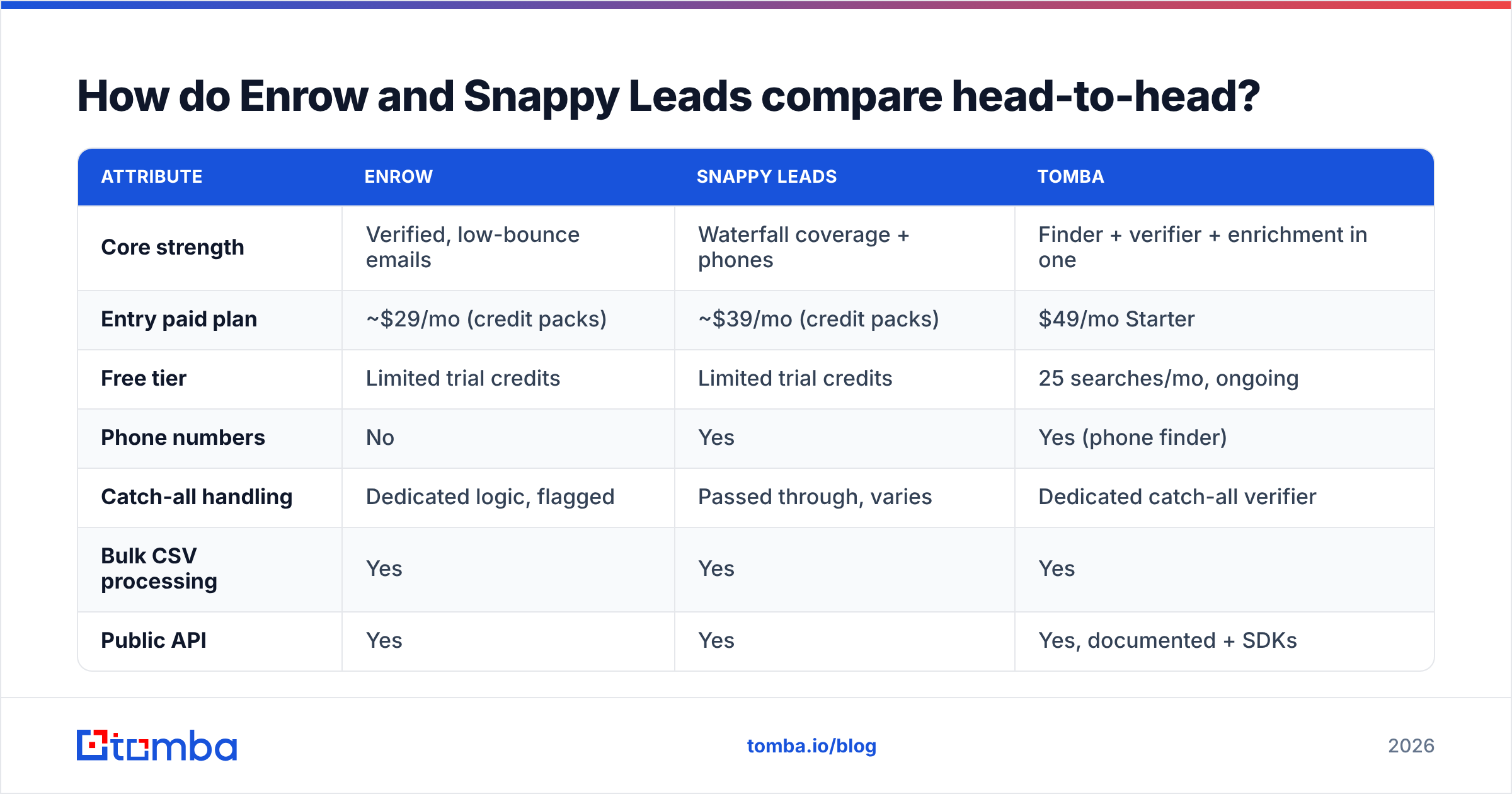
| Attribute | Enrow | Snappy Leads | Tomba |
|---|---|---|---|
| Core strength | Verified, low-bounce emails | Waterfall coverage + phones | Finder + verifier + enrichment in one |
| Entry paid plan | ~$29/mo (credit packs) | ~$39/mo (credit packs) | $49/mo Starter |
| Free tier | Limited trial credits | Limited trial credits | 25 searches/mo, ongoing |
| Phone numbers | No | Yes | Yes (phone finder) |
| Catch-all handling | Dedicated logic, flagged | Passed through, varies | Dedicated catch-all verifier |
| Bulk CSV processing | Yes | Yes | Yes |
| Public API | Yes | Yes | Yes, documented + SDKs |
| Native spreadsheet add-on | Limited | Limited | Excel + Google Sheets |
| Chrome extension | Yes | Yes | Yes |
| Best for | Deliverability-sensitive senders | Multichannel SDR teams | Teams consolidating vendors |
Read that table as three columns of trade-offs, not a scoreboard. Enrow wins on the row that matters if you are getting throttled by mailbox providers. Snappy Leads wins if your reps dial as much as they email. A consolidated platform wins if you are tired of reconciling two credit balances and two APIs.
Which one actually finds more valid emails?#
This is where most comparisons go wrong, because "hit rate" and "accuracy" are different numbers and vendors quote whichever flatters them.
Hit rate is the share of your input rows that come back with any email. Accuracy is the share of those returned emails that actually accept mail. A tool can post a 90% hit rate and still wreck your domain if a third of those addresses bounce.
Enrow's design pushes accuracy up by suppressing low-confidence guesses. In practice you see a lower hit rate and a much lower bounce rate. Snappy Leads' waterfall pushes hit rate up by trying more sources, which means more rows filled — and a wider spread of confidence on those rows.

The honest way to evaluate this yourself:
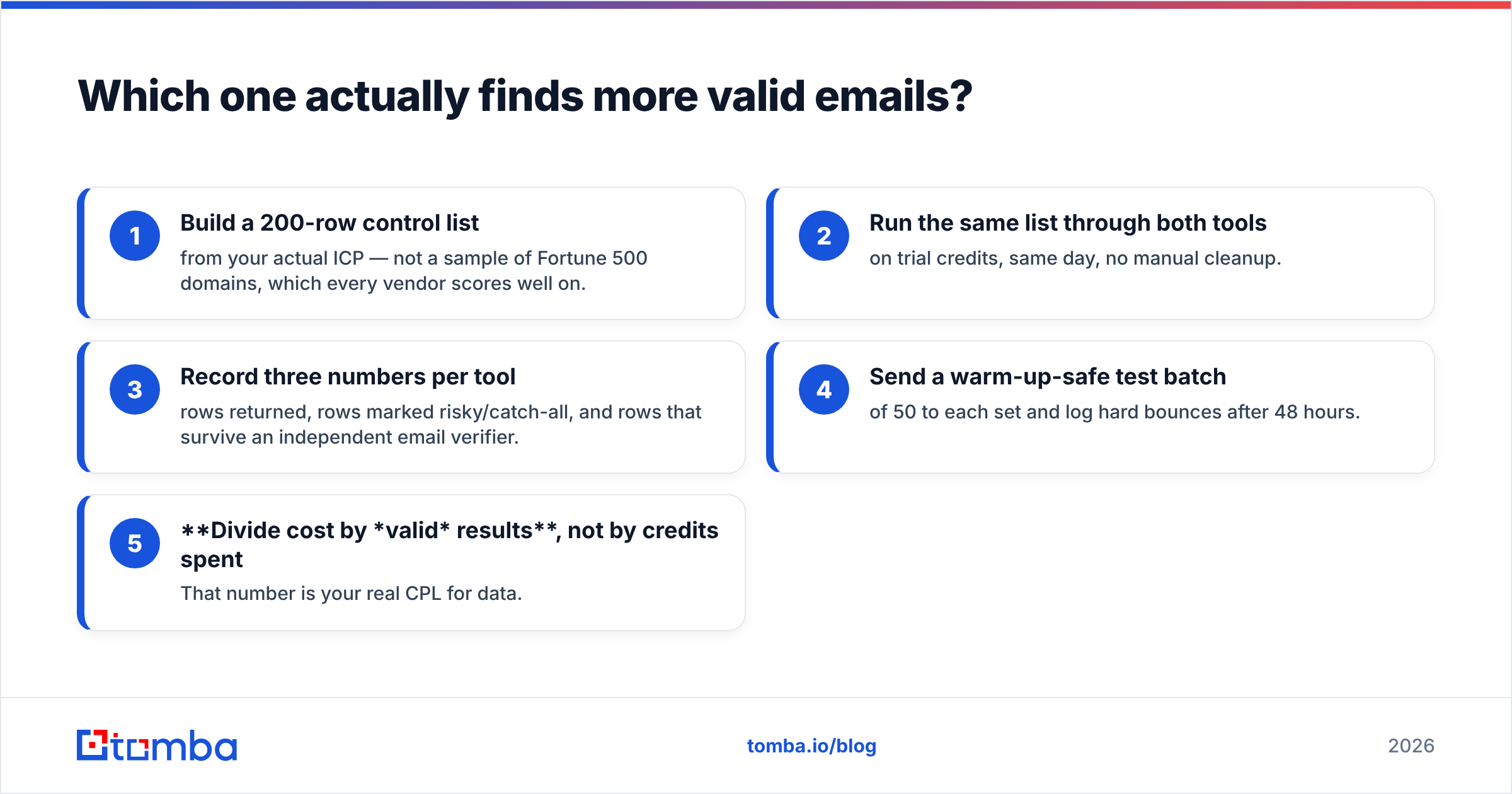
- Build a 200-row control list from your actual ICP — not a sample of Fortune 500 domains, which every vendor scores well on.
- Run the same list through both tools on trial credits, same day, no manual cleanup.
- Record three numbers per tool: rows returned, rows marked risky/catch-all, and rows that survive an independent email verifier.
- Send a warm-up-safe test batch of 50 to each set and log hard bounces after 48 hours.
- Divide cost by valid results, not by credits spent. That number is your real CPL for data.
Most teams discover their vendor ranking flips once step 5 is done. A tool that costs 40% more per credit but returns twice the deliverable addresses is the cheaper tool.
How does pricing really work on each?#
Both run on credits, and both have the same trap: a credit is consumed by an attempt, not necessarily by a usable result. Enrow's model is friendlier here because it aims not to charge for unfound or unverifiable results. Snappy Leads' waterfall can burn more credits per row when it queries several sources before landing a hit.
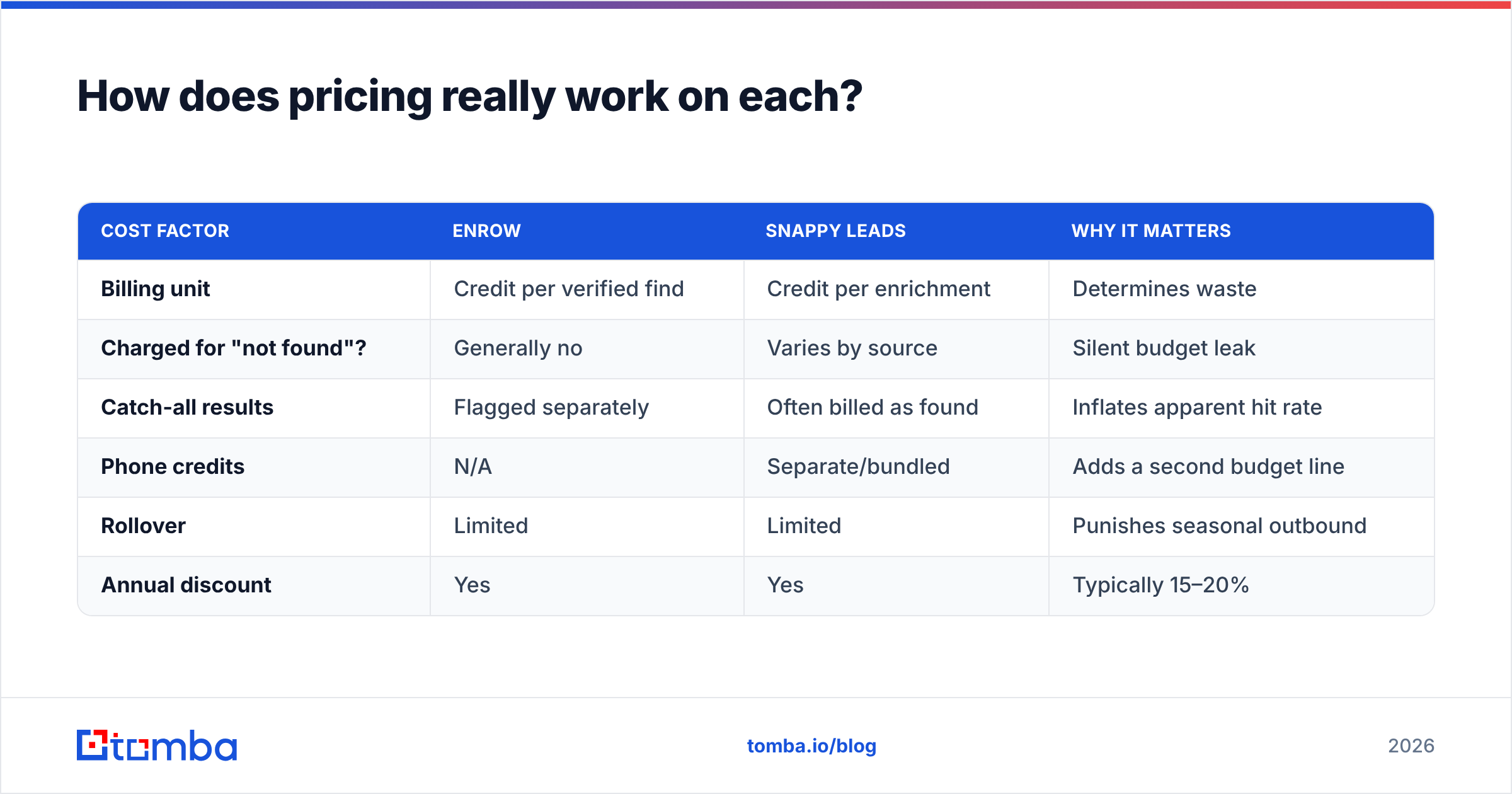
| Cost factor | Enrow | Snappy Leads | Why it matters |
|---|---|---|---|
| Billing unit | Credit per verified find | Credit per enrichment | Determines waste |
| Charged for "not found"? | Generally no | Varies by source | Silent budget leak |
| Catch-all results | Flagged separately | Often billed as found | Inflates apparent hit rate |
| Phone credits | N/A | Separate/bundled | Adds a second budget line |
| Rollover | Limited | Limited | Punishes seasonal outbound |
| Annual discount | Yes | Yes | Typically 15–20% |
For reference, Tomba pricing runs Free (25 searches/mo), Starter $49/mo, Growth $99/mo, Pro $249/mo, and custom Enterprise — with verification included in the same credit pool rather than sold as a separate SKU. That single-pool structure is the quiet reason consolidation often wins: you stop paying twice for the same contact.
One more budget note nobody advertises. If you buy a finder that does not verify, you will end up buying a verifier too. Add that line into your comparison before you sign anything annual.
What about API, integrations and workflow fit?#
If a human is copy-pasting results out of a web app, you have already lost the efficiency argument. Judge these tools on how well they disappear into your stack.
- API depth. Both expose REST endpoints. Check rate limits, whether verification is a separate call or bundled, and whether the response includes a confidence score you can branch on. The Tomba API returns finder and verifier states in one payload with official SDKs, which removes a whole class of glue code.
- CRM sync. Ask whether enrichment writes back to HubSpot or Salesforce natively or via Zapier. A Zapier hop means per-task costs and latency you will feel at volume.
- Spreadsheet reality. Most RevOps work still happens in a sheet. A native Google Sheets or Excel function beats a CSV round-trip by a wide margin, and neither Enrow nor Snappy Leads leads here.
- Bulk throughput. For list-building sprints, bulk email finder style batch processing with async webhooks matters more than single-lookup speed.
- Catch-all strategy. Roughly a third of B2B domains are catch-all. If your tool dumps them into "valid," your bounce rate is a lie waiting to surface. A dedicated catch-all verifier step is not optional at scale.
Where does each tool fall short?#
No vendor writes this section about itself, so here it is.
Enrow's limits. The precision-first design means genuinely lower coverage on long-tail domains, small consultancies, and regions with sparse public data. If your ICP is 50-person agencies in emerging markets, you will see a lot of "not found." There is no phone data, so multichannel teams need a second vendor anyway. And its heaviest marketing claims are about bounce rates measured on lists it curated — which is not the same as your list.
Snappy Leads' limits. Waterfalls inherit the weakest link. When a downstream provider returns a stale record, you get a confidently formatted address for someone who left in 2023. Credit consumption is harder to forecast because a single row can trigger multiple source queries. And enrichment tools that bundle phones tend to have uneven compliance posture by region — worth a direct question to their team if you sell into the EU.
Both. Neither is a database. You still need a source of accounts and contacts — a scraped LinkedIn export, a B2B database, or a curated list provider such as BookYourData, which takes a different and perfectly valid approach by selling pre-verified lists rather than per-lookup credits. Enrichment tools make lists better; they do not create demand.
What do reviewers and users actually say?#
Third-party review sites are noisy but useful for spotting patterns. On G2 and similar directories, the recurring themes for accuracy-first finders are praise for low bounce rates alongside complaints about coverage gaps — exactly what the design predicts. Waterfall enrichment tools draw the mirror-image feedback: strong fill rates, occasional stale records, and confusion about credit burn.

Treat individual star ratings as noise. Read the two-star and four-star reviews — those are where people describe actual workflows instead of scoring a feeling.
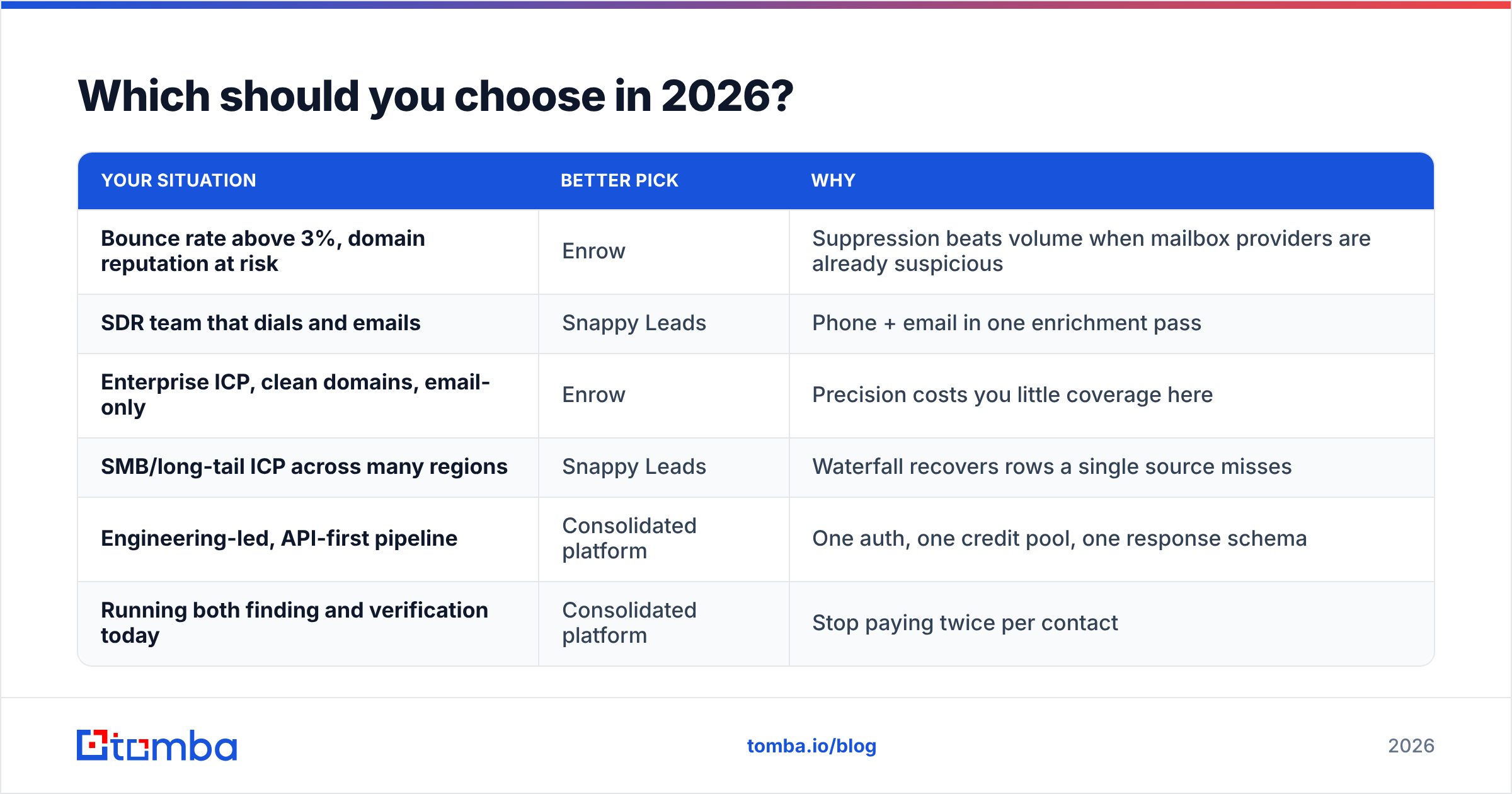
Which should you choose in 2026?#
Here is the decision framed by situation rather than by feature checklist.
| Your situation | Better pick | Why |
|---|---|---|
| Bounce rate above 3%, domain reputation at risk | Enrow | Suppression beats volume when mailbox providers are already suspicious |
| SDR team that dials and emails | Snappy Leads | Phone + email in one enrichment pass |
| Enterprise ICP, clean domains, email-only | Enrow | Precision costs you little coverage here |
| SMB/long-tail ICP across many regions | Snappy Leads | Waterfall recovers rows a single source misses |
| Engineering-led, API-first pipeline | Consolidated platform | One auth, one credit pool, one response schema |
| Running both finding and verification today | Consolidated platform | Stop paying twice per contact |
The uncomfortable answer for a lot of teams is "neither, exactly." If you are already paying for a finder and a verifier and an enrichment layer, the biggest available win is not switching between Enrow and Snappy Leads — it is collapsing three line items into one.
That is the case for evaluating a platform that does domain search, person-level finding, verification, catch-all checks and enrichment against a single credit balance. You lose the specialisation of a point tool. You gain a workflow where a contact goes in one end and a verified, enriched record comes out the other without a CSV in between.
How should you run the evaluation?#
Give yourself a week and a rule: no decision without data from your own list.
- Freeze a control list. 200 rows, real ICP, no cherry-picking.
- Trial all candidates in parallel. Same day, same input, no manual fixes.
- Verify independently. Run every returned address through a neutral checker so no vendor grades its own homework.
- Send a controlled batch. 50 addresses per tool, measure hard bounces at 48 hours.
- Compute cost per deliverable contact. Total spend divided by addresses that survived step 4.
- Check the API before you buy. Build one live call. If it takes more than an hour, that friction never goes away.
That process costs you a few hundred dollars in trial credits and saves you a year of paying for the wrong tool.
Ready to test a finder that verifies in the same step?#
If your shortlist is Enrow vs Snappy Leads, add a third column and run all three against the same 200 rows. The Tomba Email Finder returns the address and its verification state in one call, handles catch-all domains explicitly instead of hiding them, and starts free with 25 searches a month — enough to run a real control test before you spend anything. Paid plans begin at $49/mo, and finding, verifying and enriching all draw from the same credit pool, so you are not reconciling three invoices at the end of the quarter.
Run the test on your own list. Let the bounce report pick the winner.
Related guides#
Ready to find emails that actually work?
Join 150,000+ professionals who stopped guessing and started sending. Free credits on signup — no credit card required.
Get the Tomba newsletter
Practical outbound tactics and product updates — once every two weeks.
About the author