Enrow vs Warpleads: Which B2B Email Tool Wins in 2026?
Enrow verifies emails to near-zero bounce. Warpleads exports leads in bulk. They solve different halves of the same problem — here's which one your outbound stack actually needs, and what it costs.
TL;DR
- Enrow and Warpleads are not really competitors. Enrow is a verification-first email finder built to kill bounces. Warpleads is a lead database built to push large volumes of contacts out the door.
- If your problem is bounce rate, Enrow wins. Its waterfall approach and catch-all handling are the whole product.
- If your problem is list volume, Warpleads wins. Unlimited-export plans are cheaper per lead than any credit-metered finder.
- Most teams end up buying both — which is exactly where the math stops working. A single platform with finding, verification, enrichment, and an API covers ~90% of both jobs for less.
- The honest recommendation: pick based on which failure is currently costing you money — dead domains or empty pipelines — and don't pay for a category you're not bottlenecked on.
What are Enrow and Warpleads?#
Enrow is a French email-finding and verification tool that leads with one claim: accuracy. Its pitch is that most finders return a plausible-looking address and let you discover on send day whether it exists. Enrow instead runs a waterfall — checking a contact against multiple data sources and validation methods before returning a result — and labels catch-all domains rather than dumping them into your "valid" bucket. The product surface is deliberately narrow: find, verify, bulk-process, API. That's it.
Warpleads sits on the opposite side of the funnel. It's a B2B lead database with an export-heavy model — the headline feature is unlimited exports on its higher tiers, plus an on-demand list-building service where you describe an ICP and receive a matching contact file. Where Enrow asks "is this specific address real?", Warpleads asks "who should I be emailing at all?"
That distinction matters more than any feature table, because it determines whether the two are alternatives or teammates. If you already have a list of names and companies and you're bleeding bounces, Warpleads doesn't solve your problem. If you have a verified-but-empty CRM, Enrow doesn't either.

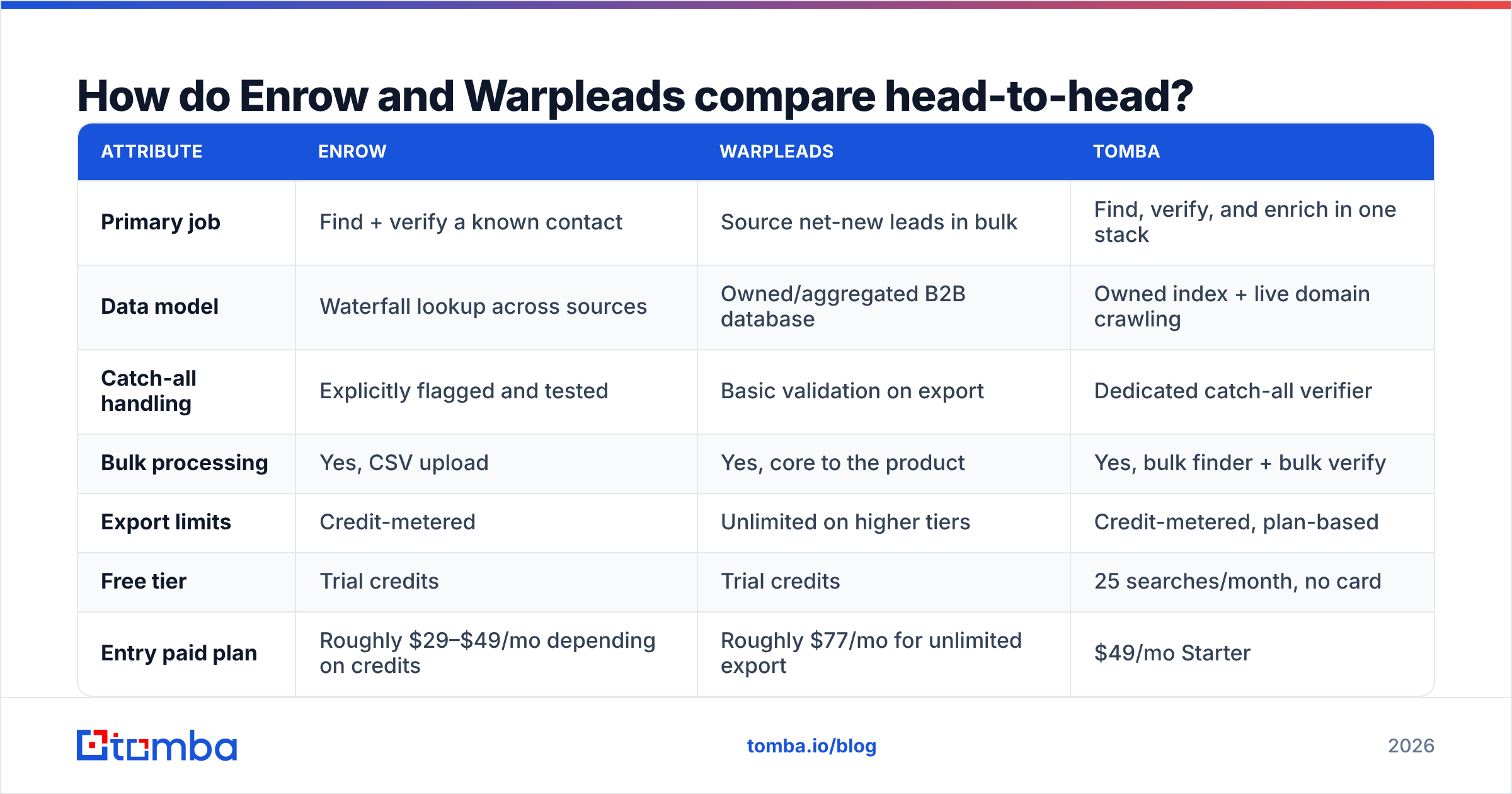
How do Enrow and Warpleads compare head-to-head?#
Here's the practical breakdown across the attributes that actually change your day-to-day workflow. Pricing figures reflect publicly listed plans at time of writing — vendors change tiers frequently, so confirm on each vendor's page before you commit.
| Attribute | Enrow | Warpleads | Tomba |
|---|---|---|---|
| Primary job | Find + verify a known contact | Source net-new leads in bulk | Find, verify, and enrich in one stack |
| Data model | Waterfall lookup across sources | Owned/aggregated B2B database | Owned index + live domain crawling |
| Catch-all handling | Explicitly flagged and tested | Basic validation on export | Dedicated catch-all verifier |
| Bulk processing | Yes, CSV upload | Yes, core to the product | Yes, bulk finder + bulk verify |
| Export limits | Credit-metered | Unlimited on higher tiers | Credit-metered, plan-based |
| Free tier | Trial credits | Trial credits | 25 searches/month, no card |
| Entry paid plan | Roughly $29–$49/mo depending on credits | Roughly $77/mo for unlimited export | $49/mo Starter |
| API access | Yes | Limited | Full REST API, CLI, MCP server |
| Phone numbers | No | Some records | Yes, via phone finder |
| Best for | Deliverability-obsessed senders | High-volume list builders | Teams that need both without two bills |
The pattern is visible immediately: Enrow is deep and narrow, Warpleads is wide and shallow, and the gap between them is where most outbound stacks quietly leak budget.
Which one actually finds more valid emails?#
Wrong question — and it's the question most comparison posts get wrong. These tools are measured on different metrics.
Enrow's relevant metric is bounce rate on delivery. You feed it a name and domain; it returns an address with a confidence label. Success means your ESP accepts the send and the mailbox exists. Users consistently report low single-digit bounce rates when they only send to Enrow's "valid" tier and discard the risky ones. That last part is the catch: strict verification means a lower coverage rate. You'll get fewer addresses back than you submitted, and that's by design.
Warpleads' relevant metric is usable records per export. Success means the file you download contains contacts who match your ICP and whose emails are good enough to send to. Database tools are structurally weaker here — records age, people change jobs at roughly 20% per year, and a database snapshot is only as fresh as its last refresh cycle. Independent reviews on G2 show this pattern across the entire lead-database category, not just one vendor: volume is easy, freshness is hard.

The practical consequence: if you export 5,000 contacts from any database — Warpleads included — and mail them without a verification pass, you should expect a meaningful chunk to bounce. That's not a knock on Warpleads specifically. It's physics. Which is why teams buy Enrow and Warpleads, and why running a separate email verifier over any bulk export is non-negotiable regardless of which vendor you chose.
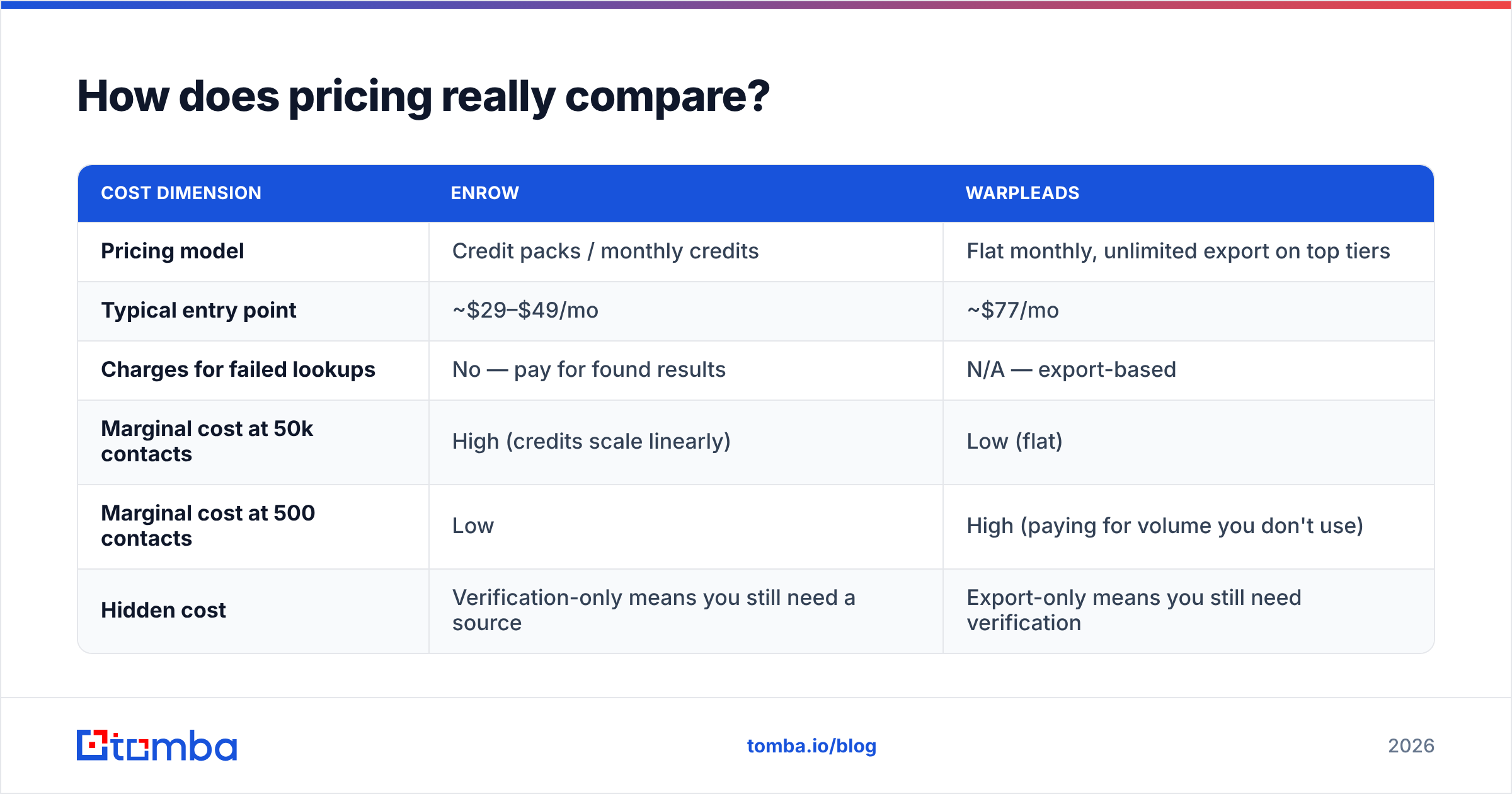
How does pricing really compare?#
Compare cost per usable contact, not cost per credit. A $0.01 credit that returns a catch-all you can't safely send to costs infinity, not a cent.
| Cost dimension | Enrow | Warpleads |
|---|---|---|
| Pricing model | Credit packs / monthly credits | Flat monthly, unlimited export on top tiers |
| Typical entry point | ~$29–$49/mo | ~$77/mo |
| Charges for failed lookups | No — pay for found results | N/A — export-based |
| Marginal cost at 50k contacts | High (credits scale linearly) | Low (flat) |
| Marginal cost at 500 contacts | Low | High (paying for volume you don't use) |
| Hidden cost | Verification-only means you still need a source | Export-only means you still need verification |
The crossover is around volume. Under a few thousand contacts a month, credit metering is cheaper and you're not paying for capacity you'll never touch. Above roughly 20,000 a month, flat-rate unlimited export wins decisively — which is the entire reason Warpleads' model exists.
But notice the "hidden cost" row. Each tool's pricing looks great in isolation and looks worse the moment you price the complete job. Enrow at $49 plus Warpleads at $77 is $126/month for a stack that still doesn't include phone numbers, CRM enrichment, or a production-grade API. For reference, Tomba pricing puts finding, verification, catch-all checks, domain search, and enrichment on one bill at $99/month for the Growth tier — with a free tier at 25 searches a month if you just want to sanity-check accuracy before paying anyone.
Who should choose Enrow?#
Pick Enrow if you can honestly say yes to two or more of these:
- Your bounce rate is above 5% and your domain reputation is trending the wrong way. Enrow's strictness is worth paying for when a burned sending domain costs you weeks.
- You already have your list. You're pulling names from LinkedIn, conferences, partner referrals, or an existing CRM — you need addresses, not audiences.
- You send low-volume, high-value outbound. Two hundred perfectly verified prospects beat twenty thousand maybes when your ACV is five figures.
- Catch-all domains are a real chunk of your TAM. Enterprise and agency-heavy markets skew heavily catch-all, and generic validators return "unknown" on all of them.
- You want a tool that does one thing. Enrow's narrow scope is a feature if you already have a data source you trust.
Where it disappoints: coverage on smaller or non-Western domains, no phone data, and the fact that it will never fill an empty pipeline for you. It's a filter, not a faucet.
Who should choose Warpleads?#
Pick Warpleads if this describes your situation:
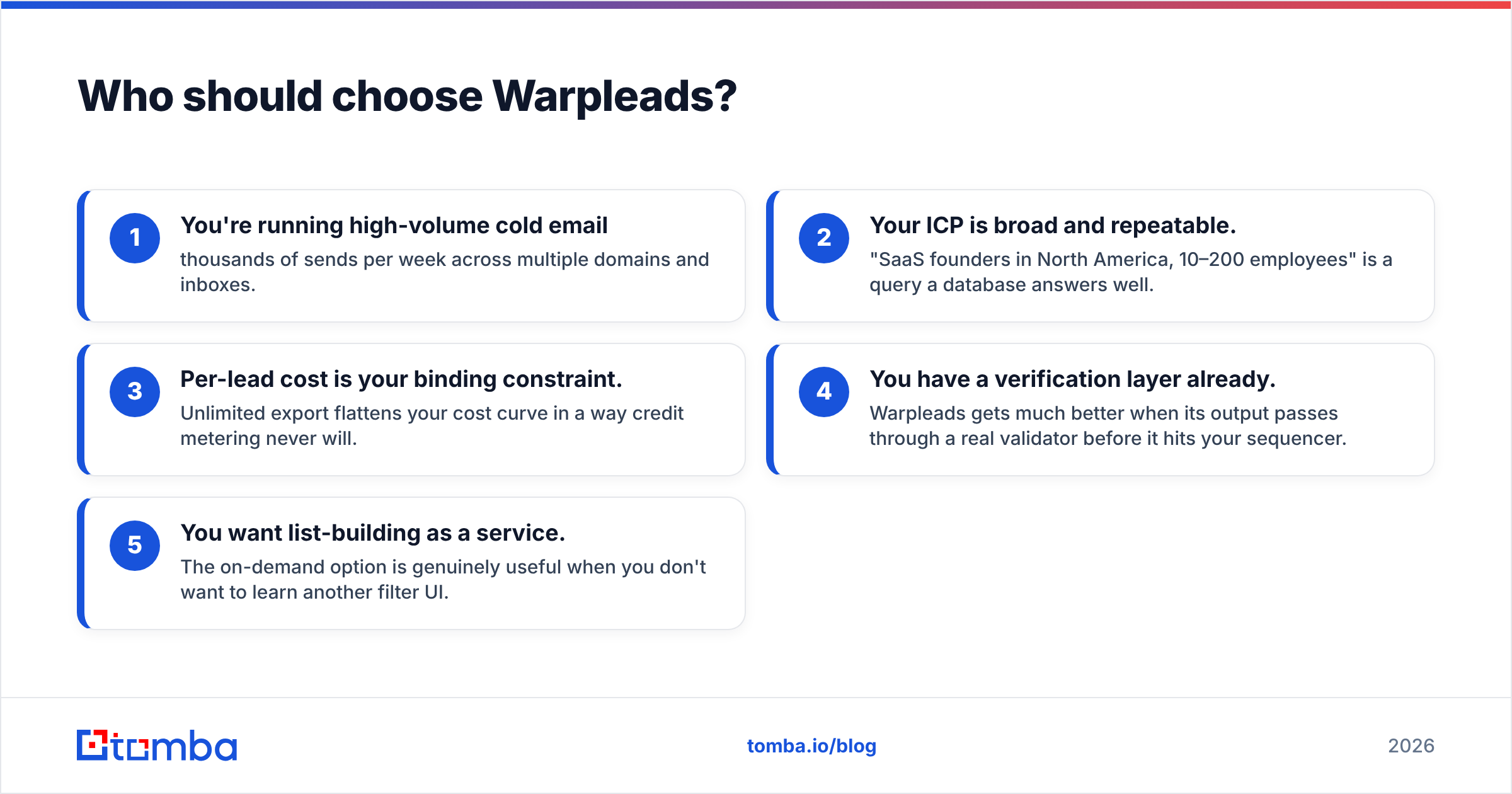
- You're running high-volume cold email — thousands of sends per week across multiple domains and inboxes.
- Your ICP is broad and repeatable. "SaaS founders in North America, 10–200 employees" is a query a database answers well.
- Per-lead cost is your binding constraint. Unlimited export flattens your cost curve in a way credit metering never will.
- You have a verification layer already. Warpleads gets much better when its output passes through a real validator before it hits your sequencer.
- You want list-building as a service. The on-demand option is genuinely useful when you don't want to learn another filter UI.
Where it disappoints: data freshness on niche verticals, limited API depth compared to established data platforms, and — like every database — the silent assumption that a record from six months ago is still accurate. Always dedupe and re-verify before sending. A quick pass through a bulk email finder or verifier will tell you what percentage of the export is actually mailable, and that number is usually lower than you'd like.
Is there a single tool that does both jobs?#
Partially, and it's worth being precise about the "partially."
No single vendor is simultaneously the best pure verifier and the largest lead database. Anyone claiming otherwise is selling. What a consolidated platform does offer is enough of both that the two-tool tax stops making sense for most teams.

Here's how the jobs map onto a consolidated stack:
- Sourcing by company — domain search returns every discoverable address at a domain with role, department, and confidence, which covers the "who works here" job without a database subscription.
- Sourcing by person — the email finder takes a name plus a domain and resolves the pattern, which is the Enrow-shaped job.
- Validation — a standalone verifier plus a dedicated catch-all verifier handles the tier that most tools mark "unknown" and quietly bill you for anyway.
- Enrichment — data enrichment fills job title, company size, and social profiles so your sequences can actually personalize.
- Automation — a documented Tomba API, CLI, and MCP server mean the whole loop runs inside your own systems instead of a monthly CSV ritual.
The honest caveat: if your entire business depends on exporting 100,000+ net-new contacts a month against very broad filters, a dedicated database like Warpleads (or a peer like BookYourData, which competes well on verified-contact guarantees) will still beat a finder-first platform on raw volume economics. Know which side of that line you're on.
What does a working outbound data stack look like in 2026?#
Regardless of vendor, the sequence that works looks like this:
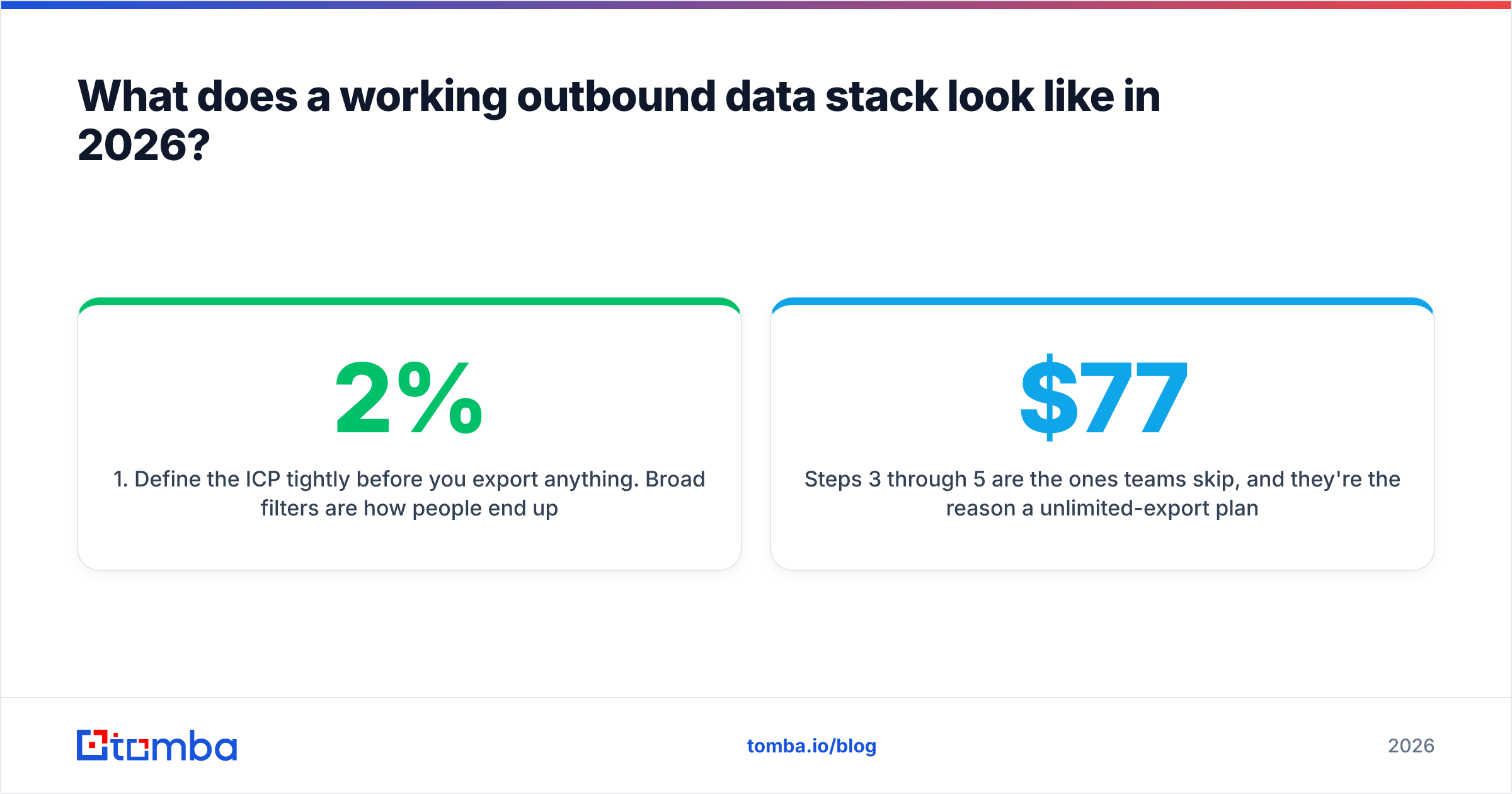
- Define the ICP tightly before you export anything. Broad filters are how people end up with 40,000 leads and a 2% reply rate. Narrow filters plus better research beat volume every quarter.
- Source from two channels, not one. Database exports for breadth, domain-level search for depth on your top accounts. Single-source lists are why everyone's prospects get the same six emails.
- Verify immediately, not before sending. Verification decays. A list verified in March and sent in June is a list that wasn't verified.
- Segment catch-alls separately. Don't discard them and don't blend them into your main sends. Run them on a dedicated warmed domain and measure the bounce rate yourself.
- Enrich before you write. Title, headcount, and tech stack are what turn a template into something worth replying to. Cheap to add, disproportionate effect on response rate.
- Monitor deliverability as a metric, not an event. Bounce rate, spam-complaint rate, and reply rate per domain should be on a dashboard, not discovered after a suspension.
Steps 3 through 5 are the ones teams skip, and they're the reason a $77 unlimited-export plan produces worse results than a $49 plan used properly.
What's the verdict on Enrow vs Warpleads?#
Enrow wins on accuracy and catch-all handling. Warpleads wins on volume economics. Neither wins on completeness.
Choose Enrow if bounces are your bottleneck and you already have names to work with. Choose Warpleads if your pipeline is empty and you need thousands of ICP-matched contacts at a flat monthly cost — then budget for a verification layer on top, because you will need one.
And if you're currently pricing out both, run the arithmetic on a consolidated stack first. Two specialized subscriptions plus a verification tool plus manual CSV plumbing between them is a real cost in dollars and a bigger one in hours.
Start with the free tier before you commit to anyone. Run 25 of your hardest contacts — the catch-all domains, the small European companies, the ones every tool has failed on — through the Tomba Email Finder and compare the results against whatever you're using now. No card, no trial countdown. If the coverage and confidence scores beat what you're getting today, the $49 Starter plan replaces two subscriptions; if they don't, you've lost ten minutes and gained a benchmark you can hold every vendor to.
Related guides#
Ready to find emails that actually work?
Join 150,000+ professionals who stopped guessing and started sending. Free credits on signup — no credit card required.
Get the Tomba newsletter
Practical outbound tactics and product updates — once every two weeks.
About the author