Enterprise B2B Sales: How to Win Six-Figure Deals in 2026
Enterprise deals die in committee, not in the demo. Here's how the 2026 enterprise B2B sales motion actually works — buying committees, procurement gates, multithreading, and the data stack that keeps it moving.
Enterprise B2B sales is a committee sport. This guide maps how the motion works in 2026: who votes, where deals stall, and what gets them moving again.
TL;DR
- Enterprise B2B sales is defined by the buying committee, not the contract size. Once six or more people can say no, the motion changes.
- Gartner puts the typical B2B buying group at 6–10 stakeholders. Each one arrives with their own research. Enterprise deals often run 11–15.
- Single-threaded deals are the top cause of slipped quarters. If your champion leaves, the deal leaves too.
- Procurement, security review, and legal add 30–90 days. No amount of "sales urgency" removes them. Plan for them in the forecast, not around them.
- Contact data is the base layer of enterprise B2B sales. You cannot reach 11 stakeholders with one verified email address.
What is enterprise B2B sales?#
Enterprise B2B sales is the practice of selling high-value, high-complexity products to large organizations. The buying process runs on consensus. It pulls in several departments, formal procurement, and a written business case.
The confusing part: "enterprise" is not a price tag. Plenty of $30K deals inside a Fortune 500 behave like enterprise B2B sales. There is a security questionnaire, a vendor portal, and three approvers. Meanwhile a $150K deal at a fast-moving Series C startup closes in six weeks on a founder's card. What defines the motion is the number of people who can kill it on their own.
Think of it like a mortgage versus a coffee. Nobody asks your coffee to clear a risk review. The mortgage brings in an underwriter you never meet and a lawyer you did not hire. There is also a compliance step that exists because something went wrong for someone else a decade ago. Enterprise selling is the mortgage. Your job is not to be persuasive. Your job is to be the vendor whose paperwork is easiest to say yes to.
How is enterprise selling different from mid-market and SMB?#
The gaps are structural, not cosmetic. Running an SMB playbook in enterprise B2B sales is the most common reason reps who crushed quota at one company flame out at the next.
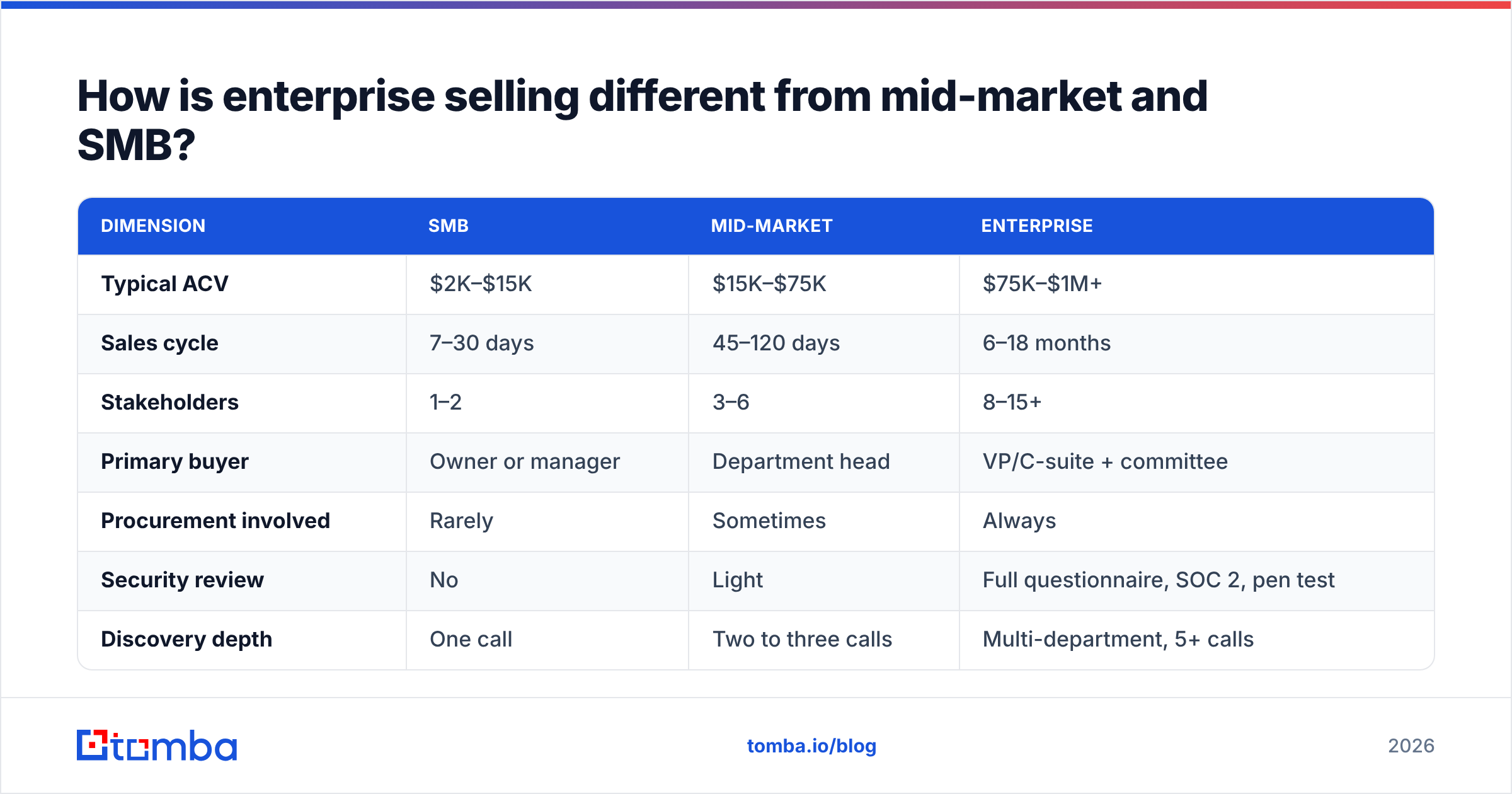
| Dimension | SMB | Mid-market | Enterprise |
|---|---|---|---|
| Typical ACV | $2K–$15K | $15K–$75K | $75K–$1M+ |
| Sales cycle | 7–30 days | 45–120 days | 6–18 months |
| Stakeholders | 1–2 | 3–6 | 8–15+ |
| Primary buyer | Owner or manager | Department head | VP/C-suite + committee |
| Procurement involved | Rarely | Sometimes | Always |
| Security review | No | Light | Full questionnaire, SOC 2, pen test |
| Discovery depth | One call | Two to three calls | Multi-department, 5+ calls |
| Loss reason #1 | Price | Competitor | No decision / status quo |
| Post-sale | Self-serve onboarding | CSM check-ins | Dedicated implementation team |
Look at the loss reason row. In SMB you lose to a cheaper tool. In enterprise you lose to inertia. The committee never reaches consensus, so the project slides to next fiscal year. Roughly half of enterprise pipeline dies this way. It never shows up in your CRM as a competitive loss, because there was no competitor.
Who is actually on the enterprise buying committee?#
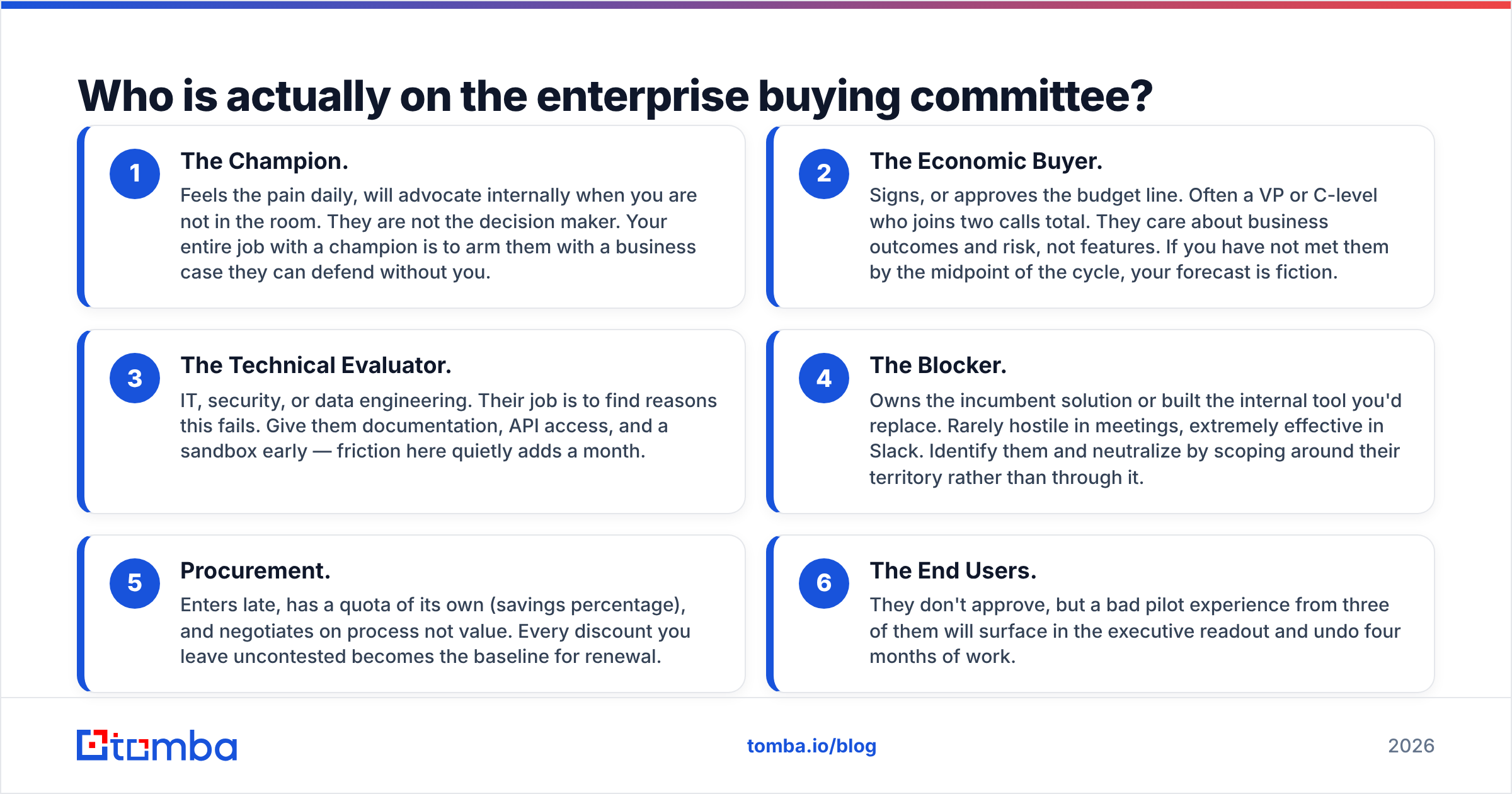
Every enterprise deal has the same cast of characters in different job titles. Map them in your CRM, not in your head.
- The Champion. Feels the pain daily. Argues for you when you are not in the room. They are not the decision maker. Your job is to arm them with a business case they can defend without you.
- The Economic Buyer. Signs the deal, or approves the budget line. Often a VP or C-level who joins two calls total. They care about outcomes and risk, not features. If you have not met them by the midpoint, your forecast is fiction.
- The Technical Evaluator. IT, security, or data engineering. Their job is to find reasons this fails. Give them documentation, API access, and a sandbox early. Friction here quietly adds a month.
- The Blocker. Owns the current tool, or built the internal one you would replace. Rarely hostile in meetings. Very effective in Slack. Find them, then scope around their turf instead of through it.
- Procurement. Enters late. Carries a savings quota of its own. Negotiates on process, not value. Every discount you hand over becomes the baseline at renewal.
- The End Users. They do not approve anything. But a bad pilot for three of them shows up in the executive readout and undoes four months of work.

Why do single-threaded enterprise deals fail?#
Your champion is one reorg away from vanishing. Enterprise B2B sales runs long enough that people change jobs mid-cycle. When your only relationship walks out the door, the deal restarts at zero with someone who never bought the idea.
Multithreading is the counter. The practical bar: at least three live relationships per open deal above $50K, across two or more departments. That means an economic buyer, a technical evaluator, and a champion who all know your name.
Reps resist this. It feels like going around the champion. It is not, if you are open about it. The script is simple. "To build a business case your CFO will approve, I need 20 minutes with the security owner and the budget owner. Can you introduce me, or should I reach out and copy you?" Champions almost always pick one. Either answer moves you forward.
The real blocker is not courage. It is contact data. You cannot email the VP of Revenue Operations without her address. This is where a reliable email finder stops being a prospecting toy and becomes deal infrastructure. You already know the account and the names from LinkedIn. You just need verified addresses for the other seven people in the room. Pair it with a phone finder for the executives who ignore email but pick up on a Tuesday morning.
What does the enterprise sales cycle actually look like?#
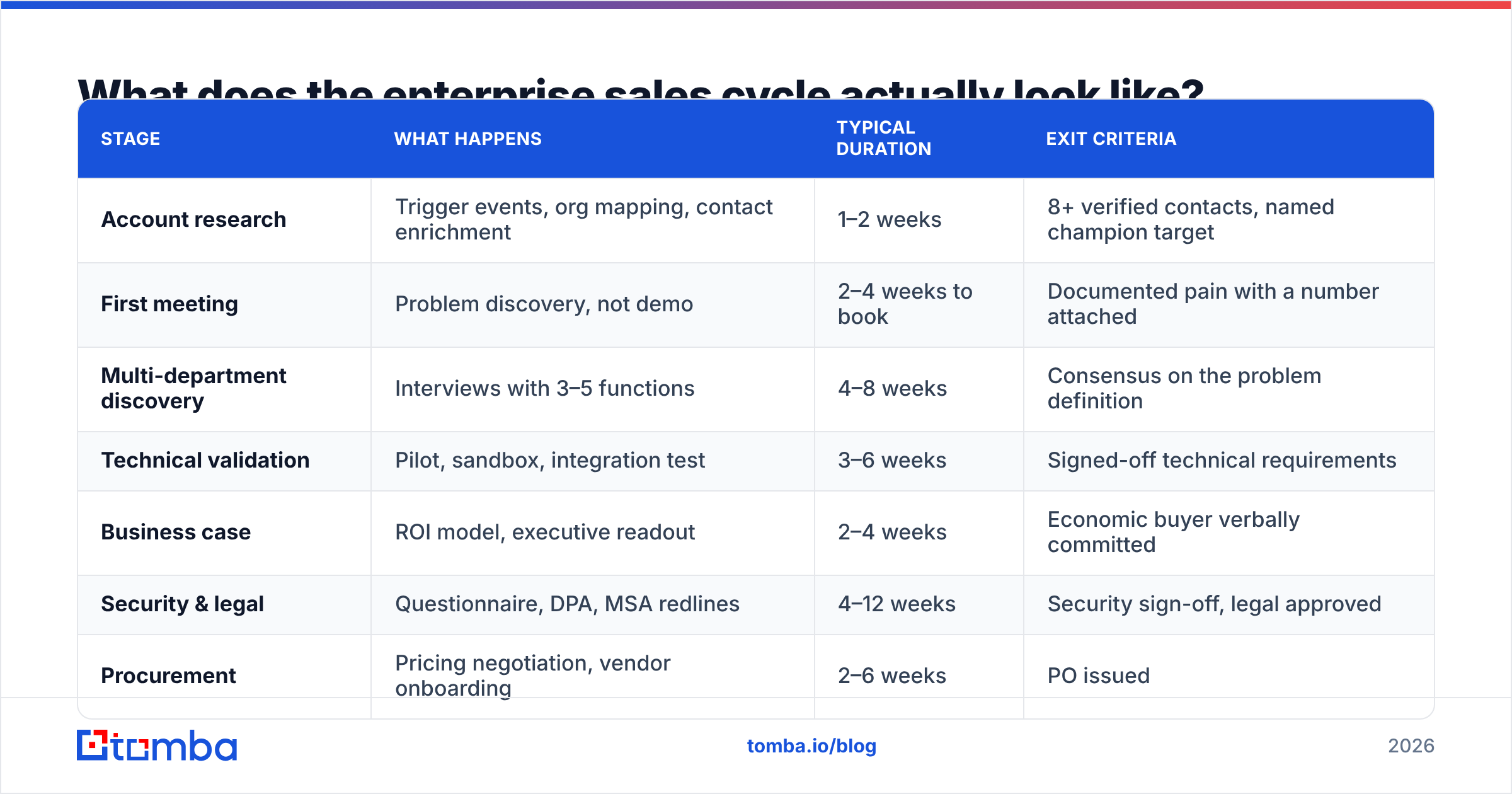
Here is the honest stage map for enterprise B2B sales, with the time each stage really takes. It is not the optimistic version in your methodology deck.
| Stage | What happens | Typical duration | Exit criteria |
|---|---|---|---|
| Account research | Trigger events, org mapping, contact enrichment | 1–2 weeks | 8+ verified contacts, named champion target |
| First meeting | Problem discovery, not demo | 2–4 weeks to book | Documented pain with a number attached |
| Multi-department discovery | Interviews with 3–5 functions | 4–8 weeks | Consensus on the problem definition |
| Technical validation | Pilot, sandbox, integration test | 3–6 weeks | Signed-off technical requirements |
| Business case | ROI model, executive readout | 2–4 weeks | Economic buyer verbally committed |
| Security & legal | Questionnaire, DPA, MSA redlines | 4–12 weeks | Security sign-off, legal approved |
| Procurement | Pricing negotiation, vendor onboarding | 2–6 weeks | PO issued |
| Close | Signature, kickoff scheduled | 1–2 weeks | Countersigned contract |
Add it up. Six to nine months is normal. Two stages surprise people: security and procurement. Together they can eat more calendar time than everything before them. Reps who forecast the month the champion says "we're ready to move" are forecasting the start of the back half, not the end.
The fix is to run those stages in parallel instead of in sequence. Ask for the security questionnaire during technical validation. Send the MSA to legal while you build the ROI model. This is not pushy. Procurement teams like vendors who arrive with the paperwork already in motion.
What does an enterprise business case need to contain?#
Your champion will present your solution in a meeting you cannot attend. Three other projects want the same budget. Assume you get one slide.
That slide needs four things: the cost of the current state in dollars, the change your product delivers, the payback period, and the risk of doing nothing. Feature grids, customer logos, and integration diagrams belong in the appendix.
Build the numbers with your champion, not for them. A model they helped build is one they can defend under questioning. A model you emailed is one they will stumble over when the CFO asks where 30 percent came from.
Be conservative. If the honest range is 20–40 percent, present 20. Enterprise buyers have been burned by vendor math. A small, solid number survives scrutiny. A big, aggressive one does not. HubSpot's sales research keeps finding that trust and credibility beat feature superiority in enterprise B2B sales. Understating your case is a credibility play, not modesty.
How do you build an enterprise prospecting list that doesn't waste six months?#
Enterprise prospecting flips the SMB approach. You want a narrow list with deep data, not a wide list with thin data. Fifty accounts you understand well will beat two thousand you sprayed.
The workflow that holds up:
- Define the ICP tightly. Industry, employee band, tech stack, and at least one trigger: a funding round, an exec hire, an expansion, a rule change. "Companies over 1,000 employees" is not an ICP.
- Map the org before you write a word. For each account, list the eight to twelve people who would touch this decision. Use LinkedIn for the org chart. Then resolve the details — a LinkedIn finder turns profile URLs into verified work emails, so your map has addresses on it, not just names.
- Enrich for context, not just contact. Job history, mutual connections, recent posts, tools in use. Data enrichment at the account level lets you open with something specific instead of "I noticed you're in the SaaS space."
- Verify before you send. A bounce to a VP can flag your domain inside the account and burn the whole company. Run every address through an email verifier first. You get one shot per account here, not a thousand.
- Sequence by role, not by list. The note to the security lead and the note to the CFO should share no sentences. Same account, same problem, different consequence.
Gartner's research on the B2B buying journey found buyers spend only about 17 percent of the process with suppliers. That time is then split across every vendor in the running. So your face time with any one stakeholder may be under an hour across nine months. Every touch has to carry weight.

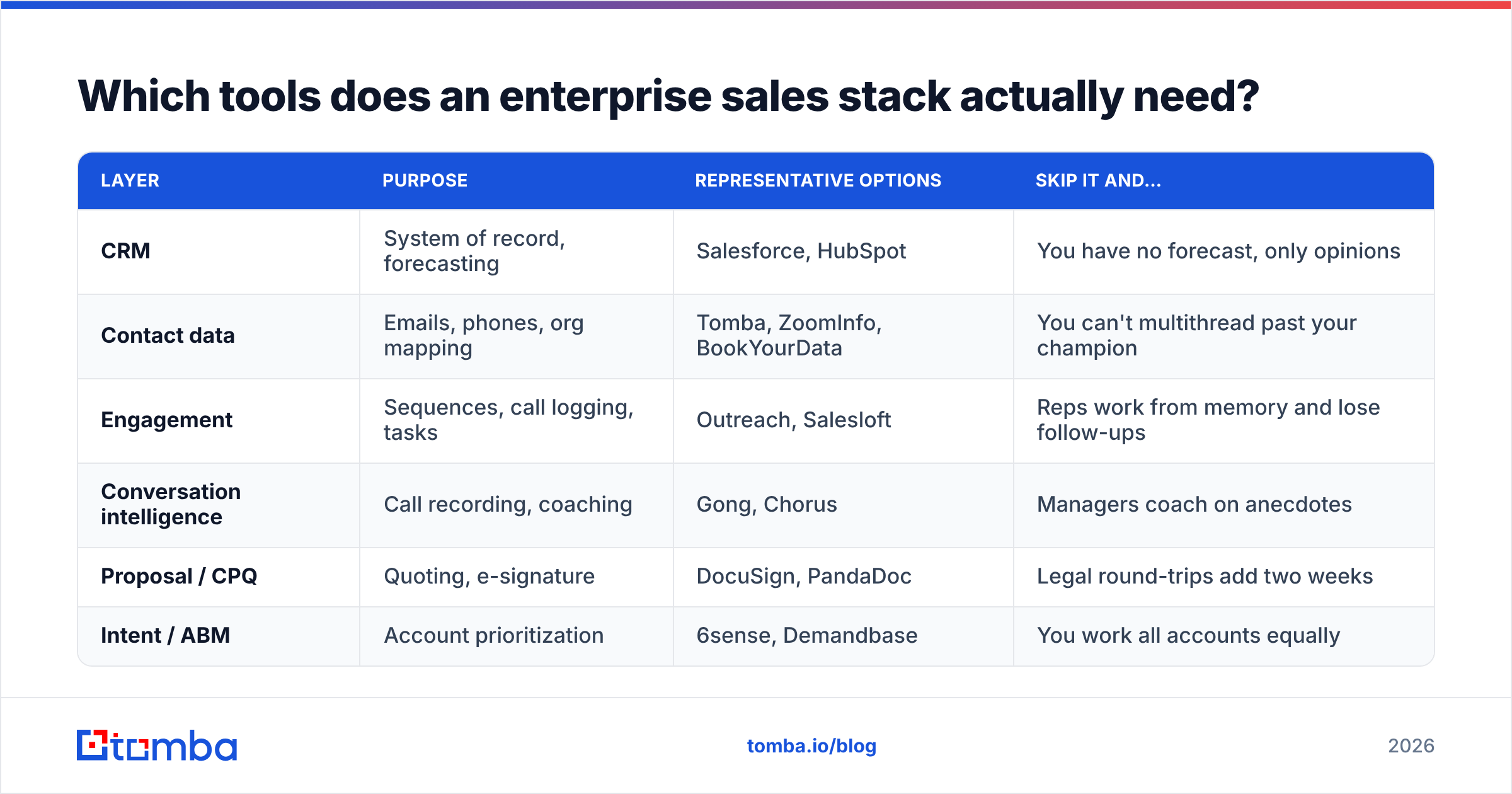
Which tools does an enterprise sales stack actually need?#
The stack sprawls fast, and most of it is optional. Here is the honest breakdown by layer, plus what breaks if you skip it.
| Layer | Purpose | Representative options | Skip it and… |
|---|---|---|---|
| CRM | System of record, forecasting | Salesforce, HubSpot | You have no forecast, only opinions |
| Contact data | Emails, phones, org mapping | Tomba, ZoomInfo, BookYourData | You can't multithread past your champion |
| Engagement | Sequences, call logging, tasks | Outreach, Salesloft | Reps work from memory and lose follow-ups |
| Conversation intelligence | Call recording, coaching | Gong, Chorus | Managers coach on anecdotes |
| Proposal / CPQ | Quoting, e-signature | DocuSign, PandaDoc | Legal round-trips add two weeks |
| Intent / ABM | Account prioritization | 6sense, Demandbase | You work all accounts equally |
Teams over-invest in intent data and under-invest in contact data. Intent tells you an account is shopping your category. It does nothing if you cannot reach the six people running the review. Contact data is the cheaper problem, and it gates every other step in enterprise B2B sales.
On budget: enterprise data platforms usually land between $15K and $50K a year. They come with seat minimums and annual commits. That is fair if you need firmographic depth, intent signals, and org charts at scale.
For a team that just needs verified emails and phone numbers at named accounts, it is far too much tool. Tomba's pricing starts free at 25 searches per month. Starter is $49/mo, Growth is $99/mo, and Pro is $249/mo. There is no annual lock-in, which matters while you are still tuning the motion.
Peers like BookYourData serve the list-purchase use case well. The choice comes down to one question. Do you want a pre-built database, or on-demand lookups against accounts you already picked? Check current user reviews on G2 before you sign any annual contract.
How do you forecast enterprise deals without lying to yourself?#
Stage-based forecasting fails here. Reps advance stages on activity, not on buyer commitment. A deal sits at "Technical Validation — 60%" for four months while everyone nods along in pipeline review.
Replace probability percentages with evidence gates. A deal only moves when the buyer does something that proves it moved:
- Champion identified → they've sent you an internal email you can see
- Economic buyer engaged → they've attended a call, not been mentioned on one
- Technical validation complete → written sign-off from IT, in writing
- Procurement engaged → you have a vendor onboarding portal login
- Commit → PO number or countersigned contract
Every gate is a buyer action. Demos delivered, proposals sent, and follow-ups logged are seller actions. They prove nothing. This one change often cuts forecast error in half within two quarters. It works by exposing the deals that were never real.
Also track deal age against your median cycle. Any deal past 1.5x median with no gate progress in 30 days belongs in a nurture track, not in the quarter. Carrying zombie deals is how teams hit 60 percent of forecast while calling the pipeline healthy.
What's the fastest way to improve enterprise win rates?#
Three changes, ranked by impact per hour invested.
First, require multithreading and check it in pipeline reviews. Ask one question on every deal: "Who besides your champion knows our name?" If the answer is nobody, the deal is not in the forecast. This alone lifts win rate within a cycle. It kills single-point-of-failure deals early instead of at quarter end.
Second, front-load security and procurement. Publish your SOC 2 report, your standard DPA, and a pre-filled security questionnaire in a shared folder. Send it in week two. Vendors who make compliance easy get picked over vendors who make it a fight.
Third, fix your contact data before your messaging. Teams A/B test subject lines for months while sending to addresses that bounce, or to people who left in 2024. Verified data lifts reply rates more than any copy change. Half of what looks like a messaging problem is a delivery problem in a costume.
Where should you start this quarter?#
Pick ten target accounts. For each one, map everyone who would touch the decision: champion, economic buyer, technical evaluator, blocker, and two end users. Get verified contact details for all of them. Then run a truly multithreaded play on all ten. Compare the results to your last twenty single-threaded attempts.
You will know within a quarter whether the motion fits your market. You will also have built the muscle before you scale it across the team.
Stuck on the contact-data half of that plan? Start with the Tomba Email Finder. Feed it a company domain and the names from your org map. It returns verified professional emails with confidence scores and source attribution.
That is what makes enterprise B2B sales multithreading possible. You can reach eleven stakeholders at an account instead of hoping one champion survives the reorg. The free tier covers 25 searches a month. That is enough to map your first two or three accounts and see whether deals move differently when the whole room already knows your name.
Related guides#
Ready to find emails that actually work?
Join 150,000+ professionals who stopped guessing and started sending. Free credits on signup — no credit card required.
Get the Tomba newsletter
Practical outbound tactics and product updates — once every two weeks.
About the author