9 Best Evolve IP Alternatives in 2026 (Compared & Priced)
Evolve IP bundles voice, Teams calling and virtual desktops behind a quote. Here are nine alternatives compared on real entry pricing, contact center depth, and what actually breaks during migration.
TL;DR
- Evolve IP sells a bundle — hosted voice, Microsoft Teams calling, contact center, and virtual desktops — behind a custom quote. Most teams shopping for Evolve IP alternatives want either transparent per-seat pricing or deeper contact center features, not both.
- If you want published pricing and a fast rollout: Dialpad, Zoom Phone, and Vonage start between $10 and $25 per user per month.
- If you want enterprise-grade UCaaS with a channel-heavy support model similar to Evolve IP: RingCentral, 8x8, and GoTo Connect are the closest structural matches.
- If your real pain is the contact center, not the phone system: Five9 or Talkdesk beat every UCaaS bundle — at roughly 4–8x the per-seat cost.
- The phone system is rarely why outbound underperforms. Bad numbers and stale contact records are. Validate the data before you re-platform the dialer.
What is Evolve IP and who actually uses it?#
Evolve IP is a Wayne, Pennsylvania–based provider that sells what it calls a "work anywhere" workspace: hosted VoIP, Microsoft Teams direct routing, contact center (CCaaS), and DaaS/virtual desktop infrastructure, delivered as one managed bundle. It sells heavily through partners and MSPs rather than self-serve signup, and pricing is quote-only. You can see the current product lineup on the official Evolve IP site.
The typical customer is a 150–2,000-seat organization in healthcare, legal, financial services, or manufacturing — regulated industries that want a single vendor accountable for voice, desktop, and compliance. That bundling is genuinely useful when it fits. It is also exactly why people go looking for alternatives.
Three complaints show up repeatedly in buyer conversations and in public reviews on G2:
- Opaque pricing. Nothing is published. Every renewal is a negotiation, and comparing against a competitor requires two sales cycles.
- Support routed through a partner. Great when your MSP is sharp. Painful when a P1 ticket has to travel through two organizations.
- Bundle lock-in. You buy voice, contact center, and DaaS together. If you only need two of the three, you still carry the architecture of all three.
None of those make Evolve IP a bad product. They make it a specific product with a specific fit. The question is whether that fit is yours in 2026.
When should you actually replace Evolve IP?#
Switching a phone system is a six-to-twelve-week project with real downtime risk. Do it for one of these reasons, not out of vague dissatisfaction:
- Your renewal quote jumped more than 15%. This is the single most common trigger. A competing quote is leverage even if you stay.
- You've consolidated on Microsoft Teams. If Teams is already your hub, Microsoft Teams Phone plus a direct-routing carrier can replace the UCaaS layer entirely for around $8 per user per month on top of your existing M365 licenses.
- Your contact center outgrew the bundle. Bundled CCaaS is fine for 10–25 agents. At 60+ agents with skills-based routing, workforce management, and QA scoring requirements, a dedicated platform wins.
- You dropped the DaaS component. Virtual desktops are the strongest reason to stay. Without them, you're paying for an integrated architecture you no longer use.
- You need self-serve provisioning. Sales orgs that add and cut seats monthly hate quote-gated changes. Per-seat, card-on-file platforms remove that friction.
- Call quality complaints are chronic, not incidental. Get MOS scores and jitter data first — most "the phone system is bad" reports are network or headset problems that survive a migration intact.
If none of those apply, renegotiate instead of re-platforming.
How do the top Evolve IP alternatives compare on price and fit?#
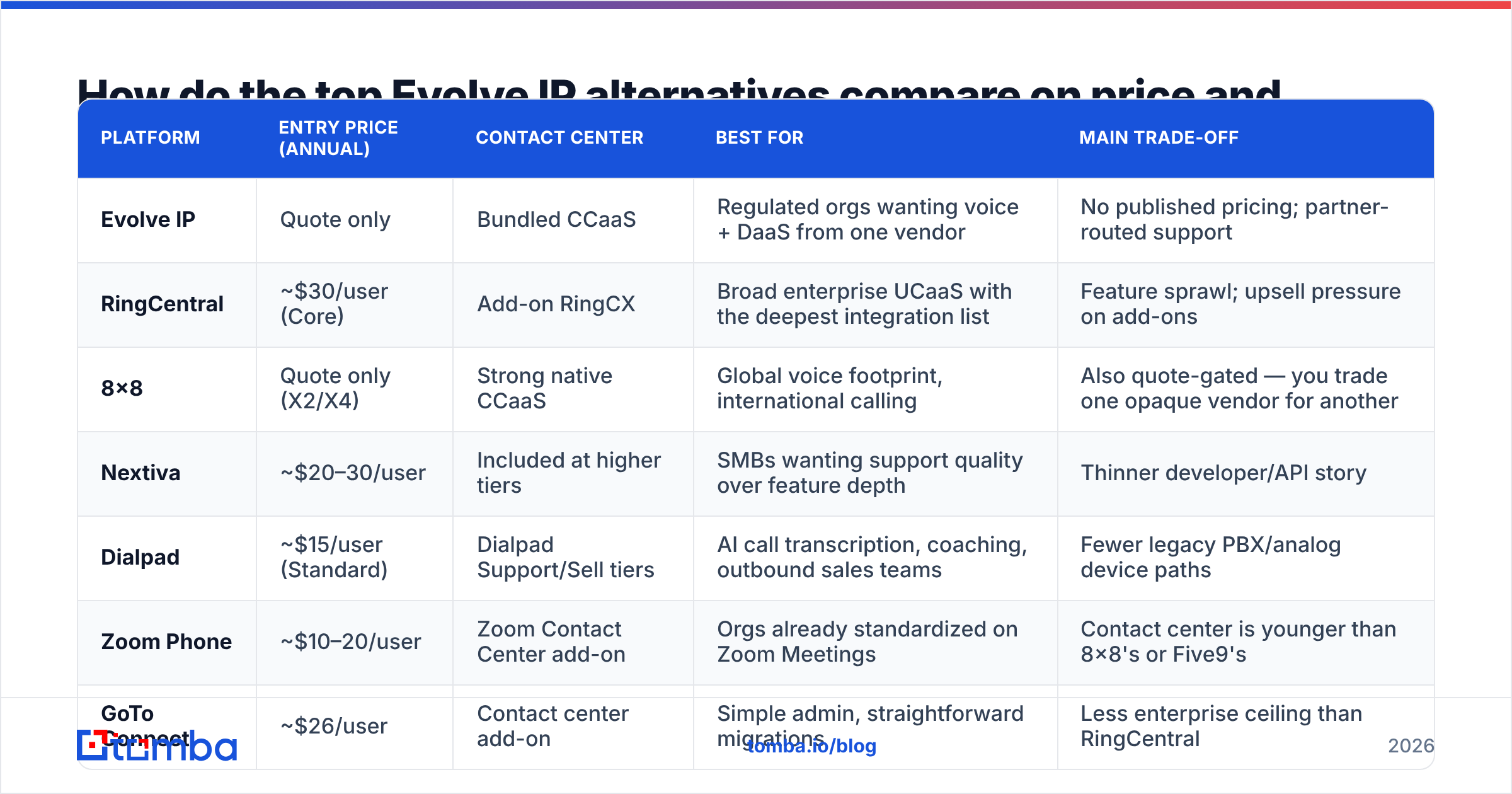
Prices below are published list rates at the time of writing, per user per month on annual billing, before taxes and regulatory fees. Always confirm current pricing with the vendor — UCaaS list pricing moves quarterly and volume discounts at 100+ seats are routine.
| Platform | Entry price (annual) | Contact center | Best for | Main trade-off |
|---|---|---|---|---|
| Evolve IP | Quote only | Bundled CCaaS | Regulated orgs wanting voice + DaaS from one vendor | No published pricing; partner-routed support |
| RingCentral | ~$30/user (Core) | Add-on RingCX | Broad enterprise UCaaS with the deepest integration list | Feature sprawl; upsell pressure on add-ons |
| 8x8 | Quote only (X2/X4) | Strong native CCaaS | Global voice footprint, international calling | Also quote-gated — you trade one opaque vendor for another |
| Nextiva | ~$20–30/user | Included at higher tiers | SMBs wanting support quality over feature depth | Thinner developer/API story |
| Dialpad | ~$15/user (Standard) | Dialpad Support/Sell tiers | AI call transcription, coaching, outbound sales teams | Fewer legacy PBX/analog device paths |
| Zoom Phone | ~$10–20/user | Zoom Contact Center add-on | Orgs already standardized on Zoom Meetings | Contact center is younger than 8x8's or Five9's |
| GoTo Connect | ~$26/user | Contact center add-on | Simple admin, straightforward migrations | Less enterprise ceiling than RingCentral |
| Vonage Business | ~$15–35/user | CCaaS via partnership | API-first builds via Vonage Communications APIs | Per-feature add-ons inflate the effective price |
| Microsoft Teams Phone | ~$8/user + M365 | None natively | Teams-first orgs with a carrier already in place | You own the carrier and routing complexity |
| Five9 / Talkdesk | ~$119–229/agent | Purpose-built CCaaS | 60+ agent contact centers | Overkill and overpriced as a company-wide phone system |
The table hides one thing worth saying plainly: 8x8 is not an escape from quote-only pricing. If transparent per-seat cost is your reason for leaving Evolve IP, your real shortlist is Dialpad, Zoom Phone, Vonage, RingCentral, and Teams Phone.
Which alternative fits which team?#
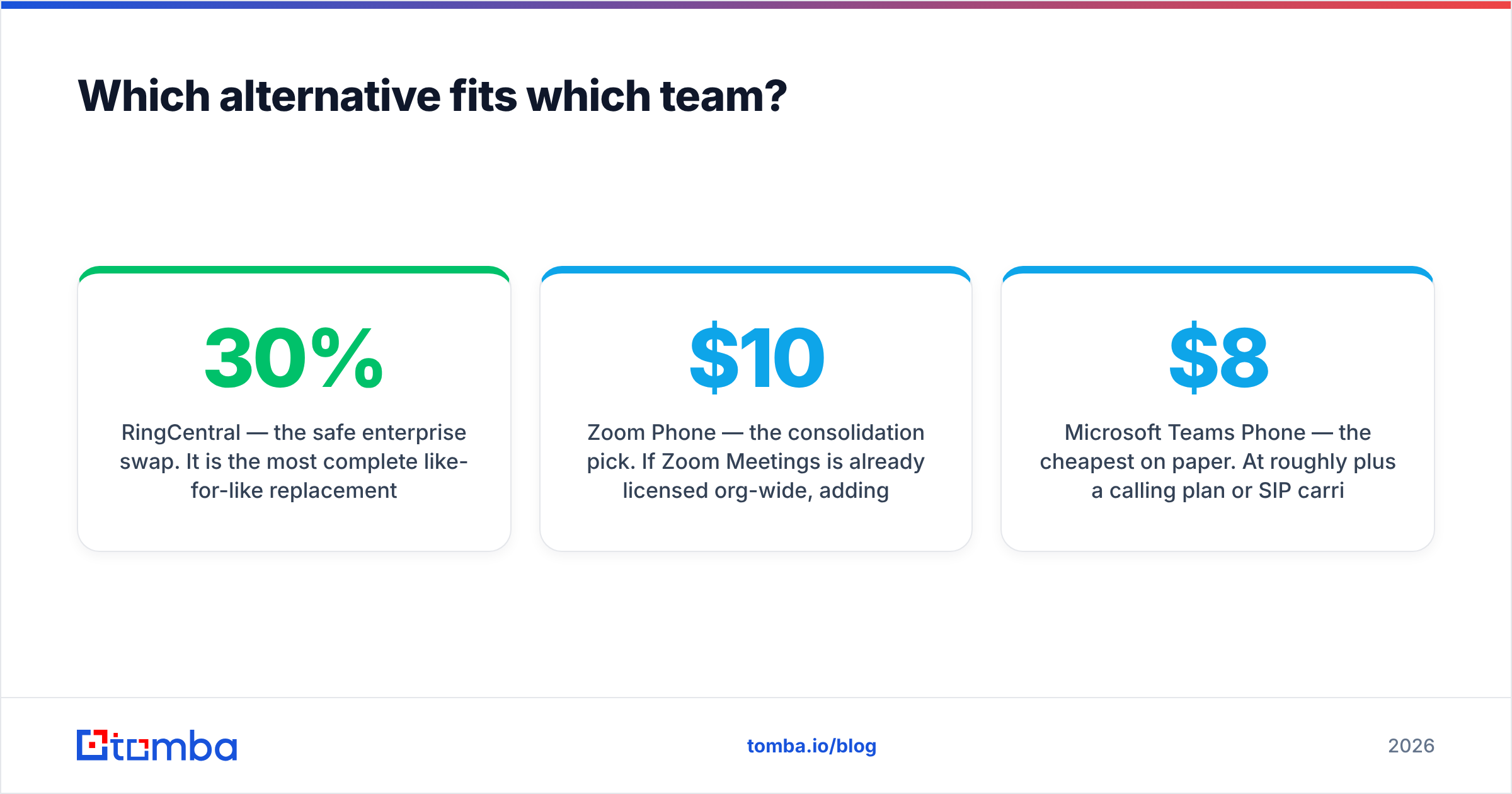
RingCentral — the safe enterprise swap. It is the most complete like-for-like replacement for the Evolve IP voice layer. Around 300+ integrations, mature APIs, strong compliance posture, and published pricing you can budget against. The trade-off is a busy product surface: analytics, RingCX, and advanced admin all sit behind separate SKUs, so the quoted seat price is rarely the final number. Budget 20–30% above list for a realistic all-in figure.
8x8 — the international play. If a meaningful share of your calling volume crosses borders, 8x8's owned global voice network and per-country DID coverage are the strongest argument in this list. X-Series pricing is quote-based, so run it in parallel with RingCentral to keep both honest.
Nextiva — the support-first SMB pick. Nextiva consistently rates well on human support quality, which matters enormously if the reason you're leaving Evolve IP is partner-routed tickets. Feature depth is respectable and the admin console is genuinely simple. Developers will find the API surface thinner than RingCentral's.
Dialpad — the sales-team pick. Real-time transcription, live sentiment, and post-call coaching notes are native rather than bolted on. For an SDR floor doing 60+ dials a day, that changes manager behavior more than any routing feature. Weakness: analog device and legacy PBX migration paths are less developed, so heavy on-prem hardware estates are a poor fit.
Zoom Phone — the consolidation pick. If Zoom Meetings is already licensed org-wide, adding Phone is the cheapest credible route off Evolve IP. Metered plans start near $10/user. The contact center product is newer and less proven than 8x8's or Five9's — fine for 15 agents, thin at 80.
GoTo Connect — the boring, reliable one. Simple pricing, simple admin, low migration drama. If your IT team is two people and you want the phone system to stop being a project, this is a defensible choice. It has the lowest enterprise ceiling on the list.
Vonage Business — the builder's pick. The differentiator is the adjacent Communications APIs. If you're embedding voice or SMS into your own product, the same vendor covers both. Watch the add-on model: call recording, CRM integration, and visual voicemail are frequently separate line items.
Microsoft Teams Phone — the cheapest on paper. At roughly $8 per user per month plus a calling plan or SIP carrier, nothing beats it on raw seat cost. But you are now responsible for direct routing, session border controllers, and E911 configuration — either in-house or through an operator connect partner. That partner starts to look a lot like the Evolve IP relationship you left.
Five9 or Talkdesk — only for the contact center. Do not buy these as a company phone system. Buy them when the contact center is a business function with its own headcount, forecasting, and QA program. Run them alongside a cheap UCaaS layer for everyone who is not an agent.
Does the phone platform actually fix outbound performance?#
Mostly no — and this is the expensive mistake in this category.
Teams migrate off Evolve IP expecting connect rates to rise, then discover the numbers were the problem. If 30% of your dialer list is disconnected, wrong-department, or a main switchboard, no UCaaS platform recovers those calls. You just fail faster on nicer software.
Before you sign anything, audit the list you're dialing:
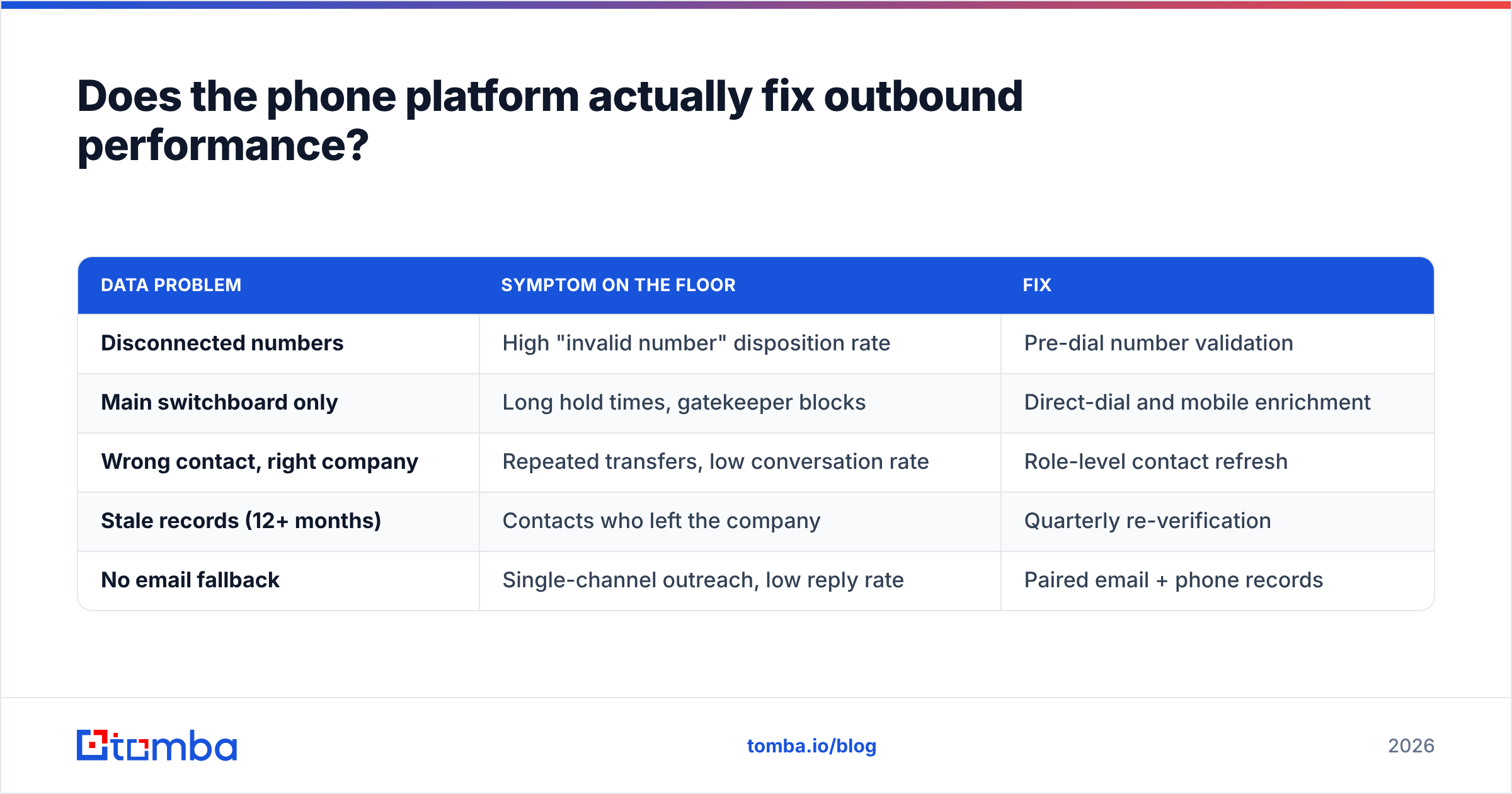
| Data problem | Symptom on the floor | Fix |
|---|---|---|
| Disconnected numbers | High "invalid number" disposition rate | Pre-dial number validation |
| Main switchboard only | Long hold times, gatekeeper blocks | Direct-dial and mobile enrichment |
| Wrong contact, right company | Repeated transfers, low conversation rate | Role-level contact refresh |
| Stale records (12+ months) | Contacts who left the company | Quarterly re-verification |
| No email fallback | Single-channel outreach, low reply rate | Paired email + phone records |
Running a list through a phone validator before it hits the dialer typically strips out a chunk of dead numbers that would otherwise burn agent hours. Pairing that with a phone finder for direct dials — rather than switchboards — moves connect rates more than any routing feature in the comparison table above. And feeding both into contact enrichment so reps see role, seniority, and a verified email before dialing turns a cold call into a warm one.

What should you check before signing a replacement contract?#
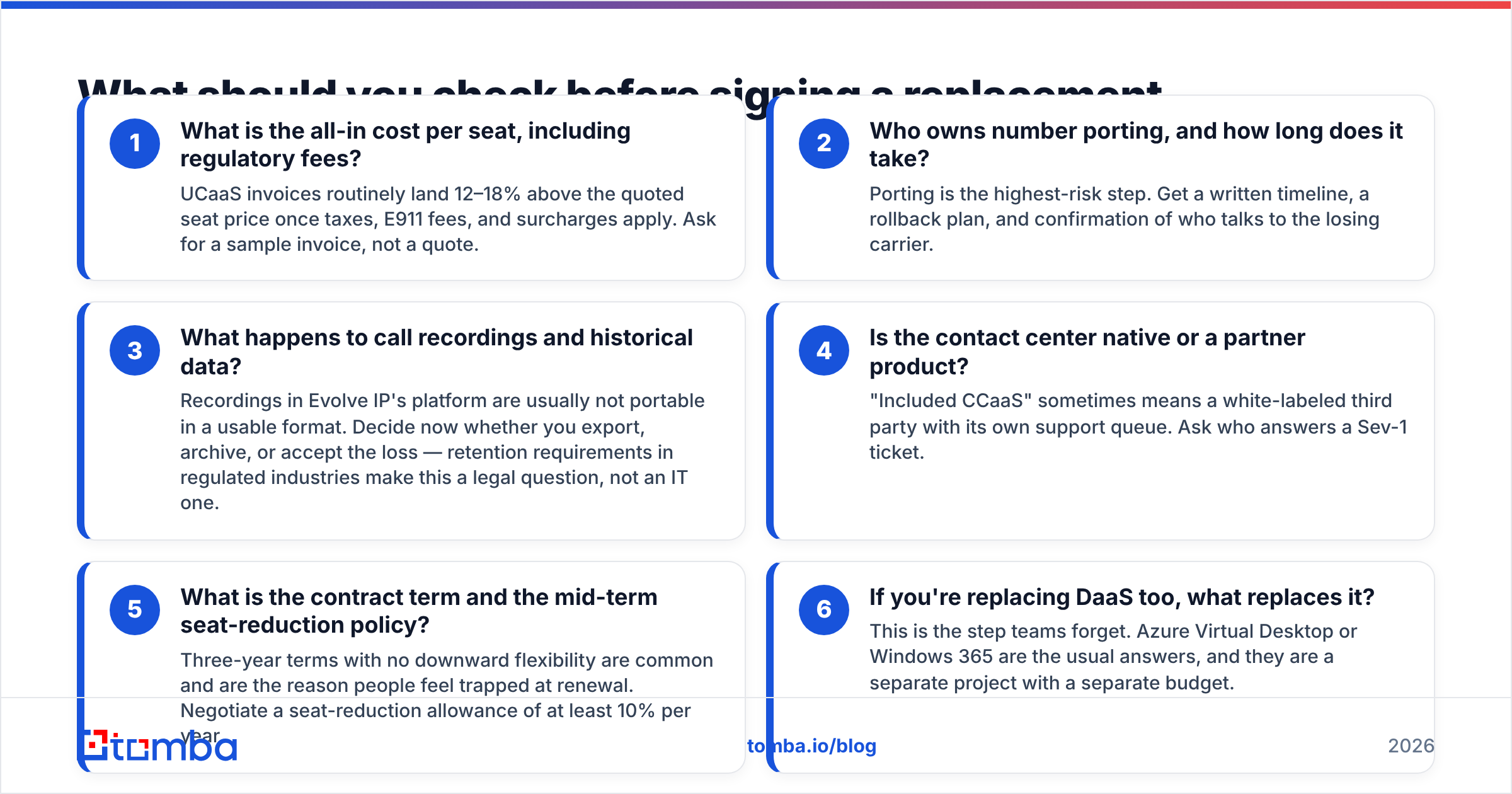
Six questions that separate a clean migration from a bad quarter:
- What is the all-in cost per seat, including regulatory fees? UCaaS invoices routinely land 12–18% above the quoted seat price once taxes, E911 fees, and surcharges apply. Ask for a sample invoice, not a quote.
- Who owns number porting, and how long does it take? Porting is the highest-risk step. Get a written timeline, a rollback plan, and confirmation of who talks to the losing carrier.
- What happens to call recordings and historical data? Recordings in Evolve IP's platform are usually not portable in a usable format. Decide now whether you export, archive, or accept the loss — retention requirements in regulated industries make this a legal question, not an IT one.
- Is the contact center native or a partner product? "Included CCaaS" sometimes means a white-labeled third party with its own support queue. Ask who answers a Sev-1 ticket.
- What is the contract term and the mid-term seat-reduction policy? Three-year terms with no downward flexibility are common and are the reason people feel trapped at renewal. Negotiate a seat-reduction allowance of at least 10% per year.
- If you're replacing DaaS too, what replaces it? This is the step teams forget. Azure Virtual Desktop or Windows 365 are the usual answers, and they are a separate project with a separate budget.
Run at least two vendors through a paid 30-day pilot with real users on real calls. Demo environments hide the problems that show up at 4pm on a Tuesday with 40 concurrent calls.
Which Evolve IP alternative should you pick?#
Short version, by situation:
- You want transparent pricing and a fast switch: Dialpad or Zoom Phone.
- You want an enterprise-grade like-for-like replacement: RingCentral, with 8x8 as the international counterweight.
- You want fewer support headaches at SMB scale: Nextiva or GoTo Connect.
- You're Teams-first and have IT depth: Microsoft Teams Phone with a direct-routing carrier.
- Your contact center is the real business: Five9 or Talkdesk, with a cheap UCaaS layer for everyone else.
- You genuinely value the voice + DaaS bundle and support is fine: Stay, and use a competing quote to reset pricing at renewal.
Whichever platform you land on, the dialer is the easy half. The hard half is the list going into it — and that half is where connect rate, conversation rate, and pipeline actually get decided.
Before your next outbound push, close the data gap. Use the Tomba Email Finder to build verified, role-accurate contact records — then pair them with direct-dial numbers so every call lands on a real person at the right company. The free tier covers 25 searches a month, and paid plans start at $49/mo on Tomba pricing if you need volume. Fix the data, then argue about the phone system.
Related guides#
Ready to find emails that actually work?
Join 150,000+ professionals who stopped guessing and started sending. Free credits on signup — no credit card required.
Get the Tomba newsletter
Practical outbound tactics and product updates — once every two weeks.
About the author