Exact Data vs Generect: B2B Data Comparison for 2026
One sells you a list. The other sells you an API. We break down Exact Data vs Generect on freshness, coverage, pricing model, and deliverability risk — plus when neither is the right buy.
TL;DR
- Exact Data is a traditional list broker: you specify filters, get a count, pay per record, and download a static file. Good for volume and postal/multichannel campaigns, weak for real-time freshness.
- Generect is an API-first B2B data provider built around LinkedIn-style search and on-demand contact resolution. Better for engineering-led outbound, weaker for offline channels and one-off list buys.
- The real difference isn't coverage — it's when the data was true. A purchased file ages from the moment you download it; an API resolves at request time.
- Neither vendor removes your obligation to verify. Any list, from any source, needs a verification pass before it touches your sending domain.
- If your bottleneck is "I have companies and names, I need valid work emails," a dedicated finder plus verifier (Tomba's stack starts free, $49/mo for Starter) is usually cheaper than either full-fat platform.
What are Exact Data and Generect, exactly?#
They solve the same surface problem — "give me contacts to reach" — with two completely different business models.
Exact Data is a US direct-marketing data company. You use their online count tool to build a segment (industry SIC/NAICS, job title, company size, geography, sometimes consumer demographics), see how many records match, and buy that slice. Delivery is a file: CSV, or a push into an ESP. Their heritage is postal and multichannel list brokerage, which shows in the field set — you'll find mailing addresses and phone data alongside email.
Generect comes from the opposite direction. It's a B2B lead-data platform with a heavy API story: search endpoints modeled on LinkedIn-style filters (headcount, industry, seniority, tech, geo), company and people lookups, and contact resolution returned as JSON. The pitch is that you don't maintain a list at all — you query when you need records, inside your own tooling.
That framing matters more than any feature checkbox. One sells you a snapshot. The other sells you a subscription to ask questions.

How do Exact Data and Generect compare head-to-head?#
Here's the practical comparison. Pricing for both is quote-driven and changes often — treat the ranges as directional and confirm on each vendor's own pricing page before you commit.
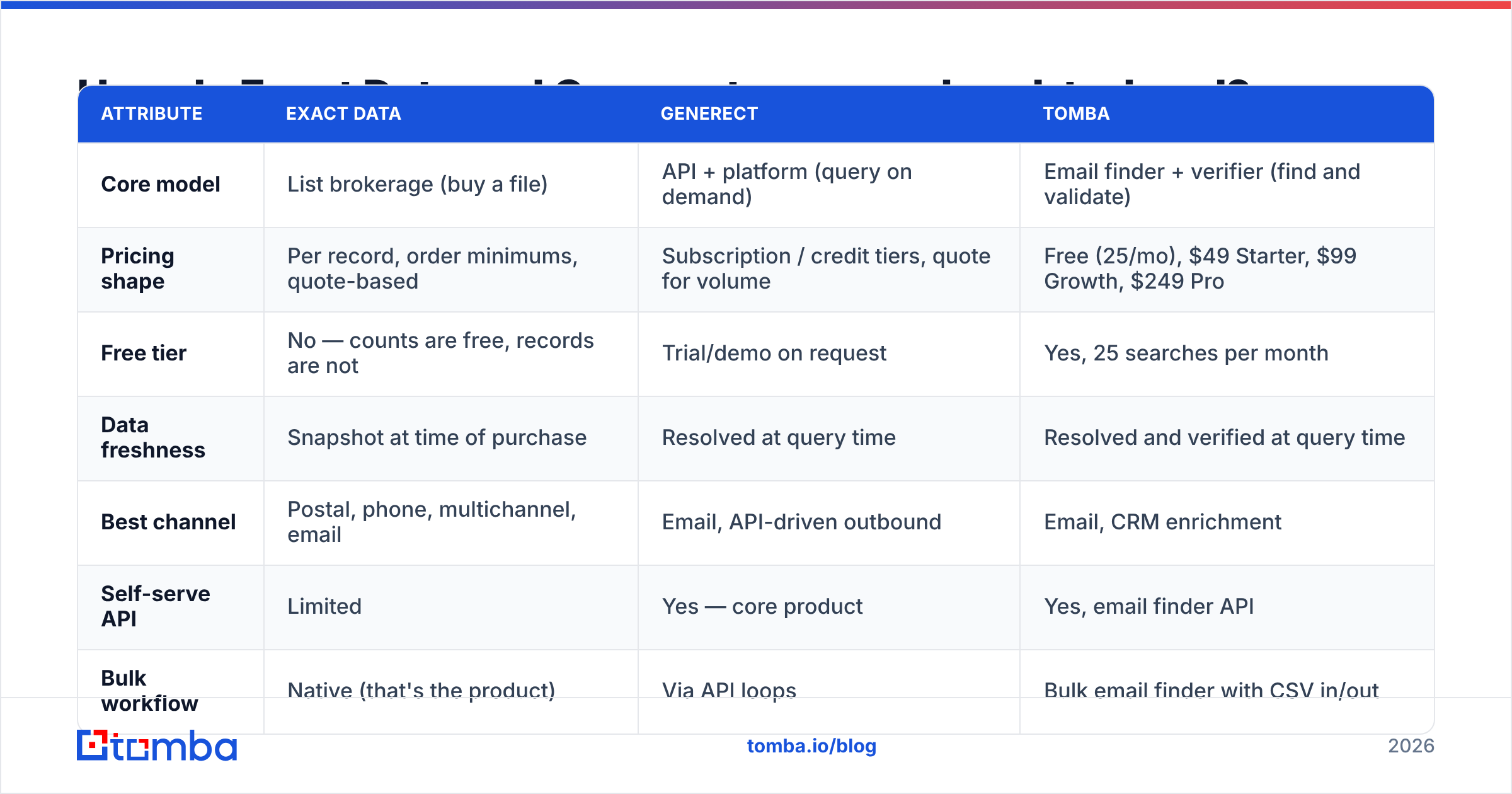
| Attribute | Exact Data | Generect | Tomba |
|---|---|---|---|
| Core model | List brokerage (buy a file) | API + platform (query on demand) | Email finder + verifier (find and validate) |
| Pricing shape | Per record, order minimums, quote-based | Subscription / credit tiers, quote for volume | Free (25/mo), $49 Starter, $99 Growth, $249 Pro |
| Free tier | No — counts are free, records are not | Trial/demo on request | Yes, 25 searches per month |
| Data freshness | Snapshot at time of purchase | Resolved at query time | Resolved and verified at query time |
| Best channel | Postal, phone, multichannel, email | Email, API-driven outbound | Email, CRM enrichment |
| Self-serve API | Limited | Yes — core product | Yes, email finder API |
| Bulk workflow | Native (that's the product) | Via API loops | Bulk email finder with CSV in/out |
| Data ownership | You keep the file forever | Records tied to plan usage | Exports are yours |
| Typical buyer | Marketing ops, agencies, direct mail | Growth engineers, RevOps | SDRs, founders, developers |
Two things jump out of that grid.
First, Exact Data wins on channel breadth. If your campaign includes physical mail, or you need a phone-heavy file for a calling team, an API that returns work emails and LinkedIn URLs doesn't help you. Exact Data's postal lineage is a genuine advantage there.
Second, Generect wins on integration. If your outbound is triggered by product events, funding announcements, or a scoring model, you want a GET request, not a quarterly file drop. Building that on top of a purchased CSV means writing your own staleness logic, and most teams never do.
Which one has fresher data?#
Generect, structurally — but the reason is worth understanding, because it's the single biggest cost driver in B2B data.
B2B contact records decay at roughly 2-2.5% per month, which compounds to a 25-30% annual rot rate as people change jobs, companies rebrand, and mail servers get reconfigured. Gartner and other analyst shops have hammered this point for years: the cost of bad data is not the wasted credit, it's the wasted sequence, the burned domain, and the rep's time.
Now apply that to the two models:
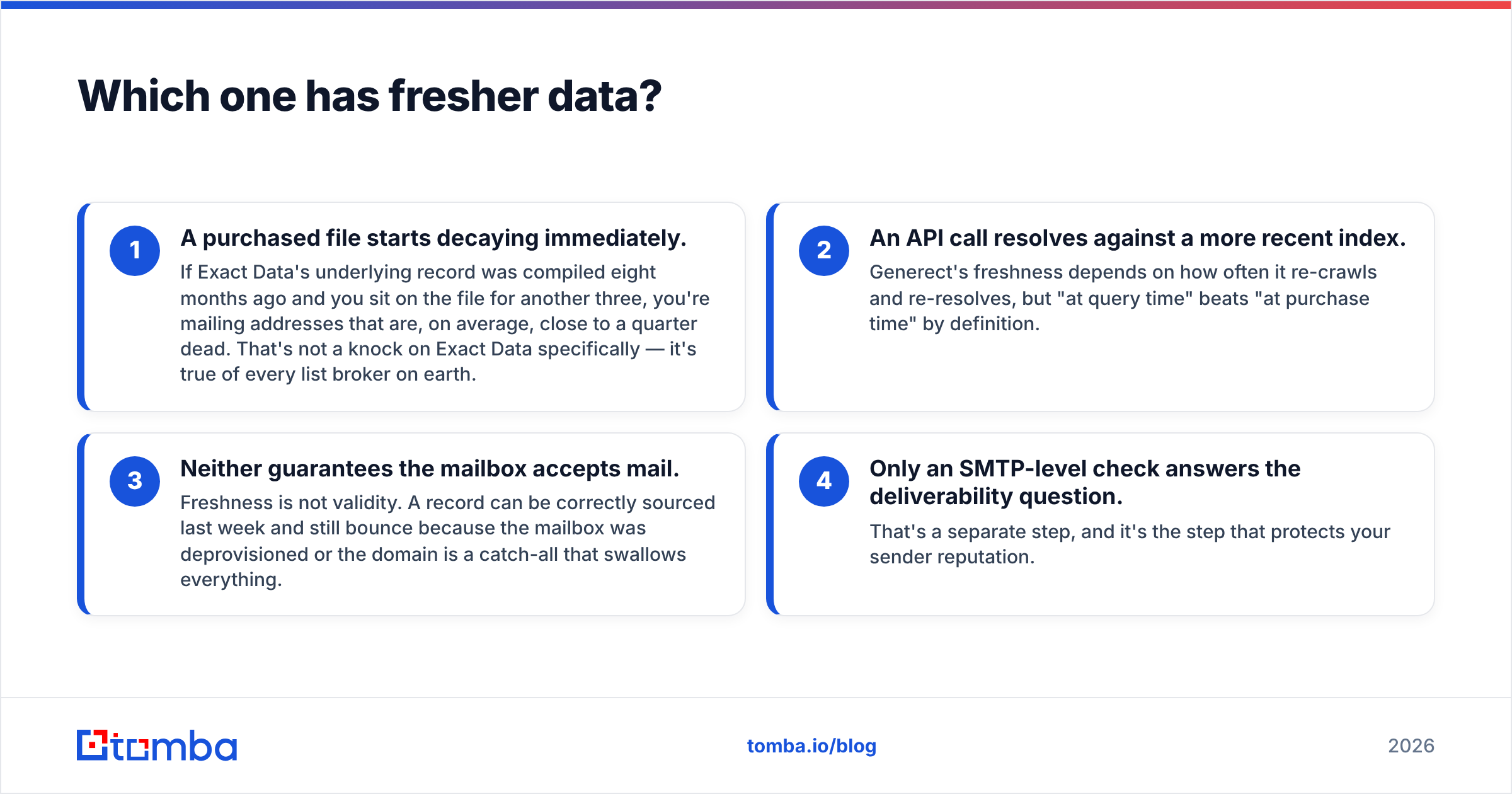
- A purchased file starts decaying immediately. If Exact Data's underlying record was compiled eight months ago and you sit on the file for another three, you're mailing addresses that are, on average, close to a quarter dead. That's not a knock on Exact Data specifically — it's true of every list broker on earth.
- An API call resolves against a more recent index. Generect's freshness depends on how often it re-crawls and re-resolves, but "at query time" beats "at purchase time" by definition.
- Neither guarantees the mailbox accepts mail. Freshness is not validity. A record can be correctly sourced last week and still bounce because the mailbox was deprovisioned or the domain is a catch-all that swallows everything.
- Only an SMTP-level check answers the deliverability question. That's a separate step, and it's the step that protects your sender reputation.
This is why most serious outbound teams run a two-stage pipeline: source from wherever the coverage is best, then run everything through an email verifier immediately before send — not at import time, not last month. If your list sat in a CRM for 60 days, re-verify it.
What does each one actually cost?#
Neither vendor publishes a simple sticker price, which is itself a data point about who they sell to.
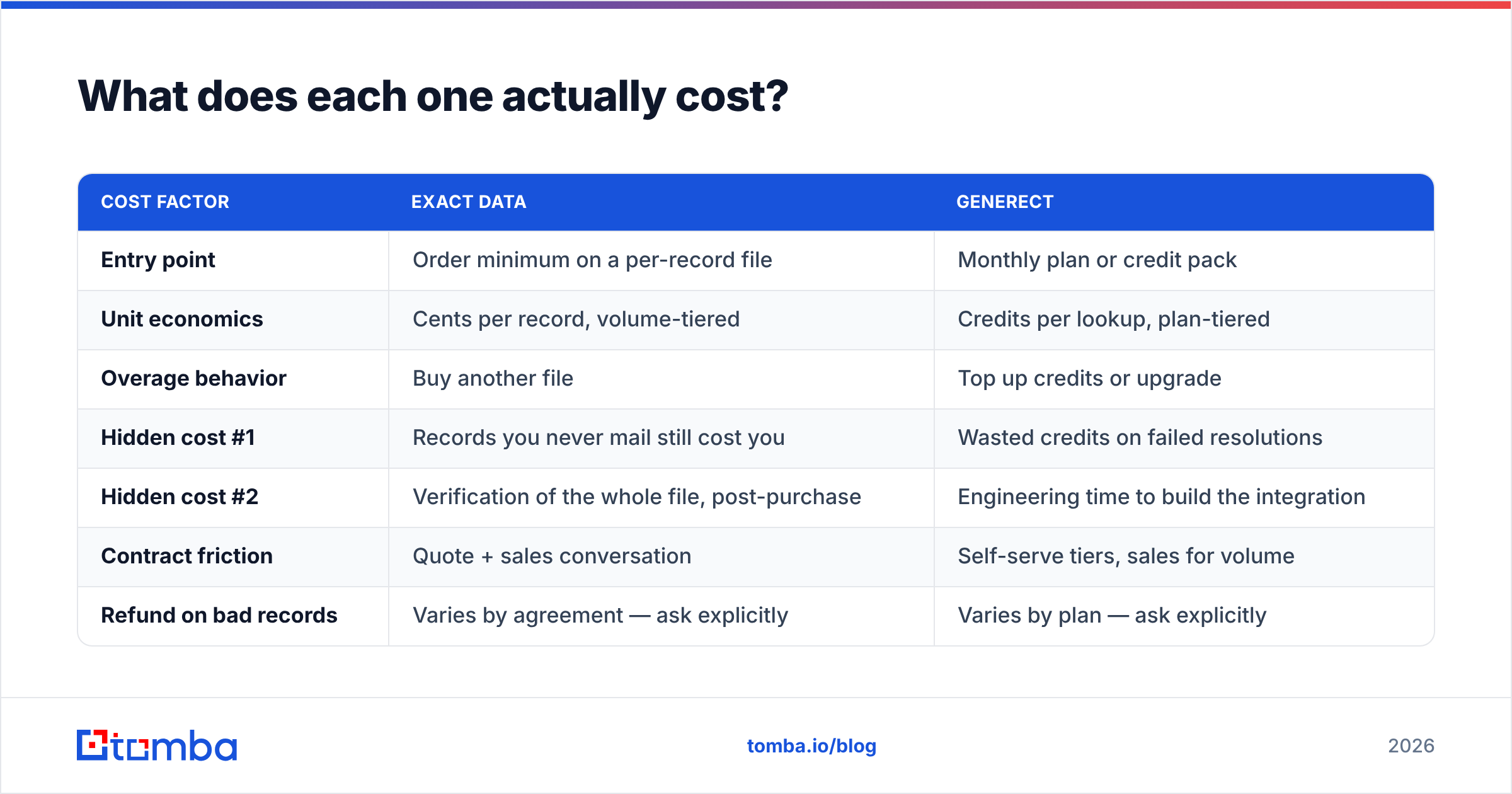
| Cost factor | Exact Data | Generect |
|---|---|---|
| Entry point | Order minimum on a per-record file | Monthly plan or credit pack |
| Unit economics | Cents per record, volume-tiered | Credits per lookup, plan-tiered |
| Overage behavior | Buy another file | Top up credits or upgrade |
| Hidden cost #1 | Records you never mail still cost you | Wasted credits on failed resolutions |
| Hidden cost #2 | Verification of the whole file, post-purchase | Engineering time to build the integration |
| Contract friction | Quote + sales conversation | Self-serve tiers, sales for volume |
| Refund on bad records | Varies by agreement — ask explicitly | Varies by plan — ask explicitly |
The buried cost in both cases is the same: you pay for records you never successfully contact. With a broker file, you pay upfront for the whole segment and discover the bounce rate later. With a credit-based API, you burn a credit whether or not the returned address is deliverable.
Ask both vendors the same three questions before signing:
- What's your bounce guarantee, in writing? A vendor confident in its data will put a number on it (often 95-97% deliverable) and credit you for the gap.
- Do failed lookups consume credits? For API vendors this can swing your effective cost by 30% or more.
- Can I sample before I buy? A 100-record test slice, verified independently, tells you more than any case study. Run it through a free email checker and count the invalids yourself.
Compare that against Tomba pricing, where the tiers are public and the free tier lets you run exactly that sample test without a sales call.

Which one fits your use case?#
Skip the feature matrix and match the tool to the shape of your motion.
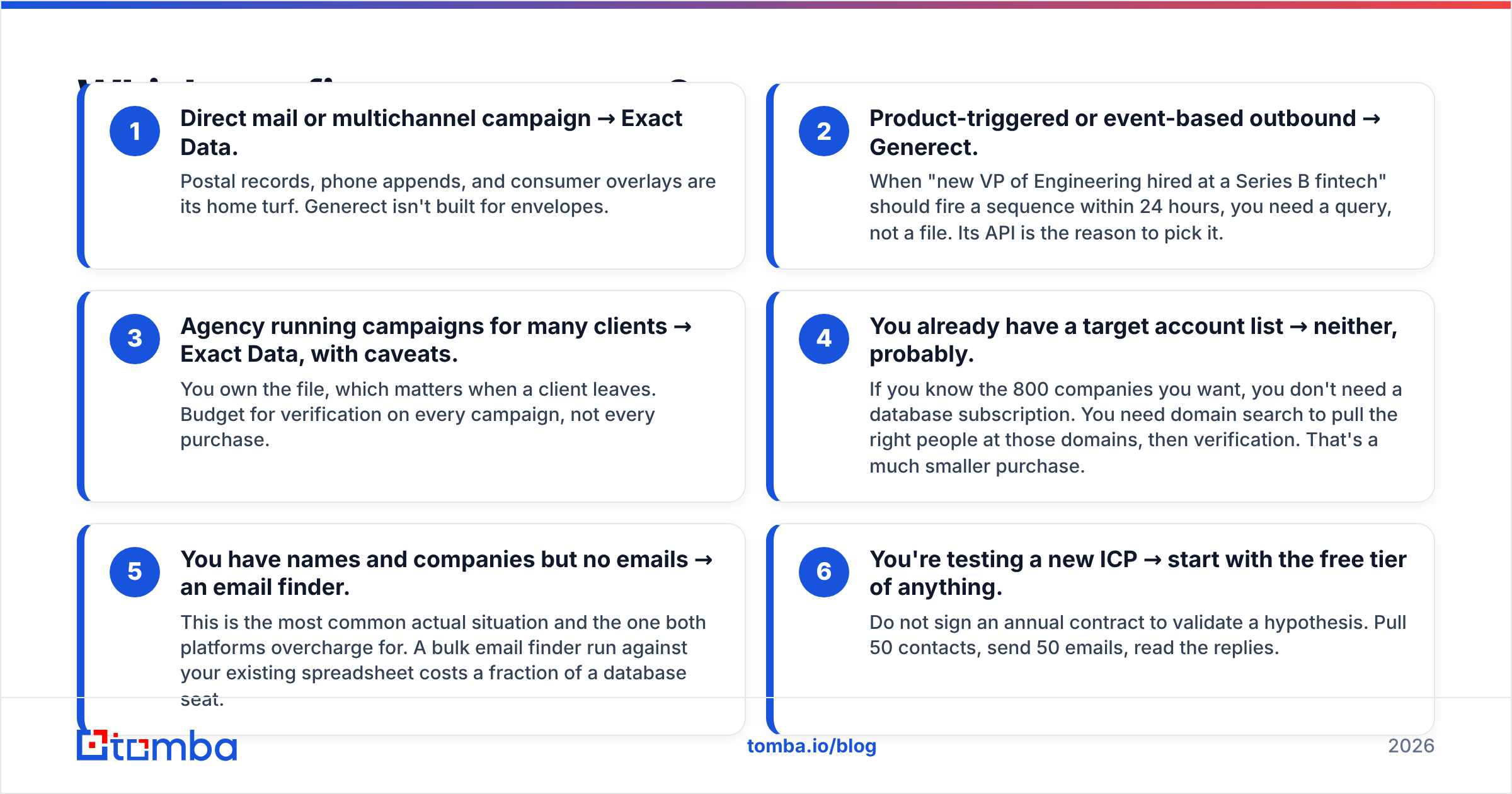
- Direct mail or multichannel campaign → Exact Data. Postal records, phone appends, and consumer overlays are its home turf. Generect isn't built for envelopes.
- Product-triggered or event-based outbound → Generect. When "new VP of Engineering hired at a Series B fintech" should fire a sequence within 24 hours, you need a query, not a file. Its API is the reason to pick it.
- Agency running campaigns for many clients → Exact Data, with caveats. You own the file, which matters when a client leaves. Budget for verification on every campaign, not every purchase.
- You already have a target account list → neither, probably. If you know the 800 companies you want, you don't need a database subscription. You need domain search to pull the right people at those domains, then verification. That's a much smaller purchase.
- You have names and companies but no emails → an email finder. This is the most common actual situation and the one both platforms overcharge for. A bulk email finder run against your existing spreadsheet costs a fraction of a database seat.
- You're testing a new ICP → start with the free tier of anything. Do not sign an annual contract to validate a hypothesis. Pull 50 contacts, send 50 emails, read the replies.
Point 4 and 5 are where most teams overspend. Buying a database when you already know your accounts is like buying a phone book to call your own customers.
What about deliverability and compliance risk?#
This is where purchased lists earn their bad reputation, and it's worth being precise about why.
The risk isn't legal in most B2B contexts — GDPR permits legitimate-interest B2B outreach in the EU with the right safeguards, and CAN-SPAM in the US doesn't require prior consent, only accurate headers and a working opt-out. Check the FTC's own CAN-SPAM guidance rather than a vendor's summary of it.
The real risk is mechanical:
- Spam traps. Recycled traps are old real addresses that mailbox providers reactivated as trip wires. Aged broker files carry more of them than fresh API pulls. One hit can tank a domain.
- High bounce rates. Google and Microsoft both throttle senders whose hard-bounce rate creeps past roughly 2%. A 15% bounce on a 5,000-record file is a domain-level event, not a campaign-level one.
- Catch-all domains. These accept everything at the gateway and reject silently later. They look valid to naive checks. Run them through a dedicated catch-all verifier instead of guessing.
- Complaint rate. Poorly targeted list data produces "who are you?" complaints, which is the metric that actually kills email deliverability.
Practical mitigation regardless of vendor: verify immediately before send, remove role accounts (info@, sales@) unless they're genuinely your buyer, ramp volume on a new sending domain, and segment your first send so a bad batch doesn't poison the whole domain.
Are there better alternatives to both?#
Depends on which half of the problem you actually have.
If you need discovery — "who are the 2,000 companies matching my ICP?" — both Exact Data and Generect are legitimate answers, alongside Apollo, ZoomInfo, and Cognism. Cross-check any of them on G2 where the review volume is high enough to spot patterns in the complaints.
If you need resolution — "I know who I want, get me their verified work email" — you're in a different, cheaper category. That's where an email finder built specifically for the job wins on cost per usable contact. Tomba's angle here is narrow on purpose: find the address, verify it against the mail server, return a confidence signal, and get out of the way. Domain search, LinkedIn finder, phone finder, and data enrichment cover the adjacent needs without turning into a $30k platform commitment.
Also worth naming: BookYourData is a strong option if you want the list-purchase model with a self-serve, transparent per-record price and a stated deliverability guarantee — it sits between Exact Data's brokerage approach and Generect's API model, and it's a credible pick for teams that genuinely want to own a file.
So which should you pick?#
Pick Exact Data if your campaign spans postal and phone, you want to own the file outright, and you're comfortable running your own verification and suppression logic on top. It's the right tool for classic direct marketing at volume.
Pick Generect if outbound is engineering-owned, freshness matters more than file ownership, and you'll actually build against the API. Buying an API-first product and then exporting everything to CSV wastes what you're paying for.
Pick neither if your list of target accounts is already defined. That's the majority case, and it's the one where a database subscription is the most expensive way to solve the smallest problem.
The honest verdict on Exact Data vs Generect: they're not really competing for the same budget line. Exact Data competes with list brokers; Generect competes with data APIs. Figure out which of those two sentences describes your workflow and the choice makes itself.
Start with the narrow problem. If you already know the companies and people you want to reach, skip the database contract and run them through the Tomba Email Finder — free for your first 25 searches, $49/mo on Starter, with SMTP-level verification built into every result so you find out about the bad addresses before your sending domain does.
Related guides#
Ready to find emails that actually work?
Join 150,000+ professionals who stopped guessing and started sending. Free credits on signup — no credit card required.
Get the Tomba newsletter
Practical outbound tactics and product updates — once every two weeks.
About the author