Exact Data vs ZoomInfo: B2B Data Pricing Compared for 2026
One sells static B2B lists by the record. The other sells a six-figure intelligence platform. Here's how Exact Data and ZoomInfo actually compare on accuracy, pricing, and fit — plus when neither is the right buy.
Exact Data vs ZoomInfo is not really a fair fight. One sells a static file of B2B records. The other sells a live data platform on a yearly contract. Here is how the two compare on price, accuracy, and fit — plus the cheaper option most teams should buy instead.
TL;DR
- Exact Data is a list broker. You buy a static file of B2B or consumer records, priced per record and delivered as a CSV. No seat licence, no annual contract.
- ZoomInfo is a go-to-market intelligence platform. You get refreshed contact data, intent signals, org charts, workflows, and CRM sync. Budget $15,000–$40,000+ a year, with a multi-seat minimum.
- They are not really competitors. Exact Data competes with other list brokers. ZoomInfo competes with Apollo, Cognism, and LinkedIn Sales Navigator.
- Accuracy is the real gap. A static list decays about 2–2.5% a month. ZoomInfo re-verifies all year, but still ships bounces on rare job titles and non-US regions.
- Need verified work emails for a known set of companies? A per-lookup email finder beats both on cost per usable contact. That is where Tomba lands.
What are Exact Data and ZoomInfo, really?#
Conclusion first: you are comparing a data file to a data subscription. That one difference drives every other line item.
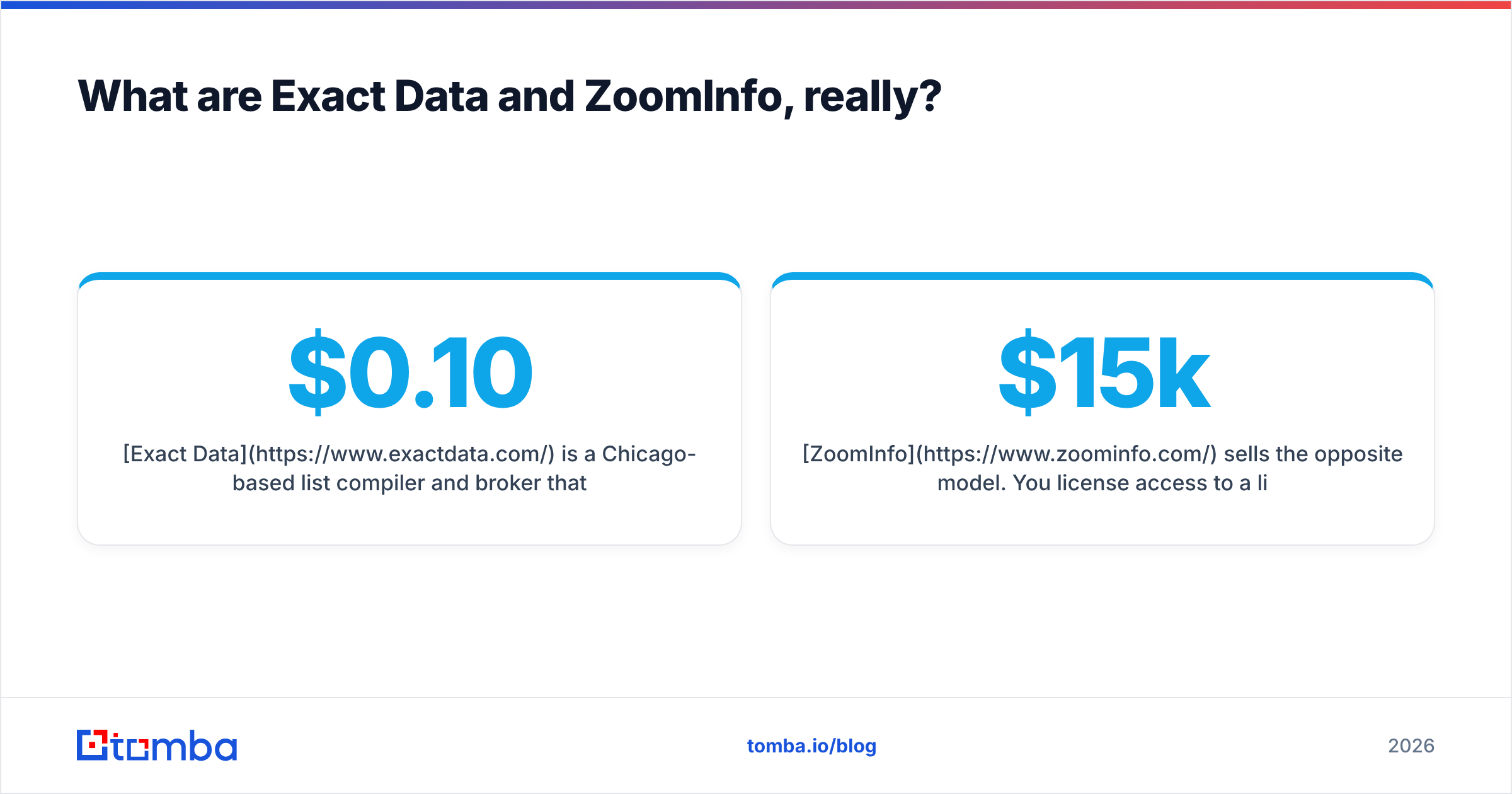
Exact Data is a Chicago-based list compiler and broker. It has sold marketing lists since the early 2000s. You define a target — SIC/NAICS code, employee count, geography, job function. The platform returns a count, and you pay per record for a one-time file you download. Business lists usually run $0.10–$0.40 per record, depending on selects and volume, and there are order minimums. Exact Data also sells consumer lists, direct-mail files, and email-append services. That mix tells you where the business grew up: postal-era database marketing, adapted for email.
ZoomInfo sells the opposite model. You license access to a live database — roughly 100M+ business contacts and 100M+ company profiles, by their own claims. With it you get a web app, a Chrome extension, an API, CRM enrichment, buyer-intent topics, and org charts. Higher tiers add conversation intelligence and sequencing. Pricing is annual, seat-based, and credit-gated. Public G2 and Vendr data put most mid-market contracts between $15k and $40k a year. Enterprise deals run well past $100k.
So the honest framing is simple. Exact Data answers "give me 20,000 names of HVAC company owners in Texas for a mail and email blast." ZoomInfo answers "tell me which of my 400 target accounts are researching data-warehouse software this week, and who owns the budget."
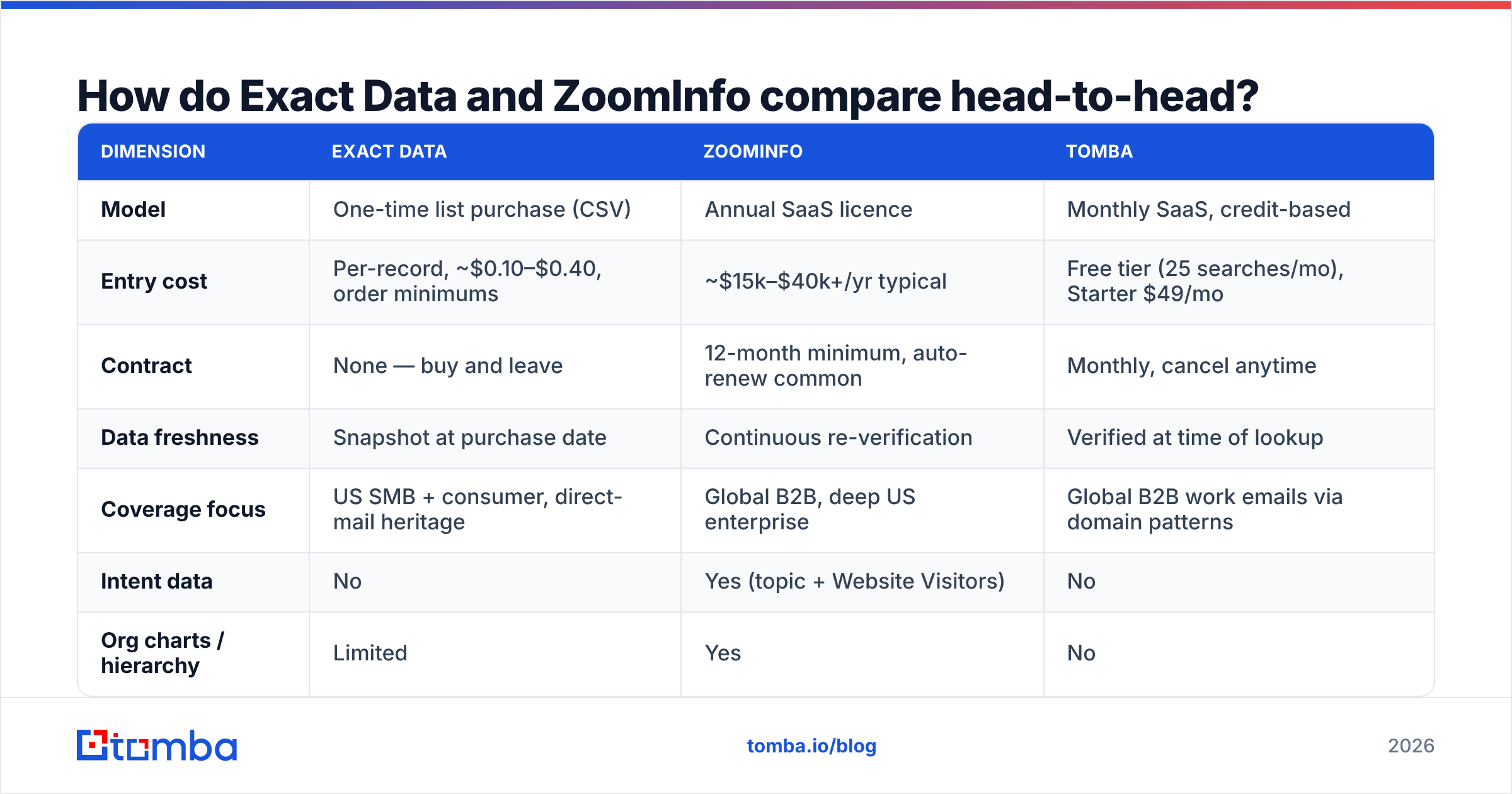
Exact Data vs ZoomInfo: how do the two compare head-to-head?#
| Dimension | Exact Data | ZoomInfo | Tomba |
|---|---|---|---|
| Model | One-time list purchase (CSV) | Annual SaaS licence | Monthly SaaS, credit-based |
| Entry cost | Per-record, ~$0.10–$0.40, order minimums | ~$15k–$40k+/yr typical | Free tier (25 searches/mo), Starter $49/mo |
| Contract | None — buy and leave | 12-month minimum, auto-renew common | Monthly, cancel anytime |
| Data freshness | Snapshot at purchase date | Continuous re-verification | Verified at time of lookup |
| Coverage focus | US SMB + consumer, direct-mail heritage | Global B2B, deep US enterprise | Global B2B work emails via domain patterns |
| Intent data | No | Yes (topic + Website Visitors) | No |
| Org charts / hierarchy | Limited | Yes | No |
| Phone numbers | Yes (landline-heavy) | Yes (direct dials a headline feature) | Yes, via phone finder |
| API access | Limited / by arrangement | Yes, credit-metered | Yes, on all paid plans |
| Email verification included | Basic hygiene | Yes | Yes, incl. catch-all handling |
| Best for | One-off mail/email campaigns, SMB volume | Enterprise ABM, RevOps teams with budget | Targeted outbound, dev teams, lean SDR orgs |
The table hides one thing worth saying plainly: cost per usable contact is not cost per record. A $0.15 record that bounces costs you $0.15 plus damage to your sender reputation. A verified, deliverable contact at $0.90 is cheaper on every metric that matters later.
Which one has better data accuracy?#
Most Exact Data vs ZoomInfo debates end here. Neither vendor's marketing number should be taken at face value, and the reason is structural.
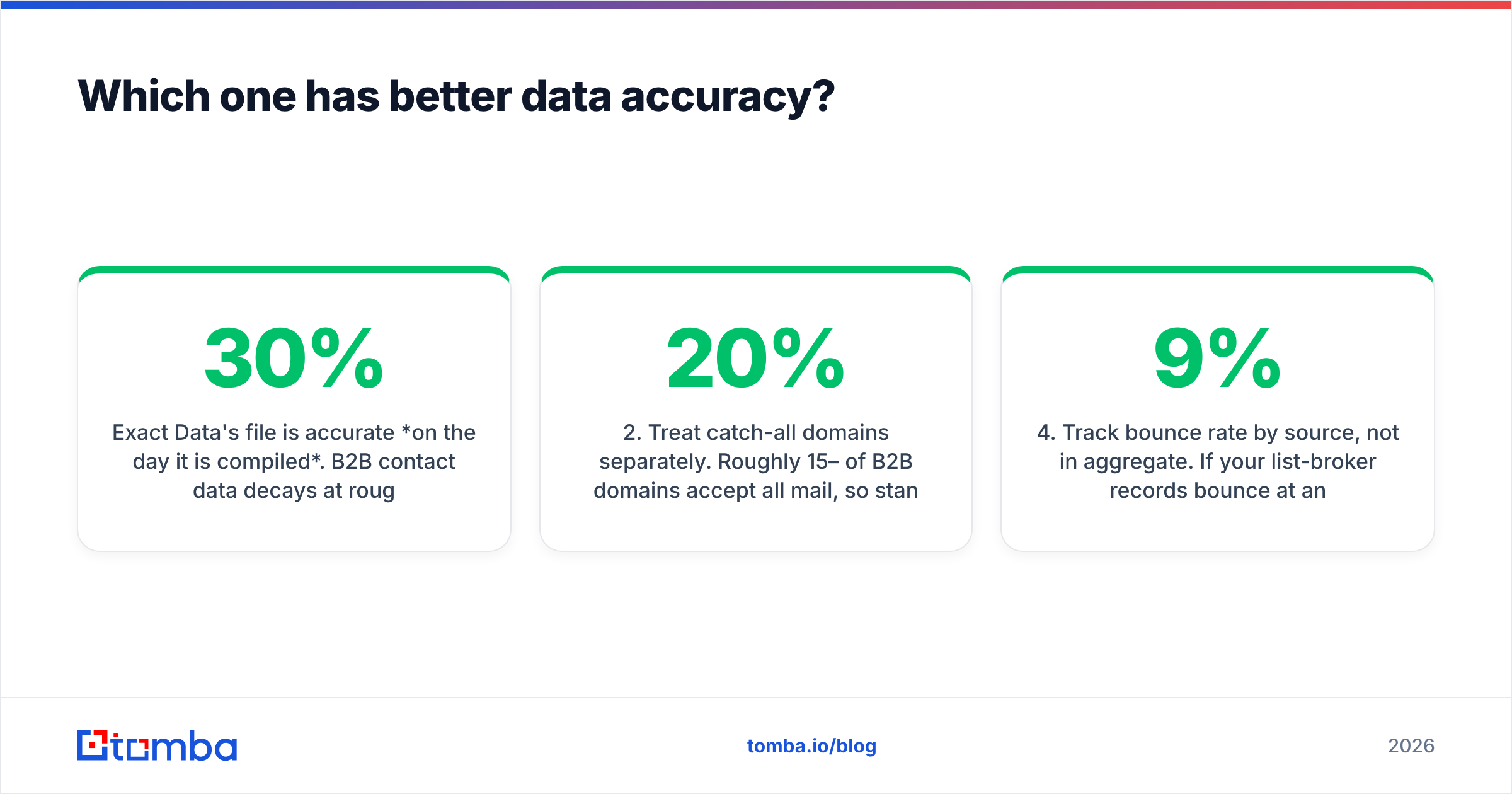
Exact Data's file is accurate on the day it is compiled. B2B contact data decays by roughly 22–30% a year. People change jobs, companies get bought, domains get merged. HubSpot's research on database decay puts the figure near 22.5% a year, and recent layoff cycles pushed job changes higher in tech. So a list you bought in January is clearly worse by June. By the next January, much of it is dead weight. Exact Data does not push updates to a file you already downloaded. That is not a knock on the vendor. It is simply how list brokerage works.
ZoomInfo runs constant re-verification. It collects data contributed by users who install its tools, pulls from public sources, and adds a verification layer. Review sites tell a consistent story. Coverage is strong for US mid-to-senior titles at companies above ~50 people. It is weaker on European contacts, because GDPR limits what can be processed and kept. It is also weaker on firms under 20 people and on very recent job changers. Read the ZoomInfo profile on G2 and you will see the same two complaints: contract friction and regional gaps.
Four practical accuracy rules, whichever you buy:
- Verify before you send, always. Even a "verified" vendor record should pass through an email verifier at send time. The vendor checked it whenever they last touched it, not this morning.
- Treat catch-all domains separately. Roughly 15–20% of B2B domains accept all mail, so a standard SMTP check returns "unknown." Segment those and run a catch-all verifier instead of guessing.
- Sample before you buy volume. Ask Exact Data for a 200-record sample against your real selects. Ask ZoomInfo for a trial export of 100 contacts in your worst segment, not their best one.
- Track bounce rate by source, not in aggregate. If broker records bounce at 9% and finder-sourced records bounce at 1.5%, your blended 4% number hides the decision.
Is ZoomInfo worth the price for a small team?#
Usually no, and the maths is not close.
ZoomInfo pays off when three things are true. You have a defined account list worth six figures per deal. You have a RevOps person to run enrichment and routing. And you have enough reps to spread the seat cost. Intent data only helps if someone acts on it within days. If you cannot staff that, you are paying for a signal you never use.
Run the numbers for a three-rep team:
| Scenario | Annual cost | Contacts reached/yr | Effective cost per contact |
|---|---|---|---|
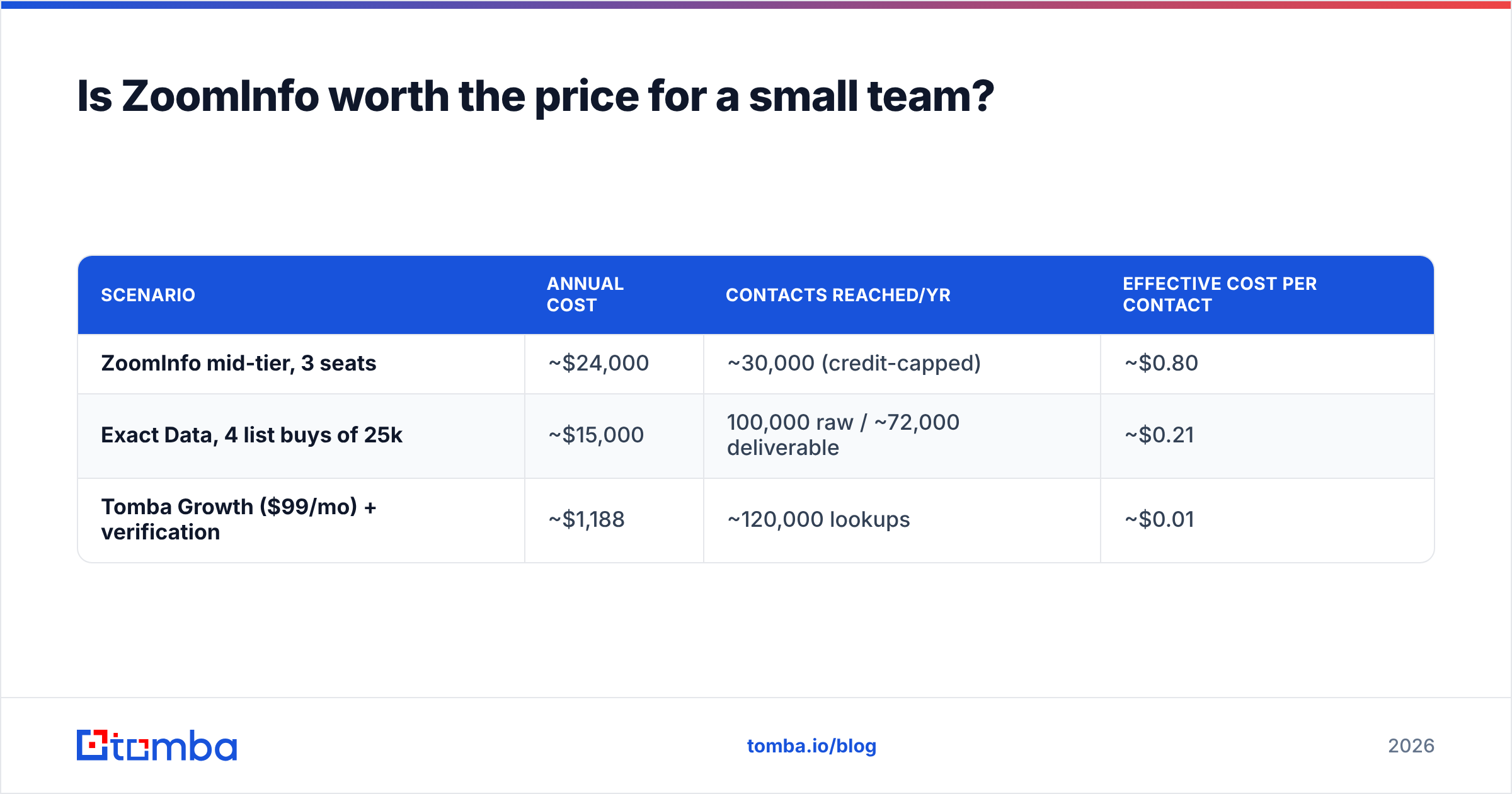
| ZoomInfo mid-tier, 3 seats | ~$24,000 | ~30,000 (credit-capped) | ~$0.80 |
| Exact Data, 4 list buys of 25k | ~$15,000 | 100,000 raw / ~72,000 deliverable | ~$0.21 |
| Tomba Growth ($99/mo) + verification | ~$1,188 | ~120,000 lookups | ~$0.01 |
Those are directional, not quoted prices. Credit allowances and per-record rates move with negotiation. But the shape holds. Platform pricing buys you workflow and signal, not raw contacts. If you are not using the signal, you are overpaying by a wide margin.
The case for ZoomInfo is still real. Say your average deal is $80k, and intent data surfaces three in-market accounts a quarter that you would otherwise miss. One closed deal pays for the platform several times over. That is a genuine ROI case. It just is not most teams' case.

What about compliance and list-buying risk?#
The two models split sharply here, and this is where buyers get burned.
Purchased lists carry real legal risk. Under GDPR, a bought contact record rarely has a lawful basis for direct marketing on its own. You have to establish legitimate interest, document it, and prove where the data came from. Under CAN-SPAM in the US, bought B2B email is legal if you honour opt-outs and include a physical address. That is why US list brokerage is still a viable business. Under CASL in Canada, the rules are much tighter.
There is a more practical issue too. Mailbox providers do not care about your legal basis. They care about your complaint rate. Google's bulk sender requirements set a hard 0.3% spam-complaint limit. Blasting 25,000 unverified addresses is one of the fastest ways to cross it and burn a domain you spent months warming.
ZoomInfo runs a notice-and-opt-out process and keeps a privacy centre. It acts as a data controller with compliance staff, and that is part of what the price tag buys. It reduces your risk. It does not remove it. You are still the sender.
Practical steps that apply to both:
- Never mail a purchased file from your primary domain. Use a separate sending domain with its own warmup.
- Suppress aggressively. Cut role accounts (info@, sales@), competitors, current customers, and anyone who unsubscribed anywhere in your stack.
- Check your sender health first. Run an email reputation checker and confirm your SPF record and DMARC are correct before the first send.
- Start at 30–50 sends a day per mailbox and ramp up slowly, no matter how good the data claims to be.
When should you pick each one?#
Pick Exact Data if: you run US SMB campaigns with direct mail in the mix, you want volume at a fixed one-time cost, and your targeting is firm-level rather than persona-level. It also fits if you refuse to sign an annual contract. Their postal-data heritage genuinely helps on multichannel, since most modern platforms have thin direct-mail files.
Pick ZoomInfo if: you sell to enterprise, your deal sizes justify $25k+ of tooling, and you have RevOps capacity to act on intent data. Org charts help here too, because multi-threading needs hierarchy. Also pick it if CRM enrichment is a real bottleneck for you. That is a core strength for them.
Pick a per-lookup email finder if: you already know which companies you want and just need the right person's verified work email. This is the majority case for outbound teams, and both models above serve it badly. You do not need 100,000 records. You need 800 correct ones. A domain search returns every discoverable address at a target company plus the email pattern, and a bulk email finder turns a company list into verified contacts with no list purchase and no annual licence.
Consider a hybrid if: you want a broad seed file plus per-contact precision. Buy a firm-level company list first — Exact Data is fine for this, since company records decay far slower than contact records. Then resolve the individual contacts yourself. You get list-broker economics on the account layer and platform-grade accuracy on the contact layer.
Neither vendor is the only option in its category. BookYourData sits between the two models, with pay-as-you-go verified B2B lists and no annual commitment. That suits teams who want list economics with a stronger accuracy guarantee. In the platform tier, Apollo and Cognism both compete on price. See our breakdown of Apollo alternatives if that is the comparison you are actually running.
How do you evaluate any B2B data vendor in 2026?#
Use the same five-step test on every vendor, including these two:
- Test against known truth. Pull 100 contacts you have already verified in your CRM. Ask the vendor to return the same records. Score the exact-match rate on email, title, and company. Below 70% on title accuracy means you will personalise with wrong facts.
- Measure bounce rate on a live send. A verification tool is not proof. Send 500 real emails from a warmed throwaway domain and count hard bounces. Under 2% is good. Over 5% means the data is stale, whatever the dashboard says.
- Check coverage where you actually sell. Vendors quote global totals. Ask for counts filtered to your exact ICP: country, employee band, and your three target job titles. The real number is usually much smaller.
- Read the renewal terms before the demo ends. Four clauses cause most disputes: auto-renew, credit rollover, mid-term seat reduction, and data retention after cancellation. Get them in writing.
- Price per usable contact, not per record. Multiply cost per record by (1 / deliverability rate). Compare that number across vendors. It reorders the leaderboard almost every time.
Run that test and the Exact Data vs ZoomInfo answer is usually neither, on its own. It is a smaller platform spend plus a precise, verified lookup layer you control.
Where does Tomba fit?#
Tomba is not trying to be ZoomInfo. There is no intent scoring, no org-chart viewer, no conversation intelligence. It does the part most outbound teams need every day. It turns a company and a name into a verified, deliverable work email, at a price that needs no procurement cycle.
The Tomba Email Finder finds professional email addresses by domain, name, or company. It verifies them at lookup time and handles catch-all domains openly, instead of dumping them into an "unknown" bucket.
Start on the free tier with 25 searches a month. Move to Starter at $49/mo or Growth at $99/mo when your volume justifies it. There is no annual contract and no seat minimum, and full Tomba API access comes with every paid plan, so your engineers can wire it into your CRM or enrichment pipeline. Check the full Tomba pricing breakdown. Or just run a few lookups against your worst segment and compare the bounce rate to whatever you pay $24,000 a year for.
Related guides#
Ready to find emails that actually work?
Join 150,000+ professionals who stopped guessing and started sending. Free credits on signup — no credit card required.
Get the Tomba newsletter
Practical outbound tactics and product updates — once every two weeks.
About the author