ExactVerify vs Warpleads 2026: Which One Fits Your Stack?
ExactVerify cleans lists. Warpleads builds them. They get compared constantly, but they solve different halves of the same problem — here is how pricing, accuracy, and workflow actually stack up in 2026.
TL;DR
- ExactVerify and Warpleads are not really competitors. ExactVerify is an email verification engine; Warpleads is a B2B lead database with bulk export. Comparing them head-to-head only makes sense because both end up in the same cold email workflow.
- If your problem is "my bounce rate is 6% and my domain is getting throttled," you need a verifier — ExactVerify or an equivalent.
- If your problem is "I have no one to email," you need a data source — Warpleads, or a finder/database that resolves emails per company.
- Buying both means two vendors, two credit systems, and no guarantee the exported records survive verification. Roughly 20–30% of scraped B2B records go stale each year, so export volume without a verification step is a vanity metric.
- A combined find-plus-verify platform is usually cheaper per usable contact than a database subscription plus a separate verifier. Tomba's Starter plan is $49/mo and covers finding, domain search, and verification in one credit pool.
What are ExactVerify and Warpleads?#
They sit on opposite ends of the outbound data pipeline.
ExactVerify is an email validation service. You upload a list — or hit an API — and it returns a status per address: valid, invalid, risky, catch-all, disposable, role-based. It does syntax parsing, MX record lookups, SMTP handshakes, and disposable-domain matching. It does not find anyone. It grades what you already have. See exactverify.com for the current feature list.
Warpleads is a lead generation platform built around export volume. Its pitch is unlimited or high-ceiling exports from a B2B contact database, plus on-demand list building for niches the database doesn't cover well. You filter by industry, geography, title, company size, and pull a CSV. Its own warpleads.com positioning leans hard on the "export as many leads as you want" angle rather than per-record precision.
So the honest framing for ExactVerify vs Warpleads is: one is a filter, one is a faucet. Asking which is better is like asking whether a water pump beats a water filter. The real question is which half of your pipeline is currently broken.
Which half of your pipeline is actually broken?#
Before you compare price tables, diagnose. Here is the five-question triage I run with sales teams before recommending either tool:
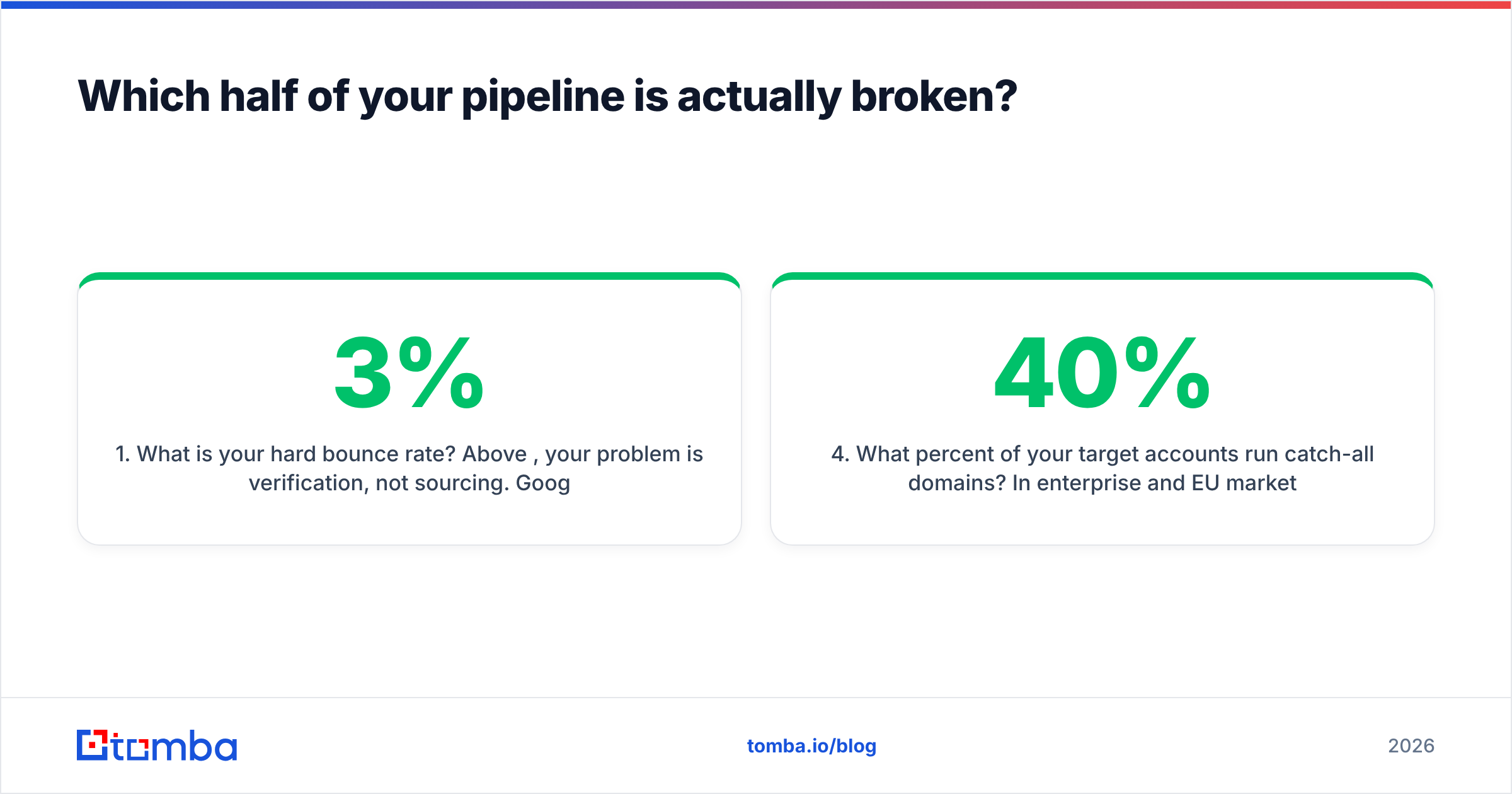
- What is your hard bounce rate? Above 3%, your problem is verification, not sourcing. Google and Yahoo's bulk sender requirements put the spam-complaint ceiling at 0.3% and expect low bounce rates; blowing past that costs you inbox placement across every campaign, not just the bad list.
- How many net-new accounts entered your CRM last month? If the answer is under 200 and you have reps sitting idle, you have a sourcing problem, and a verifier will not fix it.
- Where did your current list come from? A list scraped 8 months ago needs verification before anything else. A list you built this week from live company pages needs less.
- What percent of your target accounts run catch-all domains? In enterprise and EU markets it can exceed 40%. Generic verifiers mark those "risky" and effectively hand the decision back to you — which is a real cost when it's a third of your TAM.
- Do you need the data inside a workflow or inside a spreadsheet? CSV-first tools slow down anything that has to hit a CRM, a sequencer, or an enrichment job on a schedule.
If questions 1 and 3 hurt, start with verification. If 2 hurts, start with sourcing. If both hurt, stop buying point tools and consolidate.

How does ExactVerify actually work?#
Verification is a stack of progressively more expensive checks, and every serious verifier — ExactVerify included — runs roughly the same sequence.
Syntax and format parsing kills the typos. DNS and MX lookups confirm the domain can receive mail at all. The SMTP conversation opens a connection to the receiving server and asks whether the mailbox exists, without sending anything. Disposable and role-based detection flags info@, support@, and throwaway domains from services that mint addresses on demand. Whatever remains gets a confidence status.
The failure mode to understand: catch-all domains break SMTP verification by design. A catch-all server accepts every address at the domain, so the handshake returns "yes" for ceo@company.com and asdkjh@company.com alike. Any verifier that reports those as valid is lying to you; any verifier that reports them as "risky" is being honest but unhelpful. The differentiator in 2026 is what a vendor does after the SMTP layer returns ambiguous — pattern inference, cross-source corroboration, historical engagement signals. That's why a dedicated catch-all verifier exists as a separate product category rather than a checkbox.
ExactVerify's marketing accuracy claims sit in the same 98–99% band everyone advertises. Treat those numbers as unverifiable until you run your own control test: take 500 addresses you already know the truth about (your CRM's engaged contacts plus known-dead records), run them through, and count false positives and false negatives yourself. Vendor-reported accuracy is measured on vendor-chosen samples.

What does Warpleads actually give you?#
Volume, filtered. You pick criteria, you get records, you export.
That model has genuine strengths. If you're running high-volume outbound into a broad ICP — SMB SaaS, agencies, local services — and your economics work at low reply rates, an export-heavy database is efficient. You are not paying per-lookup, so a wide net costs the same as a narrow one.
The weaknesses are structural and worth naming plainly:
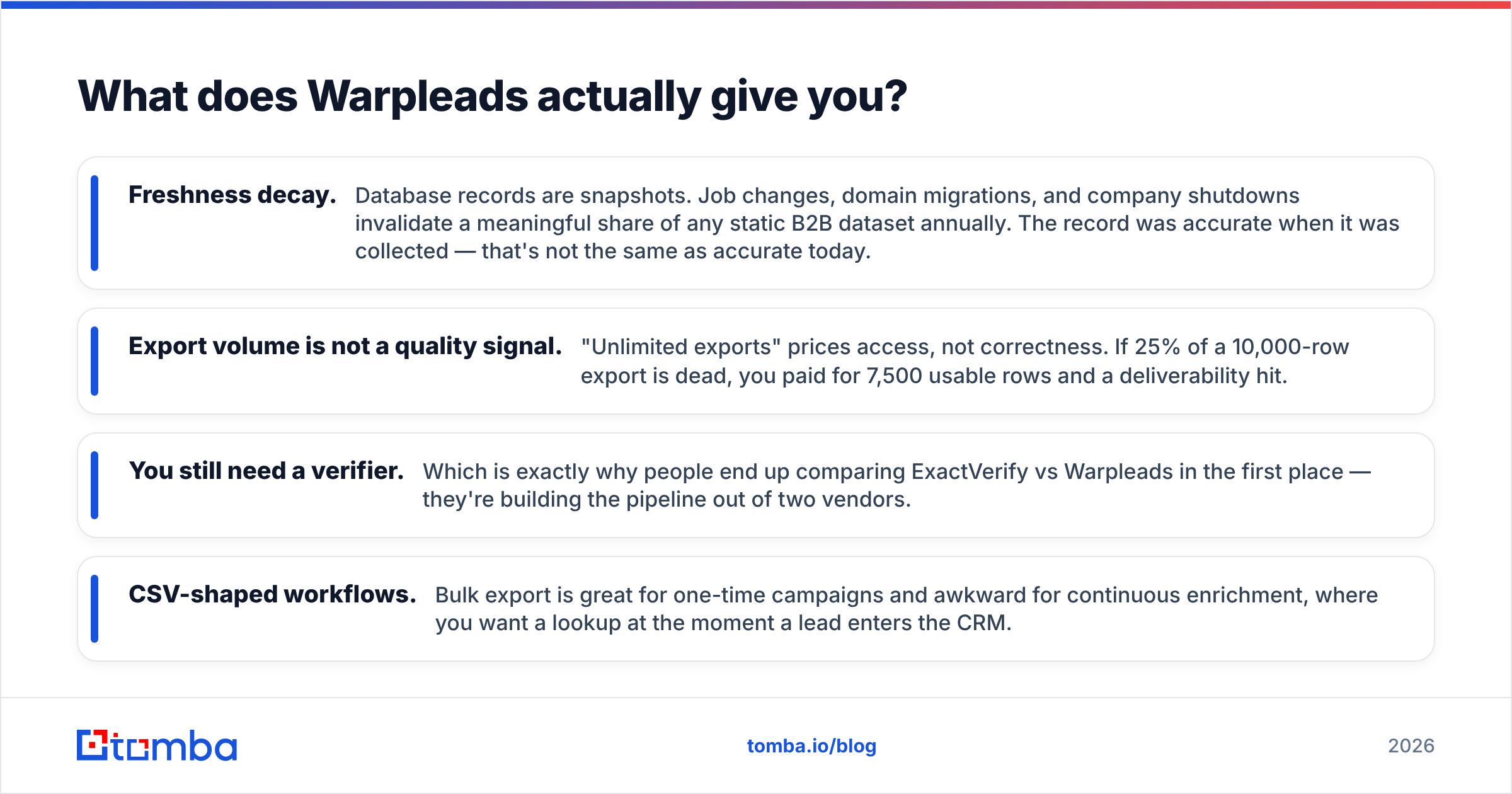
- Freshness decay. Database records are snapshots. Job changes, domain migrations, and company shutdowns invalidate a meaningful share of any static B2B dataset annually. The record was accurate when it was collected — that's not the same as accurate today.
- Export volume is not a quality signal. "Unlimited exports" prices access, not correctness. If 25% of a 10,000-row export is dead, you paid for 7,500 usable rows and a deliverability hit.
- You still need a verifier. Which is exactly why people end up comparing ExactVerify vs Warpleads in the first place — they're building the pipeline out of two vendors.
- CSV-shaped workflows. Bulk export is great for one-time campaigns and awkward for continuous enrichment, where you want a lookup at the moment a lead enters the CRM.
Peer tools in this space handle the freshness problem differently — BookYourData, for example, leans on verification-at-export as part of its model rather than treating it as a separate purchase. Worth looking at if the database route is the one you want.
ExactVerify vs Warpleads: how do they compare side by side?#
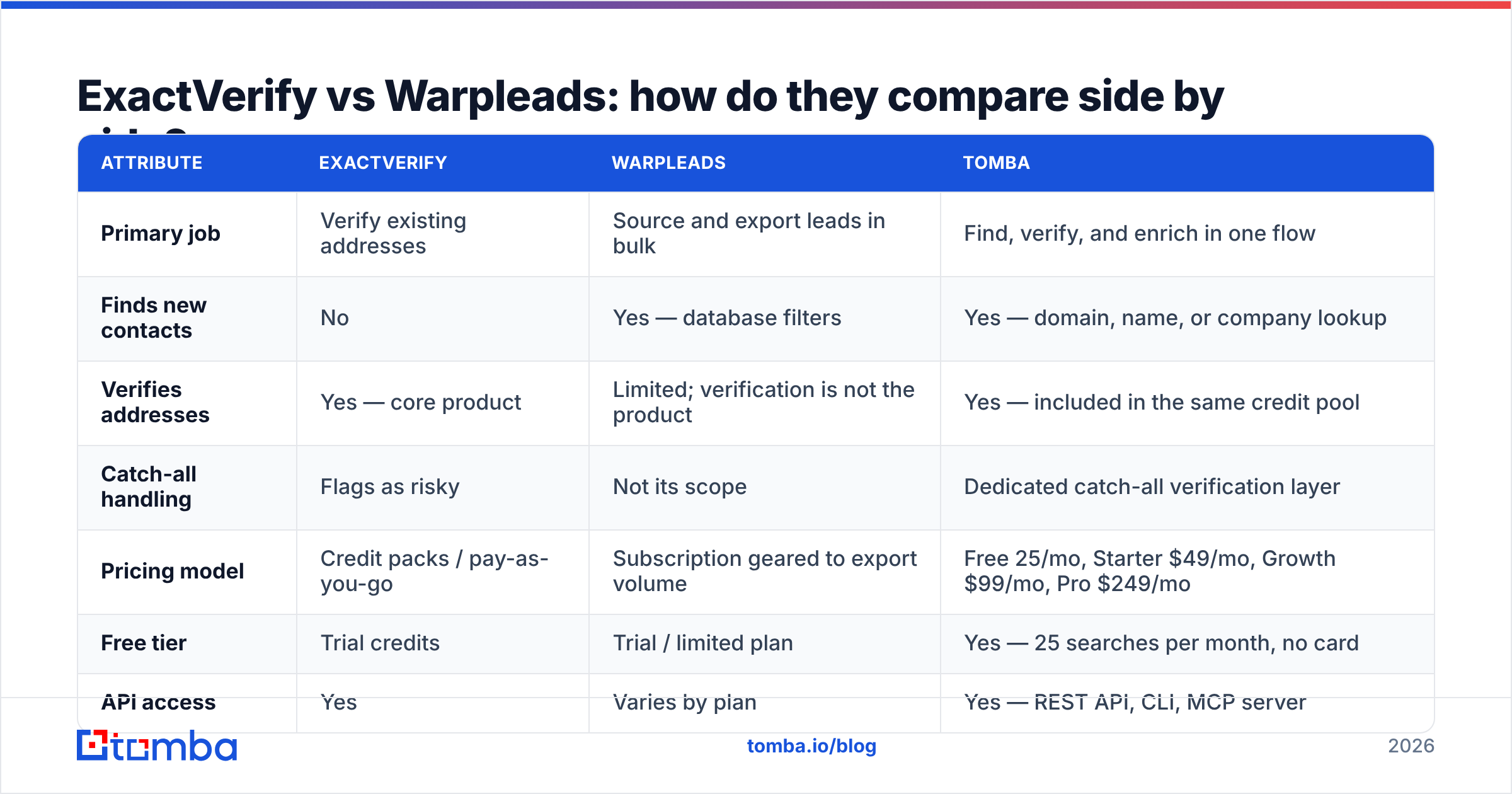
| Attribute | ExactVerify | Warpleads | Tomba |
|---|---|---|---|
| Primary job | Verify existing addresses | Source and export leads in bulk | Find, verify, and enrich in one flow |
| Finds new contacts | No | Yes — database filters | Yes — domain, name, or company lookup |
| Verifies addresses | Yes — core product | Limited; verification is not the product | Yes — included in the same credit pool |
| Catch-all handling | Flags as risky | Not its scope | Dedicated catch-all verification layer |
| Pricing model | Credit packs / pay-as-you-go | Subscription geared to export volume | Free 25/mo, Starter $49/mo, Growth $99/mo, Pro $249/mo |
| Free tier | Trial credits | Trial / limited plan | Yes — 25 searches per month, no card |
| API access | Yes | Varies by plan | Yes — REST API, CLI, MCP server |
| Native spreadsheet workflow | CSV upload | CSV export | Google Sheets, Excel, Airtable add-ins |
| Best for | Cleaning lists you already own | High-volume broad-ICP outbound | Teams that want one vendor for both halves |
| Weak spot | Zero sourcing capability | Freshness + no verification layer | Not an unlimited-export database |

Pricing on both ExactVerify and Warpleads moves — check their live pages and cross-reference user reports on G2 before you commit to an annual term. Tomba's numbers above are current and published at Tomba pricing.
Is one more accurate than the other?#
They're measuring different things, so a single accuracy number can't rank them.
ExactVerify's accuracy question is: of the addresses it marked valid, how many actually accept mail? That's a precision question with a clean test — send and count bounces.
Warpleads' accuracy question is: of the records it exported, how many are the right person, at the right company, with a working address, today? That's three failure modes stacked, and only the third one bounces. A record can pass verification perfectly and still be a person who left the company in March.
This is the trap in most cold email stacks. You verify, your bounce rate drops to 1%, and you declare victory — while 20% of your sends land in the mailbox of someone who no longer works there. Low bounce rate, zero reply rate, and no signal telling you why. Verification proves an address is live. It does not prove the contact is correct.
The fix is verification at the point of discovery, not weeks later on a stale CSV. When the email finder resolves the address and validates it in the same call, the timestamp on the data is the timestamp on the check. That's a structurally different guarantee than exporting in January and verifying in March.

When should you pick each one?#
Pick ExactVerify (or any dedicated verifier) if: you already have a large owned list — webinar signups, trade show scans, an old CRM export, a partner-shared file — and you need it cleaned once before a send. Pay-as-you-go verification credits are the right shape for a one-time cleanup job. It's also right if you're already committed to a data source you like and just need a validation layer bolted on.
Pick Warpleads if: you're running broad, high-volume outbound where the ICP is wide and per-lead cost matters more than per-lead precision. Agencies running campaigns for many clients at once, and teams whose model tolerates low reply rates at high send volume, get real leverage from export-heavy pricing. Budget separately for verification — treat it as a required line item, not an optional one.
Pick a consolidated platform if: your ICP is specific, your list is built account-by-account, and every contact matters. Targeted outbound doesn't need 10,000 exported rows; it needs 300 correct ones. At that shape, per-lookup find-and-verify beats bulk export on both cost and quality, and you cut a vendor.
Pick all three, briefly, if you're evaluating. Run the same 200 target accounts through each, then check the results against ground truth. Vendor benchmarks are marketing. Your accounts are the only test that counts.
What does the consolidated workflow look like?#
Here's the practical version, using one vendor instead of two:
- Start from the account, not the list. Run domain search on a target company and get the email pattern plus every discoverable address at that domain — with role and department attached.
- Resolve the specific person. Feed a name and domain to the email finder; get the address with a confidence score and the sources it was corroborated against.
- Verify inside the same call. The email verifier runs syntax, MX, SMTP, and disposable checks before the record reaches your CRM. Catch-all domains route to the dedicated catch-all layer rather than getting dumped into a "risky" bucket.
- Batch the repetitive work. Existing spreadsheet of companies and names? Bulk email finder processes it in one job — find and verify together, one credit pool, one export.
- Automate the recurring part. The Tomba API fires enrichment at the moment a lead is created, so records are verified when they enter the system instead of quarterly. Sheets, Excel, Airtable, HubSpot, and Zapier integrations cover the no-code path.
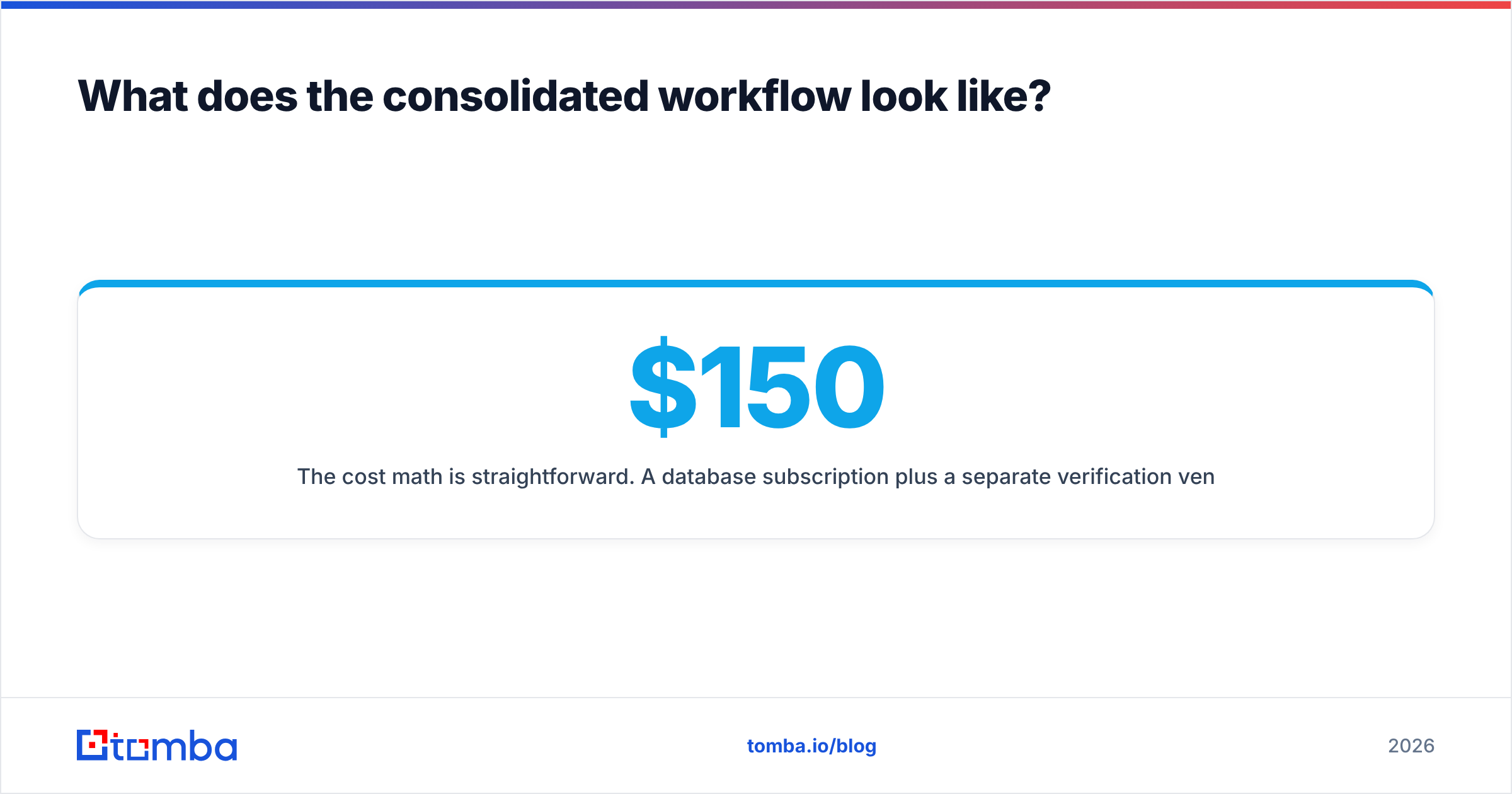
The cost math is straightforward. A database subscription plus a separate verification vendor typically runs $150–$300/mo before you've sent anything, with two credit systems to track and no shared confidence scoring between them. Tomba's Growth plan is $99/mo with finding, verification, domain search, and enrichment on one balance. For most teams under 5,000 contacts a month, consolidation is cheaper and produces fewer surprises.
What should you actually do next?#
Diagnose first, buy second.
Pull your last three campaigns and compute two numbers: hard bounce rate and reply rate. High bounces, decent replies from the ones that landed? You have a verification problem — ExactVerify or an equivalent solves it, and you can buy credits without a commitment. Low bounces, near-zero replies? Your data is technically clean and factually wrong; more export volume from any database makes that worse, not better. Not enough contacts to run a campaign at all? Sourcing is the bottleneck, and Warpleads' export model is a reasonable answer if your ICP is broad.
And if the honest answer is "both, and I'd rather not manage two vendors" — that's the case for consolidating. Test it against your own accounts rather than a vendor's benchmark deck.
Try it on your own list. Tomba's Email Finder gives you 25 free searches a month with no credit card, and every result comes back verified with a confidence score and its sources — so you can compare it directly against whatever ExactVerify or Warpleads returns for the same accounts. Run 25 target companies through all three and let the numbers pick the winner.
Related guides#
Ready to find emails that actually work?
Join 150,000+ professionals who stopped guessing and started sending. Free credits on signup — no credit card required.
Get the Tomba newsletter
Practical outbound tactics and product updates — once every two weeks.
About the author