Executive Business Review Template: The 2026 EBR Playbook
Most EBR decks are usage dumps that get skimmed and forgotten. Here's a slide-by-slide executive business review template, the metrics that actually move a renewal, and the four sections you should delete before the meeting.
TL;DR
- An executive business review (EBR) is a 45–60 minute strategic meeting with the people who control budget — not a product training session and not a support recap.
- The working executive business review template is six sections: outcomes vs. goals, ROI in currency, risks, roadmap alignment, expansion path, and next commitments.
- Cut usage screenshots, ticket volume charts, feature tours, and anything that requires the exec to remember what they bought 11 months ago.
- Preparation costs 3–5 hours per account. If you can't invest that, run a lighter QBR with the day-to-day owner instead and save the exec slot for later.
- The single highest-leverage slide is the one that converts your product's activity into the customer's own financial language. Everything else is context.
What is an executive business review?#
An executive business review is a scheduled meeting where a vendor and a customer's senior stakeholders assess whether the partnership is delivering the business result it was bought for, and decide what happens next.
The word doing the heavy lifting is executive. A VP of Operations does not care that your platform processed 412,000 records last quarter. She cares that record-processing cost dropped 18% and that her team stopped losing two days a month to manual cleanup. Same fact, different currency. The EBR is where you translate.
Think of it like a mortgage annual statement versus a bank app notification. The app tells you every transaction. The annual statement tells you how much closer you are to owning the house. Executives read statements.
Practically, an EBR is where three decisions get made or unmade:
- Renewal confidence. Does the sponsor believe this is worth funding again?
- Expansion appetite. Is there budget or political will to widen the deployment?
- Risk visibility. Are there problems your champion has been absorbing quietly that you need to see before they become a churn note?
If your meeting doesn't touch all three, it's a status call with a nicer deck.
Is an EBR the same as a QBR?#
No, and conflating them is why so many EBR decks are bloated.
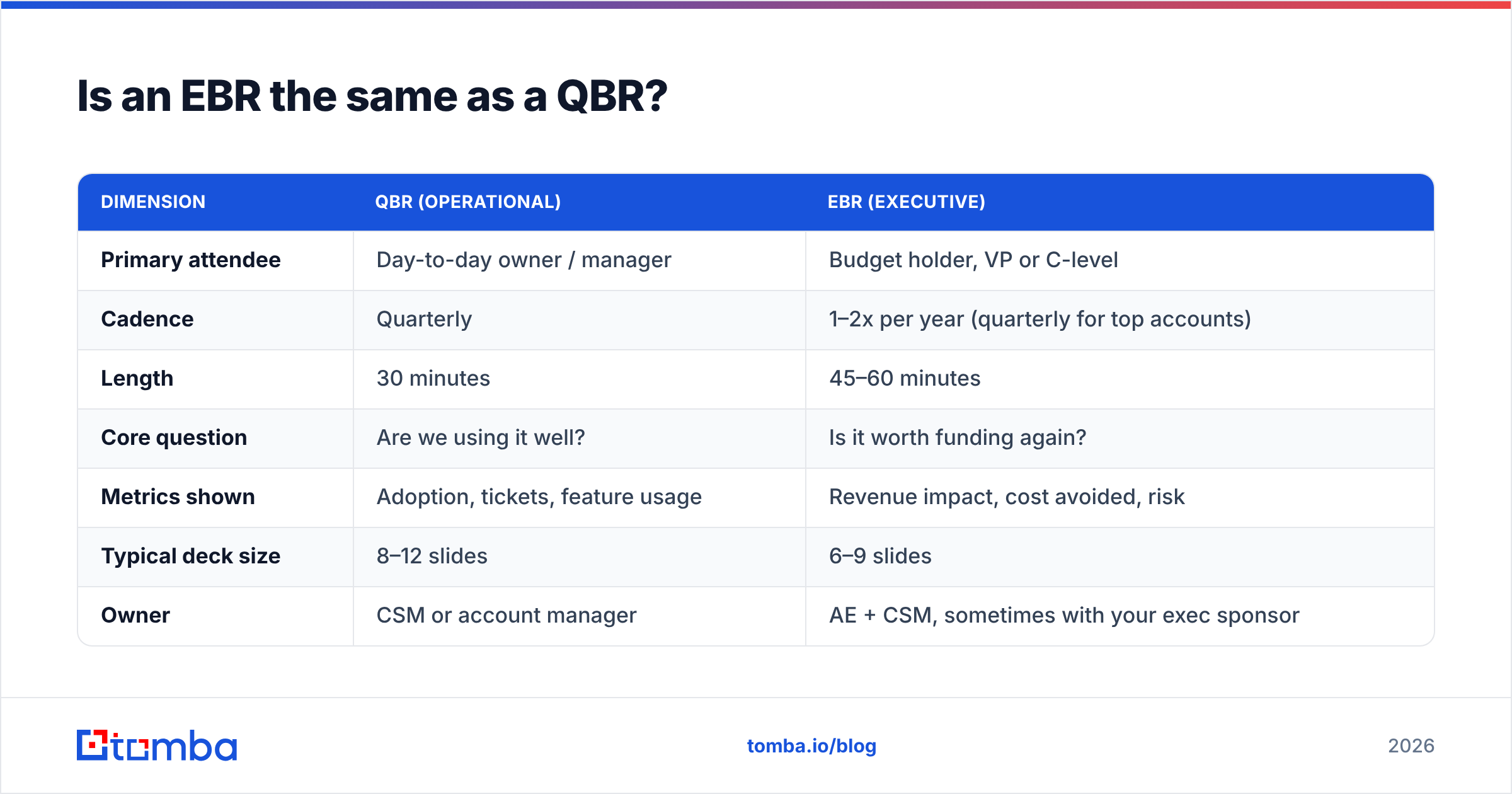
A QBR (quarterly business review) is operational. It runs with the day-to-day owner — the manager who logs in, the ops lead who owns adoption. It covers tactics: adoption gaps, upcoming launches, open tickets, training needs. It can be 30 minutes and 8 slides.
An EBR is strategic and less frequent — typically twice a year for mid-market, annually for the long tail, quarterly only for your top 10–20 accounts by revenue. Attendance changes the format entirely.
| Dimension | QBR (operational) | EBR (executive) |
|---|---|---|
| Primary attendee | Day-to-day owner / manager | Budget holder, VP or C-level |
| Cadence | Quarterly | 1–2x per year (quarterly for top accounts) |
| Length | 30 minutes | 45–60 minutes |
| Core question | Are we using it well? | Is it worth funding again? |
| Metrics shown | Adoption, tickets, feature usage | Revenue impact, cost avoided, risk |
| Typical deck size | 8–12 slides | 6–9 slides |
| Owner | CSM or account manager | AE + CSM, sometimes with your exec sponsor |
| Outcome | Action plan | Renewal, expansion, or escalation decision |
The practical rule: if the person in the room can't approve spend, you're running a QBR. Label it honestly and stop pretending otherwise, because an exec who gets invited to an operational review once will decline the next three invites.
Wait — that image is a placeholder. Here is the real one:

What goes in an executive business review template?#
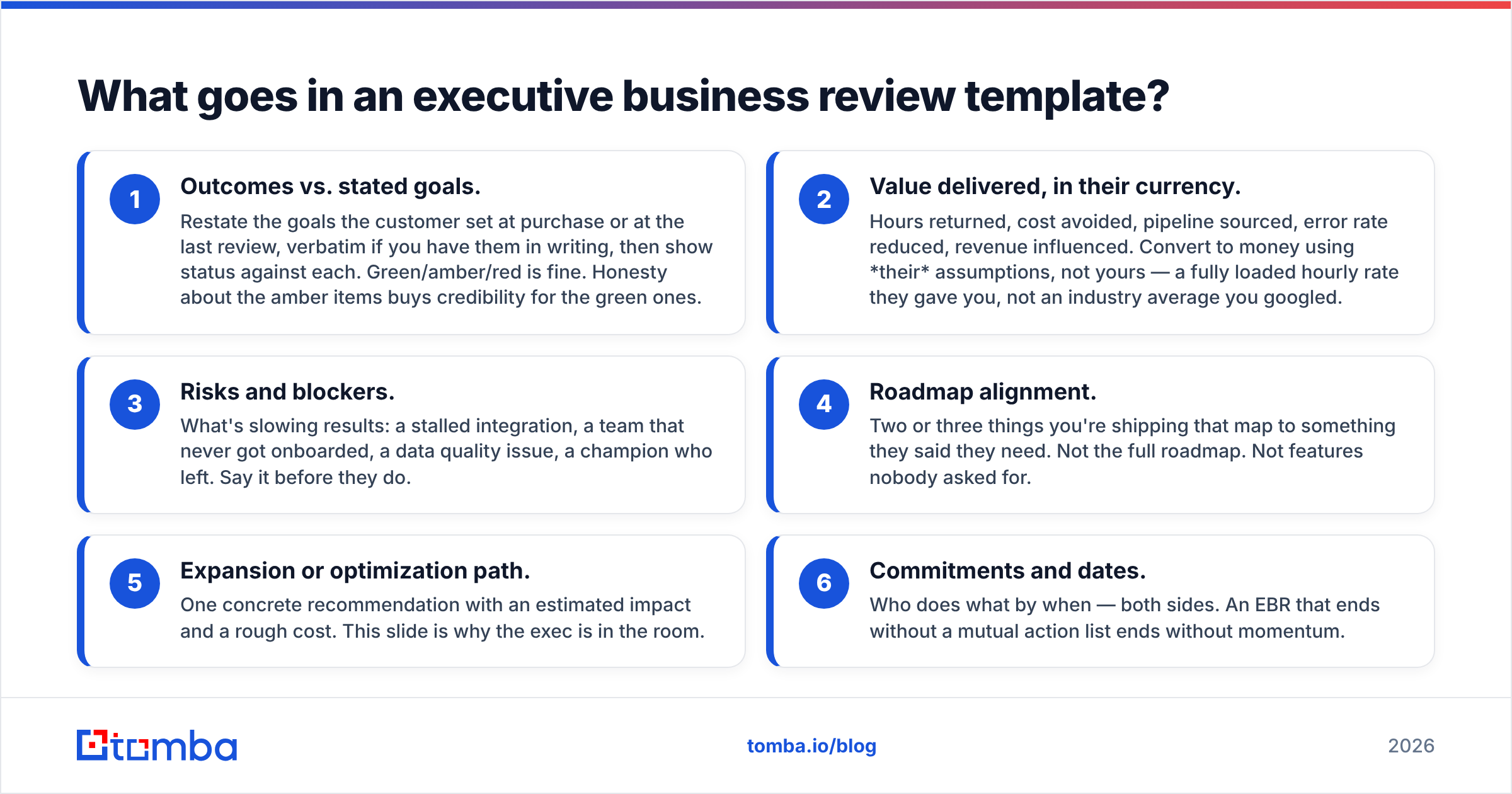
Six sections. In this order. Every additional section you add reduces the odds the last one gets discussed, and the last one is where the money is.
- Outcomes vs. stated goals. Restate the goals the customer set at purchase or at the last review, verbatim if you have them in writing, then show status against each. Green/amber/red is fine. Honesty about the amber items buys credibility for the green ones.
- Value delivered, in their currency. Hours returned, cost avoided, pipeline sourced, error rate reduced, revenue influenced. Convert to money using their assumptions, not yours — a fully loaded hourly rate they gave you, not an industry average you googled.
- Risks and blockers. What's slowing results: a stalled integration, a team that never got onboarded, a data quality issue, a champion who left. Say it before they do.
- Roadmap alignment. Two or three things you're shipping that map to something they said they need. Not the full roadmap. Not features nobody asked for.
- Expansion or optimization path. One concrete recommendation with an estimated impact and a rough cost. This slide is why the exec is in the room.
- Commitments and dates. Who does what by when — both sides. An EBR that ends without a mutual action list ends without momentum.
That's the whole executive business review template. Section 2 should take a third of the meeting.
What does the slide-by-slide EBR template look like?#
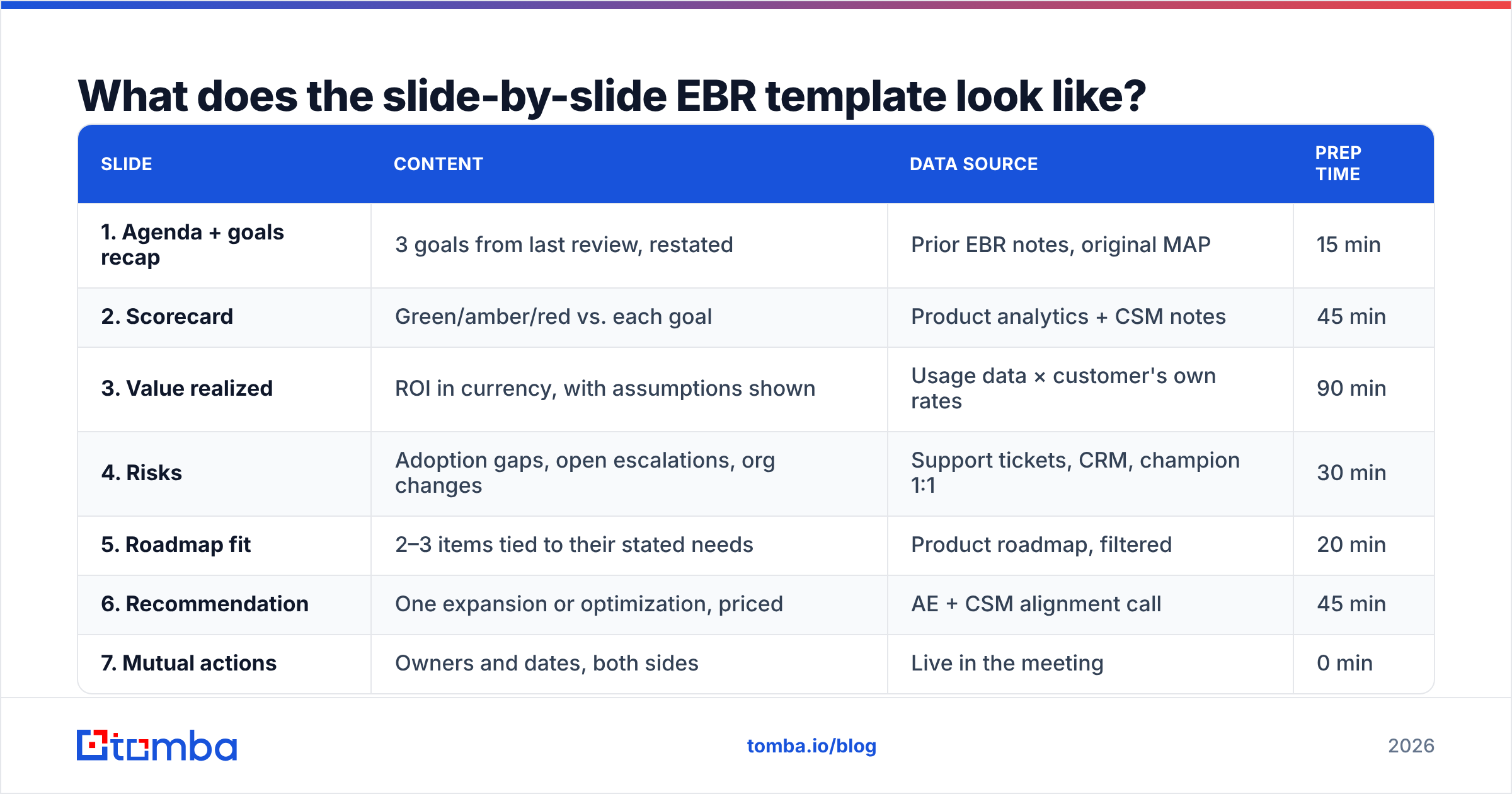
Here's the same structure as a build sheet, with the data source you'll need for each slide and the honest time cost of assembling it.
| Slide | Content | Data source | Prep time |
|---|---|---|---|
| 1. Agenda + goals recap | 3 goals from last review, restated | Prior EBR notes, original MAP | 15 min |
| 2. Scorecard | Green/amber/red vs. each goal | Product analytics + CSM notes | 45 min |
| 3. Value realized | ROI in currency, with assumptions shown | Usage data × customer's own rates | 90 min |
| 4. Risks | Adoption gaps, open escalations, org changes | Support tickets, CRM, champion 1:1 | 30 min |
| 5. Roadmap fit | 2–3 items tied to their stated needs | Product roadmap, filtered | 20 min |
| 6. Recommendation | One expansion or optimization, priced | AE + CSM alignment call | 45 min |
| 7. Mutual actions | Owners and dates, both sides | Live in the meeting | 0 min |
Total: roughly 4 hours per account. That's the real number, and it's why you should not run EBRs for every customer. Run them where the revenue or the strategic logo value justifies four hours of two people's time.
Which metrics belong in an executive business review?#
Pick three to five. Not fifteen. The metrics that survive executive scrutiny share one property: the exec was already tracking something like them before you showed up.
- Cost avoided. Headcount not hired, tooling consolidated, contractor spend eliminated. Easiest to defend, hardest to dispute.
- Cycle time. Days from request to delivery, hours per report, time to onboard a new rep. Executives feel time.
- Revenue influenced. Pipeline sourced, deals accelerated, win rate delta on accounts touched by your product versus those that aren't.
- Quality or risk. Error rates, compliance findings, data accuracy, bounce rates, churn on the customer's own book.
- Coverage. Percentage of the target population actually served — seats active, territories covered, records enriched.
Two rules keep this slide credible. First, show your assumptions on the same slide, in small type. A CFO who can't audit your math will discount it to zero. Second, never present a number you can't source when challenged live. One unverifiable claim contaminates the rest of the deck.
If your value story depends on the quality of the customer's contact data — as it does for most sales and marketing tools — measure that directly. Bad records inflate every downstream metric. Running the account's list through a email verifier before the review gives you a defensible "your database was 71% deliverable at signup, it's 94% now" line, which is far stronger than a usage chart.
How do you prepare in the two weeks before?#
The meeting is 60 minutes. The outcome is decided in the prep.
T-14 days: pre-brief your champion. Ask three questions: What does your exec care about right now? What would make this meeting a waste of their time? Is there anything you'd rather I not put on a slide? The third question saves careers. Your champion may have oversold internally, and walking in with a red metric they haven't disclosed is a betrayal from their seat.
T-10 days: pull the data. Usage, tickets, CRM activity, org changes. Check whether your main contacts still work there — quiet departures are the leading indicator of a surprise non-renewal, and the LinkedIn check takes ten minutes.
T-7 days: build the ROI slide first. If you can't build a credible one, that's the finding. Escalate internally instead of dressing up a weak story.
T-3 days: send the deck. Yes, in advance. Executives who read the deck ask better questions, and the meeting becomes a discussion rather than a recital. Amazon's written-narrative culture is built on this premise, and it works in vendor reviews too.
T-1 day: confirm attendance and re-check for a stakeholder change. If the exec sponsor cancels, reschedule. Running the EBR without the budget holder and calling it done is how teams discover in month 11 that nobody senior had an opinion about the renewal.

What should you cut from your EBR template?#
Almost everything you're currently including. The four biggest offenders:
Feature tours. If the exec wanted a demo, they'd have asked for a demo. Ship product education to the QBR, where the people who'd actually use it are sitting.
Support ticket volume. Nobody senior enjoys a slide about how many times their team needed help. Include support only as risk context ("three escalations, all closed, root cause fixed"), never as a standalone chart.
Your company news. Funding rounds, awards, headcount growth. This is the vendor talking about the vendor. It reads as filler at best and instability at worst.
Generic industry benchmarks. "The average company in your sector sees 23% improvement" invites the obvious question: what did we see? If you have their number, lead with it. If you don't, benchmarks won't save you.
Also cut length. HubSpot's sales research and most enterprise buying studies land on the same conclusion: executive attention collapses past the 20-minute mark unless there's a decision on the table. Get to your recommendation before minute 30.
How do you run the meeting itself?#
Open by restating their goals, not yours. First substantive words out of your mouth should be the customer's own language from the last review.
Then run 60/40 — sixty percent of the time on outcomes and risks, forty on the forward look. Resist the pull toward roadmap talk; it feels productive but commits nothing.
Ask one open question mid-meeting: "What would make this a clear win for you over the next two quarters?" The answer becomes your next EBR's scorecard, and executives will tell you things in that answer that no health score will surface.
Close with mutual commitments, said out loud, with dates. Then send them within 24 hours in a two-paragraph email — not a 40-slide attachment. Gartner's research on B2B buying consistently finds that buyers who receive clear, decision-focused follow-up material report higher purchase confidence, and confidence is what renews contracts.
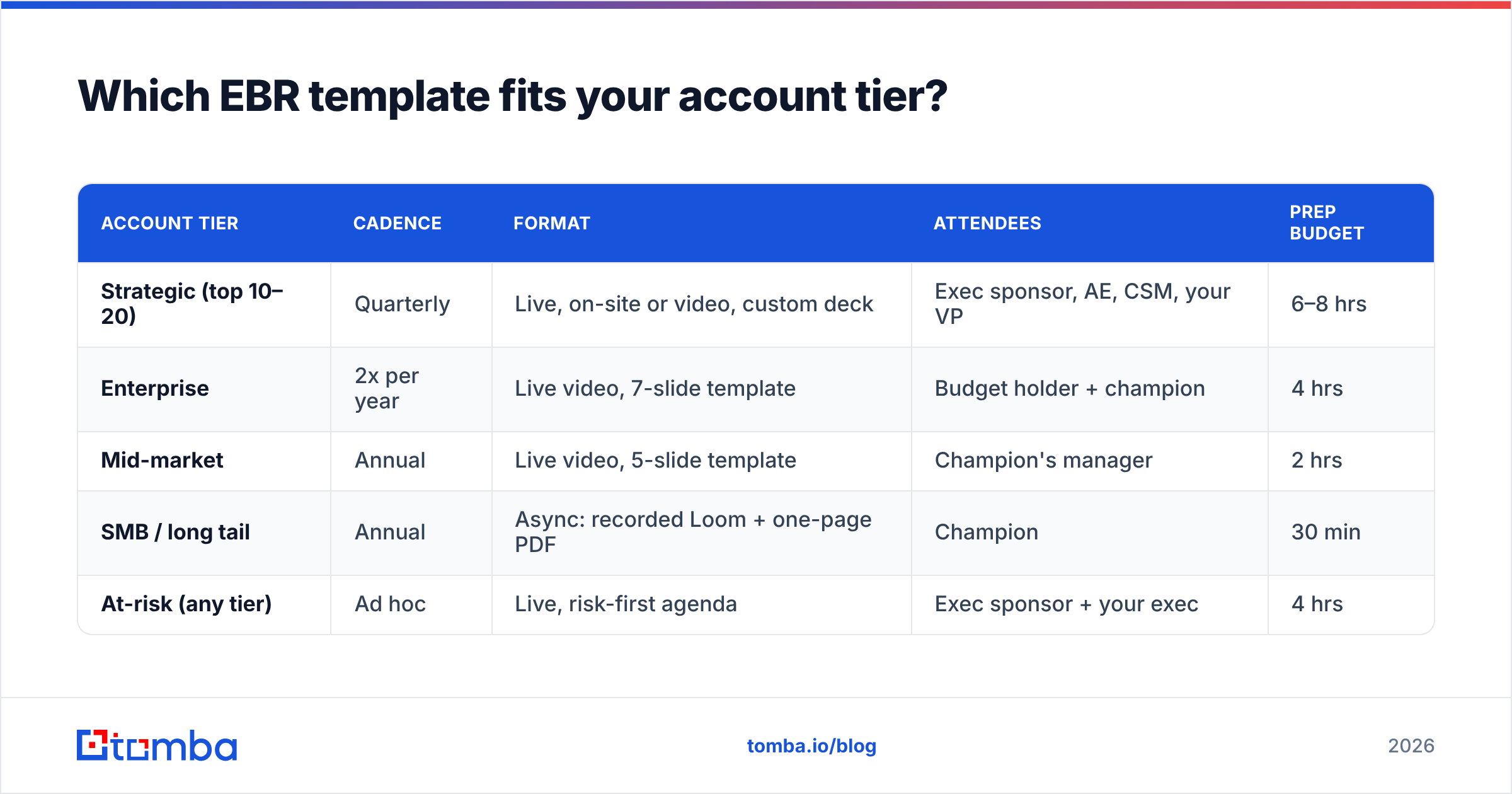
Which EBR template fits your account tier?#
One template does not fit a $12K account and a $1.2M account. Tier the effort.
| Account tier | Cadence | Format | Attendees | Prep budget |
|---|---|---|---|---|
| Strategic (top 10–20) | Quarterly | Live, on-site or video, custom deck | Exec sponsor, AE, CSM, your VP | 6–8 hrs |
| Enterprise | 2x per year | Live video, 7-slide template | Budget holder + champion | 4 hrs |
| Mid-market | Annual | Live video, 5-slide template | Champion's manager | 2 hrs |
| SMB / long tail | Annual | Async: recorded Loom + one-page PDF | Champion | 30 min |
| At-risk (any tier) | Ad hoc | Live, risk-first agenda | Exec sponsor + your exec | 4 hrs |
The async option for the long tail is not a downgrade — it's the correct format. A three-minute recorded walkthrough with a one-page value summary gets watched. A calendar invite for a 45-minute review of a $9K contract gets declined, and the decline reads as disengagement in your health score even though it's just rational time management.
What happens after the EBR?#
Three things, all within a week.
Log the outcomes in your CRM as structured fields, not as a note nobody will read: renewal sentiment, expansion identified (yes/no, estimated value), risks opened, next review date. If your EBR outputs live only in a slide deck on someone's desktop, your forecast is guesswork.
Refresh the account record. Org changes surfaced in the meeting — a new VP, a reorg, a department absorbed — should trigger updated contact records. Stale org data is the reason renewal emails go to people who left eight months ago. Running the account through contact enrichment after each review keeps the map current, and mapping the new stakeholders you just heard about starts with a domain search on the customer's domain to find who else sits in the relevant function.
Book the next one on the call. Not "we'll find time in Q3." An actual date on an actual calendar, while everyone is still in the room and agreeable.
Ready to build the stakeholder map behind your next EBR?#
The best executive business review template in the world fails if you're presenting to the wrong person. Reorgs, promotions, and quiet departures reshuffle your buying committee between every review cycle — and the champion who signed the original deal may no longer control the budget.
Tomba's Email Finder helps you identify and reach the executives who actually own the renewal decision inside your customer accounts, so you can pre-brief the right people before the meeting instead of discovering the org chart changed during it. Start free with 25 searches a month, or check Tomba pricing — plans start at $49/mo for teams running reviews across a full book of business.
Map the room before you build the deck. It's the cheapest EBR prep step there is.
Related guides#
Ready to find emails that actually work?
Join 150,000+ professionals who stopped guessing and started sending. Free credits on signup — no credit card required.
Get the Tomba newsletter
Practical outbound tactics and product updates — once every two weeks.
About the author