Exellius vs OneMoreLead: Which B2B Data Tool Wins in 2026
Both sell B2B contact data, but they sell it in very different shapes. Here is an honest breakdown of Exellius vs OneMoreLead on data freshness, verification, pricing models, and what happens when the list goes stale.
Exellius vs OneMoreLead is a choice between two ways to buy B2B contact data. One vendor builds the list for you. The other lets you filter a big database and export it yourself. Here is how they compare on freshness, checks, price, and fit.
TL;DR
- Exellius builds lists for you. You describe an ICP, they deliver a file. It suits teams that want the work done for them.
- OneMoreLead is self-serve. You filter a large pool of B2B contacts, run their checks, and export.
- Neither one is an API-first email finder. If you need live lookups inside a CRM or a script, both feel like batch delivery.
- The real question is not who has more records. It is who re-checks the data on the day you send.
- Best-fit call: Exellius for niche, hand-built lists. OneMoreLead for cheap volume. Verify either one before a single email goes out.
What are Exellius and OneMoreLead?#
Exellius sells B2B data as a service, not as software. You describe an ICP. They build the contact file and add the fields you ask for, often with human research on top of automated sourcing. That helps when you sell into a narrow vertical and no general database has clean coverage. Think regional manufacturers, specialist clinics, or job titles that never map cleanly. You can see their current pitch on the Exellius site.
OneMoreLead sits at the other end. It is a self-serve B2B contact database. You log in, filter by industry, size, location, and title, then export. The pitch is volume and price: a big pool with their own checks applied before export. Their public positioning lives at onemorelead.com.
Both answer the same question — "I need contacts to email" — with different machinery. That gap matters more than any feature list, because it sets how fast your data ages.
The core difference in four points#
- Delivery model — Exellius hands you a built file. OneMoreLead hands you search and export.
- Speed to first list — OneMoreLead gives you a CSV in minutes. Exellius runs on a build cycle of days.
- Coverage logic — Exellius chases the long tail you name. OneMoreLead covers the broad middle you can filter to.
- Refresh duty — a delivered file is a snapshot. A database depends on the vendor's re-crawl pace, which is rarely published.

Exellius vs OneMoreLead: how do they compare head to head?#
Public pricing for both vendors is quote-driven or plan-gated, and it changes often. Treat the pricing row as directional and confirm it on a call. The rest of the table reflects how each product is built.
| Attribute | Exellius | OneMoreLead | Tomba |
|---|---|---|---|
| Primary model | Managed / custom list build | Self-serve contact database | Self-serve finder + verifier + API |
| Time to first usable list | Days (build cycle) | Minutes (filter and export) | Seconds (single or bulk lookup) |
| Entry pricing | Quote-based | Plan-based, volume-oriented | Free tier (25 searches/mo), Starter $49/mo |
| Real-time email verification | Bundled into the build, not on-demand | Internal validation at export | On-demand, per address, re-runnable |
| Public API | Limited / not the core product | Limited | Full REST API, CLI, MCP server |
| Catch-all handling | Not exposed to the buyer | Not exposed to the buyer | Dedicated catch-all verifier |
| Spreadsheet-native workflow | File delivery | CSV export | Google Sheets and Excel add-ins |
| Best for | Niche verticals, hard-to-source titles | Cheap volume across common industries | Ongoing, repeatable prospecting at source |
The pattern is clear. Both vendors optimize for getting a list. Tools like Tomba optimize for keeping a list true. Those are different jobs. Most teams that get burned bought one when they needed the other.
Which has better data accuracy?#
Neither vendor publishes an audited accuracy figure. Be wary of any B2B data provider that quotes "95% accurate" without describing the test. An accuracy claim only means something when the vendor states three things: the sample size, the test date, and how catch-all domains were counted. That last one can swing a stated number by 10 to 20 points.

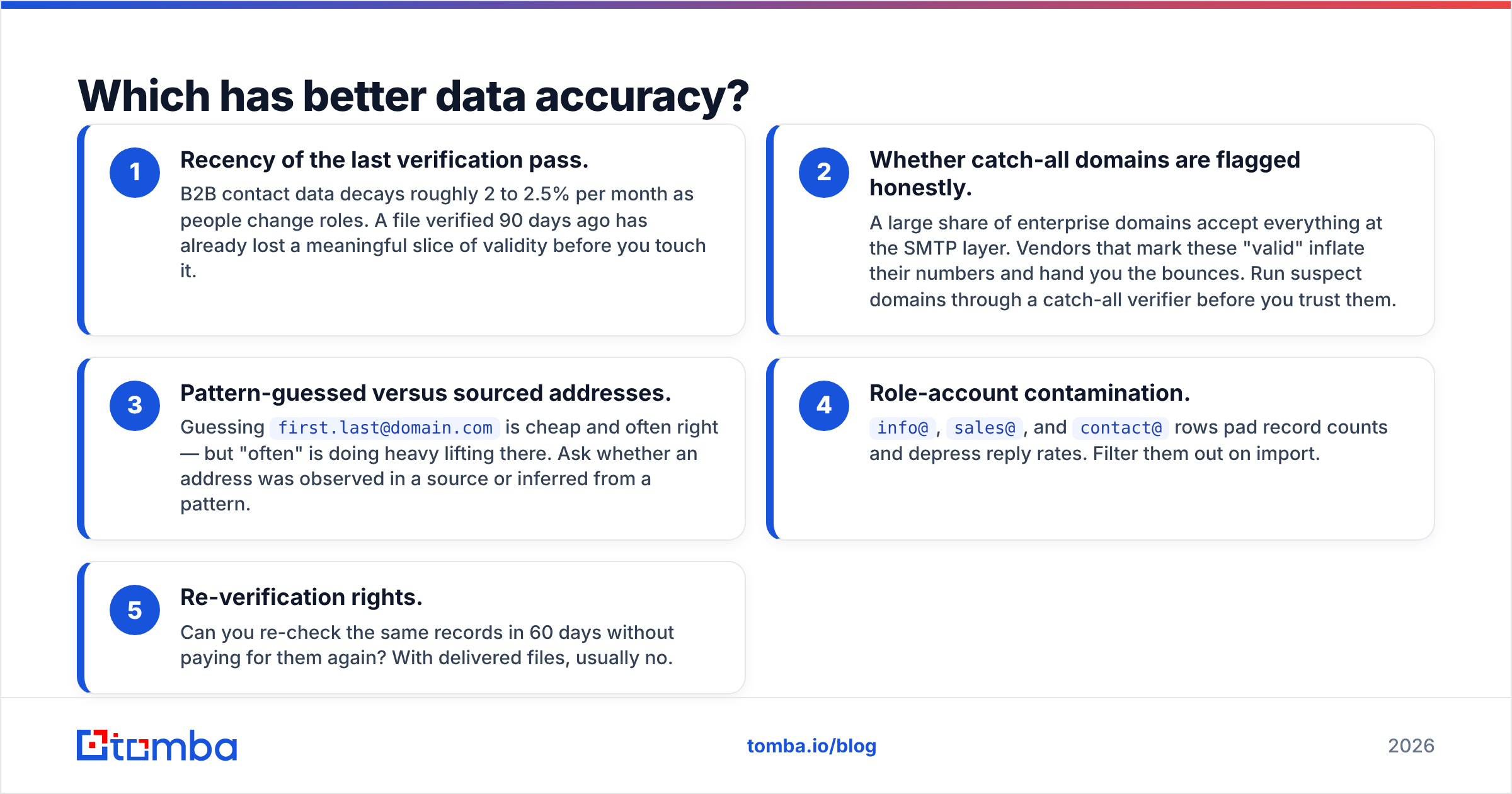
Here is what really drives accuracy, ranked by impact:
- How recent the last check was. B2B data decays about 2 to 2.5% a month as people change jobs. A file checked 90 days ago has already lost part of its value.
- Whether catch-all domains are flagged honestly. Many large domains accept every address at the SMTP layer. Vendors that call these "valid" pad their numbers and hand you the bounces. Run them through a catch-all verifier first.
- Guessed versus sourced addresses. Guessing
first.last@domain.comis cheap and often right. "Often" is doing a lot of work there. Ask whether an address was seen in a source or inferred. - Role accounts.
info@,sales@, andcontact@pad record counts and drag down replies. Filter them on import. - Re-check rights. Can you re-verify the same records in 60 days without paying again? With delivered files, usually not.
The honest verdict: on a fresh delivery, a hand-built Exellius file for a narrow vertical will likely beat a broad OneMoreLead export. Human research covers the long tail that crawlers miss.
On broad segments — SaaS, agencies, ecommerce in major markets — a big self-serve database is competitive and far cheaper per record. Neither edge survives contact with time. Both files need a fresh check before every send, so an independent email verifier belongs in the stack either way.
What does each one actually cost?#
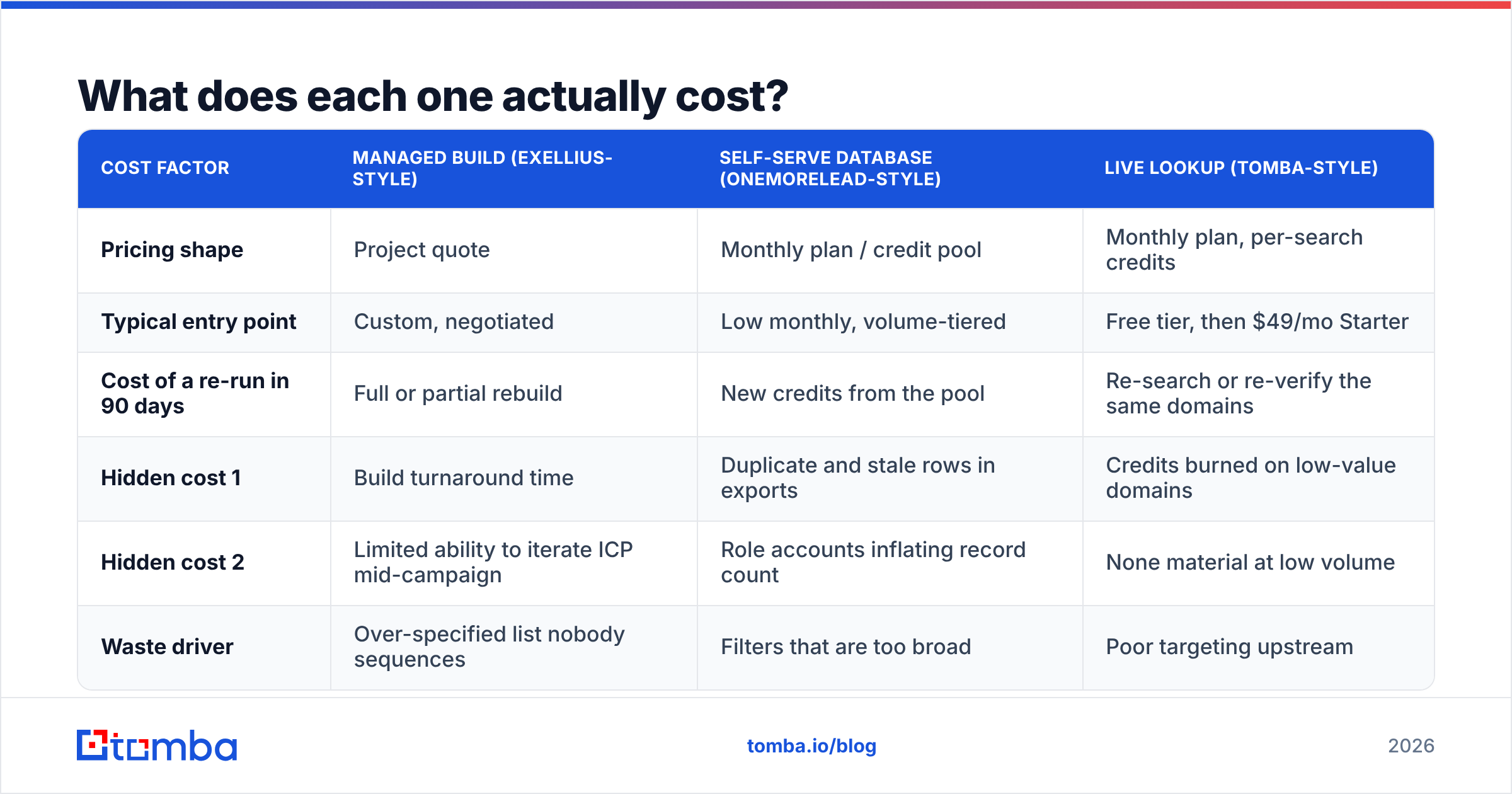
Comparing a managed service to a self-serve database only works if you normalize on cost per usable contact. Usable means the records that survive dedupe, role-account filtering, and a fresh check.
| Cost factor | Managed build (Exellius-style) | Self-serve database (OneMoreLead-style) | Live lookup (Tomba-style) |
|---|---|---|---|
| Pricing shape | Project quote | Monthly plan / credit pool | Monthly plan, per-search credits |
| Typical entry point | Custom, negotiated | Low monthly, volume-tiered | Free tier, then $49/mo Starter |
| Cost of a re-run in 90 days | Full or partial rebuild | New credits from the pool | Re-search or re-verify the same domains |
| Hidden cost 1 | Build turnaround time | Duplicate and stale rows in exports | Credits burned on low-value domains |
| Hidden cost 2 | Limited ability to iterate ICP mid-campaign | Role accounts inflating record count | None material at low volume |
| Waste driver | Over-specified list nobody sequences | Filters that are too broad | Poor targeting upstream |
Two practical notes. First, a cheap plan that delivers 10,000 rows where only 3,000 are usable is not cheap at all. Run that math before you renew.
Second, a managed build only wins when your ICP is genuinely hard to source. If a self-serve filter gets close in three clicks, you are paying a premium you do not need.
For a sense of what open per-plan pricing looks like here, Tomba pricing lists tiers in public: Free (25 searches/mo), Starter $49/mo, Growth $99/mo, Pro $249/mo, and Enterprise on request. Whatever you buy, ask for the per-record cost before you sign.
Who should choose Exellius?#
Choose the managed route when these are true:
- Your ICP is genuinely obscure. Odd titles, industries with a thin web presence, or regions where self-serve databases run dry.
- You run few, large campaigns. A build cycle is fine when you launch each quarter. It is fatal when you iterate each week.
- You want the sourcing work off your plate. If nobody owns list building, buying the output is rational.
- Compliance review matters. Managed vendors will usually put sourcing and consent in writing, which your legal team will ask for under GDPR-style scrutiny.
Where it hurts: speed. Outbound in 2026 is a testing job. If a wrong ICP guess costs you a two-week rebuild, you will test less. Testing less is the expensive mistake.
Who should choose OneMoreLead?#
Choose the self-serve database when:
- Your segments are mainstream. Standard industries, titles, and regions, where a large pool has real depth.
- You need volume at a low unit cost. For high-volume, low-touch outbound, price per record rules.
- You want to change ICP filters live. Re-exporting the same afternoon beats a build cycle.
- You already have a verification layer. This is a condition, not a bonus. Exporting straight into a sender is how domains get burned.
Where it hurts: you inherit the vendor's refresh pace, and it is almost never published. Assume the worst and verify.

What do both tools miss?#
Three gaps show up either way.
No live lookup at the moment of need. An SDR on a company page needs one contact right now. Neither model serves that. A domain search or a browser lookup does it in seconds.
No re-check loop. Data decays every day, but both products are one-off purchases. The fix is a standing step: re-check every address before each launch. Bulk verification turns that into a five-minute job.
Limited API access. If you want your CRM to enrich a record on creation, you need a documented API, not a CSV drop. Check for one before you build a workflow that assumes it.
What are the alternatives worth shortlisting?#
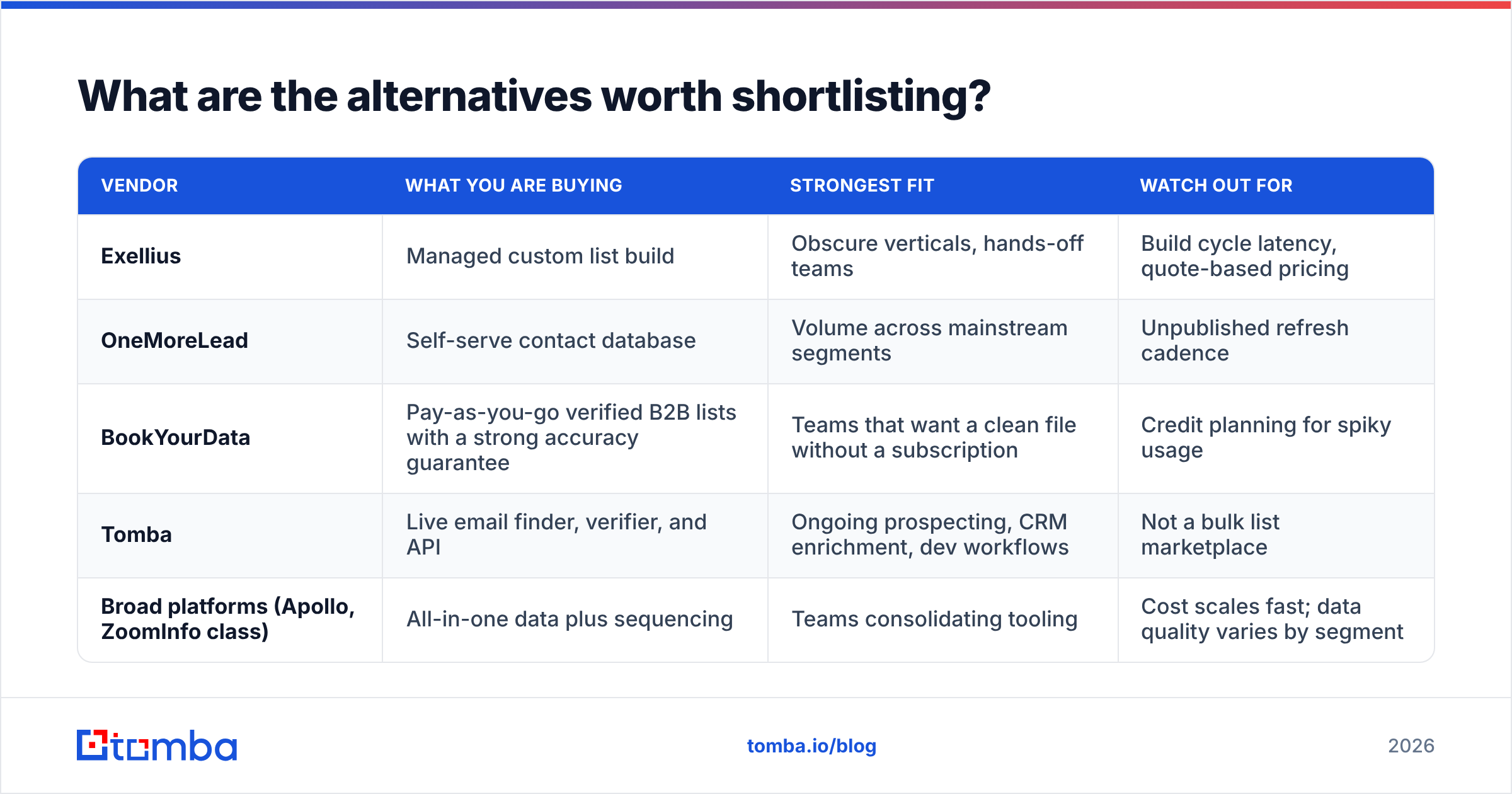
The category is crowded. The right shortlist depends on what you are buying: a list, a lookup engine, or a verified file that is ready to send.
| Vendor | What you are buying | Strongest fit | Watch out for |
|---|---|---|---|
| Exellius | Managed custom list build | Obscure verticals, hands-off teams | Build cycle latency, quote-based pricing |
| OneMoreLead | Self-serve contact database | Volume across mainstream segments | Unpublished refresh cadence |
| BookYourData | Pay-as-you-go verified B2B lists with a strong accuracy guarantee | Teams that want a clean file without a subscription | Credit planning for spiky usage |
| Tomba | Live email finder, verifier, and API | Ongoing prospecting, CRM enrichment, dev workflows | Not a bulk list marketplace |
| Broad platforms (Apollo, ZoomInfo class) | All-in-one data plus sequencing | Teams consolidating tooling | Cost scales fast; data quality varies by segment |

BookYourData earns a mention because it sits in a useful middle ground. You buy credits as you go, with a published accuracy guarantee. That removes both the lock-in of a database plan and the wait of a managed build. If your constraint is "clean file, no contract," put it on the list.
For outside signal on any of these, check the lead intelligence category on G2 and read the one-star reviews first. That is where refresh-pace and refund complaints show up.
How should you test Exellius vs OneMoreLead before you buy?#
Run the same trial on both. It takes an afternoon and it can save you a quarter. Start before you pay:
- Request an identical sample. Same ICP, same 100 records, same fields. If a vendor will not sample, that is your answer.
- Verify with a neutral third party. Push both samples through an independent email verification pass. Count valid, invalid, catch-all, and unknown on their own. Never fold catch-all into valid.
- Check the role-account share. Strip
info@,sales@,support@, andadmin@, then recount. This step alone can cut a sample by 15%.
Then work the sample you have:
- Spot-check 20 records by hand. Open the LinkedIn profile or company page. Is the person still in that role? Stale data shows up fast.
- Send a 50-contact pilot. Watch bounces and replies, not opens. A hard-bounce rate above 3% means the file needs another pass.
- Price the survivors. Divide what you paid by the count that survived steps 2 to 5. That is your real cost per contact. Compare on that number alone.
What is the verdict?#
Exellius vs OneMoreLead comes down to your ICP. If it is narrow and odd, Exellius wins. If it is mainstream and cost per record is your priority, OneMoreLead wins. Neither wins on freshness, because neither is built to run again and again. Modern outbound needs that.
The stack that holds up over a year looks like this: a bulk source for first coverage, plus a live finder and verifier that runs before every send and enriches each new CRM record. The bulk source is swappable. The verification layer is not.
Want the second half of that stack? Start with the Tomba Email Finder. Find a contact by name and domain, verify it in the same call, sweep a whole company with domain search, and wire it into your CRM through the Tomba API. The free tier gives you 25 searches a month, so you can test accuracy on your own domains first. Starter is $49/mo when you are ready for real volume.
Buy your list wherever it is cleanest. Just never send to it unverified.
Related guides#
Ready to find emails that actually work?
Join 150,000+ professionals who stopped guessing and started sending. Free credits on signup — no credit card required.
Get the Tomba newsletter
Practical outbound tactics and product updates — once every two weeks.
About the author