Exellius vs Warpleads 2026: Honest B2B Lead Data Comparison
Exellius sells done-for-you lead lists; Warpleads sells self-serve exports at volume. We break down sourcing, accuracy, export limits, and real cost per usable contact — plus when neither is the right answer.
TL;DR
- Exellius sits at the managed/done-for-you end: you describe an ICP, their team builds and hands over a targeted list. Good for teams with no data ops and a budget line for outsourcing.
- Warpleads sits at the self-serve, volume-export end: you filter a database and pull large CSVs yourself, usually on a flat monthly fee rather than per-record credits.
- The real comparison is not "which database is bigger." It is cost per contact that actually gets a reply after you strip out bounces, role accounts, and stale job titles.
- Both models leave you doing your own verification. Neither replaces a dedicated finder/verifier layer in your stack.
- If your motion is domain-driven ("get me the heads of ops at these 400 companies"), a per-domain email finder plus verification is usually cheaper and fresher than either bulk approach.
What are Exellius and Warpleads?#
They solve the same problem — "I need contacts to email" — from opposite ends of the buy-vs-build spectrum.
Exellius is positioned as a lead generation and data service. The core promise is offload: you brief them on your ideal customer profile, they run the research and sourcing, and you get a list (often with enrichment fields and sometimes appointment-setting attached). Pricing is typically quoted, not published — retainer or per-project rather than a credit meter you watch tick down.
Warpleads is a self-serve B2B lead database built around export volume. The differentiator it leads with is unlimited or very high-ceiling exports on a flat plan, so you can filter by industry, geography, headcount, and title, then pull tens of thousands of rows without the per-credit anxiety that defines most of this category. It also bundles basic email validation into the export flow.
That difference cascades into everything else: who does the QA, how fast you can iterate on an ICP, and what a "bad list" costs you.

How do Exellius and Warpleads actually source data?#
This is where most buyers stop asking questions too early. Nearly every B2B data vendor draws from some blend of the same four buckets:
- Public web crawling — company sites, press pages, team directories, job boards. Cheap, broad, and it decays fast. A "Head of Growth" scraped 14 months ago has a coin-flip chance of still holding that title.
- Contributed or co-op data — contact records shared by users of a browser extension or partner network. High coverage on frequently-prospected personas, thin on the long tail.
- Licensed third-party panels — bought from aggregators. This is why five tools often return the identical wrong email for the same person: they all bought the same upstream file.
- Live pattern inference plus SMTP validation — deriving the address from the company's known email format and then checking whether the mailbox accepts mail right now.
Managed services like Exellius lean hard on 1 and 3, with a human research layer stitched on top — which is exactly what you're paying the premium for. High-volume self-serve databases like Warpleads lean on 2 and 3, because that's what makes unlimited export economics work.
Bucket 4 is the one that decays slowest, and it's the one neither model leads with. That's the gap you have to fill yourself. If you want to see how a vendor answers this honestly, look for a published page on data sources rather than a vague "billions of records" claim on the homepage.
Is one more accurate than the other?#
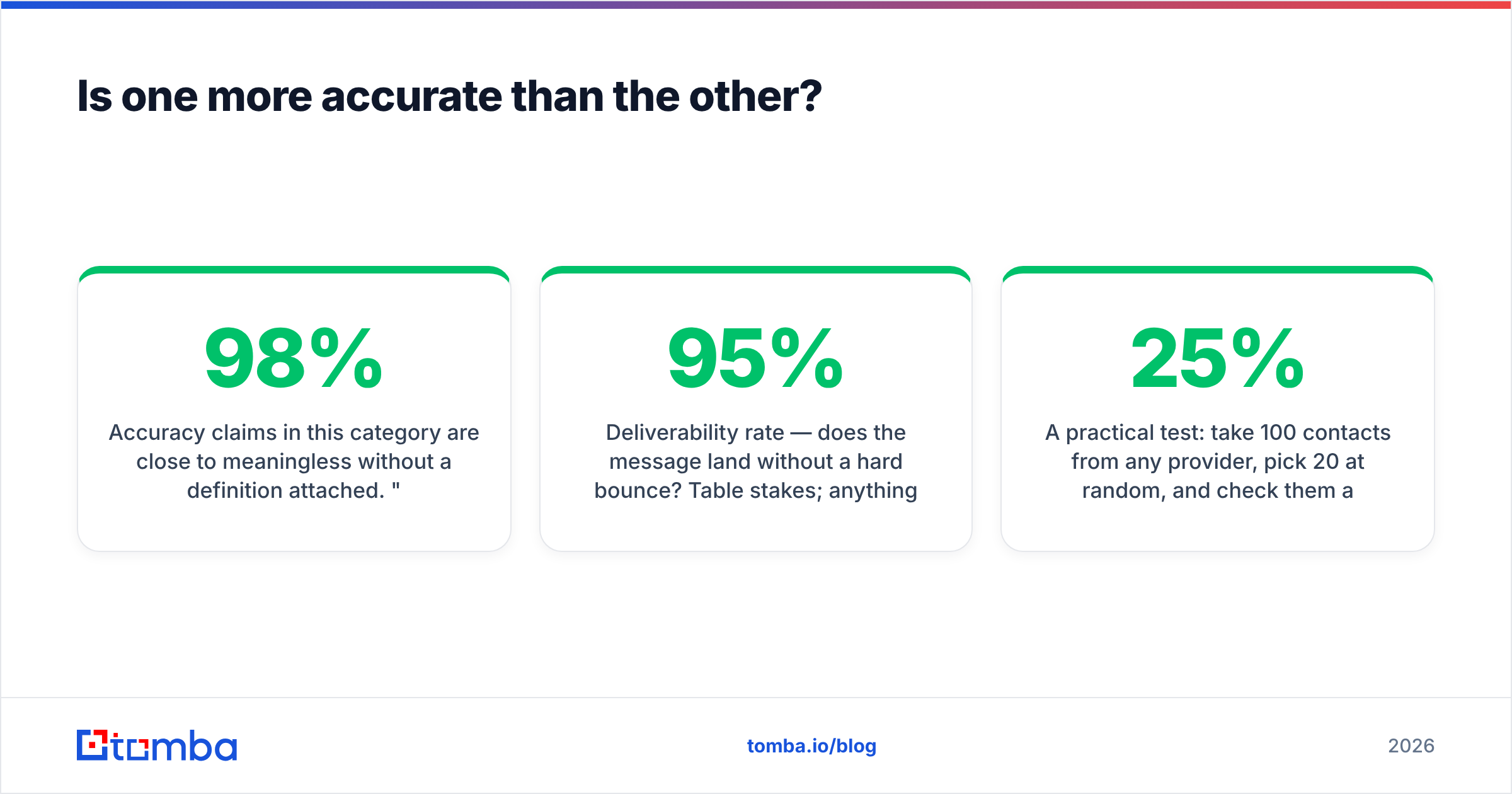
Accuracy claims in this category are close to meaningless without a definition attached. "98% accurate" usually means "98% of records passed a syntax and MX check," which is a very low bar — it does not mean the mailbox exists, and it certainly does not mean the person still works there.
The three numbers worth separating:
- Deliverability rate — does the message land without a hard bounce? Table stakes; anything under 95% on a verified list is a problem.
- Match rate — of the contacts you asked for, how many did the tool actually return? This is where big databases quietly underperform on niche ICPs, and where managed research earns its fee.
- Freshness — what percentage of returned records reflect the person's current role? Nobody publishes this. Sample it yourself.

A practical test: take 100 contacts from any provider, pick 20 at random, and check them against LinkedIn manually. If more than three have moved companies or changed titles, your reply-rate math is already broken before the first send. Then push the full list through an independent email verifier and see how many the vendor's own validation missed. On bulk exports, a 10–25% drop is common; on managed lists it's usually lower, which is part of what you're paying for.
Google and Microsoft both weight complaint and bounce signals heavily in inbox placement, so a dirty list doesn't just waste sends — it damages the domain you send from. A bounce message is a scoring event, not just an annoyance.
Exellius vs Warpleads: how do they compare feature by feature?#
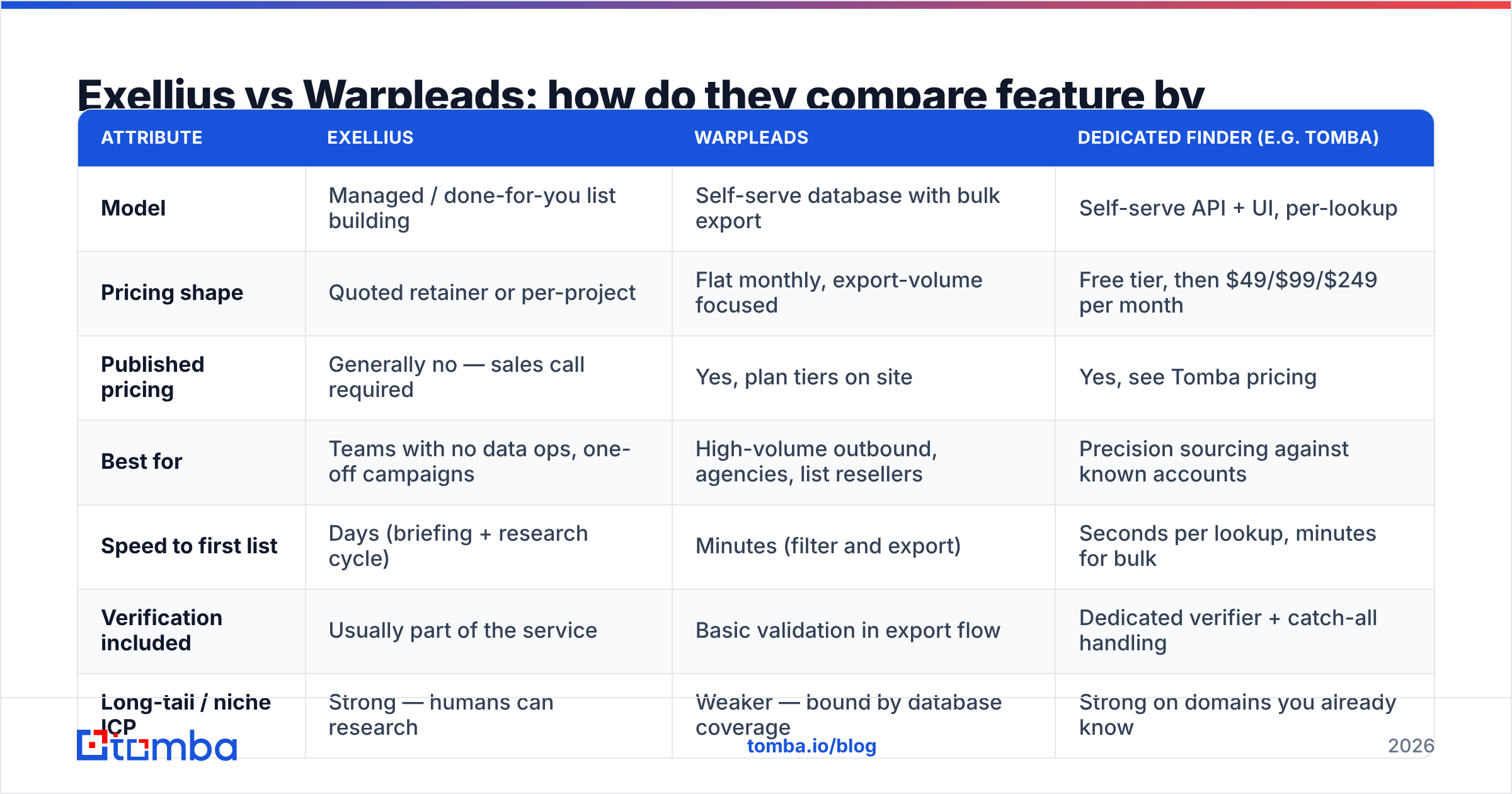
| Attribute | Exellius | Warpleads | Dedicated finder (e.g. Tomba) |
|---|---|---|---|
| Model | Managed / done-for-you list building | Self-serve database with bulk export | Self-serve API + UI, per-lookup |
| Pricing shape | Quoted retainer or per-project | Flat monthly, export-volume focused | Free tier, then $49/$99/$249 per month |
| Published pricing | Generally no — sales call required | Yes, plan tiers on site | Yes, see Tomba pricing |
| Best for | Teams with no data ops, one-off campaigns | High-volume outbound, agencies, list resellers | Precision sourcing against known accounts |
| Speed to first list | Days (briefing + research cycle) | Minutes (filter and export) | Seconds per lookup, minutes for bulk |
| Verification included | Usually part of the service | Basic validation in export flow | Dedicated verifier + catch-all handling |
| Long-tail / niche ICP | Strong — humans can research | Weaker — bound by database coverage | Strong on domains you already know |
| API access | Rare | Limited | Full email finder API |
| Who does QA | Vendor | You | You, with tooling |
| Risk if it's wrong | Sunk retainer | Wasted sends + domain damage | Low — you verify before send |

The table makes the trade explicit: Exellius costs more money and less of your time; Warpleads costs less money and more of your time. Neither is wrong. What's wrong is buying one while budgeting as though you'd bought the other.
What do they actually cost per usable contact?#
Sticker price is the wrong unit. Run every quote through this:
Effective cost per usable contact = (plan cost) ÷ (records exported × deliverable rate × ICP-match rate × freshness rate)
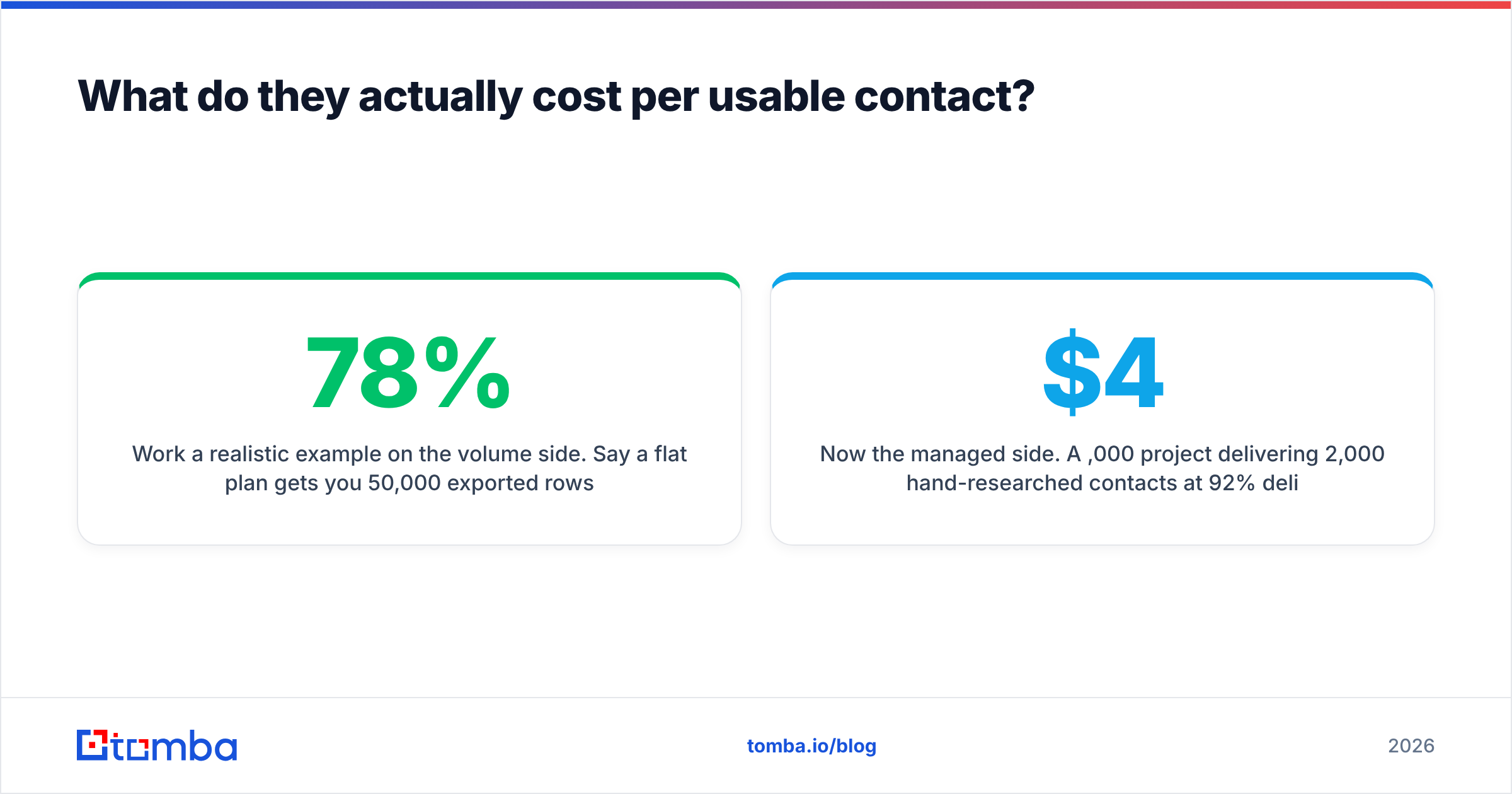
Work a realistic example on the volume side. Say a flat plan gets you 50,000 exported rows a month. Apply a 78% deliverable rate after independent verification, then a 60% true ICP match (filters are never as precise as the UI implies), then an 85% freshness rate. You're at roughly 19,900 genuinely usable contacts. On a $200/month plan that's about a cent per usable contact — still excellent, provided your team can actually process 20,000 contacts a month without the sequencing infrastructure buckling.
Now the managed side. A $4,000 project delivering 2,000 hand-researched contacts at 92% deliverable, 90% ICP match, and 92% freshness yields about 1,520 usable contacts — roughly $2.63 each. That's 250x the unit cost. It is still the correct buy if your ACV is $60,000 and your reps' time is the actual constraint. It's an obviously bad buy if you're selling a $49/month SaaS.
The mistake I see most often is teams buying volume pricing and then spending three weeks of an SDR's time cleaning it — at which point the "cheap" list cost more than the managed one.

Who should pick Exellius?#
Choose the managed route when at least three of these are true:
- No internal data ops. Nobody on the team owns list hygiene, and adding that job is worse than paying for it.
- Narrow, hard-to-filter ICP. "Clinical operations leads at multi-site dental groups running Dentrix" is not a dropdown filter anywhere. A human researcher can find them.
- High ACV, low volume. You need 300 right contacts, not 30,000 approximate ones.
- A campaign deadline with no iteration budget. You get one shot at an event or product launch and can't afford a bad first send.
- Compliance sensitivity. You want a contract and a named counterparty on the data provenance, not a self-serve checkout.
The risk you accept: opacity. You typically can't audit how the list was built, and re-running the same ICP next quarter means paying again.
Who should pick Warpleads?#
Choose the volume self-serve route when:
- Outbound is a system, not a project. You're sending continuously and need refill capacity, not a one-time file.
- Your ICP is mainstream. Standard firmographic filters — SaaS, 50–200 headcount, US, VP Sales — hit the dense part of any database.
- You have verification in place. You already run exports through a dedicated verifier and treat vendor validation as a first pass only.
- You're an agency running multiple clients. Flat-fee export ceilings amortize beautifully across accounts.
- You want to iterate ICPs weekly. Self-serve lets you test five segments in an afternoon; a managed vendor can't turn that around.
The risk you accept: you own the mess. Duplicates, catch-all domains, and title drift all become your problem. Budget for a bulk verify step and a dedup pass before anything touches your sending infrastructure. Independent review sites like G2's lead intelligence category are useful for sanity-checking whether a vendor's export limits match what buyers actually experience.
Is there a better third option?#
Often, yes — and it's not really a third vendor so much as a different sequencing of the problem.
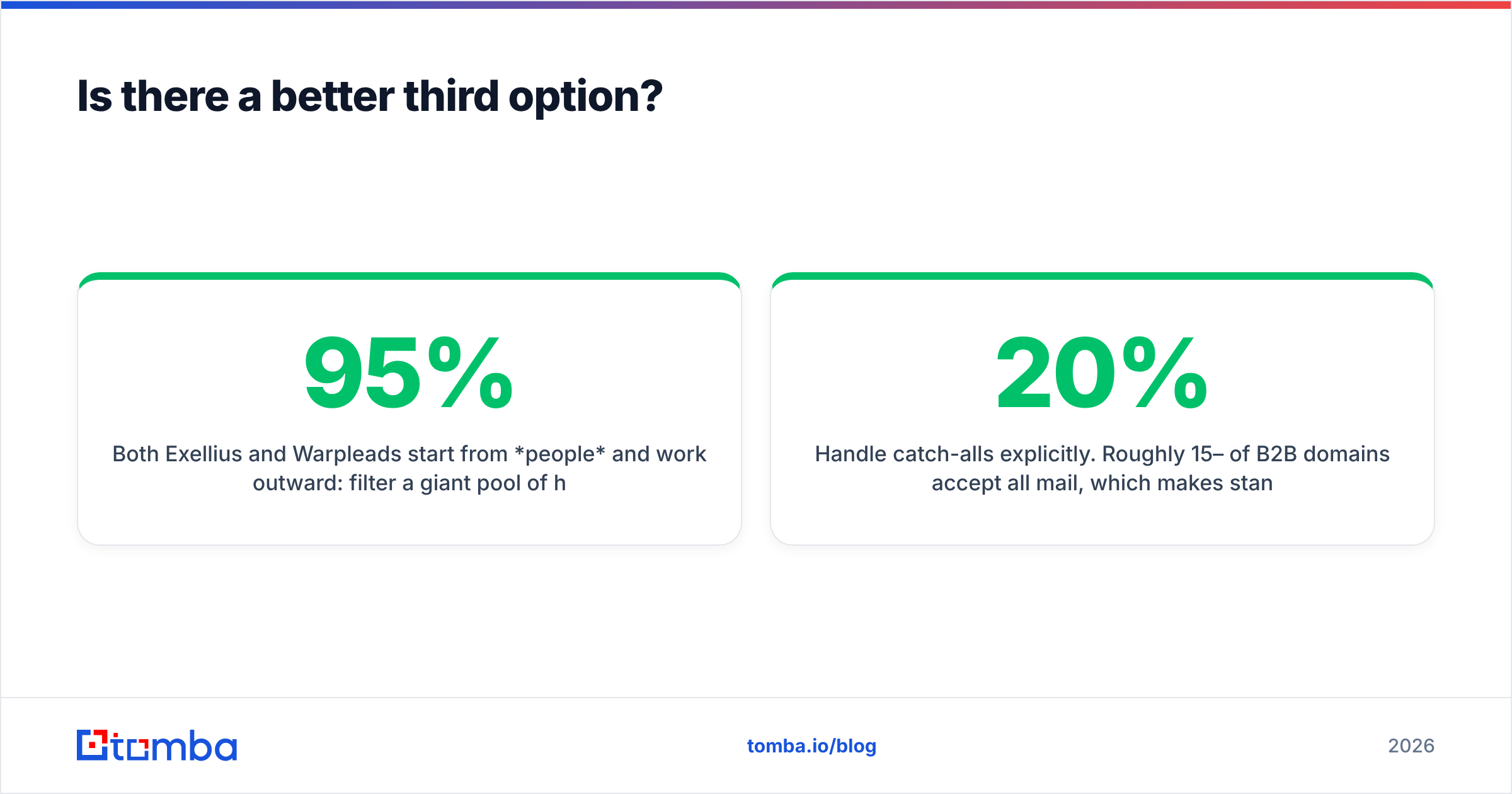
Both Exellius and Warpleads start from people and work outward: filter a giant pool of humans, hope the ones you get match your ICP. But most B2B teams already know their target accounts. You have a list of 400 companies from a conference, a funding tracker, a partner ecosystem, or your own closed-lost pipeline. In that case, buying a general-purpose people database is buying 95% of a haystack to reach 5% you could have addressed directly.
The account-first path looks like this:
- Start with domains. Run a domain search on each target company to pull the people who actually work there, with the company's real email pattern attached.
- Filter by department and seniority at that point, not before. You get precision without paying for the rest of the database.
- Verify at send time, not export time. A contact verified 90 days ago is a guess. Verification is cheap; a burned sending domain is not.
- Handle catch-alls explicitly. Roughly 15–20% of B2B domains accept all mail, which makes standard SMTP checks useless. A catch-all verifier is the difference between "unknown" and a usable risk score.
This is also the model that survives an audit. You can point to exactly where each contact came from, which matters increasingly under GDPR and CCPA scrutiny. Guides from established sales publishers like HubSpot's sales blog make the same argument from the process side: precision beats volume once your reply rates matter more than your send counts.
How should you test either tool before committing?#
Don't take a demo list. Take a demo test.
- Pick 50 contacts you already know are correct. Current employees at accounts you've closed. Ask each vendor to find them. Match rate on known-good data is the single most honest signal you can get.
- Sample 20 random records for freshness. Cross-check titles manually. More than three stale records in twenty means the underlying file is old.
- Run everything through an independent verifier. Not the vendor's own. Note the delta between their claimed valid rate and yours.
- Send 200 messages before you scale. Watch bounce rate and spam-folder placement, not open rate. If bounces exceed 3%, stop and clean.
- Price the labor. Time-box how long cleaning one export takes, multiply by your loaded hourly cost, and add it to the sticker price. That's the real number.
Run that on both vendors with the same ICP and the decision usually makes itself within a week — and it will surprise you at least a third of the time.
The bottom line#
Exellius vs Warpleads is a question about who does the work, not about which database is better. Managed research buys you precision and time at a heavy unit cost. Volume export buys you scale and iteration speed at the cost of doing your own QA. Both are legitimate; both leave a verification gap you must close regardless.
If your outbound is account-driven — and most B2B outbound should be — start with the domains you already care about and source directly against them. Tomba's Email Finder gives you 25 free searches a month to test that approach against whatever list you're currently considering buying, with paid plans starting at $49/mo and a full API when you're ready to automate it. Run the 50-known-contacts test above before you sign anything. The results will tell you more than any vendor deck.
Related guides#
Ready to find emails that actually work?
Join 150,000+ professionals who stopped guessing and started sending. Free credits on signup — no credit card required.
Get the Tomba newsletter
Practical outbound tactics and product updates — once every two weeks.
About the author