Exotel vs MyOperator (2026): Which Cloud Telephony Wins?
Exotel and MyOperator both sell cloud telephony to Indian and global sales teams, but they are built for different buyers. Here is the honest breakdown of pricing, IVR depth, call quality, CRM fit, and who should pick which.
Exotel vs MyOperator is the choice most Indian sales teams face when they shop for cloud telephony. Both sell IVR, call recording, and CRM hooks. But they are built for very different buyers. Here is the plain version.
TL;DR
- Exotel is the platform play. It is a full CPaaS: voice, SMS, WhatsApp, contact-center software (via its Ameyo buy), and a deep API layer. Buy it when you have engineers and 30+ agents.
- MyOperator is the packaged play. You get IVR, virtual numbers, call tracking, and reports. A non-technical ops person can set it up in an afternoon. Buy it when you have 3–30 agents and no dev time.
- Price is not the deciding factor. Both start in the same low-thousands-of-rupees band. The real cost driver is per-minute usage, number rentals, and how many agent seats you light up.
- Neither tool fixes bad numbers. A dialer only amplifies the list you feed it. Connect rates die from stale mobile data, not from the vendor.
- Pick by team shape. Engineering-led and omnichannel? Exotel. Sales-led and in a hurry? MyOperator.
What are Exotel and MyOperator, actually?#
Both are Indian cloud telephony companies. Both sell to sales and support teams. Both will show you a demo with the same three screens. The likeness ends at the architecture.
Exotel launched in 2011 as a cloud communications platform (CPaaS). Its center of gravity is the API. You get programmable voice, SMS, number masking, and IVR flows you can build in code or in a visual builder. It also bought contact-center vendor Ameyo, so it ships a full agent desktop with omnichannel queuing. The big Exotel accounts are ride-hailing marketplaces, fintech collections teams, and healthcare platforms. They route hundreds of thousands of calls a day.
MyOperator launched in 2013 with a narrower promise. Give a growing business one business number, a smart IVR, call recording, and a dashboard. The dashboard tells the founder who missed which call. It has since added the WhatsApp Business API, a light "leads" view, and a mobile-first product (Heyo Phone) for very small teams. The buyer here is a sales or ops manager, not a developer.
That split — platform versus package — explains almost every difference below.

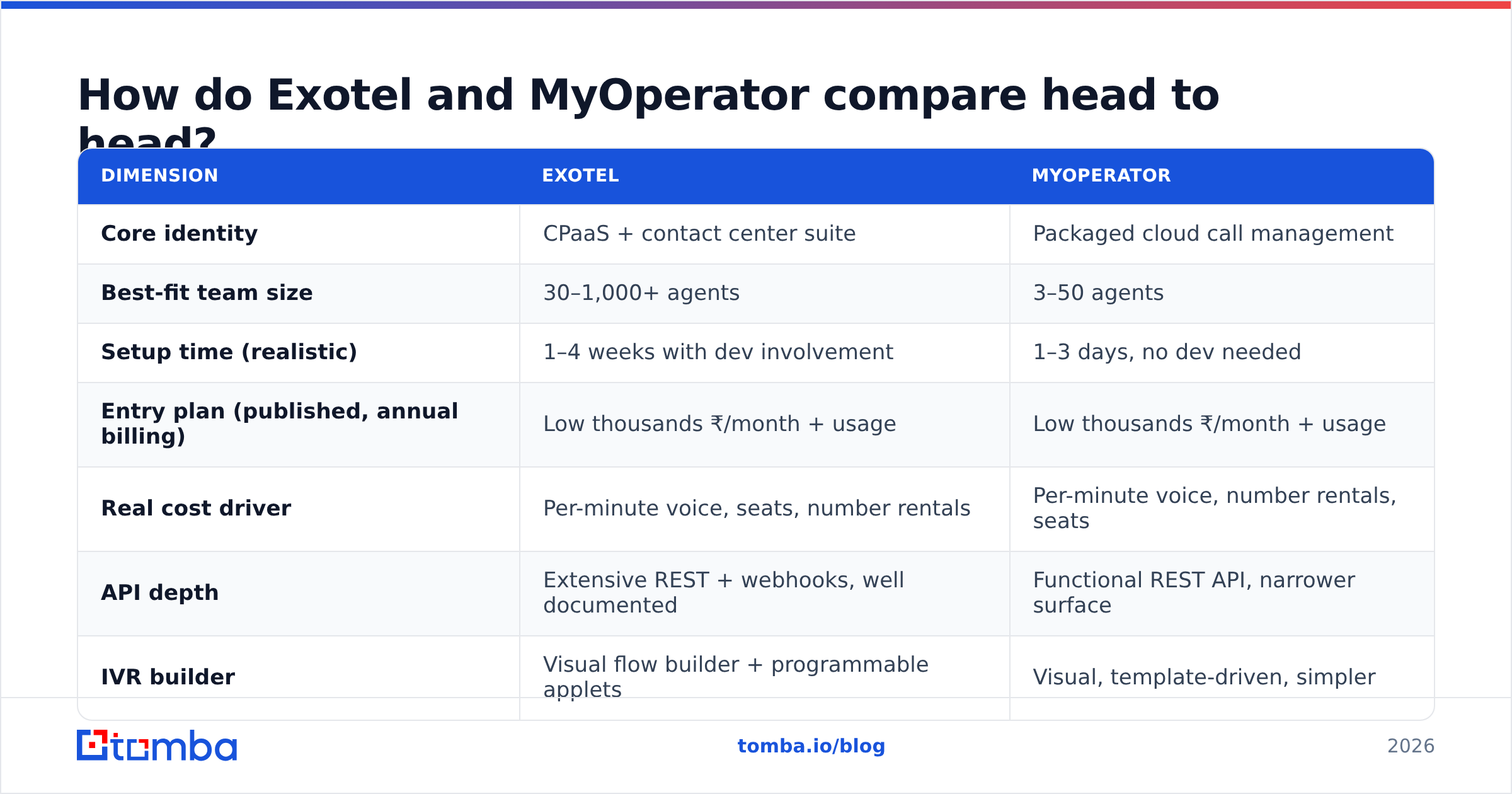
Exotel vs MyOperator: how do they compare head to head?#
| Dimension | Exotel | MyOperator |
|---|---|---|
| Core identity | CPaaS + contact center suite | Packaged cloud call management |
| Best-fit team size | 30–1,000+ agents | 3–50 agents |
| Setup time (realistic) | 1–4 weeks with dev involvement | 1–3 days, no dev needed |
| Entry plan (published, annual billing) | Low thousands ₹/month + usage | Low thousands ₹/month + usage |
| Real cost driver | Per-minute voice, seats, number rentals | Per-minute voice, number rentals, seats |
| API depth | Extensive REST + webhooks, well documented | Functional REST API, narrower surface |
| IVR builder | Visual flow builder + programmable applets | Visual, template-driven, simpler |
| Omnichannel (WhatsApp, SMS, email) | Yes, unified agent desktop | WhatsApp + SMS, lighter unification |
| Call recording & QA | Recording, monitoring, barge-in, speech analytics | Recording, basic monitoring |
| Native CRM integrations | Salesforce, Zoho, LeadSquared, Freshworks, HubSpot | Zoho, HubSpot, LeadSquared, Freshsales |
| Auto/predictive dialer | Yes (Ameyo-derived) | Click-to-call and campaign dialing |
| Reporting depth | Deep, exportable, API-accessible | Clean dashboards, less granular |
| Support model | Account manager on higher tiers | Responsive on all tiers, SMB-friendly |
| Where it strains | Overkill (and over-priced) for small teams | Ceiling hits at high concurrency/custom routing |
One caveat is worth stating plainly. Both vendors quote heavily and publish only indicative list prices. Rupee plans shift by region, contract length, and number type. Treat any number you read in a comparison post — this one included — as a starting point for a quote, not a final invoice. Ask both for a total-cost model at your projected monthly minutes before you compare anything else.
Which one is better for outbound sales calling?#
Exotel, if your outbound motion is high-volume and rules-heavy. Predictive and progressive dialing, agent state management, disposition rules, and speech analytics all live in the Ameyo-derived layer. Say you run 40 SDRs. Each one needs 120 dials a day with strict disposition hygiene. That layer earns its cost.
MyOperator, if your outbound motion is human-paced. You get click-to-call from the CRM, automatic recording, a simple campaign list, and a manager view of connect rate by rep. For eight reps doing 40 quality dials a day into a warm list, Exotel's extra machinery is a tax, not a feature.
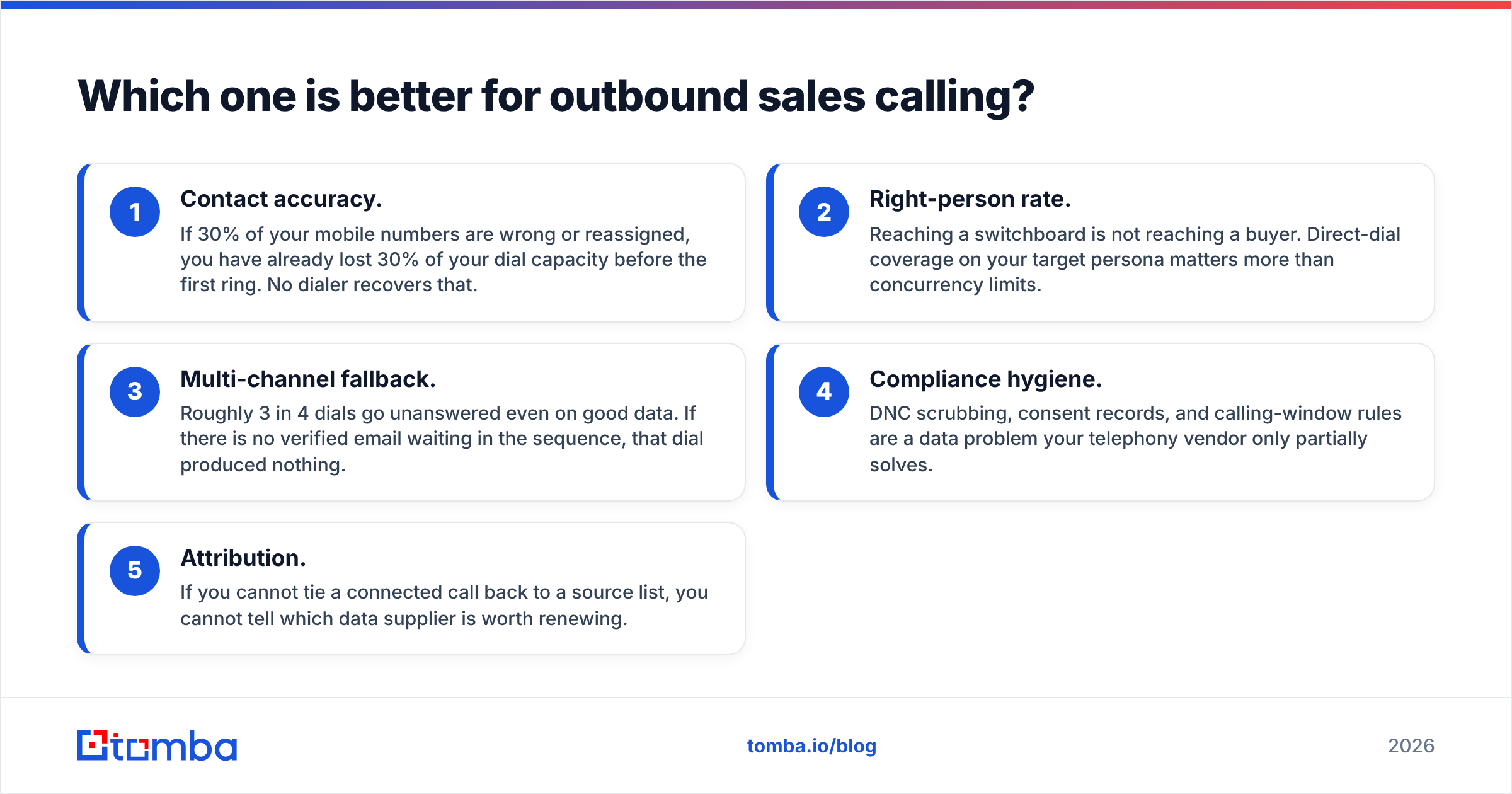
There is a third answer that neither vendor will give you. For most B2B teams under 20 reps, the dialer is not the constraint. The list is. Here is the math that decides your quarter:
- Contact accuracy. Say 30% of your mobile numbers are wrong or reassigned. You lost 30% of your dial capacity before the first ring. No dialer wins that back.
- Right-person rate. Reaching a switchboard is not reaching a buyer. Direct-dial coverage on your target persona matters more than concurrency limits.
- Multi-channel fallback. Roughly 3 in 4 dials go unanswered, even on good data. If no verified email is waiting in the sequence, that dial produced nothing.
- Compliance hygiene. DNC scrubbing, consent records, and calling-window rules are a data problem. Your telephony vendor only solves part of it.
- Attribution. You need to tie a connected call back to a source list. Without that, you cannot tell which data supplier is worth renewing.
Fix items 1–3 first. A ₹3,000/month plan on clean data beats a ₹40,000/month one running on scraped junk. So pair either platform with a verified phone finder. Then run every number through a phone validator before it hits a campaign.
Which has better call quality and reliability?#
Buyers ask this first. It is also the hardest thing to compare in public. Call quality depends on carrier interconnects, regional routing, and your own network. It is not a fixed vendor trait.
Here is what you can compare fairly:
- Carrier redundancy. Exotel runs at a scale that forces multi-carrier redundancy. It also publishes uptime commitments on enterprise contracts. MyOperator serves smaller concurrency, so it sees fewer of the failure modes that hit massive parallel campaigns.
- Concurrency headroom. Do you plan to push 200+ channels at once? Ask both vendors for a written concurrency guarantee and a burst policy. This is where packaged products usually reveal a ceiling.
- Number provisioning speed. In India, KYC and TRAI paperwork gates how fast you get toll-free and DID numbers. Both vendors handle it. Timelines vary by number type, so get it in writing.
- Coverage outside India. Exotel reaches further across Southeast Asia and the Middle East. Dialing US or EU prospects at volume? Weigh both against a global CPaaS first.
The honest test is a two-week paid pilot on both. Dial the same list, from the same office network, at the same hour. Then compare connect rate and mean opinion score. Vendor benchmarks are marketing. Your own A/B is evidence. Cross-check the pilot against real buyer reviews on G2 rather than case studies hosted on the vendor's own domain.

What does each one actually cost in practice?#
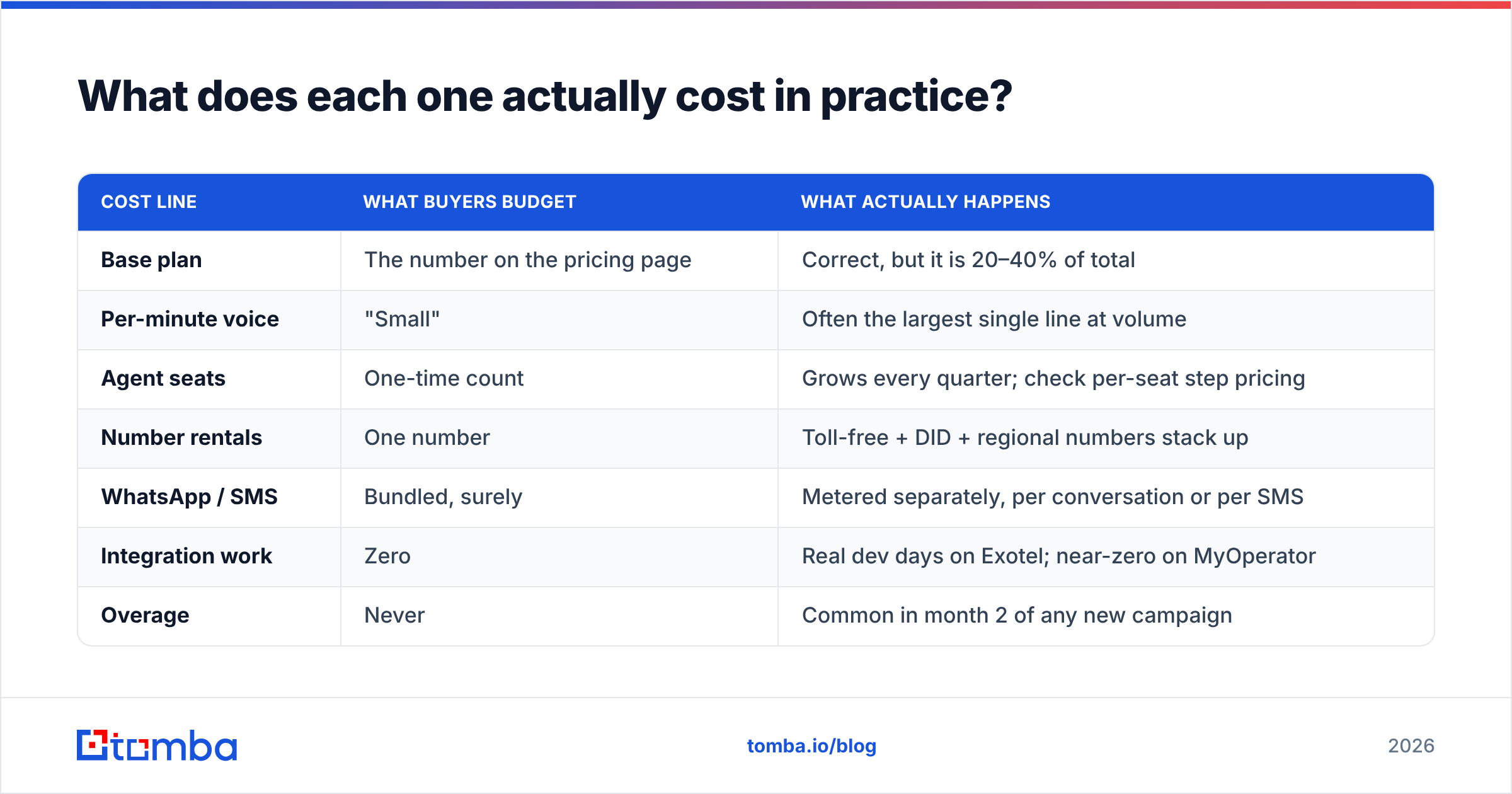
Both companies charge a base subscription plus usage. Both bill annually by default for the advertised rate. One pattern catches teams out at both vendors:
| Cost line | What buyers budget | What actually happens |
|---|---|---|
| Base plan | The number on the pricing page | Correct, but it is 20–40% of total |
| Per-minute voice | "Small" | Often the largest single line at volume |
| Agent seats | One-time count | Grows every quarter; check per-seat step pricing |
| Number rentals | One number | Toll-free + DID + regional numbers stack up |
| WhatsApp / SMS | Bundled, surely | Metered separately, per conversation or per SMS |
| Integration work | Zero | Real dev days on Exotel; near-zero on MyOperator |
| Overage | Never | Common in month 2 of any new campaign |
Model twelve months at your real dial volume, not your pilot volume. A team that grows from 8 to 25 reps will see total cost jump by a multiple. The vendor that looked cheaper at 8 seats is often not the cheaper one at 25.
The other line teams forget is data. Telephony is priced per minute. Contact data is priced per record. Teams routinely spend three times more on minutes chasing bad records than good records would have cost. Run the numbers on contact enrichment against your current connect rate. Do that before you upgrade a phone plan to fix a data problem.
Which integrates better with your CRM and stack?#
Both connect to the CRMs Indian B2B teams actually use: Zoho, LeadSquared, Freshworks, HubSpot, and Salesforce. Both offer click-to-call, automatic call logging, and recording on the activity record. The difference shows up when the stock integration is not enough.
Exotel: you drop to the API. Programmable call flows, webhook events for every call state, number masking for marketplace use cases, and routing logic that lives in your own app. This is genuinely powerful. It also takes real engineering time.
MyOperator: you stay in the UI. Native connectors, Zapier-style automation, and a REST API for the common jobs. Need something outside that surface? You file a request instead of building it.
A simple rule helps here. Does your routing depend on data that only exists inside your own product, such as seller rating, order state, or risk score? Then you need Exotel's programmability. Is your routing just "sales queue, support queue, after-hours voicemail"? MyOperator does it faster and cheaper.
Either way, the CRM is where the value compounds. A call log with no matched contact record is a wasted event. Make every dialed number resolve to an enriched person record with a verified work email. Then a no-answer becomes a follow-up, not a dead end.
Are there better alternatives to both?#
Sometimes. Three cases should widen your shortlist:
You dial mostly outside India. Both vendors are strongest on Indian carrier relationships and Indian compliance. For US or EU outbound, put global CPaaS and dialer vendors on the same sheet. The per-minute economics and local-presence numbering can differ a lot.
You want dialer and sequencer in one tool. Neither Exotel nor MyOperator is an email sequencing platform. If your motion is truly multi-channel and email-led, a sales engagement platform with a built-in dialer may merge two line items into one. You trade away telephony depth.
Your problem is reach, not routing. Reps have numbers, but the numbers do not connect. No telephony vendor fixes that. It is a data-sourcing problem, and the fix is upstream: better sourcing, better verification, and an email channel that keeps working when the phone does not.
For sales leaders in that third bucket, the fix is dull but reliable. Build the target account list. Resolve each contact to a direct dial and a verified work email. Validate both. Then let the dialer do the mechanical part. Skip the middle step and you will end up blaming a perfectly good telephony platform for a list problem.
So which should you choose?#
Choose Exotel if you have more than 30 agents, in-house engineers, omnichannel needs across voice, SMS, and WhatsApp, high concurrency, or routing that depends on your own app data. Accept a longer rollout and a higher floor price.
Choose MyOperator if you have 3–50 agents, no dedicated developer for telephony, and a need to be live this week. It fits when your needs stop at IVR, recording, call tracking, and clean manager reporting. Accept a lower ceiling on custom work.
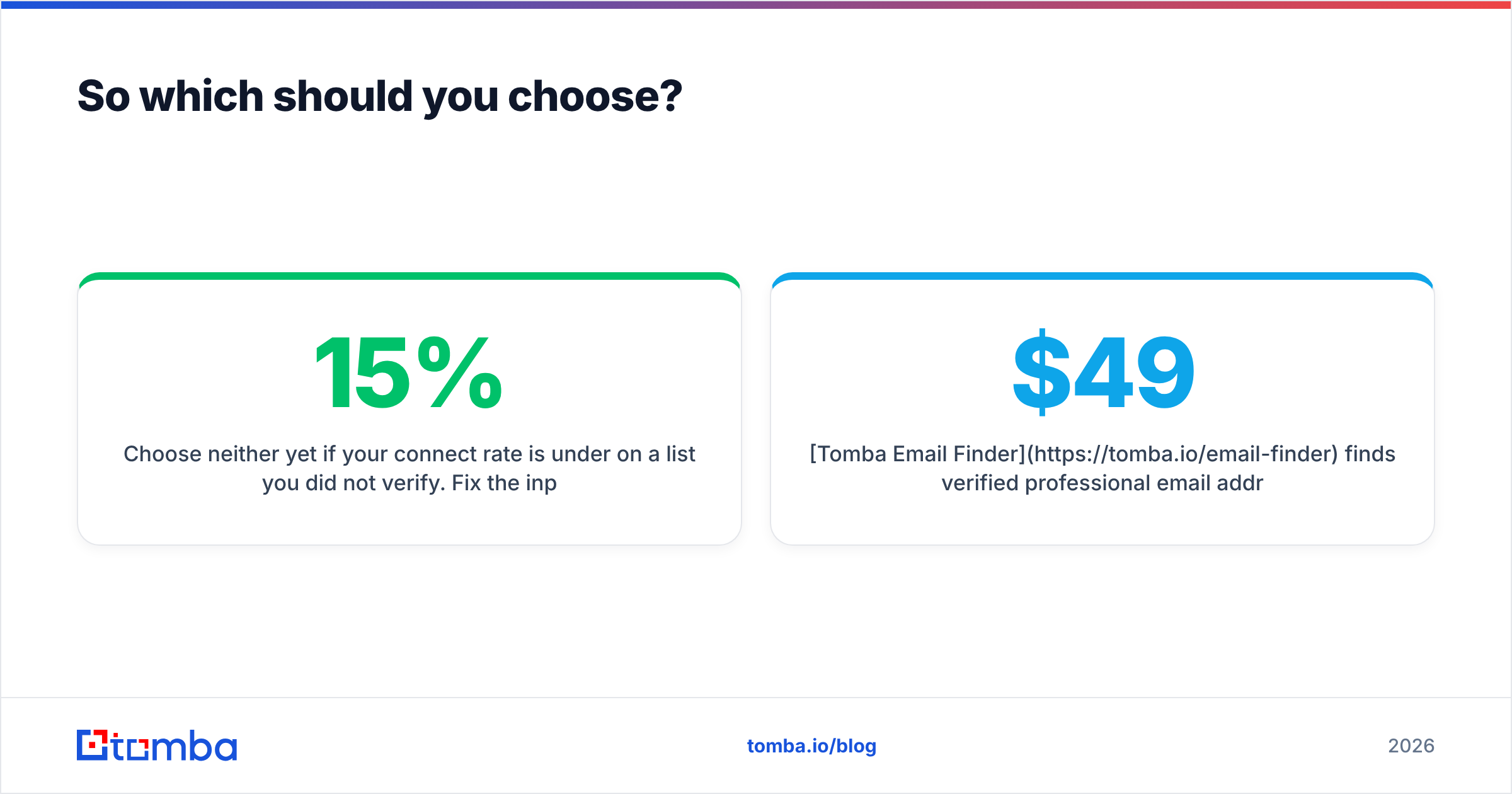
Choose neither yet if your connect rate is under 15% on a list you never verified. Fix the input first. The same reps on the same platform will post a different number next month.
That is the short answer to Exotel vs MyOperator. Buy the platform that matches your team shape, then feed it data worth dialing.
Feed your dialer better data#
A cloud telephony platform is a multiplier. It multiplies whatever contact data you put into it, including zero. So before you sign with Exotel or MyOperator, build the list that makes either one worth paying for.
Tomba Email Finder finds verified professional email addresses by name, domain, or company. Every unanswered dial then has a follow-up channel that actually lands. Start free with 25 searches a month. Then scale on Starter at $49/mo, Growth at $99/mo, or Pro at $249/mo — see full Tomba pricing for details. Pair it with the phone finder and validator. Your reps will spend the day talking to buyers instead of listening to dead lines.
Related guides#
// get started
Find, verify and enrich your first contacts today
Start on the free plan with 25 searches a month, then scale when your team is ready.
Free plan · No credit card required · GDPR & CCPA
// about the author