Extruct AI vs Leadzenai (2026): Which B2B Data Tool Wins?
Extruct AI builds AI-researched company lists. Leadzen.ai sells contact-level lead intelligence. They solve different halves of the same problem — here is which one your pipeline actually needs in 2026.
Extruct AI vs Leadzenai is a common shortlist in 2026. It is also a mismatch. One tool finds companies. The other finds people. Here is how to tell which gap you actually have.
TL;DR
- They are not really competitors. Extruct AI is an AI research agent that builds and enriches company lists from the open web. Leadzen.ai is a lead-intelligence database that sells person-level contacts, with unusually strong India coverage.
- Pick Extruct if your bottleneck is "which 400 companies should we even target?" and your ICP is defined by messy, non-firmographic signals (a specific product line, a certification, a hiring pattern).
- Pick Leadzen.ai if your bottleneck is "we know the accounts, we need names, mobiles, and emails" — especially for APAC and Indian markets where Apollo and ZoomInfo thin out.
- Neither one is a verification layer. Both hand you addresses you should re-check before sending. A dedicated email verifier is the cheapest insurance in this stack.
- Most teams that evaluate both end up running two tools, not one: a research/list-building layer plus a contact-finding layer. Budget accordingly.
What are Extruct AI and Leadzen.ai, exactly?#
Start here, because the naming conventions in this category are useless. Both call themselves "AI-powered lead generation." They do almost opposite things.
Extruct AI is a company-research platform. You describe an ICP in natural language — "US-based contract manufacturers with ISO 13485 certification and under 200 employees" — and its agents crawl the web, build a table of matching companies, and fill custom columns you define. Those columns are the real product: you can ask for "does this company sell to hospitals?" and get an answer with a source link, which no static firmographic database will give you. It is a list-building and account-research tool, not a contact database.
Leadzen.ai sits on the other side. It is a lead-intelligence platform with a large contact database, real-time search, a Chrome extension for LinkedIn prospecting, and bulk lookup. You search by role, industry, geography, or company and get people — with emails and phone numbers attached. Its India and broader APAC coverage is materially better than most US-built databases, which is the single strongest reason buyers shortlist it.
So the honest framing of Extruct AI vs Leadzenai is: account discovery versus contact acquisition. If you compare them on a single spreadsheet of "leads generated," you will misread both.
How do Extruct AI and Leadzen.ai compare head-to-head?#
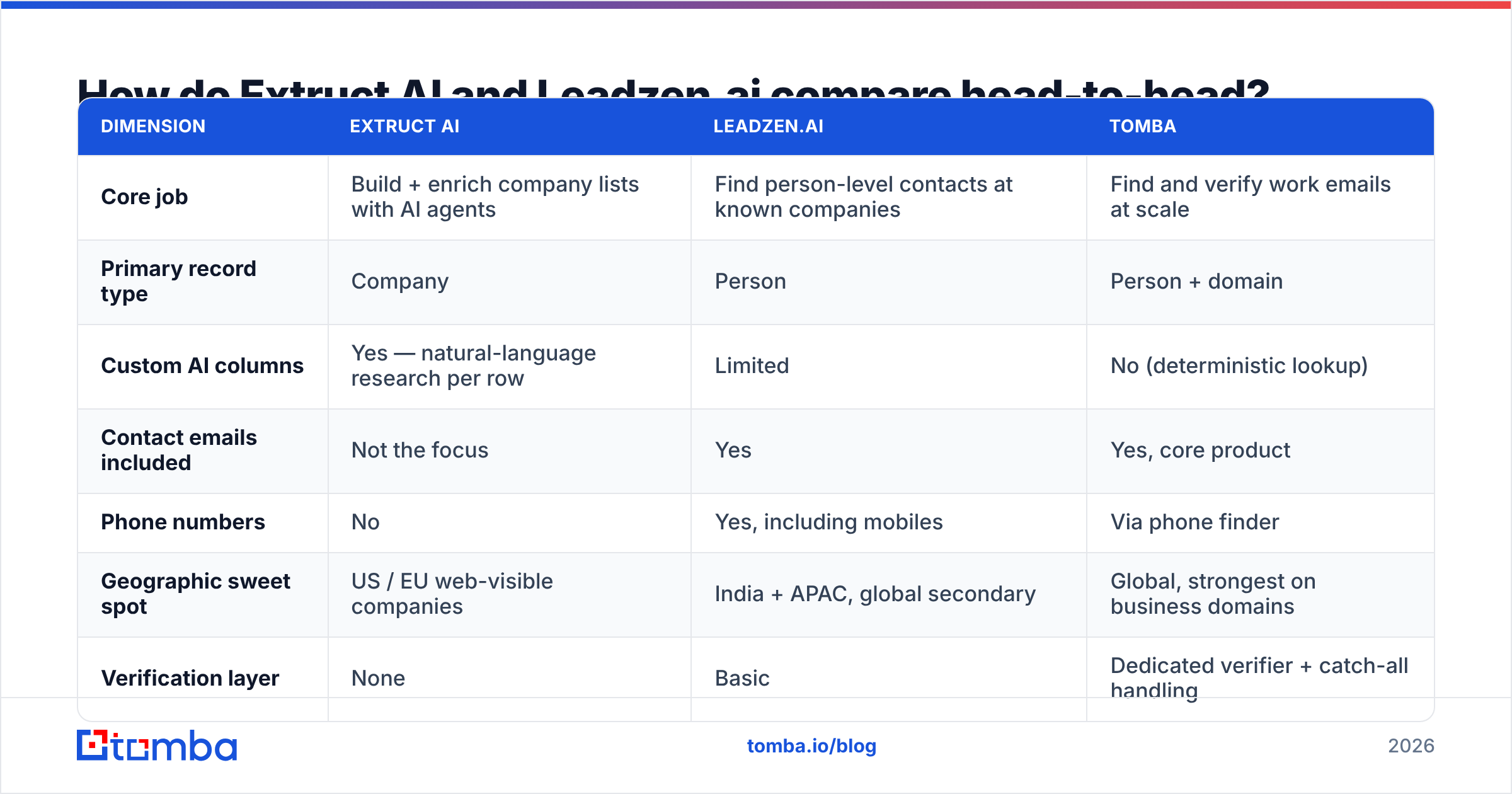
Here is the practical breakdown. Pricing for both vendors is quote- or pack-based and changes often, so treat those rows as shape rather than exact figures and confirm on the vendor page before you buy.
| Dimension | Extruct AI | Leadzen.ai | Tomba |
|---|---|---|---|
| Core job | Build + enrich company lists with AI agents | Find person-level contacts at known companies | Find and verify work emails at scale |
| Primary record type | Company | Person | Person + domain |
| Custom AI columns | Yes — natural-language research per row | Limited | No (deterministic lookup) |
| Contact emails included | Not the focus | Yes | Yes, core product |
| Phone numbers | No | Yes, including mobiles | Via phone finder |
| Geographic sweet spot | US / EU web-visible companies | India + APAC, global secondary | Global, strongest on business domains |
| Verification layer | None | Basic | Dedicated verifier + catch-all handling |
| Entry pricing | Quote-based, seat + credit hybrid | Credit packs, quote for teams | Free tier, then $49/mo Starter |
| API access | Yes | Yes | Yes, documented and public |
| Best for | Founders and RevOps defining a new ICP | SDR teams working APAC pipelines | Anyone who needs deliverable addresses |
Two things fall out of that table immediately.
First, Extruct AI produces a target list, not an outbound-ready list. You still need names and addresses for each company it returns. Teams handle this by piping the domain column into a domain search or a bulk enrichment job.
Second, Leadzen.ai produces contacts, but not the reasoning about who to contact. If your ICP is describable with standard filters — industry, headcount, title — that is fine. If it needs judgment ("companies that just opened a second warehouse"), Leadzen has no mechanism for that and Extruct does.
What does Extruct AI actually do well?#
The custom-column research is the differentiator, and it is genuinely hard to replicate manually.
- Non-firmographic ICP definition. Standard databases index SIC codes and headcount. Extruct reads websites. If your buyer is "any company whose site mentions FDA 21 CFR Part 11 compliance," that is a filter no static database exposes.
- Source-linked answers. Each researched cell can carry the URL it came from, which matters when a rep challenges the list quality. Auditability is rare in this category.
- Long-tail discovery. For niche B2B — industrial suppliers, regional service firms, specialist software — the open web is a better index than a licensed contact database that skews toward companies with big LinkedIn footprints.
- CRM-shaped output. Results come out as structured tables you can push downstream rather than a PDF report.
Where it falls short: it does not give you people. It also inherits the general reliability profile of LLM-driven web research — answers to fuzzy questions ("are they enterprise-ready?") are inference, not fact. Spot-check a sample of 20 rows on any new column before you trust 2,000.
Where does Leadzen.ai win?#
Coverage and immediacy. When a rep is on a LinkedIn profile and needs a mobile number in eight seconds, that is Leadzen's home turf.
- India and APAC depth. This is the strongest single argument for the tool. If a meaningful share of your TAM sits in Bengaluru, Mumbai, Pune, or Singapore, US-first databases will return sparse or stale records where Leadzen returns usable ones. Buyer reviews on G2 consistently reflect this regional split.
- Phone numbers alongside emails. Multi-channel SDR motions need both. Getting them from one vendor beats stitching two.
- Real-time lookup plus bulk. You can work one prospect at a time or upload a list, which suits mixed inbound/outbound teams.
- Lower price floor than enterprise incumbents. Against ZoomInfo-class contracts, the cost per usable contact is a different order of magnitude.
Where it falls short: contact data ages fast everywhere, and Leadzen is not exempt. Titles drift, people leave, and catch-all domains hide bad addresses behind "accept-all" SMTP responses. Which brings us to the part most comparison posts skip.
How accurate is the contact data from each?#
Neither vendor should be treated as a source of truth for deliverability, and this is not a knock on either — it is how the category works.
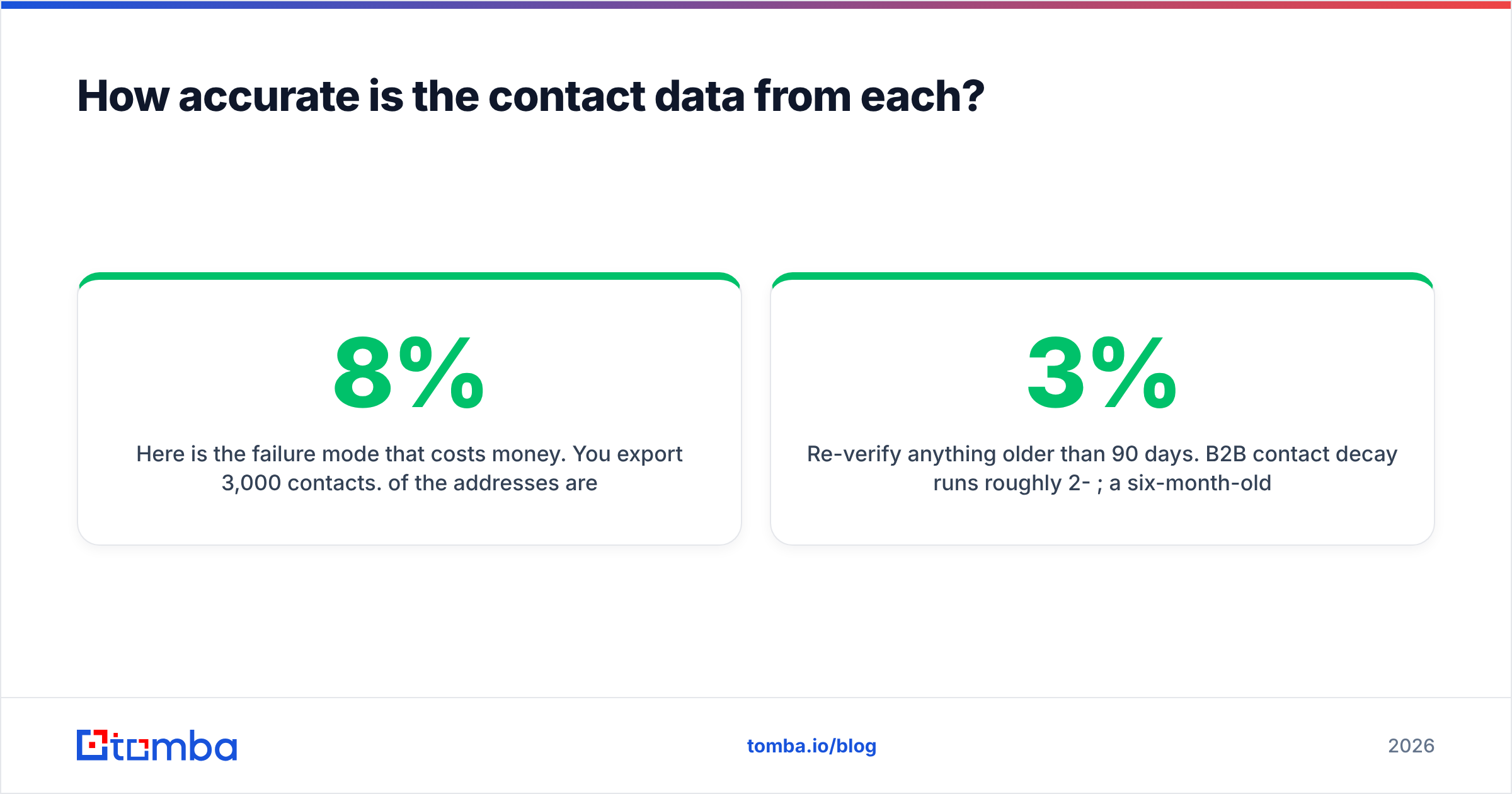
Here is the failure mode that costs money. You export 3,000 contacts. 8% of the addresses are dead. Another 6% sit on catch-all domains that will accept the message and then bounce silently or route it nowhere. You send anyway. Your bounce rate crosses 5%, your sender reputation drops, and the good 86% of that list starts landing in spam. One bad export contaminates a quarter of clean sending.
The fix is boring and cheap:
- Verify every imported address before it enters a sequence, regardless of what the source vendor claims. A syntax + MX + SMTP check catches most of it.
- Treat catch-all domains as a separate bucket. They need a catch-all verifier, not a pass/fail check, and often deserve a lower send volume until you see engagement.
- Re-verify anything older than 90 days. B2B contact decay runs roughly 2-3% per month; a six-month-old list is meaningfully worse than the day you bought it.
- Never send to a "guessed" pattern without confirmation. Permutation guessing is what generates the bounce spike in the first place.

What do they cost, and where do the hidden costs hide?#
Both vendors publish limited public pricing and route serious buyers to sales. That is normal, but it makes budget planning harder than it looks. The hidden costs are consistent across the category:
| Cost driver | How it bites |
|---|---|
| Credits burned on misses | A failed lookup often still consumes a credit. Check the refund policy in writing. |
| Seat minimums | Some contracts price per seat with a floor above your actual team size. |
| Annual-only discounts | The advertised rate frequently assumes a 12-month prepay. |
| Export caps | Monthly export limits can be tighter than your credit balance suggests. |
| Verification, billed separately | If the platform does not verify, that is another vendor and another line item. |
| Re-enrichment | Refreshing a stale list is usually charged as new lookups, not maintenance. |
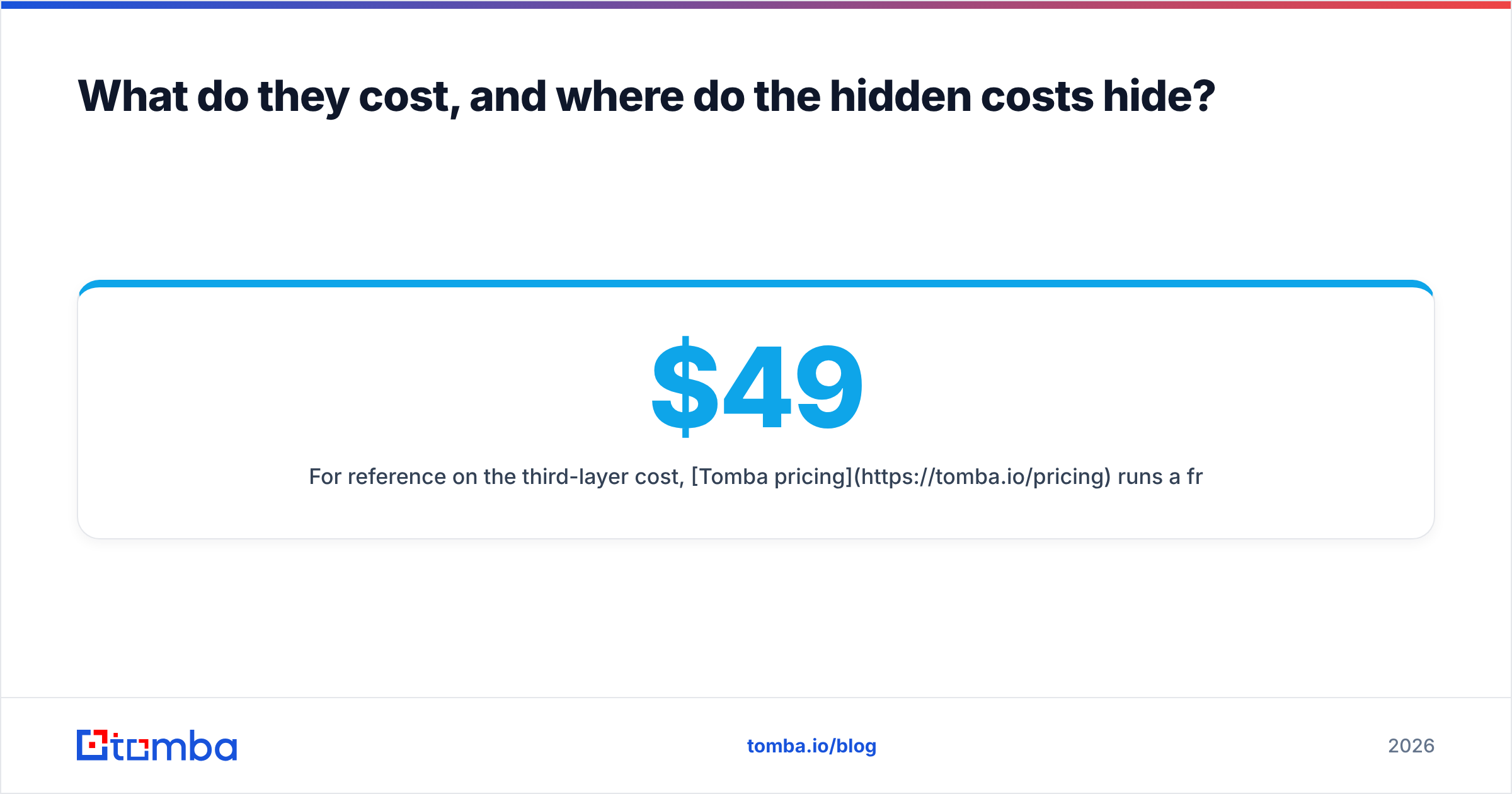
For reference on the third-layer cost, Tomba pricing runs a free tier at 25 searches per month, $49/mo Starter, $99/mo Growth, and $249/mo Pro, with verification included rather than sold as a separate SKU. Budget the verification layer explicitly when you model either platform — teams routinely forget it and then discover it after the first bounce incident.
Which one should you pick for your use case?#
Match the tool to the actual bottleneck, not to the demo that impressed you.
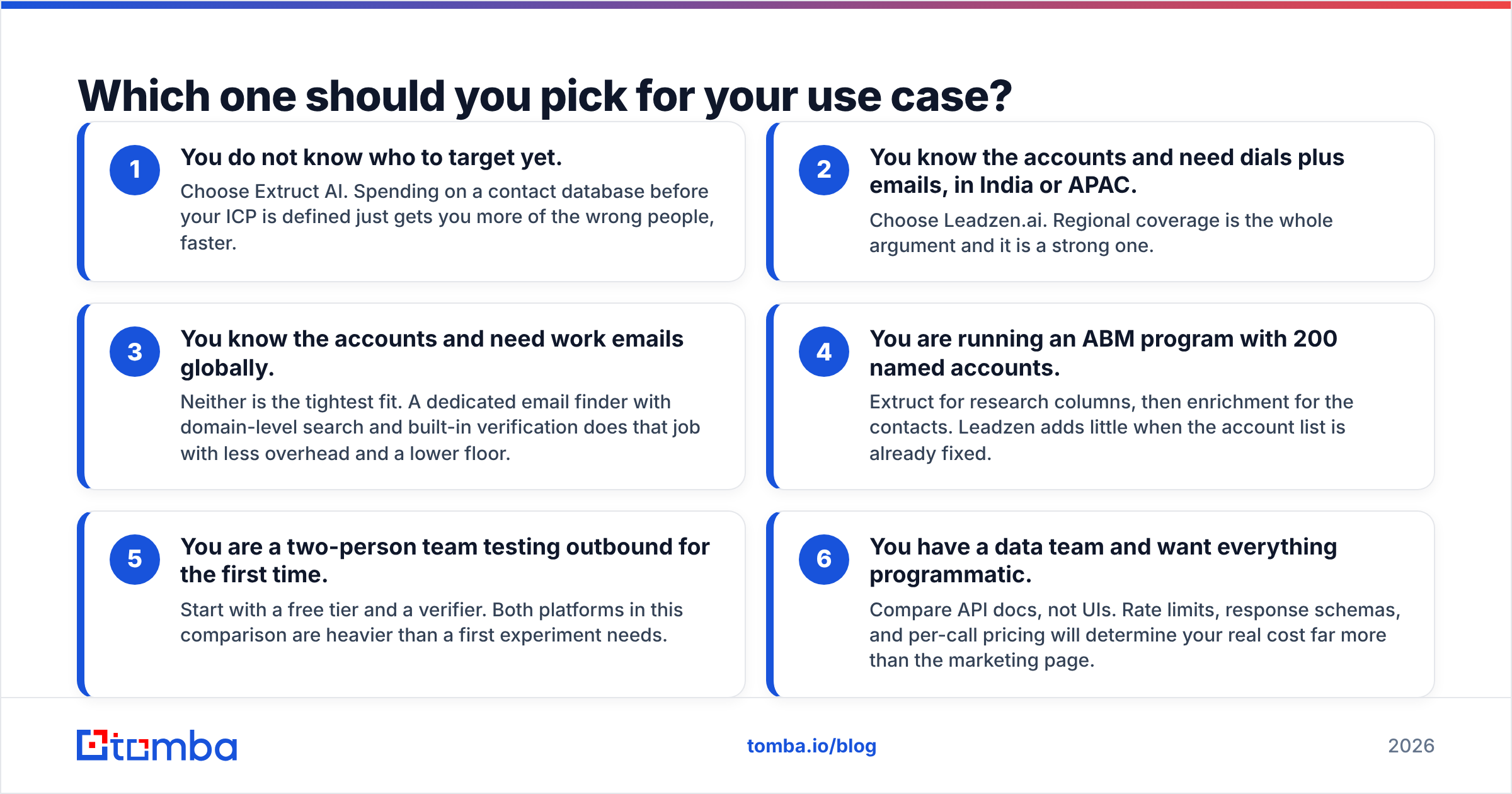
- You do not know who to target yet. Choose Extruct AI. Spending on a contact database before your ICP is defined just gets you more of the wrong people, faster.
- You know the accounts and need dials plus emails, in India or APAC. Choose Leadzen.ai. Regional coverage is the whole argument and it is a strong one.
- You know the accounts and need work emails globally. Neither is the tightest fit. A dedicated email finder with domain-level search and built-in verification does that job with less overhead and a lower floor.
Three more setups come up often. Each one changes the answer:
- You are running an ABM program with 200 named accounts. Extruct for research columns, then enrichment for the contacts. Leadzen adds little when the account list is already fixed.
- You are a two-person team testing outbound for the first time. Start with a free tier and a verifier. Both platforms in this comparison are heavier than a first experiment needs.
- You have a data team and want everything programmatic. Compare API docs, not UIs. Rate limits, response schemas, and per-call pricing will determine your real cost far more than the marketing page.
Do you need a third tool in the stack?#
Usually, yes — and pretending otherwise is how stacks get expensive.
The clean architecture is three layers. Discovery decides which companies matter. Acquisition turns those companies into named humans with contact details. Validation makes sure those details are deliverable before your sending domain pays for the mistake.
Extruct AI is a discovery layer. Leadzen.ai is mostly an acquisition layer with some discovery filters bolted on. Neither is a validation layer. If you buy one and skip the third, the failure shows up two months later as declining reply rates that look like a copywriting problem and are actually a data problem.
A practical, low-cost version of this: use Extruct or your own research to produce a domain list, run bulk email finder against it to get named contacts and addresses, verify the output, and only then load into your sequencer. That pipeline costs less than most single enterprise contracts and each layer is independently replaceable.
What is the verdict on Extruct AI vs Leadzenai?#
Extruct AI wins on research depth; Leadzen.ai wins on contact coverage — and if you only compare them on "leads per dollar," you will buy the wrong one.
Put plainly, Extruct AI vs Leadzenai comes down to one question. Is your gap research, or is it reach?
Extruct is the better purchase when your ICP is a hypothesis you are still testing and the qualifying signals live on company websites rather than in a firmographic field. It replaces analyst hours, not SDR tools.
Leadzen.ai is the better purchase when the accounts are settled, the motion is multi-channel, and your territory includes India or APAC. Its regional data is a real moat against the US-first incumbents, and the price floor is friendlier than enterprise alternatives.
Both leave the same gap: deliverable, current, verified addresses. Whichever you pick, plan for that layer before your first send rather than after your first bounce spike.
If work email addresses are the actual bottleneck — not company research, not phone dials — start with the Tomba Email Finder. Search by domain, name, or company, get verification built into the same lookup instead of buying it twice, and test the whole flow on the free tier at 25 searches per month before you commit to anything. Then layer discovery or regional contact data on top only where you can point to the specific gap it fills.
Related guides#
Ready to find emails that actually work?
Join 150,000+ professionals who stopped guessing and started sending. Free credits on signup — no credit card required.
Get the Tomba newsletter
Practical outbound tactics and product updates — once every two weeks.
About the author