Extruct AI vs RocketReach: Which B2B Data Tool Wins in 2026
One builds company lists with AI research agents. The other hands you 700M+ contact profiles. Here is where Extruct AI and RocketReach actually overlap, where they don't, and which one belongs in your stack.
TL;DR
- They solve different halves of the same problem. Extruct AI is an AI research layer that finds and qualifies companies. RocketReach is a contact database that finds people — emails, phone numbers, social profiles.
- Pick Extruct AI if your bottleneck is account selection: you need lists of companies matching a fuzzy ICP ("Series A fintechs hiring compliance staff") that no static filter can express.
- Pick RocketReach if your bottleneck is reach: you already know the accounts and need verified contact details at scale, plus a browser extension for one-off lookups.
- Neither is a complete stack. Extruct hands you companies without reliable contact data. RocketReach hands you contacts without deep account intelligence.
- The cheapest working combination is usually an account-research tool plus a dedicated email finder with a real API — Tomba starts free (25 searches/mo) and runs $49/mo on Starter.
What is Extruct AI and what does it actually do?#
Extruct AI is an AI-agent platform for company research. Instead of filtering a fixed database by industry code and headcount, you describe the kind of company you want in plain language, and Extruct's agents go out, read the web, and build a table of matching accounts — each row enriched with custom columns you define.
Think of it like hiring a junior analyst who never sleeps. You say "find me B2B SaaS companies in DACH with 50-200 employees that mention SOC 2 on their website and have a job posting for a solutions engineer," and it returns a spreadsheet with those columns filled in, each one sourced from an actual page it read.
That's the interesting part: the columns are generated, not looked up. "Does this company sell to enterprise?" isn't a field in any database — it's a judgment call an agent makes after reading the site. Extruct's pitch (see extruct.ai) is that this replaces the analyst hours your SDRs currently burn tab-hopping between LinkedIn, Crunchbase, and company blogs.
The tradeoff is obvious once you use it. Agent research is slower and more expensive per row than a database query, and the output quality depends heavily on how you word the prompt. It's a research tool with list-building attached, not a bulk-contact firehose.
What is RocketReach and who is it for?#
RocketReach is the older, more conventional product: a contact database. It claims 700M+ professional profiles and 60M+ companies, and its core job is turning a name plus a company into an email address and, on higher tiers, a direct dial.
You use it three ways:
- Search UI — filter by title, company, location, industry, headcount; export the resulting contact list.
- Browser extension — open a LinkedIn profile, click, get the email. This is the workflow most individual reps actually live in.
- API — programmatic lookups for enrichment pipelines and CRM sync.
RocketReach's reputation on review sites like G2 is fairly consistent: broad coverage, decent hit rate on professional emails, weaker on direct-dial phone numbers, and pricing that escalates faster than people expect once you need exports and API volume. Personal Gmail-type addresses inflate the coverage number but are rarely what a B2B seller wants.

How do Extruct AI and RocketReach compare head to head?#
Here's the honest side-by-side. Pricing tiers change often — treat these as directional and confirm on each vendor's own page before you buy.
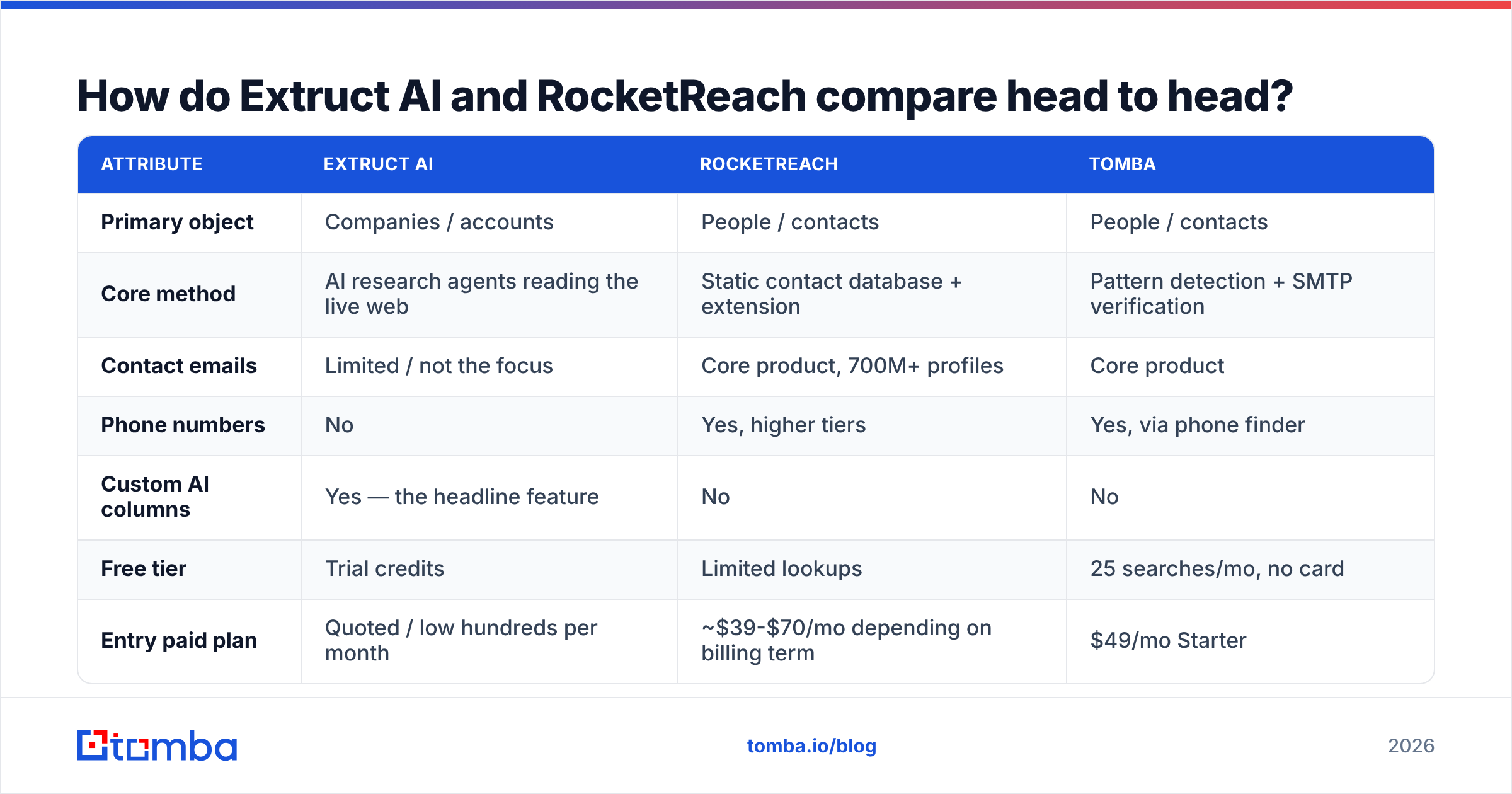
| Attribute | Extruct AI | RocketReach | Tomba |
|---|---|---|---|
| Primary object | Companies / accounts | People / contacts | People / contacts |
| Core method | AI research agents reading the live web | Static contact database + extension | Pattern detection + SMTP verification |
| Contact emails | Limited / not the focus | Core product, 700M+ profiles | Core product |
| Phone numbers | No | Yes, higher tiers | Yes, via phone finder |
| Custom AI columns | Yes — the headline feature | No | No |
| Free tier | Trial credits | Limited lookups | 25 searches/mo, no card |
| Entry paid plan | Quoted / low hundreds per month | ~$39-$70/mo depending on billing term | $49/mo Starter |
| Mid tier | Quoted by seat + credits | ~$99/mo | $99/mo Growth |
| API access | Yes | Yes, usually higher tiers | Yes, on every paid plan |
| Bulk processing | List runs | CSV enrich + export | Bulk email finder |
| Best at | Defining which accounts to target | Reaching anyone at a known account | Verified email at scale, cheap API |
| Weakest at | Contact-level data, price per row | Fuzzy ICP research, data freshness | Company-level qualitative research |
The table makes the real conclusion visible: these two products barely compete. Extruct AI answers who should we go after. RocketReach answers how do I reach them. If you're comparing them as substitutes, you probably haven't defined which of those two problems is actually costing you pipeline.
Which one fits your workflow?#
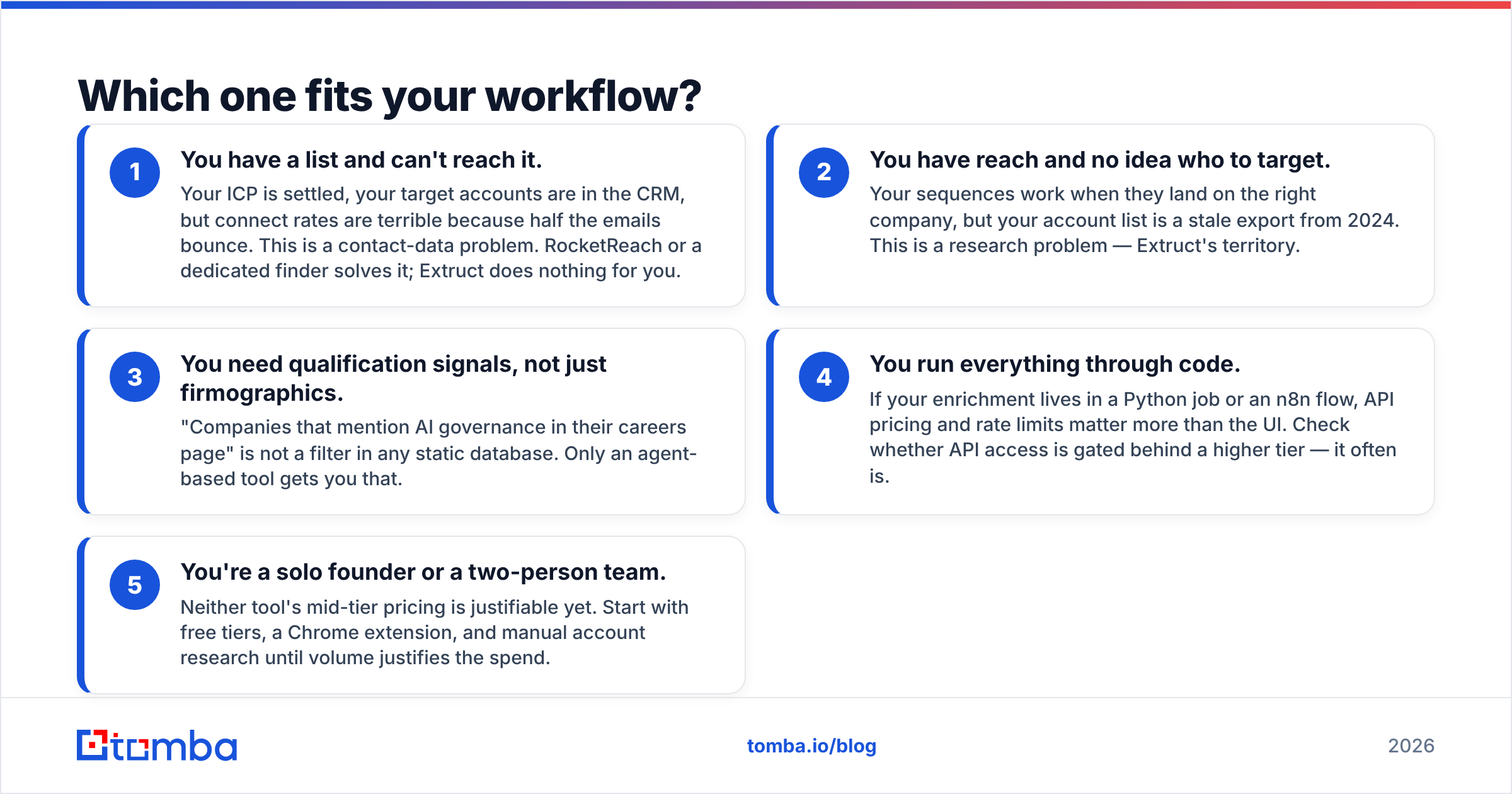
Work through these five in order. Whichever describes your last bad quarter is the tool you need first.
- You have a list and can't reach it. Your ICP is settled, your target accounts are in the CRM, but connect rates are terrible because half the emails bounce. This is a contact-data problem. RocketReach or a dedicated finder solves it; Extruct does nothing for you.
- You have reach and no idea who to target. Your sequences work when they land on the right company, but your account list is a stale export from 2024. This is a research problem — Extruct's territory.
- You need qualification signals, not just firmographics. "Companies that mention AI governance in their careers page" is not a filter in any static database. Only an agent-based tool gets you that.
- You run everything through code. If your enrichment lives in a Python job or an n8n flow, API pricing and rate limits matter more than the UI. Check whether API access is gated behind a higher tier — it often is.
- You're a solo founder or a two-person team. Neither tool's mid-tier pricing is justifiable yet. Start with free tiers, a Chrome extension, and manual account research until volume justifies the spend.
Is Extruct AI worth it over a standard database?#
It depends entirely on how weird your ICP is.
If your ideal customer is "manufacturing companies, 200-1000 employees, US Midwest," any conventional database filter gets you there in ten seconds for a fraction of the cost. Paying agent-level prices to re-derive information that's already a structured field is waste.
If your ICP is "companies that just switched from an in-house billing system," "agencies that publicly list HIPAA compliance," or "startups whose founder previously exited a company in the same vertical" — no filter exists. You either pay analysts to research it or you pay an agent. The agent is cheaper and faster, and that's the entire case for Extruct AI.
One caution: agent-generated columns are inferences, not facts. When an agent says a company "likely uses Salesforce," that's a probabilistic read of public signals. Treat those columns as prioritization signals, not as ground truth you'd put in a personalized first line without checking. Nothing kills a cold email faster than a confident detail that's wrong.
Is RocketReach accurate enough for cold outreach?#
RocketReach's coverage is genuinely broad, which is its main strength. The accuracy question is more nuanced than a single percentage.
Three things degrade real-world accuracy across every contact database, RocketReach included:
- Job changes. Roughly a fifth of B2B contacts change roles annually. A database record captured 14 months ago is a coin flip.
- Personal addresses padding coverage. A Gmail address counts as "found" in the stats but is useless for a compliant B2B sequence.
- Catch-all domains. Many enterprise domains accept every address at the SMTP layer, so a "valid" result tells you nothing. You need a dedicated catch-all verifier to separate real mailboxes from black holes.
The practical fix is the same regardless of which finder you use: verify immediately before you send, not at export time. Run every list through an email verifier as the last step in your pipeline. A two-week-old export is already decaying, and bounce rate is the fastest way to wreck your sender reputation.

What does the combined stack actually cost?#
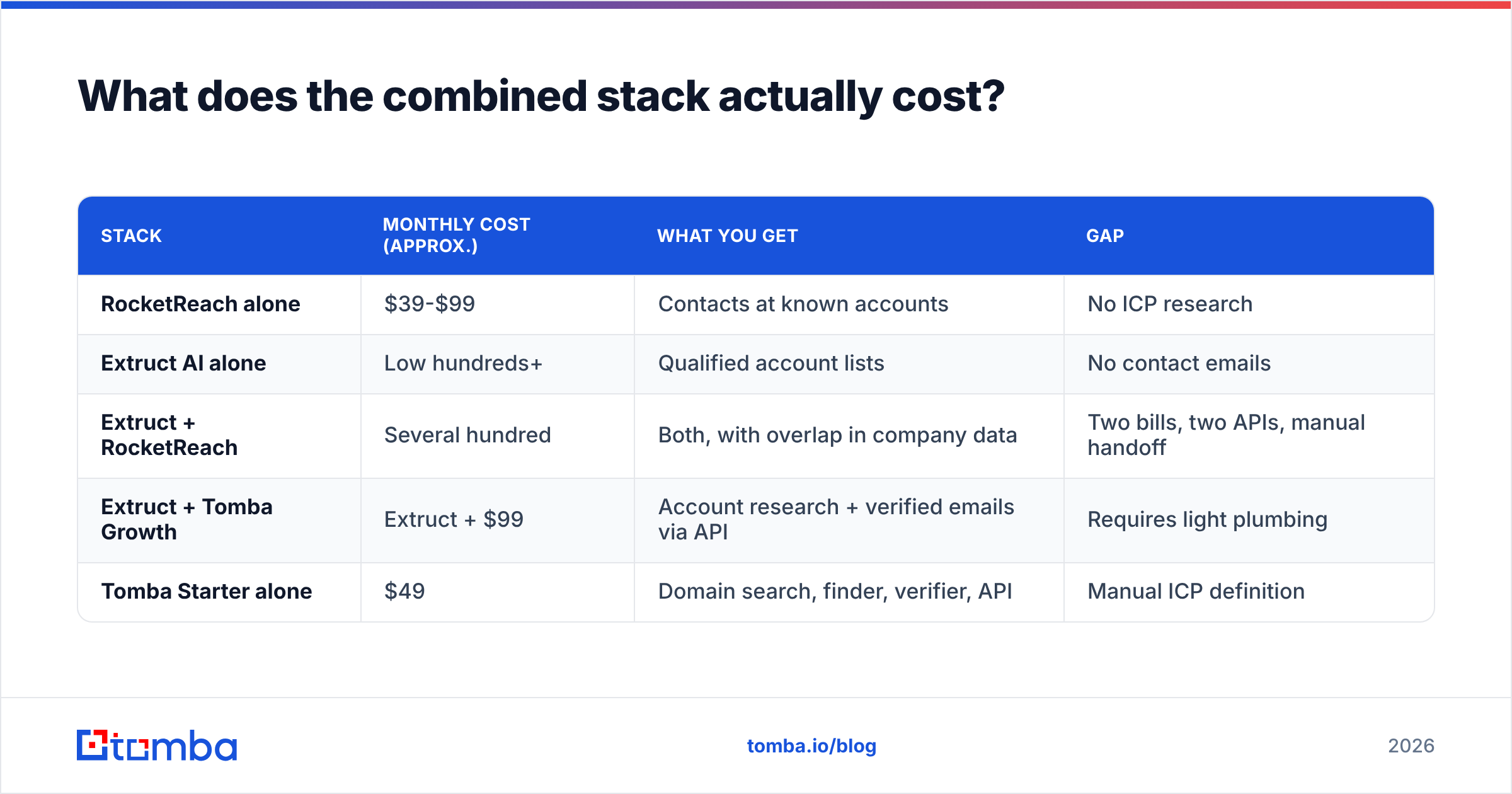
Here's where most teams get surprised. Running Extruct AI and RocketReach together means paying two subscriptions to cover one workflow, and the overlap is minimal — you're not getting a discount for redundancy, you're stacking two full prices.
| Stack | Monthly cost (approx.) | What you get | Gap |
|---|---|---|---|
| RocketReach alone | $39-$99 | Contacts at known accounts | No ICP research |
| Extruct AI alone | Low hundreds+ | Qualified account lists | No contact emails |
| Extruct + RocketReach | Several hundred | Both, with overlap in company data | Two bills, two APIs, manual handoff |
| Extruct + Tomba Growth | Extruct + $99 | Account research + verified emails via API | Requires light plumbing |
| Tomba Starter alone | $49 | Domain search, finder, verifier, API | Manual ICP definition |
The middle path most teams land on: use one research tool to define and score accounts, then use a cheap, API-first finder to resolve contacts at those accounts. Contact resolution is a commodity — it should not be your most expensive line item. Account intelligence is not a commodity, and that's where the premium spend belongs.
If you go that route, check that your finder's API is available on the entry plan rather than gated behind enterprise. Tomba exposes the email finder API on every paid tier, which matters when your whole workflow is a scheduled job rather than a person clicking a button. Full Tomba pricing is public — no "contact sales" wall for basic API access.
How do you connect these tools without a data engineer?#
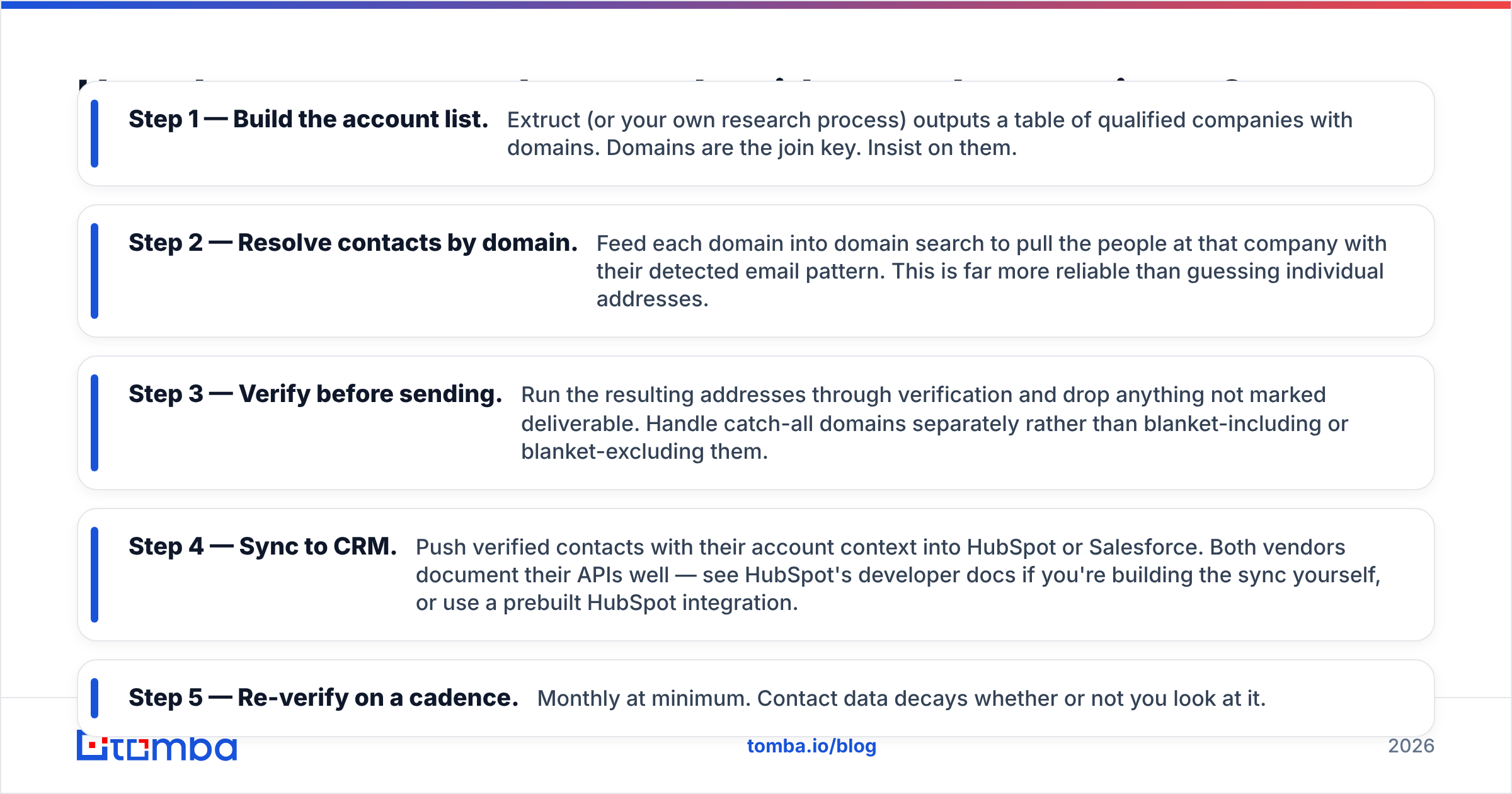
The handoff between account research and contact resolution is where teams lose weeks. A workable pattern:
- Step 1 — Build the account list. Extruct (or your own research process) outputs a table of qualified companies with domains. Domains are the join key. Insist on them.
- Step 2 — Resolve contacts by domain. Feed each domain into domain search to pull the people at that company with their detected email pattern. This is far more reliable than guessing individual addresses.
- Step 3 — Verify before sending. Run the resulting addresses through verification and drop anything not marked deliverable. Handle catch-all domains separately rather than blanket-including or blanket-excluding them.
- Step 4 — Sync to CRM. Push verified contacts with their account context into HubSpot or Salesforce. Both vendors document their APIs well — see HubSpot's developer docs if you're building the sync yourself, or use a prebuilt HubSpot integration.
- Step 5 — Re-verify on a cadence. Monthly at minimum. Contact data decays whether or not you look at it.
That's five steps, and only step 1 requires the expensive tool. Steps 2-5 should be as cheap and automated as you can make them.
What's the verdict on Extruct AI vs RocketReach?#
If you must pick one: choose based on which half of the funnel is broken. Targeting broken → Extruct AI. Reach broken → RocketReach. There is no universal winner because they are not the same product, and any review that declares one flatly better is comparing a hammer to a screwdriver.
If you're building a stack: the smart configuration is a research tool for accounts plus a specialist finder for contacts. Don't pay database prices for research, and don't pay research prices for email addresses.
If budget is the constraint: start with the contact layer. A perfectly researched account list you can't email is worth nothing, while a decent account list with verified contacts still produces meetings. Fix reach first, then get sophisticated about targeting.
Start with the layer that actually sends email. Tomba's Email Finder turns a name and domain into a verified professional address, with domain search, catch-all detection, and bulk processing built in — and API access on every paid plan, not just enterprise. Try it free with 25 searches a month, no card required, then move to Starter at $49/mo when your volume justifies it. Pair it with whatever research tool fits your ICP, and stop paying twice for the same contact record.
Related guides#
Ready to find emails that actually work?
Join 150,000+ professionals who stopped guessing and started sending. Free credits on signup — no credit card required.
Get the Tomba newsletter
Practical outbound tactics and product updates — once every two weeks.
About the author