Extruct AI vs SalesIntel: Which B2B Data Tool Wins in 2026?
Extruct AI builds company lists with research agents. SalesIntel sells human-verified contacts and intent. They solve different halves of the same problem — here is which one your pipeline actually needs, and what it costs.
Extruct AI vs SalesIntel comes down to one question. Do you need better accounts, or better contacts? Extruct finds companies. SalesIntel sells the people inside them. Here is how each tool works, what it costs, and when to buy both.
TL;DR
Extruct AI and SalesIntel are not true rivals. Extruct is an AI research agent that builds and enriches company lists from the open web. SalesIntel is a contact database that sells people — names, emails, direct dials — checked by humans.
Pick Extruct AI when your ICP is odd, narrow, or listed nowhere ("Series A robotics firms with a SOC 2 and an open controls engineer role"). No filter in a static database can say that.
Pick SalesIntel when your ICP is plain and your bottleneck is reaching the humans inside it. It fits best if you need US direct dials and Bombora intent on one contract.
Budget reality: SalesIntel is an annual deal, seats plus credits, and it lands in five figures for most teams. Extruct runs on credits and costs less to start. It will not hand you a verified inbox.
Most teams run two layers anyway: one to find accounts, one to find and check contacts. A bulk email finder at $49–$99/mo covers the second layer for a fraction of a full data-suite seat.
What problem does each tool actually solve?#
Think of building a target list like catering a wedding. Extruct AI is the researcher. It works out which 400 guests to invite, using a dozen fuzzy rules. SalesIntel is the address book. It already holds 400 million entries, and a team calls a sample to check nobody moved.
You need both jobs done. You rarely need both from one vendor.
Extruct AI (extruct.ai) runs AI agents against the live web. You define a company profile. Then you add your own columns — "does their careers page mention Kubernetes?", "how many locations do they list?", "who is the CFO on their about page?" The agent researches each row and fills it in with a source link. You end up with a sheet of companies holding facts no static provider stores.
SalesIntel (salesintel.io) is a classic B2B contact database with one twist: humans check the data. Machines re-check records all day. Researchers also confirm a large slice by hand, and you can ask them to research a record on demand. Tech stack data and Bombora intent sit in the same platform.
Buy only Extruct and you hit a wall. You have 800 perfect accounts and no way to email anyone inside them. Buy only SalesIntel and you hit a different wall. You have 40,000 contacts at firms that only half match your ICP, and your reply rate says so.
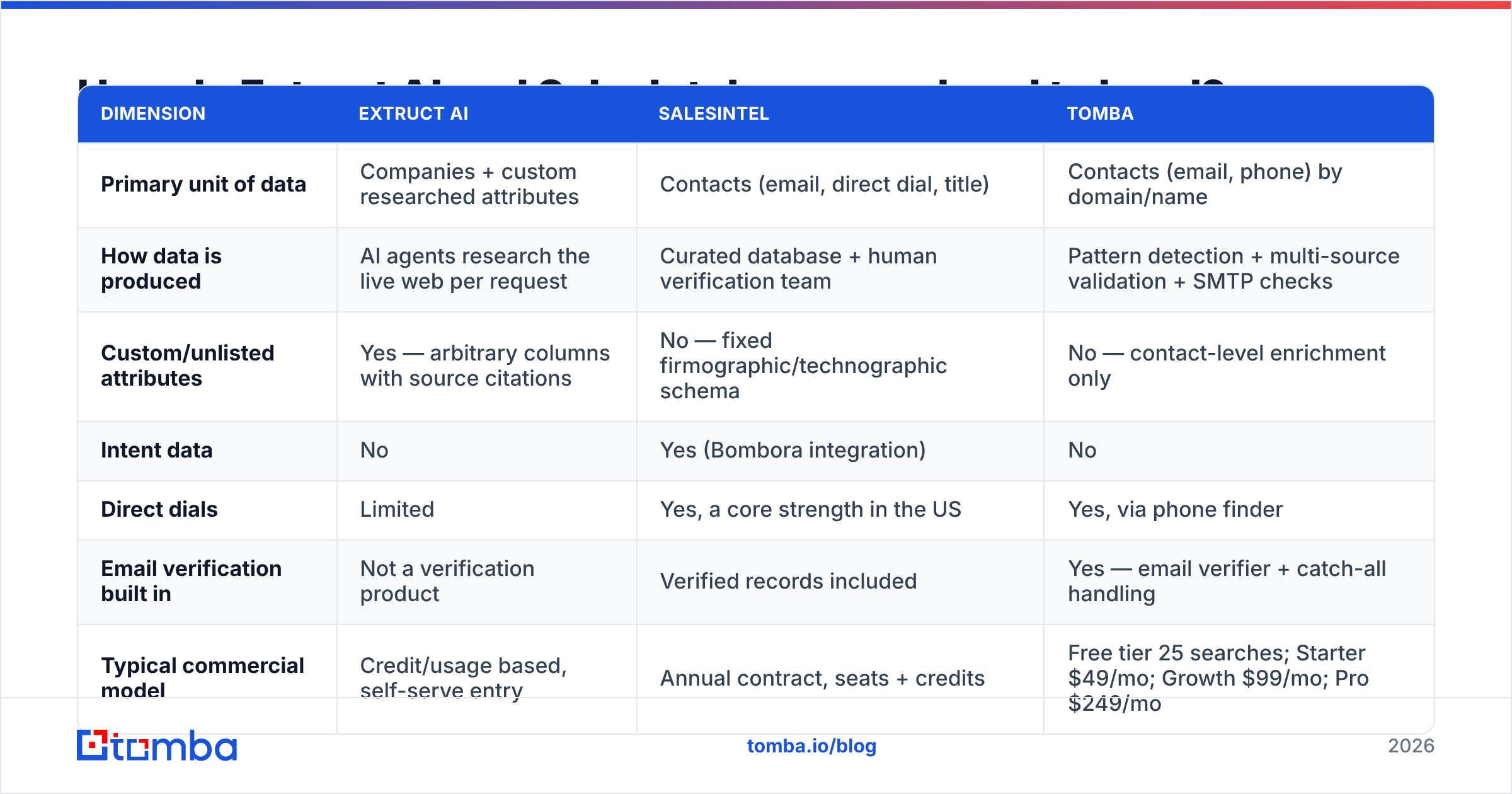
Extruct AI vs SalesIntel: how do they compare head to head?#
| Dimension | Extruct AI | SalesIntel | Tomba |
|---|---|---|---|
| Primary unit of data | Companies + custom researched attributes | Contacts (email, direct dial, title) | Contacts (email, phone) by domain/name |
| How data is produced | AI agents research the live web per request | Curated database + human verification team | Pattern detection + multi-source validation + SMTP checks |
| Custom/unlisted attributes | Yes — arbitrary columns with source citations | No — fixed firmographic/technographic schema | No — contact-level enrichment only |
| Intent data | No | Yes (Bombora integration) | No |
| Direct dials | Limited | Yes, a core strength in the US | Yes, via phone finder |
| Email verification built in | Not a verification product | Verified records included | Yes — email verifier + catch-all handling |
| Typical commercial model | Credit/usage based, self-serve entry | Annual contract, seats + credits | Free tier 25 searches; Starter $49/mo; Growth $99/mo; Pro $249/mo |
| Time to first usable list | Hours (agent runs take time per row) | Minutes (filter and export) | Minutes (domain search or bulk upload) |
| Best fit | Non-obvious ICPs, research-heavy GTM, VC/PE sourcing | US mid-market SDR teams needing dials + intent | Teams that already know their accounts and need contactable, verified addresses |
Two honest caveats about that table. First, Extruct's research cost per row grows with each custom column you add. A 5,000-company list with eight AI columns is a very different invoice from the same list with one. Second, SalesIntel has never published full pricing. Teams report annual deals, and buyer reviews on G2 talk about haggling rather than a checkout page. Get both quotes before you model ROI.
Which one has better data accuracy?#
Different questions get different answers. Most comparison posts skip that part.
SalesIntel's accuracy claim is about contact records. Is this person still in the role? Is the mobile number right? Human checks help here, above all for direct dials. Dials decay faster than any other B2B data. The weak spot, per repeated buyer feedback, is outside the US and outside mid-market SaaS. Coverage thins there, and the human-checked slice thins with it.
Extruct's accuracy claim is about research calls. Does this company really do what I said it does? The agent cites its sources. That is the smartest design choice in the product, because you can audit a row instead of trusting it. Still, LLM research brings LLM failure modes. Vague company names, stale cached pages, and puffed-up marketing copy all yield confident wrong answers. Spot-check 20 rows before you trust 2,000.
Neither tool solves the last mile. An email that existed at export time may bounce at send time. That check is separate, and it is cheap. Run the list through an email verification pass before it hits your sequencer. It costs cents per thousand and guards the asset that matters most — your sender reputation.
How should you evaluate them for your own stack?#
Run a bake-off, not a demo-led decision. Six steps, about a week.
Write your ICP as a sentence, not a filter set. Does the sentence map cleanly to industry, headcount, geo, and tech? Then a database like SalesIntel will serve you. Does it hold a clause no filter can express, such as "firms that just opened a second warehouse"? Then you need a research agent.
Pull the same 100 accounts from both. Not 10,000 — 100. The overlap tells you if you are paying twice for one list. In most tests the overlap is smaller than buyers expect. That is the real case for a two-layer stack.
Measure contact coverage per account, not database size. "400M contacts" is a marketing number. Here is the number that counts: of my 100 target accounts, how many gave me three or more reachable decision-makers in the right team?
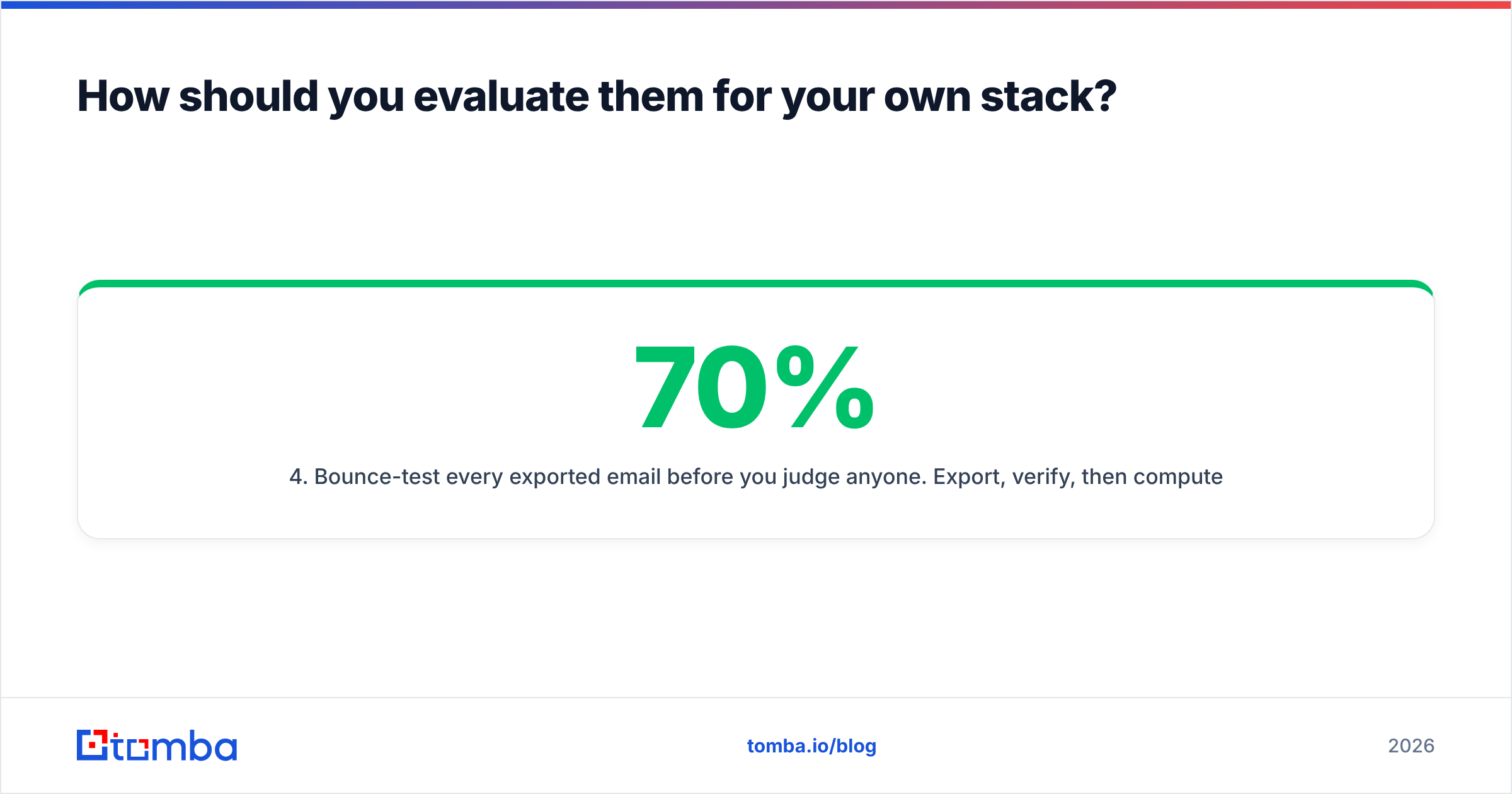
Bounce-test every exported email before you judge anyone. Export, verify, then work out the true cost per deliverable contact. A tool with 70% coverage at 96% valid beats one with 90% coverage at 78% valid, every time.
Price the whole workflow, including seats you will not use. Annual deals are priced per seat. Two SDRs need the data, but six other people want the odd lookup. That is where suite pricing quietly doubles.
Test the API before you sign. Will RevOps enrich on form fill or on CRM create? Then speed and rate limits matter more than a polished UI. Both vendors offer APIs. So does the Tomba API, with generous throughput on paid plans.
Is Extruct AI better than SalesIntel for outbound teams?#
For a classic outbound motion, SalesIntel is the more useful buy. Picture SDRs calling and emailing a set mid-market segment in North America. Direct dials, intent signals, and a filter-and-export flow match how those teams already work. Extruct asks someone to design research, and most SDR teams do not staff for that.
For founder-led sales, agency prospecting, or VC and PE deal sourcing, Extruct is the more interesting tool. The same holds for any motion where your definition of a good account is the edge. Once your criteria include something no vendor stores, a research agent stops being a toy. It becomes the only option.
There is a middle path too. Use Extruct — or any list method, such as scraping, event exhibitor lists, funding databases, or Sales Navigator exports — to nail the account set. Then resolve contacts cheaply and verify hard. This is where a dedicated finder earns its keep. Point domain search at each account domain and filter by team and seniority. You get the same contact layer with no annual deal. If your list already holds people rather than companies, a LinkedIn email extractor or a bulk CSV run does the job in one pass.
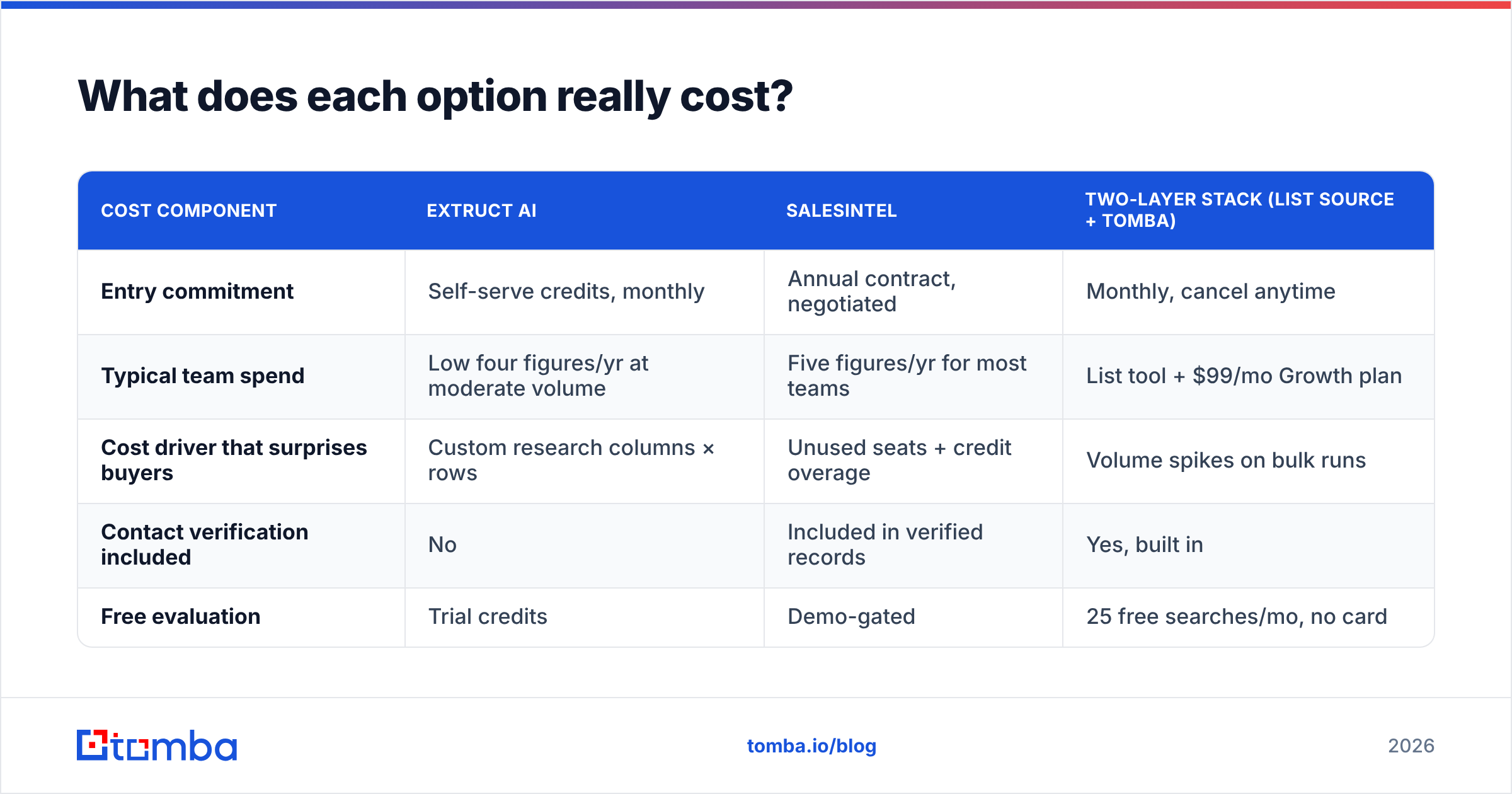
What does each option really cost?#
| Cost component | Extruct AI | SalesIntel | Two-layer stack (list source + Tomba) |
|---|---|---|---|
| Entry commitment | Self-serve credits, monthly | Annual contract, negotiated | Monthly, cancel anytime |
| Typical team spend | Low four figures/yr at moderate volume | Five figures/yr for most teams | List tool + $99/mo Growth plan |
| Cost driver that surprises buyers | Custom research columns × rows | Unused seats + credit overage | Volume spikes on bulk runs |
| Contact verification included | No | Included in verified records | Yes, built in |
| Free evaluation | Trial credits | Demo-gated | 25 free searches/mo, no card |
That last column is not an argument that free tiers win deals. It means you can test the contact layer before you commit to the account layer. That flips the usual buying order. It also saves you from paying for a whole suite to test one part. Full Tomba pricing is on the page — Starter $49/mo, Growth $99/mo, Pro $249/mo, Enterprise custom — so you can model the second layer with no sales call.
One more budget note. Intent data is the biggest line item hidden inside suite pricing. Buying SalesIntel mainly for Bombora intent? Price intent on its own and compare. Buying it for direct dials? Price a dials-only vendor. Bundles are handy, and handy carries a margin.
Which should you choose in 2026?#
Here is the short version of the Extruct AI vs SalesIntel call.
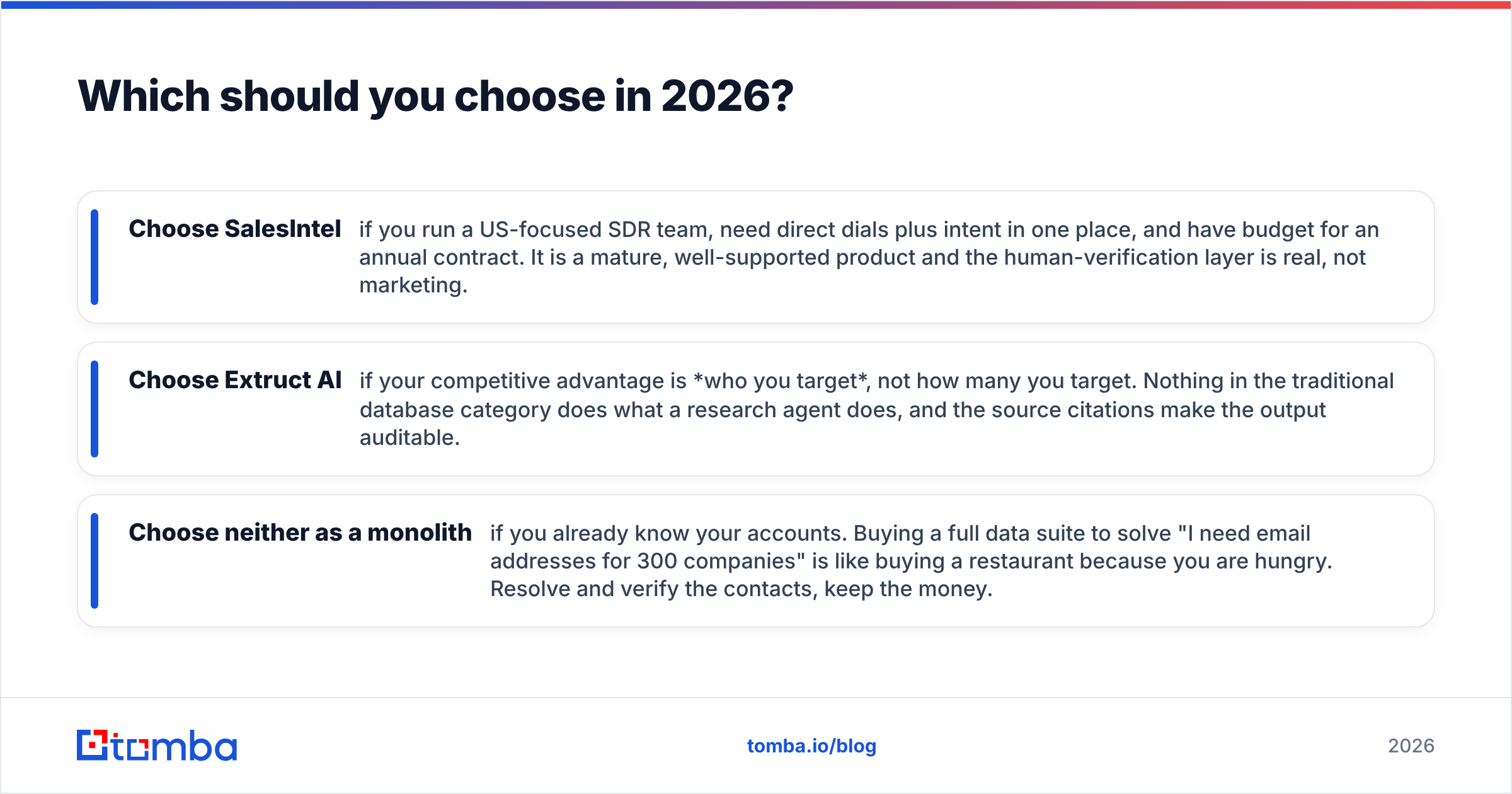
Choose SalesIntel if you run a US-focused SDR team and need direct dials plus intent in one place, with budget for an annual deal. It is a mature, well-supported product, and the human-checked layer is real, not marketing.
Choose Extruct AI if your edge is who you target, not how many. Nothing in the old database category does what a research agent does, and the source links make the output easy to audit.
Choose neither as a monolith if you already know your accounts. Buying a full data suite to solve "I need emails for 300 companies" is like buying a restaurant because you are hungry. Resolve the contacts, verify them, and keep the money.
Whatever the account layer looks like, the contact layer has to be clean. Bounces do not just waste a send. They pile up into domain damage that takes weeks to undo. Verify before you sequence, every time.
Ready to test the contact layer first? Start with the Tomba Email Finder — 25 free searches a month, no card needed. Every result comes back with a confidence score and a verification status, so you know what is safe to send. Feed it domains from Extruct, an export from SalesIntel, or a sheet you built by hand. It treats all three the same. If the numbers work, Starter is $49/mo and Growth is $99/mo, and you can cancel the month you stop needing it.
Related guides#
Ready to find emails that actually work?
Join 150,000+ professionals who stopped guessing and started sending. Free credits on signup — no credit card required.
Get the Tomba newsletter
Practical outbound tactics and product updates — once every two weeks.
About the author