Extruct AI vs UpLead: Which B2B Data Tool Wins in 2026?
Extruct AI builds company lists with agentic web research. UpLead sells a verified 160M-contact database. They solve different halves of the same problem — here's which one your team actually needs.
Extruct AI vs UpLead is a choice between two very different tools. One uses AI agents to research the live web. The other sells access to a large, ready-made contact database. This guide compares both on data, pricing, accuracy, and workflow fit. It also names the gap neither one closes.
TL;DR
- Extruct AI is an agentic research tool. You describe your ideal customer in plain language. Agents crawl the live web and hand back a company list with custom columns. It finds accounts, not inboxes.
- UpLead is a classic contact database. Roughly 160M records, filter and export, with email checks run at export time. It finds people — but only people already in its index.
- The honest split: Extruct AI wins on niche segments no filter can express, like "companies that just opened a second warehouse in Texas." UpLead wins on speed, contact coverage, and cost you can predict.
- Neither is a full outbound stack. Extruct hands you domains with thin contact data. UpLead's index goes stale on fast-moving or non-US companies.
- Most teams pair one of them with a dedicated email finder. That turns company rows into verified, sendable addresses.
What problem are Extruct AI and UpLead actually solving?#
They sit at opposite ends of the same pipeline. That is the whole comparison in one line.
UpLead is a static-index play. Someone crawled the web, sorted it into rows, and sold you filtered access. You pick "SaaS, 50–200 employees, US, uses HubSpot" and hit export. You get names with emails. The value sits in the pre-built index and the check stapled to the export button.
Extruct AI is a live-research play. There is no index to filter. You write a prompt describing the accounts you want. You also name the columns you want filled — "Do they have a careers page listing SDR roles?" or "What payment processor is on their checkout?" AI agents then read the web and fill that table. Your criteria never have to exist as a checkbox in someone else's schema.
That one difference drives everything else: pricing, accuracy, speed, and what you have to bolt on later.

Extruct AI vs UpLead: how do they compare head-to-head?#
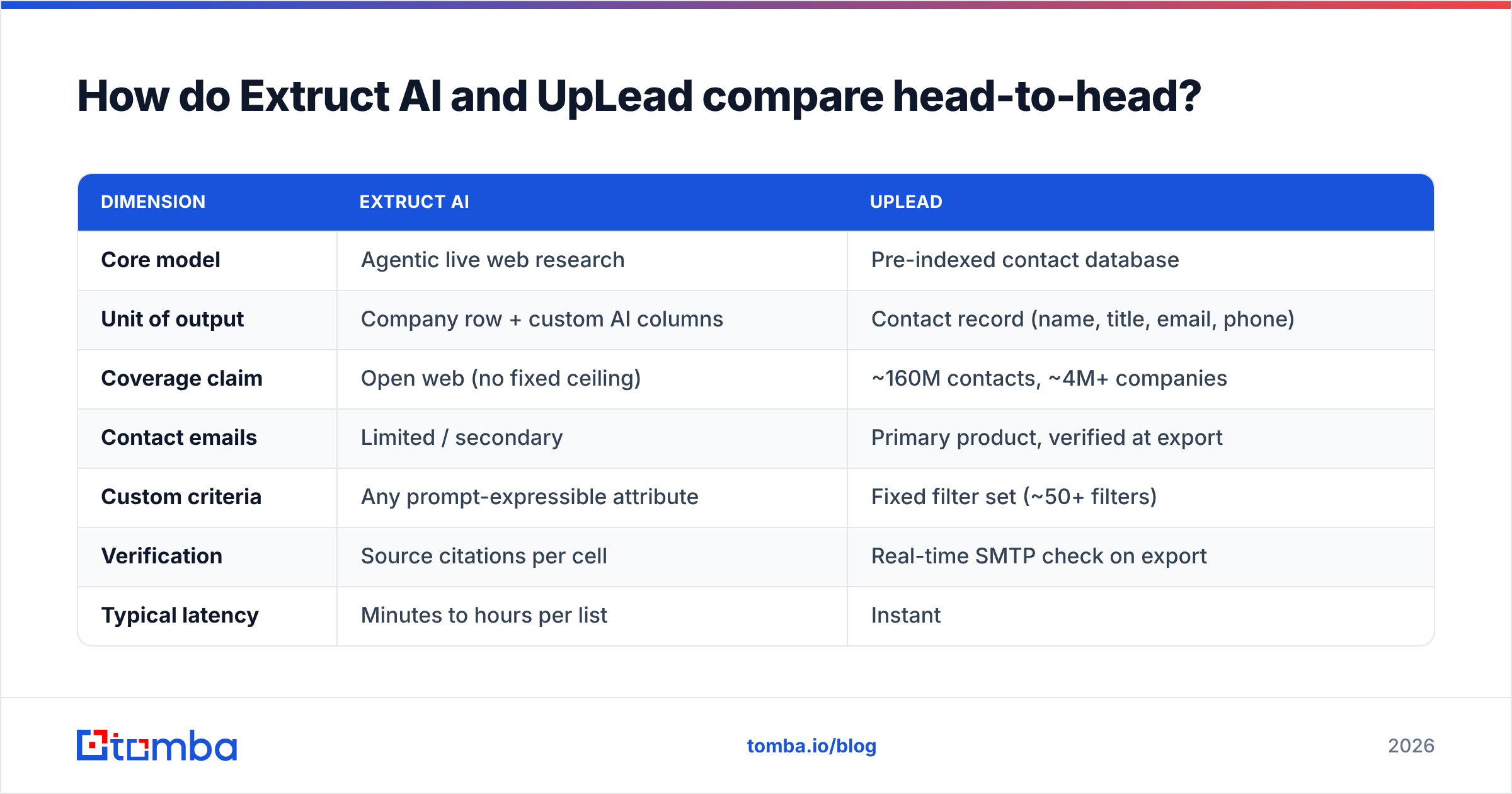
| Dimension | Extruct AI | UpLead |
|---|---|---|
| Core model | Agentic live web research | Pre-indexed contact database |
| Unit of output | Company row + custom AI columns | Contact record (name, title, email, phone) |
| Coverage claim | Open web (no fixed ceiling) | ~160M contacts, ~4M+ companies |
| Contact emails | Limited / secondary | Primary product, verified at export |
| Custom criteria | Any prompt-expressible attribute | Fixed filter set (~50+ filters) |
| Verification | Source citations per cell | Real-time SMTP check on export |
| Typical latency | Minutes to hours per list | Instant |
| Entry pricing | Custom / credit-based, mid-market up | ~$99/mo (Essentials tier) |
| Free option | Trial / limited free workspace | 5 free credits on signup |
| Best for | Niche ICPs, market mapping, research ops | High-volume SDR list building |
| Weak spot | Thin person-level contact data | Rigid filters, index staleness |
Read that table twice before you dig into feature bullets. Is your bottleneck that you can't describe your ICP with existing filters? Then Extruct is the answer, and price is secondary. Do you need 3,000 verified emails by Thursday? Then UpLead is the answer, and prompt flexibility does not matter.
Is Extruct AI worth it for niche ICP research?#
Yes — when your segment turns on something no database has a column for.
Real examples where the agentic model earns its cost:
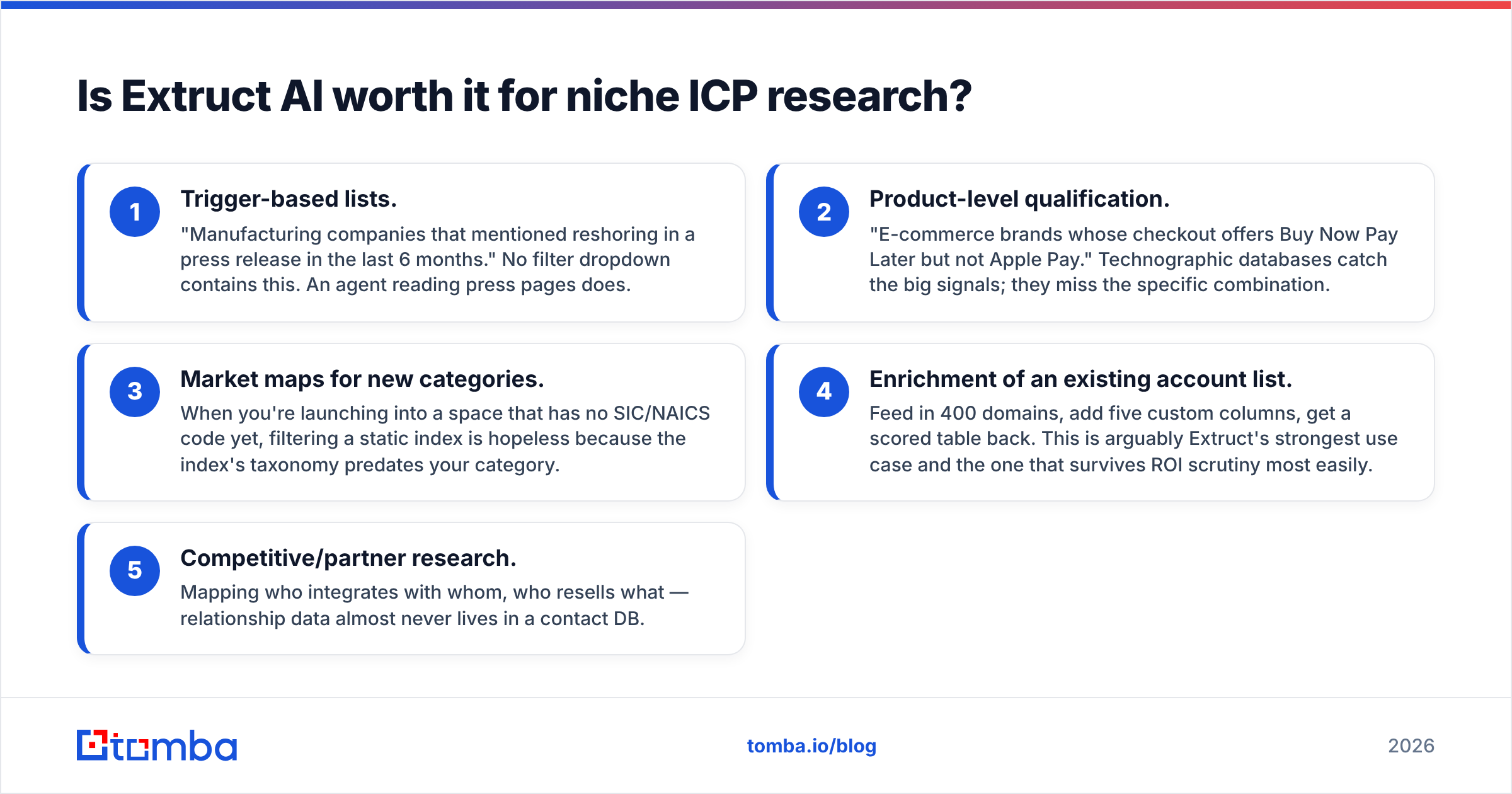
- Trigger-based lists. "Manufacturing companies that mentioned reshoring in a press release in the last 6 months." No filter dropdown holds this. An agent reading press pages does.
- Product-level qualification. "E-commerce brands whose checkout offers Buy Now Pay Later but not Apple Pay." Tech databases catch the big signals. They miss the exact combination.
- Market maps for new categories. You launch into a space with no SIC/NAICS code yet. Filtering a static index is hopeless, because the index taxonomy predates your category.
- Enrichment of an existing account list. Feed in 400 domains, add five custom columns, get a scored table back. This is Extruct's strongest use case, and the one that survives ROI scrutiny best.
- Competitive and partner research. Who integrates with whom? Who resells what? That data almost never lives in a contact database.
The honest limits: agentic research is slower, costs more per row, and does not repeat itself. Run the same prompt twice and the company list may shift. That helps discovery and hurts reporting. It also returns companies, not people. You will still need a domain search step to get from acme.com to sarah.chen@acme.com.
Is UpLead's database still competitive in 2026?#
For US, mid-market, standard-industry prospecting: yes, with caveats.
UpLead's edge has always been the verify-on-export model. Other vendors sell you a bucket of records and let bounces be your problem. UpLead runs a check the moment you export, and it does not charge credits for records that fail. That is a better deal than "buy 10,000 credits and hope 80% land."
Where it holds up:
- Speed. Filter, preview, export, push to CRM. Minutes, not hours.
- Predictable economics. Credits map to contacts. Finance can model it.
- Integrations. Native pushes to Salesforce, HubSpot, Pipedrive, and Zapier are table stakes, and UpLead has them.
- Intent data and technographics on higher tiers. They narrow lists without any prompt writing.
Where it strains:
- Non-US coverage thins out fast, especially outside Western Europe.
- Filter rigidity. You can only slice by the dimensions the schema planned for.
- Index freshness. Job changes in B2B run high, so any static database decays daily. A record for someone who moved roles six months ago still exports cleanly. It also still bounces.
- Credit anxiety. Teams ration exports. That is the opposite of what you want when testing new segments.
Shortlisting other tools in this class? The Apollo alternative and Clearbit alternative breakdowns cover the adjacent databases. Peer reviews on G2 are worth 20 minutes too. Focus on reviews from your own region, because coverage complaints cluster by geography.
Which one produces better email accuracy?#
Neither tool really competes on this axis. Most comparison posts miss that.
UpLead verifies at export, so the emails it gives you are usually clean that day. But it can only check what sits in its index. Coverage gaps show up as "no contacts found," not as bad data. Extruct AI is not an email product at all. It cites a source for every cell, which is great for company facts and weak for personal inboxes.
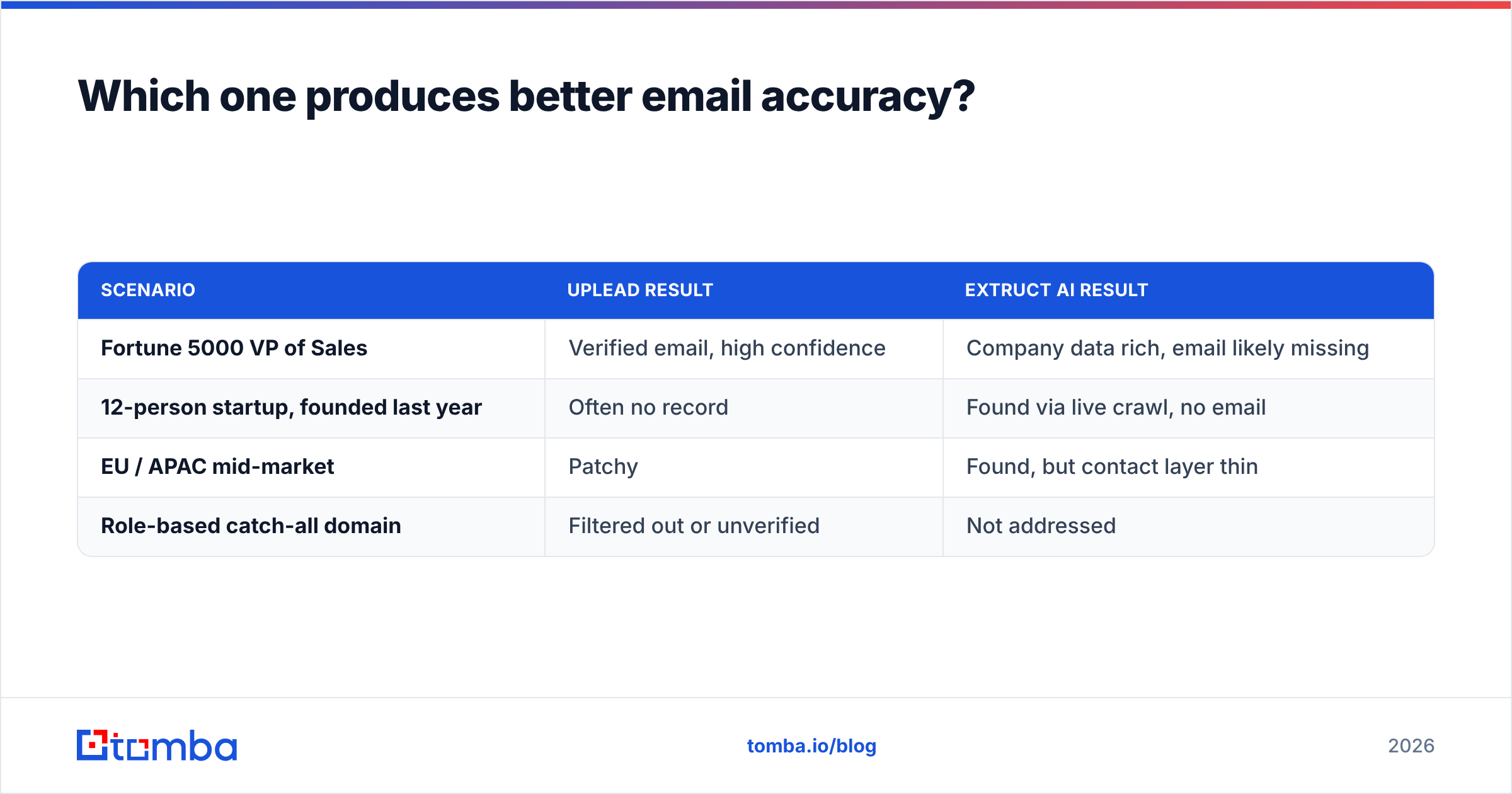
So the accuracy question turns into a coverage question:
| Scenario | UpLead result | Extruct AI result |
|---|---|---|
| Fortune 5000 VP of Sales | Verified email, high confidence | Company data rich, email likely missing |
| 12-person startup, founded last year | Often no record | Found via live crawl, no email |
| EU / APAC mid-market | Patchy | Found, but contact layer thin |
| Role-based catch-all domain | Filtered out or unverified | Not addressed |
In three of those four rows you end up with a company and no reliable inbox. That gap is where a dedicated finder and verifier slots in. Run the domains through an email verifier. Send the ambiguous ones to a catch-all verifier. That turns "probably right" addresses into a sendable list. And before you blame either vendor for bounces, check your own sending setup. Email deliverability problems get blamed on data quality all the time.

How do the pricing models compare?#
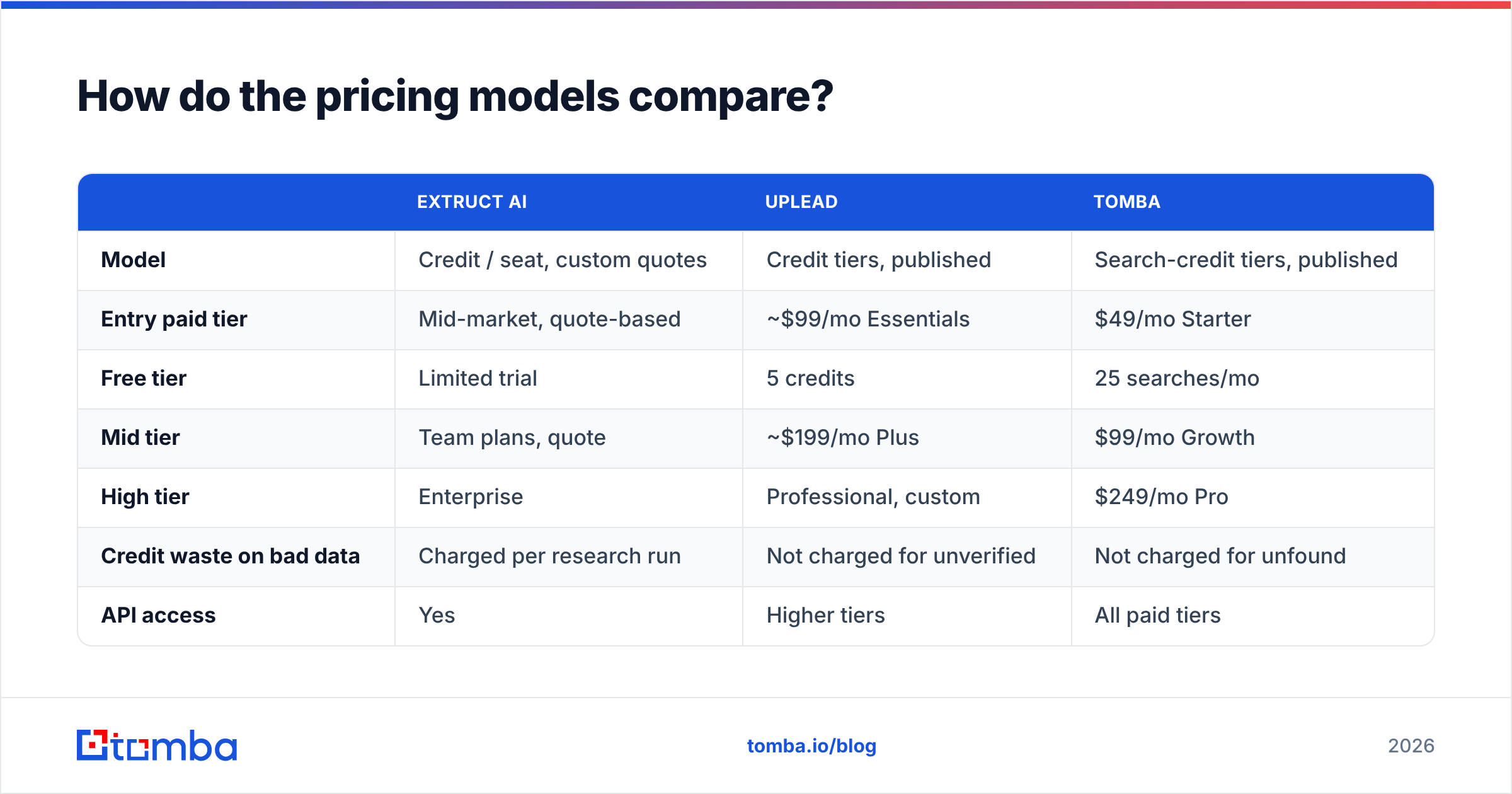
Extruct AI vs UpLead pricing is hard to compare per lead. The two models are built on different units.
| Extruct AI | UpLead | Tomba | |
|---|---|---|---|
| Model | Credit / seat, custom quotes | Credit tiers, published | Search-credit tiers, published |
| Entry paid tier | Mid-market, quote-based | ~$99/mo Essentials | $49/mo Starter |
| Free tier | Limited trial | 5 credits | 25 searches/mo |
| Mid tier | Team plans, quote | ~$199/mo Plus | $99/mo Growth |
| High tier | Enterprise | Professional, custom | $249/mo Pro |
| Credit waste on bad data | Charged per research run | Not charged for unverified | Not charged for unfound |
| API access | Yes | Higher tiers | All paid tiers |
Two practical notes. First, Extruct's cost scales with research depth. More custom columns mean more agent work, and more agent work means more spend. A 500-row list with 10 AI columns costs far more than the same list with one column. Budget it as research spend, not list spend.
Second, if the job is really just "get me verified emails at scale," both tools are overpriced for that. A focused finder at $49/mo with bulk email finder runs does that one job for a fraction of the platform cost. Check the Tomba API if you want the finding step inside your own pipeline instead of a UI.
When should you choose one over the other?#
Choose Extruct AI if:
- Your ICP turns on behavior, signals, or traits that no filter dropdown holds.
- You do market mapping, TAM sizing, or partner research — not just SDR list building.
- You already have an account list and need it enriched with judgment-heavy columns.
- You have a research or RevOps person who can write good prompts and sanity-check the output.
Choose UpLead if:
- Your ICP maps cleanly to filters: industry, size, geo, title, tech stack.
- You need contact data today, in volume, at a cost you can predict.
- Your market is mostly US mid-market and enterprise.
- Your team is SDR-heavy and wants a filter UI, not a prompt box.
Choose neither (or add a third tool) if:
- The real bottleneck is email coverage and verification, not discovery.
- You need programmatic access at low cost. An email finder API beats a seat-based platform for engineering-led work.
- You work outside the US, where both indexes thin out and pattern-based finding wins.
One more note on the wider market. Tools like BookYourData take a third position: pay-as-you-go verified B2B contacts with no subscription. That suits teams who buy lists in bursts. If your usage is spiky, give it a look.
What does a realistic combined stack look like?#
Most teams that get this right run three layers instead of betting on one vendor.
- Discovery layer. Extruct AI for niche or signal-based segments. UpLead for standard firmographic pulls. Output: target domains, plus named people where available.
- Contact layer. Run those domains through domain search to pull the people who work there now. Use the LinkedIn finder when you have a profile but no address. This is where company rows become contactable rows.
- Hygiene layer. Verify everything before it touches your sending domain. Route catch-all domains through a catch-all verifier instead of guessing or dumping them.
The mistake is expecting layer one to do layer two's job. Extruct never claimed to be an email database. UpLead only verifies what it already holds. Both facts are fine on their own. The trouble starts when you build a sending workflow that assumes otherwise, then wonder why your bounce rate crossed 5%.
Want a sanity check on the CRM plumbing? HubSpot's data-quality documentation is a decent free reference. It shows how to structure enrichment fields so they don't fight your dedupe rules.
The verdict#
Extruct AI for research, UpLead for volume, and a dedicated finder for the part both leave open.
Here is the short answer on Extruct AI vs UpLead. Buy UpLead if your team is measured on emails sent per week. Buy Extruct AI if it is measured on the quality of accounts entering the pipeline. That rule is rarely close once you phrase the question that way.
But do the math on what happens after the export. The step teams underinvest in is turning a company list into verified inboxes. It feels like it should be free. It isn't. Start with Tomba Email Finder on the free tier's 25 monthly searches. Run it against whichever discovery tool you picked. Then see what share of your list becomes a deliverable address. That number should decide your budget — not a feature matrix.
Related guides#
Ready to find emails that actually work?
Join 150,000+ professionals who stopped guessing and started sending. Free credits on signup — no credit card required.
Get the Tomba newsletter
Practical outbound tactics and product updates — once every two weeks.
About the author